ICCAS2005 JUNE 2-5, KINTEX, Gyeonggi-Do, Korea
Adaptive Decoupling for IPM Machine(ICCAS 2005)
Sung Uk Cho*, Seung Kyu Park* and Ho kyun Ahn*
*Dept. of Electrical Engineering ,Changwon National University#9 sarim-dong Changwon city, Kyungnam, 641-773, Korea (Tel: +82-55-279-7514; e-mail: [email protected])
Abstract: The current control for interior permanent magnet machines is more complicate than surface permanent magnet machine
because of its torque characteristic depending on the reluctance. For high performance torque control, it requires state decoupling between the d-current and q-current dynamics. However the variation of the inductances, which couples the state dynamics of the currents, makes the state decoupling difficult. So some decoupling methods have developed to cope this variations and each current can be regulated independently. This paper presents a novel approach for fully decoupling the states cross-coupling using parameter adaptation. The adaptation method is based on the error between reference currents and the currents with state decoupling which have to follow the references. This method is more object-oriented than the other online parameter estimation methods in IPM machine and other electrical machines
Keywords: Adaptive decoupling , IPM machine
1. INTRODUCTION
When the AC machines model in the stationary frame is transformed into a synchronous frame, unwanted cross-coupling is produced[1-4]. So permanent magnet synchronous machines have state cross-coupling terms in their models. There are two types of motors in PMSM. One is surface permanent magnet machine and the other is interior permanent magnet machine which has magnets mounted inside the rotor. IPM machines have several advantages. First, The rotor is mechanically robust for high speed operation. Second, the different between d-axes and q-axis inductance can give additional torque. IPM and SPM have the same mathematical expression in their models but very different in control problems because of the second characteristic of the IPM. In SPM, zero d-axis current can produce maximum torque with nonzero q-axis current. This cancels the state cross-coupling and makes control easier. But, in IPM, maximum torque can be produced only when the two currents are controlled to whom are given look-up tables. So the state cross-coupling difficulty can not be avoided in there. For easy control of IPM machine, decoupling is needed and the accurate parameters are inevitable. However unfortunately, stator resistance and permanent magnet flux change with motor temperature [5]. In addition, magnetic saturation limits the air gap flux density and causes the varying inductance of IPM. So the parameter estimation of the inductances is highly desirable [6]. Several parameter
estimation methods are developed in electric machine control. However they have not used decoupling. Their approaches are complicated and difficult in realization. The PI controllers are commonly used for AC machines. But this control method cannot work well in IPM because of the state cross-coupling. On-line parameter estimation method have been proposed in the decoupling problem[7][8]. However the method need the prior information of measured inductances as feed-forward term and has no guarantee for stability.
The purpose of this paper is to present a novel current controller based on decoupling and parameter estimation for IPM machine. The parameter estimation algorithm is derived from decoupled model using Lyapunov stability. Simulation results will be given.
2. IPM M
ACHINEM
ODELING ANDD
ECOUPLING OFS
TATEC
ROSS-
COUPLINGThe IPM machine is represented by ( 1)
L q t d d a q q d d q e d d q a q q T Bw i JK dt dw J V i R wi L dt di L V w K wi L i R dt di L − − = + − = + − − − =
(1)
where is a total d-axis inductance, is a total d-axis inductance, e is a back-emf constant, , are q-axis and d-axis current respectively. Note that are
q
L
L
dK
i
qi
d q dLwi
Lwi ,
1617
ICCAS2005 JUNE 2-5, KINTEX, Gyeonggi-Do, Korea
cross-coupling terms.Typical IPM machine have the following maximum torque-current characteristic which is different from that of SPM machine.
Fig.1 Typical maximum torque-current characteristic of IPM machine
From the above characteristic, it is clear that the currents have to be controlled independently. The following block diagram shows the current controlled IPM machine using state decoupling and PI controller. s Lq 1 a
R
aR
aR
a Rˆ s Kiq pqK
d L d L q L s Lq 1 q L s Kiq pqK
×
×
w q i d i * q i * d i w Ke w Kˆe w id w iq + + + + + ++ +−
−
−
+ +−
−
+ +−
−
+Fig.2 current controlled IPM machine using state decoupling and PI controller
Decoupling is a major factor which determine the control performance and depend on the accuracy of the parameter d q.
The following figures show the results of the PI control for IPM machine. They show that the parameter mismatches deteriorate control performance.
L
L ,
3. ON-LINE PARAMETER ESTIMATION
Under the assumption that other states cross-coupling have been decoupled, the q-axis current control system can be expressed as
following block diagram. The d-axis current control system can also have the same expression. To apply the Lyapunov stability easily, proper states have to be chosen.
s 1 i K p
K
s 1 q L 1 1x
2x
* qi
i
q + + + +−
w i L~d dFig.3 Q-axis current control system with states decoupling
From the fig.3 , the following equation is obtained.
1 2 1 2 1
~
x
x
w
i
L
x
K
x
K
x
L
q i p d=
=
+
+
&
&
(2)where
x
1=
e
q=
i
q−
i
q* ande
& =
qi
&
qIn this paper, the following theorem has been obtained.
Theory: The estimated parameter using the following algorithm can
make the overall system stable and parameter mismatches small.
w
i
e
p
L
ˆ
&
d=
−
1 q d (3) Proof.Lyapunov candidate function is chosen as eq.(4 ).
2 2 2 2 2 1 1 ~ 2 1 ) ( 2 1 d qp x p x L L V= + + (4) Its time derivative is
)
L
L
w
i
L
p
(x
)
x
p
x
x
p
K
x
p
K
(x
L
L
x
p
x
x
p
x
L
V
d d d d 1 1 1 2 2 2 1 1 p 2 1 i 1 d d 2 2 2 1 1 1 q&
&
&
&
&
~
~
~
~
~
+
+
+
+
=
+
+
=
We define
L&
~
das follows.w
i
x
p
L
~
&
d=
−
1 1 dSo following is obtained.
1 2 2 2 1 1 2 1 1K
p
x
K
p
x
x
p
x
x
V
&
=
i+
p+
This is negative because PI gains are chosen to make the system stable whe uncertainties do not exist. The eq.(4) comes from the relation n *
ˆ
~
L
L
L
=
−
under the assumption is constant or slowly varying. Q.E.D.*
L
ICCAS2005 JUNE 2-5, KINTEX, Gyeonggi-Do, Korea
4. SIMULATION AND EXPERIMENT RESULTS
The PI controller with decoupling and on-line parameter estimation was simulated for the IPM machine whose parameter are given in Table I
Table I. Motor Parameter
Parameter Value
Max. Torque
Max. Speed
R
Lq
Ld
λpm
J
Poles
7.66 Nm
6200rpm
1.45Ω
11.04mH
3.74mH
0.0858Wb
99.6kg.m2×10-6
4
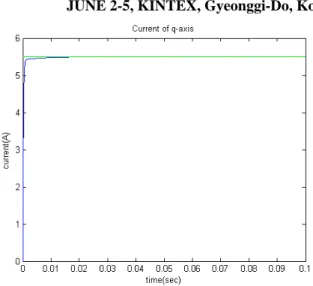
The simulation results are shown as follows.
Fig.4 Q-axis current response controlled by existing method
Fig.5 Q-axis current response controlled by proposed method
Fig.6 D-axis current response controlled by existing method
Fig.6 D-axis current response controlled by proposed method
ICCAS2005 JUNE 2-5, KINTEX, Gyeonggi-Do, Korea
5. CONCLUSIONS
A classical PI current controller cannot cope with cross-coupling which depends on the rotor speed and uncertain inductances. So On-line parameter estimation is required to mitigate this effect. A novel on-line parameter estimation was derived based on decoupling and Lyapunov stability. By using Lyapunov stability after applying decoupling method, the parameter estimation algorithm can be obtained more easily than other approaches. Simulation results show the coincident result with the theoretical assertion
.
This work was supported by the Machine Tool Research Center at Changwon National University
REFERENCES
[1] S. Morimoto, M. Sanada, Y. Taketa, “Wide-Speed Operation of Interior Permenent-Magnet SynSynchronous Motors with High Performance Current Regulator”, IEEE Trans. On Ind. Appl., vol. IA-30, pp. 920-926, Jul./Aug. 1994.
[2] J. Kim, S. Sul, ”Speed Control of Interior Permanent Magnet Synchronous Motor Drived for the Flux Weakening Operation”, IEEE Trans. On Ind. Appl., vol. IA-33, pp. 43-48, Jul./Aug. 1997. [3] H. Kubota, K Matsuse, T. Nakano, “DSP-based Speed Adaptive Flux Observer of Induction Motor”, IEEE Trans. On Ind. Appl., vol. IA-29, pp. 344-348, Mar./Apr. 1993.
[4] H. Sugimoto, S. Tamai, “Secondary Resistance Identication of an Induction Motor Applied Model Refernnce Adaptive system and Its Characteristics”, IEEE Trans. On Ind. Appl., vol. IA-23, pp. 296-303, Mar./Apr. 1987.
[5] S.R. MacMinn, T.M. Jahns, ”Control Techniques for Improved High-Speed Performance of Interio PM Synchronous Motor Drives”, IEEE Trans. On Ind. Appl., vol. IA-27, pp. 997-1004, Sep./Oct. 1991.
[6] L. Harnefors and H.P. Nee, “Model-based control of AC machines using the internal model control method,” IEEE Trans. On Ind. Appl., vol. IA-34, pp. 133-141, Jan. 1998.
[7] Hyunbae Kim, R.D. Lorenz,” Improved Current Regulators for IPM Machine Drives Using On-Line Parameter Estimation,” Proc. of IEEE IAS Annual Meeting, Pittsburgh, Oct 11-19, 2002.
[8] Hyunbae Kim, Jason Hartwig, and Robert D Lorenz,” Using On-Line Parameter Estimation to Improve Efficiency of IPM Machine Drives,” Proc. of the IEEE PESC Conference, Queensland, Australia, June 23-27,2002.