© Korean Powder Metallurgy Institute 1171
-1. Introduction
NdFeB permanent magnetic materials have enjoyed considerable attention because of their high magnetic properties. The NdFeNbB alloy was melted in vacuum induce furnace. The alloy ingot was broken and Dy2O3 and
Sn was added before ball milling with gasoline to particle size of 3-5 µm. The powders were pressed in the 1.8T magnetic field. After isotropic pressing, the green compacts were then sintered at 1115oC for 1 hour in vacuum and
subsequently heat treated at 580oC for 1h.
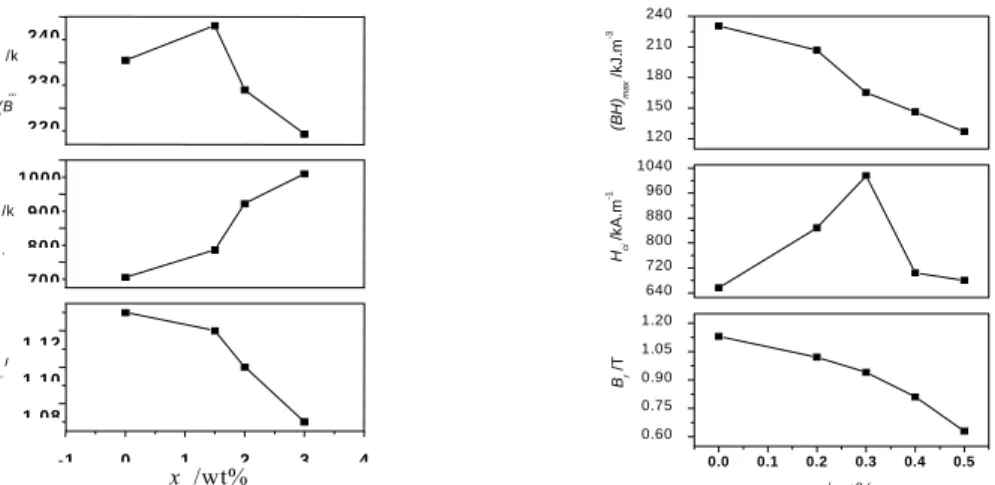
From Fig.1(a) we can see that the additions of Dy2O3 can
be seen to result in a considerable increase of Hci and Hcb.
On the other hand, Br slightly decreases with the addition of
Dy2O3. The (BH)max slightly increases up to x = 1.5wt% and
then decreases with subsequent addition of Dy2O3 content.
The alloys of NdFeNbB+xSn in the rang x=0-0.6 have been investigated and their magnetic properties are shown in Fig. 1(b). The addition of Sn up to 0.3wt% causes the value of
Hci to increase, and further addition of Sn results in the
decrease of said value. On the other hand, Br and (BH)max
slightly decrease with the addition of Sn.The simultaneous addition of Dy2O3 and Sn to NdFeNbB shows the best
temperature dependence, as shown in Table1. The temperature dependence of NdFeNbB with only Dy2O3
additions is greater than that of with Sn additions. According to the additions of Dy2O3 and Sn, the coercivity
and the temperature dependence are greatly improved, as shown in Fig. 2(b).
It can be inferred that sintered NdFeNdB magnet is a multi-phase material consisting of Φ phase as matrix and NdFe4B4(η phase), Nd-rich constituents, α-Fe as minor
phases as shown in Fig. 3. There are many small deposits distributed at the grain junctions and at the grain boundaries. From the EDAX analysis, we can deduce that Dy largely partitions to the Nd-rich phase, and less to the Φ phase. Sn mainly goes into the grain boundaries.
-1 0 1 2 3 4 1 08 1 10 1 12 B / x /wt% 700 800 900 1000 H /k 220 230 240 (Bm /k 0.0 0.1 0.2 0.3 0.4 0.5 0.60 0.75 0.90 1.05 1.20 x /wt% Br /T 640 720 800 880 960 1040 Hci /k A. m -1 120 150 180 210 240 (B H )ma x /k J .m -3
Fig. 1. Variations in Br, Hci, and (BH)max of NdFeNbB+ xDy2O3 and NdFeNbB+xSn as a function of Dy2O3-concentration(a) and Sn-concentration(b)
2006 POWDER METALLURGY World Congress
PC09-W-04
Influence of Dy
2O
3and Sn on the Structure and Magnetic
Properties of NdFeNB Magnets
Liya Li, Jianhong Yi Yuan Dong Peng
The State Key Laboratory for Powder Metallurgy, The Central South University, Changsha 410083, China
[email protected] Abstract
Addition of 2.0wt%Dy2O3 or 0.3wt%Sn proved to be very effective in improving the permanent magnetic properties of
NdFeNbB magnets. Dy2O3 additions result in the increase in the Hci and temperature dependence due to formation of
(NdDy)-rich phase and grain refinement of Φ phase. This improvement of the coercivity stability of the magnets from the addition of Sn is attributed to the smoothing effect of the Sn addition at the grain boundaries. The magnetic properties, the temperature dependence and Curie temperature of NdFeNbB with Dy2O3 and Sn combined addition were found to be
considerably improved.
© Korean Powder Metallurgy Institute 1172 -Table 1. The magnetic properties of the magnets at room temperature
Samples Br /T Hci / kA.m-1 (BH)max / kJ.m-3
NdFeNbB (A) 1.13 656.0 230.5 NdFeNbB+2%Dy2O3 (B) 1.11 824.0 221.8 NdFeNbB+0.3%Sn (C) 0.94 1016.0 165.1 NdFeNbB+2%Dy2O3+0.3%Sn (D) 1.09 1024.0 214.4 20 40 60 80 100 120 140 160 180 200 -70 -60 -50 -40 -30 -20 -10 0 A C B D h irr /% T /oC 0 50 100 150 200 200 300 400 500 600 700 800 900 1000 C B A D Hci /kA. m -1 T /oC
Fig. 2. The hirr and temperature dependence of coercive field of the magnets.
Fig. 3. MFM images of NdFeNbB+2%Dy2O3+0.3%Sn.
References
1. H J Engelmann, A S Kim and G Thomas, Scripta Materialia, 36[1],55(1997).
2. J Jiang, Z Zeng, J Wu, J. Magn. Magn. Mater, 214[1-2],61(2000).
3. Y Zhou, W Liu, X G Zhao, J. Magn. Magn. Mater, 278[1-2],1(2004).