한국정밀공학회 2013 년도 춘계학술대회논문집
1. Introduction
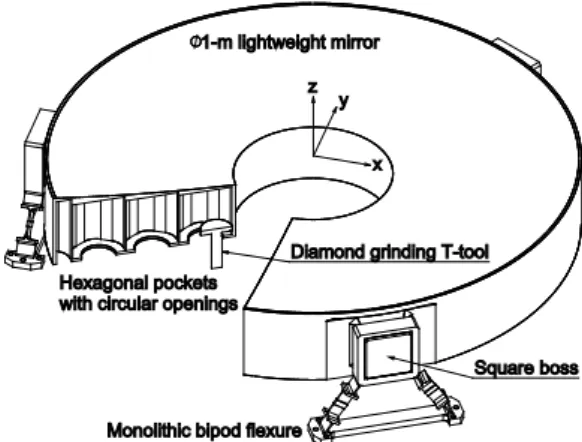
We present our design method for a 1-m lightweight mirror in a space optical system. The mirror made of Zerodur has pockets at the back surface and three square bosses at the rim. Metallic bipod flexures support the mirror at the bosses and adjust the mirror surface distortion due to gravity. Their dimensional parameters cannot be optimized independently with each other in a conventional design process, where the mirror's optical performance is greatly influenced by the flexure configuration. With our method, the design problem is separated into two independent problems; mirror design and flexure design. Resources required to achieve the design goals are reduced by almost one order of magnitude in time. We implemented a multi-objective genetic algorithm (GA) to optimize the mirror design and satisfied the design goals. We also present a new adjustable bipod flexure as an optical compensator for the gravity-induced aberration, instead of using a monolithic bipod flexure.
2. Principles
Optomechanical design is emphasized to achieve a lower system mass while preserving optical performances especially for space-borne telescopes1-2. Also the launch and operational environment requires highly robust and sustainable design. State of the art fabrication technology, material properties, and safety factors about launch loads determine overall configurations like lightweight mirror topology and
its critical dimensions. Mirror design and its mounting interface is typically chosen based on heritage, kinematic design principle, or engineering judge from trade studies. Most of all, mirror material and its fabrication method steers the design philosophy and direction.
Zerodur is one of the zero expansion glass-ceramic materials used widely in ground-based astronomy and space mission programs. Additional etching process proved to increase the strength significantly3. In this paper, we chose Zerodur as our mirror material, and adopted a diamond grinding method and an acid etching process for fabrication. Given the mechanical properties of Zerodur and its manufacturing techniques, the designer can decide a few critical dimensions up to the fabrication limit. For example, the minimum web thickness of the lightweight pocket is majorly determined by the manufacturing capability. But most other dimensions can be varied and there are many combinations among them. The optomechanical designers select one of the design solutions satisfying all the requirements.
Weight is one of the major requirements severely controlled in case of satellite telescopes. Achieving a minimum mass with a required optical performance is the designer's goal. There can be linear relations between dimensional parameters and performance metrics if the mirror's geometry is simple. But most lightweight mirrors have complicated pocket patterns at the substrate, which expands the design problem into a multidimensional design space. Nowadays
인공위성 망원경을 위한 직경 1-m 주 반사경의 최적설계
Optimization of 1-m lightweight mirror design for a satellite
telescope
*
#김학용
1, 양호순
1, 문일권
1, 이윤우
1*
#H. Kihm
1([email protected]), H.-S. Yang
1, I. K. Moon, Y.-W. Lee
11
한국표준과학연구원 우주광학센터
Key words : Optomechanics, mirror design, optimization, space optics
한국정밀공학회 2013 년도 춘계학술대회논문집
exploring a multidimensional design space with multiple constraints or targets can be done easily with optimization algorithms.
Genetic algorithm (GA) has been used for optomechanical design problems to achieve two contradicting goals: lightness and stiffness4. GA is inspired by biological processes of natural selection, mutation, and genetic crossover. At the beginning, an initial population is generated, then all of the individuals are evaluated by a fitness function. The generation is sorted with those having better fitness at the top, representing better solutions to the problem. The next step of a GA is to generate the second generation, that is different from the initial generation, using the genetic operator’s selection, crossover and mutation. The algorithm continues by generating the third, fourth, fifth, ... generation, generally increasing the average fitness and until one of the generations contains solutions which are good enough.
The design of a lightweight mirror is an optimization problem of the multivariable and multirange of discrete values. But the mirror and its mounting configuration can be fixed following the heritage. In our application the glass mirror has three monolithic bosses at the rim and is assembled with metallic bipod flexures5. Their dimensional parameters cannot be optimized independently with each other in a conventional design process, where optical performance is greatly influenced by the flexure mount configuration. Mirror’s surface error (SE) or distortion, which is one of the performance metrics in the design, changes when the rotation center of the bipod flexure is displaced from the mirror's center of gravity or shear center. Finding the optimum position or rotation center of the bipod is the design target of a flexure mount. In a conventional design process, the mirror design is followed by the flexure design process to verify the mirror's optical performance. Therefore, the mirror design problem is coupled with the flexure design problem and expands the design space. This design scheme is laborious and time-consuming as the mirror design and the flexure design should be
serial-processed. If there is a way to decouple the flexure design and the mirror design, design tasks can be parallel-processed and the whole design period will be reduced accordingly.
Fig. 1. φ1-m lightweight mirror having hexagonal pockets and circular openings at the back. A T-shaped diamond grinding tool enters the opening and carves into a hollow chamber to make a semi-open back. Metallic bipod flexures support the mirror at the square bosses.
3. Results
In this paper, we applied the GA for optomechanical design problems to achieve two contradicting goals: lightness and stiffness. We selected one of the solutions considering fabrication feasibility and raw material dimensions.
References
1. V. L. Genberg, Proc. SPIE 3786, 248-255 (1999). 2. 2. L. E. Cohan and D. W. Miller, Opt. Eng. 50,
063003-1-13 (2011).
3. P. Hartmann, K. Nattermann, T. Döhring, R. Jedamzik, M. Kuhr, P. Thomas, G. Kling, and S. Lucarelli, Proc. SPIE 7425, 74250M-1-11 (2009). 4. Z. Wei and Y. Yi, Proc. SPIE 6148, 61480T-1-6
(2006).
5. H. Kihm, H.-S. Yang, I. K. Moon, J.-H. Yeon, S.-H. Lee, and Y.-W. Lee, Appl. Opt. 51, 7776-7783 (2012).