대한소화기학회지 2004;43:364-369
서
론
1) 급성 췌장염의 진단에 있어서 전통적으로 혈청 아밀라제 접수: 2004년 1월 8일, 승인: 2004년 5월 6일 연락처: 정준표, 135-270, 서울시 강남구 도곡동 146-92 영동세브란스병원 내과 Tel: (02) 3497-3310, Fax: (02) 3463-3882 E-mail: [email protected] 가 이용되어 왔으나 진단 예민도 및 특이도에는 한계가 있 고, 이를 보완하기2)위하여 혈청 리파제가 이용되기도 하나 역시 예민도 및 특이도에 문제가 있으며,1-3 모든 병의원에Correspondence to: Jun Pyo Chung, M.D.
Department of Internal Medicine, Yongdong Severance Hospital 146-92 Dogok-dong, Gangnam-gu, Seoul 135-270, Korea Tel: +82-2-3497-3310, Fax: +82-2-3463-3882 E-mail: [email protected]
급성 췌장염의 진단에 있어서 Urinary Trypsinogen-2
Dipstick 검사의 유용성
연세대학교 의과대학 내과학교실, 응급의학교실*황성준·정준표·김영균·송대훈·이재성·백승석·김도연·이덕용·정연수·지상원·이세준·송시영
이관식·정재복·이상인·강진경·박준석*·조광현*
Usefulness of Urinary Trypsinogen-2 Dipstick Test for Diagnosis of Acute Pancreatitis
Seoung Joon Hwang, M.D., Jun Pyo Chung, M.D., Young Gyun Kim, M.D., Dae Hoon Song, M.D.,Jae Sung Lee, M.D., Seung Seok Baek, M.D., Do Yun Kim, M.D., Dok Yong Lee, M.D.,
Yon Soo Jeong, M.D., Sang Won Ji, M.D., Se Joon Lee, M.D., Si Young Song, M.D., Kwan Sik Lee, M.D., Jae Bock Chung, M.D., Sang In Lee, M.D., Jin Kyung Kang, M.D.,
Jun Seog Park, M.D.*, and Kwang Hyun Cho, M.D.*
Departments of Internal Medicine and Emergency Medicine*, Yonsei University College of Medicine, Seoul, Korea Background/Aims: The clinical usefulness of urinary trypsinogen-2 dipstick test is still in controversy. We evaluated the usefulness of urinary trypsinogen-2 dipstick test in patients with acute pancreatitis. Methods: Urinary trypsinogen-2 dipstick test was prospectively performed in 50 patients with acute pancreatitis, 50 patients with non-pancreatic abdominal pain, and 50 healthy controls. Results: On admission, urinary trypsinogen-2 dipstick test was positive in 36 of 50 patients with acute pancreatitis (sensitivity, 72%) and in 4 of 50 patients with non-pancreatic abdominal pain (specificity, 92%). On the other hand, it was all negative in controls. The sensitivity and specificity of serum lipase were 78% and 94%, respectively. At 24 hours after admission, the positive rate of urinary trypsinogen-2 dipstick test rose from 72% to 94% (p=0.02). The results of urinary trypsinogen-2 dipstick test was positive in 14 of 15 patients with severe pancreatitis and 22 of 35 patients with mild pancreatitis according to the criteria by Atlanta International Symposium, 1992. Conclusions: Urinary trypsinogen-2 dipstick test is comparable to serum lipase in diagnosing acute pancreatitis. Delayed measurement and severe pancreatitis are more likely to yield positive results with urinary trypsinogen-2 dipstick test. Thus, we suggest that the cut-off value of urinary trypsinogen-2 dipstick test should be
lowered to increase its sensitivity.
(Korean J Gastroenterol 2004;43:364-369)
황성준 외 17인. 급성 췌장염의 진단에 있어서 Urinary Trypsinogen-2 Dipstick 검사의 유용성 서 혈청 리파제 검사를 시행하기도 어려운 실정이다. 한편 이환율과 사망률이 높은 중증 급성 췌장염의 조기 진단은 매우 중요한데, 종종 중증 췌장염 환자들은 응급실에서 제 대로 진단되지 못하고 부검으로 확인되는 경우도 있다.4 따 라서 급성 췌장염을 신속, 간편 및 정확하게 검사할 수 있 는 방법이 필요한 실정이다. 최근에 개발된 dipstick test인 urinary trypsinogen-2 test strip (actim Pancreatitis, Medix Biochemica, Kauniainen, Finland)은, 급성 췌장염의 진단에 있어 예민도 및 특이도가 각각 90% 정도로5-7 이런 사실을 바탕으로 일차 진료실에서도 사용할 만한 간편하고 정확한 검사법이 될 수 있을 것으로 기대된다. 국내에서도 urinary trypsinogen-2 test strip의 급성 췌장염 진단에 대한 예민도 와 특이도를 각각 88.0%와 96.6%로 보고한 연구가 있으나8 급성 췌장염 환자의 수가 많지 않았다. 저자들은 급성 췌장 염의 진단에 있어 urinary trypsinogen-2 test strip의 유용성 을 알아보고자 비췌장성 복통 환자와 건강인과의 비교를 포함한 연구를 시행하였다.
대상 및 방법
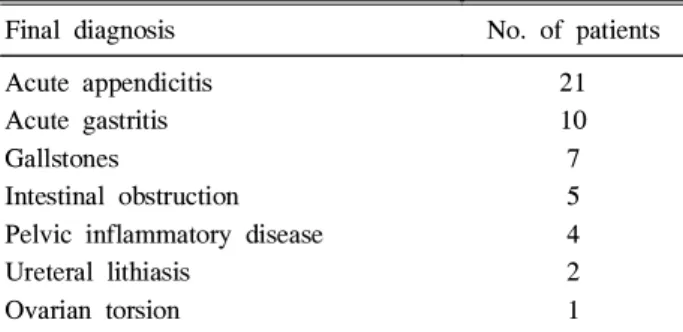
1. 대상 2001년 8월부터 2003년 7월 사이에 영동세브란스병원에 내원하여 급성 췌장염으로 진단받은 50예(평균 연령 50.5± 15.4세, 남:여=35:15)와 대조군으로 같은 기간에 급성 복통 을 주소로 본원 응급실을 내원하여 혈액 및 방사선검사에 서 급성 췌장염 진단이 배제된 비췌장성 복통 환자 50예 (평균 연령 51.0±15.2세, 남:여=38:12) 및 건강 대조군 50 예(평균 연령 49.8±14.7세, 남:여= 37:13)를 대상으로 하여 전향적인 연구를 시행하였다. 각 군간에 성별(p=0.114) 및 연령(p=0.077)의 유의한 차이는 없었다. 비췌장성 복통 환 자는 급성 충수돌기염이 21예로 가장 많았고, 심와부 동통 을 주소로 내원한 환자들에 대해 내시경검사를 시행하여 진단된 급성 위염 10예, 담석증 7예, 위장관폐쇄증 5예, 골 반내 염증성 질환 4예, 요로결석 2예, 난소염전 1예 순이었 다(Table 1). 급성 췌장염의 진단 기준은 전형적인 상복부 동통, 오심, 구토 등의 임상 소견을 보이며 혈청 췌효소, 즉 아밀라제와 리파제가 정상 상한치의 3배 이상으로 증가한 경우와 췌효 소치의 유의한 증가 소견은 없으나 전형적인 복통을 호소 하며 복부초음파나 복부전산화단층촬영 등과 같은 영상 진 단에서 췌장의 부종, 삼출액의 저류 및 주위 조직과의 경 계 소실 등 전형적인 소견을 보인 경우로 하였고 만성 췌 장염의 과거력이 있으면서 급성으로 악화된 경우는 본 연 구의 대상에서 제외시켰다.4,5,9 중증 급성 췌장염은 1992년 Atlanta International Symposium의 분류기준9에 따라 전신 합병증이나 췌장괴사, 췌장농양, 가성낭종 등이 동반된 경 우를 중증 급성 췌장염으로 정의하였다. 급성 췌장염의 원 인은 알코올이 39예로 가장 많았고, 담석 9예 및 ERCP 후 췌장염이 2예 있었다(Table 2). 2. 방법 급성 췌장염 50예와 비췌장성 복통 환자 50예에서는 혈 청 아밀라제와 리파제 등의 생화학검사와, 필요한 경우 복 부초음파와 조영 증강 복부전산화단층촬영을 시행하였다. 모든 급성 췌장염 환자 및 대조군에 대해 응급실이나 외래 내원 당시에 urinary trypsinogen-2 test strip을 바로 시행하 였고, 급성 췌장염 환자에 대해서는 입원 24시간 후에 한 차례 더 urinary trypsinogen-2 test strip을 시행하였다. 이 검 사띠에는 trypsinogen-2에 대해 특이적인 2개의 단클론 항 체가 사용되는데, 한 개의 항체는 nitrocellulose 막에 고정 되어 있고, 다른 한 개는 test strip의 결과 판정 부위 (catching zone) 내에 있는 푸른 색 latex 입자 위에 있다. Urinary trypsinogen-2 test strip을 환자의 소변에 담그면 trypsinogen-2가 푸른 latex 입자의 단클론 항체와 결합된 후 결과 판정 부위로 이동하여 2개의 푸른 선이 나타나는데, 이 검사법의 검출 한계는 trypsinogen-2 농도가 50 µg/L이다.5 12 cm의 urinary trypsinogen-2 test strip의 황색 부분을 환자 에서 채취한 소변 검체에 약 20초 정도 담근 후 꺼내어, 깨 끗하고 편평한 곳에서 약 5분 동안 두었다가 결과를 판정 하였으며, urinary trypsinogen-2 test strip의 결과 판정 부위 에 2개의 청색선이 나타나는 경우를 양성으로 판정하였다. 통계적인 분석은 SPSS for windows version 11.0 프로그램 Table 1. Final Diagnosis of Patients with Non-pancreaticAbdominal Pain
Final diagnosis No. of patients
Acute appendicitis Acute gastritis Gallstones
Intestinal obstruction Pelvic inflammatory disease Ureteral lithiasis Ovarian torsion 21 10 7 5 4 2 1
Table 2. Causes of Acute Pancreatitis
No. of patients Alcohol Gallstones Post-ERCP 39 9 2 ERCP, endoscopic retrograde cholangiopancreaticography.
The Korean Journal of Gastroenterology: Vol. 43, No. 6, 2004
의 ANOVA test, Pearson chi-squared test 및 Fisher's exact test를 이용하였고, p값이 0.05 미만인 경우를 통계적으로 유의성이 있다고 판정하였다.
결
과
1. 급성 췌장염에서 urinary trypsinogen-2 test strip, 혈청 아밀라제 및 리파제의 양성률
Urinary trypsinogen-2 test strip은 급성 췌장염 환자 50예 중 36예, 비췌장성 복통 환자 50예 중 4예에서 양성으로 나 와 각각 72% 및 8%의 양성률을 보였다. 한편 혈청 아밀라 제와 리파제의 양성률은 급성 췌장염에서 각각 68% 및 78%, 비췌장성 복통에서 각각 20% 및 6%이었다. 건강 대 조군 50예에서는 모두 음성이었다(Table 3). 2. 급성 췌장염의 진단에 있어 urinary trypsinogen-2 test strip, 혈청 아밀라제 및 리파제의 예민도, 특이 도, 양성 예측도 및 음성 예측도
급성 췌장염의 진단에 있어 urinary trypsinogen-2 test strip의 예민도, 특이도, 양성 예측도 및 음성 예측도는 각각 72%, 92%, 90% 및 77%로서 비교적 높은 특이도와 양성 예측도를 나타내었으나 예민도와 음성 예측도는 상대적으 로 낮았다. 혈청 아밀라제의 예민도, 특이도, 양성 예측도 및 음성 예측도는 각각 68%, 80%, 77% 및 71%였으며, 혈 청 리파제의 예민도, 특이도, 양성 예측도 및 음성 예측도 는 각각 78%, 94%, 93% 및 81%였다(Table 4). 혈청 리파 제도 urinary trypsinogen-2 test strip과 유사하게 비교적 높 은 특이도와 양성 예측도를 나타내었으나 예민도와 음성 예측도는 상대적으로 낮았다.
3. 내원 당시 및 24시간째의 urinary trypsinogen-2 test strip, 혈청 아밀라제 및 리파제의 양성률 급성 췌장염에서 urinary trypsinogen-2 test strip의 양성 률은 내원 당시 72%에서 24시간 후에는 94%로 의미있게 증가하였다(p=0.02). 한편 혈청 아밀라제와 리파제의 양성 률은 내원 당시 각각 68% 및 78%에서 24시간 후에 각각 72% 및 84%로 urinary trypsinogen-2 test strip과 같은 현저 한 양성률의 상승은 없었다(Table 5).
4. 급성 췌장염의 중증도에 따른 urinary trypsinogen-2 test strip, 혈청 아밀라제 및 리파제의 양성률 Atlanta International Symposium 분류 기준9에 따라 평가 한 결과 급성 췌장염 환자 50예 중 15예가 중증이었고, 35예
Table 3. Positive Rate of Each Test in Patients with Acute Pancreatitis and Non-pancreatic Abdominal Pain
Acute pancreatitis (n=50) Non-pancreatic abdominal pain (n=50) Urinary trypsinogen-2 Serum amylase Serum lipase 36 (72%) 34 (68%) 39 (78%) 4 (8%) 10 (20%) 3 (6%)
Table 4. Sensitivity, Specificity, Positive Predictive Value, and Negative Predictive Value of Each Test in Diagnosing Acute Pancreatitis Sensitivity (%) Specificity (%) PPV (%) NPV (%) Urinary trypsinogen-2 72 92 90 77 Serum amylase 68 80 77 71 Serum lipase 78 94 93 81
PPV, positive predictive value; NPV, negative predictive value.
Table 6. Positive Rate of Each Test in Patients with Acute Pancreatitis according to the Severity
Severe pancreatitis (n=15) Mild pancreatitis (n=35) p value Urinary trypsinogen-2 14 (93%) 22 (63%) 0.042 Serum amylase 7 (47%) 27 (77%) NS Serum lipase 9 (60%) 30 (86%) NS NS, not significant.
Table 5. Positive Rate of Each Test in Patients with Acute Pancreatitis on Admission and 24 hours after Admission
On admission (n=50) 24 hours after admission (n=50) p value Urinary trypsinogen-2 36 (72%) 47 (94%) 0.02 Serum amylase 34 (68%) 36 (72%) NS Serum lipase 39 (78%) 42 (84%) NS NS, not significant. 366
Hwang SJ, et al. Usefulness of Urinary Trypsinogen-2 Dipstick Test for Diagnosis of Acute Pancreatitis
가 경증이었다. 증증 급성 췌장염 환자 15예 중 urinary trypsinogen-2 test strip은 14예에서 양성으로 나와 93%의 양성률을 보였으며, 경증 환자에서는 63%의 양성률을 보여 중증 급성 췌장염에 비해 양성률이 유의하게 낮았다(p= 0.042). 반면에 혈청 리파제는 중증 급성 췌장염에서 60%, 경증에서는 86%의 양성률을 보였다(Table 6).
고
찰
급성 췌장염의 진단에 전통적으로 사용되어 온 혈청 아 밀라제는 증상 시작 후 2~12시간 사이에 증가하여 3~5일 후에 정상화되며, 위음성 및 위양성의 경우가 많아 급성 췌 장염의 진단 표지자로서는 한계가 있다.1,2 한편 혈청 리파 제는 증상 시작 4~8시간 후에 증가하기 시작하여 보통 24 시간 후에 최고 농도에 도달하고 8~14일 후 정상으로 돌아 온다.3,10 즉, 혈청 리파제는 아밀라제와 비교하여 늦게 증가 하여 더 오래 지속되는 경향을 보여 췌장염 진단에 있어서 아밀라제보다는 높은 예민도와 특이도를 가지나, 아밀라제 와 유사하게 췌장외 복강내 다른 염증이 동반된 경우와 신 부전에 의해 영향을 받을 수 있으며, 혀밑샘과 같은 췌장외 장기에도 존재할 수 있어 역시 정확성에 문제가 있다는 제 한점이 있다.1-3,11,12또한 혈청 아밀라제 검사에 비해 리파제 검사는 고가이면서 복잡한 검사 방법으로 인해 일차 진료 실에서는 잘 시행되지 않고 있다.Trypsin은 췌장의 샘꽈리세포(acinar cell)에서 형성되는 주된 단백질 분해 효소이다.13 Trypsinogen은 이의 전구체 로 분자량은 약 25 kd이며, 양이온인 trypsinogen-1과 음이 온인 trypsinogen-2라는 2개의 동종 효소를 가진다.14-16 급 성 췌장염이 발생하면 췌효소들이 순환계로 누출되어 trypsinogen도 혈청과 소변에서 증가한다.5,16Trypsinogen은 크기가 작기 때문에 비교적 쉽게 사구체에서 여과되며, 이유는 잘 알려져 있지 않으나 trypsinogen-2의 재흡수가 trypsinogen-1의 재흡수에 비해 적어 결과적으로 소변내 농 도는 trypsinogen-2가 더 높다.1,2,6,15 또한 정상인의 혈청 내 에서는 trypsinogen-1이 trypsinogen-2에 비해 4배 정도 높으 나, 급성 췌장염이 발생하면 trypsinogen-2의 농도가 더 높 아진다.1,2,6,15 이러한 이유로 혈청 또는 소변의 trypsinogen-2 측정은 급성 췌장염의 진단에 유용할 것이라는 가능성이 제시되었 고, 간편한 방법으로서 urinary trypsinogen-2 test strip이 핀 란드에서 개발되었다. Urinary trypsinogen-2 test strip의 급 성 췌장염에 대한 진단 유용성을 검토한 연구들은5,6,17대부 분 핀란드에서 시행되었는데, 그 결과들은 일관되게 90% 이상의 예민도 및 특이도, 그리고 높은 음성 예측도를 보 고하고 있다. 결국 urinary trypsinogen-2 test strip은 음성
예측도가 높기 때문에, 그 검사 결과가 음성일 경우에는 높은 신뢰도로 급성 췌장염을 배제할 수 있어 임상적으 로 유용하다는 것이다. 그러나 다른 연구에서는 urinary trypsinogen-2 test strip의 예민도를 53.3% 및 특이도를 100%로 보고하여 핀란드 그룹의 연구 결과와는 상이한 결과를 보이고,18국내 연구도 약간 낮은 예민도(88.0%)와 높은 특이도(96.6%)를 보였다.8 본 연구에서도 urinary trypsinogen-2 test strip이 급성 췌장염을 진단하는 데 있어 서 예민도가 72%, 특이도가 92%로, 혈청 리파제의 예민도 78%, 특이도 94%와 유사하기는 하지만, 예민도가 비교적 낮고 특이도가 상대적으로 높은 양상이었는데, 예민도가 낮고 특이도가 높은 경우에는 음성 예측도보다는 양성 예 측도가 높기 때문에 핀란드 그룹의 연구 결과와는 상이하 다. 핀란드 그룹의 연구 결과와 그 외의 연구 결과들이 상이 한 이유가 확실하지는 않다. 본 연구에서는 내원 24시간 후 에 urinary trypsinogen-2 test strip을 적용하였을 때, 그 양성 률이 94%로 나타났는데, 이는 내원 당시의 72%보다 높았 다(p=0.02). Pezzli 등18도 30명의 환자 중 3예에서 내원 당 시에는 urinary trypsinogen-2 test strip이 음성이었으나, 그 다음날 측정에서는 양성으로 측정되는 것을 관찰하고 trypsinogen-2의 소변 배출이 지연될 것이라는 지적을 하였 다. 즉 이것은 급성 췌장염 환자들이 빨리 내원하느냐 또는 늦게 내원하느냐에 따라 검사의 예민도가 달라질 수 있음 을 시사한다. 그러나 이것은 urinary trypsinogen-2 test strip 으로 급성 췌장염을 조기에 진단하고자 했던 본래의 목적 과는 부합하지 않는 내용이다. 이 문제를 극복하려면 결국 urinary trypsinogen-2 test strip의 예민도를 높여야 하는데, 그 방법 중의 하나는 urinary trypsinogen-2 test strip의 검출 한계를 50 µg/L보다 더 낮추어 보는 것이라고 생각된다. 그 근거는 본 연구와 Pezzli 등18의 연구에서 정상인을 대 상으로 urinary trypsinogen-2 test strip을 적용한 결과, 전 예에서 음성으로 나왔다는 것과, 다른 하나는 urinary trypsinogen-2 test strip의 위음성 예가 거의 경증 급성 췌 장염이었다는 것이다. 이미 urinary trypsinogen-2의 농도 가 급성 췌장염의 중증도를 잘 반영한다는 것은 보고된 바 있다.6,19,20 즉 경증 급성 췌장염의 초기에는 urinary trypsinogen-2의 농도가 낮을 가능성이 있다. 따라서 urinary trypsinogen-2 test strip의 검출 한계를 낮추면 예민도가 높 아질 가능성이 있으며, 특이도를 훼손하지 않으면서 예민 도가 90% 이상으로 상승할 때 비로소 urinary trypsinogen-2 test strip의 진단 유용성이 있을 것이다. 또한 이런 점들을 감안하면, urinary trypsinogen-2 test strip의 검출 한계를 더 낮추는 것은 급성 췌장염의 선별에 예민도가 상승함으로써 도움을 주고, 반대로 검출 한계를 더 높이면 췌장염의 중증 367
대한소화기학회지: 제43권 제6호, 2004
도를 예측하는 데 도움을 줄 수 있다는 양면성이 있음을 고 려할 필요가 있다. 본 연구에서 urinary trypsinogen-2 test strip의 위양성 예들을 살펴보면 급성 충수염과 급성 담낭 염이 각각 2예씩 있었는데, 이는 urinary trypsinogen-2 test strip이 양성인 경우 임상적으로 유의한 복부 질환이 있다 는 것을 의미한다.5 Urinary trypsinogen-2 test strip을 옹호 하는 입장에서는 실제 비췌장성 복통 환자에서 urinary trypsinogen-2 test strip이 양성으로 나타나는 경우가 위양성 이라기보다는 췌장에 대한 자극이 있었음을 반영하는 것이 다.5
앞에서도 언급하였지만 urinary trypsinogen-2의 농도가 급성 췌장염의 중증도를 잘 반영하는 것으로 알려져 있 다.6,19,20 본 연구와 Pezzli 등18의 연구 결과를 보면 urinary trypsinogen-2 test strip이 경증보다는 중증 급성 췌장염에 서 양성일 확률이 높은데, 이러한 관찰도 어느 정도는 trypsinogen-2의 농도가 급성 췌장염의 중증도를 반영한다 는 것을 뒷받침하는 것이라고 생각한다. 임상적으로는 urinary trypsinogen-2 test strip이 양성으로 나타나는 환자 는 소변을 계속 희석하면서 urinary trypsinogen-2 test strip 을 검사해서 양성으로 나타나는 최대 희석 배율과 급성 췌장염의 중증도를 비교하면 유용할 가능성이 있다. 한편 본 연구에서는 중증 급성 췌장염 환자 15예 중 1예에서 위음성으로 나타났는데, 이러한 현상은 hook effect로 설 명할 수 있다.18,19 즉 췌효소가 매우 증가되어 있어 urinary trypsinogen-2 test strip의 검출 한계인 50 µg/L을 훨씬 넘는 양의 trypsinogen-2가 분비되면 위음성이 될 수 있는데, 이 러한 경우에도 소변을 희석하여 검사하면 양성으로 반전될 수 있다.18,19
결론적으로 urinary trypsinogen-2 test strip은 급성 췌장염을 진단하는 데 있어 혈청 리파제와 유사한 예민도와 특이도 를 가지고 있으며, 급성 췌장염의 중증도를 반영할 가능성 이 있다. 검사 방법이 쉽고 간단하며 결과 확인까지 5분 여 의 시간밖에 소요되지 않아 일차 진료실에서도 급성 췌장 염의 진단에 이용할 수 있을 것으로 기대된다. 그러나 urinary trypsinogen-2 test strip의 진단적 유용성을 높이기 위해서는 예민도가 더 높아져야 할 필요성이 있으며, 이를 위해서 urinary trypsinogen-2 test strip의 검출 한계를 낮추 어 볼 것을 제안한다.
요
약
목적: 급성 췌장염의 진단에 있어서 신속 검사법인 urinary trypsinogen-2 test strip의 유용성에 대해서는 여전히 논란의 여지가 많아, 저자들은 급성 췌장염 환자들에 대해 urinary trypsinogen-2 test strip의 유용성 및 정확성을 평가
하고자 하였다. 대상 및 방법: 50명의 급성 췌장염 환자와 50명의 비췌장성 복통 환자, 50명의 정상 대조군을 대상으 로 urinary trypsinogen-2 test strip을 시행하였다. 결과: Urinary trypsinogen-2 test strip은, 입원 당시에는 급성 췌장 염 환자 50명 중 36명이 양성(예민도 72%)이었고, 비췌장 성 복통 환자 50명 중 4명에서 양성(특이도 92%)으로 검 출되었다. 그러나 정상 대조군 50명에 대한 결과는 모두 음성이었다. 혈청 리파제의 예민도와 특이도는 각각 78% 와 94%로 나와 urinary trypsinogen-2 test strip과 유사한 결 과를 보였다. 급성 췌장염 환자 50명을 대상으로 입원 24 시간 후 시행한 urinary trypsinogen-2 test strip 검사 양성률 은 72%에서 94%로 증가하였다(p=0.02). 1992년 Atlanta International Symposium 분류기준에 따라 경증과 중증 췌 장염을 분류하였고, 중증 췌장염 환자 15명 중 14명(93%) 에서 양성이었고, 경증 췌장염은 35명 중 22명(63%)에서 양성이었다(p=0.042). 결론: Urinary trypsinogen-2 test strip 은 급성 췌장염의 진단에 있어서 혈청 리파제와 유사한 진단적 유용성을 보였으며, 입원 24시간 경과 후 검사를 시행하거나 중증 췌장염에서 양성률이 높아진다. Urinary trypsinogen-2 test strip의 임상적 유용성을 높이기 위해서는 예민도를 향상시킬 필요가 있으며, 그러기 위해서 urinary trypsinogen-2 test strip의 검출 한계를 낮추어야 한다. 색인단어: 급성 췌장염, 소변 트립시노겐-2, 계심봉검사법
(신속 검사법)
참고문헌
1. Kolars J, Ellis C, Levitt M. Sensitivity of serum total amylase, pancreatic isoamylase and lipase measurements in the diagnosis of acute pancreatitis. Gastroenterology 1982; 82:1104-1109.
2. Smotkin J, Tenner S. Laboratory diagnostic tests in acute pancreatitis. J Clin Gastroenterol 2002;34:459-462.
3. Park IK, Kang JO, Kim HS, Park DW. Usefulness of lipase test for the diagnosis of acute pancreatitis. Korean J Clin Pathol 1997;17:1012-1021.
4. Steinberg W, Tenner S. Acute pancreatitis. N Engl J Med 1994;330:1198-1210.
5. Kemppainen EA, Hedstrom JI, Puolakkainen PA, et al. Rapid measurement of urinary trypsinogen-2 as a screening test for acute pancreatitis. N Engl J Med 1997;336:1788-1793. 6. Hedstrom J, Sainio V, Kemppainen E, et al. Urine
trypsinogen-2 as marker of acute pancreatitis. Clin Chem 1996;42:685-690.
7. Kylanpaa-Back M, Kemppainen E, Puolakkainen P, et al. 368
황성준 외 17인. 급성 췌장염의 진단에 있어서 Urinary Trypsinogen-2 Dipstick 검사의 유용성
Reliable screening for acute pancreatitis with rapid urine trypsinogen-2 test strip. Br J Surg 2000;87:49-52.
8. Song SH, Do BS, Lee SB. Usefulness of actim Pancreatitis test for screening of acute pancreatitis in the ED. J Korean Soc Emerg Med 2001;12:378-384.
9. Bradley EL 3rd. A clinically based classification system for acute pancreatitis. Arch Surg 1993;128:586.
10. Kylanpaa-Back ML, Kemppainen E, Puolakkainen P, et al. Comparison of urine trypsinogen-2 test strip with serum lipase in the diagnosis of acute pancreatitis. Hepatogastro-enterology 2002;49:1130-1134.
11. Frank B, Gottlieb K. Amylase normal, lipase elevated: is it pancreatitis? A case series and review of the literature. Am J Gastroenterol 1999;94:463-469.
12. Lin XZ, Wang SS, Tsai YT, et al. Serum amylase, isoenzyme and lipase in the acute abdomen. J Clin Gastroenterol 1989; 11:47-52.
13. Steer ML. Frank Brooks memorial Lecture: The early intraacinar cell events which occur during acute pancreatitis. Pancreas 1998;17:31-37.
14. Itkonen O, Koivunnen E, Hurme M, Alfthan H, Schroder T, Stenman UH. Time-resolved immunofluorometric assays for trypsinogen-1 and 2 in serum reveal preferential elevation of trypsinogen-2 in pancreatitis. J Lab Clin Med 1990;115:
712-718.
15. Lempinen M, Stenman UH, Finne P, Puolakkainen P, Haapiainen R, Kemppainen E. Trypsinogen-2 and trypsinogen activation peptide (TAP) in urine of patients with acute pancreatitis. J Surg Res 2003;111:267-273.
16. Neoptolemos JP, Kemppainen EA, Mayer JM, et al. Early prediction of severity in acute pancreatitis by urinary trypsinogen activation peptide: a multicentre study. Lancet 2000;355:1955-1960.
17. Hedstrom J, Korvuo A, Kenkimaki P, et al. Urinary trypsinogen-2 test strip for acute pancreatitis. Lancet 1996; 347:729-730.
18. Pezzilli R, Morselli-Labate AM, d'Alessandro A, Barakat B. Time-course and clinical value of the urine trypsinogen-2 dipstick test in acute pancreatitis. Eur J Gastroenterol Hepatol 2001;13:269-274.
19. Pezzilli R, Billi P, Miglioli M, Gullo L. Serum amylase and lipase concentrations, and lipase/amylase ratio, in the assess-ment of etiology and severity of acute pancreatitis. Dig Dis Sci 1993;38:1265-1269.
20. Lempinen M, Kylanpaa-Back ML, Stenman UH, et al. Predicting the severity of acute pancreatitis by rapid measurement of trypsinogen-2 in urine. Clin Chem 2001;47: 2103-2107.