P1-116 / K. -J. Y
• IMID 2009 DIGEST
Electro-optic Characteristics of
Polymer Dispersed Liquid Crystal Films
Kee-Jeong Yang
1, Chang-Geun Kim
2, Seung-Chul Lee
3, Yun-Seon Do
1,
Bae-In Kim
2and Byeong-Dae Choi
1*
1Division of Nano & Bio Technology, Daegu Gyeongbuk Institute of
Science and Technology (DGIST), Daegu, 704-350, Korea
Tel.:+82-53-430-8410, E-mail: [email protected]
2R&D Center, Toray Saehan Inc., Gumi-city, Gyeongbuk, 735-350, Korea 3Dept. of Chem. Eng., Keimyung Univ., Daegu, 704-230, Korea
Abstract
Polymer Dispersed Liquid Crystal (PDLC) films were prepared using the phase separation method with liquid crystal and a newly developed prepolymer. This study investigated the electro-optic characteristics of the PDLC film at various temperatures. It was found that as temperatures increased, the voltage varied, and that the ordinary refractive index of the liquid crystal and the polymer refractive index in the composite had similar dependence at various temperatures.
1. Introduction
Recently attention has been paid to the fabrication of devices using Polymer Dispersed Liquid Crystals (PDLCs) because of their potential application, which includes smart windows, mobile devices and flexible displays.
PDLCs are created when micro-droplets of liquid crystal are dispersed into a polymer matrix.[1-3] The transparency of PDLCs can be altered by external electric fields, which can control the extent of the mismatch of refractive indices between the liquid crystal and polymer matrix. That is, the birefringent liquid crystal droplets form light scattering centers, and their scattering properties, caused by the mismatch of refractive indices, can be switched on and off by applying an electric field across the film. The detailed electro-optical properties of PDLC films mainly depend on the chemical nature of the polymer and LC, and on the preparation conditions, resulting in different interface environments between the LC and polymer. LCs inside the droplets will experience different constraints under different interface environments (different droplet size and morphology). In this study, we investigated the electro-optic characteristics of PDLC film at various temperatures
and made flexible PDLC on-off working cell.
2. Experimental
The PDLC systems were prepared by the polymerization-induced phase separation process. The newly developed prepolymer (DG6071) consisted of a monomer, a crosslinker, a photo initiator and resin. 2-ethylhexyl acrylate (EHA) was used as a monomer, Darocur4265 (Ciba, Inc.) was used as a photo initiator, and 1,6-hexanediol diacrylate (HDDA) was used as a crosslinker. The LC was a eutectic mixture of liquid crystals, commercially available as TL205 (Merck, Ltd.). The PDLC formulation was prepared by mixing TL205 with DG6071 homogeneously. The mixture was injected into two ITO coated glasses spaced at 6µm and cured by UV irradiation of 365nm, 2.5mW/cm2 for 5 min.
3. Results and discussion
Figure 2 shows the voltage-transmittance characteristics at various temperatures. As the temperature increased to 45 the transmittance curves shifted to higher voltages. However, as the temperature increased further, the transmittance curves shifted back to lower voltages. The driving voltage is generally chosen as V90, and the
threshold voltage is usually defined as V10. The
expression for the V90 is given by [4] 2 / 1 0 2 90 ) 1 ( 2 3 ⎟⎟⎠ ⎞ ⎜⎜ ⎝ ⎛ ∆ − ⎟⎟ ⎠ ⎞ ⎜⎜ ⎝ ⎛ + =
ε
ε
ρ
ρ
K l a d V lc p (1)where d is film thickness, a is the LC long axes length, b is the LC short axes length, l is a/b , ρp is the polymer resistivity, ρlc is the LC resistivity, K is an elastic constant, K1 is an elastic spray constant, ε0 is the LC dielectric permittivity, and ∆ε is the LC dielectric
P1-116 / K. -J. Y
IMID 2009 DIGEST •
anisotropy. Generally, when the temperature is increased, the LC resistivity decreases more rapidly than the polymer resistivity, so that ρp/ρlc increases. But K/ε0∆ε and anchoring forces decreased. In this system, an increase in V90 up to 35 caused a rapid increase in ρp/ρlc, and as the temperature was increased further K/ε0∆ε and anchoring forces were the prevailing factors in the of increase in V90.
In the case of transmittance, the on-state transmittance (Tsat) did not change as the temperature increased. Generally, the refractive index is a function of the inter-solubility of the polymer and the LC. As much as 30% of the LC can be dissolved in the polymer network. Because of the LC, the polymer refractive index in the composite (np’) increases. In order to obtain a highly transmittance, the polymer refractive index in the composite (np’) must be adjusted to no.
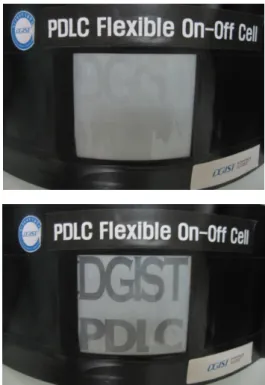
Figure 3 shows the PDLC flexible on-off cell. Cell was made between ITO coated PET substrates with 10 m cell gap. This cell works at 10Vdc.
Fig. 1. Electro-optic measurement system
Fig. 2. The V-T characteristics of PDLC film at various temperatures.
Fig. 2. PDLC flexible on-off cell (80mm x 80mm, TL205 + DG6071)
4. Summary
PDLC film was prepared with TL205 and the newly developed prepolymer. In this system, it was found that the LC ordinary refractive index and the polymer refractive index in the composite had similar characteristics at various temperature ranges. Thus, the temperature stability of this prepolymer is a benefit for stable on-state transmittance.
Acknowledgement
This work was supported by Regional Link Technology Development Program of Ministry of Knowledge Economy (MKE).
5. References
1. P.S. Drzaic, “Liquid crystal dispersions”, World Scientific Publishing, Singapore (1995).
2. L. Bouteiller, P.L Barny, Liq. Cryst., 21,157 (1996).
3. G. Spruce, R.D. Pringle, Elec. Comm. Eng. J.,
4 ,91 (1992).
4. J. W. Doane, “Liquid Crystals Applications and Uses, Vol. 1”, World Scientific Publishing, Singapore (1990).