J Korean Acad Community Health Nurs (지역사회간호학회지) https://doi.org/10.12799/jkachn.2018.29.3.257
Factors Affecting the Participation in Leisure Activities by
Elderly Women Living Alone
Gu, Min Kyung
Doctoral Student, Department of Nursing, Graduate School and College of Nursing Science, Kyung Hee University, Seoul, Korea
Purpose: The study has been conducted to identify factors affecting the participation in leisure activities by elderly women living alone. Methods: Data were collected through a questionnaire survey among 150 elderly women in Seoul and Gyeong-gi Province. The measurement tools that were used include participation in leisure activities, perceived health status, Geriatric Depression Scale Short Form-Korea (GDSS-K), psychological well-being scale, and lone-liness scale. The data were analyzed by using the Pearson correlation coefficients, t-test, analysis of variance ANOVA, and stepwise multiple regression with the SPSS/windows version 21.0 program. Results: The analysis shows that the affection for participation in leisure activities of the elderly women living alone who participated in the questionnaire survey is significant (F=14.6, p<.001). The value of the adjusted R2 is 0.55, which accounts for the
explanatory power of 55.4%. The predictor that has been found to have the greatest influence on the participation in leisure activities by the elderly women living alone include perceived health status, followed by monthly allowance (10,000 won), psychological well-being, economic status, religion, depression, family structure, and loneliness. Conclusion: The results suggest that in developing nursing interventions and practice for the participation in leisure activities by elderly women living alone, perceived health status, psychological well-being, depression, and lone-liness should be considered.
Key Words: Leisure activities; Aged; Female; Loneliness
Corresponding author: Gu, Min Kyung
Graduate School and College of Nursing Science, Kyung Hee University, 26 Kyungheedae-ro, Dongdaemun-gu, Seoul 02447, Korea. E-mail: [email protected]
- This article is article is an addition based on the rst author's master's thesis from University. Received: Nov 30, 2017 / Revised: Mar 5, 2018 / Accepted: Apr 1, 2018
This is an open access article distributed under the terms of the Creative Commons Attribution Non-Commercial License (http://creativecommons.org/licenses/ by-nc/3.0), which permits unrestricted non-commercial use, distribution, and reproduction in any medium, provided the original work is properly cited.
INTRODUCTION
1. Background
The aging of the South Korean society is progressing at an unprecedentedly rapid rate compared to the other countries in the world, including advanced countries like the United States and France. In 2026, South Korea is ex-pected to become a post-aged society, with the elderly population estimated to reach 20.8% of the total popula-tion, and elderly people living alone are estimated to ac-count for three-fifths of the total elderly population [1]. The rapid increase of the elderly population in South Ko-rea has caused many changes in the status and role of the elderly in the South Korean society due to the changes in the socioeconomic structure resulting from moderniza-tion, urbanizamoderniza-tion, and industrializamoderniza-tion, and it is
emerg-ing as a serious social problem.
As South Korea has become an aging society, the num-ber of elderly people living alone reached 987,000 at the end of 2009, and the average age of the elderly women liv-ing alone is 75.1 years, which is expected to be higher than that of the elderly men living alone. The proportion of eld-erly women living alone is 84% of the total eldeld-erly people living alone. As the social interest in the elderly women living alone is increasing, the elderly women living alone themselves need to change their attitudes and become more active and optimistic [2]. As the economic wealth of the overall society has increased, and as the people’s eco-nomic status has generally been improved, there is an in-creasing interest in pursuing the meaning of life. The eld-erly women living alone, however, are more exposed to economic and physical health problems than the other ge-nerations, and are faced with increasingly difficult
prob-lems due to a lack of family and social support [3]. In par-ticular, they mostly live in seclusion due to isolation and alienation, do not associate with the people around them, and are weakened by disease. In addition, they exhibit psychological weakness and dependency, experience lone-liness, and exert effort only to fill their daily lives. There-fore, there is a need for them to cope with the loss of their social status or role, loneliness, and feelings of alienation accompanying the physical, psychological, and social pro-blems that they face. It is possible that the role loss of eld-erly women living alone not only reduces their self-esteem in social and mental terms [3] but also exacerbates their poor health status, psychological depression, and loneli-ness. Therefore, it can be said that a healthy old-age life is a requirement for giving a new meaning to the lives of eld-erly women living alone, and finding independent work for them to maintain their good health and regain their life may be achieved through their participation in leisure ac-tivities designed for them [4].
On the other hand, for elderly women living alone, sure activities have different meanings from general sure activities. Havighurst [5] stated that engaging in a lei-sure activity means taking a break from the stress of hu-man relationships and restoring balance in one’s life; in addition, it is an attempt to embrace new challenges and experiences as well as the pursuit of enjoyment. Therefore, the leisure activities of elderly women living alone are a crucial determinant of a successful life in old age [6,7], and living a more meaningful and satisfying life may increase the morale and satisfaction of elderly women living alone and may improve their insights on life.
As a result of the extension of the average lifespan in to-day’s aging society, the problem of leisure activities of eld-erly women living alone is thought to boil down to how to utilize their free time, which has been lengthened without pastimes compared to the other age groups. Therefore, how to spend one’s abundant free time is a challenge for elderly women living alone [8]. Their participation in lei-sure activities leads to the improvement of their physical and mental confidence, contributes to their psychological well-being, and improves their health. It also drives them to pursue a pleasant life and self-worth, and enhances their self-reliance [9]. Therefore, health is very important to elderly women living alone, and their participation in leisure activities is related to the quality of their lives [10]. If their leisure activities become insufficient or if their so-cial activities are decreased, they eventually become self- centered and isolated. Therefore, their depression and loneliness, which are associated with a person’s psycho-logical health, also become more pronounced.
On the other hand, the previous domestic and foreign studies on participation in leisure activities were mostly limited to the investigation of the level of health status of elderly people, and only presented the correlations among health status, depression, solitude, successful aging, and quality of life [4,10,13]. In relation to the difference in the health status of elderly people, each type of leisure activity was reported to maintain elderly people’s physical health and was found to promote the good health of elderly peo-ple who are psychologically confused [11,12]. Moreover, it was found that participation in leisure activities reduces depression and loneliness in elderly people and is thus correlated with elderly people’s health status [13]. In addi-tion, it was suggested that because the quality of life of eld-erly people who actively participate in leisure activities is improved, participation in leisure activities is a major pre-dictor of successful aging [4,10]. The previous studies de-scribed above, however, used the variables related to the health status of the general elderly population to inves-tigate their participation in leisure activities, and there have been few studies of elderly women living alone that investigated the factors affecting their participation in lei-sure activities, which are overall positive activities that help elderly women living alone cope with the loss of their social roles.
Therefore, it is believed that the development and uti-lization of nursing intervention programs that promote elderly women living alone’s participation leisure activ-ities and help them lead a more stable and meaningful life in old age are crucially required. Thus, this study aimed to provide a basis for the development of such nursing inter-vention programs.
2. Purpose
The purpose of this study was to identify the factors in-fluencing the participation in leisure activities of elderly women living alone. Below are the specific goals of this study.
To investigate the levels of perceived health status, psychological well-being, depression, and loneliness of elderly women living alone.
To determine the level of participation in leisure ac-tivities of elderly women living alone according to their general characteristics.
To determine if participation in leisure activities is cor-related with variables such as perceived health status, psychological well-being, depression, and loneliness in elderly women living alone.
leisure activities of elderly women living alone.
METHODS
1. Study Design
This study was a survey research that was conducted to determine the level of participation in leisure activities of elderly women living alone, and to investigate their levels of perceived health status, psychological well-being, de-pression, and loneliness, which are known to be the varia-bles affecting the participation in leisure activities of eld-erly women living alone.
2. Data Collection and Participants
The subjects of this study were 150 elderly women aged 65 or older residing in Seoul or Gyeonggi Province, South Korea and who were able to communicate. The number of study subjects was calculated at the significance level of .05 and the medium effect size of .15 to secure 95% statisti-cal power for the multiple regression analysis using the G*Power 3.1.2 program. The adequate sample size was determined to be 138 persons. The survey questionnaires were administered to 155 participants, considering the dropout rate. The number of samples in this study was 150 persons, excluding five subjects who did not complete the questionnaire or whose questionnaire contained missing data. The study subjects were elderly women to whom the purpose of the study was first explained, and who there-after voluntarily agreed to participate in the study. In rela-tion to the specific criteria for selecting the study subjects, elderly women aged 65 or older who were clearly con-scious, could communicate verbally and non-verbally, and could understand the purpose of the study were finally se-lected as the study subjects. For the reliability of the data collection, two research assistants were trained to under-stand each questionnaire item, and in the case of the ques-tionnaire items that the survey participants might have difficulty understanding, or the ambiguous items, an ad-ditional explanation was added to help the participants un-derstand them. Approximately 70 people from two senior citizen centers and 1 church located in Seoul, and approx-imately 85 people from 1 senior citizen center, 3 churches, and 1 elderly welfare center located in Gyeonggi Province, were selected as the survey participants. The purpose of the study was explained to the head of each facility and the people in charge, and the survey participants’ consent was obtained before data collection was conducted. The sur-vey was conducted by visiting the facilities after making
an appointment to visit them at the time when the survey participants were to get together.
3. Measures
1) Participation in leisure activities
The tool that was used to measure the study subjects’ participation in leisure activities was the scale created by Cho and Lee [14] by translating the tool developed by Havighurst [5] into Korean. The tool consists of 20 items to investigate the types of leisure activities of elderly people. Each item was measured based on a 5-point Likert scale for easy responses considering the characteristics of the survey participants. The total score ranges from a mini-mum of 20 points to a maximini-mum of 100 points, and the higher the score is, the higher the level of participation in leisure activities. The items about participation in leisure activities include painting, reading, participation in liberal arts classes at an institution for elderly people, growing houseplants and gardening, exercise, watching TV, watch-ing movies, and sightseewatch-ing and travelwatch-ing in South Korea or abroad. In terms of the reliability of this study, Cronbach’s ⍺=.81 in Cho and Lee [14], and Cronbach’s ⍺=.86 in this study.
2) Perceived health status
Perceived health status refers to the self-perceived or subjective health status, and the perceived health status of the study subjects was assessed using the tool that was em-ployed by Sung & Cho [8], who created it by translating Ware’s health literacy scale [15] and the perceived health status scale developed by Speake et al. [16] into Korean. This tool consists of three items about one’s current health status, one’s degree of daily life disturbance, and one’s health status compared to that of the other people in the same age group, and they are measured based on a 5-point Likert scale. The total score ranges from 3 to 15 points, and the higher the score is, the higher the level of perceived health status. As to the reliability of this tool, Cronbach’s ⍺=.92 in Sung & Cho [8], and Cronbach’s ⍺=.91 in this study.
3) Psychological well-being
The psychological well-being was measured using a modified Korean version of the psychological well-being scale developed by Ryff [17], who used the scale to meas-ure the level of individuals’ quality of life. The scale that was used in this study was created by Cho [18] by trans-lating 18 items consisting of three questions each among the items of Ryff’s scale consisting of six dimensions of
psychological well-being. As the scale consists of 18 items measured based on a 5-point Likert scale, the total score ranges from 18 to 90 points. The higher the score is, the higher the level of psychological well-being. The neg-ative-statement items were reverse-scored through recod-ing. The level of psychological well-being was measured using items like “I am influenced by others’ opinions,” “I consider myself more important than others,” “I have not experienced warm and reliable relationships with others,” “It is difficult for me to maintain a close relationship with others,” and “I think I have finished what I have to do in my life.” As for the reliability of this instrument, Cron-bach’s ⍺=.80 in Cho [18], and CronCron-bach’s ⍺=.82 in this study.
4) Depression
The depression scale for elderly people that was used in this study was a modified Korean version of the Geriatric Depression Scale created by Yesavage et al [19], which was produced by Nam [20] by modifying and supplementing the Geriatric Depression Scale Short Form-Korea (GDSSF-K) created by Ki [21] by standardizing the original version created by Yesavage et al [19]. The tool consists of a total of 15 items measured based on a 5-point Likert scale. The to-tal score ranges from 15 to 75 points. Higher scores in-dicate higher levels of depression. The questions regard-ing depression include those about basic life satisfaction, life values, views about moods and emotions, etc. As for the reliability of this instrument, Cronbach’s ⍺=.87 in Nam [20], and Cronbach’s ⍺=.72 in this study.
5) Loneliness
The loneliness scale for elderly women living alone that was used in this study was the tool that was used in the study by Nam [20], who created it by translating the original version, which was developed by the Department of Human Development and the Family of Nebraska University and which Marcia R. Wythers applied to her study in 1973. The tool consists of a total of 26 items meas-ured based on a 5-point Likert scale. The possible scores range from a minimum of 26 points to a maximum of 130 points, and higher scores indicate higher levels of loneli-ness. The questions about loneliness include items like how you feel when you are alone, when your adult chil-dren leave home, when you are at home and do not go out for a long time, when you cannot go to a meeting because of lack of money, when you are ill, when there is no one to help you, and when others do not recognize you. As for the reliability of this tool, Cronbach’s ⍺=.87 in Nam [20], and Cronbach’s ⍺=.87 in this study.
4. Procedures
To select the measurement tools to be used, a prelimi-nary survey was conducted among 50 persons who were randomly selected on September 10~20, 2012 after receiv-ing IRB approval for this study. In the second survey for the main study, after the contents and purpose of the study were explained to the subjects, questionnaires were ad-ministered only to the subjects who voluntarily agreed to participate in the study. Such subjects were asked to com-plete the questionnaire through the self-reporting method. The accomplished questionnaires were collected from October 2 to November 19, 2012. It took about more than 30 minutes for each subject to complete the questionnaire. Excluding five subjects who did not complete the ques-tionnaire or had missing data, the data of the selected 150 survey participants were used for the final statistical analysis.
1) The preliminary survey
To verify the validity and reliability of the measure-ment tools to be used, a preliminary survey was con-ducted on September 10~20, 2012 among 50 elderly wom-en living alone who were going to a swom-enior citizwom-en cwom-enter, a church, or an elderly welfare center located in Seoul and Gyeonggi Province, South Korea. After finding the tools that could be used to measure their level of participation in leisure activities (which was the dependent variable in this study) as well as the independent variables (perceived health status, psychological well-being, depression, and loneliness) through literature review, the content validity was confirmed with two nursing professors and five grad-uate students. The reliability of the tool that was used in this study was .72.~91.
2) The main study
This study was conducted from October 2 to November 19, 2012, with elderly women living alone. After the re-searcher explained the purpose and contents of the study to the potential study subjects, the questionnaires were distributed to those among them who agreed to partic-ipate in the study, and the study participants were asked to accomplish the questionnaires through the self-report-ing method. Finally, 150 accomplished questionnaire cop-ies were used for the analysis.
5. Data Analysis
The collected data were analyzed using the SPSS/WIN 21.0 program, according to the purpose of the study and
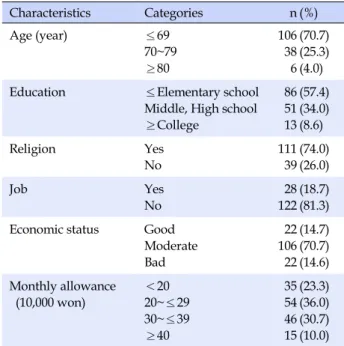
Table 1. General Characteristics of the Study Subjects (N=150) Characteristics Categories n (%) Age (year) ≤69 70~79 ≥80 106 38 6 (70.7) (25.3) (4.0) Education ≤Elementary school
Middle, High school ≥College 86 51 13 (57.4) (34.0) (8.6) Religion Yes No 111 39 (74.0) (26.0) Job Yes No 28 122 (18.7) (81.3) Economic status Good
Moderate Bad 22 106 22 (14.7) (70.7) (14.6) Monthly allowance (10,000 won) <20 20~≤29 30~≤39 ≥40 35 54 46 15 (23.3) (36.0) (30.7) (10.0)
the characteristics of the variables.
The t-test and ANOVA were performed to determine the differences in the levels of perceived health status, psychological well-being, depression, and loneliness of the survey participants according to their level of participation in leisure activities.
The general characteristics and the levels of perceived health status, psychological well-being, depression, and loneliness of the survey participants were ana-lyzed using descriptive statistics such as frequency and mean.
The correlations among the research variables were examined using Pearson’s product moment correla-tion coefficient.
To explain the variables that affect the participation in leisure activities of the study subjects, all the signifi-cant factors were included as response variables and were analyzed using stepwise multiple regression an-alysis. The Durbin-Watson test was used to indepen-dently measure the autocorrelation of errors to con-firm if all the assumptions of the regression analysis were satisfied. In addition, tolerance as an indicator of multicollinearity, and the variance inflation factor (VIF), were calculated and analyzed.
In relation to the perceived health status, psychologi-cal well-being, depression, and loneliness according to the subjects’ participation in leisure activities, the significant variables were analyzed using the Scheffé post-hoc test.
6. Ethical Considerations
In this study, after the receipt of IRB approval (Kyung Hee University IRB No. 2012-S26), the purpose and proce-dure of the study were explained to the study subjects. Their cooperation in collecting the data was then implored, and they were informed the data to be collected from them would not be used for any purpose other than research, and that they could withdraw from the study at any time, without any disadvantage. Copies of the questionnaire were distributed to those who agreed to participate in the study, and the latter were asked to accomplish these.
7. Limitations of the Study
The subjects of this study were elderly women living alone who participated in the activities of a senior citizen center, a church, or an elderly welfare center located in Seoul and Gyeonggi Province. There are limitations in explaining the participation in leisure activities of elderly
women living alone in general, due to the limitation of the sampling of the study participants. Therefore, it is neces-sary to conduct an expanded study considering the sam-pling of research participants in the future.
RESULTS
1. General Characteristics of the Study Subjects
With regard to the average age of the elderly women who participated in this study, 70.7% of them were in the 65~69 age group. As for the education level, 57.4% were elementary school graduates or lower, and 34.0% were mid-dle or high school graduates. The proportion of the subjects with a religion was as high as 74.0%, and the proportion of the subjects who were unemployed was as high as 81.3%. With respect to the economic status of the study subjects, 70.7% rated their economic status as medium. As for the average monthly allowance, the proportion of the subjects with a monthly allowance of 200,000~290,000 won was the largest (36.0%), followed by the subjects with a monthly al-lowance of 300,000~390,000 won (30.7%) (Table 1).2. Levels of Participation in Leisure Activities,
Per-ceived Health Status, Psychological Well-being,
Depression, and Loneliness of the Study Subjects
For the scores for participation in leisure activities, per-ceived health status, psychological well-being, depression,Table 2. Levels of Participation in Leisure Activities, Perceived Health Status, Psychological Well-being, Depression, and
Loneliness of the Study Subjects (N=150)
Variables Measure Range point M±SD
Dependent Leisure activity 20~100 60.00±17.20
Independent Perceived health status Psychological well-being Depression Loneliness 3~15 18~90 15~75 26~130 10.20±2.40 67.57±12.55 46.17±7.79 79.03±9.92
Table 3. Participation in Leisure Activities according to the General Characteristics of the Study Subjects (N=150)
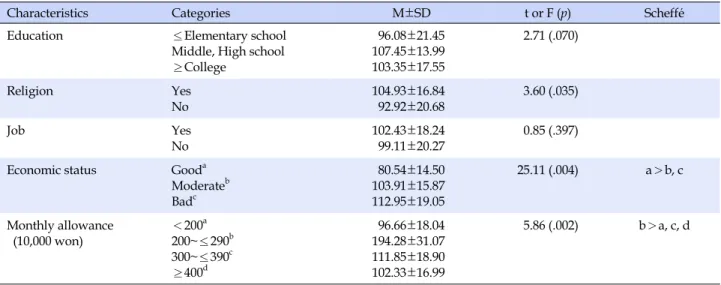
Characteristics Categories M±SD t or F (p) Scheffé
Education ≤Elementary school
Middle, High school ≥College 96.08±21.45 107.45±13.99 103.35±17.55 2.71 (.070) Religion Yes No 104.93±16.84 92.92±20.68 3.60 (.035) Job Yes No 102.43±18.24 99.11±20.27 0.85 (.397)
Economic status Gooda
Moderateb Badc 80.54±14.50 103.91±15.87 112.95±19.05 25.11 (.004) a>b, c Monthly allowance (10,000 won) <200 a 200~≤290b 300~≤390c ≥400d 96.66±18.04 194.28±31.07 111.85±18.90 102.33±16.99 5.86 (.002) b>a, c, d
and loneliness of the study subjects, the score for partic-ipation in leisure activities was found to be 60.00 points, with a median of 60 points. The score for perceived health status was 10.20 points, with a median of 9 points, the score for psychological well-being was 67.57 points, with a median of 54 points, the score for depression was 46.17 points, with a median of 45 points, and the score for lone-liness was 79.03 points, which was higher than the median (78 points) (Table 2).
3. Participation in Leisure Activities according to
the General Characteristics of the Study
Sub-jects
The analysis results of the degree of participation in leisure activities according to the general characteristics of the study subjects showed that there were statistically sig-nificant differences in the level of participation in leisure activities according to the presence of religion (F=3.60, p= .035), economic status (F=25.11, p=.004), family structure (F=4.68, p=.042), and average monthly allowance (F=5.86,
p=.002). In other words, the study subjects with a religion
had a higher level of participation in leisure activities than those without a religion. As for the economic status and
average monthly allowance, as these became higher, the level of participation in leisure activities increased (Table 3).
4. Correlations between Participation in Leisure
Activities and the Main Variables
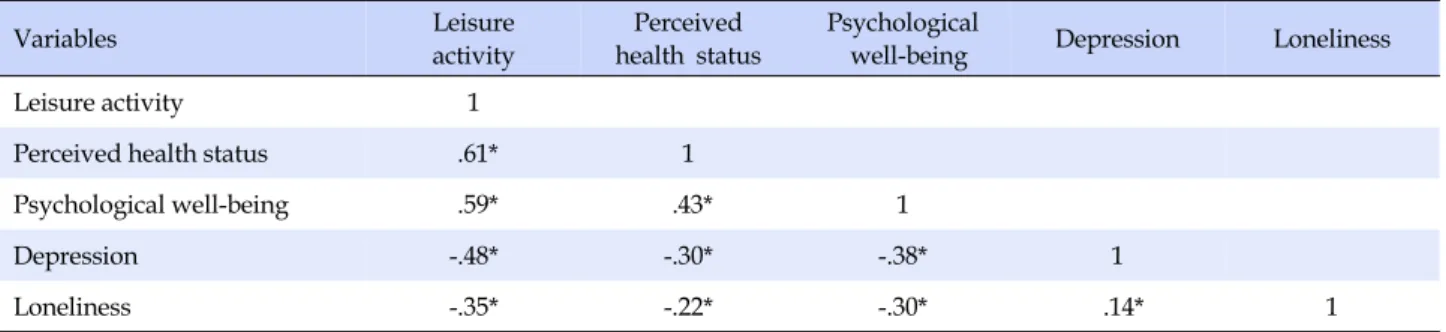
As a result of the analysis of the correlation between lei-sure activity participation and each of the main variables, perceived health status (r=.61, p<.01) and psychological well-being (r=.59, p<.01) showed a positive correlation with participation in leisure activities while depression (r=-.48, p<.01) and loneliness (r=-.35, p<.01) showed a negative correlation with it. In other words, as the level of perceived health status and psychological well-being be-came higher, the level of participation in leisure activities increased. On the other hand, as the levels of depression and loneliness became lower, the level of participation in leisure activities increased (Table 4).
5. Factors Influencing Participation in Leisure
Activities
The tests for the assumptions of the regression analysis showed that the assumptions were satisfied. First, using
Table 4. Correlations between Participation in Leisure Activities and the Main Variables (N=150)
Variables Leisure activity health statusPerceived Psychological well-being Depression Loneliness
Leisure activity 1
Perceived health status .61* 1
Psychological well-being .59* .43* 1
Depression -.48* -.30* -.38* 1
Loneliness -.35* -.22* -.30* .14* 1
*p<.01.
Table 5. Factors Influencing Participation in Leisure Activities (N=150)
Variables B SE β t p
Education 0.24 0.37 .12 0.24 .070
Religion -4.83 0.28 -.11 -2.13 .035
Job -0.72 2.35 -.02 -0.31 .397
Economic status -0.46 0.74 -.04 -0.64 .004
Monthly allowance (10,000 won) 0.27 0.11 .18 2.19 .002
Perceived health status 0.49 0.14 .26 3.49 .001
Psychological well-being 0.33 0.07 .26 5.01 .003
Depression -0.59 0.12 -.27 -5.12 .036
Loneliness -0.38 0.11 -.30 -3.33 .047
Adj. R2=.55, F=14.63, p<.001
Adj. R2=Adjust R-squared.
the Durbin-Watson test, the autocorrelation of errors was independently tested. As a result, the statistic was 1.81, which is larger than the test statistic of 1.76, indicating that there was no autocorrelation. In addition, the tolerance as an indicator of multicollinearity was 0.24~5.12, larger than .10. The VIF was 1.32~3.07, not higher than 10, indicating that all the variables did not have any problem of multi-collinearity. Finally, the correlation coefficient between the independent variables influencing the participation in lei-sure activities of the elderly women living alone was -0.48 ~0.61, lower than 0.80, indicating that all the variables were independent of one another.
The factors affecting the participation in leisure activi-ties of the subject elderly women living alone were ana-lyzed using stepwise multiple regression analysis. As a re-sult, perceived health status, average monthly allowance, psychological well-being, economic status, religion, de-pression, family structure, and loneliness (in descending order of significance) were found to affect the subjects’ participation in leisure activities, and their explanatory power was 55.4% (Table 5).
DISCUSSION
In this study, an attempt was made to identify the fac-tors influencing the participation in leisure activities of elderly women living alone, to find ways of improving their understanding of leisure activities, and to encourage their participation in these. At the same time, efforts were made to enhance the quality of life of elderly women liv-ing alone by explorliv-ing solutions to the important issues concerning them. The relevant issues concerning them will be discussed in the next section based on the study results.
With respect to the general characteristics of the elderly women living alone who participated in this study, in terms of their education level, the largest proportion of the study participants were elementary school graduates or lower, and middle or high school graduates constituted the second largest group. The results of this study are sim-ilar to those of a previous study that examined the factors affecting the quality of life of elderly women living alone [22], and they suggest that there is a need to expand the op-portunities for knowledge acquisition for that elderly
wom-en living alone so that they can overcome their isolation and alienation, recognize the importance of health, and manage their diseases by themselves. In addition, it is nec-essary to enhance their social awareness to improve their quality of life, by implementing various health manage-ment education programs centered on public health cen-ters and primary healthcare posts through the expansion of community networks.
In the present study, the average total score for partic-ipation in leisure activities of the subject elderly women living alone was 60.00 points, which is a relatively moder-ate level. This result is largely in agreement with the prior study results that (1) participation in leisure activities had a positive effect on the perceived health status of the sub-ject elderly people, thus increasing their quality of life and life satisfaction and ultimately leading to their improved psychological well-being [10,12], (2) the active participa-tion in leisure activities of the elderly subjects increased their life satisfaction, thus resulting in their improved psy-chological well-being [23], and (3) participation in leisure activities helped maintain the subject elderly people’s self- esteem and identity through the resolution of their depres-sion and loneliness caused by the loss of their social roles [13]. In other words, the participation in leisure activities of elderly women living alone plays an important role in improving their overall physical, psychological, and social factors, and as these variables are highly correlated, it is important to encourage elderly women living alone to vol-untarily participate in the programs for leisure activity participation for elderly people, in addition to providing direct and indirect social support to them.
The level of participation in leisure activities of the sub-ject elderly women living alone was higher in the group with a religion, and it was increased as the economic status and the average monthly allowance became higher. These findings suggest that the level of participation in leisure activities of elderly women living alone may be a decisive factor in their leading a more successful life as well as in their obtaining more enjoyment in old age because it al-lows them to restore their life balance as well as take a rest [5]. In addition, it is thought that it offers an opportunity for self-realization for elderly women living alone, and provides a basis for overall activities through having en-joyable diversions, achieving personal fulfillment, and taking a rest [24].
Next, as a result of the analysis of the correlations be-tween participation in leisure activities and related factors in the subject elderly women living alone, it was found that participation in leisure activities was positively corre-lated with perceived health status and psychological well-
being while it was negatively correlated with depression and loneliness. In other words, as the level of participation in leisure activities of the subject elderly women living alone became higher, the levels of perceived health status and psychological well-being became higher, and the levels of depression and loneliness became lower. These results are in agreement with those of previous studies reporting that social interaction with other people (e.g., relatives, neighbors, and friends) and physical activity were positively correlated with participation in leisure ac-tivities and health status in elderly people [2,11,25], and that participation in leisure activities was positively corre-lated with happiness, life satisfaction, and psychological well-being [26]. In addition, they support the prior study results showing that participation in leisure activities plays a significant role in reducing depression and lone-liness in the elderly population [13,27]. The rate of partic-ipation in leisure activities of the subject elderly women living alone in this study was significantly lower than that of the elderly women living with one or more family mem-bers, because of isolation, alienation, and a lack of social support, and elderly women living alone are very likely to suffer from diseases due to a lack of practice of good- health-promoting behaviors [13,25,27]. In addition, 76.3% of the subject elderly women living alone mostly com-plained of pain, which suggests that their health status was worse than that of the general elderly population [28]. The better the health status of elderly women living alone is, the more likely they are to overcome depression and loneliness. As a result, they are able to get spiritual energy boosts, develop a sense of personal fulfillment, and ach-ieve psychological stability, and thus, they are able to de-velop a positive self-concept and change their life in a pos-itive way.
Among the factors influencing the participation in lei-sure activities of the subject elderly women living alone in this study, perceived health status was found to have the greatest effect on their participation in leisure activities, followed by average monthly allowance, psychological well-being, economic status, religion, depression, and fa-mily structure, in descending order of significance. These study findings corroborate the results of previous studies that identified perceived health status, depression, and loneliness as the factors influencing the participation in leisure activities of elderly people [4,10,11], and they also support the result of prior studies that perceived health status and psychological well-being were the factors that influenced the participation in leisure activities of the eld-erly subjects in such studies [12,13].
possi-ble to help elderly women living alone live healthier for the rest of their life by encouraging them to actively partic-ipate in productive and integrated leisure activities, which also help them form various social relationships [29]. In addition, what is considered the major task of nursing care to help elderly women living alone finally achieve success-ful aging and spend the rest of their lives doing worth-while activities is to help them increase their participation in leisure activities. Thus, the development of nursing in-terventions to achieve this purpose is urgently required.
CONCLUSION
In conclusion, the results of this study revealed that as the level of participation in leisure activities of elderly women living alone increases, the level of their perceived health status also increases, which may lead to their im-proved psychological well-being. The study results also showed the increased importance of participation in lei-sure activities of elderly women living alone these days in terms of its effect of resolving depression and loneliness caused by the loss of social roles.
Therefore, it is necessary to actively consider the afore-mentioned influencing factors in a nursing intervention for elderly women living alone. In the case of healthy eld-erly women living alone, the development and use of lei-sure activity participation programs may play a more sig-nificant role in nursing interventions to decrease their de-pression, alienation, and loneliness and to help them per-ceive themselves as healthy and thus help them live a more active life.
Based on the results of this study, it is necessary to con-duct qualitative research in the future to understand and analyze the meaning of leisure activities of elderly women living alone through an inquiry into their inner world and thoughts. In addition, it is necessary to conduct an ex-perimental study to develop an intervention program for the elderly people living alone in South Korea, and to ver-ify the effects of such program by applying it.
REFERENCES
1. National Statistical Office. Statistics of aged. Seoul: The Na-tional Statistical Office [Internet]. 2015 [cited 2016, September 2]. Available from:
http://kosis.kr/statHtml/statHtml.do?orgId=101&tblId=DT _1IN1602&vw_cd
2. Chung MS, SongJH. Social support and health status based on characteristics of leisure activity of middle-aged women. The KoreanJournal of Fundamentals of Nursing. 2011;18(1):
97-106.
3. Kim HS, Kim JW, Chung KS. The future direction of infor-mation literacy for the aged in the lifelong learning: Centering on gumi senior welfare center.Journal of Digital Contents So-ciety. 2014;15(4):491-500.
https://doi.org/10.9728/dcs.2014.15.4.491
4. Lee BJ, Hong SW. The effect of older people's leisure activities on their self-esteem and life satisfaction. Northeast Asia Tour-ism Research. 2012;8(2):139-156.
5. Havighurst RJ. The leisure activities of the middle aged. Ame-ricanJournal of Sociology. 1973;63(2):152-162.
6. Park YM. A comoarative study on the perception of successful aging and life satisfaction between elderly men and women [master's thesis]. [Gimhae]: Inje University; 2011. 70 p. 7. RoweJW, Kahn RL. Successful aging. The Gerontologist. 1997;
37(4):433-440. https://doi.org/10.1093/geront/37.4.433 8. Sung HY, Cho HS. A study of successful aging model: Using
the components of Rowe & Kahn.Journal of the Korea Geron-tological Society. 2005;26(1):105-123.
9. Lee HY, Lee KJ. Effects of tai chi exercise in elderly with knee osteoarthritis.Journal of Korean Academy of Nursing. 2008; 38(1):11-18. https://doi.org/10.4040/jkan.2008.38.1.11 10. Kim KS, Lee EJ. Relation between leisure sports: Activities
among older adults on activities of daily living and successful aging. TheJournal of Korea Contents Association. 2010;10(4): 424-432.
11. Kim YR. The relationship among types of leisure activity, sub-jective health status and the happy life. KoreanJournal of Sport Science. 2009;20(3):553-566.
12. Parker S. Work and retirement. George Allen and Unwin, Lon-don: 1982; 203 p.
13. SongJJ, Um IS. The relationship between leisure types and de-pression and loneliness in the middle-aged and the elderly. InternationalJournal of Tourism Management and Sciences. 2008;23(1):43-62.
14. Cho YJ, Lee SH. Elderly women's subjective well-being differ-ences participating in productive activities: An application of demand-control-support model.Journal of Family Relations. 2007;12(1):119-145.
15. Ware JE. Scales for measuring general health perceptions. Health Services Research. 1976;11(4):396-415.
16. Speake DL, Cowart ME, Pellet K. Health perception and life-styles of the elderly.Journal of Research in Nursing Health. 1989;12(2):93-100. https://doi.org/10.1002/nur.4770120206 17. Ryff CD. Happiness is everything or is it? Exploration on the
meaning of psychological well-being.Journal of Personality and Social Psychology. 1989;57(6):1069-1081.
https://doi.org/10.1037/0022-3514.57.6.1069
18. Cho AJ. The effect of subjective health-status of social support of the older generation and health promotion
behavior[mas-ter's thesis]. [Seoul]: Ewha-Womans University; 2010. 72 p. 19. YesavageJA, Brink TL, Rose TL, Lum O, Huang V, Adey M, et
al. Development and validation of a geriatric depression screening scale: A preliminary report.Journal of Psychiatric Research. 1982-1983;17(1):37-49.
https://doi.org/10.1016/0022-3956(82)90033-4
20. Nam HJ. Factors influencing ageism of the elderly [master's thesis]. [Seoul]: Kyung Hee University; 2011. 69 p.
21. Ki BS. A preliminary study for the standardization of geriatric depression scale short form-Korea version.Journal of the Ko-rean Neuropsychiatric Association. 1996;35(2):298-307. 22. Kim HY, Lee HJ, Park SM. Factors influencing quality of life in
elderly women living alone.Journal of the Korea Gerontological Society. 2010;30(2):279-292.
23. PackJW, Kim SO, Kim MY. Factors that influence satisfaction level towards the life by the leisure activity of the users of the senior citizens: Leisure welfare facilities. KoreanJournal of Clinical Social Work. 2010;7(1):37-58.
24. DunganJM, Brown AV, Ramsey MA. Health maintenance for
the independent frail older adult: Can it improve physical and mental well-being?.Journal of Advanced Nursing. 1996;23(6): 1185-1193. https://doi.org/10.1046/j.1365-2648.1996.12016.x 25. Jang IS. The leisure type, health status, self-esteem, and social
support of the elderly living alone.Journal of Korean Public Health Nursing. 2006;20(2):130-140.
26. Cha JW, Kang BJ. Causal relationships between the elderly people's leisure activities and their self-esteem, helplessness, loneliness, leisure satisfaction, life satisfaction, and happiness. Journal of Exercise Rehabilitation. 2010;6(4):39-51.
27. PackJE, Choi HK. Successful aging according to Korean eld-erly: The definition, type, and predicting variables. Korean Home Management Association. 2005;23(3):1-16.
28. LeeJY,Jang YS, Lee WS. A study on how health of the elderly who live alone affects their psychological stability. Korea Acad-emy of Welfare Counselling Education. 2013;2(1):111-126. 29. Kim SH, Kim YJ. The relationship between elderly leisure
ac-tivity participation and recognition of successful aging. Jour-nal of Family Relations. 2011;15(4):3-23.