System development for establishing shipyard mid-term production
plans using backward process-centric simulation
Suheon Ju
a, Saenal Sung
b, Huiqiang Shen
a,*, Yong-Kuk Jeong
c, Jong Gye Shin
a,d aDepartment of Naval Architecture and Ocean Engineering, Seoul National University, Gwanak-ro, Gwanak-gu, Seoul, 08826, Republic of Korea bHyundai Heavy Industry Co., 1000, Bangeojinsunhwando-ro, Dong-gu, Ulsan, 44032, Republic of KoreacDepartment of Sustainable Production Development, KTH Royal Institute of Technology, Brinellv€agen 8, 114 28, Stockholm, Sweden dResearch Institute of Marine System Engineering, Seoul National University, Gwanak-ro, Gwanak-gu, Seoul, 08826, Republic of Korea
a r t i c l e i n f o
Article history:
Received 15 February 2019 Received in revised form 2 May 2019
Accepted 24 May 2019 Available online 13 June 2019 Keywords:
Shipyard production planning Shipyard simulation system Shipyard advanced planning system Backward simulation
Process-centric simulation
a b s t r a c t
In this paper, we propose a simulation method based on backward simulation and process-oriented simulation to take into account the characteristics of shipbuilding production, which is an order-based industry with a job shop production environment. The shipyard production planning process was investigated to analyze the detailed process, variables and constraints of mid-term production planning. Backward and process-centric simulation methods were applied to the mid-term production planning process and an improved planning process, which considers the shipbuilding characteristics, was pro-posed. Based on the problem defined by applying backward process-centric simulation, a system which can conduct Discrete Event Simulation (DES) was developed. The developed mid-term planning system can be linked with the existing shipyard Advanced Planning System (APS). Verification of the system was performed with the actual shipyard mid-term production data for the four ships corresponding to a one-year period.
© 2019 Society of Naval Architects of Korea. Production and hosting by Elsevier B.V. This is an open access article under the CC BY-NC-ND license (http://creativecommons.org/licenses/by-nc-nd/4.0/).
1. Introduction
Because the ships produced in shipyards are very large, special facilities (such as docks and goliath cranes) are used to build them. Docks are important facilities that determine the production ca-pacity of a shipyard, and the size of the docks and goliath cranes is an important index that can represent their production capacity. As such, the efficient use of docks to build ships is a crucial part of shipbuilding production. Most shipyards apply block construction to build ships to increase dock productivity and turnover rate (Kim et al., 2005).
In block construction, the ship is divided into several blocks, which are produced simultaneously at several assembly sites. Then, an erection process is performed to combine the blocks into one piece at a dock to produce the ship. Because ships are produced through contracts with the ship owners, meeting the ship's delivery
date is the most important constraint condition in ship production. When ships are produced through block construction, delays in block delivery can affect the ship's delivery date. Thus, it is very important to meet the delivery date of each block. However, because one ship is divided into hundreds of blocks, it is difficult to produce a ship efficiently without a suitable plan.
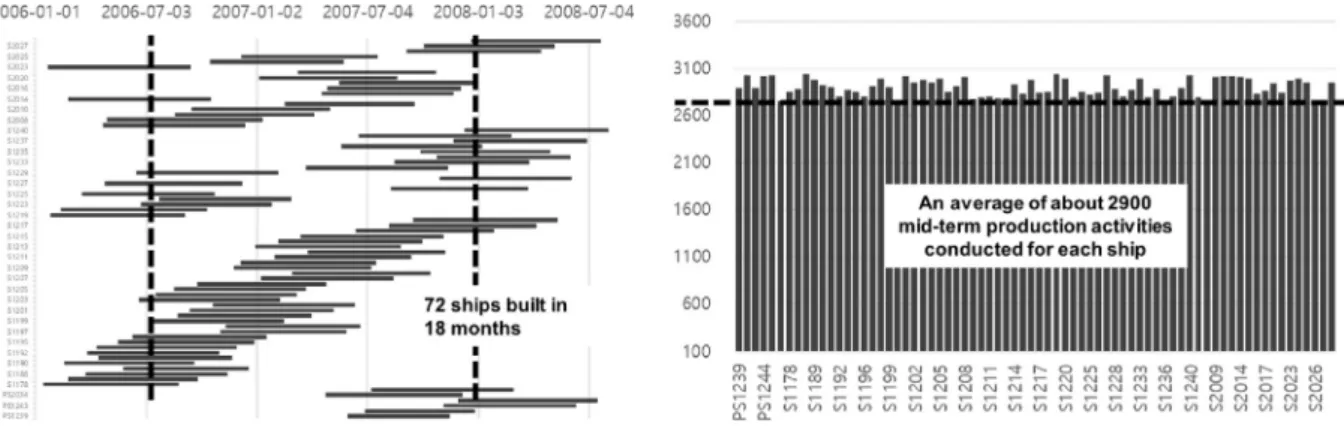
Furthermore, shipyard facilities and resources are shared among multiple ships being built simultaneously. Therefore, tasks related to other ships must also be considered when establishing a pro-duction plan (Spicknall, 1997). The tasks required to produce each block are called block production activities, and the establishment of a production plan for these block production activities is called a mid-term shipyard production plan. A mid-term shipyard produc-tion plan schedules the tasks that are part of the activities related to block production and erection over a period of six months to a year. Fig. 1shows the production activity status of shipyard A, which is a medium-to-large shipyard where an average of 2900 activities are performed daily. At most shipyards, plans for the thousands of tasks are established manually by workers and undergo repeated revisions (Neumann and McQuaide, 1991). However, these ship production plans are complex, have long planning periods, and depend on manual work and repetitive tasks; hence, establishing a
* Corresponding author.
E-mail addresses: [email protected] (S. Ju), [email protected] (S. Sung),
[email protected] (H. Shen), [email protected] (Y.-K. Jeong), jgshin@ snu.ac.kr(J.G. Shin).
Peer review under responsibility of Society of Naval Architects of Korea.
Contents lists available atScienceDirect
International Journal of Naval Architecture and Ocean Engineering
j o u r n a l h o m e p a g e :h t t p : / / w w w . j o u r n a l s . e l s e v i e r . c o m / i n t e r n a t i o n a l - j o u r n a l - o f - n a v a l - a r c h i t e c t u r e - a n d - o c e a n - e n g i n e e r i n g /
https://doi.org/10.1016/j.ijnaoe.2019.05.005
2092-6782/© 2019 Society of Naval Architects of Korea. Production and hosting by Elsevier B.V. This is an open access article under the CC BY-NC-ND license (http:// creativecommons.org/licenses/by-nc-nd/4.0/).
ship production plan requires significant time and expense. A variety of studies have been conducted on improving shipyard production planning tasks. Studies have been performed on designing and developing organized systems that can automati-cally create production plans to improve on shipyard production plans that are typically dependent on manual labor and worker experience. In the mid-1990s, ship production plans at Korea's large-scale shipyard D were divided into panel block, curved block, and erection block plans. Planning problems were defined so that spatial arrangements could be considered when establishing plans. In addition, a system was developed to actually perform pro-duction planning at a large-scale shipyard based on defined plan-ning problems (Lee et al., 1995,1997). A study was also performed on a system that improved processing planning and scheduling for block assembly by dividing the block assembly stage's production plan into planning and scheduling stages, and then performing repeated revisions to take into account the bottleneck processes of each stage (Cho et al., 1998). Jeong designed a system to compare the rule-based production plans that are used in existing ship-building production planning and optimized production plans (Jeong, 2000). To perform Genetic Algorithm (GA) and Simulated Annealing (SA) optimization, database models were designed using IDEF0(Integration DEFinition 0) which is a function modeling method to propose a system framework for optimizing building production plans. A system framework to optimize ship-yard production plans was proposed based on a designed data model.
Current research focuses on the importance of production management and production planning that considers both the shipyard and the shipyard's partner companies. Nam et al. analyzed a shipyard supply network through an SCP (Supply Chain Planning) matrix (Nam et al., 2018). The shipbuilding production plan was divided into long-term, mid-term, and short-term stages, and the inputs/outputs and functions of the production plan processes for each stage were defined in detail. Database structures and a duction plan system were developed to perform long-term pro-duction planning from among the defined production plan stages. After the 2000s, interest in simulation technology increased, and many studies were conducted by applying simulations to shipbuilding production. In the case of shipbuilding production, production environments in the form of job shops are common, and it is difficult to apply the simulation technology used in continuous-flow production to shipbuilding without modifications. Therefore, studies on shipbuilding-production-related simulations have been conducted based on the job shop production environ-ment. These studies focused on proposing simulation models and frameworks suitable to the characteristics of shipbuilding production.
Kutanoglu and Sabuncuoglu proposed an iterative simulation model that could take into account stochastic events such as equipment failures when performing scheduling for a job shop (Kutanoglu and Sabuncuoglu, 2001). Simulations were performed with the proposed model, and the results were analyzed according to changes in the look-ahead window and scheduling period. Woo et al. created a simulation model for indoor factories by focusing on shipyard processing factories (Woo et al., 2005). To create the simulation model, they used the Product, Process, and Resource (PPR) information model.
Lee et al. proposed a new simulation information model and method that reflects the characteristics of the shipbuilding busi-ness when performing simulations (Lee et al., 2014). The proposed PPR3-S information model subdivides production resources and adds scheduling to the PPR model used in existing general simu-lations. In addition, the researchers defined a process-centric simulation framework based on the PPR3-S information model and proposed a simulation methodology that reflects the charac-teristics of shipbuilding production.
Jeong et al. proposed a framework that can perform process-centric simulations to consider a shipyard's Key Performance In-dex(es) (KPIs) based on a 6-factor information model that was defined based on PPR3-S (Jeong et al., 2016). The researchers also verified a master plan by conducting modeling and simulations of a shipyard job shop based on the proposed framework.
In mid-term shipbuilding production plans, erection occurs at the dock, and the block's erection date acts as an important constraint condition. In the tasks of creating the assembly block and the Pre-Erection (PE) block, the delivery dates for each block are determined beforehand according to the erection date, and a plan that meets these delivery dates must be created. Therefore, mid-term shipbuilding production planning is concerned with the problem of establishing a plan when the delivery dates for each product have already been determined. In a situation where the delivery dates have been determined, the delivery dates arefixed, and it is normal to establish the production plan in reverse (Liu et al., 2011;Koenig et al., 2002).
As for backward scheduling in industries other than ship-building, studies that used simulations to establish or verify plans have been conducted. Lynch and Vaandrager conducted a study that used normal-direction and backward-direction simulations to establish schedule plans (Lynch and Vaandrager, 1995). The plans were established through backward simulations on plans involving several processes, and equipment allocation and verification were performed through a normal-direction simulation. Watson et al. created a system to link an enterprise Material Resource Planning (MRP) system and a backward simulation, and they defined the data input and output (Watson et al., 1995).
Musselman et al. defined a backward simulation system that integrates with the Advanced Planning and Scheduling System (APS) (Musselman et al., 2002). They defined the schedule planning system and information flows through backward- and normal-direction simulations of APS in an overall enterprise information system. Studies have been conducted on applying backward-simulation-based production planning to semiconductor pro-cesses, which have batch production and Make-to-Stock (MTS) characteristics. These studies considered the total capacity of several processes and facilities, and established plans through backward simulations (Park et al., 2008;Seo et al., 2016).
Outside of semiconductors, a study was conducted on using backward simulations to establish production plans for steelworks, which include several processes in their productionflow (Zhu et al., 2010). However, most existing studies performed backward simu-lations that focused on industries withfixed processes and facil-ities, such as semiconductors and steelworks. In production simulations with fixed facilities, a single simulation model that focuses on the facilities is used. These simulation models can be constructed once and reused multiple times, because the facilities arefixed, However, in the shipbuilding industry, all designs and characteristics of the ships to be produced are different, and they undergo different processes and require different facilities. There-fore, different from simulation models that are focused on existing facilities, new simulation models must be created each time, which is very inefficient. When different processes and facilities are used for each product, efficient simulations can be performed by using process-centered simulation models instead.
Therefore, this paper takes into account the shipbuilding pro-duction environment, in which processes and facilities are not fixed, by focusing on job shops and the characteristics of ship-building production plans established in the backward direction. This study aims to use process-centric models, which are suitable for the characteristics of shipbuilding production, to perform backward simulations in order to verify shipbuilding production plans and efficiently create revised alternatives to improve the accuracy and efficiency of those plans.
To accomplish this, the studyfirst analyzes shipbuilding pro-duction planning processes organized in a hierarchical manner. We define the major processes of mid-term shipbuilding production plans, which form the focus of this study, as well as the production activities, which are the focus of the plans. Then, process-centric simulations and backward simulations are conducted to define the procedures used to construct plans and evaluate their prob-lems. Finally, a system is developed that can perform the backward process-centric production plan simulations defined in this paper, and example data from a real shipyard are used to produce the study results.
2. Process analysis of shipyard production plan establishment 2.1. Characteristics of each stage of shipbuilding production and detailed medium-term production plan process analysis
The shipbuilding industry is a typical Engineer-to-Order (ETO) industry, and each ship is different according to customer re-quirements; therefore, a new design is executed for each ship. Because ships are large-sized products, there is a significant amount of design information, and ship design is a lengthy process. The time period for each ship is different, but each design takes approximately 6e12 months to complete. In shipbuilding produc-tion, meeting a ship's delivery date is important; therefore, reducing the ship's production time is an important goal. As such, rather than wait untilfinishing a lengthy design, the design, pro-duction planning, and actual work are performed simultaneously.
FromFig. 2, it can be seen that the major tasks of design and pro-duction planning are performed in parallel. However, because the design, production planning, and production occur in parallel, a problem occurs whereby detailed information needed to establish an accurate production plan is lacking at the point in time when the plan is established.
To deal with the problem of insufficient information at the stage when the production plan is established in medium and large shipyards, the production plan is established by dividing it into several stages according to the plan's level of detail. The high-level production planning stage establishes plans for the shipyard's long-term production and operation over a period of approximately 3e5 years based on information from the initial, most basic design stage.
Subsequently, a detailed design of each ship is made, and when sufficient design information has been gathered, detailed plans are established for the low-level stages based on the long-term plan-ning results (Nam et al., 2018). By repeating this process and creating detailed plans in stages, ultimately a plan that can actually be executed is established, and the actual production tasks are performed. The process of establishing shipbuilding production plans based on this stage wise approach can be divided into three stages of production planning: long-term, mid-term, and short-term.Fig. 3shows a shipbuilding production plan establishment process that has been divided in this way.
Long-term production plans determine the product mix for all contracted ships and establish a shipyard operation plan for a term of 3e5 years. The specific processes of a long-term production plan are as follows: First, the shipyard's workdays and rest days are determined, and a dock's batch plan is used to determine the dock batch, which is the interval during which ship launches occur at the dock. When a launch is performed at a dock, all watertight tasks for tandem ships in the dock must befinished. As such, the batch in-terval in the overall ship construction schedule is important. In addition, because each ship launch means that construction has been completed on the hull of at least one ship, the batch interval can represent the annual number of ships constructed at a dock.
After the dock batch is determined, the product-mix plan, which determines the schedule of the contracted ship's key events, is established. There are four key events determined by the produc-tion plan: Steel Cutting (SC), Keel Laying (KL), Launching (LC), and Delivery (DL). If there is a tandem ship, a Floating (FO) event is also included. When a production plan is established, it takes into ac-count the arrangement of tandem ships in the dock as well as the arrangement of ships undergoing outfitting and sea-trial processes within the quay after launch. After the production plan is estab-lished, the amount of the shipyard's production resources that will be consumed is estimated based on the determined ship key event schedule, and a shipyard production resource operation plan is established, which determines the long-term production plan.
Mid-term production plans establish the schedule plans for mid-term production activities over a period of 6e12 months. When mid-term production plans are established, there must be no changes in the number of batches, time period, or major key events for each ship as determined by the long-term production plan, which is a higher-stage plan. Therefore, constraint conditions are applied. In addition to the high-level stage's schedule, the pro-duction resource capacity, including the labor, facilities, and site areas for the type of work that is to be performed during the term production period, is a major constraint condition of a mid-term production plan.
Mid-term production plans can be classified as preliminary mid-term planning (which establishes plans for block assembly and erection based on LC), and outdoor outfitting planning (which es-tablishes plans for outfitting tasks within the quay). Preliminary
mid-term planning establishes schedule plans for block production activities such as manufacturing and assembling blocks to create the body of the ship. The preliminary mid-term planning period includes the period from SC (when the steel plates arefirst cut) to
LC (when the ship's body is complete and the ship is launched). In shipbuilding production, the dock is a place where bottleneck processes occur, and the dock's erection event is highly important. Therefore, SC and the subsequent block assembly are performed
Fig. 2. Parallel processflow of ship design, planning, and production tasks.
first in the temporal sequence, but when the production plan is established, the plannerfirst establishes the erection schedule plan, which determines the erection day and the sequence in which the erection blocks take place at the dock. The erection start and end dates arefixed by the KL and LC dates, which are determined in the long-term production plan. If there are tandem ships and other ships being launched during erection, the FO date must also be considered. When the erection block's date is determined, the erection dates are used as the basis for determining the production activity plan of the assembly block and the PE block, which are low-level blocks of the erection blocks. In preliminary mid-term plan-ning, the order in which the actual tasks are performed is the opposite of the order in which the plans are established.
The outdoor outfitting plan establishes the schedule plan for ship outfitting after LC and the subsequent production activities. The time period of the outdoor outfitting plan is from LC, when the body of the ship is completed, until DL, when the completed ship is transferred to the customer. Outdoor outfitting plan tasks are per-formed at the quay rather than the dock, and the quay is not a bottleneck facility. Therefore, unlike the preliminary mid-term plan, the actual task order after LC is the same as the order in which the plan is established. Furthermore, in the preliminary mid-term plan, the plan is established by blocks that are divided for erection, but in the outdoor outfitting plan, the plan is established by zones that are divided according to function or location. As such, the preliminary mid-term and outdoor outfitting plans have different orders of establishment and planning targets.
To establish an outdoor outfitting plan, it is first necessary to determine the key events as the criteria. Here, it is necessary to consider the arrangement plan of the quay where the ship is moored for the outdoor outfitting processes after launch. Once the outdoor outfitting key event schedule is determined, the schedule of the zone production activities in each zone of the ship is planned based on these criteria. In a short-term production plan, an execution plan is established in weekly units for the work package (WOP) and work order (WOD), which are specific production ac-tivities conducted at individual work sites. Production resource allocation is performed for the work site's facilities, including equipment for transportation between work sites and manpower.
In this study, the production plan establishment process, which focuses on a production plan simulation, is a mid-term shipyard production process. Preliminary mid-term planning establishes plans that focus on the blocks, which are the targets of the pro-duction process. In preliminary mid-term planning, the erection schedule planning, PE schedule planning, and assembly block schedule planning processes are performed. In addition, the PE schedule planning and assembly schedule planning include arrangement planning, which considers the arrangement of the physical locations and the work site for the PE block and the as-sembly block, respectively. In most shipyards, the outdoor out fit-ting plan is a process that occurs after erection (the latter being a bottleneck process); therefore, its importance is considered to be lower than that of preliminary mid-term planning. Preliminary mid-term planning is performed over several stages, but the out-door outfitting plan is established through a postliminary schedule planning process that establishes key events and a corresponding process plan. Table 1 lists the major execution tasks, decision-making variables, and constraint conditions during planning for the specific processes of mid-term shipyard production.
2.2. Definition of medium-term production planning problems using production activity network
Production activities are the minimum units of production tasks that are handled in mid-term shipyard production plans. Fig. 4
shows an example of production activity information for pre-liminary mid-term planning. Production activities include infor-mation on the product (block/zone), which is the target of the production tasks, information on the production tasks being per-formed, and information on the schedule for performing the pro-duction tasks. The product information includes a product tree structure that depicts the product's Build of Materials (BOM) structure and includes basic product information such as weight, area, and type.
The production task information includes data on the produc-tion resources used by the task, time spent on the task, and the task's classification, which shows the task's category level. Finally, the schedule information involves plan information for actually performing the task, the amount of production resources allocated during the planned period, etc. In the mid-term production plan-ning stage, it is difficult to consider all specific situations, so plan-ning is performed to the point where the start and end dates of activities are determined. Once the activities' start and end dates are determined, production resources are allocated according to the resulting schedule.
From the production activities' block information, production task information, and schedule information, the planner de-termines the block information and production task information during the design stage before establishing a plan. Therefore, the block information and production task information can be seen as input information for creating the schedule information, which cannot be changed during the establishment of the plan. Conversely, the schedule information is a variable determined during the process of establishing the plan. As such, mid-term production planning is the task of determining schedule informa-tion that meets the goals of the predetermined plan based on the block information and the production task information for all production activities corresponding to the planning period. How-ever, there are many production activities, which are targets of the mid-term production planning stage, and they have complex re-lationships with each other.
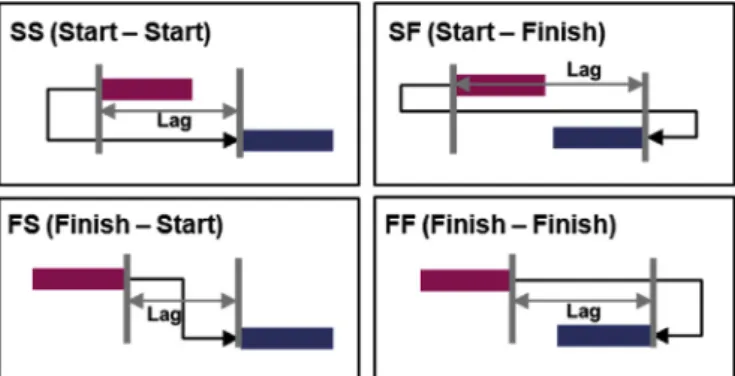
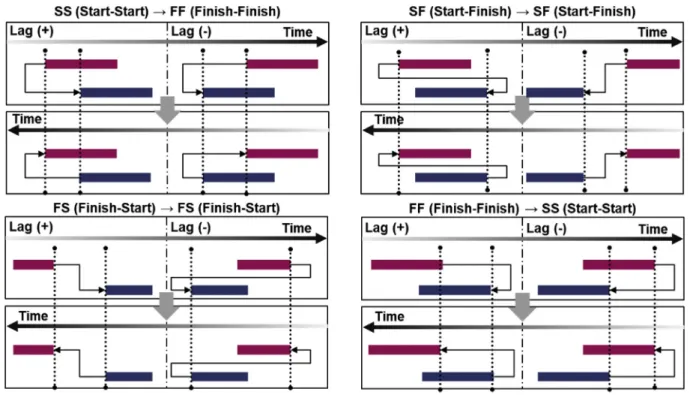
A production activity network shows the relationships between a production activity and other activities. Among the production activities are predecessor activities and successor activities, and there is a relationship between each of the predecessor activities regarding their date intervals. These relationships are shown as relation information. The relation information includes the prede-cessor/successor production activity, the relation type, and the lag information. A mid-term production plan depicts relationships using four relation types: Start-to Start (SS), Start-to-Finish (SF), Finish-to-Start (FS), and Finish-to-Finish (FF). Descriptions of each relation type are shown inFig. 5. Considering the actual relation-ships between production activities, the type that best depicts the actual process from among the four relation types is used to set the relation information.
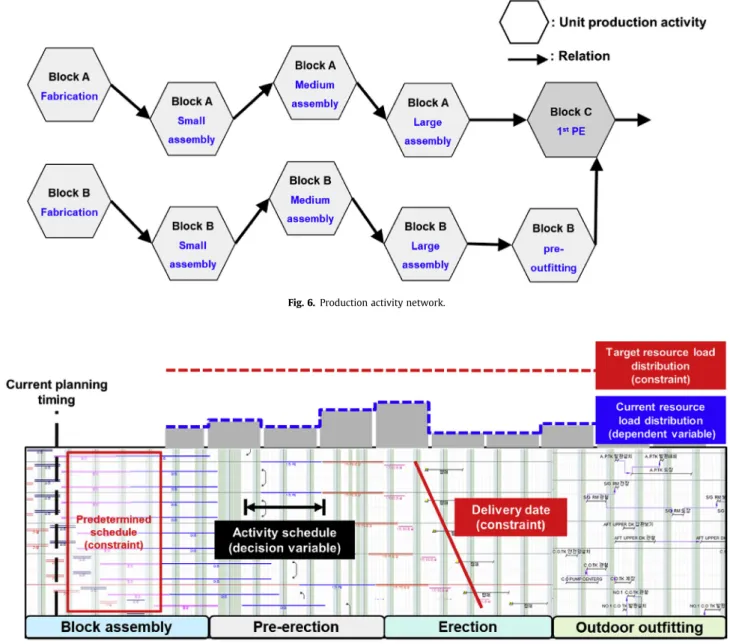
Fig. 6 shows an example of a production activity network composed of production activities and relations. The example in Fig. 6shows an activity network for the processes of assembling blocks A and B and creating block C, which is a PE block. In order for block A to be assembled into block C, it must go through fabrication, small assembly, medium assembly, and large assembly processes. Block B must go through fabrication, small assembly, medium as-sembly, large asas-sembly, and pre-outfitting processes. An activity network can be used to depict the multiple production activities that correspond to each product, and this depiction is possible even when the product (which is the target of the activities) is changed. When a mid-term production plan is established, most of the formation in this type of production activity network is input in-formation determined at the design stage. The mid-term production plan maintains limits on the network's relations and
determines the production activities' schedule information. A mid-term shipbuilding production plan at an actual work site consists of a variety of specific processes such as the assembly schedule plan, PE schedule plan, erection schedule plan, and
outdoor outfitting plan. At the work site, the specific processes are divided up and completed separately, but because they all share relationships, they can be depicted through the same production activity network.Fig. 7shows a mid-term shipbuilding production plan establishment problem and a production activity network. To establish a plan using a production activity network, the mid-term production plan constraint conditions, decision-making variables, and dependent variables are analyzed.
Plan constraint conditions are conditions or variables that limit the range in which the decision-making variables and dependent variables can be changed. Typical mid-term production plan constraint conditions include the predetermined schedule, maximum production resource capacity, and delivery dates for each block. The predetermined schedule occurs before the period that is the target of the plan or a schedule alreadyfixed in a high-level stage, and does not change while the mid-term plan is be-ing executed. Regardbe-ing delivery dates, the mid-term production plan processes are executed on the blocks or zones; therefore, in-dividual delivery dates are set for each block or zone. In the case of blocks, the delivery dates of low-level blocks are set according to the erection dates so that the erection dates can be met.
The delivery dates of the blocks that are determined this way also act as unchanging plan constraint conditions in the pre-liminary mid-term production planning stage. In the plan for outfitting after erection is completed, the schedule of postliminary key events (such as sea trials) is the delivery date of each post-liminary task. The maximum capacity of the production resources is the maximum capability of the shipyard to perform tasks ac-cording to the task type. When a particular activity network is determined, if the required capacity of the tasks for each data item exceeds the shipyard's maximum capacity, that activity network cannot be executed. Therefore, if an activity network exceeds the shipyard's maximum capacity, the schedule must be changed or the task load must be dispersed through outsourcing.
Decision-making variables are variables determined by the planner when establishing the production plan, and they are the mid-term production plan's output. In a production activity network, each production activity's start and end date, and the production resources allocated to the activity, are decision-making variables. The goal of a mid-term production plan is to determine the production activity schedule and resource allocation most suitable to the purpose of the plan while satisfying the plan's
Table 1
Execution tasks for each process in mid-term shipyard production planning.
Specific Process Main Execution Tasks Decision-Making Variables Constraint Conditions Erection Schedule Plan - Erection order determination
- Erection production activity schedule plan establishment
- Erection order - Erection date
- Production resource allocation
- Erection order constraint - PE process information - Erection process information - Production resource constraint - Key event schedule
PE
Schedule Plan
- PE start date determination - PE order determination
- PE production activity schedule plan establishment
- PE start date - PE order
- PE production activity start date
- Production resource allocation
- Erection date - PE block information - PE process information - Production resource constraint - PE block shop arrangement constraint PE
Arrangement Plan
Establishment of plan for PE block arrangement in PE workspace Block Schedule Plan - Block cutting drawing release date determination
- Block production activity schedule plan establishment
- Cutting start date
- Block production activity start date
- Production resource allocation
- PE start date - PE order
- Assembly block information - Block process information - Production resource constraint - Assembly block plate arrangement
constraint Block Arrangement
Plan
Establishment of plan for block arrangement in workspace
Postliminary Schedule Plan
Establishment of postliminary production activity schedule plan for each area
- Area production activity start date
- Production resource allocation
- Postliminary key event schedule - Production resource constraint
Fig. 4. Production activity information structure example (mid-term production planning activity).
constraint conditions. Dependent variables are calculated accord-ing to the decision-makaccord-ing variables.
The main dependent variables considered when establishing a mid-term production plan are the production resource load dis-tribution and the overall activity network'sfirst start date and last end date according to the production activity schedule. The pro-duction resource load distribution is the sum of the daily load of each task as determined according to each production activity, and it includes the work site area occupied, the number of workers that are deployed, and the number of times that cranes are used. Generally, when a mid-term shipyard production plan is estab-lished, an important goal is to establish a plan that can balance the production resource load distribution. As such, the task of creating a mid-term shipyard production plan involves determining the production activity schedule so that production resource load dis-tribution values are uniform and the shipyard's maximum capacity is not exceeded.
3. Mid-term shipyard production plan establishment process design using backward simulation and process-centric simulation
3.1. Process-centric simulation modeling methodology for using mid-term shipbuilding process plans
In the existing mid-term shipbuilding production plan estab-lishment process, the decision-making variables, which are the targets of the plan, are the start and end dates of each production activity. However, in the mid-term production planning stage, the number of production activities included in the production activity network can be several thousand. Because of this, the decision-making variables are numerous. After the many decision-decision-making variables arefixed, dependent variables and constraint conditions are considered.
Therefore, it is difficult to discover problems in a plan when they
Fig. 6. Production activity network.
occur while the plan is being established, and it is also difficult to trace which production activity caused a problem. Particularly in small-to-medium shipyards, there are many cases where the shipyard's legacy system, which establishes production plans, is inadequate and the planner must manually establish the plan and check the constraint conditions. Therefore, in the mid-term pro-duction planning stage, if there are many decision-making vari-ables and a problem occurs, the speed and accuracy with which the plan is established are decreased because it is difficult to find the causes of problems and the planner must work manually owing to deficiencies in the planning system.
To overcome these problems, this paper uses simulations in the production plan establishment process. The production plan simulation executes the production plan in a virtual environment beforehand to preemptively understand the risks and variability that occur during production. The simulation can be performed using information such as the production activity network's pre-decessor/successor activities and delivery dates. If delays or prob-lems occur during the simulation, they can be easily traced. Logic can be added to create alternatives when delays occur by consid-ering the production resources so that revised plan alternatives can be created easily.
In different industries based on mass production, simulations are performed by focusing on the facilities for production. The productflow between production facilities is determined by lines and conveyors, and the products or tasks that the facilities produce are assigned in order to perform the simulation. This type of facility-centric simulation is a method that is suitable for mass production in which the process performed for each product or facility is the same. However, the shipbuilding industry is a contract-oriented industry, and shipbuilding production processes involve different designs and processes for each ship.
As such, it is inefficient to apply facility-centric simulation methods without modification. Therefore, to create a simulation model that is more suitable to shipyards, a process-centric simu-lation methodology that performs simusimu-lations focused on pro-cesses rather than facilities has been proposed [12]. Accordingly, mid-term production planning simulations as process-centric simulations are performed in this study. To analyze information related to process-centric simulations, our study uses a six-factor information model that classifies the shipbuilding production in-formation, as presented in Jeong et al. into the following: product, process, schedule, space, facilities, and labor factors (Jeong et al., 2016).
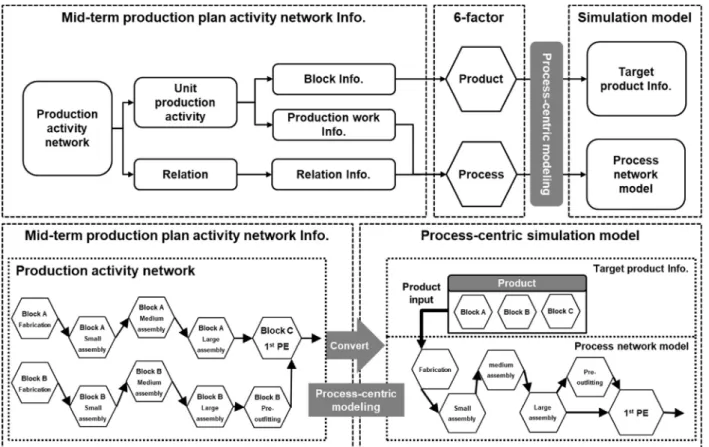
Existing mid-term shipbuilding production plans are created via production activity networks. When a production activity network is analyzed by the six-factor information standard, it consists of information on the product, which is the target of the work, and the processes that are created. To perform a process-centric simulation, a process network model consisting of only process information must be created. As such, the product information must be separated.
Fig. 8shows a production activity network being converted into a process-centric simulation model. In a production activity network having information on production activities and re-lationships for different products, the information on the products and the information on the relationships between processes is separated into product and process network models, and a process-centric simulation model is created. After the products and pro-cesses are separated and a process-centric simulation model is created, the products are allocated according to the process network, and the simulation is performed. Once the products are allocated to the processes, the production activities are created again. The start/end dates for these production activities are determined, and the mid-term production plan can be established.
3.2. Defining the problem of a mid-term production planning simulation using backward simulation
When the assembly block and the PE block are assembled, it is important to meet thefinal erection block's delivery date. There-fore, the plan is established in the order of the erection, PE, and assembly blocks in order to meet thefinal erection block's delivery date. However, when performing production through actual tasks, tasks for low-level blocks are performedfirst, the low-level blocks are assembled, and the tasks for the high-level blocks are per-formed. Therefore, the order of the actual production tasks is the opposite of the order of the planning. Preliminary mid-term pro-duction planning is performed in the backward direction of the flow of the actual tasks and time. In a normal-direction simulation, theflow of the actual tasks and the flow of the simulation activities performed in the simulation model are the same.
Therefore, when a simulation is used for a mid-term production plan, it is difficult to efficiently use a normal-direction simulation because the process of establishing the plan and the direction in which the simulation progresses are different. Furthermore, to perform a normal-direction simulation for a mid-term shipbuilding production plan, it is necessary to determine the process network, product information, and initial production activity start day of the lowest-level blocks. However, there are many low-level blocks, and there are many variables that must be determined in order to perform the simulation. It is also difficult to trace how the plan must be revised if the simulation indicates that the delivery date is delayed.
A backward simulation is used to calculate backwards from the final state of the target simulation model to the model's previous state leading toward the final state. If a backward simulation is applied to a mid-term shipbuilding production plan, the number of decision-making variables is reduced, and it is easier to create al-ternatives for making changes if a problem occurs in the plan. Table 2 lists the decision-making variables, dependent variables, and plan constraint conditions when an actual production plan, normal-direction simulation, and backward simulation are used. In an actual mid-term production plan task, the start/end dates for all mid-term production activities are decision-making variables.
Thefirst start date and final end dates for the determined ac-tivity schedule and the load distribution are calculated, and the delivery dates, predetermined schedule, and target load distribu-tion, which are constraint conditions, are confirmed. If a problem occurs with the constraint conditions at this time, there is a very large number of production activities, which are decision-making variables, and the constraint conditions are compared after the entire schedule is determined. Therefore, it is difficult to find an alternative when a problem occurs. If a normal-direction simula-tion is used, the decision-making variables can be changed in the lowest-level blocks' production start dates, and the number of decision-making variables can be reduced.
However, the highest-level block's delivery date, which is the most important constraint condition, is included in the dependent variables that are calculated in the simulation result. Therefore, if a problem occurs in the highest-level block's delivery date, it is difficult to create a revised plan. If a backward simulation is used, the delivery date for the highest-level block becomes a decision-making variable. Because of this, the number of decision-decision-making variables can be further reduced. The block delivery date decision-making variable is a major constraint condition of an actual task.
Therefore, if a problem occurs in the plan, it is easy tofind a revised solution. In an actual mid-term production plan, the goal is to create a plan quickly that is suitable to meet the delivery dates and the target load distribution determined by the contract with
the ship owner or by management decisions. Therefore, when a backward simulation is used, it is easy to create a plan quickly that fits with the actual mid-term production plan's goals and the plan processes.
To perform a backward simulation, a model for the backward simulation is necessary. If there is a normal-direction simulation model that models the same actual problem, part of the normal-direction simulation can be converted to create a backward simu-lation model. Previously it was confirmed that the production in-formation and a process network model are needed to perform a process-centric simulation. Therefore, if the production informa-tion and the process network model are converted in order to be suitable for a backward simulation model, a process-centric back-ward simulation model can be created.
In the case of the process network model, the predecessor/ successor processes' relations must be changed to be suitable for
the backward simulation. Because the simulation's time flows backward, the existing predecessor processes become successor processes, and the successor processes become predecessor pro-cesses.Fig. 9shows the backward conversions for the four relation types. The SS relation is converted to FF, and the FF relation is converted to SS. The FS and SF relations are kept as they are.
In all cases, the lag value between relations is kept the same. Regarding production information, assembly is performed from the low-level products to the high-level products in a normal-direction simulation. Therefore, the low-level products are inserted first. However, in a backward simulation, the high-level products are broken down into low-level products. Therefore, the high-level products are inserted first in the simulation, and the low-level products are inserted to fit the buffer values, which were changed by the backward relation changes.
Fig. 8. Conversion from production activity network to process network model.
Table 2
Variables and constraints of simulation applied mid-term production plan tasks.
Work Site Production Plan Tasks Using a Normal-Direction Simulation Using a Backward Simulation Decision-making
Variables
- Unit production activity schedule information
- Lowest-level block start date - Target load distribution
- Highest-level block delivery date - Target load distribution Dependent Variables - Network'sfirst start date and last end date
- Plan load distribution
- Unit production activity schedule information
- Highest-level block delivery date - Plan load distribution
- Unit production activity schedule information
- First start date of each block - Plan load distribution Plan Constraint
Conditions
- Delivery date - predetermined schedule - Target load distribution
- Production activity network relation
- Production activity network relation - Predetermined schedule
- Production activity network relation - Predetermined schedule
4. Development of a system for mid-term shipyard production plan establishment using backward simulation 4.1. Composition of a system for backward simulation production plans using shipyard production planning system
Because the shipbuilding production work is performed in the production form of job shops, different tasks are started and finished in a discrete manner, unlike the mass production form, where the production tasks are carried out continuously through conveyors. As such, when the commencement and completion of different tasks occur discretely and affect the states of targets performing the simulation, a simulation result that properly re-flects the characteristics of the simulation target can be obtained by conducting the simulation based on a Discrete Event Simulation (DES). Therefore, the process-centric and backward simulations proposed in this paper for the shipyard production plan were per-formed based on the DES.
The DES defines an event as a task that can change the state of a system that becomes a target of the simulation. Furthermore, cal-culations are performed for only the time point where the event occurs rather than the entire time period that becomes the target of the simulation. In addition, the simulation is performed with a method of updating the state of the system that has been changed by the event. As such, because it is very important to check whether an event that changes the state of the system occurs in the DES, events that will occur in the future are managed through the Future Event List (FEL), and the simulation is performed based on the FEL. At the time point of starting the simulation, the FEL for the entire time period of the simulation is generated based on the initial state of the system, and based on this, the simulation begins. If a delay or an event that could not be predicted in the initial stage occurs for an event of the initial FEL during the simulation, the FEL is updated, and the simulation is performed based on the changed FEL. When every event has been carried out and no more events remain in the FEL, the simulation is terminated.
As discussed in Section3, if a backward simulation is applied to the production plan of shipbuilding, the finishing date of the highest-level block erection becomes a decision-making variable, and the finishing date of the highest-level block erection is the same as thefinishing date of the final activity. Therefore, the start andfinish dates of previous activities can be calculated backward based on thefinal activity's finishing date and relationships with the other activities. The process of performing a backward simu-lation for the shipbuilding plan through the DES method is sum-marized as follows:
1. The starting date is set up to commence the backward simula-tion. (The latestfinishing date of the block erection is set as the starting date of the backward simulation.)
2. Based on thefinishing date of each highest-level block erection, thefinishing date of the final activity of each block erection is set (the starting date of the backward simulation).
3. When the backward simulation begins, a simulation starting event of thefinal activity determined in step 2 is generated and added to the FEL, thereby generating the initial FEL.
4. Based on the events contained in the initially generated FEL, the backward simulation is performed. Whether to start or delay the event is determined according to the state of the current system. When the current task is delayed or there exists a different ac-tivity that has a relationship with the current acac-tivity, a new event is generated. Hence, the FEL is updated using the new event.
5. Based on the updated FEL, the simulation is continued, and if no more activity exists in the FEL, the simulation is terminated and the simulation result is outputted.
As such, the backward DES can be performed for the mid-term shipbuilding production planning by updating the events of the simulation based on the relationships between the activities and thefinishing date of the top-level block erection that was initially set up with the decision-making variable. The production resources
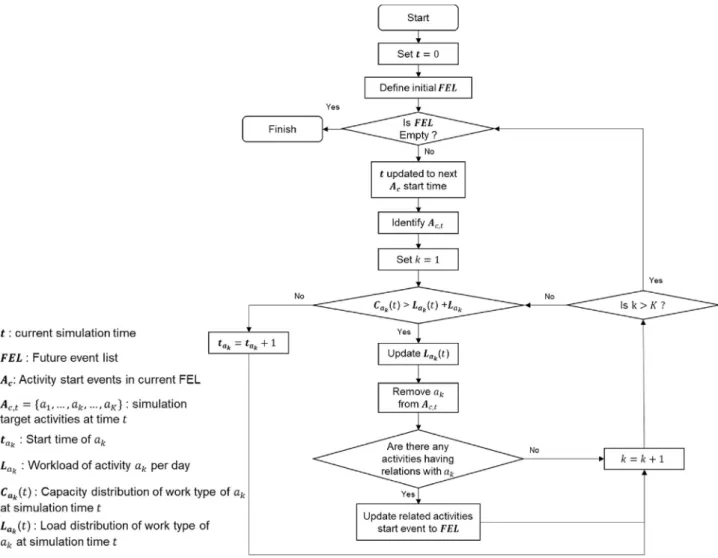
and amount of workload are compared and determined for the current simulation time point in order to determine the start or delay of the simulation regarding the starting event of a certain activity in step 4 above. Fig. 10 below shows a flowchart for determining the start or delay through the work capacity and workload with respect to the DES-based backward simulation of step 5 and the starting events of activities in the FEL in step 4.
CakðtÞ, which is used when determining whether an activity can
be started, shows the distribution of production resources by job type inputted from the results of long-term production planning. When the simulation starts, the simulation time is initialized to 0, and the simulation is performed. Based on thefinishing date of the finishing activities of the final block erection, the initial FEL is generated prior to the commencement of the simulation. Among the events of the initial FEL, the fastest starting time is used to update t, and the activities that have to start at time t are identified. For the activities that have to start at time t, the current workload and the production resources corresponding to the work type of each activity are compared.
If there is room in the production resources, the current starting event is performed, the workload is updated, and the event that started from the FEL is removed. If there is a previous activity that has a relationship with the activity that has started, the starting event is updated in the FEL according to the relationship. When there are not enough production resources for the current starting event, the starting date of the starting event is increased by 1 and
the production resource and workloads are compared again for the next starting event. Once the starting condition is confirmed for all starting events corresponding to time t, the simulation time is updated using time t, at which the next event of the FEL exists. Then, the simulation is performed repeatedly according to the aboveflow. When no more events exist in the FEL, the simulation is terminated, and the simulation results are checked.
This paper developed a system that establishes a mid-term production plan by using process-centric, backward, and DES simulations. However, because a shipbuilding production plan is established by dividing it into long-term, mid-term, and short-term plans, the results of the upper-level planning should be taken into consideration in order to establish a lower-level plan. For effective planning, therefore, it is more appropriate to develop the system for mid-term production planning to interoperate with the existing shipbuilding production planning system rather than developing it independently. Therefore, the mid-term production planning sys-tem developed based on the process-centric and backward simu-lations in this paper was designed and developed to be mounted and operated on the existing shipbuilding production plans.Nam (2018)analyzed the process of shipbuilding production planning and developed an Advanced Planning System (APS) that can establish a long-term production plan. The backward-simulation-based mid-term production planning system developed in this paper has functions that can generate a mid-term production plan based on the long-term plan information of the long-term planning
system developed byNam (2018). From the long-term production planning system, major key event date information and work ca-pacity information (manpower, space, and major equipment) by job type are incorporated.
The system in this paper was developed to establish a mid-term production plan for the block manufacturing process that manu-factures PE blocks and assembly blocks prior to the erection pro-cess. The program developed for interoperation with the existing APS consists of three modules, as shown inFig. 11. Thefirst module is a modeling module that generates a process-centric or backward simulation model using the existing APS's blocks and activity data. Using the data of the existing APS DB, in which the plan was established based on the starting andfinishing dates of activities, this module generates a production process network according to the prior and posterior relationships of the production process and the types of blocks that become the targets of tasks.
Once the production process network model is generated, a backward simulation model is generated by changing the tionship between each production process from the forward rela-tionship to the backward relarela-tionship. The second module sets the production resource target. When performing the backward simulation, the production resource distribution is a major decision-making variable along with the date of thefinal block erection. In the case of thefinal block erection date, because there is a restriction on changes owing to the erection network, an actual planning person performs the simulation by changing the distri-bution or allocation of the production resource.
Therefore, the production resource target-setting module is most frequently used by a user who actually establishes the plan. This module can select types of production resources that will be mainly considered when establishing a mid-term production plan, and set up the distribution of resource constraints. The area of the workshop, the number of blocks being worked on, and the manpower by job type can be set up as production resource targets in the block assembly stage of the mid-term production plan. The manpower by job type can be obtained through the information on the manpower plan established in the long-term production planning stage, and changes in manpower can be set up according to the period for the cases of injecting additional and less
manpower during a certain period.
Last, a DES engine performs the DES. The DES engine is a module that performs the DES based on the date of thefinal block erection and the distribution of production resources when these two var-iables are determined. The initial FEL is generated based on the erection date. The starting date of an event is finalized by comparing the production resources and the workload for the event of the FEL, and when a delay occurs, the change in the FEL is updated according to the delay.
Furthermore, considering the relationship between the changed activities and the backward relationships, the modeling module updates the starting events of different activities that have re-lationships when the starting date of a certain event isfinalized. As such, the DES engine is a module that performs the DES by generating and updating the FEL based on the simulation model as changed in the modeling module and the production resource distribution inputted from the resource target handling module.
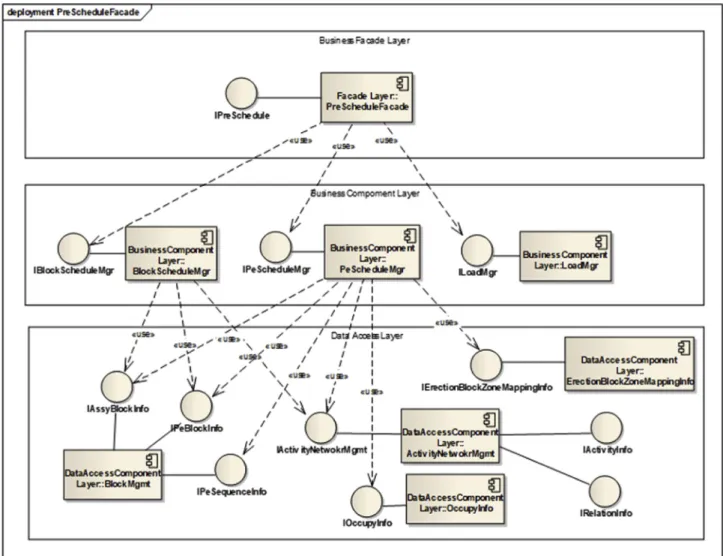
The left side ofFig. 11shows the structure of an existing APS that is interlinked with the backward simulation program developed in this paper. The existing APS consists of a function server and a client: the server processes the major planning data and DB access, and the client is installed on the PC of an actual planning person to let him/her see the results. The backward simulation system developed in this paper belongs to the mid-term planning stage of the client installed on the user's PC, and it is interlinked by using the same function components and data structure as those of existing APS client servers.Fig. 12below shows a component dia-gram for the function components used in the existing APS server. The developed backward simulation program can use the mid-term function components of the existing APS through Pre-ScheduleFacade. Moreover, it can call the IBlockScheduleMgr and IPeScheduleMgr interfaces and components to execute requests for the activity, relation, and block structure with regard to the pro-duction process before erection.
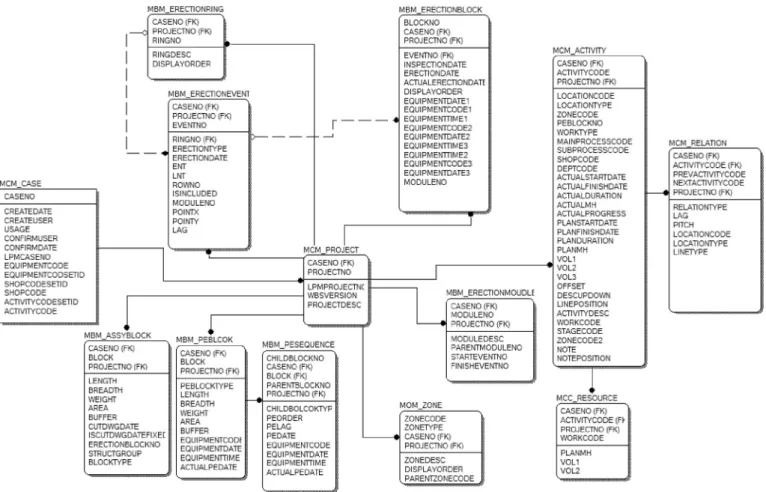
In the mid-term planning stage of the existing APS, history management is performed for the changed plan based on a unit called a case. Various plans for several ships (project) can be established in one case, and in each project, tables that show the erection blocks, PE blocks, and assembly blocks are linked. The
erection event information for an erection is managed in terms of the project. The sequence table that shows the sequence of blocks assembled has link relations with respective erection blocks and PE block tables.
Activities are managed in terms of projects, and because a relation is generated based on each prior and posterior activity, there is a link relation with the activity table. For the main results of the backward simulation module, the start date andfinish date of each activity are determined. Therefore, the start andfinish date information of each activity determined through the backward simulation is saved in the PLANSATRTDATE and PLANFINISHDATE columns of the MCM_ACTIVITY table. Therefore, no separate data feedback exists for the simulation results between the backward simulation system and the existing APS. Furthermore, the APS can also access the simulation results and use this information.Fig. 13 shows the details of a data model used in the existing APS and backward simulation model.
4.2. Application and results of mid-term production planning simulation using shipyard data
To verify the mid-term production plan establishment system that uses the backward simulation proposed in this paper, the mid-term production plan data of shipyard A, which is a midsized Korean shipyard employing approximately 3500 workers, were
analyzed, and a revised plan was created via simulation. The veri-fication result was a mid-term production plan corresponding to tasks related to the block assembly of four ships. This is a draft of planning data for a period of approximately 1 year.
The data include information on 108 erection blocks, 168 PE blocks, and 540 assembly blocks, as well as 5754 production ac-tivities of 19 different types. There were 19 types of overall activ-ities, but there were 6 work types when considering the manpower load: fabrication, small assembly, mid-large assembly, PE, pre-outfitting, and pre-painting. For example, the outfitting activity has several types of activities such as medium assembly outfitting, shop PE outfitting, and first PE outfitting. However, when the load was considered, all of the above outfitting tasks were considered together as the production load of a single work type because they are all performed by the pre-outfitting team. Therefore, even when the simulation was performed via the backward simulation system, the work was divided into the six work types, and the manpower for each type was considered.Table 3lists the data values used to verify the backward simulation production planning system.
To check the load distribution characteristics and minimum task completion period for the existing shipyard mid-term production plan alternatives, a backward simulation was executed under the condition of infinite production manpower as the first test case. In this case, only the predecessor and successor conditions between processes were used as the constraint conditions to establish the
plan. The results of performing a backward simulation assuming that the production manpower capacity is infinite indicated that delays did not occur owing to capacity deficiencies, and the overall work time period was calculated to be 341 days, from January 2, 2019, to December 9, 2019. Therefore, when the predecessor/suc-cessor relations between activities and the buffer values entered for the shipyard are considered, the shortest production time period is known to be 341 days, during which no delays occur.
Next, as a second test case, a simulation was performed on manpower arrangement alternatives using the shipyard's actual manpower arrangement. According to the standard ship informa-tion determined in the long-term producinforma-tion plan, the manpower needed for block assembly and the stage before PE represents 35% of the total manpower needed to produce a product carrier.
Therefore, the total number of workers who work on assembly and the tasks before PE was assumed to be of the same ratio, so the total number of workers who worked on the six work types was assumed to be 1235.
The number of workers assigned to each work type was deter-mined by the number of hours needed for each work type using the standard ship information entered in the long-term production planning stage. From this, 95 workers were assigned to fabrication, 200 to small assembly, 540 to mid-large assembly, 200 to PE, 100 to pre-painting, and 100 to pre-outfitting. It was assumed that there were no changes to the number of workers assigned to the overall plan's time period. The results of executing a backward simulation on this manpower arrangement showed that an extra 16 days were required to complete the block assembly for the same ship, making
Fig. 13. Data model for mid-term planning of existing APS.
Table 3
Example mid-term plan data of mid-sized shipyard.
Target data Quantity Remarks
Planning Period Mid-term plan for midsized shipyard 1 year
Ships Product carrier 4
Block PE block 168
Assembly block 540
Activities PE block activities 519
Assembly block activities 5235 19 categories of activities Work type Work type for considering manpower load 6 - Fabrication
- Small assembly - Mid-large assembly - Pre-erection (PE) - Pre-painting - Pre-outfitting
the total work time equal to 357 days.
Delays occurred in three work types: small assembly, pre-outfitting, and pre-painting. Totals of 2399 activity delays, 181 ac-tivity delays, and 1782 acac-tivity delays occurred in these work types, respectively. Evaluating the number of delays and the work types, it can be seen that many delays occurred in the small assembly and pre-painting work types. To improve on this, the third test case involved a simulation where the manpower for the major work types was changed so that manpower from work types where there was spare production manpower was distributed to work types that had insufficient manpower and were experiencing delays.
In the third test case, it was assumed that there were changes in the manpower arrangement during the plan period. A total of 350 personnel were taken from the work types with spare manpower: 45 from fabrication, 170 from large assembly, and 130 from PE. The personnel were distributed to other work types. The personnel arrangement for small assembly was increased to 300 people, pre-painting to 200 people, and pre-outfitting to 250 people. The re-sults of performing a backward production plan simulation on the third test case and creating a production plan alternative showed that the overall work time period was 346 days, which reduced delays by 9 days compared to the previous shipyard manpower arrangement alternative.
Totals of 7 activity delays occurred in the small-assembly work type, and 642 delays occurred in the large-assembly work type. From the graph inFig. 14, which shows the distribution of the large-assembly and small-large-assembly loads by time in the third test case, it can be seen that the production manpower was insufficient from April 2019 to June 2019.
Therefore, in the fourth test case, the manpower was rearranged by work type only during the specific time period when manpower was insufficient. In the fourth test case, a simulation was performed assuming that a total of 100 personnel from the pre-outfitting and pre-painting work types, which had spare manpower resources, were used to support large assembly from April to June 2019, and 30 personnel from PE were used to support small assembly during April and May 2019. The fourth test case, which redistributed manpower during periods in which manpower was insufficient, achieved the same overall work period of 341 days as thefirst test case, which assumed infinite production manpower. In this case, 12 work delays occurred in small assembly, 15 in mid-large assembly, 3 in PE, and 3 in pre-outfitting, for a total of 33 activity delays. However, even though some delays occurred in each production activity, it is believed that these did not affect the overall work time period because partial buffer values were specified in the relations between activities.
In this chapter, a backward simulation was applied to the mid-term production plan data of an operating shipyard in order to verify the production plan, and revised alternatives were created. When problems occur in the plan owing to production resource shortages in the mid-term production plan stage, a backward simulation can be used to revise the values for production re-sources such as manpower, facilities, or space, and a simulation can be run again to easily create a revised alternative. The simulation results for infinite production manpower in the operating shipyard data were revised to reflect an actual shipyard's manpower arrangement. Ultimately, the manpower arrangement for the main work types was revised, and delays occurred in some activities, but it was possible to use the simulation to easily create an alternative plan where no delay occurred in the overall work time period. Table 4lists the descriptions and results of each simulation case. Figs. 14 and 15show graphs of the load distributions of the work types when delays occurred among the work types in Cases 2 and 3, and in Case 4, respectively.
As such, if a backward simulation is performed for the mid-term
production planning, a plan can be generated quickly according to the capacity of production resources assigned by the planning person. In the case of a backward simulation for about 5000 ac-tivities performed in this paper, the calculation time is so short that the simulation can be completed in about 1 or 2 min even on a PC with a typical hardware specification. Therefore, the most time-consuming task when performing a backward simulation and verifying the production plan is setting the data and variables to execute the simulation.
When a forward simulation is performed, because the initial starting activity date has to be set up for every block, the starting conditions have to be set up for about 540 blocks in the example of this paper. Furthermore, in the case of existing shipyard production planning, because data that can be referenced are insufficient when setting the starting dates of the assembly blocks, it is difficult for the planning person to set up all of the starting conditions, and the accuracy declines. However, when a backward simulation is per-formed, the starting conditions for only about 100 erection blocks need to be set up, and because the starting conditions of the erection blocks can be set up by referring to the erection network of the existing APS, it is convenient to set up the required data.
Considering that the majority of time required for performing the simulation is consumed in the preparation stage for the data input and the simulation, the biggest advantage of the backward simulation method is that the simulation can be performed quickly by using just simple input data. When compared with the forward simulation, because the simulation can be performed without much data modification based on the existing shipyard informa-tion, the planning person can perform the simulation quickly for diverse conditions. Like the backward simulation that could be performed quickly for four different cases in this chapter, if the backward simulation is applied to an actual shipbuilding produc-tion plan, it will be possible to perform the load verification more quickly and simply compared to the forward simulation for various production planning cases.
5. Conclusions
This study developed a system that can create and revise mid-term shipyard production plans using backward simulations to improve mid-term shipyard production planning, which typically requires manual input and repetitive work. To accomplish this, the study analyzed shipyard production planning processes and iden-tified the major operations performed in the mid-term production planning stage, as well as the decision-making variables, depen-dent variables, and constraint conditions. Mid-term production planning problems were defined through the decision-making variables, constraint conditions, and dependent variables.
How the production planning problems changed when using normal direction and backward simulations was analyzed and defined. To perform the simulations in a manner suitable to the special characteristics of shipbuilding production plans, a process-centric mid-term production planning simulation methodology was defined. The production activities and activity networks, which are the targets in a mid-term production plan, were divided into process networks and blocks, which are considered as the products, and a process-centric simulation model was created. A backward simulation was applied to this process-centric simulation model to define a simulation methodology, resulting in a method capable of creating mid-term production plans so that the highest-level block's delivery date does not change.
Based on the process-centric and backward simulation meth-odologies, this paper developed a simulation-based production planning system that can interoperate with the APS system actually used in a shipyard. The simulation-based mid-term production
planning system performs a simulation based on the DES and consists of three main modules: simulation modeling module, production resource target handling module, and DES engine. Because the developed simulation system shares its function components and data model with the existing APS of shipyards, the query and simulation results for the planning data of shipyards can be quickly reflected in the actual shipyard production plan.
To verify the developed simulation system, mid-term produc-tion planning data corresponding to about a 1-year period of shipyard A, a mid-sized shipyard in South Korea, were applied. For the mid-term production plan of a midsized shipyard where about 3500 employees work, the production plan was verified through a
backward simulation of about 5700 production activities. By changing the distribution of manpower for six major job types, the load of the existing mid-term production plan data of shipyard A was verified, and a variety of modified alternative plans was generated.
As a result of performing a backward simulation by changing the manpower distribution, the total number of workdays was reduced by 16 days (from 357 days to 341 days) when compared with the existing shipyard production plan. With regard to the delay occurrence frequency of individual activity, about 4200 activity delays occurred in the existing shipyard production plan, but when the revision and verification were performed through the backward
Fig. 14. Graphs of work type load distribution for delays occurring in Case 2 and Case 3.
Table 4
Description and simulation results of each simulation case. Case
No.
Case description Total task days Delayed work type Number of delays by work type Total number of delays Remarks 1 Infinite capacity 341 e e e e
2 Existing shipyard's manpower distribution 357 Small assembly
2399 4282 No change in manpower number during plan period
Pre-outfitting 181 Pre-painting 1782 3 Manpower adjustment by work type 346 Small
assembly
7 649 No change in manpower number during plan period
Mid-large assembly
642 4 Additional manpower adjustment by time period
within work type
341 Small assembly
12 33 Change occurs in manpower number during plan period
Mid-large assembly
15 Pre-erection 3 Pre-outfitting 3