ISSN: 2288-7709 © 2020 KODISA & ICMA. http://www.icma.or.kr
doi: http://dx.doi.org/10.20482/jemm.2020.8.3.23
Effects of Smart Factory Quality Characteristics & Innovative Activities on
Business Performance : Mediating Effect of Using Smart Factory
Ik-Jun CHO*Jin-Kwon KIM**, Tony-DongHui AHN***,Hoe-Chang YANG****
Received: September 03, 2020. Revised: September 14, 2020. Accepted: September 23, 2020.
Abstract
Purpose: The purpose of this study is to identify the strategic direction of organizations and their employees to efficiently utilize
smart factories and enhance business performance among Korean manufacturing companies. Research design, data, and
methodology: We derived a structured research model to check the mediated effect of utilization of smart factory between the
characteristics of smart factory and the innovation activities. Results: Quality characteristics of smart factory and Innovation activities were all found to have a statistically significant effect on utilization of smart factory, utilization of smart factory was found to have a statistically significant effect on the business performance. And it has been shown that the utilization of smart factory is partially mediated relative to the quality characteristics of smart factory and business performance and relative to innovation activities and business performance. Conclusions: Smart factory builders can reflect the areas that affect utilization of the smart factory in their strategies by considering the quality characteristics of the smart factory and innovation Activities. Therefore, smart factory builders can identify the quality characteristics of smart factory and reflect them in the process and analyze active utilize measures through the innovative activities of the employees of the organization, thereby influencing business performance.
Keywords: Smart Factory Quality Characteristics, Innovative Activity, Using Smart Factory, Business Performance JEL Classification Code: D24, M11, O14, O33
1.
Introduction
12The fourth industrial revolution features hyperconnectivity and superintelligence. Although intelligent information and communication technologies such as artificial intelligence, Internet of Things, cloud computers, big data, and mobile are converging across existing industries and services, innovative changes are occurring in connecting all products and services to the network in real time and digitalization. Global companies and large corporations, which are rich in capital, technology, and manpower, are leading the fourth industrial revolution, but small-and medium-sized manufacturing enterprises inferior to
* First Author Graduate school of Knowledge-Based Technology & Energy, Korea Polytechnic Univ, Siheung, Korea. Email: [email protected]
** Adjunct Professor, Department of Distribution Management, Jangan University, Hwaseong, Korea. Email: [email protected]
*** Professor, Department of Business Management, Korea Polytechnic University, Siheung, Korea. Tel: +82-31-8041-0680, Email: [email protected]
**** Corresponding Author Assistant Professor, Dept, of Distribution Management, Jangan University, Hwaseong, Korea. Tel: +82-31-299-3133, Email: [email protected]
ⓒ Copyright: The Author(s)
This is an Open Access article distributed under the terms of the Creative Commons Attribution Non-Commercial License (http://Creativecommons.org/licenses/by-nc/4.0/) which permits unrestricted noncommercial use, distribution, and reproduction in any medium, provided the original work is properly cited.
large companies are hardly competitive. Therefore, the government encourages the establishment of smart factories through a support system aiming to allocate 1.2 trillion won to innovation in smart manufacturing in 2019 and establishing 30,000 smart factories by 2022. Smart factory is to rebuild the overall production system of manufacturing enterprises, including resource, supply, product development, and production operation system. Thus, domestic small-and medium-sized manufacturing enterprises should respond systematically to the construction and utilize of new production systems through the enterprises’ capabilities. It is necessary to establish a new production system introduced by the members of the organization of the enterprise and to develop it by utilizing information (Jin & Seo, 2019). Domestic small-and medium-sized manufacturing enterprises must explore and build smart factories through the characteristics of the smart factory and innovative activities conducted by the members of the organization, but specific research is insufficient.
The purpose of this research is to identify the strategic direction of the organization and its members to efficiently utilize the smart factory among Korean manufacturing companies and enhance business performance. To this end, we used the following procedures to demonstrate effectiveness. First, we examine the impact of quality characteristics on the utilization of smart factories. Second, we examine the impact of the innovative activities of organization members on the utilization of smart factories. Third, we examine the quality characteristics of a smart factory and whether its use is mediated relative to innovation activities and business performance. Fourth, we analyze the impact of the utilization of smart factory on business performance.
This study can be meaningful as it is an attempt onthe impact of the quality characteristics of smart factory on the utilization of smart factory by small-and medium-sized manufacturing enterprises, and in that it isan integrated study of the innovation activities of organization members and the utilization of smart factory. Therefore, the company is expected to provide a clue to the strategic direction of the smart factory-building company to enhance its business performance, althoughit is limited.
2. Research Background
2.1 Quality Characteristics of Smart Factory
A smart factory refers to one where manufacturing companies fuse the entire process from planning to selling new products and combining ICT technologies to produce products with the development of information and communication technology. It is a production system where all the manufacturing value chain components achieve real-time vertical/horizontal integration, communication, and collaboration (Lasi, Fettke,Feld, & Hoffmann, 2015). Integrated automation aimed at securingvisibility within the manufacturing company is preceded by data obtained by digitizing and integrating the production process (Lim et al, 2017).
The productivity and efficiency of the value chain is improved through the analysis of information collected from system components based on integrated manufacturing process automation. Moreover, it is characterized by the pursuit of the flexibility and agility of the production system by the intelligentization of the manufacturing system. These features are made possible through combining ICT technologies such as big data, Internet of Things, AI, robots, and automation of manufacturing facilities. Theyexchange information with direct and indirect stakeholders through the product in conjunction with the equipment of the manufacturing plant. Each component that is connected to each other is formed by a structure inwhich information circulates and interacts with each other under the manufacturing process (Lim et al, 2017).The circulation structure of these processes is unformatted (Kannengiesser & Muller, 2013). The characteristics of smart factory can be found in the information system success model (ISSM). The information system success models of DeLone & McLean (2003) were evaluated in terms of information quality, system quality, and service quality, and these characteristics affected the use or intention of use and user satisfaction. Petetal & Kavan (1995said that quality of service could be an important variable in the research model of DeLone & McLean (2003). In further studies, DeLone & McLean measured the overall quality of the information system by activating e-commerce, adding service quality following system quality and information quality. System quality operates smoothly withouterrors due to system performance such as hardware and software that processes information. Information quality is an evaluation of the information finally produced by the system, which is about the value and utilize of the information provided by the information system,which means that the quality of information is high as it is used efficiently for the user’s work (Jo, 2017). Quality of service means that the information system can effectively obtain the information that users expect,and it can continue to be used by supporting users, which means that the quality of service is high (Song, 2012).
Therefore, in this study, the information system success models of DeLone & McLean (2003) were used to classify system, information, and service quality as characteristics of smart factory.
2.2. Innovation Activities
In a rapidly changing market environment due to uncertainties in the environment following the fourth industrial revolution and rapid development of IT technology, enterprises are striving to have competitive advantage and core competency for sustainable growth. Innovation activities are essential in these companies’ competitive advantages and core competencies, and the performance of the companies is also showing. Innovation determines a company’s competitiveness in a rapidly changing market environment (Dess & Picken, 2000). Schumper (1939) called innovation an economic activity in a new way and classified the types of innovation into five categories: new products, production processes, market developments, supply processes, and organizational processes. Knight (1967) said that implementing changes and new ideas is not just about change, but about implementing them is about innovation. In other words, innovation means adopting and implementing new ideas, including systems, processes, products, and services (Damanpour, 1991). Innovation activities are divided into different types by researchers. Knight (1967) was divided into structural innovation, human resource innovation, product innovation, and process innovation. The term process innovation refers to structural innovation, which means improvement on the characteristics and processes of the organization and network, human resources innovation that improves the creativity and organizational culture of the organization members, partial improvement of existing products, product innovation that develops new technologies or designs, product innovation that develops services, process improvement or facility improvement that occurs in the production process to improve production efficiency, and business performance. AmongKnight’s types of innovation, Draft (1978) divided organizational and human resource innovation into management innovation, and product innovation and process innovation into innovation. Based on prior research, this study aims to utilize the innovation activities by dividing them into management innovation and technological innovation by Draft (1978).
2.3. Utilization of Smart Factory
The utilization of smart factory has various factors such as integration of value chain, improvement of production system, automation of factory, utilize of big data information, manufacturing innovation, maximization of production efficiency, reorganization of IT infrastructure, and intelligentization (Jo, 2017; Kwon & Lee, 2016; Lim, 2016; Park, 2016; Prinz et al, 2016; Shin et al, 2017; Szejka & Junior, 2017). Among these smart factory utilize factors, automation area (facility automation), and manufacturing big data technology utilize area (improvement of production process, rebuilding of production process) was established. Facility automation refers to the intelligent and autonomous production of products by inputting necessary information in using facilities for product production, and the realization of advance prediction and prevention of facility and failure (Oh et al, 2019). Process improvement of production refers to the progressively improving process by grasping the status of production process, effectiveness of work method, and lead time of current product production in real time (Kim et al, 2016). Productivity building collects and analyzes big data obtained at the production site to optimize productivity and quality performance. It refers to drastically or gradually improving the production process by reducing product production lead time by using manufacturing big data technology to build new product development processes and controlling the movement of raw materials, rework and products to improve productivity and work performance (Oh et al, 2019; Park, 2015). Firms looking to build smart factory for productivity improvement and business performance tend to seek facility automation (Balasingham, 2016; Butner, 2010; Shin et al, 2017; Wu et al, 2016). Productivity improvement and business performance in the production and supply chain can be achieved by realizing facility efficiency, production management, defect rate management, quality control, and performance processing automation according to work instructions (Lim et al, 2017; Shin et al, 2017; Waibel et al., 2017; Wu et al., 2016). In addition, the information obtained is used by the members of the organization to improve the production process (Hopkins et al., 2011).
2.4 Business Performance
We define business performance as the achievement of a corporate organization’s goals, ability of enterprise to acquire resources, ability to change the environment, organizational capacity, productivity of enterprise, profitability, and so on. (Kwak et al, 2011). Kaplan & Norton (1992) presented a balanced performance statement that complemented the limitations of past financial performance-oriented performance indicators and emphasized the organic relationship between performance
measurement indicators. To measure corporate performance, considering the performance of members of the organization, customer satisfaction, and financial performance is necessary. This is probably because the entity’s performance may vary depending on the assessment item. The market environment that an entity is dynamic, so measuring performance only in the financial statements in terms of management of planning and control is not enough. Performance measures are necessary to assess the effective business processes within the organization and effective management activities to achieve strategic goals and will be able to measure financial and non-financial performance appropriately (Kim & Ahn, 2017). Therefore, in this study, business performance is an entity’s activity that represents short-and mid-to long-term performance.
3. Research Design
3.1. Research model & Hypothesis
In this study, we check whether the quality characteristics of smart factory and the innovation activities ofthe members of the organization affect the use of smart factory and its business performance to quickly adapt to changes and achieve sustainable growth in the rapidly changing global business environment. We also check whether utilize of a smart factory has a mediated effect between smart factory quality characteristics and business performance and innovation activities and business performance. Therefore, the company wanted to find ways to secure competitive advantage for small-and medium-sized manufacturing companies in Korea,strengthen their capabilities, utilize smart factories for companies that build smart factories, and find a link to business performance.
Note) Mediation effect hypothesis (H3 ~ H4) was not presented. Figure 1 presents a research model including sub-substances.
Hypothesis 1. Quality characteristics of smart factory will have positive effects (+) on utilizing of smart factory.
Christensen (2016) classifies this type of innovation as sustainable and disruptive. Persistent innovation is an innovation that is a key part of a product’s performance that is lower than that of high-end products but cheaper and simpler to meet customer needs in low-priced markets. Destructive innovation is an innovation that improves performance and design with technological improvements over existing products and meets customers’ needs to purchase even at a high price with features attached, thereby expecting high margins (Christensen et al, 2016). Smart factory is close to sustainable innovation because its purpose is to improve productivity, efficiency, and quality. This is because smart factory is designed to improve cost structure, quality, production efficiency, and customer satisfaction by automating facilities, improving processes, and rebuilding production (Christensen et al, 2016). This can be determined that innovation activities affect smart factories. Therefore, the following assumptions were established based on prior research.
The purpose of the smart factory building enterprise is in improving the facility automation and production process by analyzing production system and information obtained. The introduction of smart factories helps improves business performance by increasing a company’s productivity and flexibility (Balasingham, 2016; Butner, 2010; Wu et al, 2016). Through the utilization of this technology, the company can integrate the company’s value chain, improve its production system, achieve factory automation, and increase productivity. This is because facility automation improves productivity by monitoring based on data obtained from manufacturing processes and rebuilding the production processes for companies (Hopkins et al, 2011. Wang et al, 2016; Wang, 2018). Productivity improvements are made through the internal capabilities of the enterprise, which should make it easy and informative to utilize the systems, information, and services of the smart factory. Therefore, the following assumptions were established based on prior research.
Hypothesis 3. The utilization of smart factory will be mediated relative to quality characteristics of smart factory and business
performance.
Firms must use their resources to establish strategies for competitive advantage in dynamic business environments (Nieves & Haller, 2014). Rosenbusch, Brinkmann, & Bausch (2011) said that implementing innovation through an innovation strategy tailored to an entity’s characteristics affects its performance. Lee, Lee, & Pennings (2001) stated that internal factors such as entrepreneurship, technical competency, and financial resources have greater impact on business performance than external factors such as partners through collaboration and especially technology capabilities. Baden-Fuller & Haepler (2013) said that the platform and innovation of the entity’s choice of processes changes the entity’s performance. Park Jin-je, Kim Tae-seok, & Song (2012) stated that the capabilities possessed by a company are expressed as the ability to innovate in accordance with the production and development of products and affects business performance. Smart factories can be said to change business performance depending on the company’s capabilities through facility automation, process improvement, and production building. Therefore, the following assumptions were established based on prior research.
Hypothesis 4. Smart factory will be mediated relative to innovative activities and business performance.
Smart factory bring increased flexibility and productivity. Moreover, they enable automatic handling of all tasks performed by human resources related to the production process, such as automatic control according to the production process, identification of the causes and nonconformities of production facilities, discovery of defects in products, identification of causes, and quality inspection. According to Mario, Tobias & Boris(2016), these features “allow us to mass-produce certain quality products in a short period of time while improving the flexibility and productivity of production." Seo(2018) said that the utilize of smart factories should involve the development of technologies and IT convergence of production processes, network-based collaboration and integration, integrated management control of production systems, and innovation in manufacturing production. A data collection system that enables information collaboration of production processes and applicable production facilities by level is also necessary. Prior research states that the following assumptions were established: (1) core information and technology are required by the high value-added existing facilities and (2) upgrading of processes and production systems could act as a competitive force for enterprises and help achieve business performance in addition to improvement of productivity.
Hypothesis 5. The utilization of smart factory will have a positive effect (+) on business performance.
3.2. Data Collection
The survey of domestic small- and medium-sized manufacturing enterprises was conducted from December 2019 to March 2020. A total of 300 copies of the questionnaire were distributed by e-mail, face-to-face, telephone, and 268 copies of the retrieved questionnaire were used in the analysis, excluding invalid responses.
3.3. Scale of Variable
In this study, the smart factory quality characteristics were based on the study by DeLone & McLean (1992:1993), which consisted of four items of system operating system stability, system speed, ease of use, error-free, system quality items, accuracy of data, necessary information, suitability for purpose of use, five items of information quality of easily understandable information, and sufficient knowledge service by smart factory system providers. Based on the research by
Damanpour (1991), Kim, & Ahn (2017), the innovation activities consisted of 10 management innovation questions, 10 new product development and activities, and 9 technical improvements in a production process, including organizational restructuring and organizational form formation, education, and technical/functional support for organizational members. Based on research by Davis & Edgar (2011), smart factory utilize consists of five questions each: automation of manufacturing facilities, intelligentization, facility efficiency, and facility automation on prevention of failures, improvement of production process, efficiency of work method, improvement of process of lead-time improvement, establishment of optimal production process, and rebuilding of production of new product development process. Business performance, which represents an entity’s management indicators, was measured on a five-point scale of each of the nine questions, based on the study by Jang (2010).
4. Research Methods
4.1. Analysis Method
The collected survey data were analyzed using SPSS 24.0 and Amos 24.0 statistical programs. Frequency analysis was performed to identify the demographic characteristics and technical statistical analysis to identify the characteristics of the variables. For the convergence feasibility analysis, a positive factor analysis was performed, and reliability was confirmed by calculating the Cronback’s ɑ value to verify internal consistency. Correlational analysis between each variable was performed, and simple regression, multiple regression, and three-step mediated regression analyses were performed to verify the hypothesis.
4.2. Demographic Character Analysis
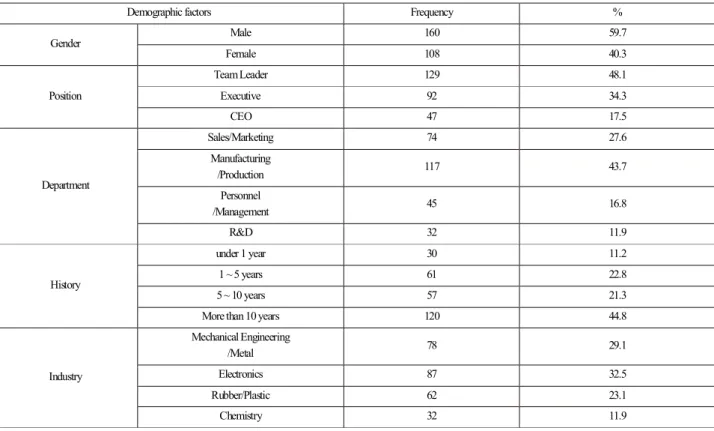
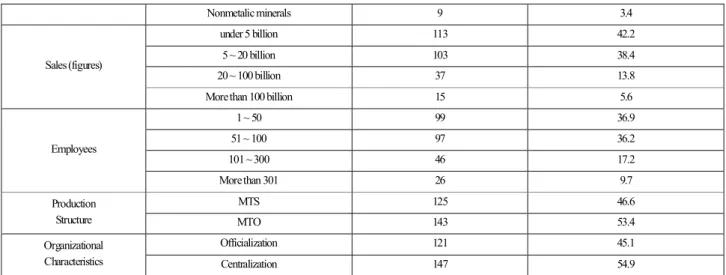
The demographic characteristics of respondents to the survey are as shown in Table 4-1.
Table 4-1: Demographic Characteristics
Demographic factors Frequency %
Gender Male 160 59.7 Female 108 40.3 Position Team Leader 129 48.1 Executive 92 34.3 CEO 47 17.5 Department Sales/Marketing 74 27.6 Manufacturing /Production 117 43.7 Personnel /Management 45 16.8 R&D 32 11.9 History under 1 year 30 11.2 1 ~ 5 years 61 22.8 5 ~ 10 years 57 21.3
More than 10 years 120 44.8
Industry Mechanical Engineering /Metal 78 29.1 Electronics 87 32.5 Rubber/Plastic 62 23.1 Chemistry 32 11.9
Nonmetalic minerals 9 3.4
Sales (figures)
under 5 billion 113 42.2
5 ~ 20 billion 103 38.4
20 ~ 100 billion 37 13.8
More than 100 billion 15 5.6
Employees 1 ~ 50 99 36.9 51 ~ 100 97 36.2 101 ~ 300 46 17.2 More than 301 26 9.7 Production Structure MTS 125 46.6 MTO 143 53.4 Organizational Characteristics Officialization 121 45.1 Centralization 147 54.9
4.3. Validity and Reliability Analysis
A confirmatory factor analysis was conducted to confirm the validity of the variables in each question, and the results of reliability analysis through the Cronbach's α coefficient for internal consistency were presented in Table 4-2.
Table 4-2: Results of Validity & Reliability
Variable Sub-Variables item Construct
Reliability AVE Chroubach’s α
Quality Characteristics of Smart Factory
System 4 0.770 0.666 0.846
Information 5 0.909 0.656 0.897
Service 4 0.883 0.534 0.879
Innovation Activities Management Innovation 10 0.985 0.700 0.934
Technological Innovation 9 0.820 0.675 0.938
Utilization of Smart Factory
FacilityAutomation 5 0.627 0.677 0.923 Process Improvement 3 0.344 0.670 0.865 Production Material Construction 5 0.046 0.792 0.904 Management Performance 9 0.128 0.792 0.933
4.4. Correlation Analysis
Correlational analysis was also performed to check the relationship and directionality of variables, the discriminant feasibility, and the possibility of causality analysis. The analysis shows that the correlation coefficient of each variable is 0.250 to 0.708, which is a positive (+) relationship; thus, the comparison between the coefficient of determination, which is the square value of the correlation, and the AVE, has a discriminant equivalence. The correlation between information quality and service quality was found to be more than 0.7, and a multicollinearity analysis was conducted. Multicollinearity analysis was conducted through multiple regression analysis with system, information, and service quality and management innovation. The tolerance values were 0.422 for system quality, 0.468 for information quality, and 0.433 for service quality. Variance inflation factor was 2.368, 2.135, and 2.308, respectively, indicating that there was no multicollinearity problem.
Table 4-3: Results of Correlation Analysis (n=268)
1. System (.666) 2. information .668** (.656) 3. Service .679** 708** (.534) 4. Management Innovation .466** .449** .468** (.700) 5. Technological Innovation .251** .316** .250** .358** (.675) 6. Facility Automation .657** .615** .694** .526** .250** (.677) 7. Process Improvement .548** .604** .604** .616** .298** .629** (.670) 8. Production Material Construction .525** .516** .516** .355** .436** .610** .465** (.792) 9. Management Performance .665** .678** .678** .493** .292** .644** .614** .693** (.792) Mean 3.31 3.42 3.35 3.31 3.78 3.14 3.28 3.55 3.50 S.D 0.92 0.87 0.89 0.96 0.93 0.97 0.88 0.89 0.84
4.5. Hypothesis Verification Result
To verify of the direct effect hypothesis, gender, position, task, history, industry, sales, and number of employees were injected as control variables, and a simple regression analysis was performed. The analysis results show that the quality characteristics of smart factory, <Hypothesis 1> are related to the utilization of a smart factory. System quality (β=.506, p<.001), information quality (β=.529, p<.001), and service quality (β=.646, p<.001) have been shown to have statistically significant positive effects on facility automation. System quality (β=.559, p<.001), information quality (β=.629, p<.001), and service quality (β=.619, p<.001) have been shown to have statistically significant positive effects on process improvement. System quality (β=.485, p<.001), information quality (β=.474, p<.001), and service quality (β=.523, p<.001) have been shown to have statistically significant positive effects on the construction of production materials. Therefore, <Hypothesis 1-1>, <Hypothesis 1-2>, <Hypothesis 1-3>, <Hypothesis 1-4>, <Hypothesis 1-5>, <Hypothesis 1-6>, <Hypothesis 1-7>, <Hypothesis 1-8>, and <Hypothesis 1-9> were all adopted. Meanwhile, the results of the multiple regression analysis conducted to determine which quality characteristics of the smart factory quality characteristics is more affected by facility automation are service quality (β=.396, p<.001), system quality (β=.297, p<.001), and information quality (β=.136, p<.001) followed by statistically significant positive effects. Process improvement involves information quality (β=.313, p<.001), service quality (β=.254, p<.001), and system quality (β=.167, p<.001) in sequence, whereas the construction of the production materials is service quality (β=.308, p<.001), system quality (β=.212, p<.001), and information quality (β=.156, p<.001) in sequence.
To verify the direct effect hypothesis of <Hypothesis 2>, gender, position, work, history, industry, sales, and number of employees were injected as control variables and a simple regression analysis was conducted. The analysis results show that the innovation activities, <Hypothesis 1> are related to the utilization of a smart factory. Management innovation (β=.513, p<.001) and Technological innovation (β=.220, p<.001) have been shown to have statistically significant positive effects on facility automation. Management innovation (β=.623, p<.001) and Technological innovation (β=.282, p<.001) have been shown to have statistically significant positive effects on process improvement.. Management innovation (β=.349, p<.001) and Technological innovation (β=.421, p<.001) have been shown to have statistically significant positive effects on the construction of production materials. Therefore, <Hypothesis 2-1>, <Hypothesis 2-2>, <Hypothesis 2-3>, <Hypothesis 2-4>, <Hypothesis 2-5>, and <Hypothesis 2-6> were all adopted. Meanwhile, the results of the multiple regression analysis
conducted to determine which quality characteristics of the smart factory quality characteristics is affected in the utilization of smart factory by facility automation is management innovation (β=.500, p<.001) and technology innovation (β=.071, p>.05) in sequence. By process improvement are management innovation (β=.585, p<.001) and technology innovation (β=.089, p>.05) in sequence. By construction of production materials is technology innovation (β=.354, p>.05) and management innovation (β=.228, p<.001) in sequence.
To verify <Hypothesis 3> and <Hypothesis 4>, a three-step mediation regression analysis presented by Baron & Kenny (1986) was conducted. On the quality characteristics of smart factory and business performance, it has been confirmed that facility automation, process improvement, and production reconstruction are all partially mediated. Therefore, <Hypothesis 3-1>, <Hypothesis 3-2>, and <Hypothesis 3-3> were all adopted. Moreover, facility automation and process improvement are partially mediated during the use of smart factories relative to innovation activities and business performance. However, the construction of production materials is a complete mediated for technological innovation. Therefore, <Hypothesis 4-1>, <Hypothesis 4-2>, and <Hypothesis 4-3> were all adopted.
Table 4-4: Facility automation between quality characteristics of smart factory, innovation activities and business
performance
Mediation
Variable Independent Variables (IV) step Result R2 F
Facility Automation System 1(β1) .657*** .518 142.431*** 2(β2) .665*** 3(β3 IV) .427*** 3(β3 MV) .364*** Information 1(β1) .615*** .542 156.939*** 2(β2) .678*** 3(β3 IV) .453*** 3(β3 MV) .385*** Service 1(β1) .694*** .531 149.948*** 2(β2) .692*** 3(β3 IV) .474*** 3(β3 MV) .315*** Management Innovation 1(β1) .526*** .447 107.221*** 2(β2) .493*** 3(β3 IV) .213*** 3(β3 MV) .532*** Technological Innovation 1(β1) .250*** .433 101.080*** 2(β2) .292*** 3(β3 IV) .140** 3(β3 MV) .609***
Table 4-5: Quality characteristics of smart factory, process improvement between innovation activities and business
performance
Mediation
Variable Independent Variables (IV) step Result R
2 F Process Improvement System 1(β1) .548*** .532 150.336*** 2(β2) .665*** 3(β3 IV) .470*** 3(β3 MV) .356*** Information 1(β1) .604*** .525 146.488*** 2(β2) .678*** 3(β3 IV) .483*** 3(β3 MV) .322*** Service 1(β1) .588*** .545 158.407*** 2(β2) .692*** 3(β3 IV) .507*** 3(β3 MV) .316*** Management Innovation 1(β1) .616*** .398 187.496*** 2(β2) .493*** 3(β3 IV) .184** 3(β3 MV) .500*** Technological Innovation 1(β1) .298*** .433 101.080*** 2(β2) .292*** 3(β3 IV) .120* 3(β3 MV) .578***
Note) *p<.05, **p<.01, ***p<.001, n.s: non-significant, R2& F-value presents resuits of three-step.
Table 4-6: construction of production materials Intermediation between quality characteristics of smart factory and
business performance
Mediation
Variable Independent Variables (IV) step Result R
2 F Construction of production materials System 1(β1) .525*** .606 203.446*** 2(β2) .665*** 3(β3 IV) .416*** 3(β3 MV) .374***
Information 1(β1) .516*** .620 215.988*** 2(β2) .678*** 3(β3 IV) .436*** 3(β3 MV) .468*** Service 1(β1) .563*** .614 210.747*** 2(β2) .692*** 3(β3 IV) .443*** 3(β3 MV) .444*** Management Innovation 1(β1) .355*** .550 161.663*** 2(β2) .493*** 3(β3 IV) .282*** 3(β3 MV) .593*** Technological Innovation 1(β1) .436*** .480 122.365*** 2(β2) .292*** 3(β3 IV) -.013 3(β3 MV) .698***
Note) *p<.05, **p<.01, ***p<.001, n.s: non-significant, R2& F-value presents resuits of three-step
As a result of the analysis for verifying the relationship between the utilization of smart factory and business performance, which is <Hypothesis 5>, facility automation (β=.644, p<.001), process improvement (β=.614, p<.001), and construction of production materials (β=.693, p<.001) have statistically significant positive effects on business performance. Therefore, <Hypothesis 5-1>, <Hypothesis 5-2>, and <Hypothesis 5-3> were all adopted. Meanwhile, the results of multiple regression analysis conducted determined which factors affect the utilization of smart factories on business performance showed a more statistically significant positive impact in the order of construction of production materials (β=.441, p<.001), process improvement (β=.286, p<.001), and facility automation (β=.195, p<.001).
5. Conclusions and Implications
This study aimed to verify the quality characteristics of smart factory that are being introduced for competitive advantage and continuous growth of small-and medium-sized manufacturing companies in the era of the fourth industrial revolution and industrial/machinery convergence due to the development of IT technology and the mediated effect of utilizing smart factory construction relative to business performance.
The analysis results are as follows. First, system, information, and service quality, which are the characteristics of a smart factory, have been confirmed to each have a positive effect on the utilization of smart factory. Among the quality characteristics of smart factory, automation of facilities is affected in order of service quality and system quality. Moreover, the automation of facilities for improving productivity due to intelligent, autonomous production and facility efficiency informs the members of the smart factory system supplier with sufficient knowledge and service spirit, and the operation system of the smart factory must be stable for ease of utilization. The process improvement is also affected in order of information, service, and system quality. This is based on the stable operation of the system and the accuracy and necessity of the information from the manufacturing facilities required for improve the process of production. It has been shown that the construction of production materials affects service, system, and information quality in sequence. Smart factories can be properly understood and utilized
to establish optimal production processes and data can be analyzed on operating systems and information. Second, both management and technological innovation, which are innovative activities, have positive impact on the utilization of smart factories. Facility automation and process improvement have been shown to affect management innovation. Both facility automation and process improvement are achieved through the training of the organization and its members and attempts to make new changes. Both the improvement of processes for improving productivity due to facility efficiency by applying smart factory and optimizing productivity and quality performance of facility failures are based on the capabilities of the organization and its members. Construction of production materials is done through the gradual improvement of new products or products. This is to build an optimal production process through product and process innovation. Third, both the quality characteristics of smart factory and the utilization of smart factory are partially mediated relative to business performance. This means that business performance will be better only when the quality characteristics of smart factory are understood and the smart factory is adopted well. In other words, for the utilization of smart factory, management can gain competitive advantage and show performance through big-data analysis by educating and improving the members of the organization and analyzing the information produced in smart factory to improve facility efficiency, improve production process, and improve production lead-time. Fourth, relative to innovative activities and business performance, facility automation and process improvement were partially mediated during the utilization of smart factory. However, the relationship between management innovation and business performance was fully mediated. Hence, both management innovation, which is an innovation activity for the organization and its members, and process innovation in the production of products and new products will improve performance through activities associated with smart factories. Improving performance by establishing optimal production processes and improving processes for improving productivity with information obtained from production through training and capacity building of members. However, in case of technological innovation such as new product or process improvement, the construction of production materials for new product development means that the relationship is meaningless and the innovation itself affects business performance. Fifth, utilization of smart factory has been shown to have a positive effect on business performance. Additionally, it was found to affect the order of building production materials, improving processes, and automating facilities during the utilization of smart factories. This means that the intelligent production of manufacturing facilities and the reduction of lead-time through the improvement of new products and products, improvement activities through process improvement, and intelligent product production of manufacturing facilities by establishing an optimal production process will affect business performance. Therefore, small-and medium-sized manufacturing companies need to analyze information that appears during smart factory construction to establish an optimal production system and strive for process improvement.
This study has an academic significance in that it empirically analyzed the impact of quality characteristics of smart factory and innovative activities on the business performance of a smart factory system from an academic perspective and analyzed the role of the utilization of smart factory relative to the quality characteristics of a smart factory and the business performance of companies based on innovative activities. Since quality characteristics and innovative activities of smart factory affect the use of smart factory, companies that build smart factory should develop strategies to understand the quality characteristics of smart factory and innovative activities of organization, and members of the organization must develop measures to the utilization of smart factory. It also suggests that education and, training, and utilize plans for members of the organization should be established so that necessary information obtained from smart factories can be identified, analyzed, and used for useful work.
This study has some limitations in analyzing the results. Future studies need to be conducted to this effect. First, it verifies that similar results for each industry are necessary, as it does not constitute a variety of industries for the respondents. By analyzing the quality characteristics and innovation activities of smart factory, utilization of smart factory, and management performance by industry, process, and organization characteristics, the company should be able to establish management strategies suitable for building smart factory and the innovative activities of the organization. Second, it is necessary to conduct various research such as smart factory system and relationship with innovative activities according to organizational culture. This will allow the establishment firm of smart factory system to create a strategy for construction and utilize according to characteristics of each industry and organizational culture. Third, various realistic and meaningful analyses are needed according to the establishment of smart factory system with additional analysis methods.
References
Baden-Fuller, C., & Haefliger, S. (2013). Business models and technological innovation. Long range planning, 46(6), 419-426.
Balasingham, K. (2016). Industry 4.0: Securing the Future for German Manufacturing Companies, Master’s Thesis, University of Twente. Butner, K. (2010). The smarter supply chain of the future, Strategy & Leadership,38(1), 22-31.
Byun, D. H. (2016). Trend of Smart Factory and Model Factory Cases. The e-Business Studies. 17(4), 211-228.
Christensen, C. M., Raynor, M. E., & McDonald, R. (2015) What is disruptive innovation," Harvard Business Review, 93, 44-53. Damanpour, F. (1991). Organizational Innovation: A Meta-Analysis of effects of determinants and moderators. Academy of Management
Journal, 34(3), 555–590.
Davis, J., Edgar, T., Dimitratos, Y., Gipson, J., Grossmann, I., Hewitt, P. , & Strupp, B.(2009). Smart Process Manufacturing: An Operations and Technology Roadmap. Smart Process Manufacturing Engineering Virtual Organization Steering Committee, Los Angeles, CA, Tech. Rep..
DeLone, W.H., & McLean E.R. (1992) Information System Success: The Quest for the Dependent Variables, Information System Research, 3(1), 60-95.
DeLone, W.H., & McLean E.R. (2003). The DeLone & McLean Model of Information Systems Success: A 10-year Update, Journal of Management Information Systems, 19(4), 9-30.
Dess, G. G., & Picken, J.C. (2000). Changing roles: Leadership in the 21st century. Organizational Dynamics, 28, 18–34. Draft, R. L. (1978) A Dual-core Model of Organizational Innovation. Academy of management Journal, 21(2), 392-409.
Hopkins, M. S., LaValle, S., Lesser, E., Shockley, R., & Kruschwitz, N. (2011). Big data, analytics and the path from insights to value, MIT Sloan Management Review, 52(2). 21-32.
Jin, S. O.,& Seo, Y. W.(2019). A Study on the Establishment of Smart Factory through the Environmental Factors and Absorption Capacity of Small and Medium Businesses. Journal of Convergence for Information Technology, 9(7), 67-77.
Jo, Y. J. (2017). Domestic smart factory promotion strategy in the 4th industrial revolution era. Communications of the Korean Institute of Information Scientists and Engineers, 35(6), 40-48.
Kannengiesser, U., & Muller, H. (2013). Towards agent-based smart factories: A sub ject-oriented modeling approach. In Web Intelligence (WI) and Intelligent Agent Technologies (IAT), 2013 IEEE/WIC/ACM International Joint Conferences on 3, 83-86.
Kaplan, R. S. & Norton, D. O(1992). The Balanced Scorecard: Measures That Drive Performance, Harvard Business Review, 70(1), 71-79. Kim, J. D., Chi, S. Y & Yoo, K. H. (2018). A Study on Factors Affecting External Manufacturing Big Data Technology Transfer Performance in Small-and-Medium-Sized Manufacturing Firms: The Technology Transfer Cases of Electronics and Telecommunications Research Institute. The Journal of Information Technology and Architecture, 15(3), 307-327.
Kim, J. D., Song, Y. W & Cho, W. S. (2016). The Usage Needs and Adoption Intention of Manufacturing Big Data Technology in Small and Medium-sized Manufacturing Companies. Korean Corporation Management Review. 23(5). 47-68.
Kim, J. K., & Ahn, D. H(2017). Effects of the fitness among Entrepreneurship, Dynamic capabilities and Innovation activities on Business performance. Journal of Digital Convergence. 15(1). 163-170.
Knight, K, E. (1967). A Descriptive model of the intra-firm innovation process. The Journal of Business. 40(4), 478-496.
Kwak, Y. W., Kwon, H. D., Suh, C. J & Kim, H. Y. (2011). A Study on the Influences of Creativity on the Quality Management Activities -Focused on Award and Certification Recipients in Quality Management. Journal of Korea Service Management Society, 12(2), 261-292.
Kwon, J. H & Lee, S. B. (2016). A Case Study of German Small and Medium Enterprises’ Introduction of ‘Industry 4.0’ and It’s Implication to Korea. Koreanische Zeitschrift fuer Wirtschaftswissenschaften. 34(3). 37-55.
Lasi, H., Fettke, P., Feld, T., & Hoffmann, M. (2015). Industry 4.0. Business and Info rmation Systems Engineering, 4,239-142.
Mario H., Tobias P.,& Boris O.(2016).Design Principles for Industrie 4.0 Scenarios, 2016 49th Hawaii International Conference on System Sciences(HICSS).
Nieves, J., & Haller, S. (2014). Building dynamic capabilities through knowledge resources. Tourism Management, 40, 224-232.
Strategic Management Journal, 22(6/7), 615-640.
Lim, J. W., Jo, D. H., Lee, S. Y., Park, H. J., & Park, J. W. (2017). A Case Study for the Smart Factory Application in the Manufacturing Industry. Korea Journal of Business Administration, 30(9), 1609-1630.
Oh, J. H., Seo, J. H., & Kim, J. D.(2019). The Effect of Both Employees’ Attitude toward Technology Acceptance and Ease of Technology Use on Smart Factory Technology Introduction level and Manufacturing Performance. Journal of Information Technology Applications & Management. 26(2),13-26.
Oh, W. G.,& Kim, I. J.(2018).The Effects of the 4th Industrial Revolution on the Capability of Smart Manufacturing. Society for e-Business Studies, 15(1), 111-118.
Park, H, G., & Park, J. W. (2015). Development Plan and Comparison of Construction Quality Management Systems in Preparation for the Economic Integration in Northeast Asia (FTA). The Korea Contents Society. 15(10). 468-480.
Park, J. J., Kim, T. S.,& Song, Y. R. (2016). A Study on the Influence of Technology Innovation Ability of SMEs on Business Performance. Korean Computers and Accounting Review. 14(2). 93-115.
Park, S. B. (2016). Development
of innovative strategies for the Korean manufacturing industry by use of the connected smart factory (CSF), Procedia Computer Science, 91(1). 744-750.
Pitt, L. F., Watson, R. T. & Kavan, C. B. (1995). Service Quality: A Measure of Information Systems Effectiveness. MIS Quarterly, 19(2), 173-187.
Prinz, C., Morlock, F., Freith, S., Kreggenfeld, N. , Kreimeier, D. , and Kuhlenkötter, B. (2016). Learning Factory modules for smart factories in Industrie 4.0, Procedia CIRP, 54(1),113-118.
Rosenbusch, N., Brinckmann, J., & Bausch, A. (2011). Is innovation always beneficial? A meta-analysis of the relationship between innovation and performance in SMEs. Journal of business Venturing, 26(4), 441-457.
Schumpeter, J. A. (1939).Business cycles. a Theoretical, historical and statistical analysis of the capitalist process(2 Vols). London: McGraw-Hill Book Co. Seo, C. D., Jung, S. J., & Kim, S. C. (2018). Establishing a smart factory to improve corporate productivity. The Journal of The Korean Institute of
Communication Sciences,35(6), 43-49.
Shin, J. C., Lim, O. K., Park, Y. H.,& Song, S. H. (2020). A Study on Determining Priorities of Basic Factors for Implementing Smart Supply Chain. Journal of the Korean Society of Supply Chain Management,17(1), 1-12.
Song, S. Y.(2012). Study on the Site Attraction Factors for Online Shopping Mall Business. Journal of the Korean Entrepreneurship Socieity. 7(4), 105-124. Szejka, A. L. & Junior, O. C. (2017). The application of reference ontologies for semantic interoperability in an integrated product development process in
smart factories, Procedia Manufacturing, 11(1). 1375-1384.
Waibel, M. W., Steenkamp, L. P., Moloko, N.,& Oosthuizen, G. A. (2017).Investigating the effects of Smart Production Systems on sustainability elements, Procedia Manufacturing, 8(1). 731-737.
Wang, J., Ma, Y.,Zhang, L.,Gao, R. X.,Wu,D. (2018).Deep learning for smart manufacturing: Methods and applications, Journal of Manufacturing Systems, 48, 144-156.
Wang, S., Wan, J.. Li, D., & Zhang, C. (2016). Implementing Smart Factory of Industrie 4.0: An Outlook, International Journal of Distributed Sensor Networks, 4(1), 1-10.
Wu, L., Yue, X., Jin, A., & Yen, D. C. (2016), Smart supply chain management: a review and implications for future research, The International Journal of Logistics Management, 27(2). 395-417.
Yam, M. S.(2016). The Convergence between Manufacturing and ICT: The Exploring Strategies for Manufacturing version 3.0 in Korea. Journal of Digital Convergence. 14(3),219-226.
Yang, D. W., & Song, J, S. (2007). A study on the empirical analysis of the relationship between management innovation activities and management innovation performance-focusing on management innovation SMEs. Korea Technology Innovation Society. 2007(11). 65-83.