© Korean Powder Metallurgy Institute 1198 -1. Introduction
The PGEC (phonon-glass and electron-crystal) concept has been considered to search novel thermoelectric materials. Good thermoelectric materials should possess thermal properties similar to that of a glass and electrical properties similar to that of a perfect single crystal material,
i.e. a poor thermal conductor and a good electrical
conductor. Thermoelectric performance of a give material is described by the dimensionless figure of merit ZT=α2σT/κ,
where α is Seebeck coefficient, σ is the electrical conductivity, κ is the thermal conductivity and T is temperature [1]. The clathrate that is one of the candidates for good thermoelectric materials has a general formula A8ⅡB16ⅢB30Ⅳ, where AⅡ=Ba, Sr, BⅢ=Al, Ga, BⅣ=Si, Sn. It
has been known to have an open framework structure to allow the introduction of atoms that can vibrate inside the cage. The lattice thermal conductivity, κL is lowered by
scattering of acoustic phonons from the vibrations of these caged atoms, which is well known as the rattling effect. In addition, these materials still maintain considerably high electric conductivity, through the covalent sp3 hybridized
BⅢ-BⅣ frameworks, which determine the electronic
transport properties [2,3]. In this work, the arc melting and hot pressing was attempted to prepare the type I clathrate Ba8Al16Si30 compounds and their thermoelectric properties
were investigated.
2. Experimental and Results
High-purity elemental Ba, Al and Si, taken in the stoichiometric atomic ratio 8:16:30 were melted in an Ar atmosphere for 60 seconds with arc current of 300A, and remelted five times to prevent the segregation. The Ti getter was employed to eliminate oxygen in an Ar gas and a
vacuum chamber. The ingot was crushed into powders and sieved to 45 ㎛ mesh in a glove box in Ar atmosphere. The powders were hot pressed in a cylindrical Inconel superalloy die with an internal diameter of 10φ at 1073K under a pressure of 60 MPa for 1 hour in Ar atmosphere. Phase identification and transformation were analyzed by X-ray diffraction (XRD) with the Cu Kα (40kV, 30mA) radiation within 2θ = 10~80° at 3°/min. Seebeck coefficient, electrical resistivity and thermal conductivity were measured at 300K-600K, and thermoelectric figure of merit was evaluated.
Figure 1 shows the phase identification results analyzed by XRD for the hot-pressed Ba8Al16Si30. Figure 2 represents
the Seebeck coefficient with temperature. The Ba8Al16Si30
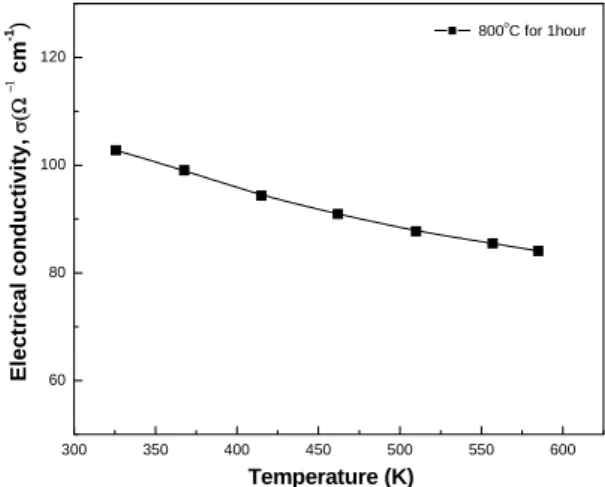
specimen showed negative Seebeck coefficient at all temperatures measured, which means that the majority carriers are electrons. Temperature dependence of electrical conductivity was shown in Figure 3 Electrical conductivity decreased by increasing temperature, indicating that all specimens showed metallic conduction behavior. Thermal conductivity as shown in Figure 4 was 0.012 W/cmK at room temperature. Figure 5 shows the temperature dependence of dimensionless thermoelectric figure of merit (ZT).
3. Summary
The arc melting and hot pressing were employed to prepare the Ba8Al16Si30 clathlate and their thermoelectric
properties were investigated. Negative Seebeck coefficient at all temperatures measured, which means that the majority carriers are electrons. Electrical conductivity decreased by increasing temperature, indicating that all specimens showed metallic conduction behavior. Thermal conductivity was 0.012 W/cmK at room temperature and dimensionless thermoelectric figure of merit (ZT) was 0.01 at 873K.
2006 POWDER METALLURGY World Congress
PC11-W-01
Thermoelectric Properties of Vacuum Hot-pressed Ba
8Al
16Si
30Clathlate
Joo-Ho Lee1, Jung-Il Lee1a, Young-Ho Kim1, Il-Ho Kim1, Kyung-Wook Jang2 and Soon-Chul Ur1 1
Department of Materials Science and Engineering/ReSEM, Chungju National University, 123 Geomdan-ri, Iryu-myeon, Chungju, Chungbuk 380-702, Korea
2
Department of Materials Science and Engineering/ReSEM, Hanseo University, 360, Daegok-ri, Haemi-myeon, Seosan, Chungnam 356-706, Korea
a
[email protected] Abstract
TypeⅠ clathrate Ba8Al16Si30 was produced by arc melting and hot pressing and thermoelectric properties were
investigated. Negative Seebeck coefficient at all temperatures measured, which means that the majority carriers are electrons. Electrical conductivity decreased by increasing temperature and thermal conductivity was 0.012 W/cmK at room temperature and dimensionless thermoelectric figure of merit (ZT) was 0.01 at 873K.
© Korean Powder Metallurgy Institute 1199 -10 20 30 40 50 60 70 80 (a) (b) (410) (633) (630) (532) (442) (530) (440) (521) (520) (420) (400) (321) (3 20) (222) (21 1 ) (21 0 ) (200) Intensity(a .u.) 2θ(deg.)
Fig. 1. Phase identifications for hot-pressed Ba8Al16Si30 ; (a) as powder, (b) hot-pressed at 800℃ for 1hr.
300 350 400 450 500 550 600 -60 -40 -20 0 800 o C for 1hour S eebeck coefficient , α ( µ V/ K ) Temperature (K)
Fig. 2. Seebeck coefficient of hot-pressed Ba8Al16Si30.
300 350 400 450 500 550 600 60 80 100 120 800o C for 1hour El ectr ica l c o nd u c tiv ity, σ(Ω −1 cm -1 ) Temperature (K)
Fig. 3. Electrical conductivity with temperature of hot-pressed Ba8Al16Si30. 300 350 400 450 500 550 600 0.000 0.005 0.010 0.015 0.020 T h e rm a l co n d u ct iv it y , λ (W /c mK) 800o C for 1hour Temperature (K)
Fig. 4. Thermal conductivity of hot-pressed Ba8Al16Si30.
300 350 400 450 500 550 600 0.000 0.005 0.010 800o C for 1hour Temperature (K) Dimensio nl e s s fig u re o f m e rit, ZT
Fig. 5. Dimensionless figure of merit (ZT) of hot-pressed Ba8Al16Si30.
Acknowledgments
This work was supported by the Regional Innovation Center (RIC) Program conducted by the Ministry of Commerce, Industry and Energy of Korean Government.
4. References
1. G.A. Slack and V.G. Tsoukala: J. Appl. Phys. Vol. 76 (1994), p.1665.
2. B. Eisenmann, H. Schäfer, R. Zagler: J. Less-Common Met. Vol. 118 (1986), p.43.
3. G. Cordier, P.Woll: J. Less-Common Met. Vol. 169 (1991), p.291.