Tests of a Gas Scattering Energy Monitor for PEFP DTL
S.H. Han, Y.S. ChoPEFP, Korea Atomic Energy Research Institute, Daejon, 305-600, Korea [email protected]
1. Introduction
The gas scattering energy monitor has been developed and tested to measure the proton energy from 3 MeV to 20 MeV at the four-vane PEFP (Proton Engineering Frontier Project) DTL (drift tube linac) tank exit as a function of RF drive power. The operating principle of the gas scattering energy monitor is to use gas scattering and collimator. The energy monitor is comprised of gas scattering chamber, collimator, and surface barrier detector (see Fig. 1). Beam going through the first collimator is spread out by multiple Coulomb scattering with scatter gas and is attenuated through the second collimator [1,2]. The reduced beam flux allows the silicon surface barrier detector to be utilized. A gas of high atomic number such as Xe is to be used to increase the scattering angle. We report on preliminary test results of the energy monitor system.
2. Test Results
Signals from the detector pass through an EG&G Ortec 142AH preamplifier and then into a Ortec 572 spectroscopy amplifier with 2 µs shaping time as shown in Fig. 2 and 3). The bipolar signal from the amplifier is passed into Ortec Trump-PCI MCA card to analyze the energy spectra. In order to perform the energy calibration for the surface detector, a linear calibration method using two points was used. The channel calibration of the signal processing electronics was performed by injecting a pulse of known amplitude into the pre-amplifier via a 10 µF capacitor (or electrical charge Q = C x V) and by calibrating the multi-channel analyzer (linear fitting of the electrical charge to channel).
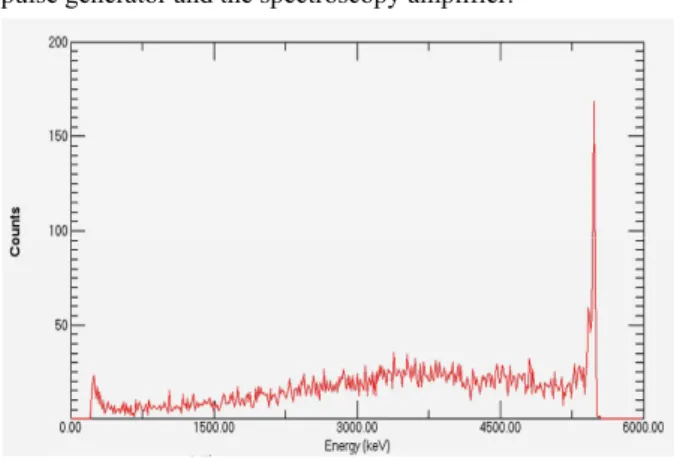
The next step for energy calibration is to find the known energy peak of a charged particle from the pulse height spectrum using the surface barrier detector. Fig. 4 shows a pulse height spectrum for the 5.486 MeV
241Am α source recorded through a tantalum collimator
(2 mm dia., 4 mm thick) at a bias voltage of 1000 V with the chamber pressure of 4 x 10⁻³ Torr. The average
energy necessary to create an electron-hole pair in the Si surface barrier detector is 3.62 eV at room temperature and is independent of the type and the energy of the ionizing radiation. The total charge produced by a 5.486 MeV 241Am α particle in the
detector is : ((5.486 x 10⁶ eV) / 3.62 eV) x (1.60 x 10⁻¹⁹
C) = 2.425 x 10⁻¹³ C. The channel corresponding to the
5.486 MeV 241Am α particle in the former linear fitting and the latter pulse
Figure 1: Schematic and photograph of the gas scattering energy monitor installed at the exit of DTL tank.
height spectrum was 432 and 429, respectively. The energy corresponding to the zero channel in the corrected linear fitting curve was 94 keV. The final step for the energy calibration was completed by marking the two channels (0 CH and 429 CH) and supplying the energies (94 keV and 5486 keV) for these channels.
Figure 2: Schematic diagram of signal processing for energy measurement and energy calibration.
Transactions of the Korean Nuclear Society Autumn Meeting Busan, Korea, October 27-28, 2005
Figure 3: Typical input pulse and output signals from the pulse generator and the spectroscopy amplifier.
Figure 4: Energy spectrum of 241Am α particle using a 5 mm
thick Si surface barrier detector. A typical detected flux corresponds to 2.23 mm-2s-1 and the 5.486 MeV main peak is
visible.
3. Conclusion
We have developed a gas scattering energy monitor to measure the energy spectrum of the proton beam from 3 MeV to 20 MeV at the DTL tank exit as a function of RF drive power. We have performed the energy calibration of the Si surface barrier detector and measure the energy spectrum of 241Am α particle. The
gas scattering energy monitor is expected to measure the energy distribution of the DTL extracted beam for different RF power settings.
ACKNOWLEDGMENT
The Korean Ministry of Science has supported this work.
REFERENCES
[1] J.P. Duke, D. J. S. Findlay, et al., “Measurements of Beam Energy Using the Gas Scattering System in the ISIS RFQ Test Stand”, EPAC 2002, France, June 2002.
[2] J.P. Duke, D. J. S. Findlay, et al., “Improved Results from the Gas Scattering Energy Spectrometer on the ISIS RFQ Test Stand”, PAC 2003, Portland, May 2002.
[3] EG&G Ortec®; now part of the Ametek® Group: http://www.ortec-online.com/