
Development of Repair System for Alloy 600 PWSCC in Reactor Vessel Head CRDM Welds
K. S. Park,a J. G. Byeon,a Y. J. Kim,a S. H. Kim,b H. C. Shin ba Doosan Heavy Industries & Construction Co., Ltd., Materials Development Team, [email protected] b NuclearRobotics Lab., KAERI, Yuseong, Daejeon, Korea, 305-600, [email protected], [email protected]
1. Introduction
As a result of the alloy 600 PWSCC(Primary Water Stress Corrosion Cracking), leak in the CRDM(Control Rod Drive Mechanism) nozzle was discovered in 2000 & 2001 in several US plants and the advanced companies have developed inspection & repair techniques. 2 or 3 years from now, more than half of the nuclear power plants in the country will be operated more than 20 years. Therefore, we need to develop repair techniques of CRDM welds. With above backgrounds, we have developed a Prototype of Repair System for Reactor Vessel Head CRDM welds.
2. The Repair System
The repair system for CRDM nozzles & welds is generally composed of machining, welding, inspection equipment and robot to deliver these equipments. The repair technology of CRDM welds varies depending on specifics of the head design. The repair system has been designed by applying the KOREA Standard Type Head.
2.1 The Machining Equipment
The equipment is to machine the defect in CRDM welds. The machining process adopted the EDM (Electro Discharge Machining) method because of the allowable load of Genesis. This equipment has z-axis for up-down moving and θ-axis for rotation. The minimum working speed is 0.01 mm/min.
Figure 1. The Machining Equipment for CRDM Welds 2.2 The Welding Equipment for CRDM Welds
The repair welding for CRDM welds should use overhead weld process. Therefore it needed to develop the equipment appropriate to this process. The developed equipment has 4 axes. The peripheral tools have 3D laser vision sensor, CCD camera and temperature sensor etc. 3D laser vision sensor has a function of the control of position and the creation of welding pass. The weld method is TIG.
There are Embedded Flaw Repair and Temperbead Welding Repair methods as repair techniques for CRDM welds.
Figure 2. The Welding Equipment for CRDM Welds 2.3 The Inspection Equipment
The inspection equipment is composed of dye-penetrant testing tool and TOFD(Time-of Flight Diffraction) UT tool. The dye-penetrant testing tool is used to inspect CRDM repaired welds. TOFD UT tool is used to inspect CRDM nozzle internal wall.
The dye-penetrant testing tool has the spray-nozzle and recording system. The spray-nozzle is used to spray cleaning, dye-penetrant & developer solution on the CRDM welds.
Transactions of the Korean Nuclear Society Autumn Meeting Busan, Korea, October 27-28, 2005
Figure 3. The TOFD Probe
2.4 The Robot for Reactor Vessel Head
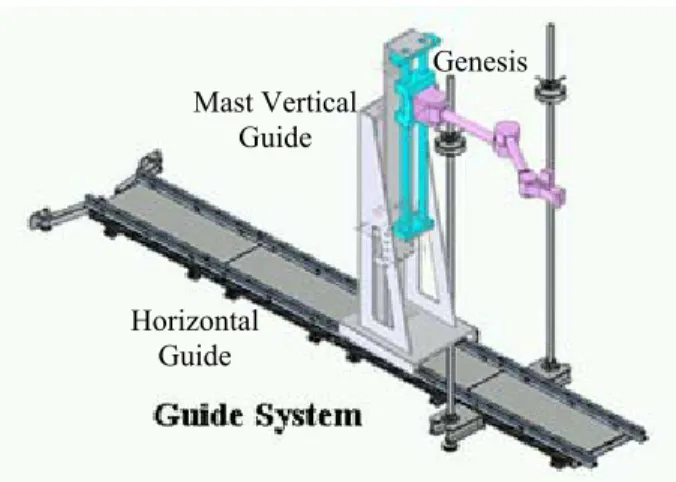
The robot is used to deliver repair and inspection tools. The robot in the figure 4 is composed of Genesis 2000, horizontal guide and mast vertical guide. The Genesis has been used to perform the tube plugging and sleeving in steam generator. The Genesis is installed in mast vertical guide and the tools are installed in the Genesis.
The horizontal guide can be divided into 4 parts for a person to move. The mast vertical guide has 2 step structures because of allowable stroke.
Figure 4. The Robot for Reactor Vessel Head
3. Conclusion
We have developed a Prototype of repair system to solve the CRDM cracking issue.
We have a plan to adjust and complete the repair system from the mock-up test.
REFERENCES
[1] S. Fyfitch, D.E. Whitaker, M.C. Arey, CRDM and Thermocouple Nozzle Inspections at the Oconee Nuclear Station, Tenth International Conference on Environmental Degradation of Materials in Nuclear Power Systems, 2001. [2] S.W. Glass, D.M. Schlader, Inspection and Repair Techniques and Strategies for Alloy 600 PWSCC in Reactor Vessel Head CRD Nozzles and Welds, ICONE 10, 2002. [3] Charles R. Frye, Melvin L. Arey, Michael R, Robinson E. Whitaker, Evaluation and Repair of Primary Water Stress Corrosion Cracking in Alloy 600/182 Control Rod Drive Mechanism Nozzles, ICONE 10, 2002.
[4] D. Waskey, R. Payne, D. Schlader, Emergent Development and Application of Reactor Vessel Head Penetration Inspections and Repairs in the United States, Welding and Repair Technology for Power Plants, p. N1-1, June 26-28, 2002. Genesis Horizontal Guide Mast Vertical Guide

![For any α ∈ K and R ∈]0](data:image/gif;base64,R0lGODlhAQABAIAAAP///wAAACH5BAEAAAAALAAAAAABAAEAAAICRAEAOw==)