Dysphagia is a problem that frequently occurs after a stroke and refers to all problems that occur in a series of processes in which food reaches the oral phase to the esophageal phase.1 Dysphagia causes a variety of complications, such as dehydration, mal-nutrition, and aspiration pneumonia.2 In particular, death can be a direct cause of aspiration pneumonia. Among the muscles involved in swallowing, the suprahyoid muscle (geniohyoid, mylohyoid, and digastric muscle) acts as the main muscle in the pha-ryngeal phase. These muscles affect airway protec-tion and upper esophageal sphincter opening by pulling the hyoid bone anteriorly and upward through contraction during swallowing.3 Therefore, a strong contraction of the suprahyoid muscle is required for
safe swallowing. However, neurological diseases such as stroke cause weakness of skeletal muscles, includ-ing the suprahyoid muscles. The weakeninclud-ing of the suprahyoid muscle reduces the distance of movement of the hyoid bone during swallowing, resulting in a variety of symptoms such as aspiration of the airways and residues of food.4 Therefore, it is important to rehabilitate the suprahyoid muscle for safe swallow-ing.
Taping is an or rehabilitation method used in vari-ous fields such as sports rehabilitation, orthopedic surgery, alternative medicine, and rehabilitation medicine.5 According to previous literature, taping is known to be effective in inducing lymph purifying, joint reinforcement, and immediate muscle activation. In addition, taping is relatively cheaper than other therapeutic methods and has the advantage of being
Effect of Suprahyoid Muscle Resistance Exercise Using
Kinesio Taping on Suprahyoid Muscle Thickness in Patients
with Dysphagia after Subacute Stroke
INTRODUCTION
Background: Recently, a new method of dysphagia rehabilitation using Kinesio taping (KT) has been attempted and demonstrated an immediate increase in the activation of the suprahyoid muscle during swallowing in healthy adults. Objectives: To investigate the effect of dysphagia rehabilitation using KT on the thickness change of the suprahyoid muscle in patients with dysphagia after stroke.
Design: Two-group pre-post design.
Methods: In this study, 20 patients with dysphagia after stroke were enrolled and assigned to the experimental and control groups. The experimental group applied KT to the front of the neck and repeatedly swallowed against the ten-sion of the tape. On the other hand, the control group performed repeated swallowing without applying KT. Patients in both groups had swallowed 50 times a day/5 times a week for 4 weeks. For evaluation, the volume of the geniohyoid, mylohyoid, and digastric muscle was measured before and after the intervention using portable ultrasound equipment.
Results: As a result of comparing the two groups after the intervention, the experimental group showed more volume increase in mylohyoid (P<.05) and digastric muscle (P<.05) than the control group.
Conclusion: This study proved that suprahyoid muscle resistance exercise using KT is effective in increasing the volume of the suprahyoid muscle.
Keywords: Dysphagia; Stroke; Suprahyoid muscles; Kinesio taping
Myunglyeol Lee, Prof., PhDa
Jinuk Kim, Prof., PhDa
Donghwan Oh, OT, Prof., PhDb
Kuija Lee, Prof., PhDa
aDepartment of Emergency Medical Services, Kyungdong University, Wonju, Republic of Korea;
bDepartment of Occuptional Therapy, Kyungdong
University, Wonju, Republic of Korea
Received : 13 May 2020 Revised : 18 June 2020 Accepted : 25 June 2020
Address for correspondence Kuija Lee, Prof., PhD
Department of Emergency Medical Services, Kyungdong University, Wonju, Republic of Korea
safer to use as a noninvasive method.6
Recently, a method of resistance exercise of the suprahyoid muscle using taping has been reported, and this has been considered as a potential treatment method for swallowing rehabilitation.7In this method, the tape is pulled down from the cervical vertebra and then attached to the sternum and both clavicles. Due to the tension of the tape, the upward movement of the hyoid bone during swallowing is suppressed, and this requires the subject to make more effort to over-come the tension of the tape.8 As a result, it was proved that the activation of the suprahyoid muscle during swallowing increases as the tension of the tape increases.7 Therefore, repetitive swallowing against the resistance of taping places load on the suprahyoid muscle, with an expected muscle physio-logical change.
Nevertheless, since previous studies have only measured the activation of the suprahyoid muscle in healthy adults using surface electromyography, the change through intervention cannot be confirmed. Therefore, the effect of the swallowing rehabilitation method using taping is still not clear. Therefore, this study investigated the effect of dysphagia rehabilita-tion using taping for 4 weeks on the change in suprahyoid muscle thickness in patients with dys-phagia after stroke.
In this study, 20 patients with dysphagia after stroke were enrolled. This study was conducted at a rehabilitation hospital in Seoul, Korea. The inclusion criteria were as follows: within 6 months after stroke onset, those who have been diagnosed with oropha-ryngeal dysphagia by videofluoroscopic swallowing study (VFSS), those who overcome the resistance of taping and are able to swallow voluntarily, and those who have a Korean Mini Mental Status Examination (K-MMSE) score of 22 or higher without cognitive problems. The Penetration-aspiration scale is more than 4 points. The exclusion criteria were as follows: patients with esophageal dysphagia symptoms, tra-cheotomy, tape allergy on the anterior neck, presence of tracheotomy, effortful swallowing impossible or difficult, and difficulty swallowing more than 5 times in a row.
The objectives and requirements of the study were explained to all participants, who voluntarily signed an informed consent form. Ethical approval was
obtained from the Seoul Medical Center Institutional Review Board prior to study commencement (SEOUL2020-01-003-002).
In this study, a total of 20 participants were ran-domly assigned to the experimental and control groups using randomly selected envelopes containing a code specifying the group. The experimental group applied Kinesio taping (KT) (BB Tape; WETAPE Inc., Seoul, Korea) to the front of the neck to perform repeated swallowing exercises against the elongation of the tape, while the control group performed repeated dry swallowing without applying KT. Both groups performed spontaneous swallowing 5 times in a row and provided rest for 10 seconds. This was performed by repeating a total of 10 times. That is, all subjects performed a total of 50 repeated dry swallows per day. In particular, the experimental group monitored the tape's firm adhesion to provide continuous resistance during the experiment. Both groups received traditional swallowing rehabilitation treatment for 30 min daily, five times weekly, for 4 weeks by an occupational therapist.
The KT method applied in the experimental group was performed in the following steps with reference to the previous study.7 The subject maintained the neutral position of the head and neck while sitting on the chair. The anterior neck was wiped with an alco-hol swab so that the tape could adhere to the skin. The tape was customized with an I-shaped tape and reverse V-shaped tape. I-shaped tape was firmly attached to the sternum by pulling it down from the thyroid cartilage. The reverse V-shaped tape was pulled down from the hyoid bone and attached to the clavicle on both sides. The applied stretch was applied at approximately 60–70%, and the application of KT was performed by a skilled practitioner with more than 7 years of clinical experience.
This study used a portable ultrasound device (SONON 300L, Healcerion, Seoul, Korea) with a 10 MHz linear- and convex-array transducer to meas-ure the suprahyoid muscle thickness. The evaluations were performed by a radiological technician with more than 5 years of clinical experience and were repeated 3 times, and the mean value was calculated to represent the suprahyoid muscle thickness for each subject. The participants were asked to sit upright in a chair with the Frankfurt plane parallel to the floor
SUBJECTS AND METHODS
Subjects
Outcome Measurement Methods
and without head support.9
The transducer was positioned between the hyoid bone and the submental to measure the thickness of the suprahyoid muscles. The digastric muscle was measured from the upper to the lower boundary of the fascia at the broadest point perpendicular to the mylohyoid muscle. The mylohyoid muscle was meas-ured under the measurement point of the digastric muscle, from the upper to the lower boundary of the fascia.
All statistical analyses were performed using SPSS version 15.0 (IBM Corporation, Armonk, NY, USA). Descriptive statistics are presented as means with standard deviations. The Shapiro–Wilk test was used to check the normality of the outcome variables. The Wilcoxon signed-rank test was used to compare pre-and post-intervention measures in each group to evaluate the intervention effects. The Mann–Whitney U test was used to compare intergroup changes in outcome measurements. A P-value of <.05 was deemed statistically significant.
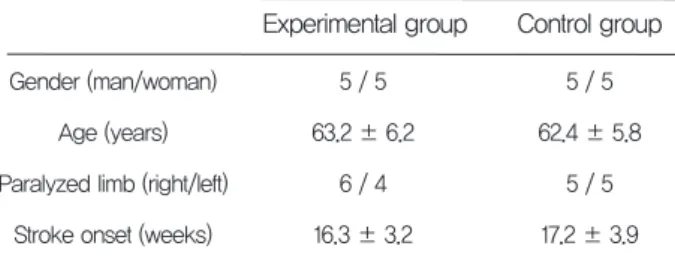
A total of 20 people were enrolled in this study, and their general characteristics are shown in Table 1. There was no dropout until the completion of the study with all the subjects performing intervention
according to the planned schedule. Therefore, finally the data of 20 people were analyzed.
As a result of the intra-group comparison, the experimental group showed a statistically significant volume increase in the mylohyoid and digastric mus-cles (P<.05). On the other hand, in the control group, there was no significant thickness increase in the mylohyoid and digastric muscles (P>.05). As a result of the comparison between groups, the experimental group showed more thickness increase in the mylo-hyoid and digastric muscles than the control group (P <.05, both) (Table 2).
There were no reported side effects in 8 patients in the experimental group in which KT was applied.
Recently, KT was reported as a new method of dys-phagia rehabilitation treatment. However, since only the surface electromyography (sEMG) was used to measure the activation of the suprahyoid muscle, evidence of its therapeutic effect is still unclear. Therefore, this study investigated the effect of suprahyoid muscle resistance exercise using KT on suprahyoid muscle thickness in patients with dys-phagia after stroke.
In this study, as a result of the suprahyoid muscle resistance exercise using KT, the experimental group showed a significant increase in the thickness of the suprahyoid muscle. On the other hand, in the control group, there was no significant increase in the thick-ness of the suprahyoid muscle, suggesting that the suprahyoid muscle resistance exercise using KT is effective in increasing the thickness of the suprahyoid muscle in patients with dysphagia after stroke. Subjects
Statistical Analysis
Effect of the suprahyoid muscle
Reported side effects
Experimental group
Gender (man/woman) Age (years) Paralyzed limb (right/left)
Stroke onset (weeks)
Control group 5 / 5 62.4 ± 5.8 5 / 5 17.2 ± 3.9 5 / 5 63.2 ± 6.2 6 / 4 16.3 ± 3.2
Table 1. General characteristics of the subject
Experimental group
Before After P-value
MM (mm) DM (mm)
Control group Between
groups P-values <.01† <.01† .71 ± .26 5.32 ± 1.28 .84 ± .28 6.22 ± 2.18 .008∗ .001∗
Before After P-value
.69 ± .34 5.18 ± 2.12 .70 ± .21 5.21 ± 2.26 .10 .12 Table 2. Changes in parameters before and after the treatment
RESULTS
DISCUSSION
∗P<.05 by Wilcoxon signed-rank test, †P<.05 Mann–Whitney U test, The values are mean ± standard deviation, MM: mylohyoid muscle, DM: digastric
Resistance exercise is known to be an effective therapeutic exercise to induce physiological muscle changes, such as muscle strength and volume increase in skeletal muscle.10–12 In this study, KT was applied as resistance to induce an increase in the vol-ume of the suprahyoid muscle. During normal swal-lowing, contraction of the suprahyoid muscle pulls the hyoid bone upward, contributing to airway pro-tection and upper esophageal sphincter opening. Therefore, a strong contraction of the suprahyoid muscle is important for safe swallowing.13 In this study, a tape was attached to the hyoid bone to pro-vide resistance to the suprahyoid muscle, pulled downward, and then attached to the sternum and both clavicles. It acts in the opposite direction to the upward movement of the hyoid bone during normal swallowing, and the patient requires effortful swal-lowing to overcome this resistance. As a result, a greater load is provided to the suprahyoid muscle during swallowing, which has the potential to cause physiological muscle changes such as thickness increase when repeatedly applied.
A previous study reported that as a result of the suprahyoid muscle resistance exercise using KT with sEMG, the higher the tape tension, the more effort-less swallowing of patients as well as the higher acti-vation of the suprahyoid muscle.7High muscle acti-vation in sEMG means increased motor unit activa-tion in the peripheral nervous system.14 In addition, this increases the number of recruited motor units, and consequently, repeated application is likely to contribute positively to increased muscle strength or volume.15Although KT is rarely applied as a method of resistance exercise, this study is the first to prove the therapeutic effect of resistance exercise using KT's adhesion and elasticity and is a clinically mean-ingful result. Therefore, dysphagia rehabilitation using KT is considered to be a simple, inexpensive, and non-invasive method for clinical use.
Nevertheless, this study has several limitations. First, due to the small number of subjects, the results of this study cannot be generalized. Second, it is dif-ficult to apply the strength of KT resistance quanti-tatively. Therefore, further studies are needed to supplement these limitations.
This study proved that KT applied for suprahyoid muscle resistance exercise was effective in increasing the volume of the suprahyoid muscle in patients with dysphagia after stroke.
The author declares that there are no conflicts of interest.
This research was supported by Kyungdong University Research In 2020.
REfERENCES
1. 2. 3. 4. 5. 6. 7. 8. 9.Lim KB, Lee HJ, Yoo J, Kwon YG. Effect of low-frequency rTMS and NMES on subacute
unilater-al hemispheric stroke with dysphagia. Ann
Rehabil Med. 2014;38(5):592–602.
Robbins J, Kays SA, Gangnon RE, et al. The effects of lingual exercise in stroke patients with dysphagia. Arch Phys Med Rehabil. 2007;88(2): 150–158.
Kang BS, Oh BM, Kim IS, Chung SG, Kim SJ, Han TR. Influence of aging on movement of the hyoid bone and epiglottis during normal swallow-ing: a motion analysis. Gerontology. 2010;56(5): 474–482.
Cook IJ, Dodds WJ, Dantas RO, et al. Opening mechanisms of the human upper esophageal sphincter. Am J Physiol. 1989;257(5pt1):748–759. Hong J, Oh D, Park J, Jung Y. Effect of Kinesiology Taping on Hyolaryngeal Complex Movement in Stroke Patient with Dysphagia. J Int Acad Phys Ther Res. 2020;11(2):2052-2059. Oh D, Park J, Kim J. Effect of Kinesiology Taping for Ankle Instability in Stroke Patients. J Int Acad Phys Ther Res. 2020;11(1):1950-1953. Park JS, Jung YJ, Kim HH, Lee G. A Novel Method Using Kinesiology Taping for the Activation of Suprahyoid Muscles in Healthy Adults: A Preliminary Research. Dysphagia. 2020;35(4):636-642.
Park JS, Lee SH, Jung SH, Choi JB, Jung YJ. Tongue strengthening exercise is effective in improving the oropharyngeal muscles associated with swallowing in community-dwelling older adults in South Korea: A randomized trial. Medicine. 2019;98(40):e17304.
Park JS, Hwang NK, Kim HH, Choi JB, Chang MY, Jung YJ. Effects of lingual strength training on oropharyngeal muscles in South Korean adults. J Oral Rehabil. 2019;46(11):1036-1041.
CONCLUSION
CONfLICT Of INTERESTS
10.
11.
12.
Steele CM, Bayley MT, Peladeau-Pigeon M, et al. A randomized trial comparing two tongue-pres-sure resistance training protocols for post-stroke dysphagia. Dysphagia. 2016;31(3):452-461.
Borde R, Hortobágyi T, Granacher U. Dose–
response relationships of resistance training in healthy old adults: a systematic review and meta-analysis. Sports Med. 2015;45(12):1693-1720.
Chen FT, Etnier JL, Chan KH, Chiu PK, Hung TM, Chang YK. Effects of Exercise Training Interventions on Executive Function in Older Adults: A Systematic Review and Meta-Analysis. Sports Med. 2020;50(8):1451-1467.
13.
14.
15.
Wheeler KM, Chiara T, Sapienza CM. Surface electromyographic activity of the submental muscles during swallow and expiratory pressure threshold training tasks. Dysphagia. 2007;22 (2):108-116.
Park JS, Oh DH, Chang MY, Kim KM. Effects of expiratory muscle strength training on oropha-ryngeal dysphagia in subacute stroke patients: a randomised controlled trial. J Oral Rehabil. 2016;43(5):364-372.
Farina D, Merletti R, Enoka RM. The extraction of neural strategies from the surface EMG. J Appl Physiol. 2004;96(4):1486–1495.