Gray matter differences in the anterior cingulate and orbitofrontal cortex of
young adults with Internet gaming disorder: Surface-based morphometry
DEOKJONG LEE1,2, JINSICK PARK3, KEE NAMKOONG1,2, IN YOUNG KIM3* and YOUNG-CHUL JUNG1,2* 1Department of Psychiatry, Yonsei University College of Medicine, Seoul, Republic of Korea
2
Institute of Behavioral Science in Medicine, Yonsei University College of Medicine, Seoul, Republic of Korea 3
Department of Biomedical Engineering, Hanyang University, Seoul, Republic of Korea
(Received: October 24, 2017; revised manuscript received: December 28, 2017; second revised manuscript received: January 31, 2018; accepted: February 18, 2018)
Background and aims: Altered risk/reward decision-making is suggested to predispose individuals with Internet gaming disorder (IGD) to pursue short-term pleasure, despite long-term negative consequences. The anterior cingulate cortex (ACC) and the orbitofrontal cortex (OFC) play important roles in risk/reward decision-making. This study investigated gray matter differences in the ACC and OFC of young adults with and without IGD using surface-based morphometry (SBM). Methods: We examined 45 young male adults with IGD and 35 age-matched male controls. We performed region of interest (ROI)-based analyses for cortical thickness and gray matter volume (GMV) in the ACC and OFC. We also conducted whole-brain vertex-wise analysis of cortical thickness to complement the ROI-based analysis. Results: IGD subjects had thinner cortices in the right rostral ACC, right lateral OFC, and left pars orbitalis than controls. We also found smaller GMV in the right caudal ACC and left pars orbitalis in IGD subjects. Thinner cortex of the right lateral OFC in IGD subjects correlated with higher cognitive impulsivity. Whole-brain analysis in IGD subjects revealed thinner cortex in the right supplementary motor area, left frontal eyefield, superior parietal lobule, and posterior cingulate cortex. Conclusions: Individuals with IGD had a thinner cortex and a smaller GMV in the ACC and OFC, which are critical areas for evaluating reward values, error processing, and adjusting behavior. In addition, in behavioral control-related brain regions, including frontoparietal areas, they also had thinner cortices. These gray matter differences may contribute to IGD pathophysiology through altered risk/reward decision-making and diminished behavioral control.
Keywords: cortical thickness, gray matter volume, Internet gaming disorder, risk/reward decision-making, surface-based morphometry
INTRODUCTION
Since Young (
1998b
) presented the concept approximately
two decades ago, behavioral addictions to Internet-related
activities have emerged as an important mental health issue
in young people (
Kuss, Grif
fiths, Karila, & Billieux, 2014
).
Of these behavioral disorders, Internet gaming disorder
(IGD) has been widely investigated as a subject of great
interest (
Kuss, 2013
). Enhanced reward sensitivity and
decreased loss sensitivity are indicated in IGD cases
(
Dong, DeVito, Huang, & Du, 2012
;
Dong, Hu, & Lin,
2013
). Problems with error monitoring (
Dong, Shen,
Huang, & Du, 2013
) and dif
ficulty in appropriately
con-trolling behavior (
Ko et al., 2014
) are also reported in IGD.
Consequently, an imbalance between enhanced
reward-seeking and diminished behavioral control in IGD
pro-motes impaired risk/reward decision-making (
Dong &
Potenza, 2014
). In IGD, altered risk/reward
decision-making, which is characterized by decision-making de
fi-cits under risky conditions and preference for immediate
reward, is closely related to pursuing short-term pleasure
from Internet games, despite long-term negative
conse-quences (
Pawlikowski & Brand, 2011
;
Yao et al., 2015
).
A meta-analysis of decision-making revealed that that the
orbitofrontal cortex (OFC) and anterior cingulate cortex
(ACC) brain regions were most consistently involved in
risk/reward-related decisions (
Krain, Wilson, Arbuckle,
Castellanos, & Milham, 2006
). Speci
fically, the OFC is
thought to assign reward values to behavioral choices, based
on the perceived or expected outcomes of the behavior
(
Wallis, 2007
). The ACC is suggested to encode a reward
prediction error (the difference between a predicted reward
and an actual outcome) (
Hayden, Heilbronner, Pearson, &
* Corresponding authors: In Young Kim, MD, PhD; Department of Biomedical Engineering, Hanyang University, 04763 Wangsimni-ro, Seongdong-gu, Seoul 133 791, Republic of Korea; Phone: +82 2 2291 1713; Fax: +82 2 2220 4949; E-mail:[email protected]; Young‑Chul Jung, MD, PhD; Department of Psychiatry, Yonsei University College of Medicine, 03722 Yonsei‑ro, Seodaemun‑gu, Seoul 120 752, Republic of Korea; Phone: +82 2 2228 1620; Fax: +82 2 313 0891; E‑mail:[email protected]
This is an open-access article distributed under the terms of theCreative Commons Attribution-NonCommercial 4.0 International License, which permits unrestricted use, distribution, and reproduction in any medium for non-commercial purposes, provided the original author and source are credited, a link to the CC License is provided, and changes– if any – are indicated.
DOI: 10.1556/2006.7.2018.20 First published online March 12, 2018
Platt, 2011
) and play a crucial role in error monitoring
and adjusting behaviors (
Amiez, Joseph, & Procyk, 2005
).
Individuals with IGD have reported altered functional
ac-tivity of the ACC and the OFC in response to several mental
tasks, which could affect their ability to make
risk/reward-related decisions. In a previous functional imaging study
using the Probabilistic Guessing Task, individuals with IGD
showed increased activation in the OFC during gain
con-ditions and decreased activation in the ACC during loss
conditions (
Dong, Huang, & Du, 2011
). Individuals with
IGD also demonstrated altered activation in the ACC and
the OFC in response to the STROOP Task, indicating a
diminished capacity to perform error monitoring and exert
cognitive control over their behavior (
Dong, DeVito, Du, &
Cui, 2012
;
Dong, Shen, et al., 2013
). Notably, these
findings
are consistent with reported structural changes in the OFC
and the ACC associated with IGD (
Lin, Dong, Wang, & Du,
2015
;
Yuan et al., 2011
). A recent study, which combined a
cross-sectional and longitudinal design, indicated that
def-icits in orbitofrontal gray matter are a marker of IGD (
Zhou
et al., 2017
). A relationship between altered gray matter in
the ACC and dysfunctional cognitive control is reported in
IGD (
Lee, Namkoong, Lee, & Jung, 2017
;
Wang et al.,
2015
). Given the in
fluence of altered gray matter on
func-tional neural activity (
Honey, Kötter, Breakspear, & Sporns,
2007
), we hypothesize that altered gray matter in the
OFC and the ACC contributes to maladaptive risk/reward
decision-making in IGD.
Several neuroanatomical techniques are used to
investi-gate gray matter, including surface-based morphometric
(SBM) analysis, which provides a sensitive method for
measuring morphological properties of the brain using
geometric models of the cortical surface (
Fischl et al.,
2004
). SBM analysis has numerous potential advantages
for investigations of cortical morphology: it can be utilized
to measure cortical folding patterns (
Fischl et al., 2007
)
and to mask out subcortical tissues (
Kim et al., 2005
). In
addition, SBM analysis provides meaningful information
on cortical thickness, whereas comparable techniques, such
as voxel-based morphometry (VBM), are limited to
asses-sing cortical shape (
Hutton, Draganski, Ashburner, &
Weiskopf, 2009
). Although VBM studies have found
re-gional gray matter volume (GMV) alterations in individuals
with IGD (
Yao et al., 2017
), there has not been suf
ficient
SBM analysis, including assessment of cortical thickness,
for IGD. Some SBM studies found a thinner OFC in
adolescents with IGD than in controls (
Hong et al., 2013
;
Yuan et al., 2013
). However, SBM analysis of young adults
with IGD has not been performed. Furthermore, although
adolescents and young adults with IGD are reported to have
smaller GMV of the ACC (
Lee et al., 2017
;
Wang et al.,
2015
), there has been no study of cortical thickness of the
ACC. Because GMV and cortical thickness provide
differ-ent kinds of information about neuropsychiatric disorders
(
Lemaitre et al., 2012
;
Winkler et al., 2010
), we speculate
that the combined measures of GMV and cortical thickness
can offer a more complete picture of altered gray matter
in IGD.
The purpose of this study was to compare ACC and OFC
gray matter in young adults with and without IGD. Using
SBM analysis, we analyzed GMV and cortical thickness in
Internet game addicts. We hypothesized that young adults
with IGD would have a smaller GMV and a thinner cortex in
the ACC and the OFC. We anticipate that these gray matter
alterations correlate with an increased tendency to make
decisions founded in short-term grati
fication, such as the
pleasure of gaming, rather than assessment of long-term
risks, such as negative psychosocial consequences. To test
our hypothesis, we conducted a region of interest
(ROI)-based analysis, focused on the ACC and the OFC, to
investigate GMV and cortical thickness in young adults
with IGD. We then used correlation analyses to investigate
the relationship between altered gray matter and the clinical
features of IGD. For a secondary analysis, we performed a
whole-brain vertex-wise analysis of cortical thickness to
examine cortical thickness alterations outside of the ACC
and OFC, as a complement to the ROI-based analysis.
MATERIALS AND METHODS
Participants
Participants for this study were recruited through online
advertisements,
flyers, and word of mouth. Only males
were included in the study. The participants were evaluated
for their Internet use patterns and screened for IGD using a
previously established Internet Addiction Test (IAT;
Young, 1998a
). The participants who scored 50 points or
above on the IAT and reported that their main use of the
Internet was playing games were then classi
fied as
candi-dates, with a diagnosis of IGD. These candidates then
underwent a clinician-administered interview to assess the
core components of their addiction, including tolerance,
withdrawal, adverse consequences, and excessive use with
a loss of sense of time (
Block, 2008
). As such, a total of
80 subjects took part in the study; these included 45 male
adults with IGD and 35 healthy male controls, who were
all right-handed and aged between 21 and 26 years (mean:
23.6
± 1.6).
All subjects received the structured clinical interview for
DSM-IV Axis I disorders (
First, Spitzer, & Williams, 1997
)
to evaluate the presence of major psychiatric disorders and
the Korean version of the Wechsler Adult Intelligence Scale
(
Wechsler, 2014
) to assess Intelligence Quotient (IQ).
Considering that IGD often has psychiatric comorbidities
(
Kim et al., 2016
), we performed the Beck Depression
Inventory (BDI;
Beck, Steer, & Brown, 1996
) for
depres-sion, the Beck Anxiety Inventory (BAI;
Beck, Epstein,
Brown, & Steer, 1988
) for anxiety, and the Wender Utah
Rating Scale (WURS;
Ward, 1993
) for childhood symptoms
of attention-de
ficit hyperactivity disorder (ADHD). Finally,
because IGD is closely associated with high impulsivity
(
Choi et al., 2014
), we used the Barratt Impulsiveness
Scale
– version 11 (BIS-11;
Patton & Stanford, 1995
) to
test impulsivity. The BIS-11 consists of three subscales:
cognitive impulsivity, motor impulsivity, and non-planning
impulsivity. All subjects were medication-naive during
assessment. Exclusion criteria for all subjects were major
psychiatric disorders other than IGD, low intelligence that
impeded ability to complete self-reports, neurological, or
medical illness, and contraindications on the MRI scan.
Data acquisition and image processing
Brain MRI data were collected using a 3T Siemens
Magne-tom MRI scanner equipped with an eight-channel head coil.
A high-resolution structural MRI was acquired in the
sagit-tal plane by means of a T1-weighted spoiled 3D gradient
echo sequence (echo time
= 2.19 ms, repetition time =
1,780 ms,
flip angle = 9°, field of view = 256 mm, matrix =
256
× 256, transversal slice thickness = 1 mm). All MRI
data were visually inspected for the presence of artifacts.
FreeSurfer 5.3.0 (
http://surfer.nmr.mgh.harvard.edu/
) was
employed for SBM analyses of cortical thickness and GMV.
The processing stream included the disposal of non-brain
tissue using a hybrid approach (
Ségonne et al., 2004
),
correc-tion of intensity non-uniformity (
Sled, Zijdenbos, & Evans,
1998
), segmentation of gray
–white matter tissue (
Dale, Fischl,
& Sereno, 1999
), tessellation of gray
–white matter boundary
and topologically correction (
Ségonne, Pacheco, & Fischl,
2007
), surface in
flation and flattening (
Fischl, Sereno, & Dale,
1999
), transformation into a spherical space atlas (
Fischl,
Sereno, Tootell, & Dale, 1999
), and automatic parcellation
of human cerebral cortex (
Fischl et al., 2004
). Cortical
thickness was determined by estimating the distance between
the gray
–white matter boundary (inner surface) and the
pial surface (outer surface). The data were smoothed using
a 10-mm full-width at half maximum Gaussian kernel.
Imaging data analysis
ROI-based analyses were performed to compare GMV and
cortical thickness between individuals with IGD and
con-trols. ROIs were de
fined using the Desikan–Killiany cortical
atlas (
Desikan et al., 2006
). ROIs included both sides of the
ACC (caudal/rostral ACC) and the OFC (lateral/medial
OFC, pars orbitalis) (Figure
1
). To assess group differences
(individuals with IGD vs. controls) in GMV and cortical
thickness, mean values of GMV, and cortical thickness
within each ROI were extracted using FreeSurfer. For each
ROI, we conducted an analysis of covariance with SPSS
24.0 (SPSS Inc., Chicago, IL, USA) for a signi
ficance level
of p
= .05. Age, IQ, and the intracranial volume (ICV) of
each subject were entered as covariates in analysis for
GMV. Age and IQ were entered as covariates in analysis
for cortical thickness, but ICV was not included as a
covariate, as previous studies have suggested that cortical
thickness is not affected by ICV (
Buckner et al., 2004
). To
assess the brain-behavior relationships, we performed a
correlation analysis for gray matter alterations (GMV and
cortical thickness in the OFC and the ACC) and the
self-reporting scales (IAT and BIS).
To complement ROI analysis, the surface-based
whole-brain analyses for cortical thickness were also performed
using general linear models in FreeSurfer
’s Query, Design,
Estimate, Contrast module after controlling for age and
IQ of each subject. As an exploratory investigation for
whole-brain, a cluster-forming threshold of uncorrected
p
< .005 was employed for a vertex-wise comparison. We
exclusively reported clusters with a signi
ficant number of
vertices greater than 200 to reduce the possibility of
generating false positives (
Fung et al., 2015
;
Wang
et al., 2014
).
Ethics
This study was carried out under the guidelines for the use of
human participants established by the Institutional Review
Board at Yonsei University. The Institutional Review Board
of the Yonsei University approved the study. Following a
complete description of the scope of the study to all
participants, written informed consent was obtained.
Figure 1. Regions of interest (ROIs). ROIs were defined according to the Desikan–Killiany cortical atlas. ROIs for the anterior cingulate cortex (ACC) included both sides of the caudal ACC (green) and the rostral ACC (orange). ROIs for the orbitofrontal cortex (OFC) included
RESULTS
Demographic and clinical characteristics of subjects
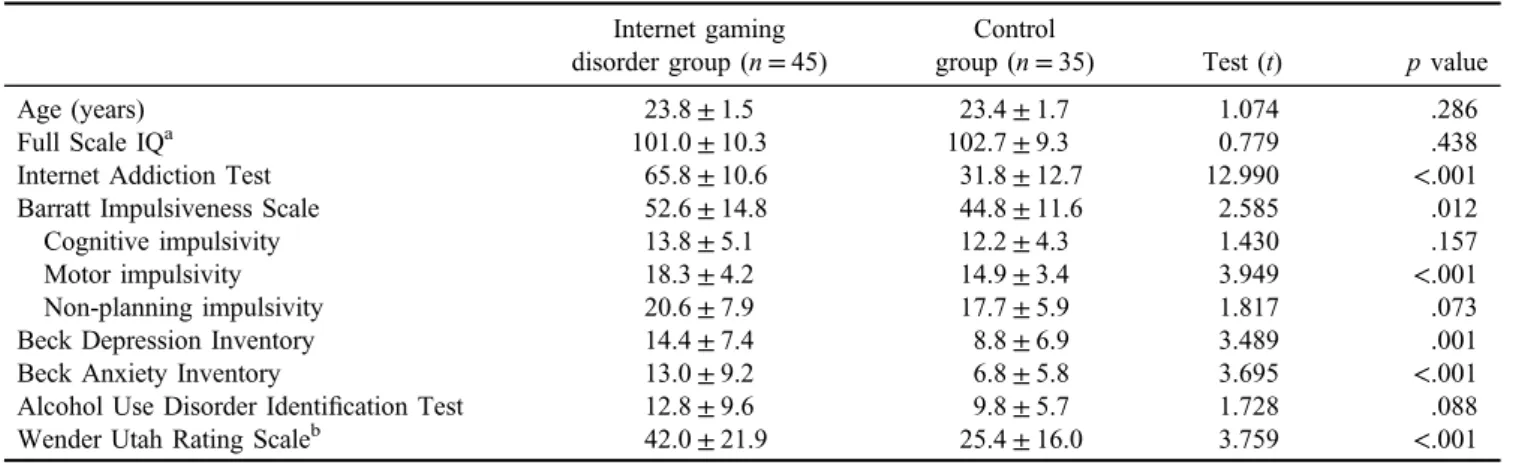
The participants in the control and IGD groups were
matched by age and full-scale IQ (Table
1
). Subjects with
IGD scored signi
ficantly higher on tests of Internet
addiction (IA) and impulsivity compared with controls
(IAT: p
< .001; BIS: p = .012). In addition, members of
the IGD group scored signi
ficantly higher on tests of
depression, anxiety, and childhood ADHD symptoms
com-pared with healthy controls (BDI: p
= .001; BAI: p < .001;
WURS: p
< .001). Total ICV was not significantly different
between controls and subjects with IGD (1,600.39
±
149.09 cm
3for IA group; 1,624.02
± 138.96 cm
3for controls;
p
= .467).
ROI-based analyses
ROI-based analyses of cortical thickness found that
sub-jects with IGD had a thinner cortex in the right rostral
ACC, the right lateral OFC, and the left pars orbitalis than
the cortex in controls (rostral ACC: p
= .011; lateral OFC:
p
= .021; pars orbitalis: p = .003; Table
2
). These
findings
remained signi
ficant after including comorbid conditions
(BDI, BAI, and WURS) as covariates (rostral ACC:
p
= .008; lateral OFC: p = .044; pars orbitalis: p = .014).
ROI-based analyses for GMV showed that subjects with
IGD had smaller GMV in the right caudal ACC and the left
pars orbitalis, compared with controls (caudal ACC:
p
= .042; pars orbitalis: p = .021). These findings remained
signi
ficant in the caudal ACC (p = .013) after including
comorbid conditions (BDI, BAI, and WURS) as covariates
but not in the pars orbitalis (p
= .098). Relative to controls,
subjects with IGD did not have a larger GMV or thicker
cortex in ROIs.
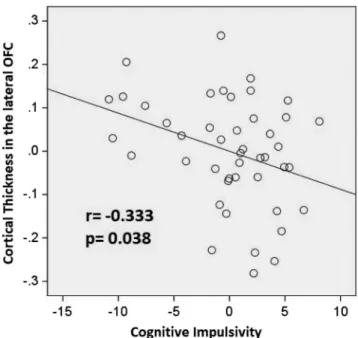
In IGD subjects, a thinner cortex in the right lateral OFC
signi
ficantly correlated with higher cognitive impulsivity
scores, after comorbid conditions (BDI, BAI, and WURS)
were included as covariates (r
= −.333, p = .038; Figure
2
).
We found no statistical correlation between gray matter
alterations, speci
fically a smaller GMV and a thinner cortex,
and IAT scores.
Whole-brain vertex-wise analysis
A whole-brain vertex-wise analysis of cortical thickness
showed that subjects with IGD had a thinner cortex in the
right supplementary motor area (SMA; peak Talairach
coordinate: X
= 7, Y = 21, Z = 53; Figure
3A
). In addition,
Table 1. Demographics and clinical variables of participantsInternet gaming disorder group (n= 45)
Control
group (n= 35) Test (t) p value
Age (years) 23.8± 1.5 23.4± 1.7 1.074 .286
Full Scale IQa 101.0± 10.3 102.7± 9.3 0.779 .438
Internet Addiction Test 65.8± 10.6 31.8± 12.7 12.990 <.001
Barratt Impulsiveness Scale 52.6± 14.8 44.8± 11.6 2.585 .012
Cognitive impulsivity 13.8± 5.1 12.2± 4.3 1.430 .157
Motor impulsivity 18.3± 4.2 14.9± 3.4 3.949 <.001
Non-planning impulsivity 20.6± 7.9 17.7± 5.9 1.817 .073
Beck Depression Inventory 14.4± 7.4 8.8± 6.9 3.489 .001
Beck Anxiety Inventory 13.0± 9.2 6.8± 5.8 3.695 <.001
Alcohol Use Disorder Identification Test 12.8± 9.6 9.8± 5.7 1.728 .088
Wender Utah Rating Scaleb 42.0± 21.9 25.4± 16.0 3.759 <.001
Note. Values are expressed as means± SD. a
Intelligence Quotient (IQ) was assessed using the Wechsler Adult Intelligence Scale. b
Wender Utah Rating Scale was performed to assess childhood ADHD symptoms.
Table 2. Region of interest-based comparison of cortical thickness and gray matter volume between young males with Internet gaming disorder (IGD) and controls (IGD group< control group)
Side
Internet gaming disorder group (n= 45)
Control
group (n= 35) Test (F) p value Cortical thickness (mm)
Rostral anterior cingulate cortex Right 2.86± 0.20 2.98± 0.19 6.747 .011
Lateral orbitofrontal cortex Right 2.71± 0.14 2.79± 0.14 5.540 .021
Pars orbitalis Left 2.71± 0.20 2.86± 0.21 9.453 .003
Gray matter volume (mm3)
Caudal anterior cingulate cortex Right 2,353.24± 556.33 2,606.89± 540.76 4.285 .042
Pars orbitalis Left 2,298.00± 323.25 2,457.83± 298.86 5.523 .021
subjects with IGD had a thinner cortex in the left frontal
eye
field (FEF; peak Talairach coordinate: X = −10,
Y
= 17, Z = 45; Figure
3B
), the left posterior cingulate
cortex (PCC; peak Talairach coordinate: X
= −9, Y = −30,
Z
= 40; Figure
3B
), and the left superior parietal lobule
(SPL; peak Talairach coordinate: X
= −15, Y = −62,
Z
= 61; Figure
3C
) than controls. Members of the IGD
group did not have any areas of the brain with a thicker
cortex compared with controls.
DISCUSSION
Using SBM analysis, we compared the gray matter of the
ACC and OFC in young adults with IGD with that of
matched healthy controls. Our
findings support the
hypoth-esis that young adults with IGD have thinner cortices and
smaller GMVs in the ACC and the OFC than controls. We
performed an ROI-based analysis and found that subjects
with IGD have a thinner cortex in the right rostral ACC,
right lateral OFC, and left pars orbitalis than controls.
Previous studies have reported a thinner cortex in the lateral
OFC and pars orbitalis of adolescents with IGD (
Hong et al.,
2013
;
Yuan et al., 2013
). This study focused on young
adults and found similar results with respect to cortical
thickness in the OFC and in the rostral ACC. In subjects
with IGD, a thinner right lateral OFC cortex correlated with
higher cognitive impulsivity, re
flecting a tendency to make
decisions based on short-term grati
fication. In addition, we
found that subjects with IGD had a smaller GMV in the right
caudal ACC and the left pars orbitalis. This
finding is
consistent with previous VBM studies, which reported that
subjects with IGD have smaller GMVs in the ACC and the
OFC (
Yuan et al., 2011
;
Zhou et al., 2011
). As in previous
studies (
Hutton et al., 2009
;
Tomoda, Polcari, Anderson, &
Teicher, 2012
), our results of GMV and cortical thickness
coincided partially, but we also found differences. Our
findings suggest that cortical thickness does not coincide
completely with GMV, indicating that GMV and cortical
thickness should be considered together for a more accurate
picture of gray matter alterations.
An important
finding of this study is that young adults
with IGD have gray matter alterations in the ACC; speci
fi-cally, these individuals have a thinner right rostral ACC
cortex, as well as a smaller GMV in the right caudal ACC,
compared with controls. The rostral part of the ACC is
implicated in error-related responses, including affective
processing, and the caudal part of the ACC is associated
with detection of con
flict to recruit cognitive control (
Van
Veen & Carter, 2002
). Because regional cortical thickness is
associated with behavior (
Bledsoe, Semrud-Clikeman, &
Pliszka, 2013
;
Ducharme et al., 2012
), the thinner rostral
Figure 2. Correlation analysis for brain-behavior relationships.Partial correlation between cortical thickness in the right lateral orbitofrontal cortex (OFC) and cognitive impulsivity score of the Barratt Impulsiveness Scale (BIS) after controlling for covariates (age, IQ, BDI, BAI, and WURS). To depict partial correlation, variables were regressed onto covariates using a linear regression.
Scatter plots were generated using calculated non-standardized residuals. The cortical thickness of the right lateral OFC significantly correlated with cognitive impulsivity in IGD subjects
(r= −.333, p = .038)
Figure 3. Whole-brain vertex-wise analysis of cortical thickness. A statistical threshold of p< .005 (uncorrected) was employed for a vertex-wise comparison. Compared with controls, subjects with IGD had a thinner cortex in the (A) right supplementary motor area (SMA; peak Talairach coordinate: X= 7, Y = 21, Z = 53; number of vertices: 271), (B) left frontal eye field (FEF; peak Talairach coordinate: X = −10, Y= 17, Z = 45; number of vertices: 224) and the left posterior cingulate cortex (PCC; peak Talairach coordinate: X = −9, Y = −30, Z = 40; number of vertices: 215), and (C) left superior parietal lobule (SPL; peak MNI coordinate: X= −15, Y = −62, Z = 61; number of vertices: 216)
ACC cortex in IGD may contribute to the failure to respond
to the negative consequences of excessive gaming using
impaired error processing. Also, the smaller GMV of the
caudal ACC in Internet game addicts may contribute to the
loss of cognitive control over excessive gaming. In addition,
our
findings of gray matter differences in the right side of the
ACC are consistent with previous evidence that monitoring
and related behavioral control is lateralized to the right
hemisphere (
Stuss, 2011
).
Here, we found that young adult males with IGD had a
thinner cortex in the right lateral OFC compared with
controls. In general, the OFC contributes to the monitoring
of reward values assigned to different decisions; in
particu-lar, the right lateral part of the OFC has been implicated in
the inhibitory processes that suppress previously rewarded
choices (
Elliott & Deakin, 2005
;
Elliott, Dolan, & Frith,
2000
) and promote the selection of delayed monetary
rewards over immediate rewards (
McClure, Laibson,
Loewenstein, & Cohen, 2004
). Moreover, recently, the role
of the right lateral OFC was proposed to include integration
of prior outcome-based information with current perceptual
information to make anticipatory signals about upcoming
choices (
Nogueira et al., 2017
). On the whole, this evidence
suggests that the right lateral OFC regulates
decision-making using internal and external information in a
flexible
and adaptive manner. Lesions to the lateral OFC impair
decision-making related to a delayed reward, leading to
short-term and impulsive decisions (
Mar, Walker, Theobald,
Eagle, & Robbins, 2011
). Here, the cortical thickness of the
right lateral OFC in IGD subjects signi
ficantly correlated
with cognitive impulsivity, which is de
fined as “making
quick decisions
” (
Stanford et al., 2009
). Recently, cognitive
impulsivity was closely related to reward-based learning and
decision-making (
Cáceres & San Martín, 2017
). Therefore,
based on the combination of our
findings and the existing
literature, we speculate that a thinner right lateral OFC
cortex prevents individuals with IGD from effectively
inte-grating information to estimate reward values, thereby
contributing to preference for short-term pleasure and
impulsive decision-making.
Another important
finding was that subjects with IGD
demonstrated smaller GMV and a thinner cortex in the left
pars orbitalis compared with controls. The pars orbitalis is
located at the anterior portion of the inferior frontal gyrus, and
the inferior frontal gyrus tends to coactivate with the lateral
OFC (
Zald et al., 2012
). Moreover, the pars orbitalis, along
with other orbitofrontal regions, has been associated with
reward-related information processing and decision-making
(
Dixon & Christoff, 2014
). In particular, the left side of the
pars orbitalis has been shown to be closely connected with the
middle temporal gyrus and is implicated in cognitively
controlled memory retrieval (
Badre, Poldrack, Paré-Blagoev,
Insler, & Wagner, 2005
). Given that adaptive response
selec-tion involves strategic control of the memory system (
Poldrack
& Packard, 2003
), gray matter alterations within the left pars
orbitalis may make it dif
ficult to guide behavior based on prior
information (
Badre & Wagner, 2007
). Therefore, in view of
the literature, our
findings suggest that smaller GMV and
thinner cortex in the left pars orbitalis of IGD subjects may
contribute to their uncontrolled Internet use by impairing their
ability to adjust their behavior based on prior information.
In the whole-brain vertex-wise analysis, we found that
subjects with IGD had a thinner cortex in the right SMA, the
left FEF, the left SPL, and the left PCC compared with
controls. The right SMA plays a role in connecting
cogni-tion and behavior (
Nachev, Kennard, & Husain, 2008
) and
is an important area for response inhibition (
Picton et al.,
2007
). Neuronal activity in the PCC is modulated by
external environmental changes, and this modulation may
be associated with a cognitive set shift for behavioral
adaptation (
Pearson, Heilbronner, Barack, Hayden, & Platt,
2011
). The FEF and the SPL are also crucial brain regions
that are involved in top-down attention control (
Corbetta &
Shulman, 2002
). Proper coordination of the frontal and
parietal regions is suggested to be essential for adaptive
action planning (
Andersen & Cui, 2009
). Although neither
the FEF nor SPL regions were ROIs in this study, we
suggest that a thinner cortex in these areas of the brain,
particularly in frontoparietal areas, plays important roles
in diminished behavioral control in individuals with IGD.
This diminished behavioral control may alter risk/reward
decision-making, resulting in dif
ficulty in suppressing urges
and the pursuit of short-term grati
fication.
This study has limitations that should be considered. First,
the
finding of a thinner cortex in the ACC and the OFC by
ROI-based analysis was not con
firmed in the whole-brain
analysis. We speculate that this discrepancy was primarily
driven by differences in methodology. For example, the
ROI-based analysis was performed by calculating the mean
cortical thickness within the manually delineated area and
group differences were investigated by subsequent statistical
analysis; in contrast, the whole-brain analysis employed a
generalized linear model to estimate vertex-wise group
differences in cortical thickness. Because the ROI-based and
whole-brain approaches offer different kinds of information,
these two methods are suggested to be complementary
(
Giuliani, Calhoun, Pearlson, Francis, & Buchanan, 2005
).
Our current
findings would be clarified by further research to
reduce errors in the ROI-based and whole-brain vertex-wise
analyses, particularly, errors derived from spatial
normaliza-tion processes. Second, although this study de
fined ROIs on
the assumption that structural alterations in the OFC and the
ACC underlie the impaired risk/reward decision-making in
IGD, there was no direct measurement of decision-making
capacity by neuropsychological tests. Thus, careful
consid-eration should be made when linking our imaging
findings to
dysfunctional risk/reward decision-making in IGD. Third,
although IGD diagnosis in this study was made using the
IAT scale and clinical interviews, the DSM-5 diagnostic
criteria for IGD were not applied. The DSM-5 IGD
diagnos-tic criteria are widely used, since DSM-5 identi
fied IGD as
one of the conditions requiring further study (
Petry &
O
’Brien, 2013
). To accumulate reliable evidences for IGD,
it is necessary to apply a consistent diagnostic tool. Thus,
future IGD studies should apply the DSM-5 diagnostic
criteria. Fourth, although we limited this study to subjects
with IGD who reported that online gaming was their primary
use of the Internet, most subjects also participated in other
online activities, including social networking. Thus, a
future-combined structural and functional study design that
mea-sure neural activities in response to gaming-speci
fic stimuli
would enhance our
findings. Fifth, we used a cross-sectional
design in this study. Future research that utilized longitudinal
study designs to measure cortical thickness changes during
adolescence and early adulthood would investigate whether
there is a causal relationship between our imaging results and
excessive Internet gaming. Sixth, our sample for this study
was small and only included male subjects. Gender
differ-ences are reported with respect to the clinical features of IGD
(
Ko, Yen, Chen, Chen, & Yen, 2005
). Larger studies that
include both men and women will be necessary to expand
our understanding of IGD.
CONCLUSIONS
We performed an SBM analysis of young adult males with
IGD to investigate gray matter alterations in the ACC and the
OFC, which were related to risk/reward decision-making.
The ROI-based comparison with controls demonstrated that
IGD subjects had a thinner cortex in the right rostral ACC,
the right lateral OFC, and the left pars orbitalis, and a smaller
GMV in the right caudal ACC and the left pars orbitalis. A
thinner cortex in the right lateral OFC correlated with higher
cognitive impulsivity in IGD subjects, providing possible
insight to decision-making based on short-term grati
fication
in IGD. The whole-brain analysis of IGD subjects found they
had a thinner cortex in behavioral control-related brain
regions, including frontoparietal areas. Our
findings suggest
that gray matter alterations may provide information about
IGD pathophysiology, by re
flecting altered risk/reward
decision-making and diminished behavioral control.
Funding sources: This research was supported by the
Original Technology Research Program for Brain Science
through the National Research Foundation of Korea funded
by the Ministry of Science, ICT, and Future Planning
(NRF-2015M3C7A1064906).
Authors
’ contribution: DL and Y-CJ conceived and
designed the study. DL recruited participants and drafted
the manuscript. JP analyzed and interpreted the data. IYK
and KN provided critical revision of the manuscript and
important intellectual content. All authors had full access to
all data in the study and take responsibility for the integrity
of the data and the accuracy of the data analysis. All authors
critically reviewed and approved the
final version of this
manuscript for publication. IYK and Y-CJ were contributed
equally to this study as co-corresponding authors.
Con
flict of interest: The authors declare no conflict of
interest.
REFERENCES
Amiez, C., Joseph, J. P., & Procyk, E. (2005). Anterior cingulate error-related activity is modulated by predicted reward. European Journal of Neuroscience, 21(12), 3447–3452. doi:10.1111/j.1460-9568.2005.04170.x
Andersen, R. A., & Cui, H. (2009). Intention, action planning, and decision making in parietal-frontal circuits. Neuron, 63(5), 568–583. doi:10.1016/j.neuron.2009.08.028
Badre, D., Poldrack, R. A., Paré-Blagoev, E. J., Insler, R. Z., & Wagner, A. D. (2005). Dissociable controlled retrieval and generalized selection mechanisms in ventrolateral prefrontal cor-tex. Neuron, 47(6), 907–918. doi:10.1016/j.neuron.2005.07.023 Badre, D., & Wagner, A. D. (2007). Left ventrolateral prefrontal cortex and the cognitive control of memory. Neuropsycho-logia, 45(13), 2883–2901. doi:10.1016/j.neuropsychologia. 2007.06.015
Beck, A. T., Epstein, N., Brown, G., & Steer, R. A. (1988). An inventory for measuring clinical anxiety: Psychometric prop-erties. Journal of Consulting and Clinical Psychology, 56(6), 893–897. doi:10.1037/0022-006X.56.6.893
Beck, A. T., Steer, R. A., & Brown, G. K. (1996). Beck Depres-sion Inventory-II. San Antonio, 78(2), 490–498. doi:10.1037/ t00742-000
Bledsoe, J. C., Semrud-Clikeman, M., & Pliszka, S. R. (2013). Anterior cingulate cortex and symptom severity in attention-deficit/hyperactivity disorder. Journal of Abnormal Psycholo-gy, 122(2), 558–565. doi:10.1037/a0032390
Block, J. J. (2008). Issues for DSM-V: Internet addiction. The American Journal of Psychiatric, 165(3), 306–307. doi:10.1176/appi.ajp.2007.07101556
Buckner, R. L., Head, D., Parker, J., Fotenos, A. F., Marcus, D., Morris, J. C., & Snyder, A. Z. (2004). A unified approach for morphometric and functional data analysis in young, old, and demented adults using automated atlas-based head size normalization: Reliability and validation against manual mea-surement of total intracranial volume. Neuroimage, 23(2), 724–738. doi:10.1016/j.neuroimage.2004.06.018
Cáceres, P., & San Martín, R. (2017). Low cognitive impulsivity is associated with better gain and loss learning in a probabilistic decision-making task. Frontiers in Psychology, 8, 204. doi:10.3389/fpsyg.2017.00204
Choi, S.-W., Kim, H., Kim, G.-Y., Jeon, Y., Park, S., Lee, J.-Y., Jung, H. Y., Sohn, B. K., Choi, J. S., & Kim, D. J. (2014). Similarities and differences among Internet gaming disorder, gambling disorder and alcohol use disorder: A focus on impulsivity and compulsivity. Journal of Behavioral Addic-tions, 3(4), 246–253. doi:10.1556/JBA.3.2014.4.6
Corbetta, M., & Shulman, G. L. (2002). Control of goal-directed and stimulus-driven attention in the brain. Nature Reviews. Neuroscience, 3(3), 201–215. doi:10.1038/nrn755
Dale, A. M., Fischl, B., & Sereno, M. I. (1999). Cortical surface-based analysis: I. Segmentation and surface reconstruction. Neuroimage, 9(2), 179–194. doi:10.1006/nimg.1998.0395 Desikan, R. S., Ségonne, F., Fischl, B., Quinn, B. T., Dickerson,
B. C., Blacker, D., Buckner, R. L., Dale, A. M., Maguire, R. P., Hyman, B. T., Albert, M. S., & Killiany, R. J. (2006). An automated labeling system for subdividing the human cerebral cortex on MRI scans into gyral based regions of interest. Neuro-image, 31(3), 968–980. doi:10.1016/j.neuroimage.2006.01.021 Dixon, M. L., & Christoff, K. (2014). The lateral prefrontal cortex
and complex value-based learning and decision making. Neu-roscience and Biobehavioral Reviews, 45, 9–18. doi:10.1016/j. neubiorev.2014.04.011
Dong, G., DeVito, E., Huang, J., & Du, X. (2012). Diffusion tensor imaging reveals thalamus and posterior cingulate cortex ab-normalities in Internet gaming addicts. Journal of Psychiatric
Research, 46(9), 1212–1216. doi:10.1016/j.jpsychires.2012. 05.015
Dong, G., DeVito, E. E., Du, X., & Cui, Z. (2012). Impaired inhibitory control in‘Internet addiction disorder’: A functional magnetic resonance imaging study. Psychiatry Research: Neu-roimaging, 203(2), 153–158. doi:10.1016/j.pscychresns.2012. 02.001
Dong, G., Hu, Y., & Lin, X. (2013). Reward/punishment sensitiv-ities among Internet addicts: Implications for their addictive behaviors. Progress in Neuro-Psychopharmacology and Biological Psychiatry, 46, 139–145. doi:10.1016/j.pnpbp. 2013.07.007
Dong, G., Huang, J., & Du, X. (2011). Enhanced reward sensitivity and decreased loss sensitivity in Internet addicts: An fMRI study during a guessing task. Journal of Psychiatric Research, 45(11), 1525–1529. doi:10.1016/j.jpsychires.2011.06.017 Dong, G., & Potenza, M. N. (2014). A cognitive-behavioral model
of Internet gaming disorder: Theoretical underpinnings and clinical implications. Journal of Psychiatric Research, 58, 7– 11. doi:10.1016/j.jpsychires.2014.07.005
Dong, G., Shen, Y., Huang, J., & Du, X. (2013). Impaired error-monitoring function in people with Internet addiction disorder: An event-related fMRI study. European Addiction Research, 19(5), 269–275. doi:10.1159/000346783
Ducharme, S., Hudziak, J. J., Botteron, K. N., Albaugh, M. D., Nguyen, T.-V., Karama, S., Evans, A. C., & Brain Develop-ment Cooperative Group. (2012). Decreased regional cortical thickness and thinning rate are associated with inattention symptoms in healthy children. Journal of the American Acad-emy of Child and Adolescent Psychiatry, 51(1), 18–27.e2. e12. doi:10.1016/j.jaac.2011.09.022
Elliott, R., & Deakin, B. (2005). Role of the orbitofrontal cortex in reinforcement processing and inhibitory control: Evidence from functional magnetic resonance imaging studies in healthy human subjects. International Review of Neurobiology, 65, 89–116. doi:10.1016/S0074-7742(04)65004-5
Elliott, R., Dolan, R. J., & Frith, C. D. (2000). Dissociable functions in the medial and lateral orbitofrontal cortex: Evi-dence from human neuroimaging studies. Cerebral Cortex (New York, NY), 10(3), 308–317. doi:10.1093/cercor/10.3.308 First, M., Spitzer, R., & Williams, J. (1997). Structured clinical interview for the diagnostic and statistical manual. Washington, DC: American Psychiatric Press.
Fischl, B., Rajendran, N., Busa, E., Augustinack, J., Hinds, O., Yeo, B. T., Mohlberg, H., Amunts, K., & Zilles, K. (2007). Cortical folding patterns and predicting cytoarchitecture. Ce-rebral Cortex (New York, NY), 18(8), 1973–1980. doi:10.1093/ cercor/bhm225
Fischl, B., Sereno, M. I., & Dale, A. M. (1999). Cortical surface-based analysis: II: Inflation, flattening, and a surface-based coordinate system. Neuroimage, 9(2), 195–207. doi:10.1006/ nimg.1998.0396
Fischl, B., Sereno, M. I., Tootell, R. B., & Dale, A. M. (1999). High-resolution intersubject averaging and a coordinate system for the cortical surface. Human Brain Mapping, 8(4), 272–284. doi:10.1002/(SICI)1097-0193(1999)8:4<272::AID-HBM10> 3.0.CO;2-4
Fischl, B., Van Der Kouwe, A., Destrieux, C., Halgren, E., Ségonne, F., Salat, D. H., Busa, E., Seidman, L. J., Goldstein, J., Kennedy, D., Caviness, V., Makris, N., Rosen, B., & Dale, A. M. (2004). Automatically parcellating the human cerebral
cortex. Cerebral Cortex (New York, NY), 14(1), 11–22. doi:10.1093/cercor/bhg087
Fung, G., Deng, Y., Zhao, Q., Li, Z., Qu, M., Li, K., Zeng, Y. W., Jin, Z., Ma, Y. T., Yu, X., Wang, Z. R., Shum, D. H., & Chan, R. C. (2015). Distinguishing bipolar and major de-pressive disorders by brain structural morphometry: A pilot study. BMC Psychiatry, 15(1), 298. doi:10.1186/s12888-015-0685-5 Giuliani, N. R., Calhoun, V. D., Pearlson, G. D., Francis, A., &
Buchanan, R. W. (2005). Voxel-based morphometry versus region of interest: A comparison of two methods for analyzing gray matter differences in schizophrenia. Schizophrenia Re-search, 74(2), 135–147. doi:10.1016/j.schres.2004.08.019 Hayden, B. Y., Heilbronner, S. R., Pearson, J. M., & Platt, M. L.
(2011). Surprise signals in anterior cingulate cortex: Neuronal encoding of unsigned reward prediction errors driving adjust-ment in behavior. The Journal of Neuroscience, 31(11), 4178– 4187. doi:10.1523/JNEUROSCI.4652-10.2011
Honey, C. J., Kötter, R., Breakspear, M., & Sporns, O. (2007). Network structure of cerebral cortex shapes functional con-nectivity on multiple time scales. Proceedings of the National Academy of Sciences of the United States of America, 104(24), 10240–10245. doi:10.1073/pnas.0701519104
Hong, S.-B., Kim, J.-W., Choi, E.-J., Kim, H.-H., Suh, J.-E., Kim, C.-D., Klauser, P., Whittle, S., Yűcel, M., Pantelis, C., & Yi, S. H. (2013). Reduced orbitofrontal cortical thickness in male adolescents with Internet addiction. Behavioral and Brain Functions: BBF, 9(1), 11. doi:10.1186/1744-9081-9-11 Hutton, C., Draganski, B., Ashburner, J., & Weiskopf, N. (2009).
A comparison between voxel-based cortical thickness and voxel-based morphometry in normal aging. Neuroimage, 48(2), 371–380. doi:10.1016/j.neuroimage.2009.06.043 Kim, J. S., Singh, V., Lee, J. K., Lerch, J., Ad-Dab’bagh, Y.,
MacDonald, D., Lee, J. M., Kim, S. I., & Evans, A. C. (2005). Automated 3-D extraction and evaluation of the inner and outer cortical surfaces using a Laplacian map and partial volume effect classification. Neuroimage, 27(1), 210–221. doi:10.1016/j.neuroimage.2005.03.036
Kim, N. R., Hwang, S. S.-H., Choi, J.-S., Kim, D.-J., Demetrovics, Z., Király, O., Nagygyörgy, K., Griffiths, M. D., Hyun, S. Y., Youn, H. C., & Choi, S. W. (2016). Characteristics and psychiatric symptoms of Internet gaming disorder among adults using self-reported DSM-5 criteria. Psychiatry Investi-gation, 13(1), 58–66. doi:10.4306/pi.2016.13.1.58
Ko, C.-H., Hsieh, T.-J., Chen, C.-Y., Yen, C.-F., Chen, C.-S., Yen, J.-Y., Wang, P. W., & Liu, G. C. (2014). Altered brain activation during response inhibition and error processing in subjects with Internet gaming disorder: A functional magnetic imaging study. European Archives of Psychiatry and Clinical Neuroscience, 264(8), 661–672. doi:10.1007/s00406-013-0483-3
Ko, C.-H., Yen, J.-Y., Chen, C.-C., Chen, S.-H., & Yen, C.-F. (2005). Gender differences and related factors affecting online gaming addiction among Taiwanese adolescents. Journal of Nervous and Mental Disease, 193(4), 273–277. doi:10.1097/ 01.nmd.0000158373.85150.57
Krain, A. L., Wilson, A. M., Arbuckle, R., Castellanos, F. X., & Milham, M. P. (2006). Distinct neural mechanisms of risk and ambiguity: A meta-analysis of decision-making. Neuroimage, 32(1), 477–484. doi:10.1016/j.neuroimage.2006.02.047 Kuss, D. J. (2013). Internet gaming addiction: Current
perspec-tives. Psychology Research and Behavior Management, 6, 125–137. doi:10.2147/PRBM.S39476
Kuss, D. J., Griffiths, M. D., Karila, L., & Billieux, J. (2014). Internet addiction: A systematic review of epidemiological research for the last decade. Current Pharmaceutical Design, 20(25), 4026–4052. doi:10.2174/13816128113199990617 Lee, D., Namkoong, K., Lee, J., & Jung, Y. C. (2017). Abnormal
gray matter volume and impulsivity in young adults with Internet gaming disorder. Addiction Biology. Advance online publication. doi:10.1111/adb.12552
Lemaitre, H., Goldman, A. L., Sambataro, F., Verchinski, B. A., Meyer-Lindenberg, A., Weinberger, D. R., & Mattay, V. S. (2012). Normal age-related brain morphometric changes: Non-uniformity across cortical thickness, surface area and gray matter volume? Neurobiology of Aging, 33(3), 617.e1–617.e9. doi:10.1016/j.neurobiolaging.2010.07.013
Lin, X., Dong, G., Wang, Q., & Du, X. (2015). Abnormal gray matter and white matter volume in‘Internet gaming addicts’. Addictive Behaviors, 40, 137–143. doi:10.1016/j.addbeh.2014. 09.010
Mar, A. C., Walker, A. L., Theobald, D. E., Eagle, D. M., & Robbins, T. W. (2011). Dissociable effects of lesions to orbitofrontal cortex subregions on impulsive choice in the rat. The Journal of Neuroscience, 31(17), 6398–6404. doi:10.1523/JNEUROSCI.6620-10.2011
McClure, S. M., Laibson, D. I., Loewenstein, G., & Cohen, J. D. (2004). Separate neural systems value immediate and delayed monetary rewards. Science (New York, NY), 306(5695), 503– 507. doi:10.1126/science.1100907
Nachev, P., Kennard, C., & Husain, M. (2008). Functional role of the supplementary and pre-supplementary motor areas. Nature Reviews. Neuroscience, 9(11), 856–869. doi:10.1038/nrn2478 Nogueira, R., Abolafia, J. M., Drugowitsch, J., Balaguer-Ballester, E., Sanchez-Vives, M. V., & Moreno-Bote, R. (2017). Lateral orbitofrontal cortex anticipates choices and integrates prior with current information. Nature Communications, 8, 14823. doi:10.1038/ncomms14823
Patton, J. H., & Stanford, M. S. (1995). Factor structure of the Barratt Impulsiveness Scale. Journal of Clinical Psychology, 51(6), 768–774. doi:10.1002/1097-4679(199511)51:6<768:: AID-JCLP2270510607>3.0.CO;2-1
Pawlikowski, M., & Brand, M. (2011). Excessive Internet gaming and decision making: Do excessive World of Warcraft players have problems in decision making under risky conditions? Psychiatry Research, 188(3), 428–433. doi:10.1016/j. psychres.2011.05.017
Pearson, J. M., Heilbronner, S. R., Barack, D. L., Hayden, B. Y., & Platt, M. L. (2011). Posterior cingulate cortex: Adapting behavior to a changing world. Trends in Cognitive Sciences, 15(4), 143–151. doi:10.1016/j.tics.2011.02.002
Petry, N. M., & O’Brien, C. P. (2013). Internet gaming disorder and the DSM-5. Addiction (Abingdon, England), 108(7), 1186–1187. doi:10.1111/add.12162
Picton, T. W., Stuss, D. T., Alexander, M. P., Shallice, T., Binns, M. A., & Gillingham, S. (2007). Effects of focal frontal lesions on response inhibition. Cerebral Cortex (New York, NY), 17(4), 826–838. doi:10.1093/cercor/bhk031
Poldrack, R. A., & Packard, M. G. (2003). Competition among multiple memory systems: Converging evidence from animal and human brain studies. Neuropsychologia, 41(3), 245–251. doi:10.1016/S0028-3932(02)00157-4
Ségonne, F., Dale, A. M., Busa, E., Glessner, M., Salat, D., Hahn, H. K., & Fischl, B. (2004). A hybrid approach to the skull
stripping problem in MRI. Neuroimage, 22(3), 1060–1075. doi:10.1016/j.neuroimage.2004.03.032
Ségonne, F., Pacheco, J., & Fischl, B. (2007). Geometrically accurate topology-correction of cortical surfaces using non-separating loops. IEEE Transactions on Medical Imaging, 26(4), 518–529. doi:10.1109/TMI.2006.887364
Sled, J. G., Zijdenbos, A. P., & Evans, A. C. (1998). A nonpara-metric method for automatic correction of intensity nonunifor-mity in MRI data. IEEE Transactions on Medical Imaging, 17(1), 87–97. doi:10.1109/42.668698
Stanford, M. S., Mathias, C. W., Dougherty, D. M., Lake, S. L., Anderson, N. E., & Patton, J. H. (2009). Fifty years of the Barratt Impulsiveness Scale: An update and review. Personal-ity and Individual Differences, 47(5), 385–395. doi:10.1016/j. paid.2009.04.008
Stuss, D. T. (2011). Functions of the frontal lobes: Relation to executive functions. Journal of the International Neuropsy-chological Society: JINS, 17(5), 759–765. doi:10.1017/ S1355617711000695
Tomoda, A., Polcari, A., Anderson, C. M., & Teicher, M. H. (2012). Reduced visual cortex gray matter volume and thick-ness in young adults who witthick-nessed domestic violence during childhood. PLoS One, 7(12), e52528. doi:10.1371/journal. pone.0052528
Van Veen, V., & Carter, C. S. (2002). The timing of action-monitoring processes in the anterior cingulate cortex. Journal of Cognitive Neuroscience, 14(4), 593–602. doi:10.1162/ 08989290260045837
Wallis, J. D. (2007). Orbitofrontal cortex and its contribution to decision-making. Annual Review of Neuroscience, 30, 31–56. doi:10.1146/annurev.neuro.30.051606.094334
Wang, H., Jin, C., Yuan, K., Shakir, T. M., Mao, C., Niu, X., Niu, X., Niu, C., Guo, L., & Zhang, M. (2015). The alteration of gray matter volume and cognitive control in adolescents with Internet gaming disorder. Frontiers in Behavioral Neurosci-ence, 9, 64. doi:10.3389/fnbeh.2015.00064
Wang, Y., Deng, Y., Fung, G., Liu, W.-H., Wei, X.-H., Jiang, X.-Q., Lui, S. S., Cheung, E. F., & Chan, R. C. (2014). Distinct structural neural patterns of trait physical and social anhedonia: Evidence from cortical thickness, subcortical volumes and inter-regional correlations. Psychiatry Research: Neuroimag-ing, 224(3), 184–191. doi:10.1016/j.pscychresns.2014.09.005 Ward, M. F. (1993). The Wender Utah Rating Scale: An aid in the retrospective. The American Journal of Psychiatry, 1(50), 885. doi:10.1176/ajp.150.6.885
Wechsler, D. (2014). Wechsler Adult Intelligence Scale–Fourth Edition (WAIS–IV). San Antonio, Texas: Psychological Corporation.
Winkler, A. M., Kochunov, P., Blangero, J., Almasy, L., Zilles, K., Fox, P. T., Duggirala, R., & Glahn, D. C. (2010). Cortical thickness or grey matter volume? The importance of selecting the phenotype for imaging genetics studies. Neuroimage, 53(3), 1135–1146. doi:10.1016/j.neuroimage.2009.12.028 Yao, Y. W., Liu, L., Ma, S. S., Shi, X. H., Zhou, N., Zhang, J. T.,
et al. (2017). Functional and structural neural alterations in Internet gaming disorder: A systematic review and meta-analysis. Neuroscience and Biobehavioral Reviews, 83, 313– 324. doi:10.1016/j.neubiorev.2017.10.029
Yao, Y.-W., Wang, L.-J., Yip, S. W., Chen, P.-R., Li, S., Xu, J., Zhang, J. T., Deng, L. Y., Liu, Q. X., & Fang, X. Y. (2015). Impaired decision-making under risk is associated with
gaming-specific inhibition deficits among college students with Internet gaming disorder. Psychiatry Research, 229(1), 302– 309. doi:10.1016/j.psychres.2015.07.004
Young, K. S. (1998a). Caught in the net: How to recognize the signs of Internet addiction – And a winning strategy for recovery. New York, NY: Wiley.
Young, K. S. (1998b). Internet addiction: The emergence of a new clinical disorder. CyberPsychology & Behavior, 1(3), 237– 244. doi:10.1089/cpb.1998.1.237
Yuan, K., Cheng, P., Dong, T., Bi, Y., Xing, L., Yu, D., Zhao, L., Dong, M., von Deneen, K. M., Liu, Y., Qin, W., & Tian, J. (2013). Cortical thickness abnormalities in late adolescence with online gaming addiction. PLoS One, 8(1), e53055. doi:10.1371/journal.pone.0053055
Yuan, K., Qin, W., Wang, G., Zeng, F., Zhao, L., Yang, X., Liu, P., Liu, J., Sun, J., von Deneen, K. M., Gong, Q., Liu, Y., & Tian, J. (2011). Microstructure abnormalities in adolescents with Internet addiction disorder. PLoS One, 6(6), e20708. doi:10.1371/journal.pone.0020708
Zald, D. H., McHugo, M., Ray, K. L., Glahn, D. C., Eickhoff, S. B., & Laird, A. R. (2012). Meta-analytic connecti-vity modeling reveals differential functional connecticonnecti-vity of the medial and lateral orbitofrontal cortex. Cerebral Cortex (New York, NY), 24(1), 232–248. doi:10.1093/ cercor/bhs308
Zhou, F., Montag, C., Sariyska, R., Lachmann, B., Reuter, M., Weber, B., Trautner, P., Kendrick, K. M., Markett, S., & Becker, B. (2017). Orbitofrontal gray matter deficits as marker of Internet gaming disorder: Converging evidence from a cross-sectional and prospective longitudinal design. Addiction Biology. Advance online publication. doi:10.1111/ adb.12570
Zhou, Y., Lin, F.-C., Du, Y.-S., Zhao, Z.-M., Xu, J.-R., & Lei, H. (2011). Gray matter abnormalities in Internet addiction: A voxel-based morphometry study. European Journal of Radi-ology, 79(1), 92–95. doi:10.1016/j.ejrad.2009.10.025