Full Terms & Conditions of access and use can be found at
https://www.tandfonline.com/action/journalInformation?journalCode=iort20
ISSN: 1745-3674 (Print) 1745-3682 (Online) Journal homepage: https://www.tandfonline.com/loi/iort20
Automated detection and classification of the
proximal humerus fracture by using deep learning
algorithm
Seok Won Chung, Seung Seog Han, Ji Whan Lee, Kyung-Soo Oh, Na Ra Kim,
Jong Pil Yoon, Joon Yub Kim, Sung Hoon Moon, Jieun Kwon, Hyo-Jin Lee,
Young-Min Noh & Youngjun Kim
To cite this article: Seok Won Chung, Seung Seog Han, Ji Whan Lee, Kyung-Soo Oh, Na
Ra Kim, Jong Pil Yoon, Joon Yub Kim, Sung Hoon Moon, Jieun Kwon, Hyo-Jin Lee, Young-Min Noh & Youngjun Kim (2018) Automated detection and classification of the proximal humerus fracture by using deep learning algorithm, Acta Orthopaedica, 89:4, 468-473, DOI: 10.1080/17453674.2018.1453714
To link to this article: https://doi.org/10.1080/17453674.2018.1453714
© 2018 The Author(s). Published by Taylor & Francis on behalf of the Nordic Orthopedic Federation.
View supplementary material
Published online: 26 Mar 2018. Submit your article to this journal
Article views: 2083 View Crossmark data
Seok Won CHUNG 1, Seung Seog HAN 2, Ji Whan LEE 1, Kyung-Soo OH 1, Na Ra KIM 3, Jong Pil YOON 4, Joon Yub KIM 5, Sung Hoon MOON 6, Jieun KWON 7, Hyo-Jin LEE 8, Young-Min NOH 9, and Youngjun KIM 10
1 Department of Orthopaedic Surgery and 3 Department of Radiology, Konkuk University School of Medicine, Seoul; 2 Department of Dermatology,
I-dermatology clinic, Seoul ; 4 Department of Orthopaedic Surgery, Kyungpook National University College of Medicine, Daegu, Korea; 5 Department of
Orthopaedic Surgery, Myungji Hospital, Goyang; 6 Department of Orthopaedic Surgery, Kangwon National University College of Medicine, Chuncheon,
Korea; 7 Department of Othopaedic Surgery, National Police Hospital, Seoul; 8 Department of Orthopaedic Surgery, Catholic University College of
Medicine, Seoul, St Mary’s Hospital, Seoul, Korea; 9 Department of Orthopaedic Surgery, Dong-A University College of Medicine, Pusan; 10 Center for
Bionics, Korea Institute of Science and Technology, Seoul, Korea Correspondence: [email protected]
Submitted 2018-01-07. Accepted 2018-02-21.
Background and purpose — We aimed to evaluate the ability of artifi cial intelligence (a deep learning algorithm) to detect and classify proximal humerus fractures using plain anteroposterior shoulder radiographs.
Patients and methods — 1,891 images (1 image per person) of normal shoulders (n = 515) and 4 proximal humerus fracture types (greater tuberosity, 346; surgical neck, 514; 3-part, 269; 4-part, 247) classifi ed by 3 specialists were evaluated. We trained a deep convolutional neural network (CNN) after augmenta-tion of a training dataset. The ability of the CNN, as measured by top-1 accuracy, area under receiver operating characteristics curve (AUC), sensitivity/specifi city, and Youden index, in compar-ison with humans (28 general physicians, 11 general orthopedists, and 19 orthopedists specialized in the shoulder) to detect and clas-sify proximal humerus fractures was evaluated.
Results — The CNN showed a high performance of 96% top-1 accuracy, 1.00 AUC, 0.99/0.97 sensitivity/specifi city, and 0.97 Youden index for distinguishing normal shoulders from proximal humerus fractures. In addition, the CNN showed promising results with 65–86% top-1 accuracy, 0.90–0.98 AUC, 0.88/0.83–0.97/0.94 sensitivity/specifi city, and 0.71–0.90 Youden index for classifying fracture type. When compared with the human groups, the CNN showed superior performance to that of general physicians and orthopedists, similar performance to orthopedists specialized in the shoulder, and the superior performance of the CNN was more marked in complex 3- and 4-part fractures.
Interpretation — The use of artifi cial intelligence can accu-rately detect and classify proximal humerus fractures on plain shoulder AP radiographs. Further studies are necessary to deter-mine the feasibility of applying artifi cial intelligence in the clinic and whether its use could improve care and outcomes compared with current orthopedic assessments.
■
Proximal humerus fractures are primarily diagnosed using plain radiographs, and the fracture type is determined accord-ing to its anatomical location as well as fragmentation and displacement levels. However, since non-orthopedic sur-geons or insuffi ciently experienced orthopedic sursur-geons are frequently the fi rst doctors to assess fractures, it is not unusual for proximal humerus fractures to be misdiagnosed. In addition, even an experienced orthopedic surgeon can mis-diagnose the fracture type due to variable presentation (Mora Guix et al. 2009, Foroohar et al. 2011). Thus, a more effi cient and accurate manner of diagnosing and classifying fracture type is of interest.
Deep learning is a branch of artifi cial intelligence that uses a cascade of many layers of nonlinear processing units to extract features and create transformations and is based on the learn-ing of multiple levels of features or representations of the data (Wang and Summers 2012, Bengio et al. 2013, LeCun et al. 2015). Deep learning comprises a neural network with mul-tiple hidden layers that enhance image recognition accuracy, thereby increasing its versatility for capturing representative features (Shin et al. 2013). Since 2012, deep learning has rapidly become the cutting-edge method of enhancing perfor-mance in medial image analysis with the use of convolutional neural networks (CNN), which are well suited for analyzing images, and has led to a decrease in the classifi cation error rate from about 25% in 2011 to 3.6% in 2015 (Russakovsky et al. 2015, Lakhani et al. 2017).
With such success in identifying and classifying images using a deep learning algorithm, there has been interest in applying deep learning to medical image analysis in sev-eral fi elds, including the detection of skin cancer (Esteva et al. 2017), diabetic retinopathy (Gulshan et al. 2016), mam-mographic lesions (Kooi et al. 2017), and lung nodules (Hua
et al. 2015). However, in the fi eld of orthopedic surgery and traumatology, trials are very scarce despite its importance to public health. To our knowledge, only one study (Olczak et al. 2017) has applied deep learning to fracture orthopedics, and reported promising outcomes of deep learning in identifying fracture, laterality, type of view, and body part.
Thus, we aimed to evaluate the diagnostic accuracy of the deep learning algorithm with deep CNN for detecting and classifying proximal humerus fractures using plain antero-posterior (AP) shoulder radiographs. We then compared the results with those of humans.
Patients and methods
Dataset
1,891 plain shoulder AP radiographs (1,376 proximal humerus fracture cases and 515 normal shoulders) from 1,891 patients (591 men, 1,300 women; 1,083 from Konkuk University Med-ical Center, 209 from Kyungpook National University Hospi-tal, 165 from Myungji HospiHospi-tal, 203 from Kangwon National University Hospital, 41 from the National Police Hospital, 25 from Seoul Saint Mary’s Hospital, and 165 from Wonkwang University Sanbon Hospital) were used as the total dataset in this study. We used only 1 image per person to decrease the overperformance of deep learning by the inclusion of a very similar image of the same patient in each test and training set. The mean age of patients was 65 (24–90) years.
Fracture classifi cation
To evaluate the performance of fracture classifi cation, we clas-sifi ed the proximal humerus fractures into 4 types based on Neer’s classifi cation, which is the most commonly used classi-fi cation for the proximal humerus fracture: greater tuberosity, surgical neck, 3-part, and 4-part (Neer et al. 1970). A greater tuberosity fracture was defi ned as 1 displaced fragment of the greater tuberosity component, and A surgical neck fracture as 1 displaced fragment of the surgical neck component. A 3-part fracture was defi ned as 2 displaced fragments, while a 4-part fracture was defi ned as having 3 or more displaced
fragments from the proximal humerus. In cases of proximal humerus fractures combined with shoulder dislocation (frac-ture dislocation type), we used the images after reduction and classifi ed them.
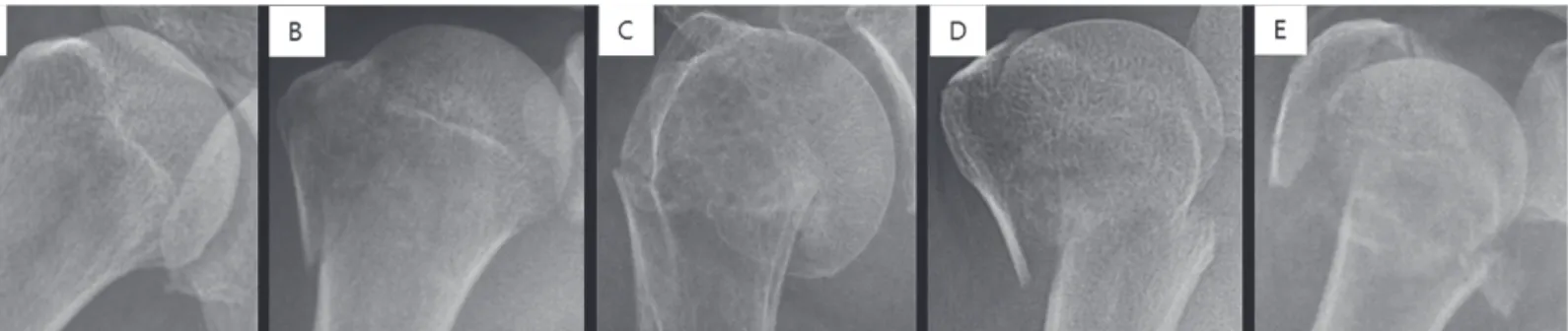
Each plain shoulder AP radiograph was manually cropped into a square in which the humeral head and neck were centered and constituted approximately 50% of the square image, resized to 256 × 256 pixels, and stored as a JPEG fi le (Figure 1).
Fracture classifi cation was performed by 2 shoulder ortho-pedic specialists with 14 and 17 years of experience (SWC and KSO) and 1 radiologist with expertise in musculoskel-etal diseases and 15 years of experience (NRK). For cases in which the 3 specialists could not agree, the corresponding CT images were checked (CTs were available for all fractures that failed consensus) and then re-discussed. If consensus still could not be achieved even after the evaluation of the CT image(s), the images were excluded from the dataset (n = 21). 346 cases were ultimately classifi ed as greater tuberosity frac-tures, 514 cases as surgical neck fracfrac-tures, 269 cases as 3-part fractures, and 247 cases as 4-part fractures. In addition, 515 cases without proximal humerus fractures were classifi ed as the normal group to evaluate the ability of the CNN to distin-guish between normal and fractured shoulders (Figure 1).
Training of the deep CNN and framework
We used and trained the deep CNN using the training dataset and validated it using the test dataset. The dataset of the 1,891 images was divided into 10 partitions without overlapping images. Among the 10 partitions, 1 partition was used as a test dataset, while all other images were used as training data-sets. Thus, for the 10 parts (1 partition = test dataset, the other 9 partitions and remnants = training dataset) 10 experiments were performed, after augmenting the training dataset. The entire training process was then repeated 3 times to adjust for possible deviations in the results. We ran Caffe 9 (http://caffe. berkeleyvision.org/) on Ubuntu 16.04 (https://www.ubuntu. com/download/desktop) with NVIDIA GTX 1070 (CUDA 8.0 and cuDNN 5.1) (https://developer.nvidia.com/cuda-zone and https://developer.nvidia.com/cudnn) and used the open source pre-trained Microsoft ResNet-152
(https://github.com/kaim-Figure 1. Each shoulder anteroposterior radiograph was manually cropped into a square in which the humeral head and neck are centered such that they comprise approximately 50% of the square image as illustrated above. Images were then resized to 256 × 256 pixels. Examples of normal and each fracture type: (A) normal, (B) greater tuberosity fracture, (C) surgical neck fracture, (D) 3-part fracture, and (E) 4-part fracture.
12479 Kim D.indd 469
Evaluation of the deep CNN algorithm
After training the deep CNN, we computed the top-1 accuracy. The deep CNN has to answer top-1 (the one with highest prob-ability) to compute the top-1 accuracy, which is the conven-tional accuracy for the deep CNN answer (top-1) being exactly the expected answer, among 5 choices of normal, greater tuberosity fracture, surgical neck fracture, 3-part fracture, and 4-part fracture. The deep CNN had to fi nd whatever differ-ences it could to make up criteria and defi ne the groups. Then, algorithm performance was measured using the area under the receiver operating curve (AUC) generated by plotting sensitiv-ity versus 1-specifi csensitiv-ity, which reported the best sensitivsensitiv-ity and specifi city that maximizes the sum of sensitivity and specifi c-ity. In addition, the Youden index (sensitivity + specifi city – 1) was calculated. The performance for discerning fractures from normal shoulders and for classifying fractures (the abil-ity to defi ne a certain fracture group (4 fracture group) after excluding normal shoulders from the test set) was evaluated using each value. For fracture type classifi cation, performance was measured only in the fracture images after excluding the normal shoulder images to evaluate the actual performance of fracture classifi cation, thus avoiding the possibility of overfi t-ting of the deep CNN by the inclusion of normal cases that are relatively easy to discern.
Evaluation of the diagnostic performance of human readers
To compare the performance in diagnosing and classifying the proximal humerus fracture between the CNN and human read-ers, we provided each reader with the same information as the CNN. The readers consisted of 3 groups of general physicians (n = 28), general orthopedists (n = 11), and orthopedists spe-cialized in shoulders (n = 19). The orthopedic surgeons mainly composed the human readers, as generally an orthopedic sur-geon both classifi es the fracture on radiographs and takes the decision to operate or not, and then performs surgeries. The 10 parts (181 images each) were converted into 10 image sheets (181 images each) containing the proximal humerus images without explanations (Figure 2, see Supplementary data).
Each reader then received 3 image sheets that were ran-domly selected using a randomization program (http://www. randomizer.org) and were requested to provide the most prob-able diagnosis of each image (543 (3 × 181) images) in the form of 1 to 5 (1, normal; 2, greater tuberosity fracture; 3, surgical neck fracture; 4, 3-part fracture; 5, 4-part fracture). We calculated the top-1 accuracy, AUC, sensitivity/specifi city, and Youden index for each group of human readers as with the CNN and then compared the values.
to report each value of the top-1 accuracy, AUC, sensitivity/ specifi city, and Youden index, which was described as a mean and a 95% confi dence interval (CI). Comparisons between the CNN and each human group were performed using a one-way analysis of variance, followed by Bonferroni post hoc analysis for multiple comparison with the signifi cance level set at p < 0.05.
Ethics, funding, and potential confl icts of interest
The study protocol was approved by the local ethics commit-tee (IRB no. KUH1060143) with a waiver of informed con-sent. This work was supported by Konkuk University in 2017. All authors declare no confl ict of interest.
Results
Deep learning CNN performance
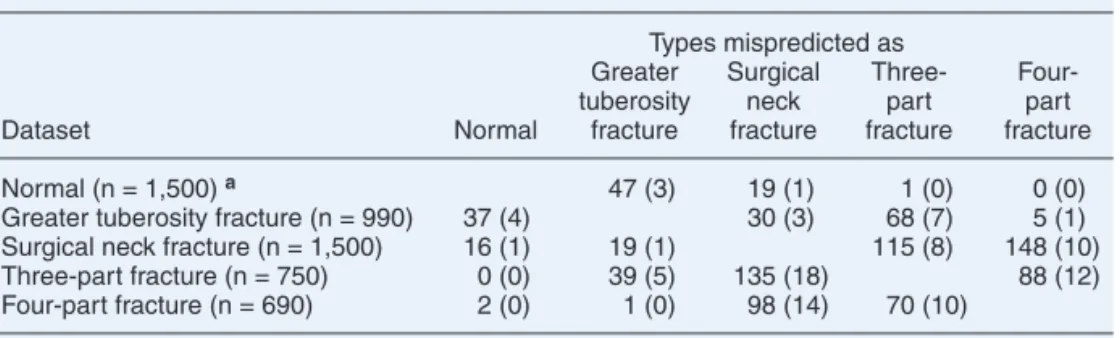
The top-1 accuracy of the deep learning CNN model in dis-tinguishing between normal and proximal humerus frac-tured shoulders exhibited more than 95% accuracy (96%, CI 94–97%). Among the proximal humerus fracture cases, the top-1 accuracy of the CNN model for distinguishing each frac-ture type from the other fracfrac-ture types was 86% (CI 83–88%) for greater tuberosity fractures, 80% (CI 77–83%) for surgical neck fractures, 65% (CI 59–71%) for 3-part fracture, and 75% (CI 71–79%) for 4-part fractures. The distribution of mispre-dicted cases in the CNN model is described in Table 1.
The deep learning CNN exhibited excellent diagnostic performance with an AUC of 0.996 (CI 0.995–0.998) for discerning normal cases from fracture cases. The CNN accu-rately classifi ed proximal humerus fractures with an AUC of 0.98 (CI 0.98–0.99) for greater tuberosity fractures, 0.94 (CI 0.93–0.94) for surgical neck fractures, 0.90 (CI 0.89–0.92) for 3-part fractures, and 0.94 (CI 0.93–0.94) for 4-part fractures. At the optimal cutoff point, the mean sensitivity/specifi c-ity in the CNN model were 0.99/0.97, 0.97/0.94, 0.90/0.85, 0.88/0.83, and 0.93/0.85 for normal versus all, greater tuber-osity, surgical neck, 3-part, and 4-part fractures, respectively. The mean Youden index of each group in the CNN model was as follows: normal, 0.97 (CI 0.96–0.97); greater tuberosity fracture, 0.90 (CI 0.88–0.92); surgical neck fracture, 0.75 (CI 0.73–0.77); 3-part fracture, 0.71 (CI 0.68–0.74); and 4-part fracture, 0.78 (CI 0.77–0.80).
Comparison between CNN and human reader perfor-mance (Tables 2 and 3 and Figure 3)
The CNN showed superior results in diagnosing proxi-mal humerus fractures compared with every human group,
although the comparison with the general orthopedist and shoulder orthopedist groups did not reach statistical signifi -cance (Table 2).
In addition, the CNN showed the highest performance for classifying proximal humerus fracture types among all fracture types except for greater tuberosity fractures, despite several comparisons with the shoulder orthopedist group not showing statistical signifi cance (Table 3, see Supplementary data).
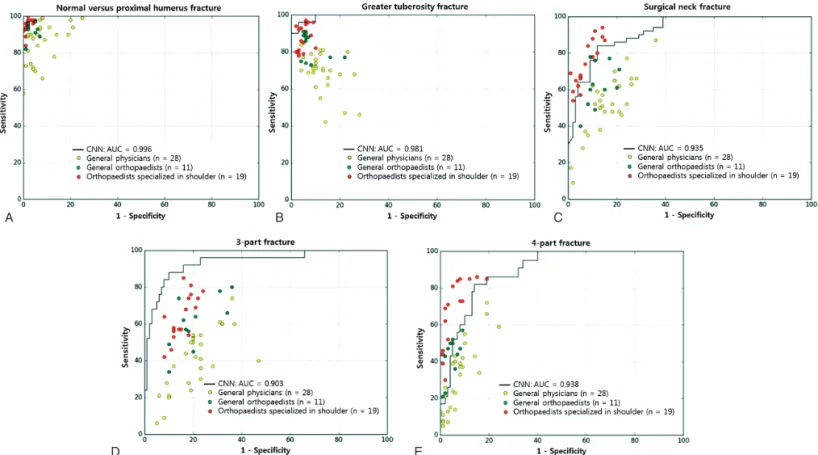
The diagnostic superiority of the CNN compared with the human groups was more marked in 3- and 4-part fractures (Table 3). The CNN was superior to a general physician or general orthopedist on comparing the diagnostic performance of CNN and each human group by overall distribution of the sensitivity/specifi city point per person on a receiver operating characteristic curve of the CNN (Figure 3).
Discussion
In this study, we demonstrate the very high performance of deep learning CNN in distinguishing normal shoulders from proximal humerus fractures. We additionally show promising results for classifying fracture type based on plain shoulder AP radiographs, with the deep learning CNN exhibiting supe-rior performance to that of general physicians and general
orthopedists and similar performance to that of the shoulder orthopedists. This indicates the possibility of automated diag-nosis and classifi cation of proximal humerus fractures and other fractures or orthopedic diseases diagnosed accurately using plain radiographs. As additional proximal humerus frac-tures would further enhance the diagnostic performance of the CNN, we think that the deep learning CNN may outperform even the shoulder orthopedists as data accumulate.
Moreover, we found higher performance of CNN, espe-cially in more complex type fractures such as 3- or 4-part frac-tures, compared with humans, which suggests the superiority of CNN for classifying fractures with various fracture shapes based on plain radiographs because humans have greater dif-fi culty, especially classifying complex fractures, but CNN performs relatively well. Since the number of images for the CNN training was smaller for 3- and 4-part fractures, the results seem more promising. With more training cases of 3- and 4-part fractures, the diagnostic performance of CNN for detecting and classifying complex fractures would improve. The higher performance of CNN for detecting and classify-ing proximal humerus fractures, especially complex frac-tures, may in part come from the fact that machine does not suffer from decreases in concentration and is consistent when presented with the same input data (i.e., the CNN will make the same prediction on a specifi c image every time) unlike
Table 1. Mispredicted cases in the convolutional neural network model. Values are n (%)
Types mispredicted as
Greater Surgical Three-
tuberosity neck part part
Dataset Normal fracture fracture fracture fracture
Normal (n = 1,500) a 47 (3) 19 (1) 1 (0) 0 (0)
Greater tuberosity fracture (n = 990) 37 (4) 30 (3) 68 (7) 5 (1) Surgical neck fracture (n = 1,500) 16 (1) 19 (1) 115 (8) 148 (10) Three-part fracture (n = 750) 0 (0) 39 (5) 135 (18) 88 (12) Four-part fracture (n = 690) 2 (0) 1 (0) 98 (14) 70 (10)
a 50 in each partition x three repetitions x 10 partitions
Table 2. Diagnostic accuracy for differentiating proximal humerus fractures from normal shoulders among the CNN and human groups. Values are mean (CI)
Orthopedists
General General specialized
CNN physician orthopedist in shoulder p-value
Top-1 accuracy (%) 96 (94–97) 85 (80–90) a 93 (90–96) 93 (87–99) < 0.001
Sensitivity 0.99 (0.99–1.00) 0.82 (0.78–0.87) a 0.93 (0.89–0.97) 0.96 (0.95–0.98) < 0.001
Specifi city 0.97 (0.97–0.98) 0.94 (0.93–0.96) a 0.97 (0.96–0.98) 0.98 (0.96–1.00) 0.002
Youden index 0.97 (0.96–0.97) 0.77 (0.72–0.82) a 0.90 (0.87–0.94) 0.94 (0.92–0.96) < 0.001
CNN, convolutional neural network
Youden index was calculated as [sensitivity + specifi city – 1].
a Statistically signifi cant in a comparison of CNN and each human group (results from a Bonferroni post hoc
analy-sis)
12479 Kim D.indd 471
humans, who are likely to make an error after a distorted pre-vious experience in fracture classifi cation (humans seem to have a tendency to guess right more often in a typical case but have diffi culty when the fracture confi guration is a less famil-iar shape) and through limited concentration. The machine can potentially be trained with an incredible amount of train-ing samples, vastly more than any orthopedist will experience in his/her lifetime, which results in an incomparable possibil-ity of deep learning CNN.
In addition, the diagnostic accuracy of CNN for classifying greater tuberosity fractures was the highest and that of 3-part fracture was the lowest. Greater tuberosity fractures exhibited a distinctive fracture line in the anatomical site of the greater tuberosity with a low variance in the fracture shape among greater tuberosity fractures, whereas all other fracture types in this study have fracture lines in the surgical neck site. We think this anatomical characteristic of the greater tuberosity frac-ture makes the detection of this fracfrac-ture type easier with a low error rate. Conversely, the 3-part fracture has a shape between that of a surgical neck fracture and a 4-part fracture. Thus, the
CNN seems to confuse more severe 3-part fracture cases with more displacement and angulation with 4-part fractures, while less severe 3-part fracture cases with less displacement and angulation, especially in the greater tuberosity fragments, are confused with surgical neck fractures.
This automated system for detecting and classifying proxi-mal humerus fractures has potential benefi ts, such as increased accuracy, consistent interpretation, effi ciency, near-instanta-neous reporting of results, reproducibility, and decreased bar-riers to access. Since a deep CNN algorithm can have mul-tiple operating points, its sensitivity and specifi city can be tuned to match the requirements of specifi c clinical settings, such as high sensitivity for a screening setting if necessary. With additional data, deep learning will facilitate diagnosis. Furthermore, we believe that the clinical application of deep learning for detection and classifi cation can be expanded to other orthopedic diseases that use radiographs for diagnosis.
Our study has several limitations. First, even though the Neer classifi cation is the most commonly used tool for proximal humerus fracture classifi cation, it has only fair to moderate
Figure 3. The diagnostic performance between the CNN and each human group was compared using the receiver operating characteristics curves of the CNN and the sensitivity–specifi city distribution of each human group to differentiate normal shoulders from proximal humerus fractures (A) and to classify each fracture type: (B) greater tuberosity fracture, (C) surgical neck fracture, (D) 3-part fracture, and (E) 4-part fracture.
CNN = convolutional neural network; AUC = area under curve of the receiver operating characteristics curve.
The representative receiver operating characteristics curve of the CNN was selected as the curve with the closest AUC value to the average AUC.
The dots on the plots represent the sensitivity and specifi city of each group (yellow, general physicians; green, general orthopedists; red, orthopedists specialized in the shoulder). All AUCs for the normal shoulder and each fracture type were over 90%. The CNN achieved superior performance at least to a general physician (yellow dot) or to a general orthopedist (green dot), most of whose sensitivity/specifi city point lay below the receiver operating characteristic curve of the CNN.
A B
D E
reliability, and there is no gold standard for proximal humerus fracture classification. Development of a more reliable classi-fication system for proximal humerus fracture could enhance the reliability in classification of the deep learning algorithm. However, the promising result of this study in detecting and classifying proximal humerus fracture by using a deep learn-ing algorithm does not mean that it can be used immediately in clinical practice. This study was not to guide treatment. This study only has the significance that we showed the possibil-ity of the future use of this deep learning algorithm even in the field of orthopedic surgery or traumatology. CNNs that consistently classify fractures could be a giant leap forward. Second, we evaluated the diagnostic performance of CNN based on a cropped single shoulder AP radiograph to keep this project simple, which may not actually reflect a clinically relevant scenario because a fracture evaluation would involve at least 2 radiographs under review. However, the evaluations based on various shoulder radiographs or CT images may enhance the diagnostic performance of CNN as well. Finally, the images were down-sampled to 256 × 256 pixels before they were fed into the network because of the sheer number of parameters inherent to the networks. The diagnostic accuracy may be improved using higher-resolution images. More devel-opment on the memory of graphics processing units would allow larger matrix sizes without increasing the training time. In addition, the lossy JPEG compression may influence the image quality. It may be better to use non-lossy compression such as PNG or TIFF.
In conclusion, the use of artificial intelligence can accu-rately detect and classify proximal humerus fractures on plain shoulder AP radiographs. Further studies are necessary to determine the feasibility of applying artificial intelligence in the clinic and whether its use could improve care and out-comes compared with current orthopedic assessments. Supplementary data
Figure 2, Table 3 and the Appendix are available as supple-mentary data in the online version of this article, http://dx.doi. org/ 10.1080/17453674.2018.1453714
Supervision: SWC, YK. Conception and design: SWC, SSH, JWL, K-SO, NRK, YK. Acquisition of data: SWC, JWL, K-SO, JPY, JYK, SHM, JK, H-JL, Y-MN. Analysis and interpretation of data: SWC, SSH, NRK, JPY, JYK, SHM, JK, H-JL, Y-MN, YK.
This work was supported by Konkuk University in 2017 and the KIST Institutional program (2E27990)
Acta thanks Max Gordon and other anonymous reviewers for help with peer review of this study.
Bengio Y, Courville A, Vincent P. Representation learning: a review and new perspectives. IEEE Trans Pattern Anal Mach Intell 2013; 35(8): 1798-828. Esteva A, Kuprel B, Novoa R A, Ko J, Swetter S M, Blau H M, Thrun S. Der-matologist-level classification of skin cancer with deep neural networks. Nature 2017; 542(7639): 115-18.
Foroohar A, Tosti R, Richmond J M, Gaughan J P, Ilyas A M. Classification and treatment of proximal humerus fractures: inter-observer reliability and agreement across imaging modalities and experience. J Orthop Surg Res 2011; 6: 38.
Gulshan V, Peng L, Coram M, Stumpe M C, Wu D, Narayanaswamy A, Venu-gopalan S, Widner K, Madams T, Cuadros J, Kim R, Raman R, Nelson P C, Mega J L, Webster D R. Development and validation of a deep learn-ing algorithm for detection of diabetic retinopathy in retinal fundus photo-graphs. JAMA 2016; 316(22): 2402-10.
Hua K L, Hsu C H, Hidayati S C, Cheng W H, Chen Y J. Computer-aided classification of lung nodules on computed tomography images via deep learning technique. Onco Targets Ther 2015; 8: 2015-22.
Kooi T, Litjens G, van Ginneken B, Gubern-Merida A, Sanchez C I, Mann R, den Heeten A, Karssemeijer N. Large scale deep learning for computer aided detection of mammographic lesions. Med Image Anal 2017; 35: 303-12.
Lakhani P, Sundaram B. Deep learning at chest radiography: automated clas-sification of pulmonary tuberculosis by using convolutional neural net-works. Radiology 2017; 284(2): 574-82.
LeCun Y, Bengio Y, Hinton G. Deep learning. Nature 2015; 521(7553): 436-44.
Mora Guix J M, Pedros J S, Serrano A C. Updated classification system for proximal humeral fractures. Clin Med Res 2009; 7(1-2): 32-44.
Neer C S, 2nd. Displaced proximal humeral fractures, I: Classification and evaluation. J Bone Joint Surg Am 1970; 52(6): 1077-89.
Olczak J, Fahlberg N, Maki A, Razavian A S, Jilert A, Stark A, Sköldenberg O, Gordon M. Artificial intelligence for analyzing orthopedic trauma radio-graphs. Acta Orthop 2017; 88(6): 581-6.
Russakovsky O, Deng J, Su H, Krause J, Satheesh S, Ma M, Huang Z, Karpa-thy A, Khosla A, Bernstein M, Berg A C, Fei-Fei L. ImageNet large scale visual recognition challenge. Int J Comput Vis 2015; 115(3): 211-52. Shin H C, Orton M R, Collins D J, Doran S J, Leach M O. Stacked
autoencod-ers for unsupervised feature learning and multiple organ detection in a pilot study using 4D patient data. IEEE Trans Pattern Anal Mach Intell 2013; 35(8): 1930-43.
Wang S, Summers R M. Machine learning and radiology. Med Image Anal 2012; 16(5): 933-51.