Vol. 11, No. 1 December, 2009, 1-7
Preparation and Characterization of Proton Conducting Membranes by
Blending PVC-g-PHEA and PVA
Jong Kwan Koh, Jin Kyu Choi, Jin Ah Seo, Xiaolei Zeng, and Jong Hak Kim†
Department of Chemical and Biomolecular Engineering, Yonsei University, 262 Seongsanno, Seodaemun-gu, Seoul 120-749, Korea
(Received November 13, 2009, Accepted December 14, 2009)
Abstract: This work reports the preparation of proton conductive crosslinked polymer electrolyte membranes by blend-ing poly(vinyl chloride)-g-poly(hydroxyl ethyl acrylate) (PVC-g-PHEA) and poly(vinyl alcohol) (PVA). The PHEA chains of the graft copolymer were crosslinked with PVA using sulfosuccinic acid (SA) via the esterification reaction between -OH of polymer matrix and -COOH of SA. The PVC-g-PHEA graft copolymer was synthesized via atom transfer radical polymer-ization (ATRP) using direct initiation of the secondary chlorines of PVC backbones. Ion exchange capacity (IEC) con-tinuously increased with increasing concentrations of SA, due to the increasing portion of charged groups in the membrane. However, the water uptake increased up to 20.0 wt% of SA concentration above which it decreased monotonically. The membrane exhibited a maximum proton conductivity of 0.026 S/cm at 20.0 wt% of SA concentration, which is presumably due to competitive effect between the increase of ionic sites and the crosslinking reaction.
Keywords: polymer electrolyte membrane, graft copolymer, poly(vinyl alcohol), crosslinking, proton conductivity
1. Introduction
1)
Solid polymer electrolytes is a material which com-prises metal salts dissolved in a polymeric matrix or the polymer backbones with covalently bonded ionizing groups attached to them. Polymer electrolytes have recently been of technological interest for the possible applications to energy conversion units such as ba-tteries, fuel cells, solar cells, electrochromic display de-vices and facilitated transport membranes [1-4]. Dur-ing the last decades, poly(vinyl chloride) (PVC) based polymer electrolytes have got their popularity in various applications due to their easy processibility, low cost and good compatibility with other compo-nents. However, only a few studies have been reported on the PVC based polymer electrolytes for proton con-ducting membranes.
†Author for all correspondences
(e-mail:[email protected])
During the past decades, sulfonated polymers have received much attention due to their significant techno-logical use as ion-exchange resins, electrodialysis, bi-polar membranes, sensors, and dehydration. Especially, sulfonated polymer membranes have been extensively investigated for the applications to fuel cells, as can be seen from the number of research papers [5-12]. The commercially available membranes in fuel cells are mostly based on perfluorosulfonic polymers such as Nafion, Gore-Select, Aciplex, Xus and Flemiom. They exhibited the excellent thermal and mechanical proper-ties as well as high proton conductivity (around 0.1 S/cm at room temperature). However perfluorosulfonic polymers have some limitations such as high methanol permeability and high cost. Therefore, there has been a great deal of research into alternative sulfonated poly-meric materials [13-21].
Here, a graft copolymer consisting of poly(vinyl chlor-ide) (PVC) backbone and poly(hydroxyl ethyl acrylate)
(PHEA) side chains was synthesized via atom transfer radical polymerization (ATRP). This graft copolymer was solution blended with poly(vinyl alcohol) (PVA) and thermally crosslinked with sulfosuccinic acid (SA), producing proton conducting crosslinked polymer elec-trolyte membranes. Several characteristics of the re-sultant polymer electrolyte membranes, e.g. ionic ex-change capacity (IEC), water uptake and proton con-ductivity are reported in this paper.
2. Experimental
2.1. Materials
PVC (Mn = 55,000 g/mol, Mw = 97,000 g/mol), 2-
hydroxy ethyl acrylate (HEA, 99%), poly(vinyl alco-hol) (PVA), 1,1,4,7,10,10-hexamethyltriethylenetetramine (HMTETA, 99%), copper (I) chloride (CuCl, 99%) and sulfosuccinic acid (70 wt% in water) were purchased from Aldrich. All solvents and chemicals were regent grade, and used as received.
2.2. Synthesis of PVC-g-PHEA Graft Copolymer
Schematic procedure for the synthesis of PVC-g-PHEA graft copolymer is presented in Scheme 1. Two grams of PVC was dissolved in 18 mL of NMP in a round flask at 70°C. Then, 3.0 mL of HEA, 0.04 g of CuCl and 0.1 mL of HMTETA were added to the solution and the reaction flask was sealed with a rubber septum. After N2 purging for 30 min, the reaction
ves-sel was immersed in an oil bath at 70°C. The reaction was allowed to proceed for 24 h. After passing the solution through a column with activated Al2O3 to
re-move the catalyst, it was precipitated into methanol. The polymer was purified by redissolving in DMSO and reprecipitating in methanol. Finally, the polymer was dried in a vacuum oven overnight at room tem-perature. The product was gained as a form of powder and the grafting ratio was 15.0 wt%.
Scheme 1. ATRP for the synthesis of PVC-g-PHEA graft copolymer.
2.3. Preparation of Crosslinked PVC-g-PHEA/ PVA Membranes
Different amounts of PVC-g-PHEA and PVA were dissolved in DMSO with stirring. After making homo-geneous solution, the different amounts of SA were added into the polymer solution and stirred for more than 2 h. The polymer mixtures were then cast on a Teflon-coated glass dish, and dried in an oven at 80°C for two days. The obtained membranes were peeled off from the dishes and then annealed at 130°C for 3 h for crosslinking reaction. The membranes were washed with water several times to remove unreacted SA.
2.4. Ion Exchange Capacity (IEC)
IEC of the membranes was measured by the classi-cal titration method. The membranes were soaked in 1.0 M NaCl solution for 24 h before measuring IEC. The protons released due to the exchange reaction with Na ions were titrated against 0.01 M standardized NaOH solution, using phenolphthalein indicator. The experimental IEC of the membranes was calculated us-ing the followus-ing equation.
(1)
where X is the volume of NaOH consumed and NNaOH
Scheme 2. Schematic procedure for the preparation of crosslinked PVC-g-PHEA/PVA membranes. 2.5. Water Uptake
Water uptake was determined by weighing vacuum dried membrane and fully equilibrated membrane with water. The surface of the membrane sample was quick-ly wiped with an absorbent paper to remove the excess of water adhering to it and the sample was then weighed. The water uptake of the membrane was de-termined from
(2)
where Ww and Wd are the weights of wet and dried
membranes, respectively.
2.6. Proton conductivity
A four-point probe method was used to measure the proton conductivity of the membranes using home made conductivity cell. Before the measurement of proton conductivity, the prepared membranes were equilibrated with deionized water. Complex impedance measure-ments were carried out in the frequency range 1 Hz-8 MHz at 25°C, using a ZAHNER IM-6 impedance analyzer. The impedance spectra of the membranes can
be used to generate Nyquist plots, and the proton con-ductivity was calculated from the plots [21,22].
2.7. FT-IR Measurement
FT-IR spectra were recorded Excalibur Series FTIR (DIGLAB Co.) instrument between the frequency range of 4000 to 400 cm-1 using ATR facility.
3. Results and Discussion
Scheme 1 shows the synthesis of PVC-g-PHEA graft copolymer. PVC backbone was directly grafted with HEA monomer at 70°C for 24 h through ATRP tech-nique. The amphiphilic PVC graft copolymer is ex-pected to molecularly self-assemble into continuous nanophase domains of semicrystalline PVC interweaved with hydrophilic domains of PHEA brush layer, pro-viding a mechanism for facile proton transport through the membranes.
The synthetic procedure for crosslinked PVC-g-PHEA/ PVA membranes is illustrated in Scheme 2. The as- synthesized PVC-g-PHEA graft copolymer was solution blended with PVA and thermally crosslinked with SA
Fig. 1. FT-IR spectra of PVC, HEA and PVC-g-PHEA.
Fig. 2. FT-IR spectra of PVC-g-PHEA/PVA membrane before and after crosslinking.
at 130°C for 3 hours via the esterification between the -OH of PHEA/or PVA and the -COOH of SA. Because SA contains sulfonic acid groups, the crosslinked PVC- g-PHEA/PVA membranes possess proton conducting properties.
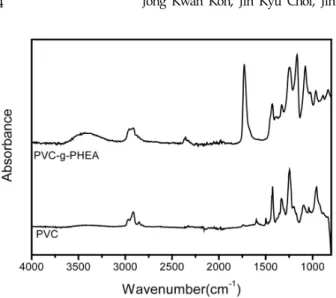
Fig. 1 shows the FT-IR spectra of pristine PVC and PVC-g-PHEA graft copolymer. The absorption bands at 1,728 and 1,167 cm-1 of PVC-g-PHEA graft copoly-mer are assigned to the carbonyl stretching vibration of PHEA, implying successful graft copolymerization from PVC. The broad band at 3,434 cm-1 is due to the hy-droxyl group of PHEA in the graft copolymer. Fig. 2 shows the FT-IR spectra of PVC-g-PHEA/
Fig. 3. IEC values of crosslinked PVC-g-PHEA/PVA membranes as a function of SA concentration.
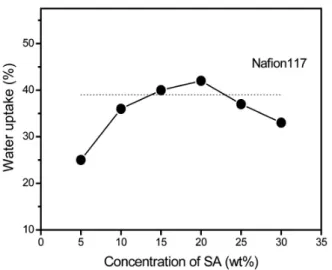
PVA membranes with various ratios after crosslinking at 130°C for 3 h. Upon crosslinking of membranes, two stretching bands at 1,730 and 1,162 cm-1 grew up, attributable to the formation of -C=O and C-O in the membranes, respectively [23]. This result supports the crosslinking reaction of the membranes by the ester-ification between -OH of PHEA and -COOH of SA [24,25]. The shoulder peak at 1,230 cm-1 is due to the stretching vibration of the sulfonic acid groups of SA. Fig. 3 shows the IEC values of crosslinked PVC-g- PHEA/PVA membranes as a function of SA concen-tration. The IEC values continuously increased with in-creasing amounts of SA, resulting from the increased portion of charged groups in the membrane. The mem-brane with 30 wt% of SA exhibited 1.1 meq/g of IEC value, which is higher than the IEC of Nafion 117. The high IEC value of the crosslinked PVC-g-PHEA/ PVA membranes represent that the higher amounts of sulfonic acid groups are contained in the membranes. Fig. 4 presents the water uptake of crosslinked PVC-g- PHEA/PVA membranes with the different amounts of SA. Upon the introduction of SA 5 wt%, the membrane exhibited 25% of water uptake. The water uptake of membranes gradually increased with SA concentration up to 20 wt% of SA concentration, after which they decreased monotonically. In general, water uptake is linearly proportional to the concentration of
Fig. 4. Water uptake of crosslinked PVC-g-PHEA/PVA membranes as a function of SA concentration.
ionic SO3- groups, i.e. IEC value. In this work,
how-ever, the water uptake was not increased linearly with SA content, which was not consistent with the behav-ior of IEC values shown in Fig. 3. It may be ex-plained by the fact that the introduction of SA pro-duces crosslinking of the membranes, resulting in more rigid and compact structures of membranes. Thus, wa-ter uptake of membranes was decreased to some de-gree at higher content of SA.
The proton conductivities of crosslinked PVC-g-PHEA/ PVA membranes at room temperature are presented in Fig. 5 as a function of the concentration of SA. As shown, proton conductivities were significantly depend-ent upon the SA concdepend-entration, i.e. the contdepend-ents of acidic SO3- groups and the degree of crosslinking. The
proton conductivity of membranes was initially in-creased with SA concentration up to 20 wt%, after which it is gradually decreased. This behavior is attrib-utable to the competitive effect between the increase of ionic sites and the crosslinking reaction, according to the SA concentration. Overall, the proton conductivities of crosslinked PVC-g-PHEA/PVA membranes were in the order of 10-3∼10-2 S/cm at room temperature. A maximum proton conductivity of 0.026 S/cm was ach-ieved at 20.0 wt% of SA concentration.
Fig. 5. Proton conductivity of crosslinked PVC-g-PHEA/ PVA membranes as a function of SA concentration.
4. Conclusion
PVC-g-PHEA graft copolymer was synthesized via ATRP process using PVC backbone as a macroini-tiator. The proton conducting crosslinked membranes were developed by blending the PVC-g-PHEA graft copolymer and PVA, followed by thermal crosslinking reaction with SA. The IEC values continuously in-creased with increasing SA concentrations whereas the water uptake increased up to 20.0 wt% of SA concen-tration above which it decreased monotonically. In ac-cord with water uptake, the proton conductivity of crosslinked PVC-g-PHEA/PVA membranes at room temperature increased up to 20.0 wt% of SA concen-tration, above which it decreased. A maximum proton conductivity of crosslinked PVC-g-PHEA/PVA mem-branes was achieved as 0.026 S/cm at 20.0 wt% of SA concentration. This maximum behavior was elucidated in terms of competitive effect between the increase of ionic sites and the crosslinking reaction with increasing SA concentrations.
Acknowledgement
This work was supported by the Korea Science and Engineering Foundation (KOSEF) grant funded by the Korea government (MEST) (R11-2007-050-04003-0) and
New & Renewable Energy R&D program (2009T100- 100606) under the Ministry of Knowledge Economy, Republic of Korea.
References
1. P. E. Trapa, B. Huang, Y.-Y. Won, D. R. Sadoway, and A. M. Mayes, Block Copolymer Electrolytes Synthesized by Atom Transfer Radical Polymeriza-tion for Solid-State, Thin-Film Lithium Batteries, Electrochem. Solid-State Letters, 5, A85 (2002). 2. J. H. Kim, M. S. Kang, Y. J. Kim, J. Won, N. G.
Park, and Y. S. Kang, “Dye- Sensitized Nanocry-stalline Solar Cells Based on Composite Polymer Electrolytes Containing Fumed Silica Nanopar-ticles”, Chem. Commun., 14, 1662 (2004).
3. S. W. Kuo, C. H. Wu, and F. C. Chang, “Thermal Properties, Interactions, Morphologies, and Conduc-tivity Behavior in Blends of Poly(vinylpyridine)s and Zinc Perchlorate”, Macromolecules, 37, 192 (2004).
4. J. H. Kim, B. R. Min, J. Won, S. H. Joo, H. S. Kim, and Y. S. Kang, “Role of Polymer Matrix in Polymer/Silver Complexes for Structure, Interac-tions, and Facilitated Olefin Transport”, Macromol-ecules, 36, 6183 (2003).
5. J.-H. Choi, P.-H. Kang, Y.-M. Lim, J.-Y. Sohn, J.-H. Shin, C.-H. Jung, J.-P. Jeun, and Y.-C. Nho, “Preparation and Characterization of Poly(styr-enesulfonic acid)-grafted Fluoropolymer Membrane for Direct Methanol Fuel Cell”, Korean Membr. J. 9, 52 (2007).
6. L. Depre, M. Ingram, C. Poinsignon, and M. Popall, “Proton conducting sulfon/sulfonamide functional-ized materials based on inorganic-organic matrices”, Electrochim. Acta, 45, 1377 (2000).
7. S. D. Mikhailenko, K. Wang, S. Kaliaguine, P. Xing, G. P. Robertson, and M. D. Guiver, “Proton conducting membranes based on cross-linked sulfo-nated poly(ether ether ketone) (SPEEK)”, J. Membr. Sci., 233, 93 (2004).
8. C. H. Park, C. H. Lee, Y. S. Chung, and Y. M. Lee, “Preparation and Characterization of Cross-linked Block and Random Sulfonated Polyimide Membranes for Fuel Cell”, Membrane Journal, 16, 241 (2006).
9. D. J. Kim, B.-J. Chang, C. K. Shin, J.-H. Kim, S.-B. Lee, and H.-J. Joo, “Preparation and Chara-cterization of Fluorenyl Polymer Electrolyte Mem-branes Containing PFCB Groups”, Membrane Journal, 16, 16 (2006).
10. S.-L. Chen, J. B. Benziger, A. B. Bocarsly, and T. Zhang, “Photo-Cross-Linking of Sulfonated Styrene- Ethylene-Butylene Copolymer Membranes for Fuel Cells”, Ind. Eng. Chem. Res., 44, 7701 (2005). 11. J. R. Varcoe, R. C. T. Slade, E. L. H. Yee, S. D.
Poynton, D. J. Driscoll, and D. C. Apperley, “Poly (ethylene-co-tetrafluoroethylene)-Derived Radia-tion-Grafted Anion-Exchange Membrane with Pro-perties Specifically Tailored for Application in Metal- Cation-Free Alkaline Polymer Electrolyte Fuel Cells.,” Chem. Mater., 19, 2686 (2007).
12. Z. Li, J. Ding, G. P. Robertson, and M. D. Guiver, “A Novel Bisphenol Monomer with Grafting Capa-bility and the Resulting Poly(arylene ether sul-fone)s”, Macromolecules, 39, 6990 (2006). 13. C. Manea and M. Mulder, “Characterization of
po-lymer blends of polyethersulfone/sulfonated poly-sulfone and polyetherpoly-sulfone/sulfonated polyethere-therketone for direct methanol fuel cell applica-tions”, J. Membr. Sci., 206, 443 (2002).
14. J. H. Choi, C. K. Yeom, J. M. Lee, and D. S. Suh, “Nanofiltration of Electrolytes with Charged Co-mposite Membranes”, Membrane Journal, 13, 29 (2003).
15. C. Heitner-Wirguin, “Recent advances in perfluo-rinated ionomer membranes: structure, properties and applications”, J. Membr. Sci., 120, 1 (1996). 16. D. K. Lee, Y. W. Kim, J. K. Choi, B. R. Min,
and J. H. Kim, “Preparation and Characterization of Proton Conducting Crosslinked Diblock Copoly-mer Membranes”, J. Appl. Polym. Sci., 107, 819
(2008).
17. Y. W. Kim, J. K. Choi, J. T. Park, and J. H. Kim, “Proton Conducting Poly(vinylidene fluoride-co- chlorotrifluoroethylene) Graft Copolymer Electrolyte Membranes”, J. Membr. Sci., 313, 315 (2008). 18. Z. Wang, H. Ni, C. Zhao, X. Li, T. Fu, and H.
Na, “Investigation of sulfonated poly(ether ether ketone sulfone)/heteropolyacid composite membranes for high temperature fuel cell applications”, J. Polym. Sci. B: Polym. Phys., 44, 1967 (2006). 19. T. Z. Fu, C. J. Zhao, S. L. Zhong, G. Zhang, K.
Shao, H. Q. Zhang, J. Wang, and H. Na, “SPEEK/ epoxy resin composite membranes in situ polymer-ization for direct methanol fell cell usages”, J. Power Sources, 165, 708 (2007).
20. Y. S. Kim, F. Wang, M. Hickner, T. A. Zawodzinski, and J. E. McGrath, “Fabrication and character-ization of heteropolyacid (H3PW12O40)/directly
poly-merized sulfonated poly(arylene ether sulfone) co-polymer composite membranes for higher temper-ature fuel cell applications”, J. Membr. Sci., 212, 263 (2003).
21. J. K. Choi, D. K. Lee, Y. W. Kim, B. R. Min, and J. H. Kim, “Composite Polymer Electrolyte
Membranes Comprising Triblock Copolymer and Heteropolyacid for Fuel Cell Applications”, J. Polym. Sci. B. Polym. Phys., 46, 691 (2008). 22. J. T. Park, K. J. Lee, M. S. Kang, Y. S. Kang, and
J. H. Kim, “Nanocomposite Polymer Electrolytes Containing Silica Nanoparticles: Comparison be-tween Poly(ethylene glycol) and Poly(ethylene ox-ide) dimethyl ether”, J. Appl. Polym. Sci., 106, 4083 (2007).
23. J. H. Kim, B. R. Min, K. B. Lee, J. Won, and Y. S. Kang, “Coordination Structure of Various Ligands in Crosslinked PVA to Silver Ions for Facilitated Olefin Transport”, Chem. Commun., 2732 (2002). 24. D. S. Kim, H. B. Park, J. W. Rhim, and Y. M.
Lee, “Preparation and characterization of cross-linked PVA/SiO2 hybrid membranes containing
sul-fonic acid groups for direct methanol fuel cell ap-plications”, J. Membr. Sci., 240, 37 (2004).
25. J.-W. Rhim, H. B. Park, C.-S. Lee, J.-H. Jun, D. S. Kim, and Y. M. Lee, “Crosslinked poly(vinyl alcohol) membranes containing sulfonic acid group: proton and methanol transport through membranes”, J. Membr. Sci., 238, 143 (2004).