The Defect Inspection of Irradiated Fuel Rods using
Differential Encircling Coil Probe
Dae-Seo Koo, Song-Yeul Yang, Eun-Po Lee, Young-Bum Chun, Jung-Won Lee Korea Atomic Energy Research Institute
[email protected], [email protected], [email protected], [email protected], [email protected] 1. Introduction
The defective fuels of nuclear reactors, which affect the safety of nuclear reactor operation, are inspected using ECT(Eddy Current Test). ECT, which inspects the defects in fuel rods through eddy current due to electromagnetic induction law, is an effective method acquiring defect shape, defect size in fuel rods and defect location[1-5]. In this study, the eddy current test on the fuel rods, which are irradiated in Young Kwang 4 reactor, is performed, and the defect signals of fuel rods are acquired and the integrity of the fuel rods is evaluated, and the reliability of the eddy current test is confirmed by comparing the results of ECT with those of visual inspection. These PIE(Post Irradiation Examination) data are available for reactor operation and the design of nuclear fuels.
2.Experiment Apparatus and Measurement The eddy current test system is composed of differential encircling coil probe inside hotcell and main equipment, signal processing device outside hot cell. The main equipment of test current test system excites the frequency in encircling coil and induces eddy current on the cladding of fuel rods. As the eddy current due to the defects of fuel rods varies, the variation of coil impedance comes to the defect signals of eddy current. The amplification of these eddy current signals is displayed on CRT. These impedance signals of main equipment are divided into resistance, reactance component and connected PC through A/D converter. The A/D converter has a resolution of 12 bits and the program for collecting and analyzing the eddy current signals is manufactured using C language. The operations of upper/lower direction and rotational direction of fuel rods are carried out and test locations of fuel rods are displayed with real time by fabricating the control device of step motor.
The fuel rods for test are fuel rods with 2.365%, 3.350% of U-235 enrichment, which are irradiated in Young Kwang 4 reactor. The ECT on these fuel rods are performed with test frequency 100-400kHz, gain 1.0-0.03125, optimal frequency 200kHz using differential encircling coil probe and the defect signals of eddy current are stored and the data are printed. Fig. 1 show the defect signals of eddy current on B208-R8.
Figure 1. ECT signals of fuel rod B208-R8.
3. Results and Discussion
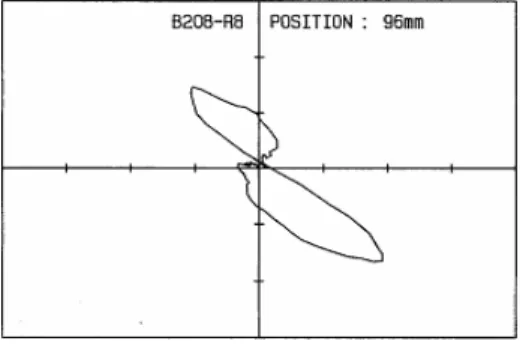
The results of ECT on B208-R8 fuel rod show the defect signal of ECT at 96 mm from the bottom of the fuel rod. This defect is predicted as through-hole by analyzing impedance phase angle in impedance plane in Fig. 2. The predicted through-hole of ECT is confirmed by comparing the results of ECT with those of visual inspection in Fig. 3.
Figure 2. Impedance plane on 96mm from fuel rod B208-R8 bottom end.
Figure 3. Photograph of fuel rod B208-R8.
Transactions of the Korean Nuclear Society Autumn Meeting Busan, Korea, October 27-28, 2005
Figure 4. ECT signals of fuel rod D103-K2.
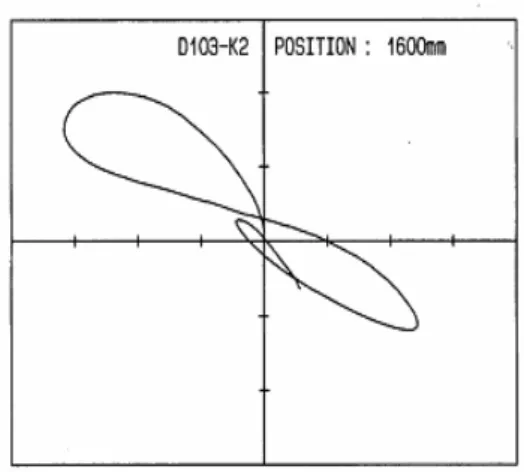
From Fig. 4, the results of ECT on D103-K2 fuel rod show the defect signals of ECT at 284, 1160, 1410 and 1600 mm from the bottom of the fuel rod. The reactance and resistance components of defect signals at 1610 and 1600 mm are saturated respectively, while those of defect signal at 284 mm are small. The Fig.5-7 show impedance planes of these defect signals at 1160, 1410 and 1600 mm. The defect signal at 1160 mm is predicted as the through-hole and those at 1410 and 1600 mm as hydrides respectively.
Figure 5. Impedance plane on 1160mm from fuel rod D103-K2 bottom end.
Figure 6. Impedance plane on 1410mm from fuel rod D103-K2 bottom end.
Figure 7. Impedance plane on 1600mm from fuel rod D103-K2 bottom end.
Thus, defect signals on the cladding of fuel rods were detected and the phase angle of the impedance are analyzed. The defect shapes, defect sizes and defect locations on fuel rods are acquired from the impedance planes. It is confirmed that the method of the ECT using the differential encircling coil enables to evaluate the integrity of irradiated fuel rods by comparing the results of ECT with those of visual inspection.
4. Conclusion
1. The defect signals of ECT on fuel rods, which are irradiated at Young Kwang 4 reactor, are detected at optimal frequency 200kHz and the defect shapes are predicted and are confirmed by comparing the results of ECT with those of visual inspection.
2. The defect shapes, defect sizes and defect locations on irradiated fuel rods, using the differential encircling coil probe are acquired. 3. It is confirmed that the method of the ECT enables to evaluate the integrity of irradiated fuel rods in real time.
REFERENCES
[1] E. M. Frankin, R. D. Phiss, "Eddy-Current Cladding Integrity Testing and Data Analysis," Hot Cell Examination and Maintenance Equipment, ANS, V. 33, No. 11-15, p. 906-907, 1979.
[2] R. D. Phipps, R. E. Kleiss, and J. B. Coughlan,"Eddy-Current Examination of Irradiated Elements at HFEF," Proc. 25th Conf. Remote Syst. Technol., p. 245, 1977.
[3]G.V.Drunen, V. S. Cecco, "Recognition Limitation in Eddy-Current Testing," NDT INTERNATIONAL, V. 17, No. 1, p. 210-213, 1975.
[4] D. J. Hagemaier, "Eddy Current Impedance Plane Analysis," Materials Evaluation, V. 41, p.
211-218, 1983.
[5] F. R. Bareham, B. Sc., and A. Inst. P., "Choice of Frequency for Eddy-Current Tube Testing," British Journal of Applied Physics, V.11, p. 218-222, 1960.