1. Introduction
Clinical dental hygiene is an internationally standardized curriculum in which students in the department of dental hygiene understand the dental hygiene management process and learn evidence-oriented studies1). Clinical
dental hygiene is also an integrated curriculum that learns practical practices and theories that require expertise related to various clinical areas as dental hygienists such as specialized dental plaque management process, preventive treatment, and comprehensive periodontal care based on understanding patientsʼ health and oral needs2,3).
In particular,this subject is addressed as a very important part of the Acton Medical Technicians, etc. of Dental Hygiene4), including the removal of dental calculus or
scaling practice, which is directly related to the practical examination of the Dental Hygiene Examination5).
Therefore, a lot of time is invested in theory and
practice education on scaling in clinical dental hygienics curriculum. Looking at Choiʼs research6), the theory
and practice of probe were operated for an average of 6. 6 hours in clinical dental hygiene education as a subject of practice needed for the operation of hand instrument, or scaling. The theory and practice for the application of hand instrument, such as scaler and curets, were conducted 64. 4hours, while the actual subject practice, including scaling (hand instrument, ultrasonic instrument), was found to be running 100. 4 hours on average. In addition, a total of 34.1 hours of hand instrument practice and evaluation were conducted to prepare for the national test. As such, the importance of scaling practice by operating the periodontal instrument in clinical dental hygiene courses can be seen as a major factor. This is because the scaling proficiency of dental hygienists is stated as the core basic hygiene competency of dental hygienists and is evaluated as the greatest competence of dental hygienists after graduation7), and is directly related to the elimination of
national exams8). In addition, an investigation of what
is the most skilled practical ability of dental hygienists to perform in dental hygienistsʼ core basic hygiene skills
대한치위생과학회지
Vol. 3, No. 2, 2020
Doi : 10.22753/JKDHS/2020.3.2.39
A Study on the Change of Clinical Self-Confidence according
to the Number of Clinical Dental Hygiene Practices of
Students in the Department of Dental Hygiene
Focusing on scaling practices
-최용금
1·김미선
2·정수라
3·김은정
4* 선문대학교 건강보건대학 치위생학과 및 유전체 기반 바이오 IT 융합연구소1· 경동대학교 치위생학과2·이화여자대학교 신산업융합대학 융합보건학과3·강동대학교 치위생과4 접수일: 2020년 12월 7일 최종수정일: 2020년 12월 24일 게재 확정일: 2020년 12월 26일 교신저자: 김은정, (27600) 충북 음성군 감곡면 대학길 278 강동대학교 치위생과 Tel: 043-879-3416, Fax: 043-879-3411 E-mail: [email protected]showed that they were definitely capable of performing dental calculus removal using ultrasonic instrument, and that the most important ability of dental hygienists to perform clinical procedures before graduation was performing ultrasonic instrument7). Therefore, in
the clinical dental hygienic curriculum, it is a very important problem to effectively educate students on dental hygiene and studentsʼ actual scaling skills so that they have the skills required in clinical practice. On the other hand, dental hygiene students experience a lot of stress during the scaling practice. The main factors of stress can be summarized as the use of unfamiliar periodontal instrument, the difficulty and burden of removing large quantities of dental calculus due to the operation of in accurate instruments, the discovery of oneʼs lack of knowledge of scaling and the lack of skills, and the professorʼs assessment of scaling practices9), which can be reported as a major
stress-induced by the overall lack of confidence in scaling. Students experience a great deal of anxiety during scaling practices. Lim and Wu10) said that students
lack their skills and feel more anxious when they are less confident during the scaling practice, so they should be able to provide effective practice strategies to reduce studentsʼ anxiety, and that in light of studentsʼ psychological difficulties, the professor needs specific teaching design so that students can find the best way to improve their abilities and improve their level of perfection. However, there is still a lack of research on how to effectively educate students in dental hygiene so that they can lower their anxiety about scaling practices and gain confidence in their skills. Therefore, in this study, we would like to measure the changes in studentsʼ confidence in scaling according to the number of scaling practices in the clinical dental hygiene curriculum to provide the basic data needed to plan effective teaching design for practical training
on scaling, which is also the most important clinical practice in dental hygiene.
2. Methods
2.1. Study subjects
From August 29 to December 19, 2019, 52 third-year students of the department of dental hygiene at S University in Asan, Chungcheongnam-do were selected as candidates for agreeing to and volunteering for the study during the practice-based clinical dental hygiene curriculum. Among them, a total of 48 people were selected and analyzed, excluding four who did not respond to the survey. Since this paper confirms the changes and demands of face-to-face practice in the repeated practice process of students in the Department of Dental Hygiene in the curriculum of clinical dental hygiene, all the previous semesterʼs hand instrument training was over, and the third grade student who first faced the patient was selected as the subject.
2.2. Study methods
In the department of dental hygiene at S University, clinical dental hygiene and practical IV courses have been opened and operated with four credits in the second semester of the third grade. 52 third-grade students will provide expert clinical dental hygiene treatment courses to improve oral health of participants once a week for four hours, and provide a complex professional dental hygiene management course to communicate for oral health awareness and behavioral changes of participants. Two professors who have drawn up a class plan and shared the direction, goals and guidance courses of the class will supervise a total of 52 subjects, and check the process of the dental hygiene (assessment-judgment-planning-performance-assessment) management process.
By the 15th week, each of the 16~18 students, under the supervision of one professor, made a reservation in advance and conducted a dental hygiene management program led by a dental hygienist, and were required to complete a survey immediately after the dental hygiene management course was completed.
As shown in Figure 1, five survey responses were obtained from students who faced each other five times every two weeks after the first face-to-face scaling
practices, excluding orientation, midterm, final exams, two hands-on assistants, and two hands-on practices (Figure 1). For an honest response, the representatives of each division were required to turn over the contents so that they could not see the contents and submit them in batches. This study was conducted after being approved by the Institutional Committee of S University (SM0201904-011-1). N=16 N=18 N=18 Total=52 Total=48 2w 4w 6w 10w 12w Drop out=4 Figure 1. Program flow and research subjects
2.3. Questionnaire structure
2.3.1. Confidence in face-to-face scaling practices
Self-confidence is defined by the unquestioned belief and ability of oneself11). It is often used in a
similar way to self-efficacy and uses indicators such as confidence, self-efficacy, and anxiety to predict actual academic performance12,13). In this study, studentsʼ
confidence in practice was utilized in the dental hygiene
program curriculum. As an item of confidence, each question consisted of a scale of 1 point for “little confidence” and 5 points for “very confidence” in “little confidence” and 5 points for “little confidence” in “larger confidence”, and the higher the score, the more confident you are. The above scale was used in the analysis by dividing “little confidence” and “little confidence” and “lack of confidence” into “little confidence” and “lack of confidence” scales.
2.3.2. Confidence in instrument application
In the previous Confidence Study of Dental College graduates, ‘Dental Treatment Techniqueʼ was adapted as ‘Dental Hygieneʼs Instrument Performanceʼ and evaluated as a sub-item divided into the performance of hand instrument and ultrasonic instrument14).
2.3.2.1. Confidence with hand instrument
The confidence level of using the hand instrument is asked in the confidence survey of the current subject “the degree of confidence in applying the hand instrument,” each question consists of one point for “little confidence” and five points for ʼvery confidence,” and the higher the score, the more confident you are. The above scale was used in the analysis by dividing “little confidence” and “little confidence” and “lack of confidence” into “little confidence” and “lack of confidence” scales.
2.3.2.2. Confidence with ultrasonic instrument
The application of ultrasonic instrument also consisted of a scale of 1 point for ‘little confidenceʼ and 5 points for ‘very confidenceʼ for ‘little confidenceʼ and 5 points for ‘little confidenceʼ for ‘lots of confidenceʼ in the survey of confidence, and the higher the score, the more confident I am. The above scale was used for analysis by including ‘very confidentʼ and ‘very confidentʼ and ‘very confidentʼ as a measure of ‘little confidenceʼ and ‘little confidenceʼ and ‘lack of confidenceʼ as a measure of ‘little confidenceʼ and ‘lack of confidenceʼ.
2.4. Statistical Analysis
The general characteristics of the students who participated in the survey and confidence in the application of the patient care, hand instrument, and ultrasonic instrument during the dental hygiene control
program were used using the frequency analysis and the chi-square test was used. The difference in self-esteem over the time of the exercise was analyzed and compared with Repeated Measure ANOVA. The collected data were analyzed as SPSS 23.0 (SPSS Inc., Chicago, IL, USA), and the significance level for determining statistical significance was set at 0 .05.
3. Results
According to the survey, 93.7% were female and 3% were male. The final response rate was 85.7%. Five students were excluded from the analysis because they did not respond.
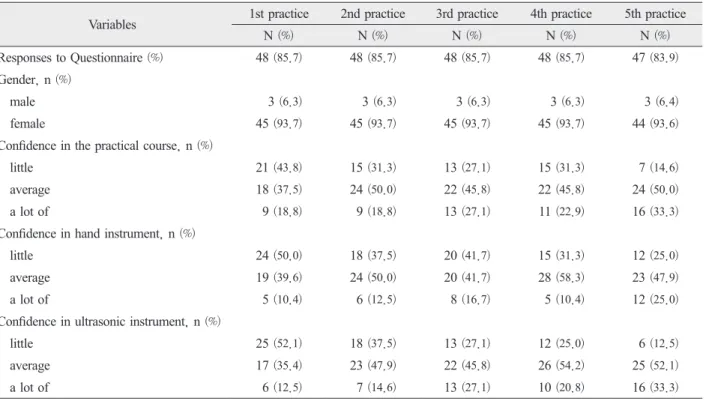
Table 1, 43.8% of students said they had little confidence when they first met the participants in the dental hygiene program, and 37.5% said that about 80% of students had no confidence with ordinary confidence. In particular, 50% and 39.6% of the students said they had little or no confidence in hand instrument, respectively. 52.1% and 35.4% said they had little confidence in using ultrasonic instrument. Students showed a similar tendency in the second practice, with 31%, 37.5%, and 37.5%, respectively, responding that they had little confidence in the face-to-face care of the subject, confidence in using hand instrument, and little confidence in the use of ultrasonic instrument. During their third visit, the students also responded that they had little confidence in the face-to-face care of the subject, confidence in using hand instrument, and confidence in using ultrasonic instrument, with 27.1%, 41.7% and 27.1% of the respondents. During their fourth practice, students complained of lack of confidence in facing the target with 31.3%, 31.3% and 25.0%, in using hand instrument and in using ultrasonic instrument. And
during the final practice, students were less confident in facing the target, confidence in using hand instrument 14.6%, 25.0%, and 12.5%, respectively, when meeting the target. Studentsʼ lack of confidence was diminishing as they carried out the practice.
Table 2 shows the average of five points on the scale of confidence that students respond to. Face-to-face practice in each car averaged 2.64 in the first practice, with 2.85, 3.00, 2.94, and 3.17 in the second, third, fourth and fifth practice, respectively. In the use of hand instrument, the students had an average confidence of 2.49 in their first practice and 2.66, 2.70, 2.79, 2.98 in the second, third, fourth and fifth practice, respectively. Ultrasonic instrument, like hand instrument, also showed confidence of an average of 2.51 in the first practice and 2.75, 3.00, 2.98 and 3.21 in the second, third, fourth and fifth practice, respectively. As the practices progressed, confidence
increased in all categories as expected, which was statistically significant. In particular, from three or more innings, the confidence score increased noticeably, which was a significant result in all categories.
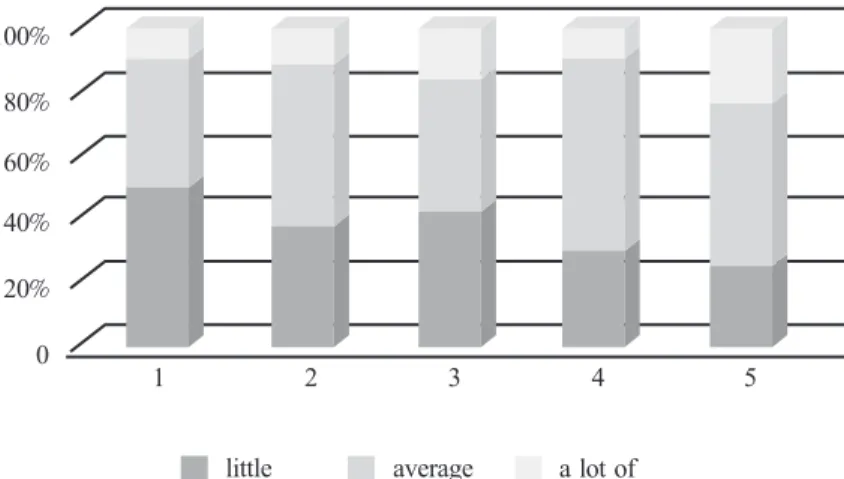
Figures 2, 3 and 4 were compared to examine the distribution and trend of each response according to the timing of the practices. As the practice progressed as shown in Figure 2, students who had a lot of confidence in face-to-face practice were clearly distributed in the fifth practice, and it was confirmed that they were gaining confidence from the third practice. As the practice progressed, the lack of confidence decreased, and the confidence increased slightly. In ultrasonic instrument, confidence also increased, and students who said they were not confident decreased significantly after three practice.
Table 1. Confidence of the Dental Hygiene Students in Entering the Practical Course (N=48)
Variables 1st practice 2nd practice 3rd practice 4th practice 5th practice
N (%) N (%) N (%) N (%) N (%)
Responses to Questionnaire (%) 48 (85.7) 48 (85.7) 48 (85.7) 48 (85.7) 47 (83.9) Gender, n (%)
male 3 (6.3) 3 (6.3) 3 (6.3) 3 (6.3) 3 (6.4)
female 45 (93.7) 45 (93.7) 45 (93.7) 45 (93.7) 44 (93.6)
Confidence in the practical course, n (%)
little 21 (43.8) 15 (31.3) 13 (27.1) 15 (31.3) 7 (14.6)
average 18 (37.5) 24 (50.0) 22 (45.8) 22 (45.8) 24 (50.0)
a lot of 9 (18.8) 9 (18.8) 13 (27.1) 11 (22.9) 16 (33.3)
Confidence in hand instrument, n (%)
little 24 (50.0) 18 (37.5) 20 (41.7) 15 (31.3) 12 (25.0)
average 19 (39.6) 24 (50.0) 20 (41.7) 28 (58.3) 23 (47.9)
a lot of 5 (10.4) 6 (12.5) 8 (16.7) 5 (10.4) 12 (25.0)
Confidence in ultrasonic instrument, n (%)
little 25 (52.1) 18 (37.5) 13 (27.1) 12 (25.0) 6 (12.5)
average 17 (35.4) 23 (47.9) 22 (45.8) 26 (54.2) 25 (52.1)
Table 2. Confidence of the Dental Hygiene Students in the Practical Course (N=48)
Participation Confidence in the practical course
Confidence in hand instrument practice
Confidence in ultrasonic instrument practice
Mean (SE[95% CI]) p* Mean (SE[95% CI]) p* Mean (SE[95% CI]) p-value*
1st 2.64 (0.13[2.37-2.91]) <0.001 2.49 (0.11[2.26-2.72]) <0.001 2.51 (0.12[2.26-2.75]) <0.001 2nd 2.85 (0.11[2.63-3.07]) 2.66 (0.11[2.44-2.88]) 2.75 (0.11[2.53-2.96]) 3rd 3.00 (0.11[2.78-3.22]) 2.70 (0.11[2.48-2.92]) 3.00 (0.12[2.75-3.25]) 4th 2.94 (0.12[2.70-3.18]) 2.79 (0.12[2.60-2.97]) 2.98 (0.11[2.76-3.20]) 5th 3.17 (0.11[2.96-3.39]) 2.98 (0.11[2.75-3.20]) 3.21 (0.11[2.99-3.43]) * Obtained from Repeated measure ANOVA, based on Greenhouse-Geisser correction.
100% 80% 60% 40% 20% 0 1 2 3 4 5 little average a lot of
Figure 2. Graph of the change in students’confidence in each practical course
100% 80% 60% 40% 20% 0 1 2 3 4 5 little average a lot of
4. Discussion
This study was conducted to provide the basic data necessary to plan the effective teaching design of practical training for dental hygienists. White said individual confidence and anxiety are important influences on clinical decision making, and Oneil reported that high anxiety and low confidence in individuals are obstacles to decision-making skills15,16).
Other Korean studies have also shown that the burden felt by students in the dental hygienics clinical practice curriculum causes serious anxiety and tension17). In
clinical practice, student anxiety and tension at the point of decision can be a hindrance to decision making. Therefore, students should try to help themselves have a positive experience and improve their confidence.
Most dental hygienists expect clinical practice to improve their clinical skills. There are not many studies of confidence in clinical practice in the department of dental hygiene in Korea, but many have been studied in nursing research. Nursing student’s confidence in carrying out patient safety practices was high at an average of 3.85 points out of 5 points18). The
level of confidence in dental hygiene students of Lee and Kim was slightly higher than that of our study
when conducting practice such as general medical preparation. Similar to our research, however, the confidence in the subject of the practice for a relatively long period of time, such as checking the patient's symptoms after face-to-face, and in the field of self-directed application of the technique, showed a level of confidence similar to that of our research19). In our
study, students were significantly more confident in both face-to-face, hand instrument and ultrasonic instrument as they repeated the practice, and the previous study, the frequency of the practice, supported the report that the performance confidence and quantity were correlated20). Jungʼs study shows that confidence
increases as the practice progresses, and as with our study, the frequency of practice performance was an important factor in improving confidence21). Especially
in our study, we were able to see more confidence increase than the first practice in more than three times. Therefore, it is considered that repeated practical designs will require at least three designs. Many prior studies have stated that various educational methods such as presentation of clinical scenarios, role play, preceptor-based education programs, simulation training, and utilization of clinical performance programs are effective strategies to reduce the burden 100% 80% 60% 40% 20% 0 1 2 3 4 5 little average a lot of
of meeting subjects for the first time and enhance their ability to perform clinical trials by increasing their confidence22,23,24). Simulation training reported that
the theory learned by the lecture in the classroom was excellent for clinical practices skill25). Thus, in the field
of dental hygiene, efforts should be made to improve clinical practice skill and confidence by applying various teaching methods.
The significance of this study is that studentsʼ confidence was confirmed during repeated practice in dental hygiene practice, which is a part of little research at present. The studentʼs confidence in clinical practice education is an important indicator that must be considered because studentsʼ subjective responses to their educational experience can increase motivation to actively participate in their own learning and achieve their learning goals.
Currently, confidence and anxiety measurement tools related to clinical practice are being developed and used in nursing in Korea26), but there are no measurement
tools in dental hygiene. Therefore, based on this study, it is expected that diversity in teaching design methods for increasing studentsʼ confidence will be studied by developing accurate measurement indicators of studentsʼ confidence and anxiety related to clinical practice in the field of dental hygiene. This study has many limitations. First, it is difficult to generalize because it is a study of students in some areas. Second, confidence measures are not indicators developed by the Department of Dental Hygiene. Third, there is a lack of control over various factors, such as prior learning levels and individual achievement that affect confidence. Nevertheless, the study is the first to observe changes in confidence as the number of dental hygienics students in Korea increases. It is imperative to develop an objective tool that can pre-evaluate studentsʼ confidence in clinical decision making and
anxiety through repeated research, and based on this, follow-upresearch will be needed to improve studentsʼ confidence and efficiency in performing practical skills and objectively check their educational performance. ORCID ID
Yong-Keum Choi, https://orcid.org/0000-0002-5537-4208
Su-Ra Jeong, https://orcid.org/0000-0002-7853-8893
Eun-Jeong Kim, https://orcid.org/0000-0002-6316-7807
Mi-Sun Kim, https://orcid.org/0000-0002-3191-9541
References
1. Choi YK, et al. Study on Clinical Dental Hygiene in Korea Based on Analysis of Clinical Dental Hygiene Curriculum of Fones School in the United States. J Dent Hyg Sci 2017; 17(2): 123-133. https://doi.org/10.17135/jdhs.2017.17.2.123 2. Choi YK, et al. A case study on evaluation of
team-based learning effectiveness in clinical dental hygiene. J Korean Acad Oral Health 2019;43(1): 33-39. https://doi.org/10.11149/jkaoh.2019.43.1.33 3. Bae SM, et al. Satisfaction and Content Validity
of Learnerʼs Satisfaction Using Problem-Based Learning (PBL): Focusing on Dental Hygiene Department and Clinical Dental Hygiene Department. AJMAHS 2019;9(11): 9651-660.
https://doi.org/10.35873/ajmahs.2019.9.11.058 4. Choi YR, et al. Dental Hygienists` Awareness of
Medical Technician Jurisprudence. J Dent Hyg Sci 2016;16(6): 495-501.
5. Jeong SR, et al. A case study on the development and application of flipped learning based clinical dental hygiene curriculum. J Korean Soc Dent Hyg 2020;20(2): 155-66.
https://doi.org/10.13065/jksdh.20200015
6. Choi YK, et al. Study on Current Curriculum Analysis of Clinical Dental Hygiene for Dental Hygiene Students in Korea. J Dent Hyg Sci 2017;17(6): 523-532. https://doi.org/10.17135/jdhs.2017.17.6.523 7. Chae SH, et al. Research on dental hygienists’ clinical
skill proficiency in core dental hygiene competency. J Korean Soc Dent Hyg 2016;16(5): 651-606. http://dx.doi.org/10.13065/jksdh.2016.16.05.651 8. Nam YO et al. A study on the improvement of the
national dental hygienist practical examination. J Korean Soc Dent Hyg 2013;13(2): 201-209. https://doi.org/10.13065/jksdh.2013.13.2.201 9. Lee HS, Hwang MY. A Study on Causes of Stress
Experienced by Students of the Dept. of Dental Hygiene, D Health College Public Health under Practical Training on Scaling. J Dent Hyg Sci 1998;4(2): 15-25.
10. Kim SR, Woo HS. The effect of perfectionism on stress and anxiety during Scaling practice. J Dent Hyg Sci 2009;9(2): 161-167.
11. Pajares F, Johnson M. Confidence and competence in writing: the role of self-efficacy, outcome, expectancy and apprehension. Res Teach Eng 1994.;8: 313-331.
https://www.jstor.org/stable/40171341
12. Bandura A. Social cognitive theory: an agenic cognitive. Asian J. Soc. Psychol. 1999; 2(1): 21-41/
https://doi.org/10.1111/1467-839X.00024 13. Stankov L, et al. Confidence: the best
non-cognitive predictor of academic achievement? Educ Psychol. 2014;34(1): 9-28.
https://doi.org/10.1080/01443410.2013.814194
14. Fine P, et al. The impact of confidence on clinical dental practice. Eur J Dent Educ. 2019;23(2): 159-167.
https://doi.org/10.1111/eje.12415
15. White KA. The development and validation of a tool to measure self-confidence and anxiety in nursing students while making clinical decisions. Las Vegas:University of Nevada; 2011:1-291.
https://digitalscholarship.unlv.edu/thesesdissertations/1384 16. ONeill ES, et al. Modelling novice clinical reasoning
for a computerized decision support system. J Adv Nurs 2005;49(1):68-77.
https://doi.org/10.1111/j.1365-2648.2004.03265.x 17. Son JL, et al. Relationship between incivility
through clinical experience and major satisfaction in dental hygiene students. J Korean Soc Dent Hyg 2016;16(5):701-708.
https://doi.org/10.13065/jksdh.2016.16.05.701 18. Park JH, Park MH. Knowledge, Attitude, and
Confidence on Patient Safety of Undergraduate Nursing Students J Korean Acad Soc Nurs Educ 2014;20(1):5-14.
https://doi.org/10.5977/jkasne.2014.20.1.5 19. Lee YA, Kim YS. A Study on the Experience of
Clinical Practice and the Performance Confidence. J Dent Hyg Sci 2008;8(4):353-359.
20. Han HH. A Study of Convergence on Frequency of Performance, Self-Confidence, Performance Assessment Scores of Core Nursing Skills of Nursing Students. J Digit Converg 2016;13:355-362.
https://doi.org/10.14400/JDC.2016.14.8.355 21. Jung AH, Moon MY. A Study on the Clinical
Competence, Problem solving ability according to Frequency of fundamental nursing skill performance, Confidence of Core fundamental nursing skill performance during Clinical Practice in Nursing Student. AJMAHS 2018;14(8):451-463.
22. Noh YG, Lee IS. Effect of Stepwise Communication Education Program using SBAR among Nursing Students: Focusing on Scenarios and Nursing Case-based Role Playing. J Korean Acad Soc Nurs Educ 2018;24(2):115-126.
http://dx.doi.org/10.5977/jkasne.2018.24.2.115 23. Kim HS, et al. Empowerment on Clinical Nursing
Skills Core Program. J. Converg. Inf. Technol 2014;12(12):589-599.
https://doi.org/10.14400/JDC.2014.12.12.589 24. Kim YH, Lee YM. Relationship of learning
motivation, self-directed learning ability and problem solving process of nursing students after practice evaluation of fundamentals of nursing course using role play. J Korea Acad Industr Coop Soc 2012;13(1):147-155.
https://doi.org/10.5762/KAIS.2012.13.1.147
25. Chae HJ. The needs and effects of convergence-based simulation practice for obstetrical nursing. J Digit Converg 2013;13(9):377-386.
https://doi.org/10.14400/JDC.2015.13.9.377 26. Yu M, et al. Reliability and Validity of Korean
Version of Nursing Studentsʼ Anxiety and Self-Confidence with Clinical Decision Making Scale. J Korean Acad Nurs 2019;49(4):411-421.
ABSTRACT
A Study on the Change of Clinical Self-Confidence according
to the Number of Clinical Dental Hygiene Practices of
Students in the Department of Dental Hygiene
Focusing on scaling practices
-Yong-Keum Choi
1· Mi-Sun Kim
2· Su-Ra Jeong
3· Eun-Jeong Kim
4* 1Department of Dental Hygiene, College of Health Science and Genome-based BioIT Convergence Institute, Sun Moon University2Department of Dental hygiene, Kyungdong University
3Department of Health Convergence, The Graduate School Ewha Womans University 4Department of Dental hygiene, Gangdong University