© Korean Powder Metallurgy Institute 853
-1. Introduction
Cu is an excellent electrical conductor with relatively low strength. Addition of alloying elements will severely decrease its conductivity. Ti3SiC2 is a good anti-friction material with good electrical and thermal conductivity [1]. Electrical conductivity and mechanical property of powder metallurgy (PM) materials are directly related to their density. Conventional powder metallurgy (PM) process can produce Cu compact with a density of 8.3 g/cm3. Mechanical properties and electrical conductivity of this sintered material are substantially less than that of their full density counterparts. Warm compaction is an effective way to produce high density PM parts [2-3]. In this study, warm compaction was used to produce a Ti3SiC2 particulate reinforced copper matrix composite. Fabrication parameters and warm compaction behaviors of Cu powder were studied. Based on the optimized fabrication parameters Cu-based composite for electrical contacts was prepared.
2. Experimental and results
Cu powder with 99.7 mass % purity and particle size of ≦ 74 µm, was mixed with an admixed lubricant for 120 min. Lubricant concentrations of 0, 0.1, 0.15, 0.2, 0.3 and 0.4 mass % was used. The mixed powder was heated to 145°C and then compacted into standard tensile specimens in a steel mold, which maintained at 145°C also. Compaction pressure of 100 to 700 MPa was used. The green compacts were then pre-sintering at 800°C for 0.5 h and sintered at 1000°C for 1 h under cracked ammonia atmosphere.
For the composite samples, mixed powder was prepared by mixing Cu powder with 5 % Ti3SiC2 (≦50 µm). Then 0.2 % of lubricant was added and mixed for 2 h. The
powder was warm compacted at 700 MPa and sintered under the condition mentioned above. Density, hardness, ultimate tensile strength, elongation and electrical resistivity of the sintered samples were measured. The Cu powder was melted and cast to form the cast pure Cu samples for comparison.
Friction coefficient and wear volume of the sintered samples were measured using a block on ring tribotester. The counterpart was a GCr15 steel ring with a hardness of HRC 60. No lubricant was used in the test; a rotating speed of 200 r/min and a load of 98 N were used. The total testing time was 7.5 min.
100 200 300 400 500 600 700 6.0 6.4 6.8 7.2 7.6 8.0 8.4 8.8 Green dens ity (g /c m 3 ) Compaction pressure(MPa) Conventional compaction Warm compaction
Fig. 1. Density Vs. compaction pressure.
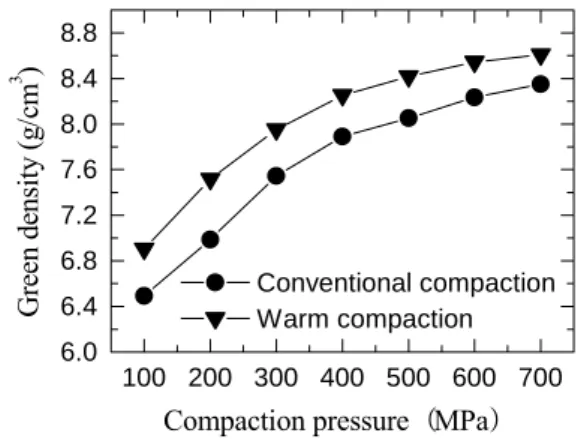
Fig. 1 is a comparison between the green densities of warm compacted and conventionally compacted Cu powder mix with 0.2% lubricant, using different compaction pressure. Fig. 1 shows that green densities of the compacts that obtained from both warm and conventional compaction 2006 POWDER METALLURGY
World Congress
C03-02-3
Studies on Preparation of Ti
3SiC
2Particulate Reinforced Cu Matrix Composite by
Warm Compaction and its Tribological Behavior
Tungwai L. Ngaia, Zhiyu Xiaob, Yuanbiao Wuc, and Yuanyuan Lid
College of Mechanical Engineering, South China University of Technology, Guangzhou, China a
[email protected], [email protected], [email protected], [email protected] Abstract
Warm compaction powder metallurgy was used to produce a Ti3SiC2 particulate reinforced Cu matrix composite. Fabrication
parameters and warm compaction behaviors of Cu powder were studied. Based on the optimized fabrication parameters a Cu-based electrical contact material was prepared. Results showed that in expend of some electrical conductivity, addition
of Ti3SiC2 particulate increased the hardness, wear resistivity and anti-friction ability of the sintered Cu-base material.
© Korean Powder Metallurgy Institute 854 -increase with increasing pressure, then leveled off when compaction pressure reached 700 MPa.
0.0 0.1 0.2 0.3 0.4 8.4 8.6 8.8 De ns ity ( g/ cm 3 )
Lubricant concentration (mass%) Green
Sintered
Fig. 2 Density versus lubricant concentration.
Fig. 2 shows the relation between compact density (both green and sintered) and lubricant concentration for samples compacted at 700 MPa and 145℃. From Fig. 2 it can be seen that green density increase slightly as lubricant con- centration increase, then drop after lubricant concentration reached at 0.15 %. From Fig. 2 it can be seen that highest green density can be obtained by using a lubricant content of 0.15 %. However, if the green density is too high, there is no way out for the trapped gases such as vaporized or dissociated lubricant and leads to blistering of the sintered samples [4]. Results show that blisters can be found in samples that contain lubricant less than 0.1 mass%. Thus, 0.2 % was chosen as the optimal lubricant concentration in order to avoid blistering.
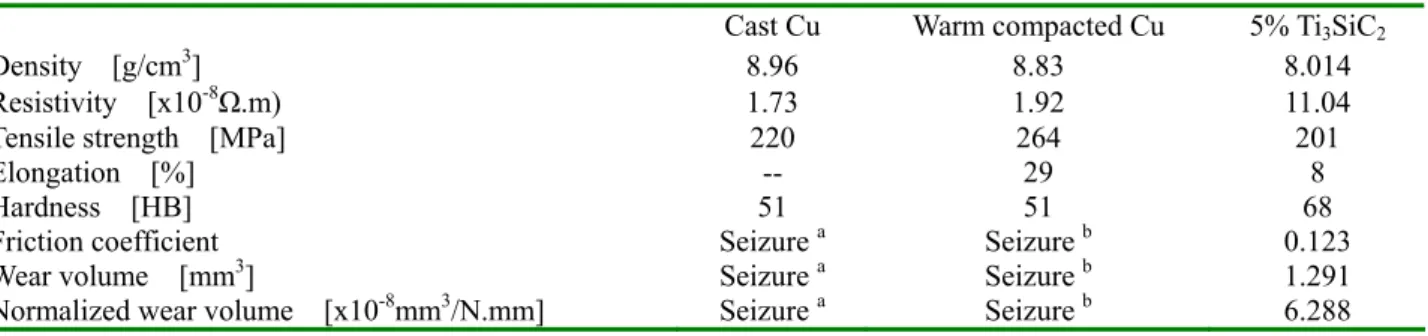
Based on above results, warm compacted copper material with a green density of 8.57 g/cm3 and a sintered density of 8.83 g/cm3 was obtained. Its ultimate tensile strength was 264 MPa compared to 182 MPa of the conventionally compacted and sintered material. Using the same processing parameters, Cu-based composite reinforced by 5 % Ti3SiC2 particulate was prepared. Mechanical properties, electrical
resistivity and tribological behaviors of the warm compacted pure Cu and the Ti3SiC2 reinforced Cu-based composites were listed in Table 1.
The warm compacted and sintered pure Cu fabricated in this study has a resistivity of 1.92 x 10⁻⁸ Ω m. While the sintered composite, with 5 % Ti3SiC2, has a resistivity of 11.04 x 10⁻⁸ Ω m.
As shown in Table 1, all pure Cu samples could not endure the complete tribo-test; they failed within couples of minutes in the test. However, the 5% Ti3SiC2 reinforced composite show remarkable tribological behaviors. In expend of some electrical conductivity, the addition of Ti3SiC2 particulate increased the hardness, wear resistivity and anti-friction ability of Cu-base PM materials.
3. Summary
In this study, warm compaction was employed to develop a Ti3SiC2 particulate reinforced copper matrix composite with high density, high electrical conductivity and high strength. Sintered composite with 5 % Ti3SiC2, has an ultimate tensile strength of 201 MPa, an elongation of 8% and a hardness of HB 68 and an electrical resistivity of 11.04 x 10⁻⁸ Ω m. The increase in hardness from HB 51 (sintered pure Cu) to HB 68 will greatly enhance the tribological behaviors of the Cu-based PM material without losing much of the electrical conductivity.
4. References
1. M.W. Barsoum and T. El-Raghy. J. Am. Ceram. Soc. 79[7], 1953(1996).
2. H.G. Rutz and F.G.. Hanejko. The International Journal of Powder Metallurgy 31[1], 9(1995).
3. H. Rutz, F. Hanejko and S. Luk. Met. Powder Report 9, 40(1994).
4. J. Tekegawa: J. Japan Soc. Powder/Powder Metall. 46[8], 692(2001).
Table 1. Some properties of the prepared materials compared with Cu
Cast Cu Warm compacted Cu 5% Ti3SiC2
Density [g/cm3] 8.96 8.83 8.014
Resistivity [x10-8Ω.m) 1.73 1.92 11.04
Tensile strength [MPa] 220 264 201
Elongation [%] -- 29 8
Hardness [HB] 51 51 68
Friction coefficient Seizure a Seizure b 0.123
Wear volume [mm3] Seizure a Seizure b 1.291
Normalized wear volume [x10-8mm3/N.mm] Seizure a Seizure b 6.288