© Korean Powder Metallurgy Institute 980 -1. Introduction
Carbon nanotubes (CNTs) have been the focus of the growing attention of scientific communities, attracted to them by their many interesting properties as well as by their large potential for practical applications. Due to their unique size and structural diversities, many interesting physical properties were found. Of particular importance is the mechanical properties [3]. CNTs are attractive reinforcement materials for light weight and high strength metal matrix composites. Although extensive research has been performed on their electrical, mechanical and functional properties, there are not many successful results on the mechanical properties of CNT dispersed nanocomposites. In polymer- and ceramic-matrix composites, the strength and stiffness increased considerably with the reinforcement of the CNT [4]. However, reports on the improvement of properties in metal matrix composite (MMC) systems are rare possibly because of the low interfacial bonding strength between the matrix and the CNT reinforcements.
It is well known that heavy cold deformation can result in significant refinement of the microstructure of metallic materials [5]. Based on this grain refinement effect, bulk nanostructured materials processed by several methods of severe plastic deformation (SPD) were developed [6-9]. Among the various SPD processes, equal channel angular pressing (ECAP) is a convenient procedure for obtaining ultrafine grained materials by extruding metallic materials through specially designed channel dies without a
substantial change in geometries. Although numerous studies have dealt with ECAP of many pure metals and alloys, no studies on ECAP of CNT/MMCs starting from powder mixtures have been reported, as far as the authors know.
In this abstract we investigated the powder ECAP processing and mechanical properties of powder ECAP processed CNT/Cu matrix composites.
2. Experimental and Results
Atomized commercial purity copper powders of 2-3 µm in diameter produced by Changsung Co. were used for a matrix material. Single-wall CNTs manufactured by Iljin Nanotech Co. using an arc discharge method were used for a reinforcement. The CNTs exist in the shape of bundles having 10 nm in diameter and 20 µm in length. Copper powders and 1 vol.% of CNT were mixed in ethanol, vibration treated for 1 hr with an ultrasonic cleaner to separate agglomerated powder and to help homogeneous mixing, dried at 50 oC to remove ethanol and inserted into a
copper sheath of 6 x 6 x 50 mm3.
The copper sheath containing powder mixtures of CNT and Cu were finally cold ECAP processed. ECAP processing was conducted up to eight passes at room temperature, following Route C, the workpiece being rotated by 180° around the longitudinal axis between the passes. A mixture of MoS2 powder and commercial oil was
used for lubrication between the workpiece and the channel 2006 POWDER METALLURGY
World Congress
PB01-W-02
Carbon Nanotube Reinforced Metal Matrix Nanocomposites via Equal
Channel Angular Pressing
Pham Quang1,a, Young Gi Jeong2,b, Seung Chae Yoon1,c, Sun Ig Hong1,d , Soon Hyung Hong3,e and Hyoung Seop Kim1,f,* 1
Department of Metallurgical Engineering, Chungnam National University, Yuseong, Daejeon 305-764, Korea
2
Korea Institute of Industrial Technology, Yeonsu, Incheon 406-130, Korea
3
Korea Advanced Institute of Science and Technology, Yuseong, Daejeon, Korea
a
[email protected], [email protected], [email protected], [email protected],
e
[email protected], [email protected], *corresponding author
Abstract
In this study, bottom-up type powder processing and top-down type SPD (severe plastic deformation) approaches were combined in order to achieve full density of Carbon nanotube (CNT)/metal matrix composites with superior mechanical properties by improved particle bonding and least grain growth, which were considered as a bottle neck of the bottom-up method using the conventional powder metallurgy of compaction and sintering. ECAP (equal channel angular pressing), the most promising method in SPD, was used for the CNT/Cu powder consolidation. The powder ECAP processing with 1, 2, 4 and 8 route C passes was conducted at room temperature.
Keywords : Carbon nanotubes, Metal matrix nanocomposite, Equal channel angular pressing, Plastic deformation homogeneity, Densification
© Korean Powder Metallurgy Institute 981
-surfaces.
The Vickers microhardness was measured using an Akashi HM0-122 tester by applying a load of 100 g force for 10 sec and taking an average over 8 separate measurements.
3. Results
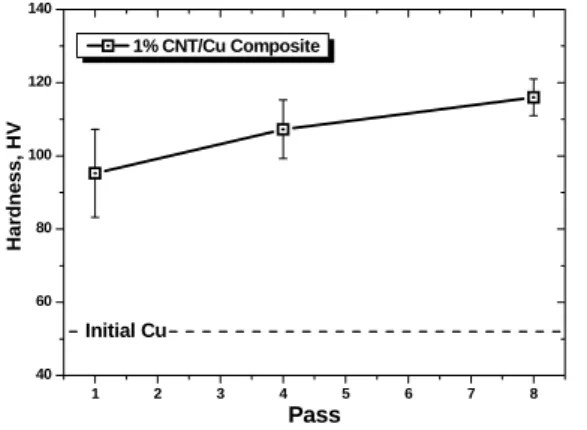
Figure 1 shows the effect of ECAP on the strengthening of the CNT/Cu nanocomposites. The hardness of the ECAP processed samples are more than twice of the initial Cu powders, due to a combined effect of matrix strengthening, densification and CNT particle strengthening. It should be noted that with the number of ECAP passes, hardness increases and hardness variations with measured position decreases (24 HV. 16 HV and 20 HV in 1 passed, 4 passed and 8 passed samples, respectively); the latter result implies that ECAP enhances spatial homogenization of the composite workpieces. Hence, ECAP has one more viable industrial application; homogenization of microstructures of bulk composite parts in addition to grain refinement. The fact that the increases of indenting load by 20% and 12% by adding only 1 vol.% of CNT is promising in the development of CNT-metal matrix nanocomposite.
1 2 3 4 5 6 7 8 40 60 80 100 120 140 Initial Cu H a rdnes s , H V Pass 1% CNT/Cu Composite
Fig. 1. Hardness with the number of ECAP passes for 1 vol.% CNT/Cu nanocomposites.
4. Summary
Bulk CNT-Cu nanocomposites from powder mixtures were processed by room temperature ECAP up to 8 passes
using Route C to achieve densification and sound bulk formation without grain growth. It was found by the microhardness tests that effective densification, homogeneous microstructure and high mechanical strength could be achieved effectively as a result of the severe plastic deformation of ECAP and the well bonded powder contact surface during powder ECAP. The SPD processing of powders is a viable method to achieve both fully density and good particle bonding in CNT-metal matrix composites. The effects of CNT/matrix interface and CNT alignment will be the focus of our future work.
5. References
1. Kroto, H. W., Heath, J. R., O’Brien, S. C., Curl, R. F. & Smalley, R. E.(1985) C60: Buckminsterfullerene. Nature
318, p. 162.
2. Iijima, S. (1991) Helical Microtubules of Graphitic Carbon. Nature 354, pp. 56-57.
3. Popov, V. N. (2004) Carbon Nanotubes: Properties and Application. Mater. Sci. Eng. R43, pp. 61-102.
4. Lau, K-T., Chipara, M., Ling, H-Y. & Hui, D. (2004) On the Effective Elastic Moduli of Carbon Nanotubes for Nanocomposite Structures. Composites B35. pp. 95-101. 5. Gil Sevillano, S. J., Van Houtte P. & Aernoudt, E. (1980) Large Strain Work Hardening and Textures. Prog. Mater. Sci. 25, pp. 69-412.
6. Segal, V. M. (1995) Materials Processing by Simple Shear. Mater. Sci. Eng. A197, pp. 157-164.
7. Valiev, R. Z. (2001) Developing SPD Methods for Processing Bulk Nanostructured Materials with Enhanced Properties. Met. Mater. Int. 7, pp. 413-420.
Acknowledgements
This research was supported by a grant (code #: 05K1501-00511) from 'Center for Nanostructured Materials Technology' under '21st Century Frontier R&D Programs' of the Ministry of Science and Technology, Korea. The authors thank the Changsung Co. for supporting copper powders and ILJIN Nanotech. Co. for supporting their CNTs.