R E V I E W
Open Access
Gene mutation discovery research of
non-smoking lung cancer patients due
to indoor radon exposure
Jung Ran Choi
1, Seong Yong Park
2, O Kyu Noh
3, Young Wha Koh
4and Dae Ryong Kang
5*Abstract
Although the incidence and mortality for most cancers such as lung and colon are decreasing in several countries,
they are increasing in several developed countries because of an unhealthy western lifestyles including smoking,
physical inactivity and consumption of calorie-dense food. The incidences for lung and colon cancers in a few of
these countries have already exceeded those in the United States and other western countries. Among them, lung
cancer is the main cause of cancer death in worldwide. The cumulative survival rate at five years differs between 13
and 21 % in several countries. Although the most important risk factors are smoking for lung cancer, however, the
increased incidence of lung cancer in never smokers(LCINS) is necessary to improve knowledge concerning other
risk factors. Environmental factors and genetic susceptibility are also thought to contribute to lung cancer risk.
Patients with lung adenocarcinoma who have never smoking frequently contain mutation within tyrosine kinase
domain of the epidermal growth factor receptor(EGFR) gene. Also, K-ras mutations are more common in individuals
with a history of smoking use and are related with resistance to EFGR-tyrosine kinase inhibitors. Recently, radon(Rn),
natural and noble gas, has been recognized as second common reason of lung cancer. In this review, we aim to
know whether residential radon is associated with an increased risk for developing lung cancer and regulated by
several genetic polymorphisms.
Keywords: Radon, Non-small-cell lung cancer, Nerver smoker, Genetic polymorphism, Next generation sequencing
Background
Non-small cell lung cancer(NSCLC) is the leading cause
of cancer-related death worldwide [1, 2]. During the past
decades, survival rate of lung cancer has improved
mod-erately and remains still poor (around 10 % at 5 years)
[1–5]. Although early-stage lung cancer can be treated
with good survival, most cases are diagnosed at a late
stage when surgery as usual is no longer needed.
Late-stage lung cancers observe poor response to
chemother-apy and radiotherchemother-apy, although tyrosine kinase inhibitors
were investigated to be efficient in reducing tumor tissue
in NSCLC with epidermal growth factor receptor
(EGFR) mutations. The most important risk factors are
smoking for lung cancer, however, the increased
incidence of lung cancer in non-smokers(LCINS) is
necessary to concern other risk factors [3]. Recently,
radon(Rn), natural and noble gas, has been recognized
as second common reason of lung cancer. Still, smoking
is related to lung cancer risk factor, this review focused
on NSCLC in never smokers.
Lung cancer in never smoker
Smoking explains for more than 90 % of lung cancers in
men and 75 to 85 % lung cancers in women in the
United States and European Union. Although these
pat-terns are similar in Asian men, the proportion of Asian
women with lung cancer in smoker is much lower. The
proportion of women with lung cancer who have
smok-ing differs from region even within Asia, from 25 % in
Korea to 56 % in Hong Kong [6]. Tobacco smoking still
remains the predominant risk factor for the development
of lung cancer. However, lung cancer induces also in
individuals without a history of smoking [7
–9].
* Correspondence:[email protected]
5Department of Humanities and Social Medicine, Ajou University School of
Medicine, Suwon, Republic of Korea
Full list of author information is available at the end of the article
© 2016 Choi et al. Open Access This article is distributed under the terms of the Creative Commons Attribution 4.0 International License (http://creativecommons.org/licenses/by/4.0/), which permits unrestricted use, distribution, and reproduction in any medium, provided you give appropriate credit to the original author(s) and the source, provide a link to the Creative Commons license, and indicate if changes were made. The Creative Commons Public Domain Dedication waiver (http://creativecommons.org/publicdomain/zero/1.0/) applies to the data made available in this article, unless otherwise stated.
LCINS has been acknowledged as a disease entity
sepa-rated from smoking-associated lung cancer [10].
Accord-ing to the World Health Organization, the incidence of
LCINS is almost 25 % of all cases [8, 11]. Recently, there is
noticeable variance in the ratios of LCINS ranging from
nearly 10 % in males in Western and up to approximately
40 % in females in Asia [7]. However, its ethnic/genetic
attributes and/or environmental features remain still
unknown.
LCINS occurs more often in women than in men and
the major histological subtype is adenocarcinoma [10].
During decades, the incidence of lung adenocarcinoma
has increased compared to that of squamous cell
carcin-oma in western and Asian countries [12]. Small-cell lung
cancer is rarely investigated in never-smokes, while in
NSCLC, the most common histological type in never
smokers is adenocarcinoma [7, 11, 13, 14]. Toh CK et al.
[13] shown adenocarcinomas involved 69.9 % of patients
in never smokers, 39.9 % in current and 47.3 % in
former smokers [13]. Especially in Asian countries, a
sig-nificant proportion of current patients with lung cancer
are never smoker. It shown 38.3 % of 10,279 patients
with smoking status in Japan, 32.4 % of 883 patients in
Singapore, and 34.5 % of 4622 patients in Korea were
never smokers [12].
Numerous studies have been demonstrated the roles
of candidate susceptibility in LCINS and those was
in-volved in carcinogen metabolism, DNA repair or
inflam-matory response. However, their role remains still to be
identified and further studies are needed to better
under-stand the role for genetic factors in LCINS development
and treatment [7]. Recently, it has been observed LCINS
has a dramatic response to EGFR tyrosine kinase
inhibi-tors (TKIs) [15, 16]. The distinct response pattern was
associated with the higher frequencies of EGFR mutations
in never smokers [10, 15, 16].
Several studies have shown LCINS patients have better
survival compared to ever smoker patients [17, 18]. The
biologic dissimilarity of lung cancer in never-smokers
versus ever-smokers are shown in differential response
according to specific therapies including EGFR inhibitors,
and in distribution of histology such as adenocarcinoma
in never-smokers [11]. Therefore, better understanding of
the incidence rate and etiology of LCINS is important
because of the implications for therapeutic trials and
epidemiologic studies of lung cancer [7].
Genetic susceptibility and LCINS
Despite standard platinum-based chemotherapy and
newer targeted therapies, there is an increasing need for
the appropriate use of targeted and tailored therapies to
improve efficiency and response in LCINS [17, 18]. In
an attempt to improve the outcomes of the therapy, the
role of inherited genetic factors in the development of
non-smoking
related
carcinogenesis
is
investigated
(Table 1).
Recently, genome-wide association(GWAS) studies
identified specific chromosomal locus, 15q24-15q25 and
5p15.33, as one of the regions associated with LCINS.
This 5p15.33 region consists two candidate susceptibility
genes, TERT and CLPTMIL and Hsiung study included
only lung adenocarcinoma never smoker female [19–21].
Hypoxia-inducible factor-2α (also called endothelial
periodic acid-Schiff domain protein 1, EPAS1) seems to
play an important role in some carcinogenesis, though
there is no information on the relationship between
single nucleotide polymorphism(SNP) of EPAS1 and
lung cancer development so far [22]. Iwamoto S et al.
observed EPAS1 rs4953354 may be a potentially
suscep-tible marker for development of lung adenocarcinoma,
especially in female never-smokers [22].
Kang HG et al. [23] identified three SNPs
(colony-stimulating factor 1 receptor, CSF1R; tumor protein p63,
TP63; and corepressor interacting with RBPJ 1, CIR1)
were found to be significantly associated with lung
can-cer. Among them, Kang HG et al. suggested CSF1R
rs10079250 may contribute to lung cancer susceptibility
in never-smoking females [23].
The ataxia-telangiectasia mutated (ATM) gene plays a
crucial role in the DNA double-strand breaks repair
pathway. Shen L et al. [24] suggested ATM rs189037
might be associated with the risk of lung
adenocarcin-oma in Chinese non-smoking females. Furthermore,
ATM rs189037 AA genotype might be a risk factor of
lung adenocarcinoma among female non-smokers
with-out cooking oil fume exposure [24].
Yongjun Zhang MM et al. investigated the potential
association between SNPs in transglutaminase 5 (TGM5),
phosphatidic acid phosphatase type 2B (PPAP2B) and
pro-teasome subunit, alpha type 4 (PSMA4) and NSCLC
sus-ceptibility in Chinese patients who were non-smokers
[25]. The polymorphisms of TGM5, PPAP2B and PSMA4
are not major contributors to NSCLC susceptibility,
however, this primarily be attributed to the significantly
distinct genetic background of Asian populations from
western populations [25].
Until now, several reports have been studied the role
of candidate genetic polymorphisms in LCINS (Table 1),
[26
–35] however, their role remains still to be identified
and further studies are needed to better understand the
role for genetic factors in LCINS developing.
Radon as one of risk factors for LCINS
Although the most established risk factor for lung
cancer is smoking in several studies, unrelated to
smok-ing risk factors such as second hand smoksmok-ing, radon
exposure, cooking oil vapors and indoor coal burning,
hormonal factors, and infectious factors have been
identified [7]. Among them, radon (Rn) is the most
important natural source of human exposure to
ioniz-ing radiation and the second leadioniz-ing cause of LCINS
[36, 37]. The Environmental Protection Agency (EPA)
action level is 148 Bq/m
3and the World Health
Organization (WHO) has recently lowered the
recom-mended radon exposure to levels below 100 Bq/m
3[38].
Many case–control studies have presented the association
between airborne radon exposure and lung cancer,
how-ever, several observations have analyzed the effect of radon
exposure for different categories of smoking [38]. On the
other hand, possible biologic mechanisms by radon
expos-ure might increase the risk of LCINS leading gene
muta-tion, chromosome aberrations, generation of reactive
oxygen species, up or down-regulation of cytokines, and
production of proteins associated with cell cycle
regula-tion [36].
Radon exposure and genetic factors
Sinitsky MY et al. suggested the elevated frequency of
cyto-genetic damage in people with DNA-repair gene
polymor-phisms due to chronic exposure to radon and XpG,
ADPRT, and NBS1 gene can be used as molecular genetic
markers of increased individual radiosensitivity in
long-term residents with high concentrations of radon [39].
An-other report suggested GSTM1 and GSTT1 genes deletion
increase the risk of lung cancer and these genes
might regulate the carcinogenic pathway by radon
radiation [40, 41]. Torres-Durán M et al. shown radon
exposure of never smokers seems to be a risk factor for
lung cancer and individuals diagnosed at a younger age
might have a higher residential radon concentration
explaining an accumulative effect on lung cancer
appear-ance (Table 2) [42, 43].
Although, several studies have been demonstrated the
role of candidate genes for developing LCINS, however,
the genetic determinants for susceptibility in LCINS with
residential radon exposure are still uncertain (Table 2),
[44–50] and further studies will require analyzing the
as-sociation between radon exposure and LCINS.
Next-generation sequencing (NGS) for analyzing
of SNP in LCINS
Next-generation sequencing (NGS) is a cost-effective
technology enabled screening several genes
simultan-eously, however, its application in a clinical context needs
an established workflow to acquire available sequencing
results. When combined with various selective capture
ap-proaches, NGS has allowed for the efficient simultaneous
genetic analysis of a large number of candidate genes.
Sev-eral studies applied a polymerase chain reaction (PCR)
based NGS in determining oncogene alternations in the
state of disease progression [51–53]. PCR based NGS is an
outstanding tool to provide a comprehensive genomic
diagnosis in patients with recurrent LCINS [53]. Recently,
Vanni I et al. [51] investigated an optimized NGS
Table 1 Genetic susceptibility and lung cancer in nerver smokers
Author/year Region No. of pts. Histologic type Genetic markers McKay JD et al. 2008 [20] France 3259 case adenocarcinoma CLPTM1L-TERT
4159 control
Hsiung CA et al. 2010 [21] Taiwan 584 case adenocarcinoma CLPTM1L-TERT 585 control
Iwamoto S et al. 2014 [22] Japan 341 NSCLC EPAS1
Kang HG et al. 2014 [23] Korea 360 lung cancer CSF1R, TP63, CIR1 Shen L et al. 2014 [24] China 1003 adenocarcinoma ATM
Yongjun Zhang MM et al. 2013 [25] China 400 NSCLC TGM5, PPAP2B, PSMA4
Sun Z et al. 2014 [26] USA 27 adenocarcinoma EGFR, TP53, KRAS, RPS6KB2, ATXN2, DHX9, PTPN13, SP1, SPTAN1, MYOF
Bennett WP et al. 1999 [27] USA 106 lung cancer GSTM1
Ahn MJ et al. 2012 [28] Korea 446 NSCLC APCDD1, NAPG, FAM38B
Lim WY et al. 2011 [29] Singapore 433 IL6, cyclooxygenase-2, PPAR-γ, IL1RN Li Y et al. 2010 [30] USA 1489 lung cancer 13q31.3 GPC5
Wu X et al. 2013 [31] USA 1583 NSCLC LEMD3, TMBIM, ATXN7L2, SHE, ITIH2, NUDT5 Zhou W et al. 2003 [32] USA 1091 lung cancer XRCC1, ERCC2
Hung RJ et al. 2003 [33] France 302 case lung cancer CYP1A1, GSTM1 1631 control
Liu L et al. 2014 [34] China 298 case lung cancer GPC5 599 control
Table 2 Genetic susceptibility in subjects with high radon concentration
Author/year Region Subjects Gene
Sinitsky MY et al. 2015 [39] Russia children ADPRT, hOGG1, NBS1, XRCC1, XpC, XpD, XpG Ruano-Ravina A et al. 2014 [40] Spain 792 lung cancer GSTM1,GSTT1
Bonner MR et al. 2006 [41] US 270 lung cancer GSTM1
Druzhinin VG et al. 2011 [44] Russia healthy voluteers hOGG1, ADPRT, APE1, XRCC1, XpG, XpC, XpD, NBS1 Kiuru A et al. 2005 [45] Finland 84 healthy nonsmokers OGG1, XPD, XRCC1, XRCC3
Yngveson A et al. 1999 [46] Sweden 83 nonsmoking lung cancer p53 250 smoking lung cancer
Hayes VM et al. 1996 [47] South Africa SCLC TP53
Takeshima Y et al. 1996 [48] Japan 28 adenocarcinomas non smoking female p16/CDKN2, p53 Leng S et al. 2013 [49] USA 267 SCC case SIRT1
383 control
Leng S et al. 2015 [50] USA 242 SCC IL-6 336 control
workflow analyzing 22 lung cancer-related genes to
se-quence critical samples such as DNA from formalin-fixed
paraffin-embedded (FFPE) blocks [51]. Masago K et al.
[52] shown NGS is able to detect EGFR T790M mutations
in cases not easy to diagnose by other conventional
methods and play a role in acquired EGFR-TKIs
resist-ance, showing the need for alternative treatment
strat-egies, with PCR-based NGS playing an important role in
disease diagnosis.
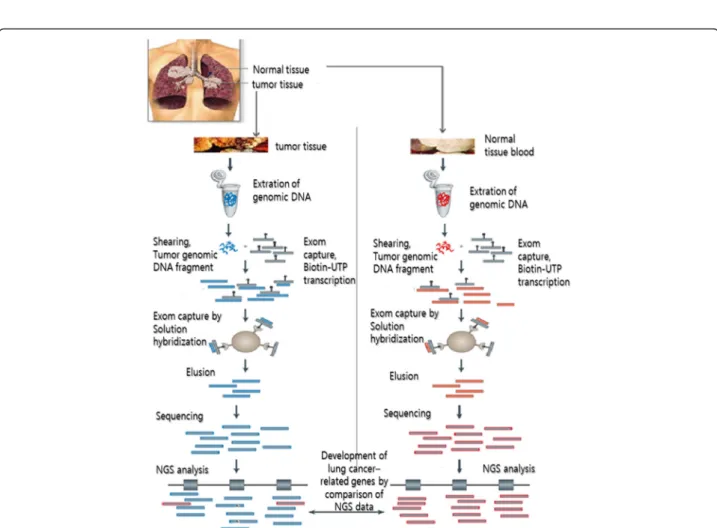
Here, we suggest the strategy based on NGS enabled to
detect lung cancer-related genetic mutations in LCINS
patients with radon exposure (Fig. 1). We will optimize
exom sequencing based on NGS platform to analyze
LCINS-related gene in normal and lung cancer tissues.
Conclusion
Several etiologic factors have been proposed for the
development of LCINS, including exposure to radon,
cooking fumes, asbestos, heavy metals, and
environmen-tal tobacco smoke, human papillomavirus infection, and
inherited genetic susceptibility. However, the relative
sig-nificance of radon exposure and genetic polymorphisms
in the development of LCINS has not been
well-characterized. This review summarized whether radon
ex-posure is associated with an increased risk of developing
lung cancer and regulated by several genetic
polymor-phisms in never smokers.
Competing interests
The authors declare that they have no competing interests.
Authors’ contributions
JRC, the first author, drafted the initial manuscript, performed writing and corrected this manuscript. SYP and OKN reviewed the articles and advised medical view. YWK searched and assisted the related references. DRK is a corresponding author and corrected this manuscript. All authors read and approved the final manuscript.
Acknowledgements
This subject is supported by Korea Ministry of Environment (MOE) as“the Environmental Health Action Program.” (Grant Number 2015001350002). Author details
1Department of Bio-resource engineering, College of Life Sciences, Sejong
University, Seoul, Republic of Korea.2Department of Thoracic and
Cardiovascular Surgery, Ajou University School of Medicine, Suwon, Republic of Korea.3Department of Radiation Oncology, Ajou University School of Medicine, Suwon, Republic of Korea.4Department of Pathology, Ajou
University School of Medicine, Suwon, Republic of Korea.5Department of
Humanities and Social Medicine, Ajou University School of Medicine, Suwon, Republic of Korea.
Received: 25 January 2016 Accepted: 18 February 2016
References
1. Brennan P, Hainaut P, Boffetta P. Genetics of lung-cancer susceptibility. Lancet Oncol. 2011;12:399–408.
2. Jemal A, Bray F, Center MM, Ferlay J, Ward E, Forman D. Global cancer statistics. CA Cancer J Clin. 2011;61:69–90.
3. American Cancer Society, Lung Cancer (Non-Small Cell), Updated on September 15, 2011.
(http://www.cancer.org/Cancer/LungCancer-Non- SmallCell/DetailedGuide/non-small-cell-lung-cancer-what-is-non-small-cell-lung-cancer).
4. National Cancer Institute, Non-Small Cell Lung Cancer (PDQ), Updated on December 9, 2010. (http://www.cancer.gov/contact).
5. Ding L, Getz G, Wheeler DA, Mardis ER, McLellan MD, Cibulskis K, Greulich H, Muzny DM, Morgan MB, Fulton L, Fulton RS, Zhang Q, Wendl MC, Lawrence MS, Larson DE, Chen K, Dooling DJ, Sabo A, Hawes AC, Shen H, Jhangiani SN, Lewis LR, Hall O, Zhu Y, Mathew T, Ren Y, Yao J, Scherer SE, Clerc K, Metcalf GA, Ng B, Milosavljevic A, Gonzalez-Garay ML, Osborne JR, Meyer R, Shi X, Tang Y, Koboldt DC, Lin L, Abbott R, Miner TL, Pohl C, Fewell G, Haipek C, Schmidt H, Dunford-Shore BH, Kraja A, Crosby SD, Sawyer CS, Vickery T, Sander S, Robinson J, Winckler W, Baldwin J, Chirieac LR, Dutt A, Fennell T, Hanna M, Johnson BE, Onofrio RC, Thomas RK, Tonon G, Weir BA, Zhao X, Ziaugra L, Zody MC, Giordano T, Orringer MB, Roth JA, Spitz MR, Wistuba II, Ozenberger B, Good PJ, Chang AC, Beer DG, Watson MA, Ladanyi M, Broderick S, Yoshizawa A, Travis WD, Pao W, Province MA, Weinstock GM, Varmus HE, Gabriel SB, Lander ES, Gibbs RA, Meyerson M, Wilson RK. Somatic mutations affect key pathways in lung adenocarcinoma. Nature. 2008;455:1069–75.
6. Subramanian J, Govindan R. Lung cancer in never smokers: a review. J Clin Oncol. 2007;25:561–70. Review.
7. Pallis AG, Syrigos KN. Lung cancer in never smokers: disease characteristics and risk factors. Crit Rev Oncol Hematol. 2013;88:494–503.
8. Couraud S, Zalcman G, Milleron B, Morin F, Souquet PJ. Lung cancer in never smokers—a review. Eur J Cancer. 2012;48:1299–311.
9. Yano T, Haro A, Shikada Y, Maruyama R, Maehara Y. Non-small cell lung cancer in never smokers as a representative‘non-smoking-associated lung cancer’: epidemiology and clinical features. Int J Clin Oncol. 2011;16:287–93. 10. Lee YJ, Cho BC, Jee SH, Moon JW, Kim SK, Chang J, Chung KY, Park IK, Choi SH,
Kim JH. Impact of environmental tobacco smoke on the incidence of mutations in epidermal growth factor receptor gene in never-smoker patients with non-small-cell lung cancer. J Clin Oncol. 2010;28:487–92.
11. Wakelee HA, Chang ET, Gomez SL, Keegan TH, Feskanich D, Clarke CA, Holmberg L, Yong LC, Kolonel LN, Gould MK, West DW. Lung cancer incidence in never smokers. J Clin Oncol. 2007;25:472–8.
12. Suda K, Tomizawa K, Yatabe Y, Mitsudomi T. Lung cancers unrelated to smoking: characterized by single oncogene addiction? Int J Clin Oncol. 2011;16:294–305. 13. Toh CK, Gao F, Lim WT, Leong SS, Fong KW, Yap SP, Hsu AA, Eng P, Koong HN,
Thirugnanam A, Tan EH. Never-smokers with lung cancer: epidemiologic evidence of a distinct disease entity. J Clin Oncol. 2006;24:2245–51. 14. Yano T, Miura N, Takenaka T, Haro A, Okazaki H, Ohba T, Ohba T, Kouso H,
Kometani T, Shoji F, Maehara Y. Never-smoking nonsmall cell lung cancer as a separate entity: clinicopathologic features and survival. Cancer.
2008;113:1012–8.
15. Miller VA, Kris MG, Shah N, Patel J, Azzoli C, Gomez J, Krug LM, Pao W, Rizvi N, Pizzo B, Tyson L, Venkatraman E, Ben-Porat L, Memoli N, Zakowski M, Rusch V, Heelan RT. Bronchioloalveolar pathologic subtype and smoking history predict sensitivity to gefitinib in advanced non-small-cell lung cancer. J Clin Oncol. 2004;22:1103–9.
16. Shigematsu H, Lin L, Takahashi T, Nomura M, Suzuki M, Wistuba II, Fong KM, Lee H, Toyooka S, Shimizu N, Fujisawa T, Feng Z, Roth JA, Herz J, Minna JD, Gazdar AF. Clinical and biological features associated with epidermal growth factor receptor gene mutations in lung cancers. J Natl Cancer Inst. 2005;97:339–46.
17. Sasaki T, Rodig SJ, Chirieac LR, Jänne PA. The biology and treatment of EML4-ALK non-small cell lung cancer. Eur J Cancer. 2010;46:1773–80. 18. Lee DH, Lee JS, Wang J, Hsia TC, Wang X, Kim J, Orlando M.
Pemetrexed-Erlotinib, Pemetrexed Alone, or Erlotinib Alone as Second-Line Treatment for East Asian and Non-East Asian Never-Smokers with Locally Advanced or Metastatic Nonsquamous Non-small Cell Lung Cancer: Exploratory Subgroup Analysis of a Phase II Trial. Cancer Res Treat. 2015;47:616–29. 19. Amos CI, Wu X, Broderick P, Gorlov IP, Gu J, Eisen T, Dong Q, Zhang Q, Gu X,
Vijayakrishnan J, Sullivan K, Matakidou A, Wang Y, Mills G, Doheny K, Tsai YY, Chen WV, Shete S, Spitz MR, Houlston RS. Genome-wide association scan of tag SNPs identifies a susceptibility locus for lung cancer at 15q25.1. Nat Genet. 2008;40:616–22.
20. McKay JD, Hung RJ, Gaborieau V, Boffetta P, Chabrier A, Byrnes G, Zaridze D, Mukeria A, Szeszenia-Dabrowska N, Lissowska J, Rudnai P, Fabianova E, Mates D, Bencko V, Foretova L, Janout V, McLaughlin J, Shepherd F, Montpetit A, Narod S, Krokan HE, Skorpen F, Elvestad MB, Vatten L, Njølstad I, Axelsson T, Chen C, Goodman G, Barnett M, Loomis MM, Lubiñski J, Matyjasik J, Lener M, Oszutowska D, Field J, Liloglou T, Xinarianos G, Cassidy A; EPIC Study,
Vineis P, Clavel-Chapelon F, Palli D, Tumino R, Krogh V, Panico S, González CA, Ramón Quirós J, Martínez C, Navarro C, Ardanaz E, Larrañaga N, Kham KT, Key T, Bueno-de-Mesquita HB, Peeters PH, Trichopoulou A, Linseisen J, Boeing H, Hallmans G, Overvad K, Tjønneland A, Kumle M, Riboli E, Zelenika D, Boland A, Delepine M, Foglio M, Lechner D, Matsuda F, Blanche H, Gut I, Heath S, Lathrop M, Brennan P. Lung cancer susceptibility locus at 5p15.33. Nat Genet. 2008;40(12):1404–6.
21. Hsiung CA, Lan Q, Hong YC, Chen CJ, Hosgood HD, Chang IS, Chatterjee N, Brennan P, Wu C, Zheng W, Chang GC, Wu T, Park JY, Hsiao CF, Kim YH, Shen H, Seow A, Yeager M, Tsai YH, Kim YT, Chow WH, Guo H, Wang WC, Sung SW, Hu Z, Chen KY, Kim JH, Chen Y, Huang L, Lee KM, Lo YL, Gao YT, Kim JH, Liu L, Huang MS, Jung TH, Jin G, Caporaso N, Yu D, Kim CH, Su WC, Shu XO, Xu P, Kim IS, Chen YM, Ma H, Shen M, Cha SI, Tan W, Chang CH, Sung JS, Zhang M, Yang TY, Park KH, Yuenger J, Wang CL, Ryu JS, Xiang Y, Deng Q, Hutchinson A, Kim JS, Cai Q, Landi MT, Yu CJ, Park JY, Tucker M, Hung JY, Lin CC, Perng RP, Boffetta P, Chen CY, Chen KC, Yang SY, Hu CY, Chang CK, Fraumeni JF Jr, Chanock S, Yang PC, Rothman N, Lin D. The 5p15.33 locus is associated with risk of lung adenocarcinoma in never-smoking females in Asia. PLoS Genet 2010;6(8).
22. Iwamoto S, Tanimoto K, Nishio Y, Putra AC, Fuchita H, Ohe M, Sutani A, Kuraki T, Hiyama K, Murakami I, Eguchi H, Isobe T. Association of EPAS1 gene rs4953354 polymorphism with susceptibility to lung adenocarcinoma in female Japanese non-smokers. J Thorac Oncol. 2014;9:1709–13. 23. Kang HG, Lee SY, Jeon HS, Choi YY, Kim S, Lee WK, Lee HC, Choi JE, Bae EY,
Yoo SS, Lee J, Cha SI, Kim CH, Lee MH, Kim YT, Kim JH, Hong YC, Kim YH, Park JY. A functional polymorphism in CSF1R gene is a novel susceptibility marker for lung cancer among never-smoking females. J Thorac Oncol. 2014;9:1647–55. 24. Shen L, Yin Z, Wu W, Ren Y, Li X, Zhou B. Single nucleotide polymorphism in
ATM gene, cooking oil fumes and lung adenocarcinoma susceptibility in Chinese female non-smokers: a case–control study. PLoS ONE. 2014;9:e96911. 25. Yongjun Zhang MM, Zhang A, Hua Shi MM, Xiangming Kong MM.
Association between TGM5, PPAP2B and PSMA4 polymorphisms and NSCLC in never-smoking Chinese population. J Cancer Res Ther. 2013;9:660–3. 26. Sun Z, Wang L, Eckloff BW, Deng B, Wang Y, Wampfler JA, Jang J, Wieben ED,
Jen J, You M, Yang P. Conserved recurrent gene mutations correlate with pathway deregulation and clinical outcomes of lung adenocarcinoma in never-smokers. BMC Med Genomics. 2014;7:32.
27. Bennett WP, Alavanja MC, Blomeke B, Vähäkangas KH, Castrén K, Welsh JA, Bowman ED, Khan MA, Flieder DB, Harris CC. Environmental tobacco smoke, genetic susceptibility, and risk of lung cancer in never-smoking women. J Natl Cancer Inst. 1999;91:2009–14.
28. Ahn MJ, Won HH, Lee J, Lee ST, Sun JM, Park YH, Ahn JS, Kwon OJ, Kim H, Shim YM, Kim J, Kim K, Kim YH, Park JY, Kim JW, Park K. The 18p11.22 locus is associated with never smoker non-small cell lung cancer susceptibility in Korean populations. Hum Genet. 2012;131:365–72.
29. Lim WY, Chen Y, Ali SM, Chuah KL, Eng P, Leong SS, Lim E, Lim TK, Ng AW, Poh WT, Tee A, Teh M, Salim A, Seow A. Polymorphisms in inflammatory pathway genes, host factors and lung cancer risk in Chinese female never-smokers. Carcinogenesis. 2011;32:522–9.
30. Li Y, Sheu CC, Ye Y, de Andrade M, Wang L, Chang SC, Aubry MC, Aakre JA, Allen MS, Chen F, Cunningham JM, Deschamps C, Jiang R, Lin J, Marks RS, Pankratz VS, Su L, Li Y, Sun Z, Tang H, Vasmatzis G, Harris CC, Spitz MR, Jen J, Wang R, Zhang ZF, Christiani DC, Wu X, Yang P. Genetic variants and risk of lung cancer in never smokers: a genome-wide association study. Lancet Oncol. 2010;11:321–30.
31. Wu X, Wang L, Ye Y, Aakre JA, Pu X, Chang GC, Yang PC, Roth JA, Marks RS, Lippman SM, Chang JY, Lu C, Deschamps C, Su WC, Wang WC, Huang MS, Chang DW, Li Y, Pankratz VS, Minna JD, Hong WK, Hildebrandt MA, Hsiung CA, Yang P. Genome-wide association study of genetic predictors of overall survival for non-small cell lung cancer in never smokers. Cancer Res. 2013;73:4028–38. 32. Zhou W, Liu G, Miller DP, Thurston SW, Xu LL, Wain JC, Lynch TJ, Su L, Christiani DC.
Polymorphisms in the DNA repair genes XRCC1 and ERCC2, smoking, and lung cancer risk. Cancer Epidemiol Biomarkers Prev. 2003;12:359–65.
33. Hung RJ, Boffetta P, Brockmöller J, Butkiewicz D, Cascorbi I, Clapper ML, Garte S, Haugen A, Hirvonen A, Anttila S, Kalina I, Le Marchand L, London SJ, Rannug A, Romkes M, Salagovic J, Schoket B, Gaspari L, Taioli E. CYP1A1 and GSTM1 genetic polymorphisms and lung cancer risk in Caucasian non-smokers: a pooled analysis. Carcinogenesis. 2003;24:875–82.
34. Liu L, Zhong R, Zou L, Fu J, Zhu B, Chen W, Ye X, Gao Y, Yang Y, Christiani DC, Chen S, Miao X. Variants in the 5’-upstream region of GPC5 confer risk of lung cancer in never smokers. Cancer Epidemiol. 2014;38:66–72.
35. COSMIC (Catalogue Of Somatic Mutations in Cancer) (http://www.sanger.ac. uk/genetics/CGP/cosmic/). Accessed 29 Dec 2015.
36. Choi H, Mazzone P. Radon and lung cancer: assessing and mitigating the risk. Cleve Clin J Med. 2014;81:567–75.
37. Lino Ada R, Abrahão CM, Amarante MP, de Sousa Cruz MR. The role of the implementation of policies for the prevention of exposure to Radon in Brazil-a strategy for controlling the risk of developing lung cancer.
Ecancermedicalscience. 2015;9:572.
38. Barros-Dios JM, Ruano-Ravina A, Pérez-Ríos M, Castro-Bernárdez M, Abal-Arca J, Tojo-Castro M. Residential radon exposure, histologic types, and lung cancer risk. A case–control study in Galicia, Spain. Cancer Epidemiol Biomarkers Prev. 2012;21:951–8.
39. Sinitsky MY, Larionov AV, Asanov MA, Druzhinin VG. Associations of DNA-repair gene polymorphisms with a genetic susceptibility to ionizing radiation in residents of areas with high radon (222Rn) concentration. Int J Radiat Biol. 2015;91:486–94.
40. Ruano-Ravina A, Pereyra MF, Castro MT, Pérez-Ríos M, Abal-Arca J, Barros-Dios JM. Genetic susceptibility, residential radon, and lung cancer in a radon prone area. J Thorac Oncol. 2014;9:1073–80.
41. Bonner MR, Bennett WP, Xiong W, Lan Q, Brownson RC, Harris CC, Field RW, Lubin JH, Alavanja MC. Radon, secondhand smoke, glutathione-S-transferase M1 and lung cancer among women. Int J Cancer. 2006;119:1462–7. 42. Torres-Durán M, Ruano-Ravina A, Parente-Lamelas I, Leiro-Fernández V,
Abal-Arca J, Montero-Martínez C, Guzmán-Taveras R, Mejuto-Martí MJ, Provencio M, Fernández-Villar A, Barros-Dios JM. Residential radon and lung cancer characteristics in never smokers. Int J Radiat Biol. 2015;91:605–10. 43. Ruano-Ravina A, Prini-Guadalupe L, Barros-Dios JM, Abal-Arca J,
Leiro-Fernández V, González-Silva AI, Golpe-Gómez A, González-Barcala FJ, Pena C, Montero-Martínez C, Martínez-González C, Mejuto-Martí MJ, Veres-Racamonde A. Exposure to residential radon and lung cancer in never-smokers: the preliminary results of the LCRINS study. Arch Bronconeumol. 2012;48:405–9. 44. Druzhinin VG, Volkov AN, Glushkov AN, Golovina TA, Minina VI, Ingel’ FI,
Larionov AV, Meĭer AV, Lunina AA, Tolochko TA, Akhal'tseva LV, Krivtsova EK, Iurtseva NA, Iurchenko VV. Role of repair gene polymorphism in estimating the sensitivity of human genome to radon in concentrations exceeding maximum permissible level. Gig Sanit. 2011;5:26–30.
45. Kiuru A, Lindholm C, Heilimo I, Ceppi M, Koivistoinen A, Ilus T, Hirvonen A, Norppa H, Salomaa S. Influence of DNA repair gene polymorphisms on the yield of chromosomal aberrations. Environ Mol Mutagen. 2005;46(3):198–205. 46. Yngveson A, Williams C, Hjerpe A, Lundeberg J, Söderkvist P, Pershagen G. p53 Mutations in lung cancer associated with residential radon exposure. Cancer Epidemiol Biomarkers Prev. 1999;8:433–8.
47. Hayes VM, Oosthuizen CJ, Kotze MJ, Marx MP, Buys CH. A nonsense mutation (Arg-196-Term) in exon 6 of the human TP53 gene identified in small cell lung carcinoma. Mol Cell Probes. 1996;10:393–5.
48. Takeshima Y, Nishisaka T, Kawano R, Kishizuchi K, Fujii S, Kitaguchi S, Inai K. p16/CDKN2 gene and p53 gene alterations in Japanese non-smoking female lung adenocarcinoma. Jpn J Cancer Res. 1996;87:134–40. 49. Leng S, Picchi MA, Liu Y, Thomas CL, Willis DG, Bernauer AM, Carr TG, Mabel PT,
Han Y, Amos CI, Lin Y, Stidley CA, Gilliland FD, Jacobson MR, Belinsky SA. Genetic variation in SIRT1 affects susceptibility of lung squamous cell carcinomas in former uranium miners from the Colorado plateau. Carcinogenesis. 2013;34:1044–50.
50. Leng S, Thomas CL, Snider AM, Picchi MA, Chen W, Willis DG, Carr TG, Krzeminski J, Desai D, Shantu A, Lin Y, Jacobson MR, Belinsky SA. Radon Exposure, IL-6 Promoter Variants, and Lung Squamous Cell Carcinoma in Former Uranium Miners. Environ Health Perspect 2015 ahead of print. 51. Vanni I, Coco S, Truini A, Rusmini M, Dal Bello MG, Alama A, Banelli B, Mora M,
Rijavec E, Barletta G, Genova C, Biello F, Maggioni C, Grossi F. Next-Generation Sequencing Workflow for NSCLC Critical Samples Using a Targeted Sequencing Approach by Ion Torrent PGM™ Platform. Int J Mol Sci. 2015;16:28765–82. 52. Masago K, Fujita S, Muraki M, Hata A, Okuda C, Otsuka K, Kaji R, Takeshita J,
Kato R, Katakami N, Hirata Y. Next-generation sequencing of tyrosine kinase inhibitor-resistant non-small-cell lung cancers in patients harboring epidermal growth factor-activating mutations. BMC Cancer. 2015;15:908. 53. Gnirke A, Melnikov A, Maguire J, Rogov P, LeProust EM, Brockman W,
Fennell T, Giannoukos G, Fisher S, Russ C, Gabriel S, Jaffe DB, Lander ES, Nusbaum C. Solution hybrid selection with ultra-long oligonucleotides for massively parallel targeted sequencing. Nat Biotechnol. 2009;27:182–9.