Comparison of attitudes towards five
end-of-life care interventions (active
pain control, withdrawal of futile
life-sustaining treatment, passive
euthanasia, active euthanasia and
physician-assisted suicide): a
multicentred cross-sectional survey of
Korean patients with cancer, their
family caregivers, physicians and the
general Korean population
Young Ho Yun,1,2 Kyoung-Nam Kim,3 Jin-Ah Sim,1 Shin Hye Yoo,4 Miso Kim,4
Young Ae Kim,5 Beo Deul Kang,6 Hyun-Jeong Shim,7 Eun-Kee Song,8
Jung Hun Kang,9 Jung Hye Kwon,10 Jung Lim Lee,11 Eun Mi Nam,12
Chi Hoon Maeng,13 Eun Joo Kang,14 Young Rok Do,15 Yoon Seok Choi,16
Kyung Hae Jung17
To cite: Yun YH, Kim K-N, Sim J-A, et al. Comparison of attitudes towards five end-of-life care interventions (active pain control, withdrawal of futile life-sustaining treatment, passive euthanasia, active euthanasia and physician-assisted suicide): a multicentred cross-sectional survey of Korean patients with cancer, their family caregivers, physicians and the general Korean population. BMJ Open 2018;8:e020519. doi:10.1136/ bmjopen-2017-020519
►Prepublication history for this paper is available online. To view these files, please visit the journal online (http:// dx. doi. org/ 10. 1136/ bmjopen- 2017- 020519).
Received 4 January 2018 Revised 10 July 2018 Accepted 21 August 2018
For numbered affiliations see end of article.
Correspondence to Professor Young Ho Yun; lawyun08@ gmail. com © Author(s) (or their employer(s)) 2018. Re-use permitted under CC BY-NC. No commercial re-use. See rights and permissions. Published by BMJ.
AbstrACt
Objectives This study determined attitudes of four
groups—Korean patients with cancer, their family caregivers, physicians and the general Korean population—towards five critical end-of-life (EOL) interventions—active pain control, withdrawal of futile life-sustaining treatment (LST), passive euthanasia, active euthanasia and physician-assisted suicide.
Design and setting We enrolled 1001 patients with cancer
and 1006 caregivers from 12 large hospitals in Korea, 1241 members of the general population and 928 physicians from each of the 12 hospitals and the Korean Medical Association. We analysed the associations of demographic factors, attitudes towards death and the important components of a ‘good death’ with critical interventions at EoL care.
results All participant groups strongly favoured active
pain control and withdrawal of futile LST but differed in attitudes towards the other four EoL interventions. Physicians (98.9%) favoured passive euthanasia more than the other three groups. Lower proportions of the four groups favoured active euthanasia or PAS. Multiple logistic regression showed that education (adjusted OR (aOR) 1.77, 95% CI 1.33 to 2.36), caregiver role (aOR 1.67, 95% CI 1.34 to 2.08) and considering death as the ending of life (aOR 1.66, 95% CI 1.05 to 1.61) were associated with preference for active pain control. Attitudes towards death, including belief in being remembered (aOR 2.03, 95% CI 1.48 to 2.79) and feeling ‘life was meaningful’ (aOR
2.56, 95% CI 1.58 to 4.15) were both strong correlates of withdrawal of LST with the level of monthly income (aOR 2.56, 95% CI 1.58 to 4.15). Believing ‘freedom from pain’ negatively predicted preference for passive euthanasia (aOR 0.69, 95% CI 0.55 to 0.85). In addition, ‘not being a burden to the family’ was positively related to preferences for active euthanasia (aOR 1.62, 95% CI 1.39 to 1.90) and PAS (aOR 1.61, 95% CI 1.37 to 1.89).
strengths and limitations of this study
► This is the first survey studying attitudes of
end-of-life (EoL) interventions, such as active pain control, the withdrawal of futile life-sustaining treatment, active and passive euthanasia and physician-as-sisted suicide, which enable researchers to explore issues related to EoL care in Korea.
► While few studies have dealt with the attitudes of
in-dividual groups, including patients with cancer, their family caregivers, physicians and the general popu-lation, this study concluded that four groups differed in their attitudes towards five EoL interventions, and those attitudes were analysed.
► Only Korean patients with caner and their family
caregivers were enrolled, so our results may not be generalisable to other terminal illnesses or cultures.
on 28 March 2019 by guest. Protected by copyright.
interventions, and those attitudes were significantly associated with various attitudes towards death.
IntrODuCtIOn
Advances in our ability to postpone the death of the termi-nally ill has led to a debate about the ethics and legality of euthanasia and physician-assisted suicide (PAS) in many European countries,1–5 Canada,6 the USA,7 Israel8
and Japan.9 Acceptance of euthanasia has grown in both
the lay and medical communities.10 11 Euthanasia or PAS
is legal only in the Netherlands, Belgium, Switzerland, Colombia, Luxembourg, Canada and five US states,7 12–15
but is being considered in several other countries. In 2009, the Korean Supreme Court ordered physi-cians to remove a ventilator from an elderly woman in a persistent vegetative state, based on her presumed wishes.16 That led to increased awareness of the rights
of terminally ill patients and to public debate on the withdrawal of futile life-sustaining treatment (LST).17
In February 2016, the Court ruled that patients could make LST decisions, and in February 2018, that physi-cians would be able to withhold or withdraw LSTs such as chemotherapy, ventilator, cardiopulmonary resuscita-tion and haemodialysis from dying patients.18 This will
have a profound impact on Korean end-of-life (EoL) decision-making.
Studying EoL interventions such as the withdrawal of futile LST, euthanasia and PAS enables researchers to explore issues central to EoL care.19 Many studies of
attitudes towards EoL interventions for the terminally ill have focused on euthanasia and PAS.1 12 17 20–22 To the best
of our knowledge, however, few have dealt with the atti-tudes among individual groups, including patients with cancer, their family caregivers, physicians and the general population.17 Country-specific factors enter into debates
on the right to die, but data about the attitudes in Asia are limited and in need of rigorous study.7 17 23–25
This study determines attitudes towards five critical EoL interventions—active pain control, withdrawal of futile LST, passive and active euthanasia and PAS—via a survey of patients with cancer, their family caregivers, physi-cians and the general Korean population and identifies26
factors associated with those attitudes.
MAterIAls AnD MethODs Design and participants
We recruited patients with cancer and family caregivers from 11 university hospitals and the National Cancer Center, physicians from the same 12 institutions and the Korean Medical Association (KMA) and representatives of the general population. All of the surveys except for those from the physicians were collected via semi-struc-tured interviews.
Patient and public involvement
This research arose because our investigations found that robust evidence about ‘modes of death’ was lacking
study design of this study was formulated in consultation with a World Research , specialised in surveys in Korea and several medical oncologists. In addition, the involve-ment of a pilot study provided valuable feedback on the conduct of the study. All the participants provided the feedback throughout the study. On publication of this manuscript, the study results disseminated to our research team and participants through our newsletters.
Patients
Our study team members, who were oncologists at 12 participating hospitals, were asked to identify clinic patients aged ≥18 years who could be recruited for the study. Of the 6024 patients identified, those who were seriously ill, felt uncomfortable, or had time constraints or invasion of privacy concerns were excluded. The remaining 1001 patients (16.6% response rate) were asked to fill out questionnaires or communicate with an interviewer, to provide informed consent, and to identify their family caregiver (the relative who provided them with the most assistance).
Family caregivers
For each patient included in the study, the relatives who assisted the patient the most were regarded as the family caregivers, and they were told about the study and interviewed by a trained research assistant. All partici-pants provided informed consent. Finally, 1006 family caregivers were given information about the study and interviewed by a trained research assistant. (Total 5017 caregivers were contacted, 1006 completed the survey and the response rate was 20.1%.)
Physicians
We recruited professors, residents and fellows from 12 large general hospitals and medical doctors from local clinics through the KMA. We sent each physician an email with the survey URL, which included an application form and instructions. The response rate was about 30%, with 928 physicians participating. Among specialties, internal medicine was the most represented (27.2%), followed by family medicine (10%) and radiology (5.9%). In the case of status, medical school professors responded at the highest rate (39.5%), followed by residents and fellows.
General population
We aimed to recruit about 1000 members of the general Korean population, aged 20–70 years, distributed over 17 major cities and local districts. At each of the 17 major cities and local districts, interviews were conducted in two strata (age and sex) based on the guidelines of the 2015 Census of Korea. In the final sample selection, we used a probability-proportional-to-size technique, which is widely recommended for identifying a national represen-tative sample.27 Finally, 1241 participants from the general
population agreed to participate. Individuals included in the study were aged ≥20 years, agreed to participate in the survey and understood the purpose and intention of the
on 28 March 2019 by guest. Protected by copyright.
survey. Considering a response rate of 10%, we contacted approximately 10 000 members of the general population distributed over 17 major city and local districts. Of those, 1241 agreed to participate. Those who were aged <20 or >70 years, could not speak, understand or read Korean or were considered to be in poor physical or mental health were excluded.
Measurement
The questionnaire collected participants’ (a) attitudes towards dying and death, (b) preference for mode of ending life and (c) sociodemographic variables (sex, age, education level, employment status, religion and income).
Attitudes towards dying and death
The survey, which was taken from a previous study,28 asked
about attitudes towards death as follows: 1) death is the ending of life, 2) death is painful, 3) death is the begin-ning of an afterlife, 4) death is a time to be charitable and 5) death is the time of being remembered. Each response was rated on a 4-point Likert scale (1, strongly agree; 2, agree; 3, disagree; 4, strongly disagree).
Important components of a ‘good death’
A 'good death is a dynamic concept, influenced by cultural values, which has evolved over time.29–33 Several studies used the same questionnaire used here33–36 to investigate the concept among patients, family members and physicians. The respondents were asked to select the most important components of a ‘good death’ from the following 10 choices: 1) presence of family, 2) not being a burden to the family, 3) resolving unfinished business, 4) feeling that life was meaningful, 5) being free of pain, 6) being at peace with God, 7) getting treatment choices, 8) having finances in order, 9) being mentally aware and 10) dying at home.
Preference for end-of-life interventions
The survey asked about the preferences for five EoL inter-ventions, which are based on those of study issues2 16 17 37–39
and were validated in a previous study17: 1) withdrawal
of futile LST, 2) active pain control, 3) withholding of life-sustaining measures, 4) active euthanasia and 5) PAS, scoring responses from 1 to 4 (1, strongly agree; 2, agree; 3, disagree; 4, strongly disagree). When the response to any question was ‘strongly agree’ or ‘agree’, the partici-pant was classified as approving the intervention.
statistical analysis
Because the physicians were recruited via an online survey, they tended to be familiar with computers and the internet and to be relatively young. To increase the gener-alisability of findings among physicians, we weighted physician observations according to the age and sex distribution of the Korean physician population using the annual report of KMA membership statistics.40
We conducted all further analyses using the weighted data. After we estimated the proportion of respondents
who preferred each mode of death, we performed adjusted logistic regression analyses to evaluate the differences of preference for specific EoL care choices between patients, family caregivers, physicians and the general Korean population. We then constructed sepa-rate stepwise logistic regression models to examine the associations of 1) sociodemographic characteristics, 2) attitudes towards dying and death and 3) the important components of a good death with preferred EoL care choices. In those analyses, we identified factors signifi-cantly associated with approval of each EoL care choice. Then we constructed final multiple stepwise logistic regression models including all demographic factors, atti-tudes towards death and the important components of a good death that were found to be significant in previous analyses. We used this sequential modelling approach to reduce the possibility of multicollinearity and to improve the interpretability of the results. We used SAS statistical software V.9.4 (SAS Institute, Cary, North Carolina, USA) for all analyses and calculated two-sided p values.
results
A total of 4176 participants—1001 patients with cancer, 1006 family caregivers, 928 physicians and 1241 members of the general Korean public—were included in this study. The baseline sociodemographic and clinical char-acteristics of the four study populations are previously described.25
Preference for mode of death by participant group
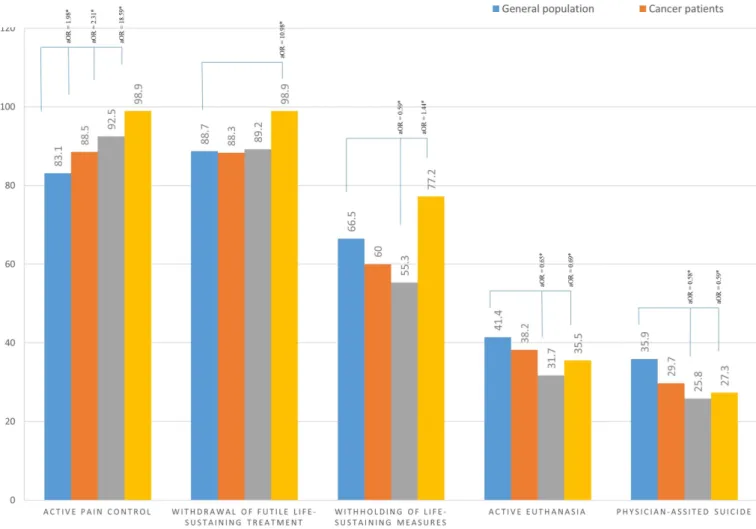
Figure 1 displays the proportion of respondents who answered positively for each mode of death. Overall, the four participant groups strongly agreed with active pain control and withdrawal of futile LST; 98.9% of physi-cians approved both, which was the highest approval rate among the groups. Physicians also exhibited the highest proportion of positive attitudes for passive eutha-nasia. Most of the participants in all four groups did not approve of active euthanasia or PAS. Statistically signifi-cant differences in positive responses to those two inter-ventions were observed between the general population, family caregivers and physicians.
Associations between sociodemographic factors and preference for critical eol interventions
Table 1 shows the univariate logistic regression analyses of sociodemographic factors associated with preferences for five EoL interventions. From each model including socio-demographic variables, significant predictors differed. Higher education, having religion and caregiver expe-rience were associated with a positive attitude for active pain control. Higher income and caregiver experience were associated with a positive preference for withdrawal of futile LST. Participants who preferred passive eutha-nasia were more likely to have higher levels of education and income. Similarly, education was associated with a positive attitude towards active euthanasia, whereas
on 28 March 2019 by guest. Protected by copyright.
having had a caregiving role was negatively associated. A higher educational level was also associated with approval of PAS, as was the absence of religion.
Associations between attitude towards death and preference for mode of death
Several attitudes towards death were associated with pref-erences for mode of death (table 2). Positive attitudes towards death as the ending of life and as being painful and to be feared, believing in an afterlife, and preparing to forgive were associated with approval of active pain control. Regarding death as something to be feared and being remembered after death were positively associated with withdrawal of LST.
Associations between components of a good death and preference for eol interventions
Table 3 shows associations between components of a good death and attitudes towards five EoL care choices. Active pain control and withdrawal of futile LST were positively associated with the feeling that life was meaningful and negatively associated with presence of family. Participants
who considered resolving unfinished business or freedom from pain as important components of a good death were likely to view passive euthanasia negatively. Preference for active euthanasia and PAS was positively associated with being of little burden to one’s family and negatively asso-ciated with the feeling that life was meaningful.
Multiple logistic regression models for factors considered important in preference for eol interventions
We used 16 factors—6 demographic, 5 from attitudes towards death and 5 from components of a good death— to perform stepwise multiple logistic regression analyses (table 4).
Preference for active pain control was positively asso-ciated with higher education, caregiver experience and positive attitudes for death as the ending of life and inversely associated with the presence of family as a component of a good death. Belief in being remembered after death and that ‘life was meaningful’ as core compo-nents of a good death, as well as monthly income, were strong correlates of approval of withdrawal of LST. The
Figure 1 Proportion of respondents who preferred each mode of death by participant group. The number means the proportion (%) of respondents who preferred the specific end-of-life interventions. *P<0.05, estimated from logistic regression models adjusted for age, sex, education level, religion, monthly income, health insurance, comorbidity and caregiver
experience.
on 28 March 2019 by guest. Protected by copyright.
Table 1
Associations between sociodemographic factors and pr
efer
ence for mode of death
Active pain vontr
ol Withdrawal of futile LST Passive euthanasia Active euthanasia Physician-assisted suicide Positive Negative P values Positive Negative P values Positive Negative P values Positive Negative P values Positive Negative P values Sex Male 1840 (90.5) 193 (9.5) N.S. 1853 (91.2) 180 (8.8) N.S. 1375 (67.6) 658 (32.4) 0.001 769 (37.8) 1265 (62.2) N.S. 636 (31.3) 1398 (68.7) N.S. Female 1923 (89.8) 219 (10.2) 1946 (90.9) 196 (9.2) 1323 (61.8) 819 (38.2) 775 (36.2) 1367 (63.8) 618 (28.9) 1524 (71.1) Age (years) <50 2046 (90.3) 220 (9.7) N.S. 2080 (91.8) 186 (8.2) N.S. 1512 (66.7) 755 (33.3) N.S. 846 (37.3) 1421 (62.7) N.S. 706 (31.2) 1560 (68.8) N.S. ≥50 1718 (90.0) 192 (10.0) 1720 (90.1) 190 (9.9) 1187 (62.2) 723 (37.8) 699 (36.6) 1211 (63.4) 549 (28.7) 1361 (71.3)
Education Middle school or less
389 (84.8) 70 (15.2) 0.001 393 (85.6) 66 (14.4) N.S. 242 (52.7) 217 (47.3) 0.002 132 (28.8) 327 (71.2) <0.001 116 (25.3) 343 (74.7) 0.018
High school or higher
3280 (91.0) 324 (9.0) 3305 (91.7) 299 (8.3) 2389 (66.3) 1215 (33.7) 1368 (38.0) 2236 (62.0) 1100 (30.5) 2504 (69.5) Religion No 1818 (89.1) 223 (10.9) 0.034 1846 (90.4) 195 (9.6) N.S. 1309 (64.2) 732 (35.8) N.S. 784 (38.4) 1257 (61.6) N.S. 655 (32.1) 1386 (67.9) 0.003 Ye s 1945 (91.2) 189 (8.8) 1953 (91.5) 181 (8.5) 1388 (65.1) 746 (34.9) 759 (35.6) 1374 (64.4) 599 (28.1) 1535 (71.9) Monthly income <3000$ 943 (88.0) 129 (12.0) N.S. 927 (86.5) 145 (13.5) <0.001 604 (56.3) 468 (43.7) <0.001 358 (33.4) 714 (66.6) N.S. 293 (27.3) 779 (72.7) N.S. ≥3000$ 2787 (90.9) 280 (9.1) 2841 (92.6) 226 (7.4) 2076 (67.7) 991 (32.3) 1174 (38.3) 1893 (61.7) 950.6 (31.0) 2116 (69.0)
Health insurance National Health Insurance
3615 (90.0) 400 (10.0) N.S. 3652 (91.0) 363 (9.0) N.S. 2611 (65.0) 1404 (35.0) N.S. 1488 (37.0) 2527 (63.0) N.S. 1204 (30.0) 2811 (70.0) N.S. Medicaid 94 (90.4) 10 (9.6) 93 (89.4) 11 (10.6) 61 (58.7) 43 (41.3) 43 (41.4) 61 (58.6) 39 (37.5) 65 (62.5) Comorbidity No 2704 (90.6) 280 (9.4) N.S. 2748 (92.1) 236 (7.9) N.S. 1971 (66.1) 1012 (33.9) N.S. 1091 (36.6) 1892 (63.4) N.S. 906 (30.4) 2078 (69.6) N.S. Ye s 1060 (88.9) 132 (11.1) 1052 (88.3) 140 (11.8) 727 (61.0) 465 (39.0) 453 (38.0) 739 (62.0) 349 (29.2) 844 (70.8) Car egiver experience No 1853 (87.7) 260 (12.3) <0.001 1894 (89.7) 219 (10.3) 0.007 1384 (65.5) 729 (34.5) N.S. 820 (38.8) 1294 (61.2) 0.010 662 (31.3) 1451 (68.7) N.S. Ye s 1911 (92.7) 152 (7.4) 1906 (92.4) 157 (7.6) 1315 (63.7) 748 (36.3) 725 (35.2) 1338 (64.9) 592 (28.7) 1471 (71.3) P values wer e estimated fr
om models using stepwise selection.
LST
, life-sustaining tr
eatment; N.S., non-significant.
on 28 March 2019 by guest. Protected by copyright.
Table 2
Associations between attitude towar
ds death and pr
efer
ence for mode of death
Active pain contr
ol Withdrawal of futile LST Passive euthanasia Active euthanasia Physician-assisted suicide Positive Negative P values Positive Negative P values Positive Negative P values Positive Negative P values Positive Negative P values
Life ends with death Negative
1003 (87.6) 142 (12.4) 0.001 1030 (90.0) 115 (10.0) N.S. 707 (61.7) 438 (38.3) N.S. 311 (27.1) 834 (72.9) <0.001 242 (21.1) 903 (78.9) <0.001 Positive 2761 (91.1) 270 (8.9) 2770 (91.4) 261 (8.6) 1992 (65.7) 1039 (34.3) 1234 (40.7) 1797 (59.3) 1013 (33.4) 2018 (66.6)
Death is painful and ther
efor e to be fear ed Negative 1645 (88.4) 215 (11.6) 0.014 1671 (89.8) 190 (10.2) 0.009 1174 (63.1) 686 (36.9) 0.016 632 (34.0) 1229 (66.0) N.S. 500 (26.9) 1361 (73.2) 0.033 Positive 2119 (91.5) 196 (8.5) 2129 (92.0) 186 (8.0) 1524 (65.8) 791 (34.2) 913 (39.4) 1403 (60.6) 755 (32.6) 1560 (67.4) Life continues to r
emain intact after ending of life
Negative 1743 (88.8) 220 (11.2) 0.003 1785 (90.9) 178 (9.1) N.S. 1254 (63.9) 709 (36.1) N.S. 710 (36.2) 1253 (63.8) 0.002 568 (28.9) 1395 (71.1) 0.002 Positive 2022 (91.3) 192 (8.7) 2015 (91.0) 198 (9.0) 1445 (65.3) 769 (34.7) 835 (37.7) 1379 (62.3) 687 (31.0) 1527 (69.0)
Dying people should pr
epar e to practice charity Negative 343 (86.3) 54 (13.7) 0.018 338 (85.1) 59 (14.9) 0.018 238 (60.0) 159 (40.0) N.S. 137 (34.4) 261 (65.6) N.S. 115 (28.9) 282 (71.1) N.S. Positive 3421 (90.6) 357 (9.5) 3462 (91.6) 317 (8.4) 2460 (65.1) 1318 (34.9) 1408 (37.3) 2371 (62.7) 1140 (30.2) 2639 (69.8) People should be r emember ed Negative 304 (86.6) 47 (13.4) N.S. 293 (83.4) 58 (16.6) 0.001 171 (48.7) 180 (51.4) <0.001 117 (33.2) 235 (66.8) N.S. 100 (28.4) 252 (71.6) N.S. Positive 3460 (90.5) 364 (9.5) 3507 (91.7) 318 (8.3) 2528 (66.1) 1297 (33.9) 1428 (37.3) 2397 (62.7) 1155 (30.2) 2670 (69.8) P values wer e estimated fr
om models using stepwise selection.
LST
, life-sustaining tr
eatment; N.S., non-significant.
on 28 March 2019 by guest. Protected by copyright.
Table 3
Associations between factors r
elated to well-dying and pr
efer
ence for mode of death
Active pain contr
ol Withdrawal of futile LST Passive euthanasia Active euthanasia Physician-assisted suicide Positive Negative P values Positive Negative P values Positive Negative P values Positive Negative P values Positive Negative P values Pr
esence of family Negative
2849 (90.5) 298 (9.5) N.S. 2889 (91.8) 257 (8.2) 0.031 1996 (63.4) 1151 (36.6) N.S. 1182 (37.6) 1965 (62.4) N.S. 970 (30.8) 2177 (69.2) N.S. Positive 916 (89.0) 114 (11.1) 911 (88.5) 119 (11.5) 703 (68.3) 327 (31.7) 363 (35.2) 667 (64.8) 285 (27.7) 744 (72.3) Not be a bur den to family Negative 2927 (90.2) 319 (9.8) N.S. 2964 (91.4) 281 (8.7) N.S. 2084 (64.2) 1161 (35.8) N.S. 1103 (34.0) 2142 (66.0) <0.001 888 (27.4) 2357 (72.6) <0.001 Positive 838 (90.0) 93 (10.0) 836 (89.8) 95 (10.2) 615 (66.0) 316 (34.0) 442 (47.5) 489 (52.5) 366 (39.4) 565 (60.7)
Resolve unfinished business Negative
3101 (90.2) 337 (9.8) N.S. 3124 (90.9) 314 (9.1) N.S. 2249 (65.4) 1190 (34.6) 0.004 1280 (37.2) 2158 (62.8) N.S. 1038 (30.2) 2401 (69.8) N.S. Positive 663 (90.0) 74 (10.0) 676 (91.6) 62 (8.4) 450 (61.0) 287 (39.0) 264 (35.8) 473 (64.2) 217 (29.4) 521 (70.6)
Feel life was meaningful Negative
3233 (89.8) 369 (10.2) 0.035 3248 (90.2) 354 (9.8) <0.001 2305 (64.0) 1297 (36.0) N.S. 1280 (38.3) 2222 (61.7) 0.004 1130 (31.4) 2472 (68.6) 0.003 Positive 532 (92.6) 43 (7.4) 552 (96.2) 22 (3.8) 394 (68.6) 180 (31.4) 165 (28.7) 409 (71.3) 124 (21.7) 450 (78.3) Fr eedom fr om pain Negative 3373 (90.0) 374 (10.0) N.S. 3406 (90.9) 340 (9.1) N.S. 2456 (65.6) 1290 (34.4) <0.001 1383 (36.9) 2363 (63.1) N.S. 1113 (29.7) 2633 (70.3) 0.032 Positive 392 (91.2) 38 (8.8) 394 (91.6) 36 (8.4) 243 (56.5) 187 (43.5) 162 (37.6) 268 (62.4) 141 (32.9) 288 (67.1) P values wer e estimated fr
om models using stepwise selection.
LST
, life-sustaining tr
eatment; N.S., non-significant.
on 28 March 2019 by guest. Protected by copyright.
Table 4
Multiple logistic r
egr
ession models for factors consider
ed important in pr
efer
ence for mode of deaths
Active pain contr
ol Withdrawal of futile LST Passive euthanasia Active euthanasia Physician-assisted suicide aOR 95% CI aOR 95% CI aOR 95% CI aOR 95% CI aOR 95% CI Sex Male Ref Ref Ref Female 0.80 0.70 to 0.91 0.87 0.76 to 1.00
Age (years) <50 ≥50 Education Middle school or less
Ref Ref Ref Ref Ref Ref Ref Ref
High school or higher
1.77 1.33 to 2.36 1.43 1.14 to 1.79 1.70 1.36 to 2.12 1.40 1.12 to 1.77 Religion No Ref Ref Ye s 1.28 1.02 to 1.59 Monthly income <3000 $ Ref Ref Ref Ref ≥3000 $ 1.83 1.46 to 2.30 1.38 1.17 to 1.63 Car egiver experience No Ref Ref Ref Ref Ref Ref Ref Ref Ye s 1.67 1.34 to 2.08 1.38 1.11 to 1.72 0.87 0.76 to 1.00 0.86 0.75 to 0.98
Life ends with death Negative
Ref Ref Ref Ref Ref Ref Positive 1.66 1.30 to 2.11 1.80 1.54 to 2.12 1.87 1.57 to 2.22
Death is painful and ther
efor e to be fear ed Negative Ref Ref Ref Ref Ref Ref Ref Ref Ref Ref Positive 1.3 1.05 to 1.61 1.39 1.12 to 1.73 1.18 1.04 to 1.35 1.15 1.01 to 1.32 1.19 1.03 to 1.37 Life continues to r
emain intact after ending of life
Negative Ref Ref Ref Ref Ref Ref Positive 1.27 1.02 to 1.60 1.18 1.03 to 1.35 1.26 1.09 to 1.46 People should pr epar e to show mer cy Negative Ref Ref Positive 1.39 1.01 to 1.93 Continued
on 28 March 2019 by guest. Protected by copyright.
Active pain contr ol Withdrawal of futile LST Passive euthanasia Active euthanasia Physician-assisted suicide aOR 95% CI aOR 95% CI aOR 95% CI aOR 95% CI aOR 95% CI People should be r emember ed Negative Ref Ref Ref Ref Positive 2.03 1.48 to 2.79 1.96 1.56 to 2.46 Pr
esence of family Negative
Ref Ref Ref Ref Positive 0.78 0.62 to 0.99 0.71 0.56 to 0.90 Not be a bur den to family Negative Ref Ref Ref Ref Positive 1.62 1.39 to 1.90 1.61 1.37 to 1.89
Resolve unfinished business Negative
Ref
Ref
Positive
0.82
0.69 to 0.98
Feel life was meaningful Negative
Ref Ref Ref Ref Ref Ref Positive 2.56 1.58 to 4.15 0.73 0.60 to 0.89 0.68 0.54 to 0.85 Fr eedom fr om pain Negative Ref Ref Positive 0.69 0.55 to 0.85
aOR, adjusted OR; LST
, life-sustaining tr
eatment.
Table 4
Continued
on 28 March 2019 by guest. Protected by copyright.
higher education, was positively associated with passive euthanasia. On the other hand, regarding ‘freedom from pain’ as an important factor of a good death negatively predicted a preference for passive euthanasia. Education level, three attitudes towards death (being the end of life, being feared and being remembered) and not being a burden to one’s family as a component of a good death were related to positive attitudes towards both active euthanasia and PAS (table 4).
DIsCussIOn
Our study is unique in its recruitment of a large number of patients with cancer, family caregivers, physicians and members of the general public. An important finding was the extensive support for active pain control and withdrawal of futile LST in terms of EoL care by most members of the participant groups and the negative atti-tudes towards euthanasia and PAS. These findings suggest that recent debates on withdrawal of futile LST17 41 and its
legalisation18 may be influenced by societal preferences
aligning with government policy. The findings are consis-tent with those of Western and other Asian studies.9 23 42
Physicians had a more negative attitude towards the active ending of life (euthanasia and PAS) than members of the other groups. Despite the general consensus of positive attitudes towards euthanasia and PAS in some Western studies,1 12 17 20–22 only a small percentage of participants
among our four groups reported a similar attitude. The Korean Supreme Court decision16 and
legalisa-tion of withdrawal of futile LST by physicians18 have a
long and painful history. Physician-assisted dying (PAD) and PAS are still illegal in Korea, as well as in China and Japan,9 although the Canadian Supreme Court
legal-ised PAD in 2015.6 43 The guidelines of the Consensus
Committee on the withdrawal of LST designated by the Korean Minister of Health and Welfare permit withdrawal of LST from terminally ill patients according to their advance directives or will and via a review of the hospital ethics committee.25 44 The Korean law also emphasises
continuous pain control, nutritional support and admin-istration of fluid.
In Korea, there have been public debates on passive euthanasia and withdrawal of LST issues involving current medical and legal situations.45 Ceasing LST with the
primary intention of ending the life of an unconscious patient (eg, one who is in a vegetative state) who could survive with such treatment is considered passive eutha-nasia and is banned. Withholding futile LST, however, while it may border on passive euthanasia, allows natural death when death is imminent even after medical treat-ment; it is not a life-shortening action. Thus, we distin-guished between passive euthanasia and withholding futile LST in this study. Despite the euthanasia ban, however, over half of our participant groups supported withholding futile LST, suggesting the possibility that following the February 2018 Supreme Court ruling,
a super-aged society.1
The proportion of positive attitudes in Korea towards euthanasia or PAS is relatively low compared with the Neth-erlands,46 the USA47 and Canada,1 48 where 60%–90% of
patients support these procedures.17 As Koreans generally
support only conservative EoL care choices, that is not surprising. The greater public acceptance of euthanasia in earlier studies from Western countries might follow from a rising belief in personal autonomy regarding EoL decisions and the secularisation and individualisation of society.1 In the USA, however, public support for active
euthanasia and PAS decreased from 75% in 2005 to 64% in 2012 and has also decreased in most Central and Eastern European countries.7 Regardless of public
atti-tudes, the new rulings might change the attitudes towards withdrawal of futile LST and be viewed as an expansion of the rights of patients. Although euthanasia or PAS is unethical and illegal in Korea, its time will come.
Several earlier studies found that demographic charac-teristics have little predictive power on attitudes towards EoL interventions. In the present study, women were less likely than men to prefer passive euthanasia and PAS, but sex was not associated with any significant difference in attitude towards other EoL interventions. The influ-ence of sex was inconsistent and not a major factor.7 17 As
people age, they are faced with deteriorating health and the loss of family members and friends and thus may be expected to support withdrawal of LST, euthanasia and PAS.17 In this survey, however, age was not associated with
attitudes towards acceptance of euthanasia and PAS, and its influence in most other studies was inconsistent.37 38 49
Our finding that participants who were more educated and affluent were more supportive of euthanasia and PAS is not consistent with findings from a 2000 US study.38
Previous studies showed that religion was strongly asso-ciated with attitude towards PAS,15 38 46 while the present
study showed only a moderate association of religion with attitude towards active pain control. Since our study surveyed attitudes towards death and towards ‘a good death’, and included those attitudes in multiple logistic analyses, attitudes might have had a greater influence than religion on the results.
This study showed that attitudes towards dying and death were positively associated with various EoL inter-ventions. It is understandable that participants ‘fearing death because it is painful’ are more likely to favour all five EoL interventions. Interestingly, participants ‘preparing to practice charity’ for a good death favour active pain control, and participants who anticipate ‘being remem-bered’ favour dignity with death and passive euthanasia more than active euthanasia and PAS. As few studies include attitudes towards dying and death in the final logistic regression results for EoL interventions, these findings need further study.
This study also showed that attitudes towards death and towards ‘a good death’ were associated with the mode of death. Participants choosing ‘presence of family’ as
on 28 March 2019 by guest. Protected by copyright.
a component of a good death were less likely to favour active pain control and withdrawal of futile LST. The wish to be conscious at EoL or surrounded by family would more likely be associated with a refusal of high dosages of morphine and cessation of LST.50 Multiple
regres-sion modelling also confirmed the association of ‘not to be a burden to family’ with hastened death, such as active euthanasia and PAS.51 Participants wanting to not
be a burden to family at EoL were more likely to accept euthanasia and PAS. In other studies, fear of becoming dependent on the family, perceiving oneself as a finan-cial burden to others and lacking sofinan-cial support were related to acceptance of a hastened death.50 51
Interest-ingly, our study also found that subjects ‘feeling life was meaningful' were more likely to consider withdrawal of futile LST but less likely to consider euthanasia or PAS, a finding similar to that of an earlier US study suggesting that ‘feeling appreciated’ was associated with being less likely to consider euthanasia or PAS.38
Our study confirmed that various attitudes towards death, and towards a ‘good death’, influence attitudes towards mode of death. These findings suggest that physi-cians should systematically explore those attitude of EoL patients and manage their multidimensional care needs so as to support their preference.15
As our study had several limitations, these findings should be cautiously interpreted. First, the response rates of the four subject groups were low, so the results may not be generalisable. Second, we enrolled only Korean patients with cancer and their family caregivers, so our results may not be generalisable to other cultures or other terminal illnesses. Most patients, however, are likely to face EoL issues such as those discussed here. In addition, we did not investigate details about whether patients were receiving active cancer treatment or palliative care. Since they were patients at oncologic clinics, they were likely to be receiving active treatment. Nevertheless, people’s opinions change as they move along a disease trajectory, and particularly as they become closer to death, so this information should be included in future studies. Finally, attitudes towards EoL care interventions such as eutha-nasia and PAS vary with the wording of the survey ques-tions and whether the quesques-tions are focused on law7 or ethics,14 so comparison of our findings with those from
other studies has limitations. Author affiliations
1Department of Biomedical Science, College of Medicine, Seoul National University, Seoul, Korea
2Department of Biomedical Informatics, College of Medicine, Seoul National University, Seoul, Korea
3Public Health Medical Service, Seoul National University Hospital, Seoul, Korea 4Department of Internal Medicine, Seoul National University Hospital, Seoul, Korea 5Cancer Survivorship Branch, National Cancer Control Institute, National Cancer Center, Goyang, Korea
6Department of Internal Medicine, Seoul National University Bundang Hospital, Seongnam, Korea
7Division of Hematology and Medical Oncology, Department of Internal Medicine, School of Medicine, Chonbuk National University, Jeonju, Korea
8Division of Hematology/Oncology, Chonbuk National University Medical School, Jeonju, Korea
9Department of Internal Medicine, Postgraduate Medical School, Gyeongsang National University, Jinju, Korea
10Department of Internal Medicine, Kangdong Sacred Heart Hospital, Hallym University College of Medicine, Seoul, Korea
11Department of Hemato-oncology, Daegu Fatima Hospital, Daegu, Korea 12Department of Internal Medicine, Ewha Womans University College of Medicine, Seoul, Korea
13Department of Medical Oncology and Hematology, Kyung Hee University Hospital, Seoul, Korea
14Department of Internal Medicine, Korea University Guro Hospital, Korea University College of Medicine, Seoul, Korea
15Department of Internal Medicine, Dongsan Medical Center, Keimyung University School of Medicine, Daegu, Korea
16Department of Internal Medicine, Chungnam National University Hospital, Daejeon, Korea
17Department of Oncology, Asan Medical Center, University of Ulsan College of Medicine, Seoul, Korea
Acknowledgements The authors would like to thank Dr Miriam Bloom from SciWrite for English-language editing.
Contributors YHY participated in the design of the study, provided financial support and study materials, collected and assembled the data, interpreted the analyses and participated in the sequence alignment and drafting of the manuscript. K-NK participated in the design of the study, the statistical analyses and drafting of the manuscript. J-AS participated in the study design and coordination, data analyses and the sequence alignment and drafting of the manuscript. SHY and MSK participated in the design of the study, the statistical analyses and the drafting of the manuscript. YAK participated in the design of the study, the collection and assembly of the data and the drafting of the manuscript. BDK, HJS, E-KS, JHKa, JHKw, JLL, EMN, CHM, EJK, YRD, YSC and KHJ participated in the design of the study, the provision of study materials and patients, the collection and assembly of the data and the drafting of the manuscript. All authors read and approved the final manuscript.
Funding This research was supported by a grant from the Korea Health Technology R&D Project through the Korea Health Industry Development Institute (KHIDI), funded by the Ministry of Health & Welfare, Republic of Korea (grant number: HC15C1391), Seokchun Daewoong Foundation (grant number: 80020160249). Competing interests None declared.
Patient consent Obtained.
ethics approval The Institutional Review Boards (IRBs) at all participating institutions (Seoul National University Hospital, Seoul National University Bundang Hospital, National Cancer Center, Keimyung University Dong-san Hospital, Ewha Womans University Hospital, Chonnam National University Hospital, Chonbuk National University Hospital, Gyeongsang National University Hospital, Kangdong Sacred Heart Hospital, Daegu Fatima Hospital, Kyung Hee University Hospital, Korea University Guro Hospital, Chungnam National University Hospital, Asan Medical Center) approved the study protocol (IRB No. E-1607-107-777).
Provenance and peer review Not commissioned; externally peer reviewed. Data sharing statement No additional data available.
Open access This is an open access article distributed in accordance with the Creative Commons Attribution Non Commercial (CC BY-NC 4.0) license, which permits others to distribute, remix, adapt, build upon this work non-commercially, and license their derivative works on different terms, provided the original work is properly cited, appropriate credit is given, any changes made indicated, and the use is non-commercial. See: http:// creativecommons. org/ licenses/ by- nc/ 4. 0/.
reFerenCes
1. Cohen J, Marcoux I, Bilsen J, et al. Trends in acceptance of euthanasia among the general public in 12 European countries (1981-1999). Eur J Public Health 2006;16:663–9.
2. Gielen J, Van Den Branden S, Broeckaert B. Attitudes of European physicians toward euthanasia and physician-assisted suicide: a review of the recent literature. J Palliat Care 2008;24:173–84.
on 28 March 2019 by guest. Protected by copyright.
in selected European countries and US states: systematic literature review. Med Care 2013;51:938–44.
4. Pennec S, Riou F, Gaymu J, et al. Physician-assisted deaths in France: results from a nationwide survey. Presse Med 2015;44(7-8):864–7.
5. Radbruch L, Leget C, Bahr P, et al. Euthanasia and physician-assisted suicide: a white paper from the European Association for Palliative Care. Palliat Med 2016;30:104–16.
6. Attaran A. Unanimity on death with dignity–legalizing physician-assisted dying in Canada. N Engl J Med 2015;372:2080–2.
7. Emanuel EJ, Onwuteaka-Philipsen BD, Urwin JW, et al. Attitudes and practices of euthanasia and physician-assisted suicide in the United States, Canada, and Europe. JAMA 2016;316:79–90.
8. Doron D, Wexler ID, Shabtai E, et al. Israeli dying patient act: physician knowledge and attitudes. Am J Clin Oncol 2014;37:597–602.
9. Miyashita M, Morita T, Tsuneto S, et al. The Japan HOspice and Palliative Care Evaluation study (J-HOPE study): study design and characteristics of participating institutions. Am J Hosp Palliat Care 2008;25:223–32.
10. Rietjens JA, van der Heide A, Onwuteaka-Philipsen BD, et al. A comparison of attitudes towards end-of-life decisions: survey among the Dutch general public and physicians. Soc Sci Med 2005;61:1723–32.
11. Rathor MY, Abdul Rani MF, Shahar MA, et al. Attitudes toward euthanasia and related issues among physicians and patients in a multi-cultural society of Malaysia. J Family Med Prim Care 2014;3:230–7.
12. van der Heide A, Onwuteaka-Philipsen BD, Rurup ML, et al. End-of-life practices in the Netherlands under the Euthanasia Act. N Engl J Med 2007;356:1957–65.
13. Hurst SA, Mauron A. Assisted suicide and euthanasia in Switzerland: allowing a role for non-physicians. BMJ 2003;326:271–3.
14. Griffith JD, Toms A, Reese J, et al. Attitudes toward dying and death: a comparison of recreational groups among older men. Omega 2013;67:379–91.
15. Periyakoil VS, Kraemer H, Neri E. Multi-ethnic attitudes toward physician-assisted death in California and Hawaii. J Palliat Med 2016;19:1060–5.
16. Myo-ja S. Top court upholds ‘die with dignity’ right: JoongAng Daily, 2009.
17. Yun YH, Han KH, Park S, et al. Attitudes of cancer patients, family caregivers, oncologists and members of the general public toward critical interventions at the end of life of terminally ill patients. CMAJ 2011;183:E673–E679.
18. Montgomery K, Sawin KJ, Hendricks-Ferguson VL. Experiences of pediatric oncology patients and their parents at end of life: a systematic review. J Pediatr Oncol Nurs 2016;33:85–104.
19. Breitbart W, Rosenfeld B, Pessin H, et al. Depression, hopelessness, and desire for hastened death in terminally ill patients with cancer. JAMA 2000;284:2907–11.
20. Sullivan M, Rapp S, Fitzgibbon D, et al. Pain and the choice to hasten death in patients with painful metastatic cancer. J Palliat Care 1997;13:18–28.
21. Wolfe J, Fairclough DL, Clarridge BR, et al. Stability of attitudes regarding physician-assisted suicide and euthanasia among oncology patients, physicians, and the general public. J Clin Oncol 1999;17:1274–9.
22. Sullivan M, Ormel J, Kempen GI, et al. Beliefs concerning death, dying, and hastening death among older, functionally impaired Dutch adults: a one-year longitudinal study. J Am Geriatr Soc 1998;46:1251–7.
23. Zhang N, Ning XH, Zhu ML, X-h N, M-l Z, et al. Attitudes towards advance care planning and healthcare autonomy among community-dwelling older adults in Beijing, China. Biomed Res Int 2015;2015:1–10.
24. Gu X, Cheng W. Chinese oncologists' knowledge, attitudes and practice towards palliative care and end of life issues. BMC Med Educ 2016;16:149.
25. Ivo K, Younsuck K, Ho YY, Yy H, et al. A survey of the perspectives of patients who are seriously ill regarding end-of-life decisions in
2012;38:310–6.
26. Shi Z, Taylor AW, Riley M, et al. Association between dietary patterns, cadmium intake and chronic kidney disease among adults. Clin Nutr 2018;37.
27. Levy P. Sampling. New York: Wiley, 1965.
28. Yun YH, Kim K-N, Sim J-A, et al. Attitudes of the general
population, cancer patients, their family caregivers, and physicians toward dying and death: a nationwide survey. Glob J Health Sci 2017;9:201–11.
29. Cottrell L, Duggleby W. The "good death": an integrative literature review. Palliat Support Care 2016;14:686–712.
30. Cheng SY, Hu WY, Liu WJ, et al. Good death study of elderly patients with terminal cancer in Taiwan. Palliat Med 2008;22:626–32. 31. Steinhauser KE, Clipp EC, McNeilly M, et al. In search of a good
death: observations of patients, families, and providers. Ann Intern Med 2000;132:825–32.
32. Miyashita M, Sanjo M, Morita T, et al. Good death in cancer care: a nationwide quantitative study. Ann Oncol 2007;18:1090–7. 33. Granda-Cameron C, Houldin A. Concept analysis of good death in
terminally ill patients. Am J Hosp Palliat Care 2012;29:632–9. 34. Miyashita M, Kawakami S, Kato D, et al. The importance of good
death components among cancer patients, the general population, oncologists, and oncology nurses in Japan: patients prefer "fighting against cancer". Support Care Cancer 2015;23:103–10.
35. Meier EA, Gallegos JV, Thomas LP, et al. Defining a good death (successful dying): literature review and a call for research and public dialogue. Am J Geriatr Psychiatry 2016;24:261–71.
36. Steinhauser KE, Christakis NA, Clipp EC, et al. Factors considered important at the end of life by patients, family, physicians, and other care providers. JAMA 2000;284:2476–82.
37. Meier DE, Emmons CA, Wallenstein S, et al. A national survey of physician-assisted suicide and euthanasia in the United States. N Engl J Med 1998;338:1193–201.
38. Emanuel EJ, Fairclough DL, Emanuel LL. Attitudes and desires related to euthanasia and physician-assisted suicide among terminally ill patients and their caregivers. JAMA 2000;284:2460–8. 39. Ganzini L, Nelson HD, Schmidt TA, et al. Physicians' experiences
with the oregon death with dignity act. N Engl J Med 2000;342:557–63.
40. Association KM. Annual report membership statistics Korean Medical
Association: Research Institute for Healthcare Policy, 2015.
41. Legalize the right to die: JoongAng Daily, 2009.
42. Chen HP, Huang BY, Yi TW, et al. Attitudes of Chinese oncology physicians toward death with dignity. J Palliat Med 2016;19:874–8. 43. Chochinov HM, Frazee C. Finding a balance: Canada's law on
medical assistance in dying. Lancet 2016;388:543–5.
44. Ministry of Health and Welfare of Republic of Korea. Announcement
of the guidance on the withdrawal of LST from the terminal patient by the Consensus Committee, 2010.
45. Kyongjin Ahn HB. Reflections on the Movement for the Legalization of "Death with Dignity as Withdrawal of Futile Life-Sustaining Treatment" in South Korea. Journal of Korean Law 2010;10:43–64. 46. van der Maas PJ, Pijnenborg L, van Delden JJ. Changes in
Dutch opinions on active euthanasia, 1966 through 1991. JAMA 1995;273:1411–4.
47. Blendon RJ, Szalay US, Knox RA. Should physicians aid their patients in dying? The public perspective. JAMA 1992;267:2658–62. 48. Tg R. Toronto: Canadian Institute of Public Opinion. Gallup Canada,
1968-2002.
49. Suarez-Almazor ME, Newman C, Hanson J, et al. Attitudes of terminally ill cancer patients about euthanasia and assisted suicide: predominance of psychosocial determinants and beliefs over symptom distress and subsequent survival. J Clin Oncol 2002;20:2134–41.
50. Rietjens JA, van der Heide A, Onwuteaka-Philipsen BD, et al. Preferences of the Dutch general public for a good death and associations with attitudes towards end-of-life decision-making. Palliat Med 2006;20:685–92.
51. Chochinov HM. Dying, dignity, and new horizons in palliative end-of-life care. CA Cancer J Clin 2006;56:84–103. quiz 04-5.
on 28 March 2019 by guest. Protected by copyright.