119 -P1-54 금강 유역 약초체험공원 조성시 유용 약용자원 선발 충청남도농업기술원 청양구기자시험장, 충청남도농업기술원1, 공주대학교2, 국립원예특작과학원 인삼특작부3, 충북대학교4, 전라남도농업기술원 쌀연구소5 서정석*, 이보희, 주정일, 남윤규1, 강영식1, 송홍선2, 안영섭3, 박충범3, 이철희4, 김명석5
Selection of Suitable Medicinal Plants for Establishment of Medicinal Park in the Geum-River Basin
Chungcheongnam-do Agricultural Research & Extension Services Cheongyang Boxthorn Experiment Station, Chungcheongnam-do Agricultural Research & Extension
Services1, College of Industrial Science, Kongju National Univ.2, National Institute of Horticultural & Herbal Science, RDA3, Dept. Crop Scinence, Chungbuk National University4,
Rice Research Institute, Jeollanamdo Agricultural Research & Extension Services5
Joung-Seok Seo*, Bo-Hee Lee, Jung-Il Ju, Yun-Gyu Nam1, Young-Sik Kang1,
Hong-Seon Song2, Young-Sup Ahn3, Chung-Berm Park3, Cheol-Hee Lee4, Myeong-Seok Kim5
실험목적 (Objectives)
최근 주요 4대강 살리기 일환으로 생태하천 조성, 수변의 다양한 문화콘텐츠 개발이 시 도되고 있다. 향후 행정중심복합도시 및 인근 주변 도시민의 여가 활용을 위한 쉼터 조성 등과 연계하여 금강 유역 수변의 약초체험공원 조성에 적합한 유용 약용작물 선발을 위한 연구가 필요하였다.
재료 및 방법 (Materials and Methods)
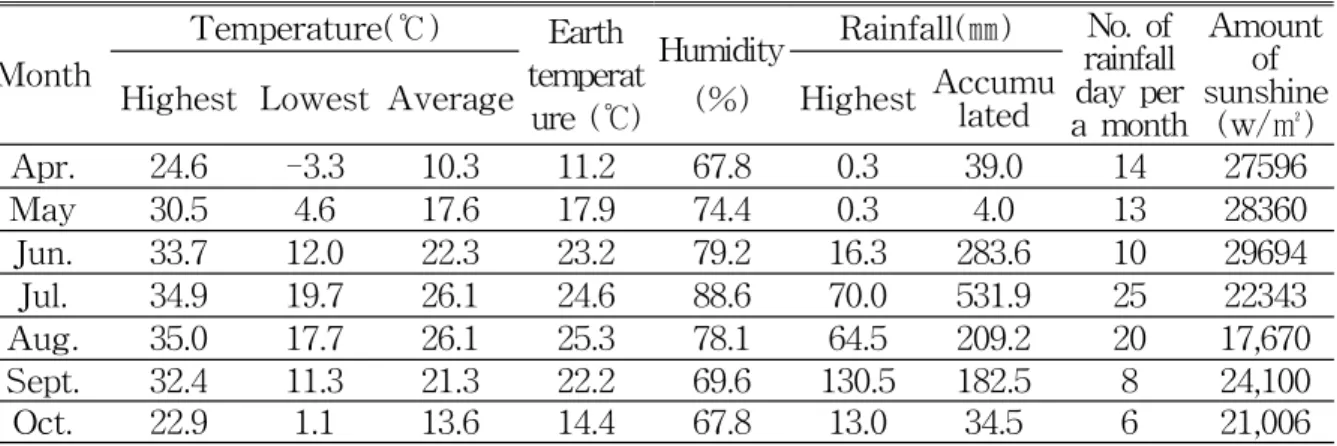
◦ 조사지역 : 금강 미호천 주변의 연기군 동면 용호리 ◦ 조사식물 : 맥문동, 구기자, 독할 등 약용식물 50종 ◦ 조사내용 : 기상, 생활환경, 개화기 등 생육특성 실험결과 (Results) ◦ 생육기간의 기상은 4월 최저기온이 -3.3℃를 기록하였으며 강우일수가 다소 많았고 일조 량은 평균 27,596W/㎡이었으며 6월의 기상은 일조량이 29,694W/㎡로 4월과 비슷하였 으며 7, 8월은 고온다습하여 흐리거나 비가 오는 날이 많았으며 9월과 10월은 강우일수가 적고 일조량이 많은 경향이었다. ◦ 금강유역에 맥문동, 천년초 등 50여종의 약용작물을 식재한 결과 술패랭이와 오미자는 개화시기가 5월경이었고 감초, 구기자 등 4종은 6월상순~7월상순, 맥문동, 개미취, 등 11종은 7월 중하순이었다. ◦ 50여종의 약용작물 중 26종이 생육 가능하였으며 맥문동, 천년초 등 19종은 생존율이 70% 이상으로 생육이 양호하여 약초체험공원 조성시 재배작물로 적합할 것으로 기대었다. 주저자연락처(Corresponding author):서정석 (E-mail)[email protected] (Phone)041-943-1117
120
-* 시험성적
Table 1. The meteorograph of medicinal park field test during growth stage(2011). Month Temperature(℃) Earth temperat ure (℃) Humidity (%) Rainfall(㎜) No. of rainfall day per a month Amount of sunshine (w/㎡)
Highest Lowest Average Highest Accumulated
Apr. 24.6 -3.3 10.3 11.2 67.8 0.3 39.0 14 27596 May 30.5 4.6 17.6 17.9 74.4 0.3 4.0 13 28360 Jun. 33.7 12.0 22.3 23.2 79.2 16.3 283.6 10 29694 Jul. 34.9 19.7 26.1 24.6 88.6 70.0 531.9 25 22343 Aug. 35.0 17.7 26.1 25.3 78.1 64.5 209.2 20 17,670 Sept. 32.4 11.3 21.3 22.2 69.6 130.5 182.5 8 24,100 Oct. 22.9 1.1 13.6 14.4 67.8 13.0 34.5 6 21,006
Table 2. The wild environmental and field growth characteristics of medicinal plants in the Geum-river basin(2011).
Plant species enviroWild nment Blooming stage Plant hight (㎝) No. of
branchNo. ofleaves
Survival rate
(%) Medicinal effects
Liriope platyphylla sunny 7. 25 34 - 153 96 phlegm, asthma
Cactus 〃 6. 17 23 - - 88 bronchial, dysentery
Carnation shade 5. 28 42 8 24 70 cystitis, urethritis
Spearmint sunny 8. 12 38 - 16 100 pruritus, antifungal, aromatics
Dictamnus shade - 62 20 8 50 hypertension, bellyache
Peony sunny 6. 4 70 6 16 98 blood, dysmenorrheal
Siberian chrysanthemum 〃 8. 20 66 - 19 88 menstrual pain, sterility
Aster 〃 7. 29 120 7 7 70 phlegm, asthma
Glycyrrhiza 〃 6. 28 48 - 13 100 inappetence
Japanese Atracty-lodes 〃 8. 23 37 - 5 70 diarrhea, headache
Tumeric 〃 8. 23 45 - 5 63 menstrual pain
Angelica root 〃 8. 23 120 - 15 66 blood, menstrual pain
Sedum middendorffianum 〃 7. 20 18 8 - 55 abscess, hyperlipemia
Thunb shade 7. 20 12 - 8 88 headache, stroke
Anemarrhena Rhizoma dry 7. 20 38 - 8 75 thirst, diabetes
Lithosperrmi Raix shade 7. 29 34 - 13 92 chronic ulcer, measles
Bellflower sunny 8. 6 34 - 12 78 phlegm
Boxthorn 〃 7. 5 120 12 38 100 liver-function, blood pressure,antioxidant
job's Tears 〃 8. 20 250 - 8 100 dropsy, appendicitis
Castor oil plant 〃 7. 20 200 - 28 100 epilepsy
Sedum shade 7. 29 40 19 7 100 bruise, tuberculosis
Patrinia villosa sunny 7. 29 110 4 20 90 an ache
agromony 〃 7. 28 90 7 15 90 hemoptysis
Figwort 〃 8. 12 56 6 12 50 sore throat, abscess