Seoul National University System Health & Risk Management
Chapter 11.
Fatigue Crack Growth
Seoul National University System Health & Risk Management
CONTENTS
11.1 Introduction
11.2 Preliminary Discussion
11.3 Fatigue Crack Growth Rate Testing
11.4 Effects of
𝑹𝑹 = 𝑺𝑺𝐦𝐦𝐦𝐦𝐦𝐦/𝑺𝑺𝐦𝐦𝐦𝐦𝐦𝐦on Fatigue Crack Growth 11.5 Trends in Fatigue Crack Growth Behavior
11.6 Life Estimates for Constant Amplitude Loading 11.7 Life Estimates for Variable Amplitude Loading 11.8 Design Considerations
11.9 Plasticity Aspects and Limitations of LEFM for Fatigue Crack Growth
11.10 Environmental Crack Growth
11.11 Summary
11.1 Introduction
• Objectives
– Apply the stress intensity factor 𝐾𝐾 of fracture mechanics to fatigue crack growth and to environmental crack growth, and understand test methods and trends in behavior.
– Explore fatigue crack growth rate curves, 𝑑𝑑𝑑𝑑/𝑑𝑑𝑑𝑑 versus ∆𝐾𝐾, including fitting common equations and evaluating 𝑅𝑅-ratio (mean stress) effects.
– Calculate the life to grow a fatigue crack to failure, including cases requiring numerical integration and cases of variable amplitude loading. Employ such calculations to evaluate safety factors and inspection intervals.
• Types of Crack Growth
– Fatigue crack growth
: crack growth caused by cyclic loading (11.3-11.9) – Environmental crack growth
: crack growth when a hostile environment is present (11.10)
11.2 Preliminary Discussion
• 11.2.1 Need for Crack Growth Analysis
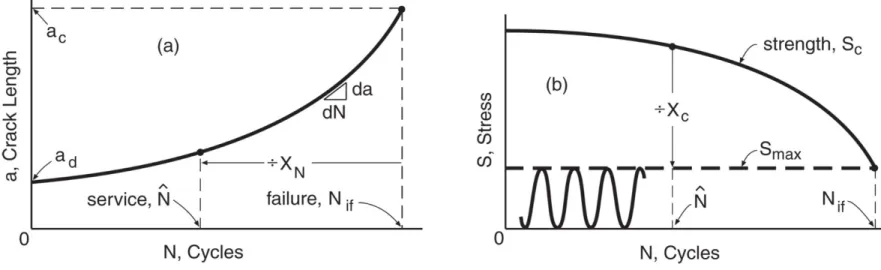
– If the number of cycles expected in actual service is 𝑑𝑑�, then the safety factor on life is
𝑋𝑋𝑁𝑁 = 𝑁𝑁𝑁𝑁�𝑖𝑖𝑖𝑖 (11.2)
– The critical strength for brittle fracture of the member is determined by the current crack length and the fracture toughness 𝐾𝐾𝑐𝑐 for the material and thickness involved:
𝑆𝑆𝑐𝑐 = 𝐹𝐹 𝜋𝜋𝜋𝜋𝐾𝐾𝑐𝑐 (11.3)
– The safety factor on stress against sudden brittle fracture due to the applied cyclic load is
𝑋𝑋𝑐𝑐 = 𝑆𝑆𝑆𝑆𝑐𝑐
max (11.4)
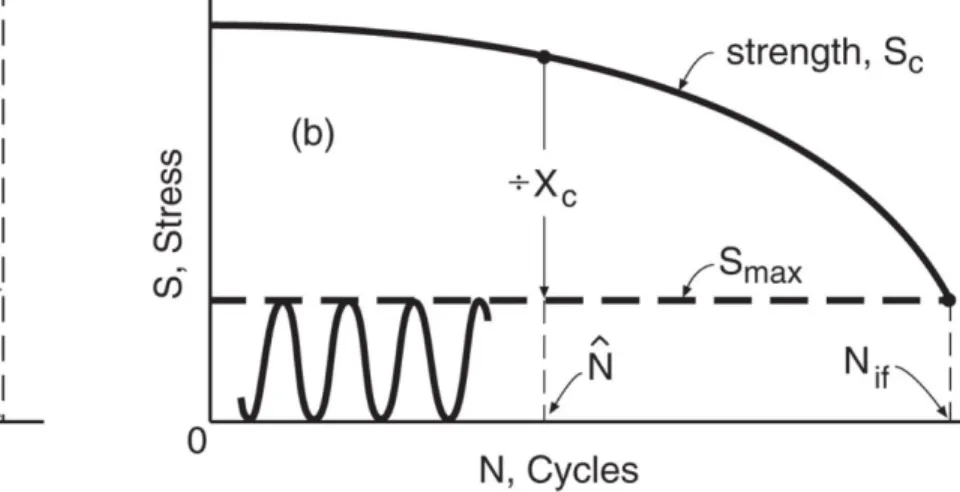
– Predicted failure prior to reaching the actual service life, 𝑋𝑋𝑁𝑁 < 1, Periodic inspections for cracks are then necessary. The safety factor on life is then determined by the inspection period:
𝑋𝑋𝑁𝑁 = 𝑁𝑁𝑁𝑁𝑖𝑖𝑖𝑖
𝑝𝑝 (11.5)
Figure 11.2 Variation of worst-case crack length (a), and strength (b), where periodic inspections are required.
Figure 11.1 Growth of a worst-case crack from the minimum detectable length ad to failure (a), and the resulting variation in worst-case strength (b).
Definition for Fatigue Crack Growth
• Fatigue crack growth rate: the slope at a point on an 𝑑𝑑 versus 𝑑𝑑 curve.
• The primary variable affecting the growth rate of a crack is the range of the stress intensity factor, 𝐾𝐾 .
∆𝐾𝐾 = 𝐹𝐹 ∆𝑆𝑆 𝜋𝜋𝑑𝑑
(11.7)where,
∆𝑆𝑆 = 𝑆𝑆max − 𝑆𝑆min , 𝑅𝑅 = 𝑆𝑆𝑆𝑆min
max (11.6)
• Also, it may be convenient, especially for laboratory test specimens, to use the alternative expression of 𝐾𝐾 in terms of applied force 𝑃𝑃 , as
discussed in Ch. 8, relative to Eq. 8.13.
∆𝐾𝐾 = 𝐹𝐹
𝑃𝑃 𝑡𝑡 𝑏𝑏∆𝑃𝑃, 𝑅𝑅 =
𝑃𝑃𝑃𝑃minmax (11.9)
Describing Fatigue Crack Growth Behavior of Materials (1)
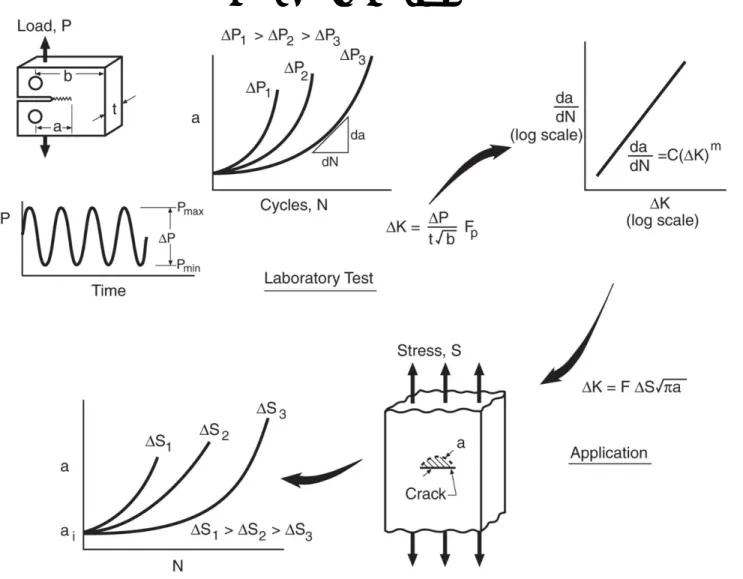
• The crack growth behavior can be described by the relationship
between cyclic crack growth rate 𝒅𝒅𝒅𝒅/𝒅𝒅𝒅𝒅 and stress intensity range ∆𝑲𝑲 .
𝑑𝑑𝜋𝜋
𝑑𝑑𝑁𝑁
= 𝐶𝐶 ∆𝐾𝐾
𝑚𝑚 (11.10)where 𝐶𝐶 is a constant and 𝑚𝑚 is the slope on the log-log plot.
• Fatigue crack growth threshold, ∆𝑲𝑲
𝒕𝒕𝒕𝒕:At low growth rates, the curve generally becomes steep and appears to approach a vertical asymptote denoted ∆𝐾𝐾
𝑡𝑡𝑡.
• At high growth rates, the curve may again become steep, due to rapid unstable crack growth. In this case the curve approaches an asymptote corresponding to 𝑲𝑲
𝒎𝒎𝒅𝒅𝒎𝒎= 𝑲𝑲
𝒄𝒄, the fracture toughness for the material and thickness of interest.
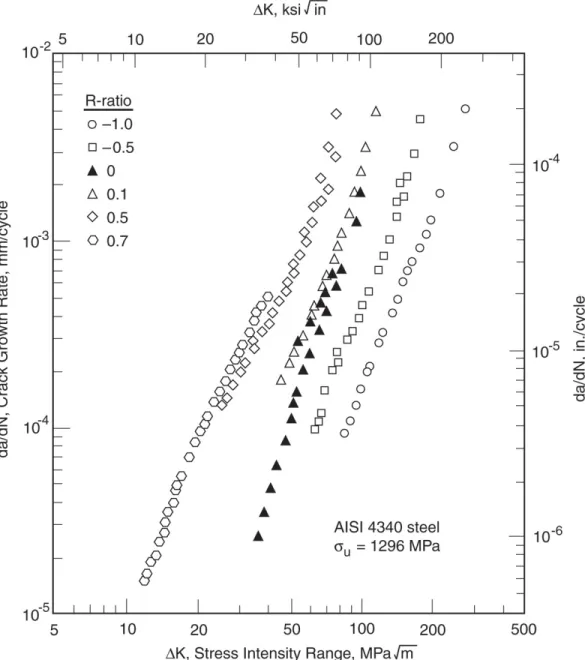
• The value of the stress ratio 𝑅𝑅 or mean stress affects the growth rate.
For a given ∆𝐾𝐾 , increasing 𝑹𝑹 increases the growth rate, and vice versa.
Figure 11.3 Fatigue crack growth rates over a wide range of stress intensities for a ductile pressure vessel steel. Three regions of behavior are indicated: (a) slow growth near the threshold ΔKth, (b) intermediate region following a power equation, and (c) unstable rapid growth. (Plotted from the original data for the study of [Paris 72].)
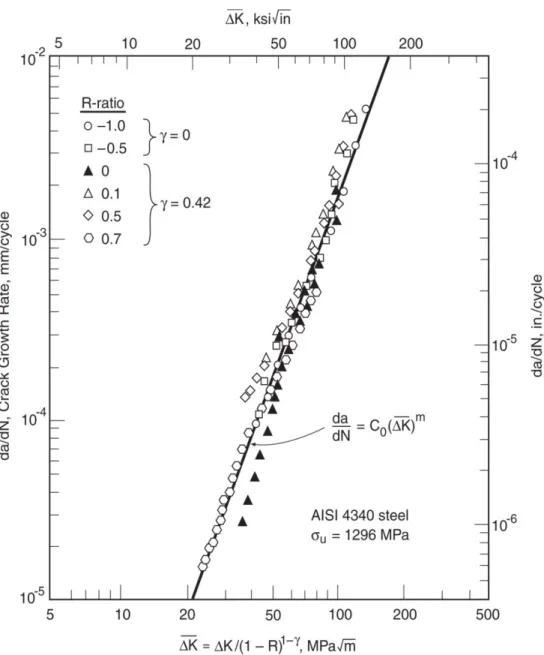
Figure 11.4 Effect of R-ratio on crack growth rates for an alloy steel. For R < 0, the compressive portion of the load cycle is here included in calculating ΔK. (Data from [Dennis 86].)
Describing Fatigue Crack Growth Behavior of Materials (2)
Figure 11.5 Steps in obtaining da/dN versus ΔK data and using it for an engineering application. (Adapted from [Clark 71]; used with permission.)
11.3 Fatigue Crack Growth Rate Testing
• Standard methods for conducting fatigue crack growth test: ASTM E647
• Two commonly used test specimen geometries are the standard
compact specimen and center-cracked plates.
Test Methods and Data Analysis
Figure 11.6 Crack growth rates obtained from adjacent pairs of a versus N data points.
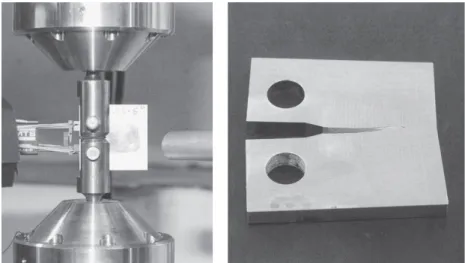
Figure 11.7 Crack growth rate test under way (left) on a compact specimen (b = 51 mm), with a
microscope and a strobe light used to visually monitor crack growth. Cycle numbers are recorded when the crack reaches each of a number of scribe lines (right).
(Photos by R. A. Simonds.) 𝑑𝑑𝜋𝜋
𝑑𝑑𝑁𝑁 𝑗𝑗 ≈ ∆𝜋𝜋
∆𝑁𝑁 𝑗𝑗 = 𝑁𝑁𝜋𝜋𝑗𝑗−𝜋𝜋𝑗𝑗−1
𝑗𝑗−𝑁𝑁𝑗𝑗−1 (11.11)
∆𝐾𝐾𝑗𝑗 = 𝐹𝐹∆𝑆𝑆 𝜋𝜋𝑑𝑑avg, ∆𝐾𝐾𝑗𝑗 = 𝐹𝐹𝑃𝑃 𝑡𝑡 𝑏𝑏∆𝑃𝑃 (11.12)
Test Variables
• Variations of R in the range 0 to 0.2 have little effect on most materials, and tests in this range are accepted by convention as the standard basis for comparing the effects of various materials, environments, etc.
• Test conditions may be selected to include situations that resemble the anticipated service use of the material:
Wide range of variables:Temperature, frequency of the cyclic load, hostile chemical environment
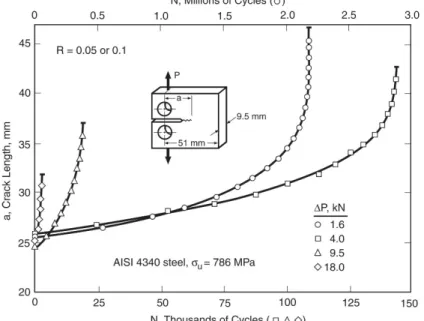
Figure 11.8 Crack length versus cycles data for four different levels of cyclic load applied to compact specimens of an alloy steel.
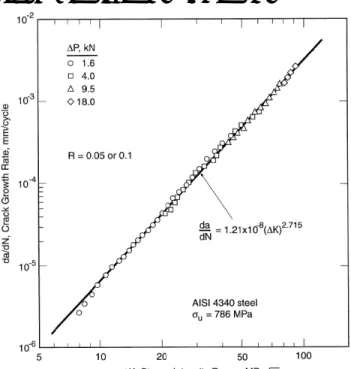
Figure 11.9 Data and least-squares fitted line for da/dN vs ∆𝐾𝐾 from the a versus N data of Fig. 11.8.
Geometry Independence of 𝒅𝒅𝒅𝒅/𝒅𝒅𝒅𝒅 versus ∆𝑲𝑲 Curves
• For a given material and set of test conditions, such as a particular R value, test frequency, and environment, the growth rates should depend only on ∆𝑲𝑲.
• Regardless of the load level, crack length, and specimen geometry, all da/dN vs ∆𝑲𝑲 data for a given set of test conditions should fall together along a single curve.
• However, difficulty with the applicability of ∆𝑲𝑲 can occur if there is excessive yielding, or for very small cracks (Section 11.9)
Figure 11.10 Fatigue crack growth rate data for a 0.65% carbon steel, demonstrating geometry independence. (Adapted from [Klesnil 80] p. 111;
used with permission.)
11.4 Effects of 𝑹𝑹 = 𝑺𝑺 𝐦𝐦𝐦𝐦𝐦𝐦 /𝑺𝑺 𝐦𝐦𝐦𝐦𝐦𝐦 on Fatigue Crack Growth
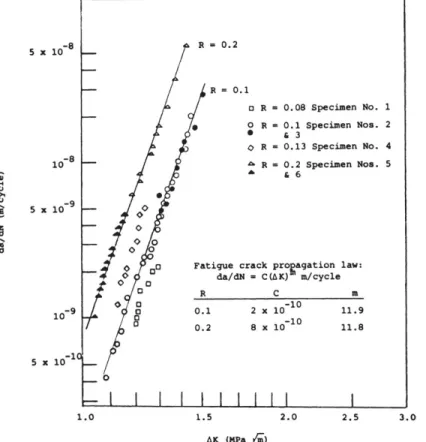
• The effect is usually more pronounced for more brittle materials.
• In contrast, mild steel and other relatively low-strength, highly ductile, structural metals exhibit only a weak 𝑹𝑹 effect in the intermediate
growth rate region of the 𝒅𝒅𝒅𝒅/𝒅𝒅𝒅𝒅 versus ∆𝑲𝑲 curve.
Figure 11.11 Effect of R-ratio on fatigue crack growth rates for Westerly granite, tested in the form of three-point bend specimens. (From [Kim 81]; copyright © ASTM; reprinted with permission.)
Equations for Characterizing the 𝑹𝑹 effect (Optional)
• The Walker Equation
– Based on the Walker relationship (Section 10.6.4)
∆𝐾𝐾 = 𝐾𝐾max 1 − 𝑅𝑅 𝛾𝛾 (11.15)
– 𝛾𝛾 is a constant for the material, ∆𝐾𝐾 is an equivalent zero-to-tension stress intensity
– From Eq. 11.10,
𝑑𝑑𝜋𝜋
𝑑𝑑𝑁𝑁 = 1−𝑅𝑅𝐶𝐶𝑚𝑚 1−𝛾𝛾0 ∆𝐾𝐾 𝑚𝑚 (11.19)
– However, it is primarily employed for intermediate growth rates where Eq. 11.10 does apply
• The Forman Equation
– The equation has the attractive feature of predicting accelerated growth near the final toughness failure, while approaching Eq. 11.10 at low ∆𝐾𝐾
𝑑𝑑𝜋𝜋
𝑑𝑑𝑁𝑁 = 1−𝑅𝑅 𝐾𝐾𝐶𝐶2 ∆𝐾𝐾 𝑚𝑚2
𝑐𝑐−∆𝐾𝐾 = 1−𝑅𝑅𝐶𝐶2(𝐾𝐾∆𝐾𝐾 𝑚𝑚2
𝑐𝑐−𝐾𝐾max) (11.22)
Figure 11.12 Representation of the data of Fig. 11.4 by a single relationship based on the Walker equation. (Data from [Dennis 86].)
Figure 11.13 Effect of R-ratio on growth rates in 7075-T6 aluminum (a), and correlation of these data (b) on the basis of the Forman equation, with constants as listed in Table 11.3. (Data from [Hudson 69].)
11.5 Trends in Fatigue Crack Growth Behavior
• 11.5.1 Trends with Material
– If various major classes of metals are considered, such as steels, aluminum alloys, and titanium alloys, crack growth rates differ considerably when compared on a 𝒅𝒅𝒅𝒅/𝒅𝒅𝒅𝒅 versus ∆𝑲𝑲 plot.
– However, the ∆𝑲𝑲 values corresponding to a given growth rate scale roughly with the elastic modulus 𝑬𝑬.
– Polymers exhibit a wide range of growth rates which are considerably higher than for most metals
(left) Figure 11.18 Fatigue crack growth trends for various metals correlated by plotting ΔK/E. (From [Bates 69]; used with permission.)
(right) Figure 11.19 Fatigue crack growth trends for various crystalline and amorphous polymers. (From [Hertzberg 75]; used with permission.)
11.5 Trends in Fatigue Crack Growth Behavior
• 11.5.2 Trends with Temperature and Environment
– Changing the temperature usually affects the fatigue crack growth rate, with higher temperature often causing faster growth.
– However, an opposite trend can occur in BCC metals due to the cleavage mechanism contributing to fatigue crack growth at low temperature.
(Section 8.6)
Figure 11.21 Effect of temperature on fatigue crack growth rates in two metals. (From [Tobler 78]; used with permission.)
Figure 8.36 Cleavage fracture surface (left) in a 49Co-49Fe-2V alloy, and dimpled rupture (right) in a low-alloy steel. (Photos courtesy of A. Madeyski, Westinghouse Science and Technology Ctr., Pittsburgh, PA.)
11.5 Trends in Fatigue Crack Growth Behavior
• 11.5.2 Trends with Temperature and Environment
– Hostile chemical environments often increase fatigue crack growth rates, with certain combinations of material and environment causing especially large effects.
– The term corrosion fatigue is often
used when the environment involved is a corrosive medium, such as seawater even the gases and moisture in air.
Figure 11.23 Contrasting sensitivity to corrosion fatigue crack growth of two strength levels of an alloy steel. (Adapted from [Imhof 73]; copyright © ASTM;
reprinted with permission.)
11.6 Life Estimates for Constant Amplitude Loading
• Crack growth rates, 𝒅𝒅𝒅𝒅/𝒅𝒅𝒅𝒅
– Crack growth rates 𝑑𝑑𝑑𝑑/𝑑𝑑𝑑𝑑 for a given combination of material and R-ratio are given as a function of ∆𝐾𝐾 by Eqs. 11.10, 11.18, and 11.22
𝑑𝑑𝜋𝜋
𝑑𝑑𝑁𝑁 = 𝑓𝑓(∆𝐾𝐾,𝑅𝑅) (11.26)
– where any effects of environment, frequency, etc., are assumed to be included in the material constants involved.
– The life in cycles required for crack growth may be calculated by solving this equation for 𝑑𝑑𝑑𝑑 and integrating both sides:
∫𝑁𝑁𝑁𝑁𝑖𝑖𝑖𝑖𝑑𝑑𝑑𝑑 = 𝑑𝑑𝑓𝑓 − 𝑑𝑑𝑖𝑖 = 𝑑𝑑𝑖𝑖𝑓𝑓 = ∫𝜋𝜋𝜋𝜋𝑖𝑖𝑖𝑖𝑓𝑓(∆𝐾𝐾,𝑅𝑅)𝑑𝑑𝜋𝜋 (11.27)
Figure 11.26 Area under the dN/da versus a curve used to estimate the number of cycles to grow a crack from initial size ai to final size af.
𝑑𝑑𝑖𝑖𝑓𝑓 = ∫𝜋𝜋𝜋𝜋𝑖𝑖𝑖𝑖 𝑑𝑑𝑁𝑁𝑑𝑑𝜋𝜋 𝑑𝑑𝑑𝑑 (11.29)
11.6 Life Estimates for Constant Amplitude Loading
• Closed-Form Solutions
– Consider a situation where growth rates are given by Eq. 11.10 and where 𝐹𝐹 = 𝐹𝐹(𝑑𝑑/𝑏𝑏) in Eq. 11.7 can be approximated as constant over the range of crack lengths 𝑑𝑑𝑖𝑖 to 𝑑𝑑𝑓𝑓:
𝑑𝑑𝜋𝜋
𝑑𝑑𝑁𝑁 = 𝑓𝑓 ∆𝐾𝐾,𝑅𝑅 = 𝐶𝐶 ∆𝐾𝐾 𝑚𝑚, ∆𝐾𝐾 = 𝐹𝐹∆𝑆𝑆 𝜋𝜋𝑑𝑑 (11.30) – Assume that 𝑆𝑆max and 𝑆𝑆min are constant, so that ∆𝑆𝑆 and 𝑅𝑅 are also both
constant. Substituting this particular 𝑓𝑓(∆𝐾𝐾,𝑅𝑅) into Eq. 11.27 and then substituting for ∆𝐾𝐾 gives
𝑑𝑑𝑖𝑖𝑓𝑓 = ∫𝜋𝜋𝜋𝜋𝑖𝑖𝑖𝑖 𝐶𝐶 ∆𝐾𝐾𝑑𝑑𝜋𝜋 𝑚𝑚 = ∫𝜋𝜋𝜋𝜋𝑖𝑖𝑖𝑖 𝐶𝐶 𝐹𝐹∆𝑆𝑆 𝜋𝜋𝜋𝜋𝑑𝑑𝜋𝜋 𝑚𝑚 = ∫𝜋𝜋𝜋𝜋𝑖𝑖𝑖𝑖 𝐶𝐶 𝐹𝐹∆𝑆𝑆 𝜋𝜋1 𝑚𝑚 𝑑𝑑𝜋𝜋
𝜋𝜋𝑚𝑚/2 (11.31) – Since 𝐶𝐶, 𝐹𝐹, ∆𝑆𝑆, and 𝑚𝑚 are all constant, the only variable is 𝑑𝑑, and integration
is straightforward, giving
𝑑𝑑𝑖𝑖𝑓𝑓 = 𝜋𝜋𝑖𝑖1−𝑚𝑚/2−𝜋𝜋𝑖𝑖1−𝑚𝑚/2
𝐶𝐶 𝐹𝐹∆𝑆𝑆 𝜋𝜋 𝑚𝑚(1−𝑚𝑚2) (𝑚𝑚 ≠ 2) (11.32)
11.6 Life Estimates for Constant Amplitude Loading
• Solutions by Numerical Integration
– When 𝐹𝐹 changes excessively between the initial and final crack lengths, 𝑑𝑑𝑖𝑖 and 𝑑𝑑𝑓𝑓, closed-form integration of Eq. 11.27 is seldom possible, numerical integration becomes necessary.
Figure 11.27 Area under the dN/da versus a curve over two intervals Δa as estimated by Simpson’s rule.
11.7 Life Estimates for Variable Amplitude Loading
• One simple approach – assume that growth for a given cycle is not affected by the prior history –that is, sequence effects are absent.
• 11.7.1 Summation of crack Increments
𝑑𝑑𝑗𝑗+1 = 𝑑𝑑𝑗𝑗 + ∆𝑑𝑑𝑗𝑗 = 𝑑𝑑𝑗𝑗 + 𝑑𝑑𝑁𝑁 𝑗𝑗𝑑𝑑𝜋𝜋 (11.39)
where 𝑑𝑑𝑗𝑗 is the current crack length, ∆𝑑𝑑𝑗𝑗 is the increment, 𝑑𝑑𝑗𝑗+1 is the new value of crack length.
Denoting the initial crack length as 𝑑𝑑𝑖𝑖, we find that the crack length after 𝑑𝑑 cycle is
𝑑𝑑𝑁𝑁 = 𝑑𝑑𝑖𝑖 + ∑𝑗𝑗=1𝑁𝑁 𝑑𝑑𝜋𝜋
𝑑𝑑𝑁𝑁 𝑗𝑗 (11.40)
For highly irregular loading, rainflow cycle counting as described in Chapter 9 can be used to identify the cycles.
11.7 Life Estimates for
Variable Amplitude Loading (optional)
• 11.7.2 Special Method for Repeating or Stationary Histories
– In some cases, it may be reasonable to approximate the actual service load history by assuming that it is equivalent to repeated applications of a loading sequence of finite length.
– This can be useful where some repeated operation occurs, such as lift cycles for a crane, or flights of an aircraft, and also for random loading with
characteristics that are constant with time, called stationaryloading.
∆𝑑𝑑𝑗𝑗 = 𝐶𝐶0 ∆𝐾𝐾𝑗𝑗 𝑚𝑚 (11.41) where different 𝑅𝑅-ratios are handled by calculating an equivalent zero-to- tension (𝑅𝑅 = 0) value ∆𝐾𝐾, as in the Walker approach using Eq. 11. 15. Note that the coefficient 𝐶𝐶0 corresponding to 𝑅𝑅 = 0 applies due to the use of ∆𝐾𝐾 .
11.7 Life Estimates for
Variable Amplitude Loading (optional)
• 11.7.2 Special Method for Repeating or Stationary Histories (cont’d)
If the repeating load history contains 𝑑𝑑𝐵𝐵 cycles, the increase in crack length during one repetition is obtained by summing:
∆𝑑𝑑𝐵𝐵 = ∑𝑗𝑗=1𝑁𝑁𝐵𝐵 ∆𝑑𝑑𝑗𝑗 = ∑𝑗𝑗=1𝑁𝑁𝐵𝐵 𝐶𝐶0 ∆𝐾𝐾𝑗𝑗 𝑚𝑚 (11.42) The average growth rate per cycle during one repetition of the history is thus
𝑑𝑑𝜋𝜋
𝑑𝑑𝑁𝑁 avg. = ∆𝜋𝜋𝑁𝑁𝐵𝐵
𝐵𝐵 = 𝐶𝐶0 ∑𝑗𝑗=1𝑁𝑁𝐵𝐵 ∆𝐾𝐾𝑗𝑗 𝑚𝑚 (11.43) Note that 𝐶𝐶0 is constant and so can be factored from the summation:
𝑑𝑑𝜋𝜋
𝑑𝑑𝑁𝑁 avg. = 𝐶𝐶0 ∑𝑗𝑗=1𝑁𝑁𝐵𝐵 ∆𝐾𝐾𝑗𝑗
𝑚𝑚
𝑁𝑁𝐵𝐵
1/𝑚𝑚 𝑚𝑚
= 𝐶𝐶0 ∆𝐾𝐾𝑞𝑞 𝑚𝑚 (11.44) where
∆𝐾𝐾𝑞𝑞 = ∑𝑗𝑗=1𝑁𝑁𝐵𝐵 ∆𝐾𝐾𝑗𝑗
𝑚𝑚
𝑁𝑁𝐵𝐵
1/𝑚𝑚
(11.45)
11.7 Life Estimates for
Variable Amplitude Loading (optional)
• 11.7.2 Special Method for Repeating or Stationary Histories (cont’d)
∆𝐾𝐾𝑞𝑞 = ∑𝑗𝑗=1𝑁𝑁𝐵𝐵 ∆𝐾𝐾𝑗𝑗
𝑚𝑚
𝑁𝑁𝐵𝐵
1/𝑚𝑚
(11.45)
The quantity ∆𝐾𝐾𝑞𝑞 can be interpreted as an equivalent zero-to-tension stress intensity range that is expected to cause the same crack growth as the variable amplitude history when applied for the same number of cycles 𝑑𝑑𝐵𝐵.
∆𝑆𝑆𝑞𝑞 = 𝐹𝐹 𝜋𝜋𝜋𝜋∆𝐾𝐾𝑞𝑞 = ∑𝑗𝑗=1𝑁𝑁𝐵𝐵 ∆𝑆𝑆𝑗𝑗
𝑚𝑚
𝑁𝑁𝐵𝐵
1/𝑚𝑚
(11.46)
Since ∆𝑆𝑆𝑞𝑞 is independent of crack length, it can be applied throughout the life as the crack grows. Hence, we can make a life estimate by using ∆𝑆𝑆𝑞𝑞 just as if it were a constant amplitude loading at 𝑅𝑅 = 0, for example, by using Eq. 11.32.
𝑑𝑑𝑖𝑖𝑓𝑓 = 𝐶𝐶 𝐹𝐹∆𝑆𝑆 𝜋𝜋𝜋𝜋𝑖𝑖1−𝑚𝑚/2−𝜋𝜋𝑚𝑚𝑖𝑖1−𝑚𝑚/2(1−𝑚𝑚2) (𝑚𝑚 ≠ 2) (11.32)
• Example 11.6
– A center-cracked plate of the AISI 4340 steel of Table 11.2 has dimensions, as defined in Fig. 8.12(a), of 𝑏𝑏 = 38and 𝑡𝑡 = 6𝑚𝑚𝑚𝑚, and the initial crack length is 𝑑𝑑𝑖𝑖 = 1 𝑚𝑚𝑚𝑚. It is repeatedly subjected to the axial force history of Fig.
E11.6. How many repetitions of this history can be applied before fatigue failure is expected?
11.7 Life Estimates for
Variable Amplitude Loading (optional)
Figure 8.12 Stress intensity factors for three cases of cracked plates under tension. Geometries, curves, and equations labeled (a) all correspond to the same case, and similarly for (b) and (c).
Figure E11.6
• Solution: Example 11.6
From rainflow counting of the given force history, we obtain the results presented in the first four columns of Table E11.6. The single cycle for 𝑗𝑗= 4arises from rainflow cycle counting as the major cycle between the highest peak and lowest valley.
Since multiple cycles occur at each of k=4 load levels, the summation for Eq. 11.46 may be done in the form
∑𝑗𝑗=1𝑁𝑁𝐵𝐵 𝑆𝑆�𝑗𝑗 𝑚𝑚 =∑𝑗𝑗=1𝑘𝑘 𝑑𝑑𝑗𝑗 ∆𝑆𝑆𝑗𝑗 𝑚𝑚 Noting that 𝑑𝑑𝐵𝐵 = ∑𝑑𝑑𝑗𝑗 = 166𝑐𝑐𝑐𝑐𝑐𝑐𝑐𝑐𝑐𝑐𝑐𝑐, we may now calculate ∆𝑆𝑆𝑞𝑞 ∶
∆𝑆𝑆𝑞𝑞 = ∑𝑗𝑗=1𝑘𝑘 𝑁𝑁𝑗𝑗 ∆𝑆𝑆𝑗𝑗
𝑚𝑚
𝑁𝑁𝐵𝐵
1/𝑚𝑚
= 1.986×10166 10 1/3.24 = 311.3 Mpa 𝑑𝑑𝑖𝑖𝑓𝑓 = 𝐶𝐶 𝐹𝐹∆𝑆𝑆 𝜋𝜋𝜋𝜋𝑖𝑖1−𝑚𝑚/2−𝜋𝜋𝑚𝑚𝑖𝑖1−𝑚𝑚/2(1−𝑚𝑚2) = 0.0158−0.62−0.001−0.62
5.11×10⁻¹³ 1.00×311.3 𝜋𝜋 3.24(−0.62) = 2.45 × 10⁵𝑐𝑐𝑐𝑐𝑐𝑐𝑐𝑐𝑐𝑐𝑐𝑐
Finally, the number of repetitions to failure is 𝐵𝐵𝑖𝑖𝑓𝑓 = 𝑁𝑁𝑁𝑁𝑖𝑖𝑖𝑖
𝐵𝐵 = 2.45×10166 5 = 1477𝑟𝑟𝑐𝑐𝑟𝑟𝑐𝑐𝑡𝑡𝑟𝑟𝑡𝑡𝑟𝑟𝑟𝑟𝑟𝑟𝑐𝑐
11.7 Life Estimates for
Variable Amplitude Loading (optional)
11.7 Life Estimates for
Variable Amplitude Loading (optional)
• 11.7.3 Sequence Effects
– Assumption: the crack growth in a given cycle is unaffected by prior events in the load history ≠ sometimes lead to significant error
– In case C, after high tensile overload is applied the growth rate during the lower level cycles is decreased
– This beneficial effect of tensile overloads is called crack growth retardation – Overload sequence effects are likely to be important where high overloads
occur predominantly in one direction
– Less effect is expected if overloads occur in both directions, if the history is highly irregular, or if the overloads are relatively mild.
Figure 11.28 Effect of overloads on crack growth in center-cracked plates (b = 80, t
= 2 mm) of 2024-T3 aluminum. (From [Broek 86] p. 273, based on data in [Schijve 62]; reprinted by permission of Kluwer Academic Publishers.)
11.8 Design Considerations
• A damage-tolerant approach is critically dependent on initial and sometimes periodic inspections for cracks.
• Inspections of cracks, especially small ones, is an expensive process and is not generally feasible for inexpensive components that are made in large numbers
• Failures are minimized by careful attention to design detail and to
manufacturing quality control, including initial inspection to eliminate any obviously flawed parts
• All approaches to ensuring adequate life are subject to additional uncertainties, such as
1) Estimates of the service loading being too low
2) Accidental substitution during manufacturing of the wrong material 3) Undetected manufacturing quality control problems
4) Hostile environmental effects that are more severe than forecast
11.8 Design Considerations
• Example: Aircraft skin
– Cracks at fastener (rivet or bolt) holes are of concern in aircraft structure, and access to the interior of the skin of the fuselage or wing structure may be needed for situations. Design must accommodate the disassembly when this is necessary for inspection.
Figure 11.29 Cracks in the interior of an aircraft skin structure. (Adapted from [Chang 78].)
11.8 Design Considerations
• Example: Stiffened panel
– Specific measures can also be taken by the designer to allow structures to function without sudden failure even if a large crack does develop.
Stiffeners retard crack growth, and joints in skin panels may be intentionally introduced so that a crack in one panel has difficulty growing into the next.
Figure 11.30 Stiffened panel in aircraft structure with a crack delayed before growing into adjacent panels. The rivet spacing dimensioned is 38 mm. (From the paper by J. P. Butler in [Wood 70] p. 41.)
11.8 Design Considerations
• Example: Crack stopper strap
Figure 11.31 Crack (left) in a DC-10 fuselage in the longitudinal direction, due to cabin pressure loading, and (right) a crack stopper strap. Rivet locations are indicated by (+), and the longeron member with a hat-shaped cross section is omitted on the left for clarity. (From [Swift 71]; copyright © ASTM; reprinted with permission.)
11.9 Plasticity Aspects and Limitations of LEFM for Fatigue Crack Growth
• Transgranular fracture:
– In ductile metals, the process of crack advance during a cycle is thought to be similar to Fig 11.32.
– Another mechanism is crack growth by small increments of brittle cleavage during each cycle. It is not uncommon in metals
• Intergranular fracture:
– In other cases, the boundaries between grains are the weakest regions in the material so that the crack grows along grain boundaries.
Figure 11.32 Hypothesized plastic deformation behavior at the tip of a growing fatigue crack during a loading cycle. Slip of crystal planes along directions of maximum shear occurs as indicated by arrows, and this plastic blunting process results in one striation (Δa) being formed for each cycle.
Figure 9.22 Fatigue striations spaced approximately 0.12 μm apart, from a fracture surface of a Ni-Cr-Mo-V steel.
11.9 Plasticity Aspects and Limitations of LEFM for Fatigue Crack Growth
• 11.9.2 Thickness Effects and Plasticity Limitations
– If the monotonic plastic zone is not small compared with the thickness, then plane stress exists, and fatigue cracks may grow in a shear mode, with the fracture inclined about 45° to the surface.
– Since 𝐾𝐾 and hence the plastic zone size increase with crack length, a transition to this behavior can occur during the growth of a crack.
Figure 11.35 Schematic of surfaces of fatigue cracks showing transition from a flat tensile mode to an angular shear mode. The shear growth can (A) occur on a single sloping surface, or (B) form a V-shape. (From [Broek 86] p.
269; reprinted by permission of Kluwer Academic Publishers.)
11.9 Plasticity Aspects and Limitations of LEFM for Fatigue Crack Growth
• 11.9.3 Limitations for small cracks
– Small cracks: The crack is within a single crystal grain in a metal, the growth rate is much higher than expected from usual 𝑑𝑑𝑑𝑑/𝑑𝑑𝑑𝑑 versus ∆𝐾𝐾 curve
– Short cracks: Growth rates for such cracks in metals are similar to the 𝑑𝑑𝑑𝑑/𝑑𝑑𝑑𝑑 versus ∆𝐾𝐾 curve, except at low ∆𝐾𝐾
Figure 11.36 Behavior for a crack that is small in all dimensions (left) and also for a crack with one
dimension that is large compared with the microstructure (right).
𝜎𝜎 𝜎𝜎
11.9 Plasticity Aspects and Limitations of LEFM for Fatigue Crack Growth (optional)
• 11.9.3 Limitations for small cracks
11.9 Plasticity Aspects and Limitations of LEFM for Fatigue Crack Growth (optional)
• 11.9.3 Limitations for small cracks (cont’d)
– The crack length 𝑑𝑑𝑠𝑠, where the ∆𝐾𝐾𝑡𝑡𝑡 prediction exceeds the unnotched-
specimen fatigue limit, in the intersection of the lines for the two equations
∆𝑆𝑆 = ∆𝜎𝜎𝑒𝑒, ∆𝐾𝐾𝑡𝑡𝑡 = ∆𝑆𝑆 𝜋𝜋𝑑𝑑 (11.51) – where the completely reversed fatigue
limit is given as a stress range ∆𝜎𝜎𝑒𝑒 = 2𝜎𝜎𝑒𝑒𝑒𝑒, where ∆𝐾𝐾𝑡𝑡𝑡is the value for 𝑅𝑅 = −1,
and where the geometry factor is approximated as 𝐹𝐹 = 1.
– Combining these and solving for 𝑑𝑑 gives
𝑑𝑑𝑠𝑠 = 𝜋𝜋1 ∆𝐾𝐾∆𝜎𝜎𝑡𝑡𝑡
𝑒𝑒
2
(11.52)
Figure 11.37 Fatigue limit stress as a function of crack length, and the transition length as, below which special small crack effects are expected.
11.10 Environmental Crack Growth
• Time-based growth rate, or crack velocity
̇𝒅𝒅 =
𝒅𝒅𝒅𝒅𝒅𝒅𝒕𝒕= 𝑨𝑨𝑲𝑲
𝒏𝒏(11.53)
– 𝐴𝐴 and 𝑟𝑟 are material constants that depend on the particular environment and are affected by temperature.
Figure 11.38 Crack velocity data for two silica glasses in room temperature
environments as indicated. (Data from [Wiederhorn 77].)
11.10 Environmental Crack Growth
Figure 11.39 Crack velocity data (left) for 7075-T6 aluminum in a 3.5% NaCl solution similar to seawater, and approximation of such behavior (right) by use of a constant a between KIEAC and KIc. (Left from [Campbell 82] p.
20; used with permission.)
11.11 Summary
• The crack growth behavior can be described by the relationship
between cyclic crack growth rate 𝒅𝒅𝒅𝒅/𝒅𝒅𝒅𝒅 and stress intensity range ∆𝑲𝑲 .
𝑑𝑑𝜋𝜋
𝑑𝑑𝑁𝑁
= 𝐶𝐶 ∆𝐾𝐾
𝑚𝑚• For a given applied stress, material, and component geometry, the crack growth life 𝒅𝒅
𝒊𝒊𝒊𝒊depends on both the initial crack size 𝒅𝒅
𝒊𝒊and the final crack size 𝒅𝒅
𝒊𝒊𝑑𝑑
𝑖𝑖𝑓𝑓=
𝐶𝐶 𝐹𝐹∆𝑆𝑆 𝜋𝜋𝜋𝜋𝑖𝑖1−𝑚𝑚/2−𝜋𝜋𝑚𝑚𝑖𝑖1−𝑚𝑚/2(1−𝑚𝑚2)(𝑚𝑚 ≠ 2)
• For variable amplitude loading, the 𝒅𝒅𝒅𝒅/𝒅𝒅𝒅𝒅 versus ∆𝑲𝑲 curve can be used to estimate increments in crack length ∆𝒅𝒅 for each cycle
• Limitations on the use of LEFM due to excessive plasticity can be set on the basis of plastic zone size according to Eq. 11.50.
• For static loading in a hostile chemical environment, time-dependent
crack growth may occur.