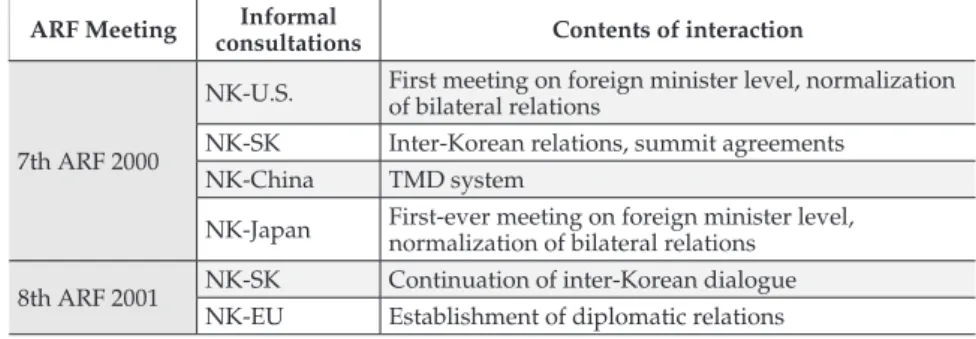
Nevertheless, North Korea's engagement with the international community through organizations and institutions is much more complex than many observers have suggested. Embedded in a broader overview of North Korea's participation in international and regional organizations and institutions in general, this article analyzes the history, structure and organization of the DPRK's involvement in the ARF with the aim of examining its motives, strategies and patterns of North Korean involvement. interaction on the part of North Korea. To counter these developments, North Korea proposed a 'one seat membership' for Korea in the UN.
Three interwoven trends and developments characterize North Korea's interaction with international organizations and institutions in the post-Cold War era. This explanation illuminates a number of motives and considerations for North Korea's decision to join the UN. For example, North Korea joined the Council for Security Cooperation in the Asia-Pacific (CSCAP) in 1994, the Northeast Asian Cooperation Dialogue (NEACD) in and the Ulaanbaatar (Northeast Asia Security) Dialogue in 2014, among others.
North Korea's participation in the ASEAN Regional Forum The ASEAN Regional Forum (ARF) was established in 1993 and formed the first regional security cooperation and dialogue platform in East Asia. As discussed above, North Korea's accession to the ARF was embedded in a broader diplomatic outreach of the DPRK to the international community in the early 2000s, both bilaterally and multilaterally. However, North Korea's application was not accepted without reservation by all the ARF countries, and Japan in particular had concerns.11 Meanwhile, 11.
Although Japan urged North Korea to join the ARF during its founding years, relations between the two countries have since deteriorated significantly due to the DPRK's missile launches over Japanese territory. In line with its overall strategy of supporting the DPRK's (re)integration into regional and international cooperation structures, North Korea's accession to the ARF was also supported by the South Korean administration of Kim Dae-jung. For example, as the Six-Party Talks made significant progress in 2007 and 2008, North Korea's rapprochement with the international community continued within the framework of the ARF.
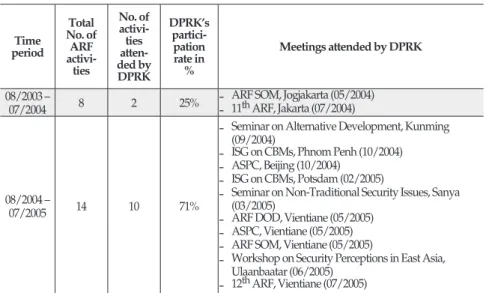
While North Korea participated at a fairly high rate in the first years after its accession to the ARF, this rate was On the contrary, the available data suggest a change in the structure of North Korea's participation in the ARF. North Korea's nuclear and missile programs have been a recurring item on the agenda of foreign ministers' meetings.
Established in 1992, North Korea joined CSCAP in 1994, thus predating its actual cooperation with the ARF. Another notable aspect of North Korea's activities within the ARF is its involvement in the publication of the Annual Security Outlook (ASO). North Korea's accession to the ARF was significant, as its diplomatic activities in international organizations and institutions before 2000 have been largely limited to the UN and its subsidiary organizations.
Especially at the Track-II level, North Korea's participation is often dependent on external funding, which, in turn, affects further aspects such as the size of the delegation.
Conclusions
For example, after the collapse of the 6PT, the DPRK repeatedly used the stage provided by the ARF to act on its discursively constructed “nuclear state identity” (Ballbach 2016). Since power in a theater state is exercised through acting, these instances of staging foreign policy in international institutions do more than just legitimate state power; they also denote the ceremonial constitution of state power in an open space – visible and recognized by all onlookers. Complemented by such Track-II activities as CSCAP, the ARF, as the only Track-I-level regional security institution in East Asia, therefore represents a valuable example for finding out more about the motives and patterns of interaction that govern the DPRK's participation with international institutions.
Building on a brief discussion of the history of North Korea's participation in the ARF, it has been shown that North Korean officials have in fact participated in a wide variety of ARF-sponsored activities and meetings since its accession in 2000, both on the Track-I and Track-II level. While North Korea's participation in the ARF was particularly extensive during 2002 and 2008, the patterns of North Korea's interaction with the ARF changed significantly thereafter, with the DPRK focusing mainly on meetings that are at a higher diplomatic level , like the foreign ministers. ' Meeting and the ARF-SOM. In conclusion, three important lessons can be drawn from North Korea's involvement in the ARF – lessons that, if verified in further research, may have significance far beyond the single case analyzed here: (1) To start, the organizational structure and the rules of decision-making are extremely important aspects regarding North Korea's decision to join or not to join an organization or institution.
In this regard, the appropriate institutional design of the ARF, combined with the right international political context, was one of the key conditions for the DPRK to join the ARF. Of particular importance in this context is the fact that ARF membership has provided a bridge to states with which the DPRK does not maintain diplomatic relations, while at the same time serving as an additional (and cost-saving) channel to other states. such as China and Russia. 3) Because foreign policy achievements are essential to the constitution of the North Korean state (Ballbach 2016), the ARF has provided North Korean representatives with a platform to articulate, promote, and dramatize Pyongyang's role conceptions. Multilateralism and North Korean Foreign Policy towards the Six-Party Talks, in: Köllner, Patrick, Rüdiger Frank, James Hoare and Susan Pares (eds.): Korea Yearbook 2013.
Habib, Benjamin (2013): An unusual case: North Korea and the United Nations Framework Convention on Climate Change, Paper prepared for the Korea Studies Reference Stream, Association of Australia Biennial Conference, Canberra, 27-28 June 2013. Habib (2014): Behind the North Korea's surprising compliance on climate change, in: The Conversation, 16 May 2014, available at: http://theconversation. Paik, Hak-soon (2015): Die Außenpolitik Nordkoreas: Autonomie oder Annäherung [North Korea's Foreign Policy: Autonomy or Rapprochement], in: Lee, Eun-Jeung and Hannes B.
Philstar Global, Philippines Rejects US Call on North Korea Expulsion, August 3, 2017, available at: http://www.philstar.com/headlines phil-ippines-rejects-us-call-north-korea-expulsion. Sydney Morning Herald, Neighbors to move in crisis, 12 March 2003 Takeshi Yuzawa (2005): Japan's changing concept of the ASEAN Regional Forum: From an optimistic liberal perspective to a pessimistic realist perspective, in: The. A Focus on North Korea's Position and Interest], in: Pukhanyŏn'gu hakhoebo [North Korean Studies Research Newsletter], vol.