With the growing needs for renewable energy storage systems, Li-ion batteries (LIBs) have become the most widely used power source for portable electronic devices such as mobile phones, laptops, and electric vehicles (EVs). The migrated Ni ions easily form the spinel and rock salt structure in the region near the particle surface, which hinders the diffusion of lithium ions. Moreover, the unstable Ni3+ ions in the near-surface area that is easily attacked by H2O or CO2 are reduced to Ni2+ and make LiOH or Li2CO3 on the surface.
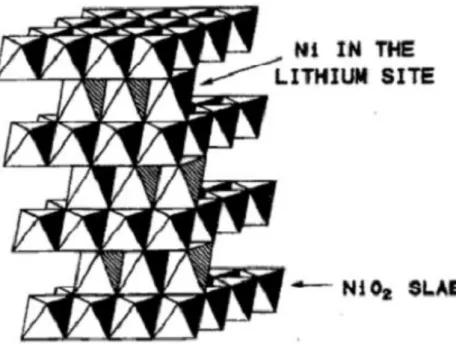
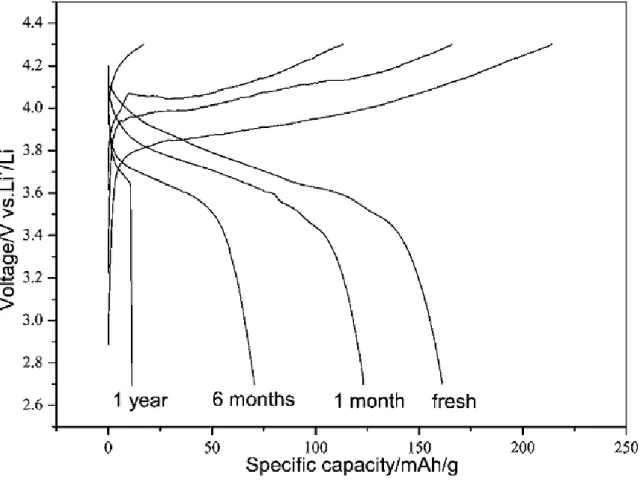
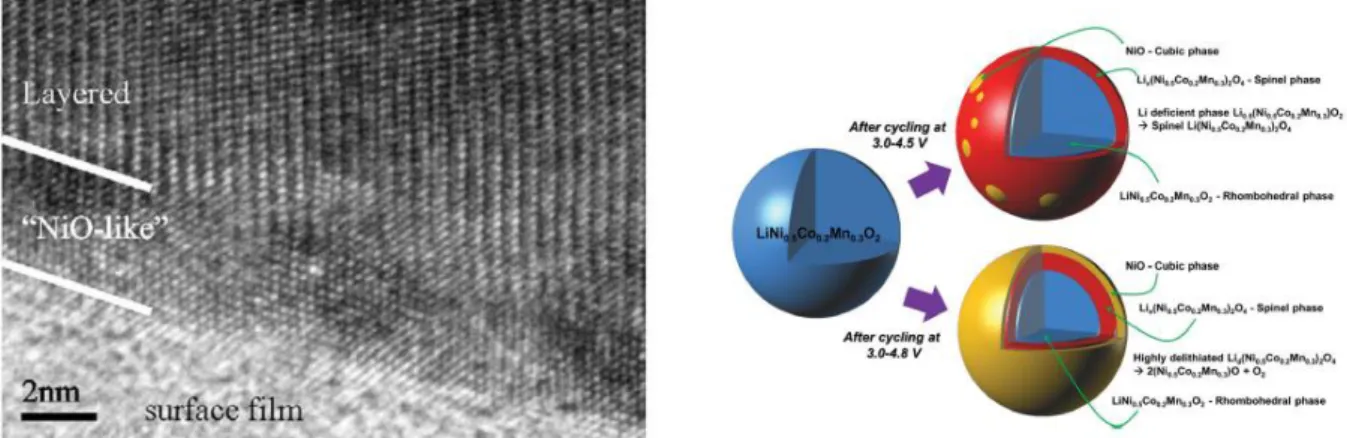
In my research, I tried to improve the electrochemical property of LiNiO2 by replacing Li with Na ion. Schematic structures of cathode materials for Li-ion batteries Figure 3. Schematic view of the mixed cation structure of LiNiO2. Charge-discharge profile of LiNiO2 after storage in air for different times in the voltage range from 2.7V to 4.3V vs. Li/Li+ at 18mA g-1. a) TEM image of LiNi0.8Co0.2O2 cycled only for the SEI forming cycle.
Vt stands for tetrahedral vacancy and Vo for octahedral vacancy1. a) TEM image of near surface region of LiNiO2 before storage (b) FFT pattern of rock salt phase very near surface region (c) FFT pattern of R-3m in bulk. a) TEM image of near-surface region of LiNiO2 after 3 weeks storage (b) FFT pattern of rock salt phase very near-surface region (c) FFT pattern of R-3m in bulk. Polt of cation mixture after storage in Ar-filled glovebox for LiNiO2 and Li0.95Na0.05NiO2.
Introduction
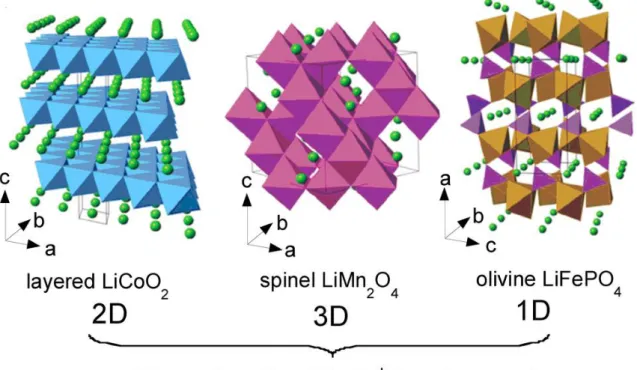
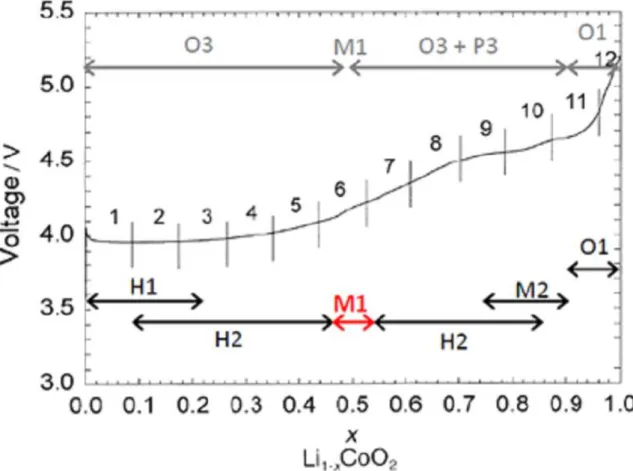
M are transition metals and are usually exclusively or a mixture of cobalt, nickel and manganese.8 The diffusion mechanisms of the layered oxides are usually called two-dimensional because Li+ ions diffuse between MO2 plates. It has been widely used in LIB systems because of its excellent rate capability and high energy density. Due to good stability of Co3+ ions in the structure, LiCoO2 can maintain R-3m structure during cycling.
Structural stability of Ni-rich cathode materials is related to the disorder between lithium sites (octahedral 3a site) and transition metal sites (octahedral 3b site). However, Ni3+ ions in octahedral sites are easily reduced to Ni2+ due to its instability as previously described. Because of this similarity, Ni2+ ions in transition metal sites readily diffuse to Li ion-dominated sites.
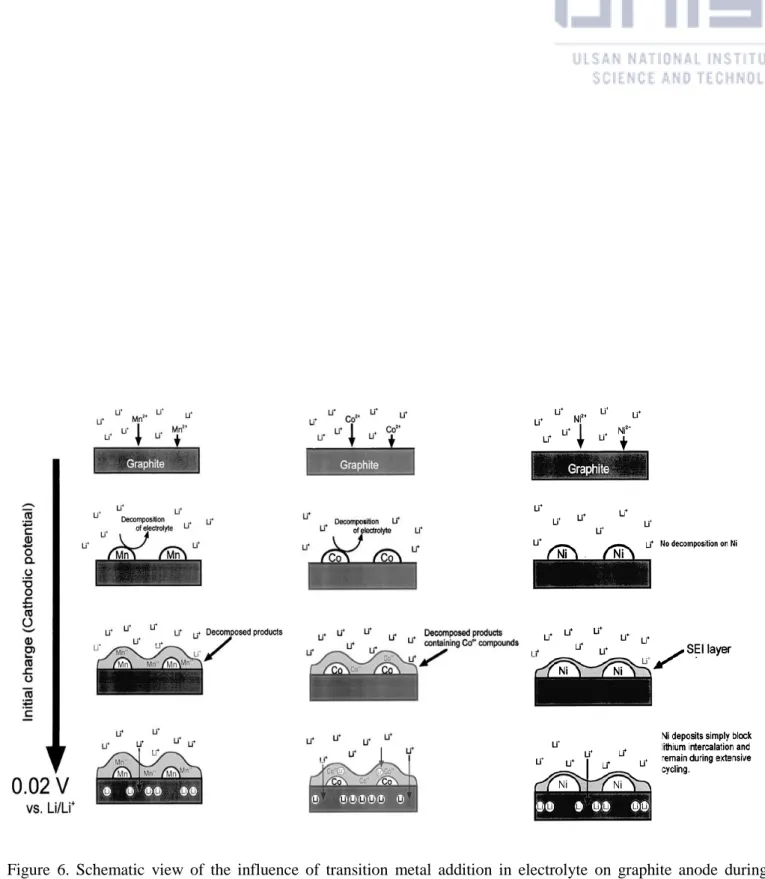
It has been reported that cation mixing occurs not only during the synthesis step, but also during long-term electrochemical cycles.16 Due to structural instability, Ni-rich cathode materials undergo significant structural disorder. Due to the chemical and structural instability of the spinel framework, Mn3+ is easily disproportioned into Mn2+ and Mn4+. Dissolved Mn2+ ions are reduced on the surface of carbon-based anodes and create compounds that hinder the diffusion of lithium due to the higher standard redox potential of Mn/Mn2+ (1.87 V vs. Li/Li+) than that of the lithium intercalation in graphite (<0.3 V vs. Li/Li+).
In the case of LiCoO2 and LiNiO2, utilization of the material at high voltage results in severe dissolution of Co and Ni ion into electrolyte. Schematic view of the influence of transition metal addition in electrolyte on graphite anode during initial charge process. As known before, the basicity of LiNiO2 and Ni-rich oxides is much higher than that of LiCoO2.
As we mentioned before, the stability of the near-surface region affects the structural stability of Ni-rich oxides. In a similar way, the phase transition in the near-surface region also affects the electrochemical performance of the materials. Not only during storage, but also during electrochemical performance, the phase transition occurs in the near-surface region.
The degradation mechanism of the NCM111 material is known as the formation of the O1 phase in a highly depleted state. So, for Ni-rich oxides, the phase transition in the near-surface region is one of the causes of decomposition. a) TEM image of LiNi0.8Co0.2O2 cycled only for the SEI formation cycle.

Experimental
Result & Discussion
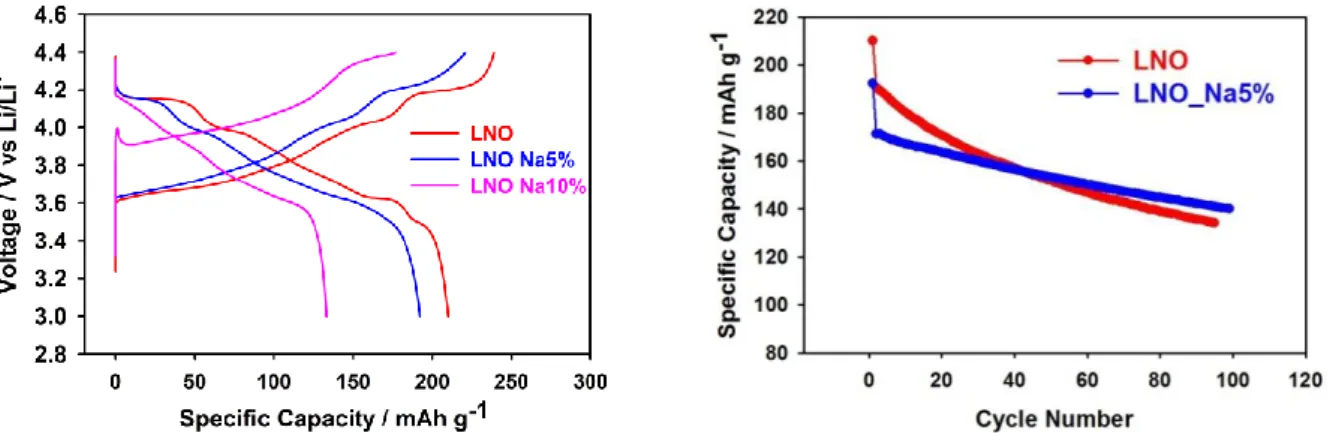
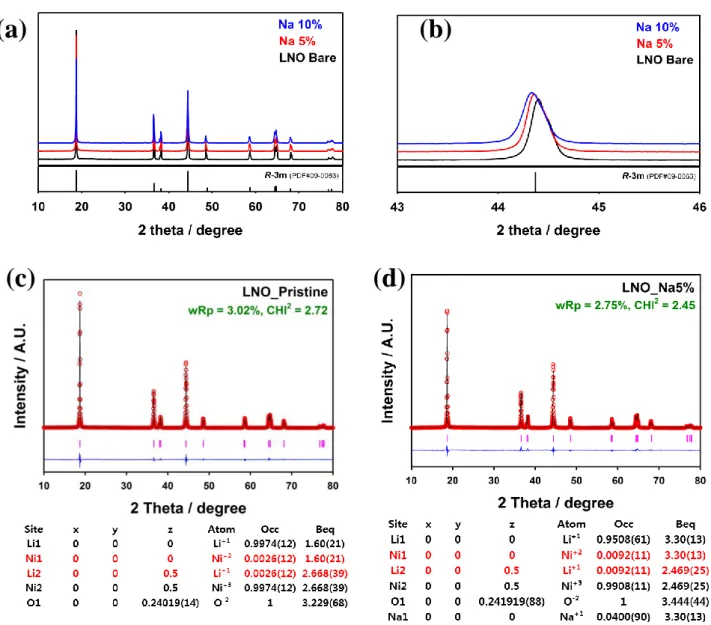
For Na-doped LiNiO2, increased cation mixing reduces the initial discharge capacity and increases polarization during the charge-discharge process. Although Na-doped LNO has a lower initial discharge capacity than a bare LNO, it exhibits better cycling ability than a bare LNO. On the other hand, the cycle retention of LNO_Na5% is more than 80% even after 100 cycles.
This result means that Na doping in LiNiO2 induces initial cation mixing but suppresses cation mixing during cycling. Ni ion dissolution in electrolyte is also a critical problem in LiNiO2.12 Transition metal dissolution affects structural stability by broadening c parameter.22 Each parameter in R-3m structure, a and c parameters, is closely related to cation and anion binding . The dissolution of Ni ions can reduce the bond between Ni-O, which can result in expanding c-parameter.
Although the dissolution of Ni ions in electrolyte is not perfectly inhibited, Na-doped sample showed lower concentration of Ni ions in the electrolyte than plain sample. This also means that dissolution of Ni ion solution is suppressed by increased structural stability by Na doping. a) 19F-NMR analysis and (b) amount of Ni ions in electrolyte measured by ICP-MS analysis\ of electrolyte stored at 60 °C for 2 weeks with electrode cycling for each cycle. He et al.24 and Li et al.1 investigated the columnar action of Na and K ions in layered structure.
Transition metal migration is closely related to the creation of tri-vacancy site in the Li layer during the discharge process. So, transition metal ion migrates into the tetrahedral site in the Li layer, which facilitates the formation of spinel or rock salt phase. However, pillaring agents in the Li layer suppress the tri-vacancy site formation, which leads to the suppression of transition metal migration during the discharge process.
To migrate from transition metal layer to Li layer, Ni ions pass through the tetrahedral site between plates. If the pillaring agent prevented the formation of the tri-vacancy site of the Li layer, Ni ions are difficult to pass through the tetrahedral site due to its ionic radius and electrostatic repulsion. The reversible capacity of bare LNO decreased by approx. 14% after 1 month of storage for both 0.1 C and 0.5 C C rates, while LNO_Na5% decreased by ca. 7%.
Larger area of NiO phase in LNO than LNO_Na5% sample may be due to contamination with CO2 or H2O during sample preparation. This means that a Na-doped sample is more thermodynamically stable than an undoped sample. a) TEM image of near surface region of LiNiO2 before storage (b) FFT pattern of rock salt phase very near surface region (c) FFT pattern of R-3m in bulk. a) TEM image of near surface region of LiNiO2 after 3 weeks storage (b) FFT pattern of rock salt phase very near surface region (c) FFT pattern of R-3m in bulk. a) TEM image of near-surface region of Li0.95Na0.05NiO2 before storage (b) FFT pattern of rock salt phase very near-surface region (c) FFT pattern of R-3m in bulk. a) TEM image of near surface region of Li0.95Na0.05NiO2 after 3 weeks storage (b) FFT pattern of rock salt phase very near surface region (c) FFT pattern of R-3m in bulk.
Conclusion
State of redox reactions of LiCoO2 (R3̅m) for 4-volt secondary lithium cells. a) Ohzuku, T.; Takeda, S.; Iwanaga, M., Solid-state redox potentials for Li[Me1/2Mn3/2]O4 (Me: 3d-transition metal) having spinel framework structures: A series of 5V materials for. Okamoto, K.; Kanzaki, S.; Kanno, R., Characterization of Li1+yNixCo1−2xMnxO2 positive active materials for lithium-ion batteries. Chen, Z.-Y.; Gong, L., Effects of chromium on the structural, surface chemistry and electrochemistry of multilayer LiNi0.8−xCo0.1Mn0.1CrxO2.
Zheng, J., Characterization of multiple metal (Cr, Mg) substituted LiNi0.8Co0.1Mn0.1O2 cathode materials for lithium-ion batteries. D.; Balasubramanian, M.; Petrov, I.; McBreen, J.; Amine, K., Surface changes in LiNi0.8Co0.2O2 particles during high power lithium-ion cell testing.