CHAPTER
9Linear control of manipulators
9.1 INTRODUCTION
9.2 FEEDBACK AND CLOSED-LOOP CONTROL 9.3 SECOND-ORDER LINEAR SYSTEMS 9.4 CONTROL OF SECOND-ORDER SYSTEMS 9.5 CONTROL-LAW PARTITIONING
9.6 TRAJECTORY-FOLLOWING CONTROL 9.7 DISTURBANCE REJECTION
9.8 CONTINUOUS VS. DISCRETE TIME CONTROL 9.9 MODELING AND CONTROL OF A SINGLE JOINT
9.10 ARCHITECTURE OF AN INDUSTRIAL-ROBOT CONTROLLER
9.1 INTRODUCTION
Armed with the previous material, we now have the means to calculate joint- position time histories that correspond to desired end-effector motions through space. In this chapter, we begin to discuss how to cause the manipulator actually to perform these desired motions.
The control methods that we wifi discuss fall into the class called linear-control systems. Strictly speaking, the use of linear-control techniques is valid only when the system being studied can be modeled mathematically by linear differential equations. For the case of manipulator control, such linear methods must essentially be viewed as approximate methods, for, as we have seen in Chapter 6, the dynamics of a manipulator are more properly represented by a nonlinear differential equation.
Nonetheless, we wifi see that it is often reasonable to make such approximations, and it also is the case that these linear methods are the ones most often used in current industrial practice.
Finally, consideration of the linear approach will serve as a basis for the more complex treatment of nonlinear control systems in Chapter 10. Although we approach linear control as an approximate method for manipulator control, the justification for using linear controllers is not only empirical. In Chapter 10, we will prove that a certain linear controller leads to a reasonable control system even without resorting to a linear approximation of manipulator dynamics. Readers familiar with linear-control systems might wish to skip the first four sections of the current chapter.
262
Section 9.2 Feedback and closed-loop control 263 9.2 FEEDBACK AND CLOSED-LOOP CONTROL
We will model a manipulator as a mechanism that is instrumented with sensors at each joint to measure the joint angle and that has an actuator at each joint to apply a torque on the neighboring (next higher) link.1. Although other physical arrangements of sensors are sometimes used, the vast majority of robots have a
position sensor at each joint. Sometimes velocity sensors (tachometers) are also present at the joints. Various actuation and transmission schemes are prevalent in industrial robots, but many of these can be modeled by supposing that there is a single actuator at each joint.
We wish to cause the manipulator joints to follow prescribed position trajec- tories, but the actuators are commanded in terms of torque, so we must use some kind of control system to compute appropriate actuator commands that willrealize this desired motion. Almost always, these torques are determined by using feedback from the joint sensors to compute the torque required.
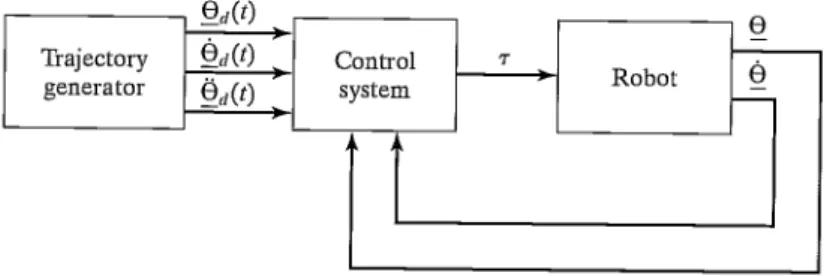
Figure 9.1 shows the relationship between the trajectory generator and the physical robot. The robot accepts a vector of joint torques, r, from the control system. The manipulator's sensors allow the controller to read the vectors of joint positions, e, and joint velocities, e.All signal lines in Fig. 9.1 carry N x 1 vectors
(where N is the number of joints in the manipulator).
Let's consider what algorithm might be implemented in the block labeled
"control system" in Fig. 9.1. One possibility is to use the dynamic equation of the robot (as studied in Chapter 6) to calculate the torques required for a particular trajectory. We are given ed, ®d, and °dbythe trajectory generator, so we could use (6.59) to compute
r =
+V(Od, ed) +G(ed). (9.1)This computes the torques that our model dictates would be required to realize the desired trajectory. If our dynamic model were complete and accurate and no
"noise" or other disturbances were present, continuoususe of (9.1) along the desired trajectory would realize the desired trajectory. Unfortunately, imperfection in the dynamic model and the inevitable presence of disturbances make such a scheme impractical for use in real applications. Such a control technique is termed an open- loop scheme, because there is no use made of the feedback from the jointsensors
FIGURE 9.1: High-level block diagram of a robot-control system.
1Remember all remarks made concerning rotational joints holdanalogously for linear joints, and vice versa
(i.e., (9.1) is a function oniy of the desired trajectory, ®d' andits derivatives, and not
afunction of 0, the actual trajectory).
Generally, the only way to build a high-performance control system is to make use of feedback from joint sensors, as indicated in Fig. 9.1. Typically, this feedback is used to compute any servo error by finding the difference between the desired and the actual position and that between the desired and the actual velocity:
E = —0,
(9.2) The control system can then compute how much torque to require of the actuators as some function of the servo error. Obviously, the basic idea is to compute actuator torques that would tend to reduce servo errors. A control system that makes use of feedback is called a closed-loop system. The "loop" closed by such a control system around the manipulator is apparent in Fig. 9.1.
The central problem in designing a control system is to ensure that the resulting closed-loop system meets certain performance specifications. The most basic such criterion is that the system remain stable. For our purposes, we wifi define a system to be stable if the errors remain "small" when executing various desired trajectories even in the presence of some "moderate" disturbances. It should be noted that an improperly designed control system can sometimes result in unstable performance, in which servo errors are enlarged instead of reduced. Hence, the first task of a control engineer is to prove that his or her design yields a stable system; the second is to prove that the closed-loop performance of the system is satisfactory. In practice, such "proofs" range from mathematical proofs based on certain assumptions and models to more empirical results, such as those obtained through simulation or
experimentation.
Figure 9.1, in which all signals lines represent N xl vectors, summarizes the fact that the manipulator-control problem is a multi-input, multi-output (MIMO) control problem. In this chapter, we take a simple approach to constructing a control system by treating each joint as a separate system to be controlled. Hence, for an N-jointed manipulator, we will design N independent single-input, single-output (SISO) control systems. This is the design approach presently adopted by most industrial- robot suppliers. This independent joint control approach is an approximate method in that the equations of motion (developed in Chapter 6) are not independent, but rather are highly coupled. Later, this chapter wifi present justification for the linear approach, at least for the case of highly geared manipulators.
9.3 SECOND-ORDER LINEAR SYSTEMS
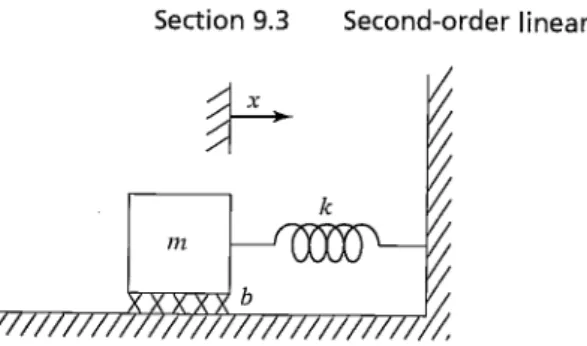
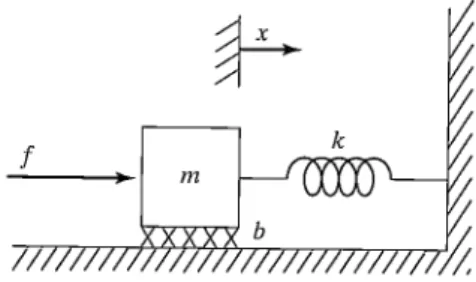
Before considering the manipulator control problem, let's step back and start by considering a simple mechanical system. Figure 9.2 shows a block of mass inattached to a spring of stiffness k and subject to friction of coefficient b. Figure 9.2 also indicates the zero position and positive sense of x, the block's position. Assuming a frictional force proportional to the block's velocity, a free-body diagram of the forces acting on the block leads directly to the equation of motion,
niI+bi+kx =0.
(9.3)Section 9.3 Second-order linear systems 265
FIGURE 9.2: Spring—mass system with friction.
Hence, the open-loop dynamics of this one-degree-of-freedomsystem are described by a second-order linear constant-coefficient differential equation [1]. The solution to the differential equation (9.3) is a time function,x (t), that specifies the motion of the block. This solution will depend on the block's initial conditions—that is, its initial position and velocity.
We wifi use this simple mechanical system as an example with which to review some basic control system concepts. Unfortunately, it is impossible to do justiceto the field of control theory with only a brief introduction here. We wifi discuss the control problem, assuming no more than that the student is familiar with simple differential equations. Hence, we wifi not use many of the popular tools of the control-engineering trade. For example, Laplace transforms and other common techniques neither are a prerequisite nor are introduced here. A good reference for the field is [4].
Intuition suggests that the system of Fig. 9.2 might exhibit several different characteristic motions. For example, in thecase of a very weak spring (i.e., k small) and very heavy friction (i.e., b large) one imagines that, if the blockwere perturbed, it would return to its resting position in a very slow, sluggish manner. However, with a very stiff spring and very low friction, the block might oscifiate several times before coming to rest. These different possibilities arise because the character of the solution to (9.3) depends upon the values of the parameters in, b, and k.
From the study of differential equations [1], we know that the form of the solution to an equation of the form of (9.3) depends on the roots of its characteristic equation,
ins2+bs-j-k=O. (9.4)
This equation has the roots
b
S1
— 2in +
2iii
b —4mk
(9.5)
2m 2in
The location of and s2 (sometimes called the poles of the system) in the real—imaginary plane dictate the nature of the motions of thesystem. If and s2 are real, then the behavior of the system is sluggish and nonoscillatory. If and
arecomplex (i.e., have an imaginary component) then the behavior of thesystem is
266 Chapter
oscifiatory. Ifwe include the special limiting case between these two behaviors, we have three classes of response to study:
1. Real and Unequal Roots. This is the case when b2 > 4ink; that is, friction dominates, and sluggish behavior results. This response is called overdamped.
2. Complex Roots. This is the case when b2 <4 ink; that is, stiffness dominates, and oscifiatory behavior results. This response is called underdamped.
3. Real and Equal Roots. This is the special case when b2 = 4ink; that is, friction and stiffness are "balanced," yielding the fastest possible nonosdillatory response. This response is called critically damped.
The third case (critical damping) is generally a desirable situation: the system nulls out nonzero initial conditions and returns to its nominal position as rapidly as possible, yet without oscillatory behavior.
Real and unequal roots
Itcan easily be shown (by direct substitution into (9.3)) that the solution, x(t), giving the motion of the block in the case of real, unequal roots has the form
x(t) = + c2eS2t, (9.6)
where s1 and s2 are given by (9.5). The coefficients c1 and c2 areconstants that can be computed for any given set of initial conditions (i.e., initial position and velocity of the block).
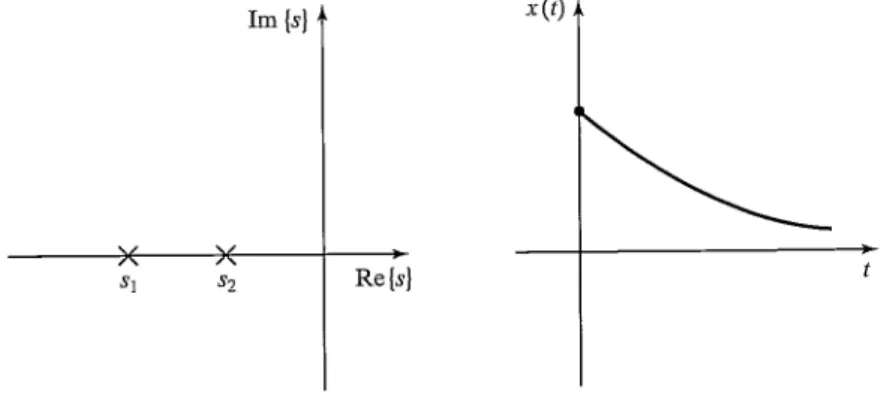
Figure 9.3 shows an example of pole locations• and the corresponding time response to a nonzero initial condition. When the poles of a second-order system are real and unequal, the system exhibits sluggish or overdamped motion.
In cases where one of the poles has a much greater magnitude than the other, the pole of larger magnitude can be neglected, because the term corresponding to it wifi decay to zero rapidly in comparison to the other, dominant pole. This same notion of dominance extends to higher order systems—for example, often a
Tm )s} x(t)
,\ /\
Rejs} t
FIGURE 9.3: Root location and response to initial conditions for an overdamped system.
Section 9.3 Second-order linear systems 267
third-ordersystem can be studied as a second-order systembyconsideringonly two dominant poles.
EXAMPLE 9.1
Determinethe motion of the system in Fig. 9.2 if parameter valuesare in =1, b =5, and k = 6 and the block (initially at rest) is released from the position x = —1.
The characteristic equation is
(9.7) which has the roots s1 = —2 and = Hence, the response has the form
x(t) = +c2e_3t (9.8)
We now use the given initial conditions, x(0) = —1 and i(0) = 0, to compute c1 and
c2.Tosatisfy these conditions at t = 0, we must have
Ci+C2 = —1
and
—2c1 —3c2 =0, (9.9)
which are satisfied by c1= —3 and c2 =2. So, the motion of the system for t ? 0 is given by
x(t) = _3e_2t+2e_3t. (9.10)
Complex roots
For the case where the characteristic equation has complex roots of the form
= A + /Li,
=A — (9.11)
it is stifi the case that the solution has the form
x(t) = c1eS1t + c2eS2t. (9.12)
However, equation (9.12) is difficult to use directly, because it involves imaginary numbers explicitly. It can be shown (see Exercise 9.1) that Euler's formula,
= cosx + isinx, (9.13)
allows the solution (9.12) to be manipulated into the form
x(t) = cieAt cos(/Lt) + (9.14)
As before, the coefficients c1 and c2 are constants that can be computed for any given set of initial conditions (i.e., initial position and velocity of the block). If we write the constants c1 and c2 in the form
C1 = r cos 8,
c2=rsin8, (9.15)
Chapter
then (9.14) can be written in the form
x(t) =rext — 8), (9.16)
where
r
8 = Atan2(c2,c1). (9.17)
In this form, it is easier to see that the resulting motion is an oscifiation whose amplitude is exponentially decreasing toward zero.
Another common way of describing oscillatory second-order systems is in terms of damping ratio and natural frequency. These terms are defined by the parameterization of the characteristic equation given by
+ + = 0, (9.18)
where is the damping ratio (a dimensionkss number between 0 and 1) and w71 is the natural frequency.2 Relationships between the pole locations and these parameters are
=
and
= (9.19)
In this terminology, the imaginary part of the poles, is sometimes called the damped natural frequency. For a damped spring—mass system such as the one in Fig. 9.2, the damping ratio and natural frequency are, respectively,
b
= (9.20)
When no damping is present (b = 0in our example), the damping ratio becomes zero; for critical damping (b2 =4km), the damping ratio is 1.
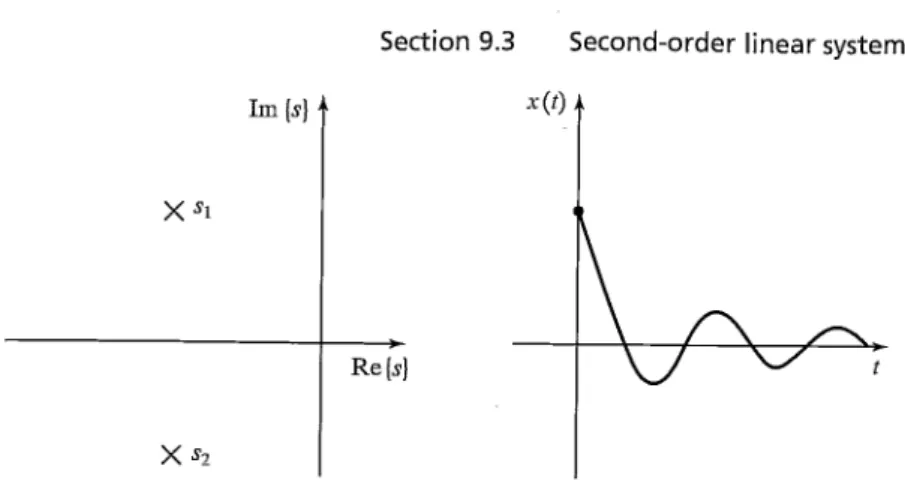
Figure 9.4 shows an example of pole locations and the corresponding time response to a nonzero initial condition. When the poles of a second-order system
are complex, the system exhibits oscifiatory or underdamped motion.
EXAMPLE 9.2
Find the motion of the system in Fig. 9.2 if parameter values are m =1,b = 1,and k = 1 and the block (initially at rest) is released from the position x = —1.
The characteristic equation is
s2+s+1=0,
(9.21)2The terms damping ratioandnatural frequency can also be applied to overdamped systems, in which case > 1.0.
Section 9.3 Second-order linear systems 269
Tm{s} x(t)
X
Re(s}
\.J
X
FIGURE 9.4: Root location and response to initial conditions foran underdamped system.
whichhasthe roots = + Hence, the response has the form
x(t) = e 2 c1 cos + c2 sin . (9.22)
We now use the given initial conditions, x (0) = —1 and (0) = 0, to compute c1 and c2. To satisfy these conditions at t = 0, we must have
C1 = —1
and
1
— = 0, (9.23)
which are satisfied by c1 = —1 and c2 = So, the motion of the system for t 0
is given by
x(t) = e 2 cos — sin (9.24)
This result can also be put in the form of (9.16), as
= cos
(4t
+1200). (9.25)Real and equal roots
By substitution into (9.3), it can be shown that, in the case of real and equal roots (i.e., repeated roots), thesolution has the form
x(t) = c1eSlt + c2teS2t, (9.26)
270 Chapter
Tm(s) x(t)
Re(s)
FIGURE9.5: Root location and response toinitial conditions for a critically damped system.
where, in this case, s1= s2= (9.26) can be written
x(t) = (c1 + (9.27)
In case it is not clear, a quick application of l'Hôpital's rule [2] shows that, for any c1,c2, anda,
urn (c1 +c7t)e_at =0. (9.28)
t-+oo
Figure 9.5 shows an example of pole locations and the corresponding time response to a nonzero initial condition. When the poles of a second-order system are real and equal, the system exhibits critically damped motion, the fastest possible nonoscifiatory response.
EXAMPLE 9.3
Workout the motion of the system in Fig. 9.2 if parameter values are in = 1, b = 4, and k =4 and the block (initially at rest) is released from the position x = —1.
The characteristic equation is
(9.29) which has the roots s1 = s2 = —2. Hence, the response has the form
x(t) = (c1 +c7t)e_2t. (9.30)
We now use the given initial conditions, x(0) = —1 and ±(0) = 0, to calculate c1 and c2. To satisfy these conditions at t = 0, we must have
Cl = —1 and
—2c1 + c2 = 0, (9.31)
which are satisfied by c1 = —1 and c2 = —2. So, the motion of the system for t 0 is given by
x(t) = (—1 — 2t)e_2t. (9.32)
Section 9.4 Control of second-order systems 271
In Examples 9.1 through 9.3, all the systems were stable. For any passive physical system like that of Fig. 9.2, this will be thecase. Such mechanical systems always have the properties
in >0,
b >0, (9.33)
k >0.
In the next section, we wifi see that the action of a control system is, in effect, to change the value of one or more of these coefficients. It will then be necessary to consider whether the resulting system is stable.
9.4 CONTROL OF SECOND-ORDER SYSTEMS
Suppose that the natural response of our second-order mechanical system is not what we wish it to be. Perhaps it is underdamped and oscillatory,and we would like it to be critically damped; or perhaps the spring is missing altogether (k = 0), so the system never returns to x = 0if disturbed. Through the use of sensors, an actuator, and a control system, we can modify the system's behavioras desired.
Figure 9.6 shows a damped spring—mass system with the addition of an actuator with which it is possible to apply a force f to the block. A free-body diagram leads to the equation of motion,
nil + + kx = f. (9.34)
Let's also assume that we have sensors capable of detecting the block's position and velocity. We now propose a control law which computes the force that should be
applied by the actuator as a function of the sensed feedback:
f =
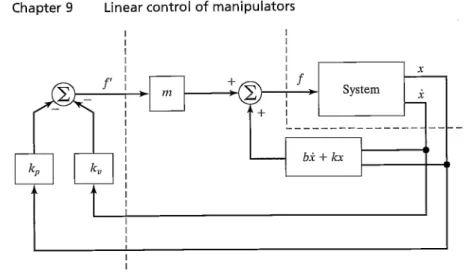
— (9.35)Figure 9.7 is a block diagram of the closed-loop system, where the portionto the left of the dashed line is the control system (usually implemented in a computer) and that to the right of the dashed line is the physical system. Implicit in the figure are interfaces between the control computer and the output actuator commands and the input sensor information.
The control system we have proposed is a position-regulation system—it simply attempts to maintain the position of the block in one fixed place regardless
/
FIGURE 9.6:A damped spring—mass system with an actuator.
272 Chapter
FIGURE 9.7:Aclosed-loop control system. The control computer (to the left of the dashed line) reads sensor input and writes actuator output commands.
of disturbance forces applied to the block. In a later section, we will construct a trajectory-following control system, which can cause the block to follow a desired position trajectory.
By equating the open-loop dynamics of (9.34) with the control law of (9.35), we can derive the closed-loop dynamics as
ml + bi + kx = — (9.36)
or
=0,
(9.37)or
ml +
b' k' =k and (9.38), it is clear that, by setting
the control gains, and we can cause the closed-loop system to appear to have any second system behavior that we wish. Often, gains would be chosen to obtain critical damping (i.e., b' = and some desired closed-loop stiffness given directly by k'.
Note that and could be positive or negative, depending on the parameters of the original system. However, if b' or k' became negative, the result would be an unstable control system. This instability will be obvious if one writes down the solution of the second-order differential equation (in the form of (9.6), (9.14), or (9.26)). It also makes intuitive sense that, if b' or k' is negative, servo errors tend to get magnified rather than reduced.
EXAMPLE9.4
If the parameters of the system in Fig. 9.6 are in = 1, b =1, and k = 1, find gains and for a position-regulation control law that results in the system's being critically damped with a closed-loop stiffness of 16.0.
x
Section 9.5 Control-law partitioning 273
If
we wish k' to be 16.0, then, for critical damping, we require that b' == 8.0. Now, k =1 and b =1, so we need
= 15.0,
= 7.0. (9.39)
9.5 CONTROL-LAW PARTITIONING
In preparation for designing control laws for more complicated systems, let us consider a slightly different controller structure for the sample problem of Fig. 9.6.
In this method, we wifi partition the controller into a model-based portion and a servo portion. The result is that the system's parameters (i.e., in, b, and k, in this case) appear only inthe model-based portion andthatthe servo portion is independent of these parameters. At the moment, this distinction might notseem important, but it wifi become more obviously important as we consider nonlinear systems in Chapter 10. We will adopt this control-law partitioning approach throughout the book.
The open-loop equation of motion for the system is
ml + hi + kx = f. (9.40)
We wish to decompose the controller for this system into two parts. In thiscase, the model-based portion of the control law wifi make use of supposed knowledge of in, b, and k. This portion of the control law is set up such that it reduces thesystem so that it appears to be a unit mass. This will become clear when we do Example 9.5.
The second part of the control law makes use of feedback to modify the behavior of the system. The model-based portion of the control law has the effect of making the system appear as a unit mass, so the design of the servo portion is very simple—gains are chosen to control a system composed of a single unit mass (i.e., nofriction,no stiffness).
The model-based portion of the control appears in a control law of the form (9.41) where u and are functions or constants andare chosen so that, if
f'is
taken as the new input to the system, the system appears to be a unit mass. With this structure of the control law, the system equation (the result of combining (9.40) and (9.41)) isinl+bi+kx =af'+tl.
(9.42) Clearly, in order to make the system appear as a unitmass from the f' input, for this particular system we should choose a and as follows:a= in,
(9.43) Making these assignments and plugging them into (9.42), we have the system equation
I = f'.
(9.44)274 Chapter
FIGURE 9.8:Aclosed-loopcontrol system employing the partitioned control method.
This is the equation of motion for a unit mass. We now proceed as if (9.44) were the open-loop dynamics of a system to be controlled. We design a control law to compute f', justas we did before:
f' =
—Combining this control law with (9.44) yields
=0.
(9.45)
(9.46) Under this methodology, the setting of the control gains is simple and is independent of the system parameters; that is,
= (9.47)
must hold for critical damping. Figure 9.8 shows a block diagram of the partitioned controller used to control the system of Fig. 9.6.
EXAMPLE 9.5
If the parameters of the system in Fig. 9.6 are in =1, b =1, and k = 1,find a, and the gains and for a position-regulation control law that results in the system's being critically damped with a closed-loop stiffness of 16.0.
We choose
a =1,
(9.48) so that the system appears as a unit mass from the fictitious f'input. We then set gain to the desired closed-loop stiffness and set = for critical damping.
Section 9.6 Trajectory-following control 275 This gives
= 16.0,
=8.0. (9.49)
9.6 TRAJECTORY-FOLLOWING CONTROL
Rather than just maintaining the block at a desired location, letus enhance our controller so that the block can be made to follow a trajectory. The trajectory is given by a ftnction of time, xd(t), that specifies the desired position of the block.
We assume that the trajectory is smooth (i.e., the first two derivatives exist)and that our trajectory generator provides xd, ia, and 1d at all times t. We define the servo error between the desired and actual trajectory as e = xd —x. A servo-control law that will cause trajectory following is
(9.50) We see that (9.50) is a good choice if we combine it with the equation of motion of
a unit mass (9.44), which leads to
I
(9.51)or
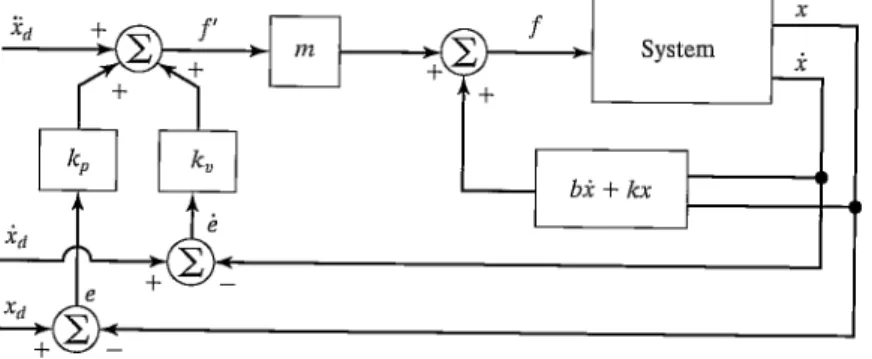
(9.52) This is a second-order differential equation for which we can choose the coefficients, so we can design any response we wish. (Often, critical damping is the choice made.) Such an equation is sometimes said to be written in error space, because it describes the evolution of errors relative to the desired trajectory. Figure 9.9 shows a block diagram of our trajectory-following controller.
If our model is perfect (i.e., our knowledge of in, b, and k), and if there is no noise and no initial error, the block will follow the desired trajectory exactly. If there is an initial error, it will be suppressed according to (9.52), and thereafter the system wifi follow the trajectory exactly.
FIG URE 9.9: A trajectory-following controller for the system in Fig. 9.6.
9.7 DISTURBANCE REJECTION
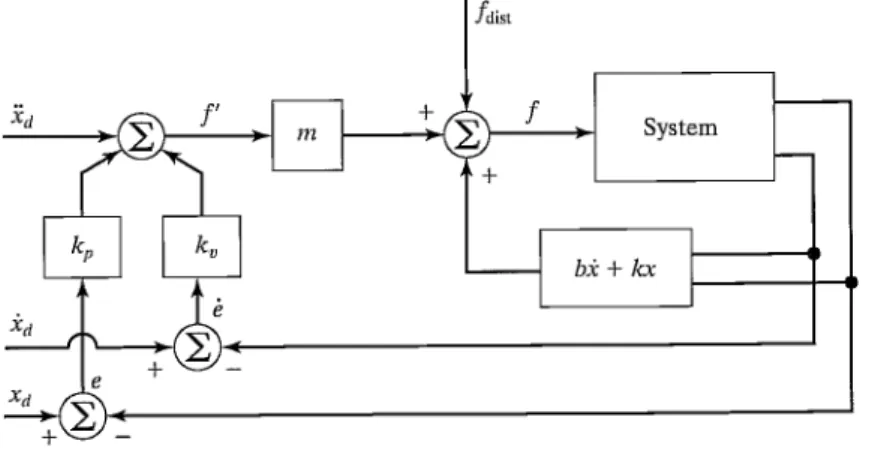
One of the purposes of a control system is to provide rejection, that is, to maintain good performance (i.e., minimize errors) even in the presence of some external disturbances or noise. In Fig. 9.10, we show thetrajectory-following controller with an additional input: a disturbance force An analysis of our closed-loop system leads to the error equation
+ + = (9.53)
Equation (9.53) is that of a differential equation driven by a forcing function.
If it is known that is bounded—that is, that a constant a exists such that
<a,
(9.54)then the solution of the differential equation, e(t),isalso bounded. This result is due to a property of stable linear systems known as bounded-input, bounded-output or BIIBO stability {3, 4]. This very basic result ensures that, for a large class of possible disturbances, we can at least be assured that the system remains stable.
Steady-state error
Let'sconsider the simplest kind of disturbance—namely, that is a constant. In this case, we can perform a steady-state analysis by analyzing the system at rest (i.e., the derivatives of all system variables are zero). Setting derivatives to zero in (9.53) yields the steady-state equation
= fthst' (9.55)
or
e = fdist/kp. (9.56)
The value of e given by (9.56) represents a steady-state error. Thus, it is clear that the higher the position gain the smaller will be the steady-state error.
FIG U RE 9.10: A trajectory-following control system with a disturbance acting.
Section 9.8 Continuous vs. discrete time control 277
Addition of an integral term
Inorder to eliminate steady-state error, a modified control law is sometimes used.
The modification involves the addition of an integral term to the control law. The control law becomes
= + + + k1 f edt, (9.57)
which results in the error equation
(9.58) The term is added so that the system wifi have no steady-state error in the presence of constant disturbances. If e(t) = 0for t <0,we can write (9.58) for t >0as
= fdist' (9.59)
which, in the steady state (for a constant disturbance), becomes
= 0, (9.60)
so
e = 0. (9.61)
With this control law, the system becomes a third-order system, and one can solve the corresponding third-order differential equation to work out the response of the system to initial conditions. Often, is kept quite small so that the third-order system is "close" to the second-order system without this term (i.e., a dominant- pole analysis can be performed). The form of control law (9.57) is called a P11.) control law, or "proportional, integral, derivative" control law [4]. For simplicity, the displayed equations generally do not show an integral term in the control laws that we develop in this book.
9.8 CONTINUOUS VS. DISCRETE TIME CONTROL
In the control systems we have discussed, we implicitly assumed that the control computer performs the computation of the control law in zero time (i.e., infinitely fast), so that the value of the actuator force f is a continuous function of time. Of course, in reality, the computation requires some time, and the resulting commanded force is therefore a discrete "staircase" function. We shall employ this approximation of a very fast control computer throughout the book. This approximation is good if the rate at which new values of f are computed is much faster than the natural frequency of the system being controlled. In the field of discrete time control or digital control, one does not make this approximation but rather takes the servo rate of the control system into account when analyzing the system [3].
We will generally assume that the computations can be performed quickly enough that our continuous time assumption is valid. This raises a question: How quick is quick enough? There are several points that need to be considered in choosing a sufficiently fast servo (or sample) rate:
278
Trackingreference inputs: The frequency content of the desired or reference input places an absolute lower bound on the sample rate. The sample rate must be at least twice the bandwidth of reference inputs. This is usually not the limiting factor.
Disturbance rejection: In disturbance rejection, an upper bound on performance is given by a continuous-time system. If the sample period is longer than the correlation time of the disturbance effects (assuming a statistical model for random disturbances), then these disturbances wifi not be suppressed. Perhaps a good rule of thumb is that the sample period should be 10 times shorter than the correlation time of the noise [3].
Antialiasing: Any time an analog sensor is used in a digital control scheme, there wifi be a problem with aliasing unless the sensor's output is strictly band limited. In most cases, sensors do not have a band limited output, and so sample rate should be chosen such that the amount of energy that appears in the aliased signal is small.
Structural resonances: We have not included bending modes in our characterization of a manipulator's dynamics. All real mechanisms have finite stiffness and so wifi be subject to various kinds of vibrations. If it is important to suppress these vibrations (and it often is), we must choose a sample rate at least twice the natural frequency of these resonances. We wifi return to the topic of resonance later in this chapter.
9.9 MODELING AND CONTROL OF A SINGLE JOINT
In this section, we wifi develop a simplified model of a single rotary joint of a manipulator. A few assumptions wifi be made that wifi allow us to model the resulting system as a second-order linear system. For a more complete model of an actuated joint, see [5].
A common actuator found in many industrial robots is the direct current (DC) torque motor (as in Fig. 8.18). The nonturning part of the motor (thestator) consists
of a housing, bearings, and either permanent magnets or electromagnets. These stator magnets establish a magnetic field across the turning part of the motor (the rotor). The rotor consists of a shaft and windings through which current moves to power the motor. The current is conducted to the windings via brushes, which make
contact with the commutator. The commutator is wired to the various windings (also called the armature) in such a way that torque is always produced in the desired direction. The underlying physical phenomenon [6] that causes a motor to generate a torque when current passes through the windings canbe expressed as
F=qVxB,
(9.62)where charge q, moving with velocity V through a magnetic field B, experiences a force F. The charges are those of electrons moving through the windings, and the magnetic field is that set up by the stator magnets. Generally, the torque-producing ability of a motor is stated by means of a single motor torque constant, which relates armature current to the output torque as
= (9.63)
Section 9.9 Modeling and control of a single joint 279 When a motor is rotating, it acts as a generator, and a voltage develops across the armature. A second motor constant, the back emfconstant,3 describes the voltage generated for a given rotational velocity:
v = ke8i)i. (9.64)
Generally, the fact that the commutator is switching the current through varioussets of windings causes the torque produced to contain some torque ripple. Although sometimes important, this effect can usually be ignored. (Inany case, it is quite hard to model—and quite hard to compensate for, even if it is modeled.)
Motor-armature inductance
Figure9.11 shows the electric circuit of the armature. The major components are a voltage source, V0, the inductance of the armature windings, the resistance of the armature windings, ra, andthe generated back emf, v. The circuit is described by a first-order differential equation:
iota + Va —keOin. (9.65)
It is generally desirable to control the torque generated by the motor (rather than the velocity) with electronic motor driver circuitry. These drive circuits sense the current through the armature and continuously adjust the voltage source Va 50 that a desired current flows through the armature. Such a circuit is calleda
amplifier motor driver [7]. In these current-drive systems, the rate at which the armature current can be commanded to change is limited by the motor inductance 1a and by an upper liniit on the voltage capability of the voltage source The net effect is that of a low-pass filter between the requested current and output torque.
Our first simplifying assumption is that the inductance of the motor can be neglected. This is a reasonable assumption when the natural frequency of the closed- loop control system is quite low compared to the cut-off frequency of the implicit low-pass ifiter in the current-drive circuitry due to the inductance. This assumption, along with the assumption that torque ripple is a negligible effect, means that we can essentially command torque directly. Although there might be a scale factor (such
as to contend with, we wifi assume that the actuator acts as a pure torquesource that we can command directly.
r11 1A
FIGURE 9.11: The armature circuitof a DC torque motor.
3"emf" stands for electromotive force.
280
b
FIGURE 9.12:Mechanical model of a DC torque motor connected through gearing to an inertial load.
Effective inertia
Figure9.12 shows the mechanical model of the rotor of a DC torque motor connected through a gear reduction to an inertial load. The torque applied to the rotor, tm, is given by (9.63) as a function of the current flowing in the armature circuit. The gear ratio (11) causes an increase in the torque seen at the load and a reduction in the speed of the load, given by
t
=9 = (9.66)
where > 1.Writing a torque balance for this system in terms of torque at the rotor yields
= + + (1/17) (Jo + be), (9.67)
where and I are the inertias of the motor rotor and of the load, respectively, and and b are viscous friction coefficients for the rotor and load bearings, respectively.
Using the relations (9.66), we can write (9.67) in terms of motor variables as
= + + + (9.68)
or in terms of load variables as
= (I+ +(b + (9.69)
The term I + 172 is sometimes called the effective inertia "seen" at the output (link side) of the gearing. Likewise, the term b + can be called the effective damping. Note that, in a highly geared joint (i.e., 17 >> 1), the inertia of the motor rotor can be a significant portion of the combined effective inertia. It is this effect that allows us to make the assumption that the effective inertia is a constant. We know
a/fl
Section 9.9 Modeling and control of a single joint 281
fromChapter 6 that the inertia, I, of a joint of the mechanism actually varies with configuration and load. However, in highly geared robots, the variations represent a smaller percentage than they would in a direct-drive manipulator (i.e., = 1).To ensure that the motion of the robot link is never underdamped, the value used for I should be the maximum of the range of values that I takes on; we'll call this value This choice results in a system that is critically damped or overdamped in all situations. In Chapter 10, we will deal with varying inertia directly and will not have to make this assumption.
EXAMPLE 9.6
Ifthe apparent link inertia, I, varies between 2 and 6 Kg-m2, the rotor inertia is
= 0.01,and the gear ratio is =30,what are the minimum and maximum of the effective inertia?
The minimum effective inertia is
'mm + =2.0 + (900)(0.01) =11.0; (9.70)
the maximum is
'max + = 6.0+ (900) (0.01) =15.0. (9.71) Hence, we see that, as a percentage of the total effective inertia, the variation of inertia is reduced by the gearing.
Unmodeledflexibility
Theother major assumption we have made in our model is that the gearing, the shafts, the bearings, and the driven link are not flexible. In reality, all of these elements have finite stiffness, and their flexibility, if modeled, would increase the order of the system. The argument for ignoring flexibility effects is that, if the system is sufficiently stiff, the natural frequencies of these unmodeled resonances are very high and can be neglected compared to the influence of the dominant second-order poles that we have modeled.4 The term "unmodeled" refers to the fact that, for purposes of control-system analysis and design, we neglect these effects and use a simpler dynamic model, such as (9.69).
Because we have chosen not to model structural flexibiities in the system, we must be careful not to excite these resonances. A rule of thumb [8] is that, if the lowest structural resonance is cores, then we must limit our closed-loop natural frequency according to
< (9.72)
This provides some guidance on how to choose gains in our controller. We have seen that increasing gains leads to faster response and lower steady-state error, but we now see that unmodeled structural resonances limit the magnitude of gains. Typical industrial manipulators have structural resonances in the range from 5 Hz to 25 Hz [8]. Recent designs using direct-drive arrangements that do not contain flexibility
4This is basically the same argument we used to neglect the pole due to the motor inductance.
Including it would also have raised the order of the overall system.
introduced by reduction and transmission systems have their lowest structural resonances as high as 70 Hz [9].
EXAMPLE 9.7
Consider the system of Fig. 9.7 with the parameter values in = 1, b =1,and k = 1.
Additionally, it is known that the lowest unmodeled resonance of the system is at 8 radians/second. Find a, andgains and for a position-control law so the system is critically damped, doesn't excite unmodeled dynamics, and has as high a closed-loop stiffness as possible.
We choose
a =
1,(9.73) so that the system appears as a unit mass from the fictitious f' input. Using our rule of thumb (9.72), we choose the closed-loop natural frequency to be
=4radians/second. From (9.18) and (9.46), we have = co2, so
=16.0,
=8.0. (9.74)
Estimating resonant frequency
The same sources of structural flexibility discussed in Chapter 8 give rise to reso- nances. In each case where a structural flexibility can be identified, an approximate analysis of the resulting vibration is possible if we can describe the effective mass or inertia of the flexible member. This is done by approximating the situation by a simple spring—mass system, which, as given in (9.20), exhibits the natural frequency
= (9.75)
where k is the stiffness of the flexible member and inisthe equivalent mass displaced in vibrations.
EXAMPLE 9.8
Ashaft (assumed massless) with a stiffness of 400 Nt-rn/radian drives a rotational inertia of 1 Kg-m2. If the shaft stiffness was neglected in the modeling of the
dynamics, what is the frequency of this unmodeled resonance?
Using (9.75), we have
= \/400/1 =20 rad/second =20/(27r)Hz 3.2 Hz. (9.76)
For the purposes of a rough estimate of the lowest resonant frequency of beams and shafts, [10] suggests using a lumped model of the mass. We already
Section 9.9 Modeling and control of a single joint 283
0.23 in
0.33I
FIGURE9.13: Lumped models of beams for estimation of lowest lateral and torsional resonance.
have formulas for estimating stiffness at the ends of beams and shafts; these lumped models provide the effective mass or inertia needed for our estimation of resonant
frequency. Figure 9.13 shows the results of an energy analysis [10] which suggests that a beam of mass rn be replaced by a point mass at the end of 0.23 in and, likewise, that a distributed inertia of I be replaced by a lumped 0.33 I at the end of the shaft.
EXAMPLE 9.9
Alink of mass 4.347 Kg has an end-point lateral stiffness of 3600 Nt/m. Assuming the drive system is completely rigid, the resonance due to the flexibility of the link wifi limit control gains. What is Wres?
The 4.347 Kg mass is distributed along the link. Using the method of Fig. 9.13, the effective mass is (0.23) (4.347) 1.0 Kg. Hence, the vibration frequency is
Wres = =60radians/second = 60/(27r)Hz 9.6 Hz. (9.77) The inclusion of structural flexibilities in the model of the system used for control-law synthesis is required if we wish to achieve closed-loop bandwidths higher than that given by (9.75). The resulting system models are of high order, and the control techniques applicable to this situation become quite sophisticated. Such control schemes are currently beyond the state of the art of industrial practice but are an active area of research [11, 12].
Control of a single joint
Insummary, we make the following three major assumptions:
1. The motor inductance 1a can be neglected.
2. Taking into account high gearing, we model the effective inertia as a constant equal to 'max+
3. Structural flexibilities are neglected, except that the lowest structural resonance is used in setting the servo gains.
With these assumptions, a single joint of a manipulator can be controlled with the partitioned controller given by
a= 'max +
= (b+ (9.78)
r=8d+kVe+kPe.
(9.79)Theresulting system closed-loop dynamics are
+ + = tdjst, (9.80)
wherethe gains are chosen as
kP a 4 res
= = Wres. (9.81)
9.10 ARCHITECTURE OF AN INDUSTRIAL-ROBOT CONTROLLER
In this section, we briefly look at the architecture of the control system of the Unimation PUMA 560 industrial robot. As shown in Fig. 9.14, the hardware archi- tecture is that of a two-level hierarchy, with a DEC LSI-11 computer serving as the top-level "master" control computer passing cormnands to six Rockwell 6503 microprocessors.5 Each of these microprocessors controls an individual joint with a PID control law not unlike that presented in this chapter. Each joint of the PUMA 560 is instrumented with an incremental optical encoder. The encoders are interfaced to an up/down counter, which the microprocessor can read to obtain the current joint position. There are no tachometers in the PUMA 560; rather, joint positions are differenced on subsequent servo cycles to obtain an estimate of joint velocity. In order to command torques to the DC torque motors, the microprocessor
FIG U RE 9.14: Hierarchical computer architecture of the PUMA 560 robot-control system.
5These simple 8-bit computers are already old technology. It is common these days for robot controllers to be based on 32-bit microprocessors.
Bibliography 285
FIG U RE 9.15:Functional blocks of the joint-control system of the PUMA 560.
is interfaced to a digital-to-analog converter (DAC) so that motor currents can be commanded to the current-driver circuits. The current flowing through the motor is controlled in analog circuitry by adjusting the voltage across the armature as needed to maintain the desired armature current. A block diagram is shown in Fig. 9.15.
Each 28 milliseconds, the LSI-11 computer sends a new position command (set-point) to the joint microprocessors. The joint microprocessors are running on a 0.875 millisecond cycle. In this time, they interpolate the desired position set-point, compute the servo error, compute the PID control law, and command a new value of torque to the motors.
The LSI-11 computer carries out all the "high-level" operations of the overall control system. First of all, it takes care of interpreting the VAL (Uriimation's robot programming language) program commands one by one. When a motion command is interpreted, the LSI-11 must perform any needed inverse kinematic computations, plan a desired trajectory, and begin generating trajectory via points every 28 miffiseconds for the joint controllers.
The LSI-11 is also interfaced to such standard peripherals as the terminal and a floppy disk drive. In addition, it is interfaced to a teach pendant. A teach pendant is a handheld button box that allows the operator to move the robot around in a variety of modes. For example, the PUMA 560 system allows the user to move the robot incrementally in joint coordinates or in Cartesian coordinates from the teach pendant. In this mode, teach-pendant buttons cause a trajectory to be computed
"on the fly" and passed down to the joint-control microprocessors.
BIBLIOGRAPHY
[1] W. Boyce and R. DiPrima, Elenwntary Differential Equations, 3rd edition, John Wiley and Sons, New York, 1977.
[2] E. Purcell, Calculus with Analytic Geometry, Meredith Corporation, New York, 1972.
[3] G. Franklin and J.D. Powell, Digital Control of Dynamic Systems, Addison-Wesley, Reading, MA, 1980.
[4] G. Franklin, J.D. Powell, and A. Emami-Naeini, Feedback Control of Dynamic Sys- tems, Addison-Wesley,Reading, MA, 1986.
[5] J. Luh, "Conventional Controller Design for Industrial Robots—a Tutorial," IEEE Transactions on Systems, Man, and Cybernetics, Vol. SMC-13, No. 3, June 1983.
[6] D. Haffiday and R. Resnik, Fundamentals of Physics, Wiley, New York 1970.
[7] Y. Koren and A. Ulsoy, "Control of DC Servo-Motor Driven Robots," Proceedings of Robots 6 Conference, SIvifi, Detroit, March 1982.
[8] R.P. Paul, Robot Manipulators, MIT Press, Cambridge, MA, 1981.
[9] H. Asada and K. Youcef-Toumj, Direct-Drive Robots—Theory and Practice, MIT Press, Cambridge, MA, 1987.
[10] J. Shigley, Mechanical Engineering Design, 3rd edition, McGraw-Hill, New York, 1977.
[11] W. Book, "Recursive Lagrangian Dynamics of Flexible Manipulator Arms," The International Journal of Robotics Research, Vol. 3, No. 3, 1984.
[12] R. Cannon and E. Sclmiitz, "Initial Experiments on the End-Point Control of a Flexible One Link Robot," The International Journal of Robotics Research, Vol. 3, No. 3, 1984.
[13] R.J. Nyzen, "Analysis and Control of an Eight-Degree-of-Freedom Manipulator,"
Ohio University Master's Thesis, Mechanical Engineering, Dr. Robert L. Wffliams II, Advisor, August 1999.
[14] R.L. Williams II, "Local Performance Optimization for a Class of Redundant Eight- Degree-of-Freedom Manipulators," NASA Technical Paper 3417, NASA Langley Research Center, Hampton, VA, March 1994.
EXERCISES
9.1 [20] For a second-order differential equation with complex roots
= —
showthat the general solution
x(t) = + c9eS2t, can be written
x(t) = c1eAtcos(jst) + c2eAt
9.2 [13] Compute the motion of the system in Fig. 9.2 if parameter values are in=2, b = 6, and k = 4and the block (initially at rest) is released from the position x =1.
9.3 [13] Compute the motion of the system in Fig. 9.2 if parameter values are in = 1,
b = 2, and k = 1 and the block (initially at rest) is released from the position x =4.
9.4 [13] Compute the motion of the system in Fig. 9.2 if parameter values are in = 1,
b = 4, and k = 5 and the block (initially at rest) is released from the position x =2.
9.5 [15] Compute the motion of the system in Fig. 9.2 if parameter values are in= 1, b =7,and k =10and the block is released from the position x = 1with an initial velocity of x =2.
9.6 [15] Use the (1, 1) element of (6.60) to compute the variation (as a percentage of the maximum) of the inertia "seen" by joint 1 of this robot as it changes configuration. Use the numerical values
=12 0.5 m, in1 = 4.0Kg, ifl2 =2.0Kg.
Programming exercise (Part 9) 287
Consider that the robot is direct drive and that the rotor inertia is negligible.
9.7 [17] Repeat Exercise 9.6 for the case of a geared robot (use = 20) and a rotor inertia of =0.01 Kg m2.
9.8 [18] Consider the system of Fig. 9.6 with the parameter values in = 1, b = 4, and k = 5. The system is also known to possess an unmodeled resonance at
Wres =6.0 radians/second. Determine the gains and that will critically damp the system with as high a stiffness as is reasonable.
9.9 [25] In a system like that of Fig. 9.12, the inertial load, I, varies between 4 and 5 Kg-rn2. The rotor inertia is = 0.01Kg-rn2, and the gear ratio is = 10.
The system possesses uninodeled resonances at 8.0, 12.0, and 20.0 radians/second.
Design a and fi ofthe partitioned controller and give the values of and such that the system is never underdamped and never excites resonances, but is as stiff as possible.
9.10 [18] A designer of a direct-drive robot suspects that the resonance due to beam flexibility of the link itself will be the cause of the lowest unmodeled resonance. If the link is approximately a square-cross-section beam of dimensions 5 x 5 x 50 cm with a 1-cm wall thickness and a total mass of 5 Kg, estimate cores.
9.11 [15] A direct-drive robot link is driven through a shaft of stiffness 1000 Nt-rn/radian.
The link inertia is 1 Kg-m2. Assuming the shaft is massless, what is Wres?
9.12 [18] A shaft of stiffness 500 Nt-mlradian drives the input of a rigid gear pair with
1) = 8. The output of the gears drives a rigid link of inertia 1 Kg-rn2. What is the C0res caused by flexibility of the shaft?
9.13 [25] A shaft of stiffness 500 Nt-rn/radian drives the input of a rigid gear pair with
= 8.The shaft has an inertia of 0.1 Kg-rn2. The output of the gears drives a rigid link of inertia 1 Kg-rn2. What is the Wres caused by flexibility of the shaft?
9.14 [28] In a system like that of Fig. 9.12, the inertial load, I, varies between 4 and 5 Kg-rn2. The rotor inertia is = 0.01 Kg-rn2, and the gear ratio is = 10.The system possesses an unmodeled resonance due to an end-point stiffness of the link of 2400 Nt-rn/radian. Design a and fi ofthe partitioned controller, and give the values of and k0 such that the system is never underdamped and never excites resonances, but is as stiff as possible.
9.15 [25] A steel shaft of length 30 cm and diarneter 0.2 cm drives the input gear of a reduction of 17 = 8. The rigid output gear drives a steel shaft of length 30 cm and diameter 0.3 cm. What is the range of resonant frequencies observed if the load inertia varies between 1 and 4 Kg-rn2?
PROGRAMMING EXERCISE (PART 9)
We wish to simulate a simple trajectory-following control systern for the three-link planar arrn. This control system will be implemented as an independent-joint PD (proportional plus derivative) control law. Set the servo gains to achieve closed-loop stiffnesses of 175.0, 110.0, and 20.0 for joints 1 through 3 respectively. Try to achieve approximate critical damping.
Use the simulation routine UPDATE to simulate a discrete-time servo running at 100 Hz—that is, calculate the control law at 100 Hz, not at the frequency of the numerical integration process. Test the control scheme on the following tests:
1. Start the arm at 0 = (60, —110, 20) and command it to stay there until time = 3.0, when the set-points should instantly change to 0 = (60, —50, 20). That is, give a step input of 60 degrees to joint 2. Record the error—time history for each joint.
2. Control the arm to follow the cubic-spline trajectory from Programming Exercise Part 7. Record the error—time history for each joint.
MATLAB EXERCISE 9
Thisexercise focuses on linearized independent joint-control simulation for the shoulder joint (joint 2) of the NASA eight-axis AAI ARJVIII (Advanced Research Manipulator II) manipulator arm—see [14]. Familiarity with linear classical feedback-control systems, including block diagrams and Laplace transforms, is assumed. We will use Simulink, the
graphical user interface of MATLAB.
Figure 9.16 shows a linearized open-loop system-dynamics model for the ARMII electromechanical shoulder joint/link, actuated by an armature-controller DC servomo- tor. The open-loop input is reference voltage (boosted to armature voltage via an amplifier), and the output of interest is the load shaft angle ThetaL. The figure also shows the feedback-control diagram, where the load-shaft angle is sensed via an optical encoder and provided as feedback to the PTD controller. The table describes all system parameters and variables.
If we reflect the load shaft inertia and damping to the motor shaft, the effective polar inertia and damping coefficient are J = + JL(t)/n2 and C = CM + CL/n2.
By virtue of the large gear ratio n, these effective values are not much different from the motor-shaft values. Thus, the gear ratio allows us to ignore variations in the configuration-dependent load-shaft inertia (t) and just set a reasonable average value.
The ARJVHI shoulder joint constant parameters are given in the accompanying table [13]. Note that we can use the English units directly, because their effect cancels out inside the control diagram. Also, we can directly use deg units for the angle. Develop a Simulink model to simulate the single-joint control model from the model and feedback- control diagram shown; use the specific parameters from the table. For the nominal case, determine the PID gains by trial and error for "good" performance (reasonable percent overshoot, rise time, peak time, and settling time). Simulate the resulting motion for moving this shoulder joint for a step input of 0 to 60 deg. Plot the simulated load-angle value over time, plus the load-shaft angular velocity over time. In addition, plot the
Commanded
metaL
Encoder
Closed-Loop Feedback Control Diagram
FIGURE 9.16: Linearized open-loop system-dynamics model for the ARMII elec- tromechanical shoulder joint/link, actuated by an armature-controller DC servomo- tor.
Door rotio Integrator
Open-Loop Electromechanieal System Diagrom
MATLAB Exercise 9 289 TABLE 9.1: ARMII shoulderloirit constant parameters.
Va(t) armature
voltage
-rM(t) generated
motor torque
TL(t) load torque
L =0.0006H armature induc- tance
9M(t) motor shaft
angle
OL(t) load shaft angle
R = 1.40Q armature resis- tance
coM(t) motor shaft velocity
WL(t) load shaft velocity
(t) armature
current
=0.00844 lbf -in-s2
lumped motor polar inertia
(t) = 1
lbf -in-s2
lumped load polar inertia
Vb (t) back emf
voltage
CM = 0.00013
lbf-in/deg/s
motor shaft viscous damping coefficient
CL = 0.5
lbf- in/deg/s
load shaft viscous damping coefficient
=12 amplifier gain
n =200 gear ratio g =0
in/s2
gravity (ignore gravity at first) Kb =0.00867
V/deg/s
back emf constant
KM =4.375 lbf -in/A
torque con- stant
=1 encoder transfer function control effort—that is, the armature voltage Va over time. (On the same graph, also give the back emf Vb.)
Now, try some changes—Simulink is so easy and enjoyable to change:
1) The step input is frustrating for controller design, so try a ramped step input instead: Ramp from 0 to 60 deg in 1.5 sec, then hold the 60-deg command for all time greater than 1.5 sec. Redesign PID gains and restimulate.
2) Investigate whether the inductor L is significant in this system. (The electrical sys- tem rises much faster than the mechanical system—this effect can be represented by time constants.)
3) We don't have a good estimate for the load inertia and damping and CL). With your best PID gains from before, investigate how big these values can grow (scale the nominal parameters up equally) before they affect the system.
4) Now, include the effect of gravity as a disturbance to the motor torque TM. Assume that the moving robot mass is 200 lb and the moving length beyond joint 2 is 6.4 feet. Test for the nominal "good" PID gains you found; redesign if necessary. The shoulder load angle 87 zero configuration is straight up.