Robust Control of Robot Manipulators using Vision Systems
Young-Chan Lee, Min-Seok Jie, Kang-Woong Lee ABSTRACT
In this paper, we propose a robust controller for trajectory control of n-link robot manipulators using feature based on visual feedback. In order to reduce tracking error of the robot manipulator due to parametric uncertainties, integral action is included in the dynamic control part of the inner control loop. The desired trajectory for tracking is generated from feature extraction by the camera mounted on the end effector. The stability of the robust state feedback control system is shown by the Lyapunov method. Simulation and experimental results on a 5-link robot manipulator with two degree of freedom show that the proposed method has good tracking performance
Key words : visual feedback, robot , robust control, state feedback control, integral control
Department of Avionics Engineering Hankuk Aviation University
․논문번호 : 2003-2-9
․접수일자 : 2003년 10월 28일
Ⅰ. Introduction
Visual information is an attractive solution for the position and motion control of robot manipulators working in unstructured environment.
A camera mounted on the end effector of the robot manipulator supplies visual information of the object. The control objective of this approach is to move the manipulator in such a way that the projection of feature on either a moving or a static object in the camera frame be always at a desired location in the image captured by the camera [1].
This control problem has attracted the attention of researchers in recent years. In most previous works, robot dynamics do not interact with visual feedback loop. Although this assumption is valid for slow robot motion, it dose not hold for high speed tasks. However robot dynamics are not exactly known because of parametric uncertainties such as an unknown payload or unmodeled joint friction. Eventhough visual feedback is used in
robot control system, parametric uncertainties deteriorate the performance of the inner dynamic control loop.
Robust control schemes for robot manipulators [2]
are required to achieve good tracking performance in the presence of parametric uncertainties. The robust saturation control techniques are typically applied to guarantee uniform ultimate boundedness of the tracking errors [3]. Most of these schemes require known uncertainty bounds, which is difficult to estimate precisely. Hence, the estimated uncertainty bounds may be very conservative. These conserv -ative bounds lead to excessive large control magnitudes. However, robust control schemes require high feedback gains in order to maintain small tracking errors. In practice, high feedback gains are limited because of hardware issues such as digital implementation, neglected high frequency modes, and actuator saturation. Limitation of high feedback gains induces large tracking errors [4], [5]. To overcome this problem, integral control is introduced.
Integral control [6] reduces tracking error.
In this paper we proposed a robust feedback controller using visual feedback for trajectory control of n-link robot manipulators with bounded parametric uncertainties. The feature extraction by the camera mounted on the end effector makes the desired position, velocity and acceleration vectors for tracking. The robust controller with integral action reduces tracking error due to the limitation of high feedback gains. The proposed method is implemented on a two degree of freedom 5-link FARA robot.
Ⅱ. Robot Dynamic Model and Control Problem In the absence of friction, the dynamic equation of an n-link rigid robot can be expressed as [7].
M(q)q̈ +C(q,q)̇ q̇ +G(q) =τ (1)
where q∈Rn is the vector of joint displacements,τ∈Rn is the vector of the torques applied to the joints, M(q)∈Rn×n is the symmetric positive definite inertia matrix, C(q, q̇)q̇ is the n×1 vector of centripetal and Coriolis forces and G(q) is the vector of the gravitational force.
By a linear parameterization property of the rigid robot, the equation (1) can be expressed
M(q)q̈ +C(q,q)̇q̇ +G(q) =Y(q, q̇,q̈)θ (2)
whereY(q, q̇, q̈) is called the regression matrix and θ is the p×1 vector of physical parameters of the robot manipulator.
Let us consider a camera mounted at the robot end effector. When an object point with
coordinates [X Y Z]T in the camera frame projects onto a point on the image plane, the image feature point of the object in the image plane is given by
ξ=[ ]xy = f Z
X Yα β
(3)
where is a focal length of the camera and ,
are the scaling factors in pixels per meter due to the camera sampling. The time derivative of the position vector yields
ξ̇= f Z
1
α 0 - X
αZ
0 1
β - Y
βZ
Ẋ Ẏ
Ż (4)
The time derivative of the object point can be expressed as follows
Ẋ Ẏ Ż =
- 1 0 0 0 -Z Y
0 - 1 0 Z 0 -X
0 0 - 1 -Y X 0
[ RTc0(q) RTc0(q)][ ]ωvcc
(5)
where is the rotational matrix of the camera frame with respect to the robot coordinate frame and and stand for the camera linear and angular velocities with respect to the robot frame, respectively.
Substituting (5) into (4), the motion of the image feature point is obtained
ξ̇=Jimg( ξ,Z)[ RTc0(q) RTc0(q)][ ]ωvcc (6) where
Jimg(ξ,Z) =
- f
αZ 0 x
Z βxy
f -f2+α2x2
αf βy
α
0 - f
βZ y
Z f2+β2y2
βf -αxy
f -αx β
(7)
Since the joint velocities and the corresponding end-effector translational velocity and angular velocity are related via the geometric Jacobian
: [8].
[ ]ωvcc =Jg(q) q̇ (8) the time derivative of the image feature vector can be expressed as
ξ̇=J(q,ξ,Z) q̇ (9)
where
J(q,ξ,Z) =Jimg( ξ,Z)[R0Tc R0Tc]
Jg(q) (10)
Let us denote with the desired image feature vector and define the image feature error
˜ = ξξ d- ξ (11)
Assuming be a constant vector, the time derivative of (11) is given by
˜̇ =-ξ J(q,ξ,Z) q̇ (12) We take
q̇ =J+(q, ξ,Z)Kv˜ξ (13)
where is positive definite gain matrix to be designed and J+(q, ξ,Z) is the pseudo-inverse matrix of the image Jacobian such that
J+(q, ξ,Z) =[JT(q, ξ,Z)J(q,ξ,Z)]TJT(q, ξ,Z) (14)
Substituting (13) into (12), the error dynamic
equation is given by
˜̇ =-ξ Kv˜ξ (15)
The gain matrix can be chosen such that the error vector converges to zero as →∞.
For state feedback control, we use (13) as the desired joint velocity vector . Then the desired position vector and the acceleration vector
are generated by integrating and differentiating,
respectively.
Let us define the set of the desired position, velocity and acceleration vector
Qd= [qTd qḋ T qd̈ T]T
It is assume that belongs to the compact set Q D⊂R3nand the gravitational forces are bounded.
The control objective is to design a robust state feedback controller with integral action in order to reduce tracking error in the presence of bounded parameter uncertainties due to load variation.
Ⅲ. Robust State Feedback Control
Defining the tracking error as , the error dynamic equation for robot manipulators of (1) is described by
x1̇= x2 (16)
x2̇= - qd̈-M- 1(x1,q d)[C(x,qd,qḋ) (x2+ q ḋ) + G(1x,qd)+ τ]
where , , and .
We augment the state equation (16) with an integrator driven by the tracking error of each joint position:
σi= κ ⌠⌡
t
0 e i(τ)dτ i= 1,2,⋯,n (17) where is the design parameter to be determined. Hence, the augmented state equation is given by
ζ̇=Aζ+B M- 1(x1,qd)[-Y(x,Qd)θ+τ ] (18)
where ζ= [ σTxT1xT2]T,
A =
0 κI 0 0 0 I
0 0 0 B =
00
I (19)
and
Y(x,Q d)θ = (x1,qd)qd̈
+C(x,qd,qḋ)( x2+ qḋ) + G(1x,qd) (20)
We assume that the vector is constant but unknown and is the nominal value of . For the nominal vector , (20) becomes
Y(x,Qd)θ0=M0(x1,qd)qd̈
+ C0(x,qd,qḋ) (x2+ qḋ) +G 0(x1,qd) (21)
where M0( ⋅),C 0( ⋅) and G 0(⋅) are nominal matrices of M(⋅),C(⋅) andG(⋅) respectively. We make the following assumptions on the robot dynamics (1).
Assumption 1: There exist positive constants
and such that
λm≤||M- 1(q)||≤λM (22)
Assumption 2: There exist positive constants
and a positive function
β0(ζ) =β1+β 2||ζ||+β3||ζ|| 2 such that
| |M0(q)-M(q) ||≤αM (23)
||C 0(q, q̇) -C(q,q)̇||≤αC||q̇|| (24)
||G0(q)-G(q) ||≤αG (25)
||Y(x,Qd)(θ0-θ)||≤β0(ζ) (26)
whereβ1≥α M||qd̈||+α C||qḋ||+αG ,
β2≥2α C||qḋ|| ≧ and ≧ . We propose a robust state feedback controller
τ=Y(x,Qd)θ 0+M0(x1,qd)Kζ+ τn (27)
where, is the gain matrix to be defined and
is a nominal control input term and is a nonlinear control input term to achieve robustness to the bounded parametric uncertainties.
The nonlinear term is taken as:
τn={-- λλλ2MmMββ∥(ζ)s2(ζ)∥ss if λMβ(ζ)∥s∥≥μ
μλm if λMβ(ζ)∥s∥ < μ (28) where is a design parameter to be chosen,
, , and is the solution of the Lyapunov equation
(A+BK)TP+P(A+BK) =-I (29)
Theorem1: Suppose that assumption 1 and 2 hold. Given the error dynamic equation of (19) the proposed controller of (27) and (28) ensures link position tracking errors to be bounded in finite time.
Proof: We take the Lyapunov function candidate
V=ζTPζ (30)
For , define
Ωc={ζ∈R 3nV(ζ)≤c} (31)
where belongs to the ball defined by
B 0={ζ∈R 3n:| |ζ r|| } inside, we have
||ζ||2≤ c λ m(P)
The time derivative of V along the trajectory of (19) leads to
V̇≤ - ∥ζ∥2+2 λM∥s∥β(ζ)+ 2sTM- 1(x1,qd)τn(32)
For all ζ∈{ ζ :{ λ Mβ( ζ)||s|| >μ ∩Ω c }}
we have
V̇≤ - ||ζ||2 (33)
while for all
ζ∈{ ζ :{ λ Mβ( ζ)| |s||≤μ ∩Ω c }}, we have
V̇≤ - ||ζ||2+2 μ (34)
For ≦
, with , the inequality of (34) becomes
V̇≤ - 2 μ( α- 1) (35)
This implies that the set
≦ is positively invariant set and will approach the set in finite time.
Ⅳ. Simulation and Experiment
In order to demonstrate the efficiency of the proposed robust controller, computer simulations and an experiment are performed on a 2-degree of freedom of 5-link Samsung FARA robot. The dynamic equation of the manipulator is given by
[MM1121((qq)) MM1222((qq))][ ]qq2̈1̈ +[CC1112 CC2212][ ]qq21̇̇ +[GG12((qq))]=[ ]ττ21
(36)
where,
M11(q)=m1l2c2+m3l2c3+m4l21+I1+I3
M12(q) = (m3l2lc3-m4l1lc4) cos (q2-q1) M21(q) = (m3l2lc3-m4l1lc4) cos (q2-q1) M22(q) = (m3l2lc3-m4l1lc4) cos (q2-q1) C11(q, q̇) = 0
C12(q, q̇) =- (m3l2lc3-m4l1lc4) sin (q2-q1)q2̇ C21(q, q̇) = (m3l2lc3-m4l1lc4) sin (q2-q1)q2̇ C22(q, q̇) = 0
G1=g(m1lc1+m3lc3+m4l1) cosq1 G2=g(m2lc2+m3l2-m4lc4) cosq2 The parameter values are given by
, ,
,
,
, ,
,
, ,
,
By denoting with φ,χ, and ψ , the ZYZ Euler angles for parameterization of camera orientation, we obtain the direct kinematics equation
cpo=
py py py φ χ ψ
=
l1cosq1-l4cosq2 l1sinq1-l4sinq2
q20- π 00
(37)
where we have used the fact that ,
, because the arm moves in the plane x-y.
The analytical Jacobian is computed by differentiating the direct kinematics equation (37)
JA(q) = ∂cp 0
∂q
=
-l1sinq1 l4sinq2 l1cosq1 -l4cosq2
0 0
0 1
0 0
0 0
(38)
The transformation matrix which relates the camera angular velocity to the time derivative of the Euler angles is
w2 =w1(1 -q cos(πPx))
T(q) =
0 - sin ( -π +q2) 0 0 cos ( -π+q2) 0
1 0 1 (39)
The rotation matrix of the camera frame with respect to the robot frame is given by
RTc=
- cosq2 - sinq2 0 sinq2 - cosq2 0
0 0 1 (40)
The focal length of the camera is f= 0.016m and the scaling factors of the X-axis and Y-axis are
α= 6.941 ×10- 6m/πxel and β= 9.4251 ×10- 6m/πxel. It is assumed that the initial angles of Joint 1 and Joint 2 are q1= π/2(rad) and q2= π(r ad).
We assume the initial feature point is
ξT= [100 100]T and the desired feature point is
ξTd= [0 0]T. We also assume that a payload of around 5.5Kg is added to the mass and the other parameters are not affected by this added payload. We take design parameters and
outside the setΩ μ and inside the set Ω μ. The control gain matrix is chosen as K= [ - 5I - 100I - 50I]. The control param -eters of the nonlinear terms are set as
and and,
, and .
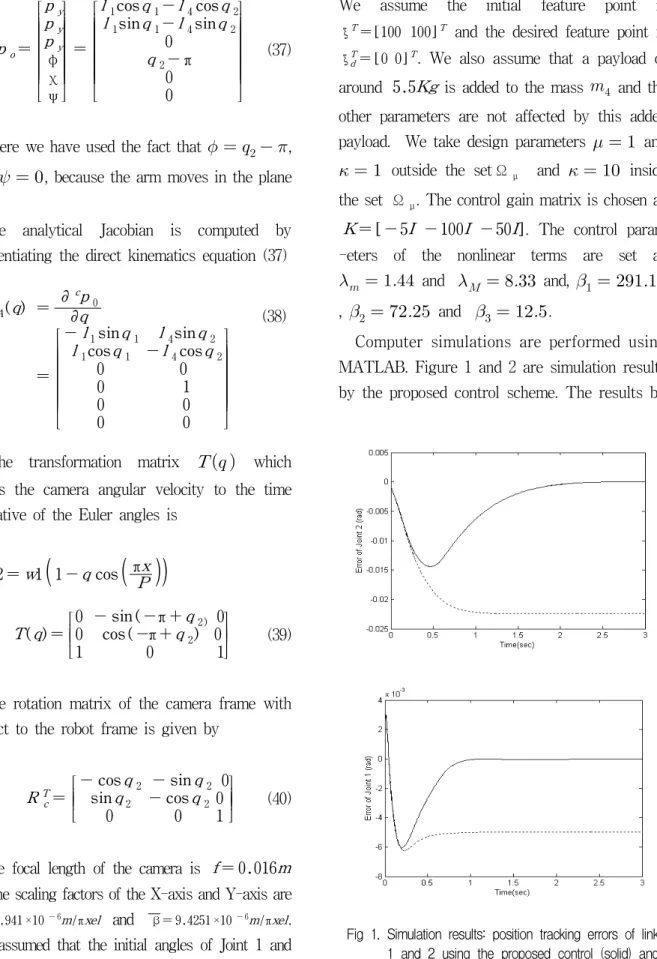
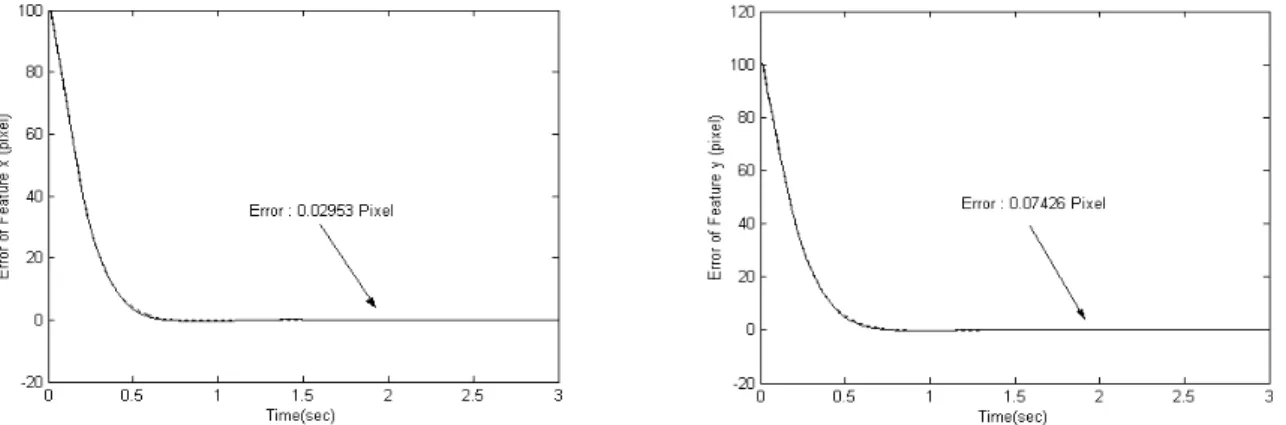
Computer simulations are performed using MATLAB. Figure 1 and 2 are simulation results by the proposed control scheme. The results by
Fig 1. Simulation results: position tracking errors of link 1 and 2 using the proposed control (solid) and robust control without integral action(dashed)
Fig 2. Simulation results: feature tracking errors of link 1 and 2 using the proposed control (solid) and robust control without integral action(dashed)
the proposed method are compared to those without integral action. Experimental results on 5-link Samsung FARA robot applying the proposed method are shown in Figure 3 and 4.
Since load variation does not make during this experiment, it is not distinguished the advantage
Fig 3. Experimental results: position tracking errors of link 1 and 2 using the proposed control (solid) and robust control without integral action(dashed)
of the proposed method in figures. However experimental results show that the proposed method make each link track the desired joint position generated by the camera mounted on the end-effector. Hence the proposed one can be implemented to the industrial robot control.
Fig 4. Experimental results: feature tracking errors of link 1 and 2 using the proposed control (solid) and robust control without integral action(dashed)
Ⅴ. Conclusion
A new robust state feedback controller with visual feedback for robot manipulators is proposed.
The feature extraction by the camera mounted on the end effector makes the desired position, velocity and acceleration vectors for tracking. The proposed controller with integral action reduces tracking error due to parametric uncertainties. Integral part is designed to have lower gain during transient and higher gain after tracking error is under predetermined level. This scheme avoids wind-up phenomenon and improves the control performance in steady-state. The stability of the robust state feedback is shown by the Lyapunov method. The proposed method as been implemented on 5-link FARA robot with two degree of freedom.
Simulation and experiment results show that good tracking performance is obtained.
References
[1] N. P. Papanikolopoulos, P. K. Khosla, and T.
Kanade, "Visual tracking of a moving target by a camera mounted on a robot: A combi -nation of control and vision,"IEEE Trans.
Robot. Automat. Vol.9, Feb. 1993.
[2] H. G. Sage, M. F. De Mathelin, and E.
Ostertag, "Robust control of robot manipu -lators: a survey,"Int. J. Control, vol. 72, no.
16, pp.1498-1522, 1999.
[3] M. W. Spong, "On the robust control of robot manipulators," IEEE Trans. Automat. Contr., vol. 37, no. 11, pp. 1782-1786, 1992.
[4] G. J. Liu and A. A. Goldenberg, "Robust control of robot manipulators based on dynamic decomposition," IEEE Trans. Rob -otics and Automation, vol. 13, no. 5, pp.
783-789, Oct. 1997.
[5] S. Nicosia and P. Tomei, "Robot control by using only joint position measurements," IEEE Trans. Automat. Contr., vol. 35, no. 9, pp.1058-1061, 1990.
[6] H. K. Khalil, "Universal integral controllers for minimum phase nonlinear systems," IEEE Trans. Automat. Contr., vol. 45, no. 3, pp.
490-494, 2000.
[7] M. W. Spong and M. Vidyasagar, "Robot dynamics and control," John Wiley, New York, 1989.
[8] L. Sciavicco and B. Siciliano, "Modeling and control of robot manipulators", NewYork:
McGraw-Hill,1996.
이 영 찬 (李 永 燦)
1997년 2월 한국항공대학교 항공전자 공학과(공학사)
1999년 2월 한국항공대학교 항공전자공학과(공학석사)
현재 한국항공대학교 항공전자공학과 대학원 재학 중 (박사과정) 관심분야 : 강인제어, 로봇 비젼
지 민 석 (池 旻 錫)
1995년 2월 한국항공대학교 항공전자 공학과(공학사)
1997년 2월 한국항공대학교 항공전자 공학과(공학석사)
1997년 3월 ~ 2000년 3월 (주)한국레 이컴
2000년 3월 ~ 2002년 6월 (주)휴니드 테크놀러지스
현재 한국항공대학교 항공전자공학과 대학원 재학 중 (박사과정)
관심분야 : 적응제어 로봇 비젼
이 강 웅(李 康 熊)
1980년 2월 한국항공대학교 항공전 자공학과(공학사)
1982년 2월 서울대학교 전자공학과 (공학석사)
1989년 8월 서울대학교 전자공학과 (공학박사)
1994년 1월 ~ 1995년 1월 미시간 주립대학교 전기공학과 연구교수
현재 한국항공대학교 항공전자공학과 교수
관심분야 : 강인제어, 적응제어, 로봇 비젼, 이동로봇