저작자표시-비영리-변경금지 2.0 대한민국 이용자는 아래의 조건을 따르는 경우에 한하여 자유롭게
l 이 저작물을 복제, 배포, 전송, 전시, 공연 및 방송할 수 있습니다. 다음과 같은 조건을 따라야 합니다:
l 귀하는, 이 저작물의 재이용이나 배포의 경우, 이 저작물에 적용된 이용허락조건 을 명확하게 나타내어야 합니다.
l 저작권자로부터 별도의 허가를 받으면 이러한 조건들은 적용되지 않습니다.
저작권법에 따른 이용자의 권리는 위의 내용에 의하여 영향을 받지 않습니다. 이것은 이용허락규약(Legal Code)을 이해하기 쉽게 요약한 것입니다.
Disclaimer
저작자표시. 귀하는 원저작자를 표시하여야 합니다.
비영리. 귀하는 이 저작물을 영리 목적으로 이용할 수 없습니다.
변경금지. 귀하는 이 저작물을 개작, 변형 또는 가공할 수 없습니다.
Master's Thesis
The Impact of Corporate Social Responsibility and Irresponsibility on Corporate Financial Performance:
An Event Study of Korean Conglomerates
Jong-heon Park
Department of Management Engineering
Graduate School of UNIST
2017
The Impact of Corporate Social Responsibility and Irresponsibility on Corporate Financial Performance:
An Event Study of Korean Conglomerates
Jong-heon Park
Department of Management Engineering
Graduate School of UNIST
ABSTRACT
Corporate Social Responsibility (CSR) is regarded as an integral part of management and is particularly important for corporate sustainability. Although CSR is performed in the context of corporate survival, Corporate Social Irresponsibility (CSI) occurs at the same time.
Furthermore, both CSR and CSI influence Corporate Financial Performance (CFP) either directly or indirectly. Thus, in this study, I wanted to research the impact of CSR and CSI on CFP through an event study. Empirical data were collected from three years of news articles for affiliates of Korean conglomerates. The sample data consisted of 1,254 CSR news items and 267 CSI news items. As a result, I found that CSR has a positive impact on CFP, whereas CSI does not. More specifically, philanthropic CSR showed a strongly positive relationship with CFP, whereas economic, legal, and ethical CSR presented no significant relationship.
Regardless of whether CSI is intentional or unintentional, it has no effect on CFP.
Keywords: Corporate Social Responsibility, Corporate Social Irresponsibility, Corporate Financial Performance, Korean Conglomerate, Event Study
Contents
1. Introduction --- 1
2. Theoretical Background and Hypotheses--- 4
2.1 Corporate Social Responsibility --- 4
2.2 Corporate Social Irresponsibility --- 5
2.3 Corporate Social Responsibility – Corporate Financial Performance--- 6
2.4 Corporate Social Irresponsibility – Corporate Financial Performance --- 11
3. Data and Methodology --- 12
3.1 Data --- 12
3.2 Event Study --- 14
4. Results --- 15
5. Discussion and Conclusion --- 17
List of Figures & Tables
Table 1. Summary statistics for Korean conglomerates and affiliates --- 13 Table 2. Summary statistics for CSR and CSI --- 14 Table 3. The result of event study analysis for CSR and CSI --- 17
1 Introduction
It is argued that firms need to actively fulfill their social responsibilities to increase corporate sustainability, a goal that has become increasingly prominent (Donaldson and Preston 1995). Corporate sustainability can be seriously affected if firms do not actively engage in corporate social responsibility (CSR) by considering and responding to diverse and complex social issues involving stakeholders such as
shareholders, employees, customers, partners, competitors, and communities (Jones 1980). Therefore, CSR is considered to be not a matter of choice, but a matter of survival.
CSR is meaningful because it contributes to society based on the resources and knowledge gained from management activities while satisfying profit maximization, which is the firm’s original purpose. Smith (1994) argued that CSR has evolved from simple cash donations to a form of social engagement that continues to encourage the resolution of specific social problems. When a department with a separate budget for CSR is established, CSR moves in a direction that benefits management performance.
An effective management mechanism shows that CSR is an aspect of good management that increases CFP (Kang, Germann et al. 2016).
Although CSR has continued to evolve and increase in importance, perceptions of CSR remain double-faceted. As expectations of CSR steadily increase, so do its drawbacks. For example, Sony suffered $200 billion in losses because of the detection of higher-than-legal-standard levels of cadmium, a heavy metal, in its Play Station 2, which was launched in Europe in late 2001. Nike was criticized for exploiting the labor of Third World children in soccer ball production and suffered a 37% decline in
operating profits and a loss of corporate image (Locke 2003). Enron, a global energy company, went bankrupt in 2001 because of corruption involving fraudulent
accounting. Thus, CSR is directly linked to firm survival, and corporate social irresponsibility (CSI) not only leads to corporate crises but also directly affects corporate survival.
2
The purpose of this study is to examine how CSR and CSI affect Corporate Financial Performance (CFP). Furthermore, based on Carroll’s (1991) definition of CSR, I attempted to analyze each category’s impact on CFP. I also attempted to identify the impact of CSI on CFP by dividing CSI into intentional cases and unintentional accidents. Therefore, this study differs from previous research in several respects.
First, the existing literature on CSR has focused too much on “doing good” and overlooked “doing bad.” Although CSR is spreading worldwide, social problems are not decreasing. For instance, corporate employees are arrested for dereliction and
embezzlement, corporations violate laws, illegal practices cause social resentment, and unintended accidents occur with frequency. Although CSR has been steadily receiving attention, the strange phenomenon of recurring CSI remains. Academic interest in CSI is growing, but it has been the subject of few studies (Kotchen and Moon 2011, Lange and Washburn 2012, Surroca, Tribó et al. 2013) . Therefore, this study analyzes both CSR and CSI in detail according to the most general and comprehensible standards available.
Second, most of the literature uses corporate social performance (CSP) as assessed by third-party institutions. KLD (Kinder Lydenberg and Domini) has done so repeatedly in analyzing the relationship between scores and financial performance.
However, third-party institutions are only a tool for measuring CSR performance. In other words, it is necessary to discuss the validity of measurement tools. Because there have been discussions about the validity and reliability of measurement tools for CSR outcomes (Chatterji and Levine 2008, Scalet and Kelly 2010), I did not utilize such tools to measure CSR performance. Rather, I sought improved accuracy by conducting an event study based on CSR’s and CSI’s new intentions.
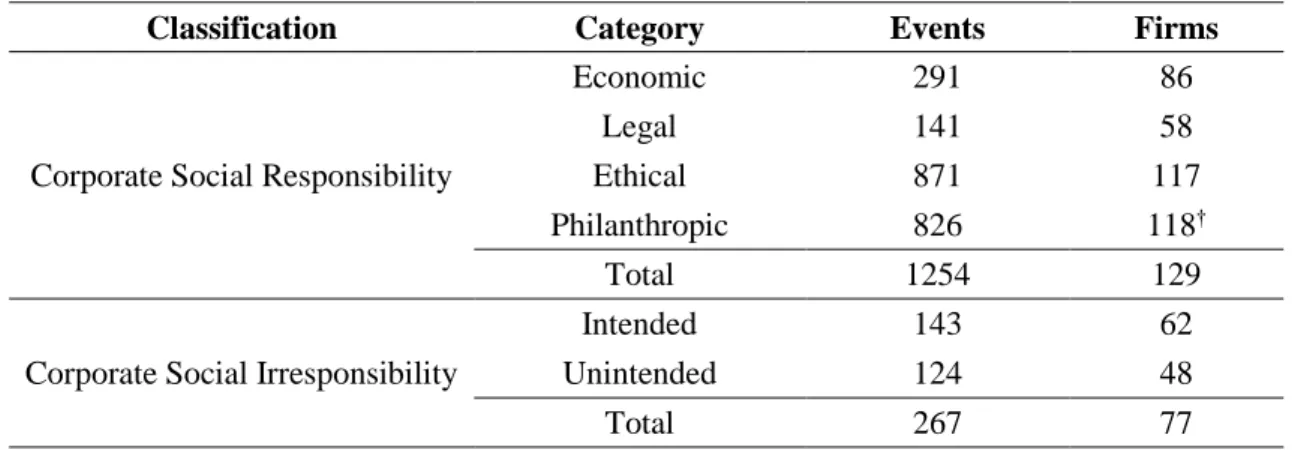
In this study, I collected CSR and CSI news data from the affiliates of Korean conglomerates. I focused on affiliates of approximately 60 conglomerates selected by the Fair Trade Commission in Korea from 2012 to 2014. As a result, I obtained 1,254 articles on CSR news (economic: 291, legal: 141, ethical: 871, and philanthropic: 826) and 267 articles on CSI news (intentional cases: 143, unintentional accidents: 124). In
3
terms of CFP, I used the KOSPI index and the closing price of each affiliate, which are only listed on the KOSPI, to examine financial performance.
Based on the empirical analysis of the event study, it was found that CSR has a positive impact on CFP. In particular, economic, legal and ethical CSR have no
meaningful effect on CFP, but philanthropic CSR had a strongly positive impact on CFP. In contrast, CSI does not significantly affect CFP. Moreover, there was no significant effect on CFP regardless of whether CSI was intended or unintended.
This study contributes to previous CSR research as follows. First, it extends the scope of CSR in addressing CSI. I conceptualize and measure CSI, which is not
noteworthy compared to CSR, and conduct an empirical analysis. I wanted to contribute to broadening the scope of CSR research and diversifying a fragmented research area.
Second, I analyzed the impact of CSR and CSI on CFP and included the effects of each sub-field. Two core research issues are covered in this study: “Does CSR, which is an essential part of a company, positively affect its financial performance?” and “Does CSI, which is the most fundamental element of an enterprise, negatively affect its financial performance?” I classified CSR into four non-mutually exclusive categories following the most broadly used standards, as suggested by Carroll (1991). CSI was most easily classified based on the presence or absence of intent. Third, I analyzed the empirical data of CSR and CSI in relation to financial performance. Unlike previous studies, I did not use indexes or scores (some studies set up keywords to search for CSR and CSI), instead collecting news announcements manually. This may be considered an arbitrary problem, but I designed a cross-checking system to enhance accuracy.
This article proceeds as follows. The first section describes the theoretical model and contains hypotheses. The second section outlines the empirical method used to investigate the hypotheses. The third section presents the results of the empirical
analysis. The fourth and concluding section discusses the limitations and the interesting implications of my findings.
4 Theoretical Background and Hypotheses
Corporate Social Responsibility
In recent years, corporate social responsibility (CSR) has attracted a great deal of attention along with corporate sustainability. CSR implies that firms should fulfill social roles and responsibilities because they are part of society. Since the 1960s, when the concept of CSR emerged in earnest, it has undergone a variety of meanings. Since the 1980s, approximately 50 ideas have been proposed by various studies (Dahlsrud 2008). Carroll (1991) established some early concepts by separating CSR into economic, legal, ethical, and philanthropic responsibilities. Since then, it has been argued that strategic consideration should be given to the various stakeholders that influence business activities, and comprehensive responsibility for stakeholders has formed the basis of the CSR concept (Freeman and Liedtka 1991, Donaldson and Preston 1995).
Researchers define CSR in various ways. Bowen (2013), who first introduced CSR to the academic field, defined CSR as “the obligation of firms to follow a series of behaviors that are considered desirable in terms of the purpose and value of our society, or to make decisions or pursue principles.” Although this definition has been the
theoretical foundation of many studies, the scope of CSR has been expanded as the importance of its relationship with social members and stakeholders has increased or stakeholders becomes more important (Maignan and Ferrell 2004).
Eells and Walton (1969) recognized CSR as an issue related to business ethics, and McGuire (1963) described CSR as a business’s social responsibility and economic and legal obligation. Freeman (2010) and other stakeholder advocates emphasized that firms are not merely profit-seeking organizations but should serve their stakeholders. In 2010, the International Standardization Organization (ISO) defined CSR as
“Responsibility for the organization’s impact on decisions and activities surrounding society and environment” through ISO 26000, the international standard for social responsibility. CSR includes activities in seven areas: organizational governance, human rights, labor practices, the environment, fair operating practices, consumer
5
issues, and community involvement and development. Over the years, many researchers and organizations have defined CSR in various ways.
For example, several researchers have begun to pay attention to the benefits of CSR beyond its usual concept and scope. Weber (2008) lists five management benefits of CSR. First, it contributes to the improvement of corporate image and reputation.
Second, it positively affects human resource concerns such as employee motivation, job turnover, and competent recruitment. Third, it helps reduce costs by facilitating the procurement of capital from investors who are sensitive to sustainability management.
Fourth, it increases sales and market share through business activities. Finally, it is beneficial to a firm’s risk management through positive public opinion. Thus, CSR helps firms manage their businesses from various perspectives and even contributes to increased sales.
Fry, Keim et al. (1982) focused on the relation between CSR and profits using the term “strategic philanthropy.” They introduced the CSR strategy concept and described firms’ CSR activities with profit in mind. Drucker (1984) suggested examining CSR from a new perspective: “turning social issues into economic opportunities and benefits.” In short, firms must transform CSR into a new business opportunity. This interest in the economic benefits of CSR led us to identify the causal relationship between CSR and CFP.
Corporate Social Irresponsibility
As social interest in CSR increases, CSI is also receiving attention. Interest in this field has only recently begun, and academic research is sparse. However, many aspects of CSI have attracted research interest. First, many firms are taking the lead in CSR policies and activities, but continual instances of negative events have raised growing doubts about the authenticity of CSR and concerns about image washing (Strike, Gao et al. 2006). Second, CSI is considered a means of confirming the validity of CSR performance evaluation results (Chatterji, Levine et al. 2009). CSI is thus a tool to identify the predictability of CSR performance evaluation results, and if these show a high level of reliability, the probability of an incident occurring should be low. Third,
6
because of the spread of globalization, it is now common for firms to operate in several countries with varying levels of regulation and societal expectations (Surroca, Tribó et al. 2013). In some regions, firms with high levels of CSR engage in CSI in other countries. As globalization progresses, the transfer and diffusion of CSR or CSI is becoming an increasingly important research topic.
CSI is generally defined as the opposite of CSR. Bateman and Snell (2002) have defined CSR as “business activity that positively affects stakeholders and does not violate their legitimate rights in the long run.” In contrast, CSI is defined as “business activities that have a negative impact on stakeholders and are against their legitimate rights.” As described by Kotchen and Moon (2011), CSI is an anti-CSR concept or a
“business activity that raises externalization costs and triggers conflict in the distribution process.” One can see that CSI is a clearer concept and more easily evaluated than CSR, which is a voluntary act that goes beyond legal requirements and thus is not subject to limits. Moreover, it is also difficult to compare firms’ CSI. That said, CSI is related to incidents such as legal violations and management errors, so its concepts are relatively clear and easy to measure compared to CSR.
Corporate Social Responsibility – Corporate Financial Performance
People who support CSR propose business license, corporate sustainability, moral obligation, and reputation as reasons to implement CSR (Porter and Kramer 2006). The claim that CSR is a prerequisite for conducting business is based on the need for firms to obtain permits from governments, communities, and related stakeholders.
Sustainability-based claims emphasize environmental and community management.
Those claiming a moral obligation as a basis for CSR argue that a firm, like any good citizen, has a duty and obligation to do what is right. Finally, it is argued that reputation- based claims should be implemented because CSR can improve corporate image, promote morale, and enhance stock value.
Based on these arguments, CSR’s effect on firms’ financial performance has been studied continuously. Although many studies address the relationship between CSR and CFP, they do not provide consistent empirical results. There are various
7
perspectives on the impact of CSR on a firm’s financial performance: positive, negative, and unrelated (Aguinis and Glavas 2012). First, the idea that CSR essentially induces costs and lowers corporate value is taken as the rationale for a negative relationship.
Traditional economics explain that voluntary and additional spending on CSR
undermines shareholder value when competitors do not engage in the same activities.
Empirical studies of this negative relationship have been consistently presented (Van Oosterhout and Heugens 2006). In the literature, analyzing financial performance and relevance by subdividing CSR, one finds many negative relationships, although those relationships have varying degrees of difference.
In contrast, many studies have focused on a positive relationship. CSR is dominant in that it promotes corporate innovation, raises employee morale, promotes the efficient use of resources, and improves corporate reputation to boost performance (Waddock and Graves 1997, Carroll and Shabana 2010). Waddock and Graves
(1997)offered significant empirical results on slack resource theory and good
management theory by analyzing the two-way relationship between CSR and CFP using a time-leg model. Garcia-Castro, Ariño et al. (2010) derived through panel analysis the positive effect of CSR on various financial indicators such as ROA (Return on Assets), ROE (Return on Equity), and Tobin’s Q. Furthermore, Orlitzky, Schmidt et al. (2003) conducted a meta-analysis of the empirical research literature and concluded that CSR has a positive impact on overall financial performance.
According to these studies, CSR will show a positive relationship with CFP based on promoting corporate innovation, discouraging employee fraud, utilizing efficient resources, and enhancing corporate image. The following hypothesis is presented.
Hypothesis 1: Corporate Social Responsibility (CSR) will have a positive impact on Corporate Financial Performance (CFP).
Generally, CSR has a positive literal meaning. In other words, firms seek to advance society’s interests as a whole in various fields simultaneously while engaging in production and sales activities and making decisions accordingly. Carroll (1991)
8
categorized CSR into economic, legal, ethical, and philanthropic responsibility. First, economic responsibility is the enterprise’s responsibility to create products and services that society wants, to sell them at reasonable prices and to make a profit. Legal
responsibility is compliance with the laws established by the society to which the firm belongs. Although ethical responsibility is not enforced legally, firms must act in accordance with the expectations, standards and values of all stakeholders. Finally, philanthropic responsibility is related to donations and social contributions. Whereas both economic and legal responsibility represent a firm’s basic responsibilities, ethical and philanthropic responsibility are also firm responsibilities (Carroll 1991). Therefore, ethical and philanthropic responsibility have similar meanings. However, the above four categories are not mutually exclusive but instead are categorized to reflect the spectrum of economic interests and social concerns.
Drucker (1984) proposed the following examples for the above categories.
Economic responsibility included business activities for the firm’s survival and respect for the interest of stakeholders. Legal responsibility involved providing transparency to stakeholders, enhancing the morality of the organization’s members, and complying with legal norms. As with Carroll (1991), both economic liability and legal liability were classified as an essential responsibility for business performance. However, ethical responsibility included social support activities and public order compliance, whereas philanthropic responsibility focused on the contribution to the community and to humanity. Thus, ethical and philanthropic responsibilities were required as initiatives for members of society.
These four categories will have a positive effect on the CFP in each sector as a subclass of CSR. For instance, economic responsibility can promote corporate
innovation with the aim of increasing profit margins, and legal responsibility enhances employee morale in relation to their labor. Ethical responsibility can lead to the efficient use of resources in connection with energy savings, and philanthropic responsibility can lead to an improved corporate image through donations and volunteer activities. These four categories include factors affecting CFP, which will consequently have a positive impact on CFP, as in the CSR-CFP relationship.
9
Based on the four categories suggested by Carroll (1991), economic CSR has four characteristics: operational efficiency, competitive strategy, profit making, and shareholder return. Operational efficiency lowers costs by maintaining high levels of efficiency in operations. Competitive strategy is important to maintaining a strong competitive advantage. Profit making creates as much profit as possible to develop a successful firm. Shareholder returns operate in a manner that maximizes earnings per share. These are economic CSRs, which take precedence over other CSRs and will positively impact CFP.
Hypothesis 1a: Economic Responsibility will have a positive impact on Corporate Financial Performance (CFP).
Legal CSR can be divided into general compliance, concrete compliance, governmental and legal expectations, contractual obligations, and quality guarantees.
Carroll (1991) suggested general compliance, concrete compliance, and governmental and legal expectations. General compliance means that a corporate citizen obeys the laws and regulations of various countries and regions. Concrete compliance involves providing goods and services that meet at least minimum legal requirements. The expectation of government and law indicates that one behaves in accordance with social needs beyond mere compliance. Carroll and Buchholtz (2014) added the concepts of contractual obligation and quality guarantee. Literally, companies must legally perform all obligations in their contracts and ensure the quality of their goods or services.
Consequently, legal CSR will have a positive impact on CFP because it represents a company’s fundamental duty to create economic value.
Hypothesis 1b: Legal Responsibility will have a positive impact on Corporate Financial Performance (CFP).
Ethical CSR is based on ethical standards and the spirit of the law and is extended to include the prevention of suspicion, the realization of justice, and leadership. The most basic ethical standards seek to operate in accordance with customer expectations and the societal codes for overall ethics. Companies should not compromise their code of ethics to achieve their goals. Therefore, it is important to
10
define good corporate citizen consciousness as a company living up to its moral and ethical expectations (Carroll 1991). The spirit of the law involves knowing that laws are the foundation of action; thus, a company must operate beyond the minimum standards required and focus on the spirit rather than the text of the law (Carroll 1991). Carroll and Buchholtz (2014) extended legal CSR to include the prevention of suspicion, the realization of justice, and leadership. Companies should prevent suspicion by avoiding doubtful practices, realizing justice through fair and righteous behavior, and
establishing ethical leadership. They defined ethical CSR as a willingness to respect and observe the spirit of the law over basic legal provisions. Thus, ethical CSR, which expresses voluntary actions, will have a positive effect on CFP.
Hypothesis 1c: Ethical Responsibility will have a positive impact on Corporate Financial Performance (CFP).
Philanthropic CSR is most frequently composed of charity, volunteer activities, community, arts, and education. Carroll (1991) mentioned that a company, acting as a good citizen, should contribute in line with society’s humanitarian and charitable expectations. Voluntary activity stands for the active involvement of managers and employees in benevolent activities(Carroll 1991). In terms of community, it is important to voluntarily help with projects that improve local people’s quality of life (Carroll 1991). Specifically, Carroll and Buchholtz (2014) proposed providing programs in various fields, such as education, health/human services, culture, and the arts, to improve the community. In this regard, education should serve philanthropic goals by helping public and private institutions, and art should help both the visual arts and the performing arts, for which social support is absent or difficult to obtain. These
philanthropic CSRs will have a positive impact on CFP, as the most voluntary and well- intentioned sector of the CSR classification.
Hypothesis 1d: Philanthropic Responsibility will have a positive impact on Corporate Financial Performance (CFP).
11
Corporate Social Irresponsibility – Corporate Financial Performance
CSR begins when a firm does not engage in CSI or, at least, when a firm reduces its corporate scandals. CSR performance assumes that the number of adverse event incidents is small or nonexistent. Therefore, CSR and CSI should be considered as having an opposite relationship. However, CSI does happen, and in practice, potential CSI may occur even if it is not known beyond the firm. Previous research has suggested several reasons that CSR and CSI may co-exist. First, CSR may aim to reduce the risk of CSI, but it may also conceal CSI. Second, the tools related to CSR performance may be incomplete. For example, a method involving the provision of selective information by a firm, such as a sustainability report, may not allow the detection of CSI (Lyon and Maxwell 2011).
Previous studies have confirmed that CSI has a negative impact on CFP.
Davidson and Worrel (1988) identified through longitudinal analysis that CSI strongly negatively affects CFP. Further, Frooman (1997) conducted a meta-analysis based on a study of 27 event studies and found that CSI had an adverse effect on CFP. Recently, Kang, Germann et al. (2016) analyzed panel data for 19 years (1991~2009) and 4,500 firms and found that CSI leads to negative CFP.
These studies confirm that CSI plays a negative role in CFP. It not only
undermines the firm’s corporate image but also reduces its economic value. Therefore, I suggest that CSI will have a negative impact on CFP.
Hypothesis 2: Corporate Social Irresponsibility (CSI) will have a negative impact on Corporate Financial Performance (CFP).
When evaluating CSI from an ethical standpoint, people make judgments based on two criteria. The first criterion is the outcome of an act. It is an attitude that
acknowledges and criticizes behavior as an obstacle to society if the outcome is negative, regardless of intention. The second criterion is Kant’s categorical ethic.
According to this ethic, when people evaluate negative behavior, they must look beyond outcome to intention. If the intention is to covet one’s own gains, a person can be said to have engaged in a genuinely negative act that should be condemned as greed-based
12
hypocrisy. For example, CSI can be an intentional event, such as tax evasion,
misappropriation, or embezzlement. Therefore, intentional CSI will definitely have a negative effect on CFP.
Hypothesis 2a: Intentional Corporate Social Irresponsibility (CSI) will have a negative impact on Corporate Financial Performance (CFP).
In contrast, firms can unintentionally cause negative accidents. Such accidents might be the result of accidental misconduct or management decision-making (e.g., consumer information leakage, plant environmental leakage, etc.). These CSIs are considered accidents even though they may cause decreased reliability, corporate image damage, and economic loss. The presence of intent is an important factor in evaluating CSI but will have a negative impact on the firm because it will disturb stakeholder interests. Thus, unintentional CSI will also have a negative effect on CFP.
Hypothesis 2b: Unintentional Corporate Social Irresponsibility (CSI) will have a negative impact on Corporate Financial Performance (CFP).
Data and Methodology
Data
This study examined CFP, which is the stock market’s reaction to news announcing CSR and CSI activity. I targeted affiliates of Korean conglomerates1
selected by the Fair Trade Commission in Korea from January 1, 2012, to December 31, 2014. Excluding public conglomerates, there were 51, 51, and 49 private conglomerates selected each year between 2012 and 2014. The conglomerates had 1740, 1680, and 1579 affiliates, respectively (Table 1). The reason I chose private conglomerates was to examine the relationship between CSR and stock market reaction, which is listed on the
1. According to Online Provision of Enterprise Information (OPNI), conglomerates is a group of companies whose same entity actually controls the business based on share ratio or power.
13
KOSPI. To gauge stock market reaction, I obtained each affiliate’s closing price and KOSPI index from Google Finance.
Table 1. Summary statistics for Korean conglomerates and affiliates
2012 2013 2014
Private conglomerates 51 51 49
Affiliates 1740 1680 1579
* Based on Online Provision of Enterprise Information (OPNI), public conglomerates are excluded.
To collect news articles related to CSR and CSI, two undergraduate student assistants and I conducted a search. Using three of the most famous economic newspapers in Korea—Maeil Business Newspaper, The Korea Economic Daily, and The Seoul Economic Daily—we searched for the names of all firms and selected the news equivalent of CSR activity, reading each article that corresponded to such activity.
Next, we classified each firm’s CSR (i.e., the degree of socially responsible activities) and CSI (i.e., the degree of socially irresponsible activities). CSR included economic (must be primarily concerned with turning a profit), legal (ensures that a business is legal), ethical (goes further than the law requires), and philanthropic (promotes human welfare and spreads goodwill) responsibilities (Carroll 1991). However, according to Schwartz and Carroll (2003), the categorization of CSR activities cannot capture the overlapping nature of CSR categories. Therefore, we did not classify CSR activity as mutually exclusive among the four categories, so that the sum of those categories is not the same as the number of CSR activities (Table 2). In contrast, CSI was categorized as intentional cases perpetrated by employees or unintentional accidents. All of these CSR and CSI activities are coded as dummy variables.
A potential concern with data is that although we followed the definition of each category of CSR and CSI activity, our classification could be arbitrary. Nonetheless, we chose this method to collect empirical data and improved our accuracy through cross- checking. Most importantly, we read all of the firms’ articles by year and extracted the data instead of using specific keywords. This prevented us from missing certain articles because of keyword usage.
14
To achieve the final data set, I conducted standard data filters. Articles were excluded in the following cases: (1) the firms were not publicly traded on KOSPI, (2) no stock market information was available during the sample period, (3) the article was previously published in the economic newspapers, and (4) the article was concerned with past history instead of recent activity. These conditions left me with a sample of 1,254 articles on CSR news and 267 articles on CSI news. CSR activities consisted of 291 economic events, 141 legal events, 871 ethical events, and 826 philanthropic events, with the four types of categories overlapping. CSI comprised 143 cases with intentions and 124 accidents without intentions.
Table 2. Summary statistics for CSR and CSI
Classification Category Events Firms
Corporate Social Responsibility
Economic 291 86
Legal 141 58
Ethical 871 117
Philanthropic 826 118†
Total 1254 129
Corporate Social Irresponsibility
Intended 143 62
Unintended 124 48
Total 267 77
* Positive CSR activities are categorized not mutually exclusive.
Event Study
Event study analysis is a statistical method of assessing the impact of a specific event on stock price reaction (Boehmer, Masumeci et al. 1991). For example, the announcement of a strategic alliance between two firms can be analyzed to determine whether shareholders believe the alliance will increase or decrease their stock’s value.
Stock market reaction obtains the average cumulative abnormal returns (CARs) on an event window. The CAR is the sum of all abnormal returns, which is the difference between a stock’s actual return and its expected return during an event window (Agrawal and Kamakura 1995).
My model follows the common practice of using the announced date of the corresponding news article as the event date (day 0). Furthermore, to check for any
15
impact of the event on stock price after the one-day event window (day 1), I set a two- day event window denoted by (0, +1) (Schnietz and Epstein 2005). Based on this event window, the estimate is expressed as follows:
𝑅𝑖𝑡 = 𝛼𝑖 + 𝛽𝑖 × 𝑅𝑚𝑡+ 𝜀𝑖𝑡
In this model, the coefficients α capture the average return for the i firm’s stock with no market movement. The coefficients β measure the stock’s performance relative to the market. These are estimated based on 270 trading days prior to the first time interval (i.e., the 270 trading days used in the estimation correspond to the interval [- 270, -50]) using daily return data. R_it captures the expected return for the i firm’s share price on that day, controlling for market-based fluctuations. ε_it is the abnormal return for the i firm.
The abnormal return is the difference between the actual return at time t, during the event window, and the return predicted from the estimation period. Thus, the abnormal return (AR) is represented as follows:
𝜀𝑖𝑡 = 𝑅𝑖𝑡− ( 𝛼𝑖+ 𝛽𝑖 × 𝑅𝑚𝑡 )
Finally, I computed the CARs for the time interval by summing up the ARs within the specific event window (i.e., [0, +1]). To examine whether CSR or CSI is perceived differently by the stock market, I divided the sample into CSR (economic, legal, ethical, and philanthropic) and CSI (intentional case, unintentional accident).
Results
This research assessed how the stocks of publicly traded firms on the KOSPI responded after announcing their CSR activities. The final sample was composed of 129 (77) firms that announced CSR (CSI) activity to newspapers from 2012 to 2014 (Table 2). Table 3 presents the results of our event study analysis. I provided the CAR mean as
16
a percentage with the corresponding z-statistics, along with a number of positive and negative individual CARs with their corresponding generalized sign z-statistics.
Initially, Hypothesis 1 posits that CSR has a positive impact on market share reaction.
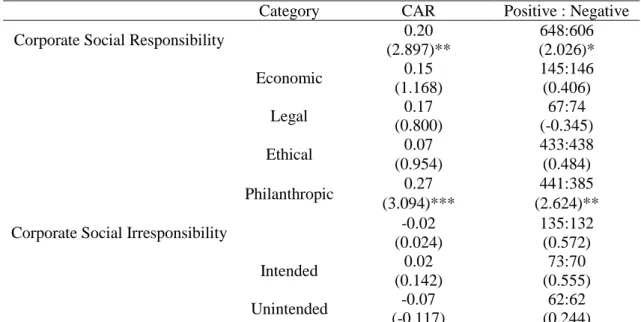
In support of Hypothesis 1, the CAR mean in the two-day event window is 0.20% and significant at the 1 percent level (z = 2.897). Furthermore, 648 of the 1,254 individual CARs are positive. CSI, in contrast, does not have any influence on shareholders’
reactions. The CAR mean is -0.02 and insignificant (z = 0.024) and does not support Hypothesis 2.
For the sub-hypotheses, we also conducted an event study analysis, providing the same factors for the results. CSR is categorized as economic, legal, ethical, or
philanthropic. Hypothesis 1a, which stated that a firm’s stock price is positively affected by economic CSR activity, was not supported. Although the average CAR is 0.15, the value of the Patell z is not significant (z = 1.168). Likewise, Hypotheses 1b and 1c were not supported. In other words, legal and ethical CSR activities have no effect on
shareholders’ reaction. Both legal and ethical CSR activities’ Patell z is not significant (z = 0.800; z = 0.954). Philanthropic CSR activity, however, does affect market share reaction, supporting Hypothesis 1d. At the 0.1 percent level, the Patell z is strongly significant (z = 3.094), showing that the CAR mean is 0.27. Moreover, more than half of the 826 individual CARs are positive (441 positive CARs versus 385 negative CARs). With respect to CSI activities, we categorized them according to whether or not they had a negative intention. CSI for intentional cases does not influence a firm’s stock price, which does not support Hypothesis 2a (z = 0.142). Additionally, CSI involving unintentional accidents has no negative impact on shareholders’ reactions (z = -0.117).
In conclusion, Hypotheses 1 and 1d are supported, while the rest of the
hypotheses are not significant. With respect to Hypothesis 1, positive CSR activity has a positive impact on CFP. Specifically, philanthropic CSR activity has a strongly positive effect on shareholders’ reaction.
17
Table 3. The result of event study analysis for CSR and CSI
Category CAR Positive : Negative
Corporate Social Responsibility 0.20 648:606
(2.897)** (2.026)*
Economic 0.15 145:146
(1.168) (0.406)
Legal 0.17 67:74
(0.800) (-0.345)
Ethical 0.07 433:438
(0.954) (0.484)
Philanthropic 0.27 441:385
(3.094)*** (2.624)**
Corporate Social Irresponsibility -0.02 135:132
(0.024) (0.572)
Intended 0.02 73:70
(0.142) (0.555)
Unintended -0.07 62:62
(-0.117) (0.244)
Event window is set two-day denoted by ( 0 ,+1 ). “CAR” is “cumulative abnormal return” and is expressed as a percentage. *p < 0.05, **p < 0.01, ***p < 0.001
Discussion and Conclusion
The purpose of this study was to analyze of the impact of CSR and irresponsibility (CSI) on CFP. The effect of CSR on CFP has been addressed in
numerous studies. A great deal of research has supported the positive impact of CSR on CFP in both logical and empirical testing. This study reexamined the traditional
question of the relationship between CSR and CFP using data from recent years. CSI, which has been overlooked in previous studies, has been treated as an important topic.
In addition to the existing CSR variable, CSI was introduced as a key variable to explore the following two fundamental research questions: Does CSR have a positive impact on CFP? Does CSI have a negative impact on CFP? Moreover, this paper categorized CSR and CSI in detail and analyzed their relationship to CFP. It discussed not only which classification of CSR – economic, legal, ethical, or philanthropic – affects CFP positively but also the presence of intention in CSI that affects CFP negatively.
For three years, from 2012 to 2014, I conducted an event study based on CSR and CSI news articles about affiliates listed on the KOSPI among Korean
18
conglomerates. The results showed that CSR positively affected CFP and supported Hypothesis 1. The model analyzed by the CSR sub-classification showed mixed results in which philanthropic CSR had a strongly positive influence, whereas economic, legal and ethical CSRs did not show a significant relationship. Only Hypothesis 2d was supported, along with the remaining hypotheses: H 1a, H 1b, and H 1c. This means that philanthropic CSR, which is the most voluntary and benevolent activity in the sub- classification, can be regarded as an acknowledgment of goodwill by stakeholders.
Meanwhile, CSI did not have a significant impact on CFP and did not support Hypothesis 2. The analytical results of CSI obtained by classifying the presence or absence of intention also showed no significant relationship to CFP. In other words, the firm had no effect on CFP even if it intentionally caused a case of CSI or
unintentionally through an accident.
This study, which analyzed the impact of CSR and CSI on CFP, has meaningful theoretical implications from an academic point of view. First, this study investigates not only CSR but also CSI, providing a theoretical and empirical extension for CSR research. Although CSR has become so important that it is now regarded as a management principle for corporate sustainability, negative cases and accidents are increasing. The coexistence of CSR and CSI shows that the CSR research system is expanding to address CSR and CSI simultaneously. The CSI concept, measurement method, and empirical data from this study can be an important asset for future CSI studies.
Second, the results of this study, which are consistent with the existing literature, were presented to reaffirm the positive effects of CSR on CFP. The difference in the effect of the detailed classification of CSR on CFP is additionally presented so that future studies on CSR will be more detailed and sophisticated. Although only
philanthropic CSR had a significant relationship with CFP, future studies will reconfirm the impact of economic, legal, and ethical CSR on CFP.
Third, this study used empirical data based on news articles. Previous studies utilized indexes or scores as the CSR variable. These methods were limited to proving the immediate association of CSR with CFP. For this reason, some studies attempted to
19
show an immediate impact using news articles. However, they chose specific keywords and searched news articles, which was problematic because some articles that did not contain the specific keywords were missed. Thus, the students and I entered each affiliate name, searched all news articles related to those affiliates, and read millions of news articles. Although this method involved arbitrary problems, we carefully studied the definition and classification of CSR and improved our accuracy through a cross- checking system. The use of such empirical data confirmed the immediate impact of CSR and CSI on CFP.
In circumstances in which many companies have considered corporate
sustainability, this study provides several managerial implications. First, firms should conduct CSR activities in good faith to remain loyal to the basic objective of CSR, which is a social contribution. Even though CSR has a positive relationship with CFP, it was found that only philanthropic CSR has a significant effect on CFP. Namely, if firms perform CSR activities – such as charities, volunteer activities, or community, arts, and education activities – that we often see, instead of other CSR activities for corporate benefit, economic effects will naturally ensue.
Second, to maximize the effect of CSR, concrete and effective efforts should be made to inform the public about CSR activities, which many firms conduct but do not communicate to stakeholders. It should be kept in mind that public relations follow-up is important for stakeholders’ right to know. Therefore, firms should aim to provide information through appropriate channels and develop optimized communication strategies for stakeholders.
Third, firms should always try to avoid CSI because of its negative effects. In this study, CSI had no significant relationship with CFP, but previous studies have reported that irresponsible activities can lead to results such as distrust, image damage, financial losses, and market share deterioration (Davidson and Worrel 1988, Baucus and Baucus 1997, Sullivan, Haunschild et al. 2007, Karpoff, Lee et al. 2008). Thus, CSI not only is negative in itself but will also weaken the effect of CSR by casting doubt upon a firm’s good faith.
20
Despite the theoretical and managerial implications of this study, I will suggest the direction that future research should take based on this study’s limitations. First, the methodology of this study resulted in a focus only on firms listed on the stock market.
Therefore, this study did not reflect the effect of CSR and CSI on unlisted firms. Future studies should further research the status and performance of non-listed firms’ CSR and CSI. Second, the data samples used in this study were collected through a news search related to CSR and CSI, with the disadvantage that the number of data samples and news contents may differ depending on the researcher’s perception or capability. In other words, since our students and I read and understood the news content, there is room for researcher subjectivity in selecting variables. Thus, future studies will need to perform a robustness check using text mining to compare sample data. Finally, this study suggests that CFP consider short-term market valuations such as changes in market value (i.e., stock returns) based on CSR and CSI. It is difficult to see how the effects of CSR and CSI are based on the evaluation of capital market participants or how this will affect long-term CFP caused by the persistence or consistency of CSR and CSI. To overcome these limitations, studies should be carried out to analyze various CFP variables in terms of persistence or consistency.
21
REFERENCES
1. Agrawal, J. and W. A. Kamakura (1995). "The economic worth of celebrity endorsers: An event study analysis." The Journal of Marketing: 56-62.
2. Aguinis, H. and A. Glavas (2012). "What we know and don’t know about corporate social responsibility a review and research agenda." Journal of management 38(4): 932-968.
3. Bateman, T. S. and S. Snell (2002). Management: Competing in the new era, Irwin Professional Publishing.
4. Baucus, M. S. and D. A. Baucus (1997). "Paying the piper: An empirical examination of longer-term financial consequences of illegal corporate behavior." Academy of
Management Journal 40(1): 129-151.
5. Boehmer, E., et al. (1991). "Event-study methodology under conditions of event-induced variance." Journal of financial economics 30(2): 253-272.
6. Bowen, H. R. (2013). Social responsibilities of the businessman, University of Iowa Press.
7. Carroll, A. and A. Buchholtz (2014). Business and society: Ethics, sustainability, and stakeholder management, Nelson Education.
8. Carroll, A. B. (1991). "The pyramid of corporate social responsibility: Toward the moral management of organizational stakeholders." Business horizons 34(4): 39-48.
9. Carroll, A. B. and K. M. Shabana (2010). "The business case for corporate social responsibility: A review of concepts, research and practice." International journal of management reviews 12(1): 85-105.
10. Chatterji, A. K. and D. I. Levine (2008). "Imitate or differentiate? Evaluating the validity of corporate social responsibility ratings." Center for Responsible Business.
22
11. Chatterji, A. K., et al. (2009). "How well do social ratings actually measure corporate social responsibility?" Journal of Economics & Management Strategy 18(1): 125-169.
12. Dahlsrud, A. (2008). "How corporate social responsibility is defined: an analysis of 37 definitions." Corporate social responsibility and environmental management 15(1): 1-13.
13. Davidson, W. N. and D. L. Worrel (1988). "The impact of announcements of corporate illegalities on shareholder returns." Academy of Management Journal 31(1): 195-200.
14. Donaldson, T. and L. E. Preston (1995). "The stakeholder theory of the corporation:
Concepts, evidence, and implications." Academy of management Review 20(1): 65-91.
15. Drucker, P. F. (1984). "Converting social problems into business opportunities: The new meaning of corporate social responsibility." California management review 26(2): 53-63.
16. Eells, R. S. F. and C. C. Walton (1969). Conceptual foundations of business, RD Irwin.
17. Freeman, R. E. (2010). Strategic management: A stakeholder approach, Cambridge University Press.
18. Freeman, R. E. and J. Liedtka (1991). "Corporate social responsibility: A critical approach."
Business horizons 34(4): 92-98.
19. Frooman, J. (1997). "Socially irresponsible and illegal behavior and shareholder wealth a meta-analysis of event studies." Business & society 36(3): 221-249.
20. Fry, L. W., et al. (1982). "Corporate contributions: Altruistic or for-profit?" Academy of Management Journal 25(1): 94-106.
21. Garcia-Castro, R., et al. (2010). "Does social performance really lead to financial performance? Accounting for endogeneity." Journal of Business Ethics 92(1): 107-126.
22. Jones, T. M. (1980). "Corporate social responsibility revisited, redefined." California management review 22(3): 59-67.
23
23. Kang, C., et al. (2016). "Washing away your sins? Corporate social responsibility, corporate social irresponsibility, and firm performance." Journal of Marketing 80(2): 59-79.
24. Karpoff, J. M., et al. (2008). "The cost to firms of cooking the books." Journal of Financial and Quantitative Analysis 43(03): 581-611.
25. Kotchen, M. J. and J. J. Moon (2011). Corporate social responsibility for irresponsibility, National Bureau of Economic Research Cambridge, MA.\
26. Lange, D. and N. T. Washburn (2012). "Understanding attributions of corporate social irresponsibility." Academy of management Review 37(2): 300-326.
27. Locke, R. M. (2003). "The promise and perils of globalization: The case of Nike."
Management: Inventing and delivering its future 39: 40.
28. Lyon, T. P. and J. W. Maxwell (2011). "Greenwash: Corporate environmental disclosure under threat of audit." Journal of Economics & Management Strategy 20(1): 3-41.
29. Maignan, I. and O. Ferrell (2004). "Corporate social responsibility and marketing: An integrative framework." Journal of the Academy of Marketing science 32(1): 3-19.
30. McGuire, J. W. (1963). Business and society, McGraw-hill.
31. Orlitzky, M., et al. (2003). "Corporate social and financial performance: A meta-analysis."
Organization studies 24(3): 403-441.
32. Porter, M. and M. Kramer (2006). "Estrategia y sociedad." Harvard business review 84(12):
42-56.
33. Scalet, S. and T. F. Kelly (2010). "CSR rating agencies: What is their global impact?"
Journal of Business Ethics 94(1): 69-88.
24
34. Schnietz, K. E. and M. J. Epstein (2005). "Exploring the financial value of a reputation for corporate social responsibility during a crisis." Corporate Reputation Review 7(4): 327-345.
35. Schwartz, M. S. and A. B. Carroll (2003). "Corporate social responsibility: A three-domain approach." Business ethics quarterly 13(04): 503-530.
36. Smith, C. (1994). "The new corporate philanthropy." Harvard business review 72(3): 105- 114.
37. Strike, V. M., et al. (2006). "Being good while being bad: Social responsibility and the international diversification of US firms." Journal of International Business Studies 37(6):
850-862.
38. Sullivan, B. N., et al. (2007). "Organizations non gratae? The impact of unethical corporate acts on interorganizational networks." Organization Science 18(1): 55-70.
39. Surroca, J., et al. (2013). "Stakeholder pressure on MNEs and the transfer of socially irresponsible practices to subsidiaries." Academy of Management Journal 56(2): 549-572.
40. Van Oosterhout, J. and P. P. Heugens (2006). "Much ado about nothing: A conceptual critique of CSR."
41. Waddock, S. A. and S. B. Graves (1997). "The corporate social performance-financial performance link." Strategic management journal: 303-319.
42. Weber, M. (2008). "The business case for corporate social responsibility: A company- level measurement approach for CSR." European Management Journal 26(4): 247-261.