Chapter 9.
Chapter 9.
Language and the Brain Language and the Brain
Cognitive Neuroscience: The Biology of the Mind, 2 Cognitive Neuroscience: The Biology of the Mind, 2ndndEd., Ed.,
M. S.
M. S. GazzanigaGazzaniga, R. B. , R. B. IvryIvry, and G. R. , and G. R. MangunMangun, Norton, 2002., Norton, 2002.
Summarized by
H. Y. Kim, E. S. Lee, and B.-T. Zhang
Biointelligence Laboratory, Seoul National University http://bi.snu.ac.kr/
(C) 2006, SNU CSE Biointelligence Lab, http://bi.snu.ac.kr/ 2
Introduction Introduction
z
“Hi, Jack!” vs. “Hijack!”
z
Human language’s complexity
z
Introduction of a cognitive neuroscience
perspective on the human language system
(C) 2006, SNU CSE Biointelligence Lab, http://bi.snu.ac.kr/ 3
Contents Contents
z
Theories of Language
z
Neuropsychology of Language and Language Disorders
z
Neurophysiology of Language
Theories of Language
Theories of Language
(C) 2006, SNU CSE Biointelligence Lab, http://bi.snu.ac.kr/ 5
The Mental Lexicon (1/4 ) The Mental Lexicon (1/4 )
z
Mental store of words and concepts
z
The characteristics of mental lexicon
♦ Semanticinformation: what is the word’s meaning?
♦ Syntactic information: how are words combined for sentences?
♦ Spelling: the details of word forms
♦ Pronunciation: sound pattern
♦ The representation of orthographic form: vision-based forms
♦ The representation of phonological forms: sound-based forms
♦ There isa store of information about words in the brain
♦ No fixed contents: words can be forgotten and new words can be learned, and more frequently used words are accessed more quickly.
♦ The neighborhood effect: accessing lexical (word) representations are influenced by the so-called neighborhood effect.
(C) 2006, SNU CSE Biointelligence Lab, http://bi.snu.ac.kr/ 6
The Mental Lexicon (2/4 ) The Mental Lexicon (2/4 )
z
The mental lexicon is organized as information-specific.
Fig. 9.1: Fragment of a lexical network according to the Levelt model
z
Three levels:
♦ Lexeme level: sound level
♦ Lemma level: grammatical properties
♦ Conceptual level: semantic knowledge of words z
Organized according to
meaningful relationships between words
z
Close connected: More
related
(C) 2006, SNU CSE Biointelligence Lab, http://bi.snu.ac.kr/ 7
The Mental Lexicon (3/4 ) The Mental Lexicon (3/4 )
z Semantic priming in a lexical decision task z Steps:
① Presented with pairs of words
② The first one is a word, the second one (target) can be a real word or a nonword.
③ If the target is a real, it can be related or unrelated in meaning to the prime.
④ The subject must decide whether the target is a word.
z Results:
Faster and more accurate when target is preceded by a related prime (car- truck) than an unrelated (tulip-truck).
Pronouncing the target, naming latencies are faster for related words than for unrelated words.
z Semantic matching: active matching the meaning of the target with the meaning of the prime.
(C) 2006, SNU CSE Biointelligence Lab, http://bi.snu.ac.kr/ 8
The Mental Lexicon (4/4 ) The Mental Lexicon (4/4 )
z Conceptual or semantic representation format
z Words are represented by conceptual nodes and are connected each other.
z The strength of the connection and the distance between the nodes are determined by the semantic relations or associative relationsbetween the words.
Fig. 9.2: An example of a semantic network. (Collins and Loftus, 1975)
(C) 2006, SNU CSE Biointelligence Lab, http://bi.snu.ac.kr/ 9
Neural Substrates of the Mental Lexicon Neural Substrates of the Mental Lexicon and Conceptual Knowledge
and Conceptual Knowledge
z Language deficits from various neurological problems –
understanding and producing the appropriate meaning of a word or concept
z Wernicke’s aphasia: make errors in speech production (semantic paraphasias)
z Semantic problems can be category-specific (e.g. living things vs. man- made objects).
z There is a correlation between type of semantic deficits and area of lesions (Warrington).
z The semantic network is organized along lines of the conceptual categories of animacy and inanimacy (Caramazza).
(C) 2006, SNU CSE Biointelligence Lab, http://bi.snu.ac.kr/ 10
Results of Brain Imaging Studies Results of Brain Imaging Studies (1/2 )
(1/2 )
z
fMRI studies support the idea of category-specific semantic problem – separable neuronal circuits engaged
Fig. 9.3: Locations of brain lesions that are correlated with selective deficits in naming persons, animals, or tools.
(C) 2006, SNU CSE Biointelligence Lab, http://bi.snu.ac.kr/ 11
Results of Brain Imaging Studies Results of Brain Imaging Studies (2/2 )
(2/2 )
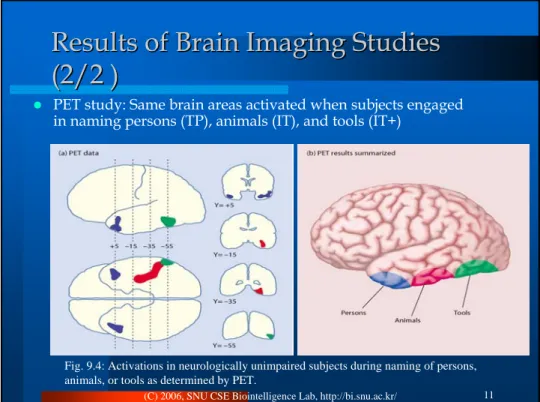
z PET study: Same brain areas activated when subjects engaged in naming persons (TP), animals (IT), and tools (IT+)
Fig. 9.4: Activations in neurologically unimpaired subjects during naming of persons, animals, or tools as determined by PET.
(C) 2006, SNU CSE Biointelligence Lab, http://bi.snu.ac.kr/ 12
The Organization of Lexical Level The Organization of Lexical Level
z Damasio proposed that the findings reflect the organization at the word (lexical) level.
z e.g. Patients having problems retrieving the name but its related properties.
Fig. 9.5: Three levels of representation that are needed in speech production: semantic features, lexical nodes, and phonological segments.
(C) 2006, SNU CSE Biointelligence Lab, http://bi.snu.ac.kr/ 13
Perceptual Analyses of the Linguistic Input Perceptual Analyses of the Linguistic Input
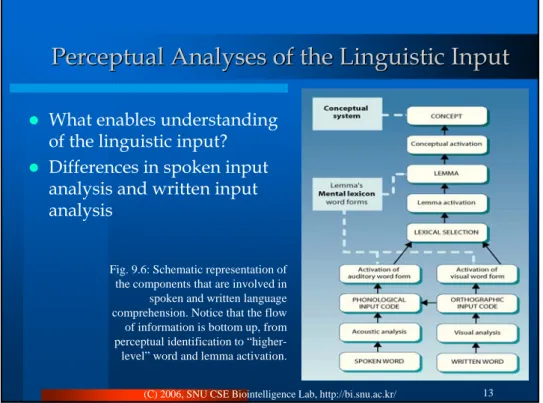
z
What enables understanding of the linguistic input?
z
Differences in spoken input analysis and written input analysis
Fig. 9.6: Schematic representation of the components that are involved in spoken and written language comprehension. Notice that the flow of information is bottom up, from perceptual identification to “higher-
level” word and lemma activation.
(C) 2006, SNU CSE Biointelligence Lab, http://bi.snu.ac.kr/ 14
Spoken Input (1/2) Spoken Input (1/2)
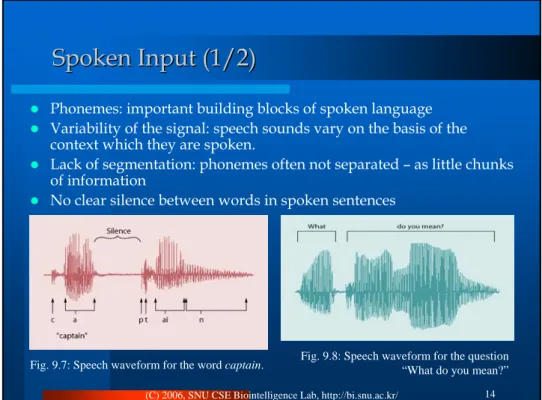
z Phonemes: important building blocks of spoken language
z Variability of the signal: speech sounds vary on the basis of the context which they are spoken.
z Lack of segmentation: phonemes often not separated – as little chunks of information
z No clear silence between words in spoken sentences
Fig. 9.7: Speech waveform for the word captain. Fig. 9.8: Speech waveform for the question
“What do you mean?”
(C) 2006, SNU CSE Biointelligence Lab, http://bi.snu.ac.kr/ 15
Spoken Input (2/2) Spoken Input (2/2)
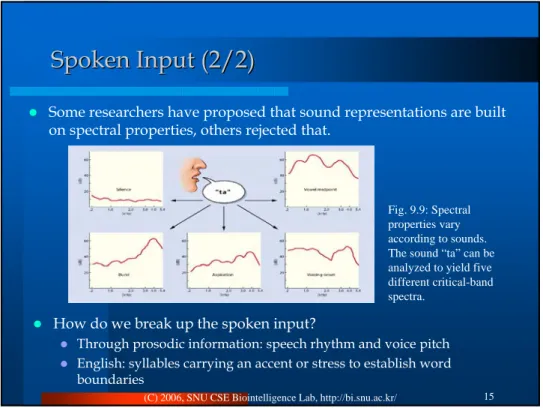
z Some researchers have proposed that sound representations are built on spectral properties, others rejected that.
Fig. 9.9: Spectral properties vary according to sounds.
The sound “ta” can be analyzed to yield five different critical-band spectra.
z How do we break up the spoken input?
z Through prosodic information: speech rhythm and voice pitch
z English: syllables carrying an accent or stress to establish word boundaries
(C) 2006, SNU CSE Biointelligence Lab, http://bi.snu.ac.kr/ 16
Neural Substrates of Spoken Word Processing Neural Substrates of Spoken Word Processing
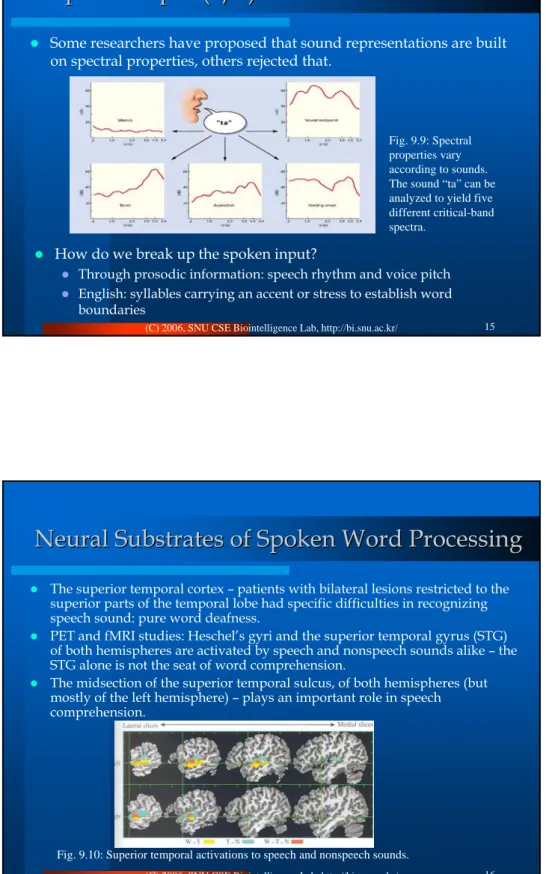
z The superior temporal cortex – patients with bilateral lesions restricted to the superior parts of the temporal lobe had specific difficulties in recognizing speech sound: pure word deafness.
z PET and fMRI studies: Heschel’s gyri and the superior temporal gyrus (STG) of both hemispheres are activated by speech and nonspeech sounds alike – the STG alone is not the seat of word comprehension.
z The midsection of the superior temporal sulcus, of both hemispheres (but mostly of the left hemisphere) – plays an important role in speech comprehension.
Fig. 9.10: Superior temporal activations to speech and nonspeech sounds.
(C) 2006, SNU CSE Biointelligence Lab, http://bi.snu.ac.kr/ 17
Written Input
Written Input – – Letter Recognition Letter Recognition
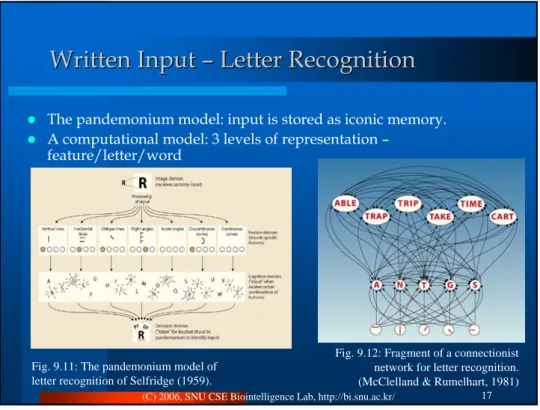
z The pandemonium model: input is stored as iconic memory.
z A computational model: 3 levels of representation – feature/letter/word
Fig. 9.12: Fragment of a connectionist network for letter recognition.
(McClelland & Rumelhart, 1981) Fig. 9.11: The pandemonium model of
letter recognition of Selfridge (1959).
(C) 2006, SNU CSE Biointelligence Lab, http://bi.snu.ac.kr/ 18
Neural Substrates of Written Word Processing Neural Substrates of Written Word Processing
z The actual identification of
orthographic units may take place in occipital-temporal regions of the left hemisphere.
z Regions of the occipital-temporal cortex activated preferentially in response to unpronounceable letter string.
Fig. 9.13: Activation of letters (L) compared to activation of faces (F) in the ventral part of the left hemisphere (white circle in the brain scan).
(C) 2006, SNU CSE Biointelligence Lab, http://bi.snu.ac.kr/ 19
The Recognition of Words
The Recognition of Words – – Lexical Access Lexical Access
z 3 components of word processing:
lexical access, lexical selection, lexical integration.
z From written text to word representation: one or two pathways?
z Dual-route reading models:
♦ From orthography to word form (direct)
♦ By grapheme-to-phoneme translation (indirect)
z The cohort model of spoken word recognition
Fig. 9.14: Cohort model of spoken word recognition.
(C) 2006, SNU CSE Biointelligence Lab, http://bi.snu.ac.kr/ 20
Brain Systems for Word Recognition (1/2) Brain Systems for Word Recognition (1/2)
z
Pathways for speech (auditory) processing:
♦ Heschl’s gyri of auditory cortex →Superior temporal gyrus→ Middle temporal gyrus→Inferior temporal gyrus→Angular gyrus (laterized more to the left hemisphere) →The left inferior frontal gyrus, including the ventral part of Broca’s area for pronouncing
z
Pathways for written input processing:
♦ The primary and secondary visual cortex of both hemispheres → Occipital-temporal regions of left hemisphere (identification of orthographic units) →Middle temporal gyrus (phonographical processing) →Left inferior frontal gyrus, including ventral part of Broca’s area (translating orthographic input to phonological information to pronounce
(C) 2006, SNU CSE Biointelligence Lab, http://bi.snu.ac.kr/ 21
Brain Systems for Word Recognition (2/2) Brain Systems for Word Recognition (2/2)
Fig. 9.15: A hierarchical processing stream for speech processing.
(C) 2006, SNU CSE Biointelligence Lab, http://bi.snu.ac.kr/ 22
Integration of Words in Sentences (1/3) Integration of Words in Sentences (1/3)
z
The role of context in word recognition – does linguistic context influence word processing?
z
Contextual representations are crucial to determine a word’s sense and grammatical form.
z
Syntactic processing: integrating syntactic information into sentence
z
For a full interpretation of linguistic input, we have to assign grammatical structure to the input.
z
Syntactic analysis possible even in the absence of real meaning.
z
Unlike words and syntactic properties, representations of
whole sentences are not stored in our brain.
(C) 2006, SNU CSE Biointelligence Lab, http://bi.snu.ac.kr/ 23
Integration of Words in Sentences (2/3) Integration of Words in Sentences (2/3)
z The garden-path model (Frazier, 1987): processing in a quick way
z Assumption: we minimizes what we have to do under the time pressure of normal linguistic comprehension.
♦ The minimal attachment mechanism: economic aspect
♦ The late closure mechanism: current processing focused
Fig. 9.16: Constituent structure of a sentence.
(under the minimal attachment mechanism)
Fig. 9.17: Constituent structure of a sentence as in Fig. 9.16. (nonminimal)
(C) 2006, SNU CSE Biointelligence Lab, http://bi.snu.ac.kr/ 24
Integration of Words in Sentences (3/3) Integration of Words in Sentences (3/3)
z Interactive models: our conceptual knowledge of order of events can immediately influence the processing of the sentence, whereas modular models would predict that this influence does not occur until later. The results are more in line with an interactive view.
Fig. 9.18: ERPs recorded in response to sentences that start with before(dashed line) or after(solid line).
(C) 2006, SNU CSE Biointelligence Lab, http://bi.snu.ac.kr/ 25
Neural Substrates of Syntactic Processing Neural Substrates of Syntactic Processing
z Agrammatic aphasia: caused by lesions in Broca’s area of the left hemisphere
z PET studies: the activation in Broca’s area increased reading complex syntactic structure.
z Syntactic processing increased activities in the anterior portions of the superior temporal gyrus (STG), in the vicinity of area 22
Fig. 9.20: (a) PET activations in the anterior portion of the superior temporal gyrus related to syntactic processing. (b) Summary of lesions in the anterior superior temporal cortex.
(C) 2006, SNU CSE Biointelligence Lab, http://bi.snu.ac.kr/ 26
Speech Production Speech Production
z
Levelt ‘s modular model for speech production
z
Brain damage can affect each of the processing stages.
z
Anomic patients with extreme TOT (tip of the tongue): lexeme level problem, not articulation
Fig. 9.21: Outline of the theory of speech production developed by Willem Levelt.
(C) 2006, SNU CSE Biointelligence Lab, http://bi.snu.ac.kr/ 27
Speech Production (1/2) Speech Production (1/2)
z Interactive view suggestion:
phonological activation begins shortly after the semantic and syntactic information of words has been activated, and overlap in time.
z ERP Test whether lemma (wor d) selection proceeds
activation of the appropriate lexeme (sound), or
phonological information can feed back and change the activation level of the lemma nodes.
Fig. 9.22: Examples of stimuli that were used in an ERP study of word production in Dutch.
(C) 2006, SNU CSE Biointelligence Lab, http://bi.snu.ac.kr/ 28
Speech Production (2/2) Speech Production (2/2)
z The LRP (lateralized readiness potential): brain wave starts to appear when a person plans to make a movement, before the actual movement is carried out.
z The correct LRP started to develop even when the subjects were not supposed to respond.
z Indication: lemma selection might occur before the phonological information at the lexeme level is activated.
Fig. 9.23: Lateralized readiness potential response to go trials (blue line) and no-go trials (red line).
(C) 2006, SNU CSE Biointelligence Lab, http://bi.snu.ac.kr/ 29
Neural Substrates of Speech Production Neural Substrates of Speech Production
z
Word generation activation – in the basal temporal regions of the left hemisphere and in the left frontal operculum (Broca’s area)
z
The articulation of words activation – in bilateral motor cortex, the supplementary motor area (SMA), and the insula
z
Epileptic patients’ temporary inability to produce words – cortical stimulation of the basal temporal region of the left hemisphere
z
The activation in the frontal operculum might be specific to phonological encoding in speech production.
z
A lesion in insula leads to apraxia of speech (a difficulty in pronouncing words) in patients with Broca’s aphasia.
Neuropsychology
Neuropsychology of Language of Language
and Language Disorders
and Language Disorders
(C) 2006, SNU CSE Biointelligence Lab, http://bi.snu.ac.kr/ 31
Historical Findings in Aphasia Historical Findings in Aphasia
z Aphasia: collective deficits in language comprehension and production that accompany neurological damage.
z Broca’s area: expressive aphasia – lesion in the posterior portion of the left inferior frontal gyrus.
z Wernicke’s area: receptive aphasia – fluent speech but speak nonsensical sounds, words, and sentences.
Fig. 9.24 (b): Broca’s area (in red). Fig. 9.25: Lateral view of Wernicke’s area.
(C) 2006, SNU CSE Biointelligence Lab, http://bi.snu.ac.kr/ 32
Classical
Classical Localizationist Localizationist Model Model
z
Lichtheim’s (1885) classic model of language
processing
z
Sometimes referred to as the connectionist model – not the McClelland &
Rumelhart’s model
Fig. 9.26: Lichtheim’s (1885) classic model of language processing.
(C) 2006, SNU CSE Biointelligence Lab, http://bi.snu.ac.kr/ 33
Classification of Aphasia (1/2 ) Classification of Aphasia (1/2 )
z
The 3 parameters for language disorders:
♦ Spontaneous speech
♦ Auditory comprehension
♦ Verbal repetition
z
Classifying Broca’s aphasia
♦ Single utterance pattern speech
♦ Sometimes from speech deficits – dysarthria (articulatory muscles control loss), speech apraxia (deficits to program articulation)
♦ limited to language production (especially spoken language) and may include comprehension deficits (e.g.
agrammatism) Fig. 9.27: Speech problems of
Broca’s aphasics.
(C) 2006, SNU CSE Biointelligence Lab, http://bi.snu.ac.kr/ 34
Classification of Aphasia (2/2 ) Classification of Aphasia (2/2 )
z
Wernicke’s aphasia – disorder of language comprehension.
z
Problems understanding spoken or written
language or both
z
Cannot speak meaningful sentences even though fluent utterance
z
The posterior third of the STG
Fig. 9.28: Wernicke’s aphasics can speak fluently.
(C) 2006, SNU CSE Biointelligence Lab, http://bi.snu.ac.kr/ 35
Damage to Connections between Damage to Connections between Language Areas
Language Areas
z
Conduction aphasia: A disconnection syndrome occurring when the pathway from Wernickes to Broca’s area, is damaged.
z
Problems producing spontaneous speech as well as repeating speech, and sometimes they use words incorrectly.
z
Damage between conceptual representation areas can harm the ability to comprehend spoken input but not the ability to what was heard.
z
Lesions in the supramarginal and angular gyri regions – loss of ability to comprehend spoken input -- may come from losing the ability to access semantic information without losing syntactic or phonological abilities
(C) 2006, SNU CSE Biointelligence Lab, http://bi.snu.ac.kr/ 36
Mechanisms of Aphasic Deficits Mechanisms of Aphasic Deficits
z Comprehension deficits: from losses of stored linguistic information? or from disruption of computational language processes on the representations of linguistic inputs?
z Broca’s aphasia: agrammatic comprehension results from a processing deficit; patients still have syntactic knowledge but they cannot use.
z Wernicke’s aphasia: when lexical-semantic processing is tested in an implicit test (such as in the lexical decision task), patients do not show impairment -- lexical-semantic knowledge might be preserved but aphasics cannot access or exploit it
z Authors’ view: patients’ brain cannot keep up with the time challenges of language comprehension or production – due to slow operation speed of accessing and exploiting stored linguistic information
Neurophysiology of Language Neurophysiology of Language
(C) 2006, SNU CSE Biointelligence Lab, http://bi.snu.ac.kr/ 38
Functional
Functional Neuroimaging Neuroimaging of Language of Language
z
Metabolic correlates of aphasia
z
Focal brain lesions from stroke – widespread changes in metabolism, extending to regions outside the lesion areas.
Fig. 9.29: (a) Diagram of lesions and (b) PET scan showing regions of lowered metabolism in the brain of a stroke patient.
(C) 2006, SNU CSE Biointelligence Lab, http://bi.snu.ac.kr/ 39
Electrophysiology of Language (1/2) Electrophysiology of Language (1/2)
z
The N400: a brain wave related to linguistic processes.
z
Increased when semantically mismatched
Fig. 9.30: ERP waveforms differentiate between congruent words at the end of sentences (work) and anomalous last words that do not fit the semantic specifications of the preceding context (socks).
(C) 2006, SNU CSE Biointelligence Lab, http://bi.snu.ac.kr/ 40
Electrophysiology of Language (2/2) Electrophysiology of Language (2/2)
Fig. 9.31: The N400 response to various language manipulations.
(C) 2006, SNU CSE Biointelligence Lab, http://bi.snu.ac.kr/ 41
Syntactic Processing and ERP (1/2) Syntactic Processing and ERP (1/2)
z
P600/SPS (the syntactic positive shift): large positive component elicited by words after a syntactic violation
Fig. 9.32: ERPs from frontal(Fz), central(Cz), and parietal(Pz) scalp recording sites elicited in response to each word of sentences that are anomalous versus those that are syntactically corrrect.
(C) 2006, SNU CSE Biointelligence Lab, http://bi.snu.ac.kr/ 42
Syntactic Processing and ERP (2/2) Syntactic Processing and ERP (2/2)
z
LAN (left anterior negativity): negative wave over the left frontal areas when words violates the required word category in a sentence
z
e.g. “the red eats,” “he mow”
Fig. 9.33: ERPs related to semantic and syntactic processing.
(C) 2006, SNU CSE Biointelligence Lab, http://bi.snu.ac.kr/ 43
Summary Summary
z
Only human possess a true language.
z
Classical models are not enough – detailed analysis of neurological lesions, functional neuroimaging, human electrophysiology, and computational modeling can provide surprising modification.
z
The human language system is complex.
z
Promising if psycholinguistic models combine with neuroscience.
(C) 2006, SNU CSE Biointelligence Lab, http://bi.snu.ac.kr/ 44
Key Terms Key Terms
Broca’s aphasia conduction aphasia lexical access lexical selection
mental lexicon parsing
semantic paraphasias Wernicke’s aphasia agrammatic aphasia
aphasia
apraxia of speech arcuate fasciculus
(C) 2006, SNU CSE Biointelligence Lab, http://bi.snu.ac.kr/ 45
Thought Questions Thought Questions
1. How might the mental lexicon be organized in the brain?
Would one expect to find it localized in a particular spot in cortex? If not, why not?
2. At what stage of input processing are the comprehension of spoken and of written language the same, and where must they be different? Are there any exceptions to this rule?
3. Describe the route that an auditory speech signal might take in the cortex, from perceptual analysis to comprehension.
4. What evidence exists for the role of the right hemisphere in language processing? If the right hemisphere has a role in language, what might that be?
5. What role, if any, does working memory play in
comprehension? Give an example of how disruptions in working memory might affect the understanding of spoken or written inputs.