Min Soo KIM
Department of Mechanical and Aerospace Engineering Seoul National University
Optimal Design of Energy Systems ( M2794.003400 )
Chapter 5. MODELING THERMAL EQUIPMENT
Chapter 5. Modeling Thermal Equipment
5.1 Using physical insight
- Major concerns of this chapter : actual thermal equipment
It is important to select the type of heat exchanger and calculate how a certain heat exchanger will perform
Understanding of separation of binary mixtures expands the horizons of applications of the simulation and optimization
Studying the turbomachinery shows how the use of dimensionless group can simplify the equation
Heat exchanger :
Distillation separator :
Turbomachinery :
Chapter 5. Modeling Thermal Equipment
5.2 Selecting vs. simulating a heat-exchanger
- Selecting the heat exchanger:
- Simulating the heat exchanger:
① Choosing type of the heat exchanger (Shell & tube, Finned, compact, etc.)
② Specifying the details (number of tubes, tube diameter, core size, etc.)
③ Heat transfer duty is specified already
① Heat exchanger already exists, either in actual hardware or specific design
② Simulation of a heat exchanger consists of predicting outlet conditions
③ Performance charicteristics of the heat exchanger are available (such as the area and overall heat transfer coefficients)
Chapter 5. Modeling Thermal Equipment
5.3 Counterflow heat exchanger
- Most favorable ΔT is achieved with a counterflow arrangement (Hot side fluid)
(Cold side fluid)
(Heat transfer rate)
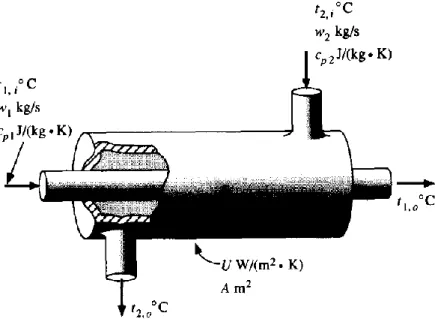
Fig. Typical counterflow heat exchanger
𝑞 = 𝑤
ℎ𝑐
𝑝ℎ(𝑡
ℎ,𝑖− 𝑡
ℎ,𝑜)
𝑞 = 𝑤
𝑐𝑐
𝑝𝑐(𝑡
𝑐,𝑜− 𝑡
𝑐,𝑖)
𝑞 = 𝑈𝐴∆𝑇
𝑙𝑚Chapter 5. Modeling Thermal Equipment
5.3.1 LMTD
(Log Mean Temperature Difference)method for a counter arrangement
𝑑𝑞 = −𝑤ℎ𝑐𝑝ℎ𝑑𝑇ℎ = −𝑊ℎ𝑑𝑇ℎ 𝑑𝑞 = −𝑤𝑐𝑐𝑝𝑐𝑑𝑇𝑐 = −𝑊𝑐𝑑𝑇𝑐 𝑑𝑞 = 𝑈𝑑𝐴(𝑇ℎ − 𝑇𝑐) = 𝑈𝑑𝐴∆𝑇
𝑑 ∆𝑇 = 𝑑 𝑇ℎ − 𝑇𝑐 = 𝑑𝑇ℎ − 𝑑𝑇𝑐 = −𝑑𝑞( 1
𝑊ℎ − 1 𝑊𝑐) (Hot side fluid)
(Cold side fluid) (Heat transfer)
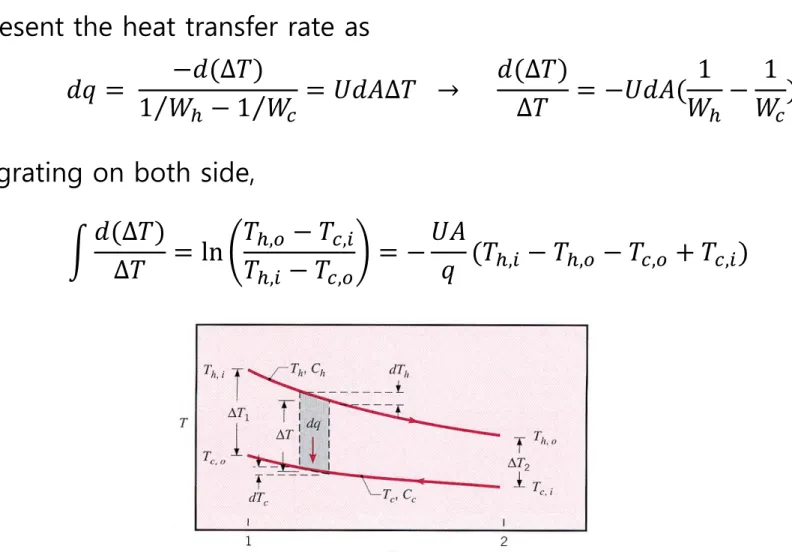
Fig. Heat exchange at counter flow HX
- represent the heat transfer rate as
- integrating on both side,
Chapter 5. Modeling Thermal Equipment
5.3.1 LMTD method for a counter arrangement
𝑑𝑞 = −𝑑(∆𝑇)
1 𝑊Τ ℎ − Τ1 𝑊𝑐 = 𝑈𝑑𝐴∆𝑇 → 𝑑(∆𝑇)
∆𝑇 = −𝑈𝑑𝐴( 1
𝑊ℎ − 1 𝑊𝑐)
න𝑑(∆𝑇)
∆𝑇 = ln 𝑇ℎ,𝑜 − 𝑇𝑐,𝑖
𝑇ℎ,𝑖 − 𝑇𝑐,𝑜 = −𝑈𝐴
𝑞 (𝑇ℎ,𝑖 − 𝑇ℎ,𝑜 − 𝑇𝑐,𝑜 + 𝑇𝑐,𝑖)
Fig. Heat exchange at counter flow HX
Chapter 5. Modeling Thermal Equipment
5.3.1 LMTD method for a counter arrangement
- finally, heat transfer rate at the counter flow hx is represented as
- When ‘select’ the heat exchanger under a certain fluid condition, LMTD method is a good way to specify the required UA
𝑞 = 𝑈𝐴∆𝑇𝑙𝑚 = 𝑈𝐴 ( 𝑇ℎ,𝑜 − 𝑇𝑐,𝑖 − 𝑇ℎ,𝑖 − 𝑇𝑐,𝑜 )
ln (𝑇ℎ,𝑜 − 𝑇𝑐,𝑖) (𝑇Τ ℎ,𝑖 − 𝑇𝑐,𝑜) = 𝑈𝐴 ∆𝑇2 − ∆𝑇1 ln(∆𝑇2Τ∆𝑇1)
Chapter 5. Modeling Thermal Equipment
5.3.2 ε-NTU method for a counter flow HX
- Effectiveness, ε :
- Number of Transfer unit, NTU :
- Heat capacity ratio, Wr : 𝜀 = 𝑞
𝑞𝑚𝑎𝑥 (0 < 𝜀 < 1) 𝑞 = ε𝑞𝑚𝑎𝑥 = ε𝑊𝑚𝑖𝑛(𝑇ℎ,𝑖 − 𝑇𝑐,𝑖)
𝑁𝑇𝑈 = 𝑈𝐴 𝑊𝑚𝑖𝑛
𝑊𝑟 = 𝑊𝑚𝑖𝑛 𝑊𝑚𝑎𝑥
Chapter 5. Modeling Thermal Equipment
5.3.2 ε-NTU method for a counter flow HX
- It is possible to represent ε as a function of NTU and heat capacity ratio for all the types of heat exchanger
- To ‘simulate’ the existing heat exchanger, ε-NTU method is a useful way to obtain heat transfer rate of the heat exchanger
𝜀 = 𝑓(𝑁𝑇𝑈, 𝑊 𝑟 )
- To get an ε-NTU relation for a counter flow HX (𝑊𝑚𝑖𝑛 = 𝑊ℎ) , effectiveness is given as
- In a fact that heat transfer rate of each side is same, heat capacity ratio is represented as
Chapter 5. Modeling Thermal Equipment
5.3.2 ε-NTU method for a counter flow HX
𝜺 = 𝑞
𝑞𝑚𝑎𝑥 = 𝑊ℎ(𝑇ℎ,𝑖 − 𝑇ℎ,𝑜)
𝑊𝑚𝑖𝑛(𝑇ℎ,𝑖 − 𝑇𝑐,𝑖) = 𝑇ℎ,𝑖 − 𝑇ℎ,𝑜 𝑇ℎ,𝑖 − 𝑇𝑐,𝑖
𝑞 = 𝑊ℎ 𝑇ℎ,𝑖 − 𝑇ℎ,𝑜 = 𝑊𝑐(𝑇𝑐,𝑜 − 𝑇𝑐,𝑖) 𝑾𝒓 = 𝑊𝑚𝑖𝑛
𝑊𝑚𝑎𝑥 = 𝑊ℎ
𝑊𝑐 = 𝑇𝑐,𝑜 − 𝑇𝑐,𝑖 𝑇ℎ,𝑖 − 𝑇ℎ,𝑜
- Meanwhile, rearranging the relation for heat transfer rate and LMTD yields
- Right hand side of the equation is represented as
Chapter 5. Modeling Thermal Equipment
5.3.2 ε-NTU method for a counter flow HX
𝑇ℎ,𝑜 − 𝑇𝑐,𝑖
𝑇ℎ,𝑖 − 𝑇𝑐,𝑜 = exp 𝑈𝐴
𝑞 𝑇ℎ,𝑜 − 𝑇𝑐,𝑖 − 𝑇ℎ,𝑖 − 𝑇𝑐,𝑜 𝑞 = 𝑈𝐴 ∆𝑇2 − ∆𝑇1
ln(∆𝑇2Τ∆𝑇1)
∆𝑇2
∆𝑇1 = exp 𝑈𝐴
𝑞 ∆𝑇2 − ∆𝑇1
= exp −𝑈𝐴 𝑇ℎ,𝑖 − 𝑇ℎ,𝑜
𝑞 − 𝑇𝑐,𝑜 − 𝑇𝑐,𝑖
𝑞 = exp −𝑈𝐴( 1
𝑊𝑚𝑖𝑛 − 1 𝑊𝑚𝑎𝑥)
𝑇ℎ,𝑜 − 𝑇𝑐,𝑖
𝑇ℎ,𝑖 − 𝑇𝑐,𝑜 = exp 𝑈𝐴
𝑊𝑚𝑖𝑛 1 − 𝑊𝑚𝑖𝑛
𝑊𝑚𝑎𝑥 = exp −NTU 1 − 𝑊𝑟
- To eliminate the outlet temperature of the left hand side, following sequence is needed.
- In a fact that 𝑾𝒓 = 𝑇𝑐,𝑜−𝑇𝑐,𝑖
𝑇ℎ,𝑖−𝑇ℎ,𝑜 and 𝜺 = 𝑇ℎ,𝑖−𝑇ℎ,𝑜
𝑇ℎ,𝑖−𝑇𝑐,𝑖
Chapter 5. Modeling Thermal Equipment
5.3.2 ε-NTU method for a counter flow HX
𝑇ℎ,𝑜 − 𝑇𝑐,𝑖
𝑇ℎ,𝑖 − 𝑇𝑐,𝑜 = 𝑇ℎ,𝑜 − 𝑇ℎ,𝑖 + 𝑇ℎ,𝑖 − 𝑇𝑐,𝑖 𝑇ℎ,𝑖 − 𝑇𝑐,𝑖 + 𝑇𝑐,𝑖 − 𝑇𝑐,𝑜 =
1 − 𝑇ℎ,𝑖 − 𝑇ℎ,𝑜 𝑇ℎ,𝑖 − 𝑇𝑐,𝑖 1 − 𝑇𝑐,𝑜 − 𝑇𝑐,𝑖 𝑇ℎ,𝑖 − 𝑇𝑐,𝑖
=
1 − 𝑇ℎ,𝑖 − 𝑇ℎ,𝑜 𝑇ℎ,𝑖 − 𝑇𝑐,𝑖 1 − 𝑇ℎ,𝑖 − 𝑇ℎ,𝑜
𝑇ℎ,𝑖 − 𝑇𝑐,𝑖
𝑇𝑐,𝑜 − 𝑇𝑐,𝑖 𝑇ℎ,𝑖 − 𝑇ℎ,𝑜
𝑇ℎ,𝑜 − 𝑇𝑐,𝑖
𝑇ℎ,𝑖 − 𝑇𝑐,𝑜 = 1 − 𝜀 1 − 𝜀𝑊𝑟
- Finally, by reconnecting the left hand side and right hand side, the relation for heat transfer rate obtained from the LMTD method is represented as
- Thus, it is obvious that LMTD relation and ε-NTU relation are two different form of one heat transfer system. Rearranging the relation for ε yields
Chapter 5. Modeling Thermal Equipment
5.3.2 ε-NTU method for a counter flow HX
1 − 𝜀
1 − 𝜀𝑊𝑟 = exp −NTU 1 + 𝑊𝑟
∆𝑇2
∆𝑇1 = exp 𝑈𝐴
𝑞 ∆𝑇2 − ∆𝑇1
𝜀 = 1 − 𝑒𝑥𝑝[−𝑁𝑇𝑈 1 + 𝑊𝑟 ] 1 − 𝑒𝑥𝑝[−𝑁𝑇𝑈 1 − 𝑊𝑟 ]
- It is possible to get same relation when 𝑊𝑚𝑖𝑛 = 𝑊ℎ
Chapter 5. Modeling Thermal Equipment
5.3.2 ε-NTU method for a counter flow HX
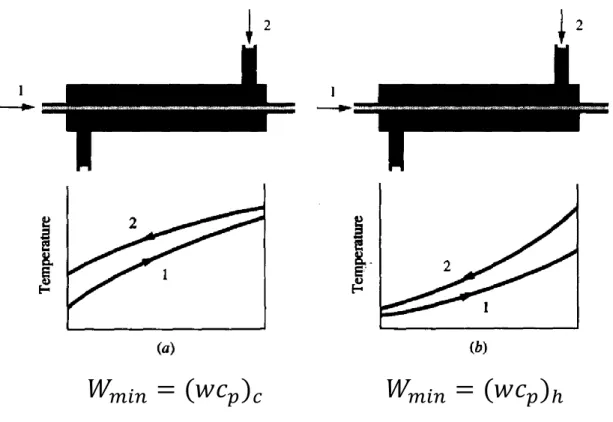
Fig. Temperature profiles in a counterflow heat exchanger 𝑊𝑚𝑖𝑛 = (𝑤𝑐𝑝)𝑐 𝑊𝑚𝑖𝑛 = (𝑤𝑐𝑝)ℎ
Liquid → Vapor Vapor → Liquid
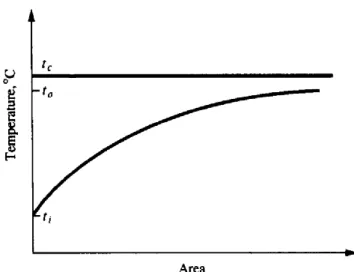
Fig. Temperature distribution in fluids in a condenser
Chapter 5. Modeling Thermal Equipment
One of the fluid changes phase, and no superheating or subcooling
→ Its temperature or pressure remains constant
5.5 Evaporator and Condensers
- When secondary fluid(hot side) is at a two phase state, temperature is at a constant state.
- Thus, 𝑡ℎ,𝑜 is represented as
𝑞 = 𝑈𝐴 𝑡ℎ,𝑜 − 𝑡𝑐 − (𝑡ℎ,𝑖 − 𝑡𝑐)
ln[ 𝑡ℎ,𝑜 − 𝑡𝑐 / 𝑡ℎ,𝑖 − 𝑡𝑐 ] → 𝑡ℎ,𝑜 − 𝑡𝑐
𝑡ℎ,𝑖 − 𝑡𝑐 = exp[𝑈𝐴
𝑞 𝑡ℎ,𝑖 − 𝑡ℎ,𝑜 ]
𝑡ℎ,𝑜 = 𝑡ℎ,𝑖 − (𝑡ℎ,𝑖 − 𝑡𝑐,𝑖)(1 − 𝑒−𝑁𝑇𝑈)
Chapter 5. Modeling Thermal Equipment
5.5 Evaporator and Condensers
- ε-NTU relation for the case is represented as
- Or as an alternative form
Chapter 5. Modeling Thermal Equipment
5.5 Evaporator and Condensers
𝑡ℎ,𝑖 − 𝑡ℎ,𝑜
𝑡ℎ,𝑖 − 𝑡𝑐,𝑖 = 𝜀 = 1 − 𝑒−𝑁𝑇𝑈
𝑁𝑇𝑈 = −ln(1 − 𝜀)
Chapter 5. Modeling Thermal Equipment
5.6 ε-NTU method for several cases
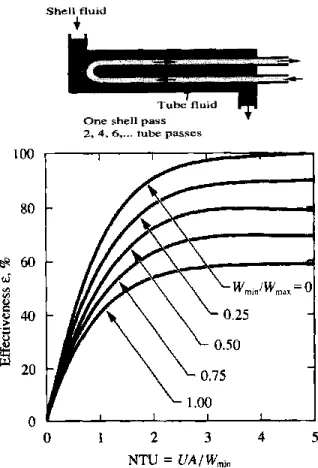
Fig. Effectiveness of counter HX Fig. Effectiveness of parallel HX
Chapter 5. Modeling Thermal Equipment
5.6 ε-NTU method for several cases
Table. ε-NTU relation (for NTU)
Chapter 5. Modeling Thermal Equipment
5.6 ε-NTU method for several cases
Table. ε-NTU relation (for ε)
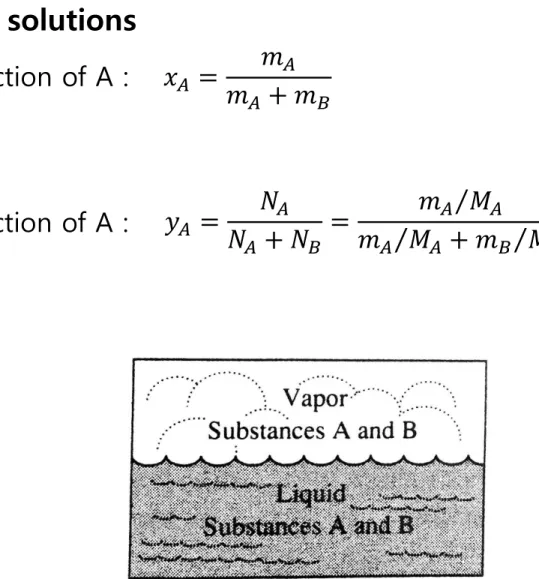
- Mass fraction of A :
- Mole fraction of A :
Chapter 5. Modeling Thermal Equipment
5.10 Binary solutions
𝑥𝐴 = 𝑚𝐴 𝑚𝐴 + 𝑚𝐵
𝑦𝐴 = 𝑁𝐴
𝑁𝐴 + 𝑁𝐵 = 𝑚𝐴Τ𝑀𝐴
𝑚𝐴Τ𝑀𝐴 + 𝑚𝐵Τ𝑀𝐵
Fig. Typical binary solution
Chapter 5. Modeling Thermal Equipment
5.11 Temperature-concentration-pressure characteristics
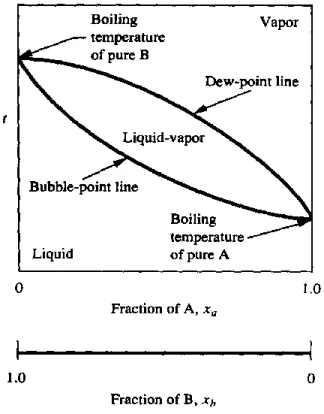
Fig. Temperature-concentration
diagram at a constant pressure Fig. Temperature-concentration diagram for two different pressure
ln D P C
T
,
a a sat a
P x P
a b
a a
b b
P P P P y P P y P
vapor pressure in mixture
sat. P of pure A
mole fraction of A in the liq. phase
total P
Chapter 5. Modeling Thermal Equipment
5.12 Develiping a T vs x diagram
- There exist three tools to develop the binary properties (Saturation pressure-temperature relation)
(Raoults’ law)
(Partial pressure)
Saturation preussre
constant.
Temperature
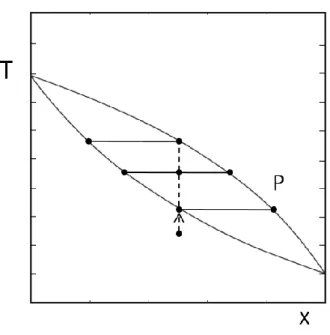
Fig. Condensation of a binary mixture
Chapter 5. Modeling Thermal Equipment
5.13 Condensation of a binary mixture
- A pure substance condenses at constant pressure, the temperature remains constant
- On the other hand, temperature of a binary mixture changes progressively
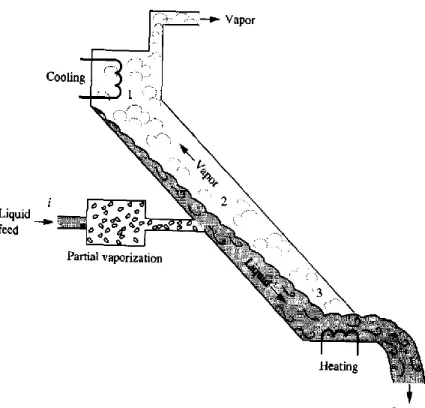
Fig. Single-stage still Fig. Some possible outlet conditions
Chapter 5. Modeling Thermal Equipment
5.14 Single stage distillation
Fig. A rectification column Fig. States of binary system in rectification column
Chapter 5. Modeling Thermal Equipment
5.15 Rectification
Fig. Form of an enthalpy-concentration diagram
Chapter 5. Modeling Thermal Equipment
5.16 Enthalpy
- Enthalpy values of binary solutions and mixtures of vapor are necessary - For system simulation, the enthalpy data would be most convenient in
equation form
- More frequently the enthalpy data appear in graphic form as shown in the Figure below
Chapter 5. Modeling Thermal Equipment
5.17 Pressure drop and pumping
- Pressure drop of an incompressible fluid :
(C : constant, w : mass of flow, n : 1.8 ~ 2.0)
- Power required incompressible fluid :
𝑷𝒐𝒘𝒆𝒓 = 𝜼𝒑𝒖𝒎𝒑𝑻𝝕 = ∆𝒑𝑸 = 𝑪 𝒘𝒏 ∙ 𝒘
𝝆 = 𝑪
𝝆𝒘𝒏+𝟏
∆𝒑 = 𝑪(𝒘𝒏)
Chapter 5. Modeling Thermal Equipment
5.18 Turbomachinery
- Dimensional form :
- Non-dimensional form :
𝑓 𝑝1, 𝑐𝑝, 𝑇1, 𝜛, 𝑤, 𝐷 = 𝑝2
𝑓 𝑤 𝑐𝑝𝑇1
𝐷2𝜌1 , 𝜛𝐷
𝑐𝑝𝑇1 = 𝑝2 𝑝1
𝑝2 𝑝1
𝑤 𝑐𝑝𝑇1 𝐷2𝜌1
𝜛𝐷
𝑐𝑝𝑇1 = 𝑐𝑜𝑛𝑠𝑡.
𝑝1 pressure input 𝑝2 pressure output
𝑤 mass flow rate
𝐷 impeller diameter 𝑐𝑝 heat capacity 𝑇1 input temperature 𝜌1 input density
Π1 =𝑤 𝑐𝑝𝑇1
𝐷2𝜌1 , Π2 = 𝜛𝐷
𝑐𝑝𝑇1, Π3 =𝑝2 𝑝1
using Pi theorem