Condensation Analysis for Thermal Sizing of PRHRS Heat Exchanger
Taeho Lee, Juhyeon YoonKorea Atomic Energy Research Institute, 150 Duckjin-dong, Yuseong-gu, Daejeon, [email protected]
1. Introduction
In the case of an emergency such as the unavailability of feedwater supply or loss of off-site power in integral reactor, the heat exchanger of Passive Residual Heat Removal System (PRHRS) removes the heat from the reactor coolant system through steam generator by condensation heat transfer to the water in Refueling Water Tank. Before the PRHRS operation, Nitrogen gas is dissolved in the coolant of PRHRS. Thus, during PRHRS operation, the noncondensable Nitrogen gas could be introduced into heat exchanger due to evaporation in steam generator. Because the noncondensable gas deteriorates the heat transfer capability, its effect should be considered in the determination of heat transfer area of PRHRS heat exchanger. In this study, simple analytical model was presented for the development of thermal sizing method of PRHRS heat exchanger, and preliminary analysis for examining the effect of noncondensable gas was performed using the existing heat transfer correlations.
2. Analytical Model
In the model, PRHRS heat exchanger is represented by single vertical straight characteristic tube. Steam goes into the tube (primary side) and flows downwards while being condensed. The secondary side is modeled as a pool which is open to atmosphere. The flow is assumed to be one dimensional, and total pressure inside the tube assumed to be constant, which is common to the condensation analysis. Also, the heat is considered to be removed by pool boiling on outer surface of the tube or single-phase natural convection depending on the tube surface temperature, and the geometry effects such as heat exchanger header and tube pitch are not considered in the present analysis.
For the analysis, the tube is divided into arbitrary number of control volumes, and the governing equations are formulated based on the above assumptions. The governing equations are mainly composed of the balances for mass, momentum and energy which are given for each control volume as follows.
Mass . . . . , 1 , 1 , 1 , , , g j f j nc j g j f j nc j m ++m ++m + =m +m +m (1) . . , , , , , , 1 g j b nc j nc j b nc j m W m W = − (2) Momentum , , total g j nc j
p
=
p
+
p
=
Constant (3) Energy . . , , 1 ( g j g j ) j fg Q m m + h ∆ = − + (4) . . , 1 , ( , , 1) , ( , , 1) g j p g b j b j nc p nc b j b j m + C T −T + +m C T −T + In Eqs. (1)~(4), m , W , p , Q. ∆ , fg h , C and T are pthe mass flow rate, the mass fraction of noncondensable gas, the pressure, the heat transfer rate, the latent heat of vaporization, the specific heat and the temperature, respectively. Also, the subscripts such as g , f , nc , b and
j mean the steam, the liquid film, the noncondensable gas,
the bulk and the control volume index, respectively. The mass fraction of noncondensable gas, , ,
b nc j
W is
determined assuming the ideal gas as follow,
, , , , , , (1 , , ) nc b nc j b nc j nc b nc j g b nc j M X W M X M X = + − (5) and the mole fraction of noncondensable gas, Xb nc j, , is calculated using the following relation between the mole fraction and the partial pressures of steam and noncondensable gas. , , , nc j b nc j total p X p = (6)
In Eq. (5), M is the molecular mass of related phase. The heat transfer rate from control volume j can be represented using the potential between temperature of steam and noncondensable gas mixture and temperature of pool as,
, ( , )
j i i j b j pool
Q πD dz U T T
∆ = − (7)
and the overall heat transfer coefficient,
,
i j
U is defined
using the tube inside heat transfer coefficient,
,
i j
h , the
tube outside heat transfer coefficient, h , the tube inner o j,
diameter, D , the tube outer diameter, i D and the o
thermal conductivity of tube wall,
, w j k as follows. , , , , 1 1 ln( ) 2 i j o i i i j i w j o o j U D D D h D k D h = + + (8)
Empirical correlations proposed by Uchida et al [1], Vierow and Schrock [2] and Khun [3] are used to calculate the tube inside heat transfer coefficients, and
Transactions of the Korean Nuclear Society Autumn Meeting Busan, Korea, October 27-28, 2005
Rhosenow’s correlation is adopted for the tube outside pool boiling heat transfer coefficients.
3. Results
Preliminary analysis was performed using the boundary condition required for thermal sizing of heat exchanger. Based on the available design data, the tube inner diameter, outer diameter, length and number of tubes were selected as 13 mm, 18 mm, 1200 mm and 141, respectively. The inlet steam flow rate was set to be 0.374 kg/s and the total pressure to be 3.5 MPa. The pool temperature and the noncondensable Nitrogen gas mass fraction at tube inlet was assumed to be 99 oC and 2.6 %.
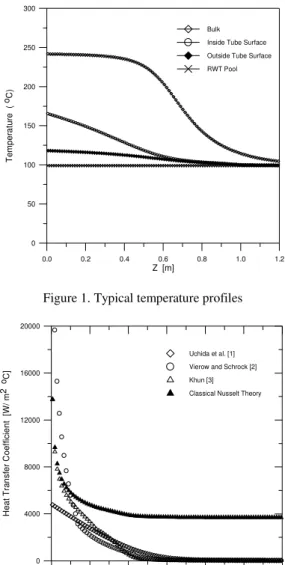
Figure 1 shows the typical calculated temperature profiles of primary and secondary sides including the temperature distributions on both inside and outside tube surfaces. Uchida et al.’s heat transfer coefficient [1] was applied to this calculation. The mixture temperature of steam and noncondensable gas decreases along the flow path due to the decrease of saturation temperature caused by decrease of steam partial pressure. Steam partial pressure decreases as the amount of noncondensable gas increases along the tube. Also, it is seen that whole steam is nearly condensed at tube outlet. Figure 2 shows the comparison of tube inside heat transfer coefficients. In the figure, the pure steam heat transfer coefficient by classical Nusselt theory is also represented to see the effect of noncondensable gas. As shown in the figure, the heat transfer coefficients calculated by three correlations decrease rapidly in about first half of tube length. Especially, the predicted heat transfer coefficients show large difference in the tube entry region. Also, the heat transfer coefficients by Vierow and Schrock [2] were predicted to be larger than those by Nusselt analysis. Even though the tube entry region is small compared with the whole tube length, the region takes an important role in the determination of heat transfer area. Thus, it is considered to be necessary to validate those models against the experimental data for selecting the optimum heat transfer coefficient which can be used in the thermal sizing of PRHRS heat exchanger.
.
4. Conclusion
For the thermal sizing of PRHR heat exchanger, simple analytical method was developed and preliminary analysis was performed to see the influence of noncondensable gas on condensation heat transfer. The results show large discrepancy in the prediction of heat transfer coefficients. Validation against experimental data is required for determination of appropriate heat transfer coefficient.
. 0.0 0.2 0.4 0.6 0.8 1.0 1.2 Z [m] 0 50 100 150 200 250 300 T e m p e ra tu re ( oC ) Bulk Inside Tube Surface Outside Tube Surface RWT Pool
Figure 1. Typical temperature profiles
0.0 0.2 0.4 0.6 0.8 1.0 1.2 Z [m] 0 4000 8000 12000 16000 20000 H e a t T ra n s fe r C o e ff ic ie n t [ W / m 2 oC ] Uchida et al. [1] Vierow and Schrock [2] Khun [3] Classical Nusselt Theory
Figure 2. Comparison of heat transfer coefficients REFERENCES
[1] H. Uchida, A. Oyama, Y. Togo, Evaluation of Post-Incident Cooling Systems of Light-Water Power Reactors, Proceedings
of 3rd Int. Conf. on the Peaceful Uses of Atomic Energy, 1969,
Geneva, Switzerland.
[2] K.M. Vierow, V.E. Schrock, Condensation in a Natural Circulation Loop with Noncondensable Gases; Part I-Heat Transfer, Proceedings of Int. Conf. on Multiphase Flows '91, 1991, Tsukuba, Japan.
[3] S.Z Khun., Investigation of Heat Transfer from Condensing Steam-Gas Mixtures and Turbulent Films Flowing Downward inside a Vertical Tube, Ph. D. thesis, University of California, Berkely, 1995.
[4] W.M Rhosenow, A Method of Correlating Heat Transfer Data for Surface Boiling of Liquids, Trans. ASME, Vol. 84, 1962.