CHAPTER 4 CHAPTER 4
The Roles & Responsibilities of Ch i l E i
Chemical Engineers
Contents
4.1 Introduction
4.2 Responsibilities for Chemical Process Safetyp y 4.3 Responsibilities for Environmental Protection 4.4 Further in Engineering Ethics
Problems
By the end of this section you should:
Be aware of the responsibilities for chemical process safety
B f th ibiliti f
Be aware of the responsibilities for environmental protection
environmental protection
Roles of Chemical Engineers
Many chemical engineers design and operate large-scale and complex chemical production facilities supplying diverse chemical products to society.
The engineer may become involved in raw materials extraction, intermediate materials processing, or
d i f h i l b i h i i
production of pure chemical substances; in each activity, the minimization and management of waste streams will
h i i d i l
have important economic and environmental
consequences.
Roles of Chemical Engineers
Chemical engineers are involved in production of bulk and specialty chemicals, petrochemicals, integrated circuits, pulp and paper, consumer products, minerals, and pharmaceuticals. p
Chemical engineers also find employment in research,
Chemical engineers also find employment in research,
consulting organizations, educational institutes.
Roles of Chemical Engineers
As engineers assume such diverse roles it is As engineers assume such diverse roles, it is increasingly important that they be aware of their responsibilities to the general public colleagues and responsibilities to the general public, colleagues and employers, the environment, and also to their profession
profession.
One of the central roles of chemical engineers is to
One of the central roles of chemical engineers is to
design and operate chemical processes yielding
chemical products that meet customer specifications
chemical products that meet customer specifications
and that are profitable.
Roles of Chemical Engineers
Another important role is to maintain safe conditions for operating personal and for residents in the immediate vicinity of a production facility.
Finally, chemical process designs need to be protective of the environment and of human health. Environmental
i b id d l i hi h f
issues must be considered not only within the context of chemical production but also during other stages of a
h i l’ lif l h i b
chemical’s life cycle, such as transportation, use by
customers, recycling activities, and ultimate disposal.
Responsibilities for Process Safety
A major objective for chemical process design is the A major objective for chemical process design is the inclusion of safeguards that minimize the number and severity of accidental release of toxic chemicals andy incidence of fire and explosions.
If not,
loss of life loss of life,
permanent disability,
destruction of chemical plant, equipment
& neighboring residences.
Responsibilities for Process Safety
Flixborough Works of Nypro Limited (1974. 6.1, Sat) Flixborough Works of Nypro Limited (1974. 6.1, Sat)
- 70,000 ton, caprolactam for nylon (cyclohexane is oxidized to cyclohexanol in air within a series of six catalytic reactors) cyclohexanol in air within a series of six catalytic reactors)
- Under process conditions, cyclohexane vaporizes upon depressurization, forming a cloud of flammable vapor mixed with air
forming a cloud of flammable vapor mixed with air.
- Reactor 5 was found to have a crack. Bypass with 20” pipe rather than 28”
30 t f l h i l d l d b l k t i th
- 30 tons of cyclohexane in a cloud was released by leak to air, then unknown ignition source caused the cloud to explode.
28 died 36 injured damage extended to nearby 1821 houses 167 shops - 28 died, 36 injured, damage extended to nearby 1821 houses, 167 shops,
and factories by 10 days burning.
- if proper safety design, operation, reducing inventory of flammableif proper safety design, operation, reducing inventory of flammable liquid on site could have been prevented the disaster
Responsibilities for Process Safety
Flixborough
Flixborough
Responsibilities for Process Safety
Flixborough
Flixborough
Responsibilities for Process Safety
Cyclohexane Oxidation Plant
Responsibilities for Process Safety
Bhopal, India, (1984.12. 2, Sun) p , , ( , )
(Union Carbide/Locals, Pesticides )
- Release of MIC gives 2000 death, 20,000 injuring nearby residents by respiratory damage.
by respiratory damage.
- Liquid MIC at ambient, boils at 39.1 C, vapor is heavier than air,
t i t l t ti ( i ll bl
very toxic at even very low concentration ( maximum allowable
exposure concentration of MIC for workers during 8-hr is 0.02 ppm) Reacts with water exothermically, but slowly and the heat released can cause MIC to boil if cooling is not provided)g p )
MIC (methyl isocyanate): CH3-N=C=O
Responsibilities for Process Safety
Unit using MIC was not operating due to a labor disputeg p g p
- storage with MIC was contaminated with water (500L) - reaction was occurred in tank
- heated above b.p. of MIC
t d d d th li f l
- vapor was generated and escaped the pressure relief valve on the tank and were diverted control system
unfortunately the relief valve 3 was not operating - unfortunately the relief valve 3 was not operating
- 25 tons of MIC vapor was released to community with catastrophe
catastrophe.
if proper safety review procedures for low inventory of MIC or by
using alternative reaction chemistries that eliminate MIC could have been prevented the disaster
Responsibilities for Process Safety
- Gauges measuring temperature and pressure in the various parts of the unit including the crucial MIC storage tanks were so notoriously unit, including the crucial MIC storage tanks, were so notoriously unreliable that workers ignored early signs of trouble (Weir, pp.41-42).
The refrigeration unit for keeping MIC at low temperatures (and therefore -The refrigeration unit for keeping MIC at low temperatures (and therefore less likely to undergo overheating and expansion should a contaminant enter the tank) had been shut off for some time (Weir, pp.41-42).
-The gas scrubber, designed to neutralize any escaping MIC, had been shut off for maintenance. Even had it been operative, post-disaster inquiries revealed, the maximum pressure it could handle was only one- quarter that which was actually reached in the accident (Weir, pp.41-42).
-The flare tower, designed to burn off MIC escaping from the scrubber, was also turned off, waiting for replacement of a corroded piece of pipe. The tower, however, was inadequately designed for its task, as it pipe. The tower, however, was inadequately designed for its task, as it was capable of handling only a quarter of the volume of gas released (Weir, pp.41-42).
Responsibilities for Process Safety
-The water curtain designed to neutralize any remaining gas was tooThe water curtain, designed to neutralize any remaining gas, was too short to reach the top of the flare tower, from where the MIC was billowing (Weir, pp.41-42).
-The lack of effective warning systems; the alarm on the storage tank failed to signal the increase in temperature on the night of the disaster
(C l 19)
(Cassels, p.19).
-MIC storage tank number 610 was filled beyond recommended capacity;
and
-a storage tank which was supposed to be held in reserve for excess MICg pp already contained the MIC (Cassels, p.19).
Responsibilities for Process Safety
Responsibilities for Process Safety
Bhopal
Bhopal
Responsibilities for Process Safety
Bhopal
Bhopal
Layer of Protection y
In incidents such as this loss of life and injuries are tragic In incidents such as this, loss of life and injuries are tragic, and economic consequences are severe. Engineers have a special role to play in preventing such incidents.p p y p g
Part of an engineer’s professional responsibility is to design processes and products that are as safe as possible.
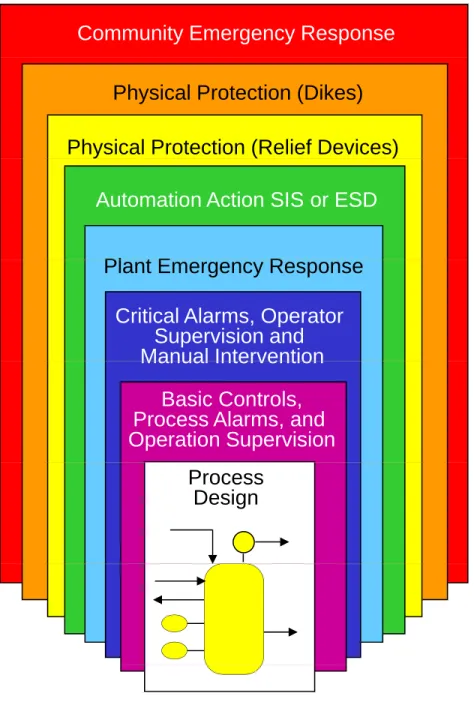
Traditionally this meant identifying hazards, evaluating their severity and then applying several layers of protections as a severity and then applying several layers of protections as a means of mitigating the risk of an accident.
Figure 4.2-1 shows the layer of protection concept and includes examples of layers that might be found in a typical
h i l l
chemical plant.
Community Emergency Response
Physical Protection (Dikes) Physical Protection (Relief Devices)
Automation Action SIS or ESD
Pl t E R
Plant Emergency Response Critical Alarms, Operator
Supervision and Manual Intervention Manual Intervention
Basic Controls, Process Alarms, and Operation Supervision
Process Design
SIS: safety interlock system EDS: emergency shutdown
Fig. 4.2-1 Typical layers of protection for a chemical plant
What were the safety layers at the Bhopal plant?
First layer
Two primary MIC storage tanks with a reserve one for overflow Two primary MIC storage tanks with a reserve one for overflow.
Refrigeration unit to keep MIC at low temperatures to minimize overheating should the tank be contaminated with water or other compounds.
Second layer Second layer
Alarm on storage tank if temperature exceeded a critical level
Layer of Protection y
Third layer Third layer
Gas scrubber to neutralize any MIC that escaped through the
t k l l
tank release valve
Fourth layer
Flare to combust any MIC not completely scrubbed
Fifth layer
Water curtain to neutralize any uncombusted MIC
Layer of Protection y
The Event The Event
At Bhopal there was a failure at all levels for safety; the MIC plant had been shut down six weeks prior to incident, but MIC had been stored.
1 000 to 2 000 pounds of water entered into the MIC storage 1,000 to 2,000 pounds of water entered into the MIC storage tank and started a runaway chemical reaction with a rapid increase in temperature and pressure MIC was released increase in temperature and pressure. MIC was released through the release valve.
Layer of Protection y
Investigation showed:
Investigation showed:
The reserve storage tank was filled to capacity. The MIC tank was filled beyond capacity. Operating beyond plant design.
Operator error.
First layer failure.y
Th f i ti it h d b h t d S l i it
The refrigeration unit had been shut down. Some claim it was shut down to save electricity (improper plant maintenance).
First layer failure.
Layer of Protection y
The gauges measuring temperature and pressure were not functioning correctly. The alarm system did not signal the temperature increase
temperature increase.
Second layer failure
The first sign of a problem was that workers eyes began to The first sign of a problem was that workers eyes began to burn and tear. Actions taken did not stop problem.
Second layer failure Second layer failure.
Layer of Protection y
Gas scrubber shut off for maintenance. Also not designed at g correct capacity.- Third layer failure
Flare turned off – being maintained. Fourth layer failure
Water curtain not properly designed and failed. Fifth layer failure
Alarm system in the plant functioned, but siren for community y p y turned off in 1982 – Sixth layer failure
No community emergency response plan. Sixth layer failure
Layer of Protection y
Subsequent analysis and investigation by a team of engineers indicated that sabotage may have been the root cause, although this remains very controversial. Regardless of whether or not the plant was sabotaged the other safety of whether or not the plant was sabotaged, the other safety devices should have prevented the release to the atmosphere.
These safety devices failed.
These safety devices failed.
In 1990 the U.S. Senate considered an EPA analysis that compared U.S. chemical incidents in the 1980’s. There were 29 incidents reviewed Of these 17 had releases of sufficient 29 incidents reviewed. Of these, 17 had releases of sufficient volumes of chemicals with toxicity such that the potential consequences (depending on weather conditions and plant consequences (depending on weather conditions and plant location) could have been more severe than in Bhopal.
Layer of Protection y
For more information:
Investigation of Large-Magnitude Incidents; Bhopal as a case study A. S. Kalelkar and A. D. Little
www.bhopal.com (go to information archive for PDF file)p (g ) Bhopal Disaster Spurs U. S. Industry, legislative Action
A Bryce U S Chemical Safety Board A. Bryce, U. S. Chemical Safety Board www.chemsafety.gov/lib/bhopal01.htm Trade and Environmental (TED) Case Studies Trade and Environmental (TED) Case Studies
#233, Bhopal Disaster
i d /TED/BHOPAL HTM www.american.edu/TED/BHOPAL.HTM
Layer of Protection y
What are lessons to learn from the Bhopal event?
What are lessons to learn from the Bhopal event?
The best approach is to design an inherently safer facility rather than protective layers. Inherently safer design is a fundamentally different approach to chemical process safety.
Instead of working with existing hazards in a chemicalg g process and adding layers of protection, the engineer is challenged to reconsider the design and eliminate or reduce
th f th h d ithi th A h t
the source of the hazard within the process. Approaches to the design of inherently safer processes have been grouped into the four categories listed below
into the four categories listed below.
Layer of Protection
Layer of protection as a means of mitigating the risk of
y
y p g g
accident. This approach can be very effective and has resulted in significant improvement of the safety resulted in significant improvement of the safety performance of chemical process.
Layer of Protection has a limitation
(1) the layers are expensive to build and maintain
(2) hazard remains and there is always a finite risk that an
accident will happen despite the layers of protection
Design of inherently safer processes
Inherently safe design is fundamentally different approach Inherently safe design is fundamentally different approach to chemical process safety.
Instead of working with existing hazards in a chemical
process and adding layers of protection, the engineer is
challenged to reconsider the design and eliminate or
reduce of hazard within the process.
Design of inherently safer processes
Approaches to the design of inherently safer processes have been pp g y p grouped into four categories.
Minimize Use smaller quantities of hazardous substances Substitute Use a less hazardous materials in place of a more Substitute Use a less hazardous materials in place of a more
hazardous substance
Moderate Use less hazardous conditions or facilities which Moderate Use less hazardous conditions or facilities which
minimize the impacts of a release of a hazardous material or energy
material or energy
Simplify Design facilities which eliminate unnecessary complexity and make operating errors less likely complexity and make operating errors less likely, and which are forgiving of errors that are made
Checklist for inherently safer process
Minimize
Use smaller quantities of hazardous substances
Have all in-process inventories of hazardous materials in storage tanks been minimized?
Are all of the proposed in-process storage tanks really d d?
needed?
Can other types of unit operations or equipment reduce
Can other types of unit operations or equipment reduce material inventories?
(ex. Continuous in-line mixers in place of mixing vessels ) (ex. Continuous in line mixers in place of mixing vessels )
Checklist for inherently safer process
S b tit t
U l h d t i l
SubstituteUse a less hazardous materials
in place of a more hazardous substance
Is it possible to completely eliminate hazardous raw s it possible to completely eliminate ha a dous aw
materials, process intermediates, or byproducts by using
lt ti h i l ?
an alternative process or chemicals ?
Is it possible to substitute less hazardous raw materials or to substitute noncombustible for flammable solvents ?
o to substitute noncombustible fo flammable solvents ?
Checklist for inherently safer process
Moderate
Use less hazardous conditions or facilities
hi h i i i th i t f l f
which minimize the impacts of a release of a hazardous material or energy
Can the supply pressure of raw materials be limited to less than the working pressure of the vessels they are delivered to ?
Can reaction conditions (T, P) be made less severe by
using a catalyst, or by using a better catalyst ?
Checklist for inherently safer process
Si lif
Simplify
Design facilities which eliminate unnecessary complexity and make operating errors less
likely, and which are forgiving of errors that are made.
Can equipment be sufficiently designed to totally contain the maximum pressure generated, p g ,
even if the worst event occur ?
Checklist for inherently safer process
More checklist can be found in
the Center for Chemical Process Safety (CCPS) publication
p
CCPS, Center for Chemical Process Safety, Guidelines for Engineering Design of Process Safety New York AIChE 1993
Design of Process Safety, New York, AIChE, 1993
Crowl, D.A. ed., Inherently Safer Chemical Processes: A Life Cycle Approach, Center for Chemical Process Safety, AIChE, 1996
New Generation of inherently safer process
T di i l A h Traditional Approach
- rely on designing layers of protection around process hazards - focus on designs that treat wastes
New Generation Approach
rely on designs that reduce hazards
-rely on designs that reduce hazards,
rather than providing protection from hazards
d i d h h d
- designed so that they do not generate waste
4.3 Responsibilities for Environmental Protection
At what stage in the design should
environmental considerations be considered?
(1) Definition of a primitive problem
(identify the chemical to be produced and annual quantity)
(2) Process creation step (choose reaction chemistry, use of design heuristics to identify process equipment and operating
diti fl h t i l ti t )
conditions, flow-sheet, simulations, etc.) (3) Detailed design
(detailed process synthesis of separation heat integration analysis (detailed process synthesis of separation, heat integration analysis,
simulation of flow-sheet, profitability analysis, optimization) (4) Final step (plant-wide controllability assessment startup
(4) Final step (plant-wide controllability assessment, startup assessment, reliability and safety analysis)
CMA Pollution Prevention Code of Management Practices
CMA: Chemical Manufacturers Association CMA: Chemical Manufacturers Association
(Now American Chemistry Council)
Outlines tangible steps along a path to continuous reduction in the amounts of all contaminants released to air, water, and soil.
These practices demonstrate a clear commitment by senior management, a path to quantify waste generation and
i iti t d ti f f d ti
prioritize waste reduction, a preference for source reduction,
reuse/recycle rather than pollution control, and a plan to
measure and report on progress in achieving reduction goals
measure and report on progress in achieving reduction goals.
Table 4.3-1 Pollution prevention Code of management practices
Fig. 4.3-1 (continued)
Homework #4 Homework #4
F h R di i E i i E hi
Further Reading in Engineering Ethics
- Process safety and environmental protection are not the only responsibilities of professional engineers. Engineers also have responsibilities to clients, to colleagues and to the professions.p , g p f
AIChE Web
http://www.aiche.org/membership/ethics.htm
Problems 1 by
Problems 1 by April 6 April 6