제 51회 KOSCO SYMPOSIUM 초록집(2015년도 추계학술대회) 177
RCCI 연소의 직접수치모사 연구 - 화학적 측면
Minh Bau Luong*․유광현*․유춘상*†
A DNS Study of RCCI Combustion - Chemical Aspects
Minh Bau Luong*, Gwang Hyeon Yu*, Chun Sang Yoo*†
ABSTRACT
The chemical aspects of primary reference fuel (PRF)/air mixture under RCCI conditions are investigated to provide fundamental insights into the ignition characteristics of RCCI combustion. Chemical explosive mode analysis (CEMA) is adopted to understand the ignition process of the lean PRF/air mixture by identifying controlling species and elementary reactions at different locations and times.
Key Words: DNS, HCCI, RCCI, chemical explosive mode analysis (CEMA)
* 유니스트 기계공학과
† 연락저자, [email protected]
TEL : (052)217-2322 FAX : (052)217-2409
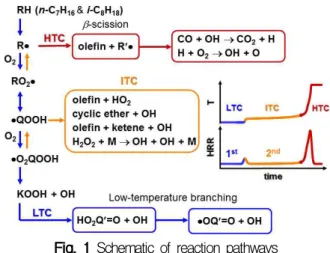
Fig. 1 Schematic of reaction pathways In this study, the chemical aspects of
reactivity controlled compression ignition
(RCCI) combustion are investigated by
analyzing two-dimensional direct numerical simulation (2-D DNS) data with the chemical explosive mode (CEM) analysis. The DNSs were performed with a 116-species reduced mechanism of primary reference fuel (PRF).
RCCI combustion uses two fuels with
different reactivity. For example, n-heptane (n-C7H16) and iso-octane (i-C8H18) can be
used because they are representative of highly reactive and less reactive fuels, respectively.
The overall low-temperature (LT),
intermediate- temperature (IT), and
high-temperature (HT) reaction pathways of
n-heptane and iso-octane oxidation relevant to RCCI combustion are shown in Fig. 1he details of the pathways can be found in [1-2].
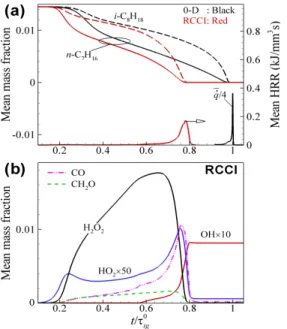
The initial conditions of mean pressure, mean temperature, mean equivalence ratio, and mean global PRF number for 2-D DNS are = 40 atm, = 900 K, and = 0.45, and
PRF50, respectively. Fig. 2 shows the
temporal evolutions of the mean heat release rate (HRR) and the mean fractions of important species for 2-D DNS, which exhibit a staged consumption of more reactive
fuel, n-heptane, and less reactive fuel,
iso-octane. n-Heptane is primarily consumed during the first-stage ignition, following the
LT reaction pathway in Fig. 1. Then, the remaining n-heptane and most iso-octane are consumed by the IT and HT reaction pathways. During these stages, n-heptane and
iso-octane are decomposed into HO2, CH2O,
C2H4, and other smaller molecules.
Consumption of CH2O, decomposition of H2O2,
and production of OH appear to coincide with the consumption of all remaining iso-octane, followed by the oxidation of CO into CO2.
It is believed that local mixtures with high
n-heptane concentration (e.g.∼PRF30 in the present study - a mixture of 30% iso-octane
and 70% n-heptane by volume) auto-ignite
first and then initiate adjacent less-reactive mixtures, resulting in a sequential ignition process. Therefore, the CEM analysis is first applied to the 0-D ignition of PRF30/air mixture under conditions of = 40 atm, =
제 51회 KOSCO SYMPOSIUM 초록집(2015년도 추계학술대회) 178
Fig. 2 Temporal evolutions of the mean HRR and mean mass fractions of important species. The 0-D ignition is also added for comparison.
Fig. 3 Temporal evolutions of temperature, HRR, Dac, λexp≡sign(Re(λe))×log(1+|Re(λe|)), EI
of important species for 0-D ignition
Fig. 4 Temporal evolutions of PI of important reactions for 0-D ignition
Fig. 5 Isocontours of sign(Re(λe))×log(1+|Re(λe|)), and EI of important species at the first-stage ignition.
concentration with low T due to evaporative cooling effect) as shown in Figs. 3 and 4. Readers are referred to [3-4] for the details of the CEMA formulation and the application of
the CEMA can be found in [5-8]. Note that
(1) a mixture with a negative Re(
) isalready burned while the ignition of mixture with a positive Re(
) is still underway; (2) important species and reactions are identified by relative magnitudes of EI and PI values, respectively. As shown in Fig. 3 and Fig. 4, during the early stage of combustion, RO2,제 51회 KOSCO SYMPOSIUM 초록집(2015년도 추계학술대회) 179
Fig. 6 Isocontours of sign(Re(λe))×log(1+|Re(λ e|)), and EI of important species at 15% cumulative heat release rate (CHRR).
Fig. 7 Isocontours of HRR, and PI of important reactions at starting of the main combustion.
Fig. 8 The conditional mean of HRR and EI of controlling species on temperature at (a) the first-stage ignition, and at (b) the 15% CHRR
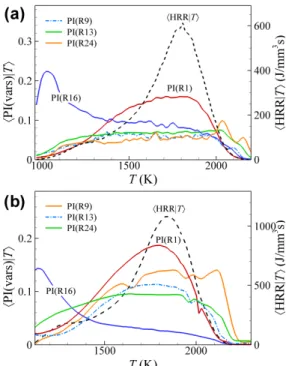
Fig. 9 The conditional mean of HRR and PI of controlling reactions on temperature at (a) the 15% CHRR, and at (b) the second-stage ignition
O2QOOH, and HO2 are controlling species,
and
R + (H, O, OH, HO2) → R + (H2, OH, H2O,
H2O2), and RO2 → QOOH are controlling
reactions. However, during the first-stage ignition, n-C7H16 and CH2O become the most
important species. Right after the first-stage
ignition, H2O2 + M → OH + OH + M (R16)
becomes active, and temperature becomes the
most important factor governing the
제 51회 KOSCO SYMPOSIUM 초록집(2015년도 추계학술대회) 180
contributions of n-C7H16, i-C8H18, and H2O2.
At the main combustion event, together with
temperature, H2O2, OH, and CO become
controlling variables, and H + O2 → O + OH
(R1) and CO + OH → CO2 + H (R24) are
controlling reactions.
Next, the same EI and PI analyses are applied to the 2-D DNS and the contours of EI and PI of critical species and reactions at different locations and time are shown in Figs. 5-7. The corresponding conditional means on temperature are calculated and shown in Fig. 8 for <EI(vars)|T> and Fig. 9 for <PI(vars)|T>. The 2-D CEM results are consistent with the findings from the 0-D ignition discussed above. However, it further reveals that at the low temperature regions (T
< 900 K), temperature, CH2O and n-C7H16 are
the key variables, while at the intermediate temperature regions (900 K < T < 1000 K),
HO2 and H2O2 become the most critical
species as readily seen in Fig. 8. Moreover, as
shown in Fig. 9, at T ∼ 1000-1200 K, the
chain-branching reaction of H2O2 via H2O2 +
M → OH + OH + M (R16) becomes highly
reactive, which subsequently results in
initiating high temperature chemistry.
Moreover, heat is primarily released at the locations of very thin flame-like fronts (deflagrations) via the reaction CO + OH →
CO2 + H (R24), which is triggered by the
chain branching reaction, H + O2 → O + OH
(R1) as readily observed in Figs. 7 and 9. The chemical aspects of the ignition process of PRF/air mixture under RCCI conditions were investigated by using CEM analysis. low temperature, CH2O and n-C7H16 are identified
as the predominant factors contributed to the CEM at the first-stage ignition, while the chain branching reaction of H2O2 and the
production reaction of HO2 are the main
reactions of the IT combustion. During thermal ignition, however, temperature is found to be the predominant factor and high-temperature reactions represented by H
+ O2 → O + OH are responsible for the
thermal ignition. At deflagrations, temperature, CO, and OH are the most important species while the conversion reaction of CO to CO2
and high-temperature chain branching reaction
of H + O2 → O + OH are identified to be
important to the CEM.
Acknowledgements
This research was supported by Basic Science
Research Program through the National
Research Foundation of Korea (NRF) funded by the Ministry of Science, ICT & Future Planning (No. 2015R1A2A2A01007378) and the 2015 Research Fund (1.150033.01) of UNIST. This research used the resources of the KAUST Supercomputing Laboratory.
References
[1] M.B. Luong, Z. Luo, T. Lu, S.H. Chung, C.S. Yoo, Combustion and Flame 160 (2013) 2038–2047.
[2] M.B. Luong, G.H. Yu, T. Lu, S.H. Chung, C.S. Yoo, Combustion and Flame (2015), http://dx.doi.org/10.1016/j.combustflame.2015.09. 015.
[4] Z. Luo, C.S. Yoo, E.S. Richardson, J.H. Chen, C.K. Law, T. Lu, Combust. Flame, 159 (2012) 265-274
[5] R. Shan, C.S. Yoo, J.H. Chen, T. Lu, Combust. Flame, 159 (2012) 3119-3127.
[6] C.S. Yoo, T. Lu, J.H. Chen, and C.K. Law, Combust. Flame 158 (2011) 1727-1741.
[7] M.B. Luong, T. Lu, S.H. Chung, C.S. Yoo, Combust. Flame 161 (2014) 2878-2889.
[8] S.O. Kim, M.B. Luong, J.H. Chen, C.S. Yoo, Combust. Flame 162 (2015) 717-726.