에스테르류의 연소열을 이용한 폭발한계의 예측
Estimation of Explosion Limits by Using Heats of Combustion for Esters
하동명 Dong-Myeong Ha 세명대학교 보건안전공학과
(2010. 4. 1. 접수/2010. 6. 11. 채택)
요 약
화학공정에서의안전하고최적화된조작과내재되어있는화재및폭발위험성평가를위해서연소특 성치를알아야한다. 폭발한계는가연성물질의화재및폭발위험성을결정하는데주요한특성치가운데하
나이다. 본연구에서, 에스테르류의폭발하한계와상한계에대해연소열을이용하여예측하였다. 제시된
예측식에의한예측값은문헌값과적은오차범위에서일치하였다. 제시된방법론을사용하여다른가연성 에스테르류의폭발한계예측이가능해졌다.
ABSTRACT
In order to evaluate the fire and explosion involved and to ensure the safe and optimized operation of chemical processes, it is necessary to know combustion properties. Explosion limit is one of the major combustion properties used to determine the fire and explosion hazards of the flammable sub- stances. In this study, the lower explosion and upper explosion limits of esters were predicted by using the heat of combustion. The values calculated by the proposed equations agreed with literature data within a few percent. From the given results, using the proposed methodology, it is possible to predict the explosion limits of the other ester flammable substances.
Key words :Explosion limit, Heat of combustion, Estimation, Esters, Combustion properties
1. 서 론
MSDS(Material Safety Data Sheet)에서제시되고있 는 가연성물질의 연소특성치로는 폭발한계(Explosion Limit), 인화점(Flash Point), 최소발화온도(Auto-ignition Temperature)를들수있다. 위험물질을취급하는사업 장에서는연소특성치를반드시알아야한다. 그러나사 업장에서널리사용되고있는물질인데도불구하고취 급물질의연소특성치가 제시되지않은 물질들이허다 하다. 이는이들물질의연소특성을고찰하기위한이 론적접근의어려움과실험의여러제약성으로한정된 연구가 이루어지기때문이다.1)
사업장에서취급하는가연성가스혹은증기는공기 또는 산소중에서어느 한정된범위의 농도가 되었을
때에만연소가일어난다. 즉공기나 산소중가연성가 스나증기의혼합비율이너무낮으면폭발을일으키지 않으며, 또한너무높아도폭발을일으키지않는다. 이 농도의 범위를 폭발범위(연소범위)라하고, 그한계를 폭발한계라고한다. 폭발한계는폭발하한계(LEL, Lower Explosion Limit)와폭발상한계(UEL, Upper Explosion
Limit)로나누어진다. 일반적으로가연성혼합가스의폭
발한계는 초기온도, 초기압력, 산소농도, 연소열, 분자 량, 발화원의특성, 불활성가스의비, 측정용기의크기,
혼합기체의물리적상태, 화염전파방향등에영향을받 는다.2)
가연성물질의연소특성치가운데폭발한계의연구로
Britton3)는 메탄의 폭발한계를 고찰하기 위해 1816년 Davy에서부터 2000년 Cashdollar 등이연구한수십편 의문헌을 고찰하여유용한폭발한계값을제시하였다.
Ha4-6)는메탄과프로판그리고수소에대한폭발특성
†E-mail: [email protected]
치를 연구하였다. 또한 Suzuki7)는유기화합물에 대해 연소열을이용하여폭발하한계예측식을제시하였으며,
Hanley8)는폭발한계와폭굉한계의관계를해석하기위
해 연소열에 의한 폭발한계의 예측식을 제시하였다.
Hshieh9)는유기 실리콘화합물에대해 연소열과끓는
점을이용하여폭발하한계의예측식을제시하였고, 최 등10)은 에스테르류의 연소열과 폭발하한계의 관계를 연구한 바있다.
본연구에서는산업현장에서용제및냉매로사용되 고 있는 에스테르류에 대해 연소열과 폭발하한계 및 상한계의관계를규명하여, 연소열에의한폭발한계를 예측할수있는경험식(Empirical Equation)을제시하고 자 한다. 여기서 제시한 방법론을 이용하여 실험에서 찾고자하는 다른에스테르류의 폭발한계자료에 도움 을 주고, 에스테르류의 산화, 발화, 연소의 공정의 안 전 자료로 사용되도록 하고, 또한 다른에스테르류의 화재및폭발특성치를예측하는방법으로이용하는데 목적이 있다.
2. 연소열과 폭발한계의 자료 및 기존 연구
2.1자료선택
연소열은 일반적으로 총연소열(Gross Heat of Combustion)과순연소열(Net Heat of Combustion)로나 타낼 수있다. 총연소열과 순 연소열의 차이는 물의 응축열이다. 화재및폭발안전의 관점에서는순연소 열이총연소열보다중요하다. 이는화재에서형성된 물이수증기상태이기때문이다. 일반적으로연소열의 자료는「Perry’s Chemical Engineers’ Handbook」11)과
「Handbook of Chemistry and Physics」12)에서얻을수 있으나, 이들문헌에서도연소열값을얻지못할경우 추산식을이용하여얻을수있다. 이런경우는모든유
기화합물에널리적용될수있는 Cardozo 방식13)이있다.
화재·폭발위험성의경우 UN IMDG(United Nations International Maritime Dangerous Goods) 및 UNRTDG (United Nations Recommendations on the Transport of Dangerous Goods) 등을참고하여 GHS의범위에서분 류내용과그근거를 확보가가능하다. 그러나 근거가
없는경우유해물질의자료조사는 HSDB (Hazardous Substances Data Bank), IUCLID(International Uniform Chemical Information Database) 등에서도 얻을 수있
다.14,15) 그리고 최근 널리 이용되는 자료로는 NFPA,
SFPE, Sigma Handbook, Ingition Handbook 등을들수 있다.16-19)
2.2폭발한계의예측연구
일반적으로화염에는그이하의온도는없다고하는 최저온도가 있고, 그값은 탄화수소화합물 등에서 약
1200oC가된다. 이와같은단열화염온도(Adiabatic Flame
Temperature)의한계가생기는것은탄화수소의폭발하
한계와 연소열에관계를 이용한 Burgess-Wheeler법칙
으로설명이가능하다.20,21)이법칙은즉두값(폭발하
한계와연소열)의곱은일정하고폭발하한계의단위를
Vol%, 연소열의단위를 kcal/mol로표시하면, 그 값은
약 1050이된다고 고려하면쉽게이해할수있다.
이법칙은폭발하한계에있어서발생하는열량은연 료의 종류에 관계없이동일하다. 따라서 그것에 관계 되는화염온도는일정하고동시에최저가되기때문이 다. 따라서 Burgess-Wheeler 법칙에 의한연소열과폭 발한계의 관계는다음과같다.
(∆Hc) × (LEL) = 1050 (1)
Suzuki7)는 Burgess-Wheeler 법칙을근거로유기화합 물에적용할수있는다음과같은관계식을제시하였다.
(2)
Hanley8)는폭발한계와 폭굉한계의관계를 연구하기
위해폭발한계의예측을다음과 같은제시하였다.
LEL(vol%) = 11.2(∆Hc)−1 (3)
UEL(vol%) = 54.24(∆Hc)−1 (4)
Hshieh9)는유기화합물및실리콘화합물에대해연소
열에의한폭발하한계의추산식을다음과같이제시하 였다.
LEL(vol%) = - 0.3822 + 11456.2246(− ∆Hc)−0.7972 (5) 3. 연소열에 의한 폭발한계 예측 모델
3.1다중회귀분석
변수와응답의관계를보다정량적으로표시하기위 해서사용된방법으로수학과통계학적인방식에의거 해서종속변수와 독립변수의관계식을구하는 방법을 다중회귀(Multiple Regression)이라 하며, 이 방법론은
그동안 최적조건(Optimum Condition)을구하는 방식 또는최적화(Optimization)에널리이용되어왔다. 변수
들에의한 화재위험성평가를 위한상관관계를 나타 낼수있는추산모델들가운데최적화된예측모델을
LEL vol%( ) = 1.80 − 3.42 1⎝⎛∆---Hc⎠⎞
+ 0.569∆Hc + 0.0538∆Hc2
찾기위해다중회귀분석(Multiple Regression Analysis)
을이용하였다.22,23)
제시한 모델을다항식의 일반적인형태로 표시하면 다음과 같다.
Y = a + bx + cx2+ dx3+ dx4+ … + pxp+ … (6)
여기서각매개변수 a, b, c, d, e, …을추산하기위해 최소화 방법을 이용하였다. 이 방법은 S.S.D.(Sum of Square of Deviation)을구하기위해각매개변수를편
미분하여 이를 영(Zero)으로 두어서 얻어지는 정규식
(Normal Equation)의해를구하면된다.
3.2연소열에의한폭발한계예측모델
에스테르류의연소열과폭발한계의 문헌자료를분 석 고찰한 결과 연소열과 폭발한계가 서로 상관관계 가있음을 알수있었다. 따라서연소열에의한 폭발 한계의 예측이 가능할것으로 사료되어 다음과 같은 관계식들을 이용하여 최적화 된추산 모델을 제시하 고자 한다.
본연구에서제시된연소열에의한폭발하한계예측 모델들은다음과같다.
(7) (8) (9)
그리고연소열에의한폭발상한계예측모델들을다 음과같이제시한다.
(10) (11) (12) (13) (14)
3.3문헌값과추산값의비교방법
추산값과문헌값의차이의정도를알기위해 A.A.P.E.
(Average Absolute Percent Error)와 A.A.D.(Average
Absolute Deviation)을사용하였다.23)
(15) (16)
여기서 ELest.는추산식에 의해 추산된 폭발하한계 및 상한계값이고, ELexp.는문헌에의한 폭발하한계및상
한계값이며, 그리고 N은자료수이다.
4. 연소열에 의한 폭발한계 고찰
4.1연소열에의한 폭발하한계예측
에스테르류의연소열과폭발하한계의관계를규명하
기위해 Graphical 방법에의해 여러모델을 이용하여
수학적 및 통계적인 방법으로 다음과 같은 최적화된 모델을얻었으며, 예측식은다음과같다.
(17)
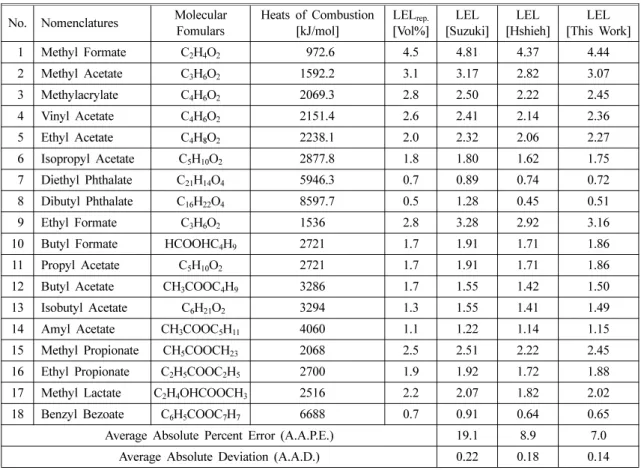
식 (17)에의해예측된폭발하한계를문헌값과 Suzuki
식과 Hshieh 식에의한예측값을비교하여 Table 1에나
타내었고, Figure 1에는문헌값과예측값의차이정도를
쉽게볼수있도록나타내었다. 본연구에서제시한예
측식에 의한예측값과 문헌값의 차이는 0.14Vol%로서
Suzuki 식에 의한 0.22Vol% 그리고 Hshieh 식에 의해
0.18Vol% 보다문헌값과일치함을보여주고있다. 따라
서본연구에서제시한식을이용하여폭발한계의예측 이가능하다. 또한실험에서조차 찾기어려운다른에 스테르류의폭발하한계예측방법으로이용할수있다.
4.2연소열에의한 폭발상한계예측
연소열에의한폭발상한계의관계를예측할수있는 최적화된 예측식을다음과같이얻었다.
(18)
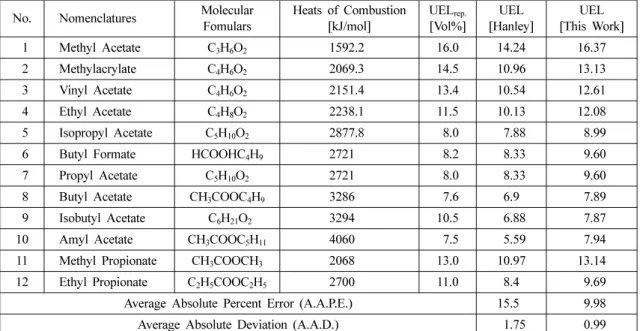
식 (18)에의해예측된폭발상한계를문헌값과 Hanley
식에 의한 예측값을 비교하여 Table 2에나타내었고,
Figure 2에는문헌값과예측값의 차이정도를쉽게볼
수있도록 나타내었다. 본연구에서 제시한 예측식에 LEL = a + b 1∆--- + cHc ∆Hc + d∆Hc2
LEL = a + b∆Hc + c∆Hc2 + d∆Hc3
LEL = a + b 1∆--- + cHc ∆Hc + d∆Hc2 + ∆Hc3
UEL = a + b 1∆---Hc
UEL = a + b 1∆--- + cHc ∆Hc
UEL = a + b 1∆--- + c 1Hc
∆Hc2
--- UEL = a + b 1∆--- + cHc ∆Hc + d∆Hc2
UEL = a + b∆Hc + c∆Hc2 + d∆Hc3
A.A.P.E. =
ELest. − ELexp.
ELexp.
--- ---N
∑ ×100 A.A.D. = ELest. − ELexp.
---N
∑
LEL = 3.0532 + 2248.969 1∆---Hc − 1092.34(∆Hc)
+ 1.4724 10× −7(∆Hc)2 − 6.7557 10× −12(∆Hc)3
UEL = 50.672 − 13204 1∆---Hc
− 2.060 10× −2∆Hc + 2.680 10× −6∆Hc2
의한예측값과문헌값의차이는 0.99Vol%로서 Hanley
식에 의한 1.75Vol% 보다 문헌값과 일치함을 보여주
고있다. 따라서본연구에서제시한식을이용하여폭
발상한계의예측이가능하다. 또한실험에서조차 찾기 어려운다른에스테르류의폭발상한계를예측할수있 는자료로이용할수있다.
5. 결 론
에스테르류에 대해 연소열과 폭발하한계의 관계를 규명하고, 연소열에의한 폭발하한계 및상한계를 예 측할수있는새로운추산식을제시하고, 기존의 예측 식과비교한결과다음과 같은결론을얻었다.
1) 에스테르류의연소열에 의한폭발하한계및상한 계예측식은다음과 같다.
2) 본연구에서제시한예측식에의한폭발하한계의
문헌값과예측값의차이가평균 0.14Vol%, 폭발상한계
의 문헌값과 예측값은 평균 0.99Vol%로서 기존의 예
측식보다향상된결과를 보였다.
3) 본연구에서제시한예측식을사용하여실험에서
Table 1. Comparison between Reported and Predicted LEL by Means of Heats of Combustion Using Several Correlation for Esters
No. Nomenclatures Molecular
Fomulars Heats of Combustion
[kJ/mol] LELrep.
[Vol%] LEL
[Suzuki] LEL
[Hshieh] LEL [This Work]
01 Methyl Formate C2H4O2 0972.6 4.5 4.81 4.37 4.44
02 Methyl Acetate C3H6O2 1592.2 3.1 3.17 2.82 3.07
03 Methylacrylate C4H6O2 2069.3 2.8 2.50 2.22 2.45
04 Vinyl Acetate C4H6O2 2151.4 2.6 2.41 2.14 2.36
05 Ethyl Acetate C4H8O2 2238.1 2.0 2.32 2.06 2.27
06 Isopropyl Acetate C5H10O2 2877.8 1.8 1.80 1.62 1.75 07 Diethyl Phthalate C21H14O4 5946.3 0.7 0.89 0.74 0.72 08 Dibutyl Phthalate C16H22O4 8597.7 0.5 1.28 0.45 0.51
09 Ethyl Formate C3H6O2 1536 2.8 3.28 2.92 3.16
10 Butyl Formate HCOOHC4H9 2721 1.7 1.91 1.71 1.86
11 Propyl Acetate C5H10O2 2721 1.7 1.91 1.71 1.86
12 Butyl Acetate CH3COOC4H9 3286 1.7 1.55 1.42 1.50
13 Isobutyl Acetate C6H21O2 3294 1.3 1.55 1.41 1.49
14 Amyl Acetate CH3COOC5H11 4060 1.1 1.22 1.14 1.15
15 Methyl Propionate CH5COOCH23 2068 2.5 2.51 2.22 2.45
16 Ethyl Propionate C2H5COOC2H5 2700 1.9 1.92 1.72 1.88
17 Methyl Lactate C2H4OHCOOCH3 2516 2.2 2.07 1.82 2.02
18 Benzyl Bezoate C6H5COOC7H7 6688 0.7 0.91 0.64 0.65
Average Absolute Percent Error (A.A.P.E.) 19.1 8.9 7.0
Average Absolute Deviation (A.A.D.) 0.22 0.18 0.14
Figure 1. Comparison between reported and predicted lower explosion limits (LEL) for esters.
조차 찾기 어려운 다른 에스테르류의 폭발하한계 및 상한계의예측이가능하다.
참고문헌
1. E. Meyer, “Chemistry of Hazardous Materials“, 2nd
ed., Prentice-Hall(1990).
2. D. Bjerketvedt, J.R. Bakke, and K. van Wingerden,
“Gas Explosion Handbook”, J. of Hazardous Materials, Vol.52, pp.1-150(1997).
3. L.G. Britton, “Two Hundred Years of Flammable Limits”, Process Safety Progress, Vol.12, No.1, pp.1-11(2002).
4. 하동명, “메탄의화재및폭발위험성평가”, 한국가스
학회지, Vol.9, No.2, pp.1-7(2005).
5. 하동명, “프로판가스의화재및폭발특성치에관한 연구”, 한국가스학회지, Vol.10, No.2, pp.33-39 (2006).
6. 하동명, “안전한수소이용을위한연소특성치고찰”,
한국가스학회지, Vol.12, No.2, pp.1-6(2008).
7. T. Suzuki, “Empirical Relationship Between Lower Flammability Limits and Standard Enthalpies of combustion of Organic Compounds”, Fire and Materials, Vol.18, pp.333-336(1994).
8. B.F. Hanley, “A Model for the Calculation and the Verification of Closed Flash Points Multicomponent Mixtures”, Process Safety Progress, Vol.17, No.2, pp.86-97(1998).
9. F.-Y. Hshieh, “Predicting Heats of Combustion and Lower Flammability Limits of Organosilicon Compounds”, Fire and Materials, Vol.23, pp.79-89 (1999).
10. 최용찬, 지성환, 오종민, 김해동, 이성희, 하동명, “에
Table 2. Comparison between Reported and Predicted UEL by Means of Heats of Combustion Using Several Correlation for Ester
No. Nomenclatures Molecular
Fomulars Heats of Combustion
[kJ/mol] UELrep.
[Vol%] UEL
[Hanley] UEL
[This Work]
01 Methyl Acetate C3H6O2 1592.2 16.0 14.24 16.37
02 Methylacrylate C4H6O2 2069.3 14.5 10.96 13.13
03 Vinyl Acetate C4H6O2 2151.4 13.4 10.54 12.61
04 Ethyl Acetate C4H8O2 2238.1 11.5 10.13 12.08
05 Isopropyl Acetate C5H10O2 2877.8 08.0 07.88 08.99
06 Butyl Formate HCOOHC4H9 2721 08.2 08.33 09.60
07 Propyl Acetate C5H10O2 2721 08.0 08.33 09.60
08 Butyl Acetate CH3COOC4H9 3286 07.6 6.9 07.89
09 Isobutyl Acetate C6H21O2 3294 10.5 06.88 07.87
10 Amyl Acetate CH3COOC5H11 4060 07.5 05.59 07.94
11 Methyl Propionate CH3COOCH3 2068 13.0 10.97 13.14
12 Ethyl Propionate C2H5COOC2H5 2700 11.0 8.4 09.69
Average Absolute Percent Error (A.A.P.E.) 15.50 09.98
Average Absolute Deviation (A.A.D.) 01.75 00.99
Figure 2. Comparison between reported and predicted upper explosion limits (UEL) for esters.
스테르류의연소열과폭발하한계관계”, 화학공학의 이론과응용, Vol.7, No.1, pp.689-692(2001).
11. R.H. Perry and G.W. Green, “Perry’s Chemical Engineers' Handbook”, 7th ed., MaGraw-Hill, New York(1997).
12. D.R. Lide, “Handbook of Chemistry and Physics”, 76th ed., CRC Press, Boca Raton(1995).
13. R.D. Cardozo, “Prediction of the Enthalpy of Combustion of Organic Compounds”, AICHE Journal, Vol.32, No.5, pp.844-847(1986).
14, HSDB (Hazardous Substances Data Bank), http://
toxnet.nlm.nih.gov/cgi-bin/sis/htmlgen?HSDB.
15. IUCLID (International Uniform Chemical Information Database), http://ecb.jrc.it/existing-chemicals/.
16. NFPA, “Fire Hazard Properties of Flammable Liquid, Gases, and Volatile Solids”, NFPA 325M, NFPA(1991).
17. SFPE, “SFPE Handbook of Fire Protection Engin-
eering”, 2nd ed., SFPE(1995).
18. R.E. Lenga and K.L. Votoupal, “The Sigma Aldrich Library of Regulatory and Safety Data, Volume I~III”, Sigma Chemical Company and Aldrich Chemical Company Inc.(1993).
19. V. Babrauskas, “Ignition Handbook”, Fire Science Publishers, SFPE(2003).
20. F.P. Lees, “Loss Prevention in the Process Industries Vol.1”, 2nd ed., Oxford Butterworth-Heinemann (1996).
21. 이수경, 하동명, “최신화공안전공학”, 동화기술(1997).
22. G.E.P. Box and N.R. Draper, “Empirical Model- Building and Response Surface”, John-Wiley &
Sons, Inc.(1987).
23. 하동명, “Prediction of Explosion Limits Using Normal Boiling Points and Flash Points of Alcohols Based on a Solution Theory”, 한국화재소방학회논 문지, Vol.19, No.4, pp.26-31(2005).