저작자표시-비영리-변경금지 2.0 대한민국 이용자는 아래의 조건을 따르는 경우에 한하여 자유롭게
l 이 저작물을 복제, 배포, 전송, 전시, 공연 및 방송할 수 있습니다. 다음과 같은 조건을 따라야 합니다:
l 귀하는, 이 저작물의 재이용이나 배포의 경우, 이 저작물에 적용된 이용허락조건 을 명확하게 나타내어야 합니다.
l 저작권자로부터 별도의 허가를 받으면 이러한 조건들은 적용되지 않습니다.
저작권법에 따른 이용자의 권리는 위의 내용에 의하여 영향을 받지 않습니다. 이것은 이용허락규약(Legal Code)을 이해하기 쉽게 요약한 것입니다.
Disclaimer
저작자표시. 귀하는 원저작자를 표시하여야 합니다.
비영리. 귀하는 이 저작물을 영리 목적으로 이용할 수 없습니다.
변경금지. 귀하는 이 저작물을 개작, 변형 또는 가공할 수 없습니다.
Doctor of Philosophy
Design and Implementation of Automatic Person Indexing and Retrieval System Based on the
Overlay Text in the News Interview Video Sequences
The Graduate School of the University of Ulsan
Department of Electrical/Electronic and Computer Engineering
Lee, Sanghee
[UCI]I804:48009-200000224447 [UCI]I804:48009-200000224447
Design and Implementation of Automatic Person Indexing and Retrieval System Based on the
Overlay Text in the News Interview Video Sequences
Supervisor: Kang-Hyun Jo
A Dissertation
Submitted tothe Graduate School of the University of Ulsan In Partial Fulfillment of the Requirements
for the Degree of
Doctor of Philosophy in Engineering by
Lee, Sanghee
Department of Electrical/Electronic and Computer Engineering Ulsan, Korea
August 2019
Design and Implementation of Automatic Person Indexing and Retrieval System Based on the
Overlay Text in the News Interview Video Sequences
This certifies that the dissertation of Sanghee Lee is approved.
Committee Chair Prof. Hee-Jun Kang
Committee Member Prof. Young-Soo Suh
Committee Member Prof. Jang-Sik Park
Committee Member Prof. Hyun-Deok Kang
Committee Member Prof. Kang-Hyun Jo
Department of Electrical/Electronic and Computer Engineering Ulsan, Korea
August 2019
iv
ACKNOWLEDGMENTS
I would like to say thank all those who accompanied and supported me during the doctor course.
First of all, I would like to take this opportunity to express my deepest gratitude to my supervisor Professor Kang-Hyun Jo, for allowing me the opportunity to be a part of his research group and for his brilliant insight, patient guidance and constant encouragement which help me to complete this work. It is very honored for me to study with him. Without his support, the completion of this dissertation would have never become possible, and have remained a dream.
I sincerely thank Professor Hee-Jun Kang, Professor Young-Soo Suh from the University of Ulsan, Professor Jang-Sik Park from the Kyungsung University, and Professor Huyn-Deok Kang from the Ulsan National Institute of Science and Technology (UNIST) who are other members of my committee. I would like to express my deepest gratitude for being gladly given time for my work and giving advice on the lack of my thesis and things I did not think about. And I would like to thank Professors at Graduate School of Electrical/Electronic and Computer Engineering, the University of Ulsan for their brilliant teaching.
I am grateful to my former and current group colleagues of our laboratory.
They are a great researcher and very good friends. Especially I would like to say thank the Korean students, Dongwook, Youlkyeong, Giseok, Bumsuk, Jinsu, Hansung, Jungwon, and Byungseok for their sincerely help during studying.
I would like to thank my parents-in-law and their family, my younger sister and her family since I always received from their encouragement. Most of all, I would like to especially thank my wife Seung-Eun, my two sons Donggeun and Dongjin for their endless love, understanding, and encouragement.
Finally, I dedicated this dissertation to my mother in heaven. My mother was always my friend and guide in my life.
v
ABSTRACT
Design and Implementation of Automatic Person Indexing and Retrieval System Based on the Overlay Text in the
News Interview Video Sequences
Graduate School of the University of Ulsan,
Department of Electrical/Electronic and Computer Engineering, Ulsan, Korea
Lee, Sanghee
With the advent of the digital age, a vast amount of video data has been created by consumers and professionals over the last few decades. And the advances in the data capturing, storage, and communication technologies have made vast amounts of video data available to consumer and professional applications. The tremendous increase in the use of video data entails a need to develop effective methods to manage these multimedia resources by their content. In response to such demands, many researchers have been motivated to develop powerful indexing systems to ensure easy access to the relevant information, navigation, and organization in the vast repositories of video data.
Recognizing the overlay text embedded in images and videos provides high-level semantic clues which enhance tremendously the automatic image and video indexing. These texts contain a more concise and direct description of the content of the video. Therefore, the overlay text plays an important role in the automated content analysis systems such as the scene understanding, indexing, browsing, and retrieval.
vi
Especially, the overlay text in the broadcasting news video sequences provides more meaningful of the content than any other type of videos. The detection and recognition of the overlay text have become a hot topic in news video analysis such as identification of person or place, name of the new-worthy event, date of the event, stock market, other news statistics, and news summaries.
This dissertation proposes a novel approach to extract meaningful content information from the broadcasted news video sequences by collaborative integration of image understanding and natural language processing. As an actual example, we developed a person browser system that associates faces and overlaid name texts in videos. This is given news videos as a knowledge source, then automatically extracts face and name text association as content information. The proposed framework consists of the text detection module, the face detection module, and the person indexing module.
For the preprocessing step, the proposed system makes the sub-clip based on the beginning frame for only focusing on the frames with overlay text. In the text detection module, the system executes overlay text detection and separates the name text line. And the system processes detection and extraction of the overlay text, and text recognition by optical character recognition (OCR). In the face detection module, the face thumbnail is extracted. The face detection module makes the representative thumbnail of the interviewee. And the person indexing module generates automatically the index metadata by named entity recognition (NER). And finally, the person indexing database is automatically made by combining the recognized text with the face thumbnail.
The successful results of person information extraction reveal that the proposed methodology of integrated use of image understanding techniques and natural language processing technique is headed in the right direction to achieve our goal of accessing real contents of multimedia information.
vii
Contents
Supervisory Committee ··· iii
Acknowledgments ··· iv
Abstract ··· v
Contents ··· vii
List of Figures ··· ix
List of Tables ··· xi
Nomenclature ··· xii
1. Introduction 1 1.1 Motivation and Background ··· 1
1.2 Kinds of Text in Video ··· 2
1.3 The Reason for Using News Videos ··· 4
1.4 The Predominant Difficulties in Video OCR ··· 6
1.5 Dissertation Objective ··· 7
1.6 Dissertation Outline ··· 8
1.7 Unification of Words, Phrases, and Definitions in This Dissertation ··· 11
2. Literature Review 12 2.1 Introduction ··· 12
2.2 Text Frame Detection ··· 12
2.3 Text Localization ··· 13
2.3.1 Region-based Approaches ··· 14
2.3.2 Texture-based Approaches ··· 15
2.4 Text Tracking and Extraction ··· 16
2.4.1 Text Tracking ··· 17
2.4.2 Text Extraction ··· 18
2.5 Text-Based Video Indexing and Retrieval ··· 19
2.6 Named Entity Recognition ··· 20
2.6.1 Using Rule-based ··· 21
2.6.2 Using Statistical Model-based ··· 22
3. Video Clip Segmentation 23 3.1 Introduction ··· 23
3.2 Characteristics of Overlay Text in Video ··· 24
3.3 Comparison of the Beginning Frame Identification Methods ··· 26
viii
3.3.1 Method by the Canny Edge Detector ··· 26
3.3.2 Method by the Harris Corner Detector ··· 28
3.4 Video Clip Segmentation ··· 31
4. Name Text Line Localization 33 4.1 Introduction ··· 33
4.2 Representative Frames Selection ··· 36
4.3 Multiple-Edge-Map Image Generation ··· 39
4.4 Overlay Text Region Detection ··· 40
4.5 Name Text Line Detection and Localization ··· 42
5. Personal Information Extraction 44 5.1 Introduction ··· 44
5.2 Text Recognition ··· 46
5.3 Personal Information Extraction ··· 46
5.4 Person Indexing Database ··· 48
6. Experimental Results and Analysis 49 6.1 Data Set ··· 49
6.2 The Example of Implementation ··· 50
6.3 Beginning Frame Detection ··· 52
6.3.1 The Beginning Frame Identification ··· 52
6.3.2 Usefulness of Beginning Frame Identification ··· 54
6.3.3 Comparison of Text Beginning Frame Detection Methods ··· 55
6.4 Name Text Line Detection and Localization ··· 58
6.5 Name Text Recognition ··· 60
6.6 Personal Information Extraction ··· 61
7. Conclusion 62 7.1 Conclusion ··· 62
7.2 Future Research Direction ··· 63
Publications I
A. Patent I
B. Journals II
C. Conferences III
Bibliography IV
ix
LIST OF FIGURES
1.1 The example of kinds of the text in video sequences ··· 3
1.2 The typical composition of news videos ··· 4
1.3 The example of the rule-based overlay text in news interview video sequences ··· 5
1.4 The proposed entire working pipeline ··· 9
1.5 The proposed framework for automatic person indexing··· 9
3.1 The example of overlay text appearance in news video sequences ··· 24
3.2 The result of edge density using the Canny edge detector (a) frame 1 (b) frame 13 (c) frame 25 (d) the plot of edge density in whole video sequences ··· 27
3.3 The result of edge density using the Harris corner detector (a) frame 1 (b) frame 13 (c) frame 25 (d) the plot of edge density in whole video sequences ··· 30
3.4 The characteristics of overlay text in news video sequences ··· 32
3.5 The workflow for the video clip segmentation ··· 32
4.1 The workflow of name text line localization ··· 35
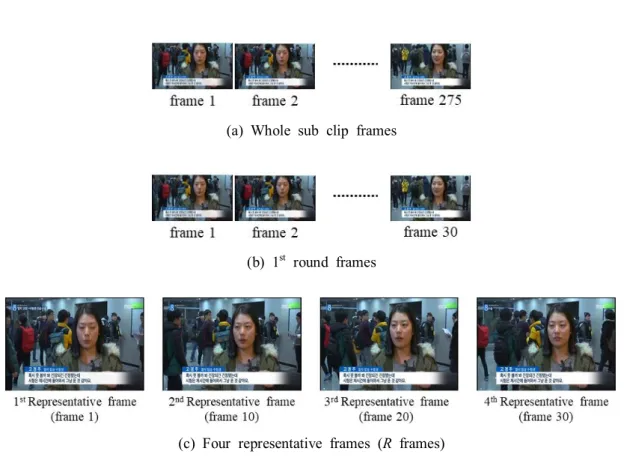
4.2 Representative frames (R frames) selection (a) Whole sub clip frames (b) 1st round frames (c) Four representative frames (R frames) ··· 38
4.3 The edge images of the four representative frames (R frames) ··· 38
4.4 The Multiple-Edge-Map image ··· 39
4.5 The result of overlay text region detection (a) 1st Representative frame (b) Overlay text region image ··· 41
4.6 The example of the broadcasting news interview video ··· 42
4.7 The result of horizontal projection detection (a) Multiple-Edge-Map image (b) Horizontal projection image ··· 43
4.8 The result of overlaid name text line localization ··· 43
5.1 The personal information extraction ··· 45
5.2 The example of a text recognition recognition (a) Name text line image (b) Name text line binary image (c) Text string obtained by ABBYY FineReader ··· 47
x
5.3 The example of a NER result of the name text line (a) Text string obtained by OCR (b) NER result ··· 47 6.1 Person browser system (a) The user interface for automatic personal
information detection (b) The user interface for retrieval ··· 51 6.2 The examples of the beginning frame identification (a) Original image (b)
Canny edge image (c) Plot of edge density ··· 53 6.3 The comparative experimental results of the usefulness of the beginning
frame (a) Original image (b) Using beginning frame (c) Not using beginning frame ··· 54 6.4 Comparison of text beginning frame detection method (a) Original image
(b) Canny edge (c) Canny density (d) Harris corner (e) Harris density ··· 57 6.5 The result of name text line detection and localization (a) Original image
(b) Overlay text region (c) Name line mask (d) Name text line ··· 59 6.6 The examples of an experimental result of text recognition (a) Name text
line (b) Binary image (c) Text string ··· 60
xi
LIST OF TABLES
Table 1. The example of the NER Table in the indexing database ··· 48 Table 2. The results of the beginning frame identification ··· 52 Table 3. Comparison of the Canny edge detector with the Harris corner
detector ··· 57 Table 4. The experimental results of name text line detection and localization · 59 Table 5. The experimental results of named entity recognition ··· 61
xii
NOMENCLATURE
OPN Overlay Person Name
OCR Optical Character Recognition NER Named Entity Recognition MPEG Moving Picture Experts Group
HSV Hue-Saturation-Value
HLS Hue-Lightness-Saturation
RGB Red-Green-Blue
LBP Local Binary Pattern HOG Histogram of Gradient DCT Discrete Cosine Transform MLP Multi-Layer Perceptron SVM Support Vector Machine
CAMSHIFT Continuously Adaptive Mean-SHIFT
ASCII American Standard Code for Information Interchange ROI Region of Interests
NLP Natural Language Processing NLTK Natural Language Tool Kit
PER Person name tag
ORG Organization tag
LOC Location tag
TP True Positive
FN False Negative
FP False Positive
TN True Negative
Chapter 1
Introduction
1.1 Motivation and Background
With the advent of the digital age, a vast amount of video data has been created by consumers and professionals over the last few decades. And the advances in the data capturing, storage, and communication technologies have made vast amounts of video data available to consumer and professional applications. The tremendous increase in the use of video data entails a need to develop effective methods to manage these multimedia resources by their content. In response to such demands, many researchers have been motivated to develop powerful indexing systems to ensure easy access to the relevant information, navigation, and organization in the vast repositories of video data.
Multimedia entities carry two types of information: content-based information and concept-based information. The content-based information of low-level features, such as colors, shapes, edges, frequencies, the energy of the signal, could be automatically identified and extracted. However, the concept-based information consists of high-level
Chapter 1 Introduction 2
features, called also semantic features. This information indicates what is represented in the video or what is meant by the audio signal. In general, this information is hardly identified automatically [1].
One of the goals of the multimedia indexing community is to design a system able to producing a rich semantic description of any multimedia document. To parse, index or abstract massive amounts of data, various video content analysis schemes have been proposed to use one or a combination of image, audio, and textual information in the videos. Among the semantic features, the text embedded in the video frames is of particular interests. Because the texts present in the video can provide important supplemental information for indexing and retrieval. And, the texts provide more intuitive information for people to understand the meaning of video content. For example, superimposed texts in news videos annotate the names of people and places or describe objects. With the help of the extracted related to the news, the news videos can be segmented and cataloged more accurately. Therefore, it enables applications such as keyword-based video search, automatic video logging, and text-based video indexing [1-3].
1.2 Kinds of Text in Video
For the problem “What is text?”, the answer could be structured edges, a series of uniform color regions, a group of strokes, or a kind of texture. However, there are many objects in natural scenes, such as leaves, fences or windows, that have similar edges, strokes, or texture properties with text, making it difficult to design effective feature representation to discriminate text. A better assumption could be that “Text is a hybrid of edges, connected-components, strokes, and texture”. Based on this assumption, this dissertation proposed for text detection work [4].
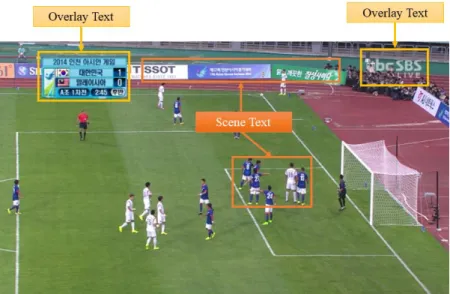
There exist mainly two kinds of text in videos. One is the scene text and the other is the overlay text (called graphics text or caption in other papers) such as Fig.
1.1. The scene text naturally exists in the image being record in native environments.
Chapter 1 Introduction 3
On the other hand, the overlay text is graphically generated and artificially overlaid on the image by a human at the time of editing.
The scene text is found in the street signs, text on cars, writing on shirts in natural scenes. The appearance of the text is occasional and usually brings less related to video information. Also, the difference between the different scene text is very big.
However, The overlay text is used to describe the content of the video or give additional information related to it. The examples of the overlay text include the subtitles in news videos, sports scores. Recognizing the overlay text embedded in images provides high-level semantic clues which enhance tremendously an automatic image and video indexing. These texts contain a more concise and direct description of the content of the video. Therefore, the overlay text plays an important role in the automated content analysis systems such as the scene understanding, indexing, browsing, and retrieval [5-7].
Fig. 1.1 The example of kinds of the text in video sequences
Chapter 1 Introduction 4
1.3 The Reason for Using News Videos
Especially, the overlay text in the news videos provides more meaningful of the content than any other type of videos. The detection and recognition of the overlay text have become a hot topic in news video analysis such as identification of person or place, name of the new-worthy event, date of the event, stock market, other news statistics, and news summaries [6-8].
Among these applications, the identification of the person from the overlay text raises a lot of interest in the information research community. The identification using the overlay person names (OPNs) has started to be investigated [2]. Since then the research area has raised a large amount of work, especially in face clustering tasks, face naming in captioned images, and recently, automatic naming within broadcasting videos [9-15].
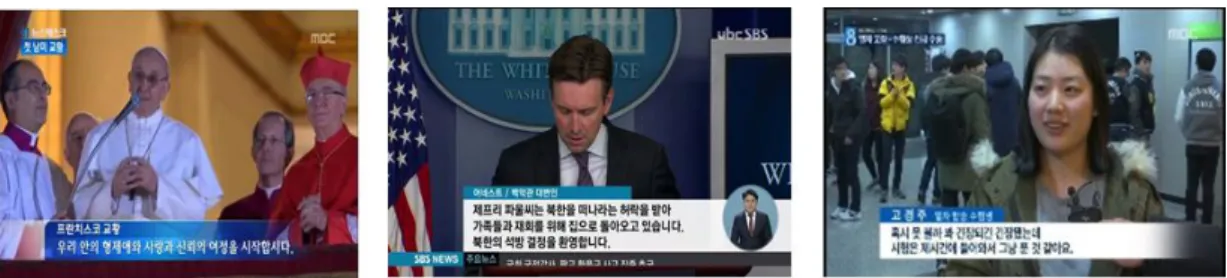
Fig. 1.2 shows a typical composition of a news video. A news video consists of image sequences which may contain persons’ face and transcripts which may contain persons’ names. We are aiming at real content information extraction from news videos.
News videos give us important content information, e.g., President... went to... to attend... meeting, Prime Minister... said... at that meeting, Senate leader ... talked about ..., etc. Looking at these types of content, it can be said that “who” information, i.e.
the face and name association, is one of the most important information in news videos [16].
Fig. 1.2. The typical composition of news videos
Chapter 1 Introduction 5
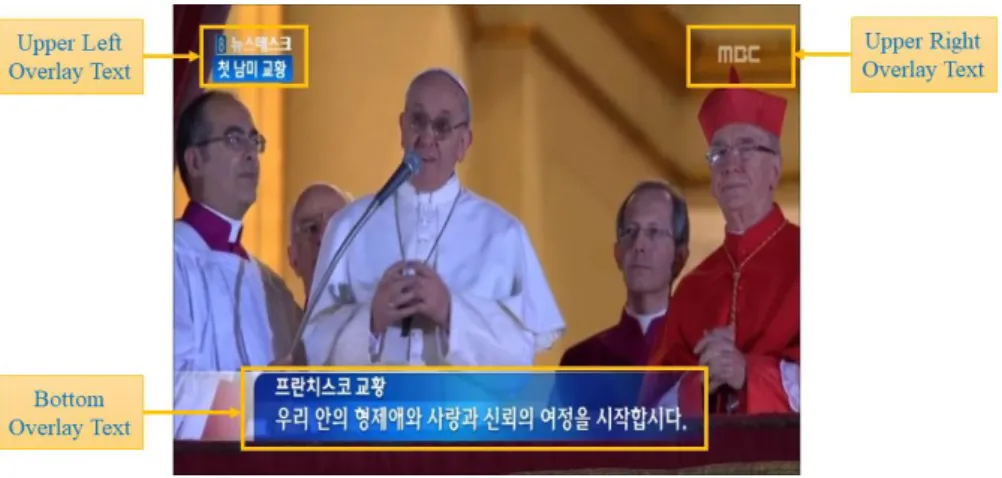
Since the broadcasting video is produced by professional, many of the accepted production rules apply to the TV contents. For example, text and log are often overlaid onto the natural content in a structured manner, such as aligned text lines at the bottom or on the upper corners of the screen, to minimize the chance of covering the important content as shown in Fig. 1.3 [8].
And the common properties in most news video sequences are summarized as follows: The overlay text position is fixed, generally in the range of 1/3 from the bottom of the frame. The background of the text is usually opaque or translucent, and in most case, the color of the background is eye-catching, such as white, blue, yellow, and so on. Colors of text characters are often very distinguishable from the background color. The size and fonts of the overlay text from the same news video generally remain unchanged for a long term [8]. Therefore, this dissertation uses the above rule-based characteristics. And this rule-based classifier well distinguishes overlay text from any other scene in news video sequences.
Fig. 1.3. The example of the rule-based production in news interview video sequences
Chapter 1 Introduction 6
1.4 The Predominant Difficulties in Video OCR
Text appears in videos in a wide range of writings, fonts, styles, colors, sizes, orientation, and so on. Therefore, these problems make the exact modeling of all types of text almost impossible [17].
In natural environments, numerous man-made objects, such as buildings, symbols, and paintings, appear that have similar structures and appearances to text.
Overlay text itself is typically laid complexity is that the surrounding scenery makes it difficult to discriminate text from non-text. Video compression and decompression procedures degrade the quality of overlay text in the video sequences. The typical influence of degradation is that they reduce characters sharpness and introduce touching characters. Therefore this effect makes basic task such as segmentation difficult [4].
Overlay text in the video sequences has different aspect ratios. To detect text, a search procedure with respect to location, scale, and length needs to be considered. As a result, high computational complexity is incurred. In the case of perspective distortion, text boundaries lose rectangular shapes and characters distort, decreasing the performance of recognition models trained on undistorted samples. Characters of italic and script fonts make it difficult to perform segmentation. Characters of various fonts have large within-class variations and form many pattern sub-spaces, making it difficult to perform accurate recognition when the characters class number is large [4].
Therefore, since the motivation behind the proposed method is semantic indexing, this dissertation concentrates on horizontally aligned overlay text in the broadcasting news. And in television news videos, the predominant difficulties in performing video OCR on overlay text are due to low-resolution characters and widely varying complex backgrounds. For the problem of complex backgrounds, an image enhancement method by multi-frame integration is employed using the enhanced resolution interpolation frames. Although complex backgrounds usually have movement, the position of video captions is relatively stable across frames. Furthermore, we assume that overlay texts have high-intensity values such as white pixels [2]. Therefore, this dissertation employs a technique to minimized the variation of the background using a time-based minimum pixel value search.
Chapter 1 Introduction 7
1.5 Dissertation Objective
Potential applications of the overlay text include the creation of the face-name association database, video annotation by person’s name, and so on [16]. This dissertation proposes a novel approach to extract meaningful content information from the broadcasted news video sequences by collaborative integration of image understanding and natural language processing. As an actual example, we developed a person browser system that associates faces and names in videos. This is given news videos as a knowledge source, then automatically extracts face and name text association as content information.
Although humans seem to be able to do this easily, this process includes several complicated, and high-level processes: Text detection and recognition, Face detection and identification, and Named entity recognition. It is very hard for a computer to achieve these processes automatically. They are still far from complete, but it may be promising to properly integrate those techniques to get useful results. This dissertation takes the strategy to bring a face and name association to fruition. The proposed method is used production rule based name text line extraction and recognition, and dictionary-based named entity extraction, despite these being still incomplete.
When a description of all multimedia information is performed by a human, not only the tremendous amount of work is needed, but also it is difficult to maintain the consistency of human subjective thoughts. Therefore, the technology of automatic metadata generation and indexing is required to retrieve related information by data contents.
Until now, a common indexing method for various videos is impossible.
Therefore, in order to handle video data efficiently, proper indexing technique considering characteristics of video data is needed. This dissertation aims at improving the convenience of news retrieval to users by efficiently and automatically indexing news that is broadcasted daily.
Chapter 1 Introduction 8
1.6 Dissertation Outline
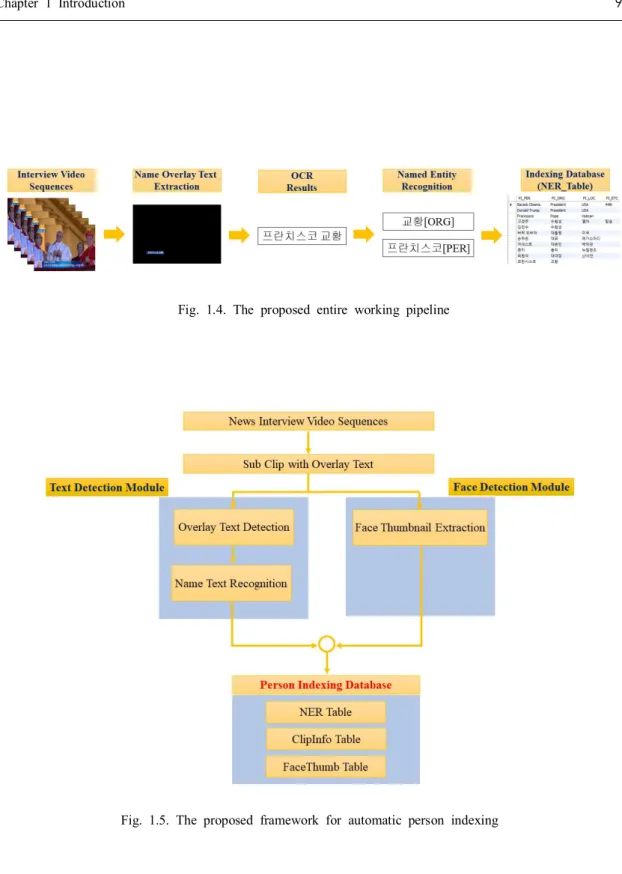
This dissertation is presented an entire working pipeline for automatic person information extraction tailored specially for the broadcasted news interview video sequences as shown in Fig. 1.4. To do this goal, the proposed framework consists of the text detection module, the face detection module, and the person indexing database module as shown in Fig. 1.5.
For the preprocessing step, this system makes the sub-clip based on the beginning frame for only focusing on the frames with overlay text. In the text detection module, this system executes the overlay text detection and separates the name text line.
And the system processes detection and extraction of the overlay text, and text recognition by optical character recognition (OCR). In the face detection module, the face thumbnail is extracted. The face detection module makes the representative thumbnail of the interviewee. And the person indexing database module generates automatically the index metadata by named entity recognition (NER). And finally, a person indexing database is automatically made by combining the recognized text with the face thumbnail.
The process of extraction carries detection, localization, tracking, extracting, enhancement and recognition of the text from a given image as shown in Fig. 1.4. Text detection refers to the identification of text in a given video frame. Text localization refers to determine the location of the text in the frame or sequence of the video frame. Text tracking is performed to cut back the interval for text localization and to maintain the position across adjacent frames. The precise location of text in a frame indicated by bounding boxes, the text still has to be divided from the background to use for its recognition. Text extraction is the stage that the text components are segmented from the background. Extracted text components are required enhancement because the text region usually has low-resolution and is susceptible to noise. The extracted text images are transformed into plain text using OCR technology.
The remainder of this dissertation is given as follows. Section 2 describes the relatives’ works per step by step of the proposed system.
Chapter 1 Introduction 9
Fig. 1.4. The proposed entire working pipeline
Fig. 1.5. The proposed framework for automatic person indexing
Chapter 1 Introduction 10
In section 3, for the preprocessing step, the proposed system makes the sub-clip based on the beginning frame for only focusing on the frames with overlay text. This dissertation is compared to the performance of the beginning frame identification by the experiment between the Canny edge detector and the Harris corner detector. Then, the appropriate processing method is proposed with the detection beginning frame with Canny edge.
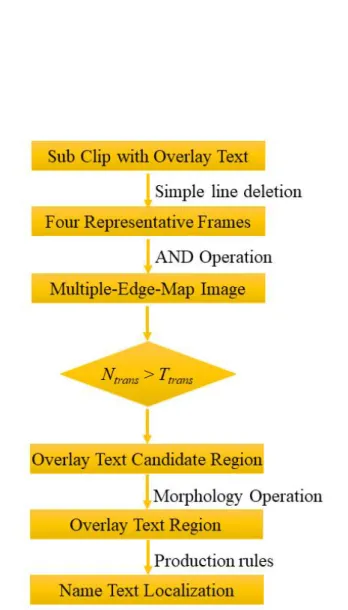
Section 4 describes the name text line localization. This dissertation uses the temporal analysis of the broadcasted news videos to achieve a good accuracy of video text detection. And the method uses the rule-based characteristics in the production of a TV news program.
Section 5 describes personal information extraction. For the broadcasted interview video archives, this dissertation presents how to build automatically indexing by identifying the named entities in the extracted overlay name text.
Section 6 presents the person browser system using the proposed method and the experimental results.
In section 7, the conclusion is drawn and presents some ideas and suggestions for future works.
Chapter 1 Introduction 11
1.7 Unification of Words, Phrases, and Definitions in This Dissertation
In computer vision, several words, phrases, and definitions get a relative meaning. For instance, for text-based video indexing and retrieval, a typical system contains four main parts: Text Detection, Text Localization, Text Tracking, Text Extraction, and Text Recognition [18]. To easily discuss and compare our method and the others, we unify the commonly used words, phrases, and definitions as follows.
Text detection refers to the identification of text in a given frame. Text localization refers to determine the location of text in the frame or sequence of a video frame. Text tracking is performed to cut back the interval for text localization and to maintain the position across adjacent frames. The precise location of text in a frame indicated by bounding boxes, the text still has to be divided from the background to use for its recognition [19].
Text extraction is that the stage wherever the text components are segmented from the background. Extracted text components are required enhancement because the text region usually has low-resolution and is susceptible to noise. The extracted text images are transformed into plain text using OCR technology [19].
Chapter 2
Literature Review
2.1 Introduction
Text data present in multimedia business videos and images contain useful information for automatic annotation, indexing. In general, the process of extraction of information is detection, localization, tracking, extraction, enhancement, and recognition of the text from a given image and video [19]. This chapter mainly analyzes the technologies of the process components.
2.2 Text Frame Detection
Text detection refers to the identification of text in a given video frame. Since not all the video frames contain text, it is a waste of time if detect and recognize every frame of the video, so a simple method is needed to detect the frames that contain the text.
Chapter 2 Literature Review 13
Kim chosen frame form shots detected by a scene-change detection methodology as a candidate containing text. Kim’s scene-change detection methodology isn’t delineated thoroughly in his literature, he has mentioned that low threshold values are required for scene-change detection as a result of a very small region of images occupied by text regions. This approach is incredibly sensitive to scene-change detection.
The text-frame choice is performed at an associated interval of two seconds for caption text within the detected scene frames. This can be an easy and economical resolution for video indexing applications that only need keywords from video clips, instead of the whole text [20].
Smith and Kanade proposed a method to detect the scene change based on the difference between two sequential frames and detect the text frame by the information of scene switch [21]. Gargi et al. performed text detection by assuming the amount of intra-coded blocks in P- and B- frames of a MPEG compressed video will increase, once a text caption appears [22].
Lim et al. made an easy assumption that text typically includes a higher intensity than the background. Author(s) counted the number of pixels that are less than a threshold and exhibited a big color distinction to their neighborhood. This methodology is very simple and fast [23]. Zhong Ji used a small window to scan the whole video frame, and extracted the mix characteristics from it, then extracted the text from the background by SVM classifier [24].
2.3 Text Localization
The objective of the text localization is to localize text components precisely as well as to group them into candidate text regions with as little background as possible. Since the text’s color, size, font, and location are changeable, it is difficult to find a general method to separate it from the background. According to the features used and the ways they work, text location approaches can be divided into two categories:
region-based approach and texture based approach [18, 25].
Region-based approach utilizes the different region properties between text and
Chapter 2 Literature Review 14
background to extract text objects. This approach works in a bottom-up way by separating the image into small regions and then grouping character regions into text regions. Color features, edge features, and connected component methods are often used in this approach [25].
The texture-based approach uses distinct texture properties of text to extract text objects from the background. This approach works typically in a top-down way by extracting texture features of the image and then locating text regions. Spatial variance, Fourier transform, Wavelet transform, and machine learning methods are often used in this approach. Besides the above two categories, there are still some other text extraction approaches, such as hybrid based, compressed domain based, graphical model based, and so on [25].
2.3.1 Region-based Approaches
Text is often produced in a consistent and distinguishable color so that it contrasts with the background. Under this assumption, color features could be used to localize text in many papers. Color based text localization operates often simply and efficiently, although it is sensitive to multi color characters and uneven lighting, which can seriously degrade color features [20].
Jain et al. used color reduction to generate color layers, a clustering algorithm to obtain connected components and connected the connected components into text candidates with color similarity and component layout analysis [26]. Garcia et al.
performed text extraction with a k-means clustering algorithm in the Hue-Saturation-Value (HSV) color space [27]. Karatzas et al. extracted text components with a split-and-merge strategy in the Hue-Lightness-Saturation (HLS) color space [28].
Chen et al. proposed using Gaussian mixture models in RGB, hue and intensity channels to localize text [29]. Nikolaou et al. show that the use of the mean shift algorithm to generate color layers could improve the robustness to complex backgrounds [30].
The family of edge or gradient-based approaches assumes that text exhibits a
Chapter 2 Literature Review 15
strong and symmetric gradient against its background. Thus, those pixels with large and symmetric gradient values could be regarded as text components. Compared with color features, gradient or edge features are less sensitive to uneven lighting and multi-color characters. They are combined with such classifiers as artificial neural networks or AdaBoost to perform sliding window based text localization. However, they often have difficulty when discriminating text components with complex backgrounds having a strong gradient [20].
Wu et al. proposed using Gaussian derivative to extract horizontally aligned vertical edge, which is aggregated to produce chips corresponding to text strings if
‘short path’ exist between edge pairs [31]. Phan et al. proposed grouping horizontally aligned components of ‘Gradient Vector Flow’ into text candidates based on spatial constraints of sizes, positions, and color distances [32].
2.3.2 Texture-based Approaches
The main idea of texture based approaches is to consider that text and the background has a different texture. The texture-based approaches are more robust than region-based approaches, but its cost is bigger at the same time [18]. When characters are dense, the text could be considered as a texture. Texture features including Fourier Transform, Discrete Cosine Transform, Wavelet, Local Binary Pattern (LBP), and HOG have been used to localize text. Such features are usually combined with a multi-scale sliding window classification method to perform text localization. Texture features are effective for detecting dense characters, although they might not detect sparse character, i.e., signs in scene image which lack significant texture properties [20].
Kwang et al. used a small window to scan the whole image, then analyze its texture features by SVM to divide the center point of the window into text and non-text, then use Continuously Adaptive Mean-SHIFT(CAMSHIFT) to analyze text area and get text finally [33].
Chen et al. proposed a two-step method to detect and locate text in videos.
The first step is to determine candidate text area: use Canny operator to get vertical
Chapter 2 Literature Review 16
and horizontal edges of the image, then extend the edges in both vertical and horizontal directions by dilation operators. The second step is to determine the final location by four features: gray-scale spatial derivative features; distance map feature; DCT coefficients; constant gradient variance feature. Finally, multi-layer perceptrons (MLP) and SVM are used to classify the text objects [34].
Qian et al. used the method of Discrete Cosine Transform (DCT) [35]. Ji et al.
used two texture features namely wavelet coefficients and Gray-level co-occurrence matrix for text detection along with SVM [36]. Peng et al. computed the feature using s-D Gabor filters and Harris corner detection [37].
Anthimopoulos et al. proposed a two-stage hybrid system for text detection in video frames. In the first stage text regions are detected based on the edge map of the image. An SVM classifier is used in the second stage, they used this classifier and a sliding window model to refine the result that got in the first stage. They pointed out that the most important aspect in designing the machine learning technique is the choice of features. These highly discriminating feature set based on a new texture operator which is called Local Binary Pattern(LBP) based operator [38].
2.4 Text Tracking and Extraction
The text localization step often introduces false positives because a small piece of components or patches may not contain sufficient information for classification. Ager text localization, holistic features of text regions are available for precise classification and verification. Due to many reasons, utility, enhancement speedup, and so on, tracking of the text in video has not been studied in great extends. Locating text in images, such as low resolution and complex backgrounds, these topics need to be more investigation [19].
Chapter 2 Literature Review 17
2.4.1 Text Tracking
To enhance the system performance, it’s necessary to consider temporal changes in a frame sequence. The text tracking stage will serve to verify the text localization results. Additionally, if text tracking may be performed in a shorter time than text detection and localization, this might speed up the general system. In cases wherever text is occluded in different frames, text tracking can be facilitated recover the original image.
Lienhart et al. represented a block-matching algorithm, that is an international standard for video compression like H.261 and MPEG, and used temporal text motion info to refine extracted text regions. The minimum mean absolute difference is used as the matching criterion. Each localized block is checked on whether or not its fill factor is higher than a given threshold value. For every block that meets the specified fill actor, a block-matching algorithm is performed [39].
Li et al. presented approach or many circumstances, including scrolling, captions, text printed on an athlete’s jersey, etc. Authors used the sum of the square difference for a pure translational motion model, based on multi-resolution matching, to reduce the computational complexity. The text contours are used to stabilize for additional complex motions for the tracking process. Edge maps are generated using the Canny operator for the larger text block. Once a horizontal smearing method to cluster the text blocks, the new text position is extracted. However, since a translational model is used, this methodology isn’t appropriate to handle scale, rotation, and perspective variations [40].
Swaki et al. projected techniques for adaptively acquiring templates of degraded characters in scene images involving the automated creation of content-based image templates from text line image [41].
Antani et al. [42] and Gargi et al. [43] utilize motion vectors in a compressed video MPEG-1 bit stream for tracking the text, based on the strategies of Nakajama et al. [44] and Pilu [45]. This methodology is implemented on the P and that I frames in MPEG-1 video streams. The original bounding box is then moved by the total of the motion vectors of all the macroblocks that correspond to the current bounding box.
Chapter 2 Literature Review 18
2.4.2 Text Extraction
It is necessary for the text to be an enhancement and binarized processed before the process of OCR since the text area still complex background and low resolution.
SY. Liu et al. proposed a method to extract text from complex color structure background by color clustering in HSV space: first do the color clustering in HSV space, then separate te color layer (sub layer) which is get from the first step, put the text that have similar color and non-text into different layers, extract the text layer based on its features, finally combine the text layers with the same color [46].
L. N. Sun et al. proposed a method to do text binary processing based on Otsu’s threshold and region filling [47].
Since most of the previous approaches to extracting label text from videos are based on low-level features, such as edge, color, and texture information. Kim proposed a novel framework to detect and extract the label text from the video scene. He found that there exist transient colors between inserted text and its adjacent background. So he firstly generated a transition map, and then a candidate regions. The projection of label text pixels in the transition map is used to localize the detected label text accurately and the text extraction is finally conducted [48].
Anoual et al. proposed a method: the first stage consisted of two steps: Edge detection and closed contour selection. And then they capitalized on the fact that a text area is a closed contour and used this texture information to discriminate text from non-text regions and verify regions in order to reduce false alarms and to generate valid text regions [49].
Shivakumara et al. proposed a segmentation scheme based on grayscale [50].
Wang Qi et al. used the gradient method to detect the edge of text, then mapped the text location extracted from the gradient image to the original video frame to get a large amount of accurate text pixels color. Use global mix Gaussian model to build a color model based on these color information. After modeling, use it to extract the text color layer from the subsequent text layer directly, and updating model parameters at the same time [51].
Shivakumara et al. proposed a method using Bayesian classification and boundary growing to detect multi-oriented scene text: they intersected the output of
Chapter 2 Literature Review 19
Bayesian classifier with the Canny edge map of the input frame to obtain the text candidates, and a boundary growing method is introduced to traverse the multi-oriented scene text lines using text candidates [52].
2.5 Text-Based Video Indexing and Retrieval
Satoh et. al. proposes a novel approach to extract meaningful content information from video by collaborative integration of image understanding and natural language processing. As an actual example, authors integrate both visual (face, text caption) and audio (closed caption) to associate face and names in news video. This paper work on using video OCR for video indexing and retrieval. The success of their system demonstrates the benefits of a multi-modal approach for video indexing [16].
Lienhart presented the experimental results on video indexing using recognized text. After automatic text segmentation, the output is directly passed to a standard OCR software package to translate the segmented text into ASCII. This algorithm makes use of typical characteristics of text in videos in order to enable and enhance segmentation performance. Especially the inter-frame dependencies of the characters provide new possibilities for their refinement. Then, a straightforward indexing and retrieval scheme is introduced [53].
Li and Doermann present text-based video indexing and retrieval by expanding the semantics of query word and using the Glimpse to perform approximate matching instead of exact matching. To solve the problem that the text in digital video is usually of poor quality, this paper uses an approximate word matching algorithm instead of exact word matching. To challenge the problem that the text in digital video is usually very terse and may lack semantic breadth, this paper considers a limited class of video types, such as news, finance, or sports. Therefore, it is possible to build a local semantic dictionary. Aa result, this paper solve the expected OCR errors and the lack of semantic breadth in video text [54].
Jawahar, et al. propose an approach that enables search based on the textual information present in the video. Regions of textual information are identified within the
Chapter 2 Literature Review 20
frames of the video. Video is then annotated with the textual content present in the images. Traditionally, OCRs are used to extract text within the video. The choice of OCRs bring in may constraints on the language and the font that they can take care of.
Authors hence proposed an approach that enables matching at the image-level and thereby avoiding an OCR. Videos containing the query string are retrieved from a video database and stored based on the relevance [55].
Cees et al. propose an automatic video retrieval method based on high-level concept detectors. This paper aims to throw a bridge between the two fields by building a multimedia thesaurus, i.e., a set of machine-learned concept detectors that is enriched with semantic descriptions and semantic structure obtained from WordNet. Given a multimodal user query, this paper identifies three strategies to select a relevant detector from this thesaurus, namely: text matching, ontology querying, and semantic visual querying [56].
In the literature, many algorithms have been presented but any techniques didn’t provide satisfactory performance.
2.6 Named Entity Recognition
Information extraction (IE) aims to locate inside a text passage domain-specific and pre-specified facts (for example, in a passage about athletics, facts about the athlete participating in a 100m event, such as his name, nationality, performance, as well as about the specific event, such as its name). Information extraction can be defined as the automatic identification of selected entities, relations or event in free text. Named entity recognition (NER), where entity mentions are recognized and classified proper types for the thematic domain such as persons, places, organizations, dates, and so on [57].
Named entity annotation for English is extensively examined in the literature and a number of automated annotation tools exist. The majority of them such as GATE, Stanford NLP tools, Illinois NLP tools, Apache OpenNLP library, LingPipe contain a number of reusable text processing toolkits for various computational problems such as tokenization, sentence segmentation, part of speech tagging, named entity extraction,
Chapter 2 Literature Review 21
chunking, parsing, and frequently, co-reference resolution. GATE additionally comes with numerous reusable text processing components for many natural languages [57].
Another category of NER tools involves stand-alone automated linguistic annotation tools such as Callisto for task-specific annotation interfaces e.g., named entities, relations, time expression, and so on. MMAX2 which uses stand-off XML and annotation schemas for customization, and Knowtator which supports semi-automatic adjudication and the creation of a consensus annotation set [57].
2.6.1 Using Rule-based
One approach to performing NER is to use a combination of lists and regular expressions to identify named entities. This approach was popular in the early research on named-entity recognition systems but has become less popular because such a system is difficult to maintain for the following reasons: Maintaining the lists is labor intensive and inflexible. Moving to other languages or domains may involve repeating much of the work. Many proper nouns are also valid in other roles (such as Will or Hope). Said another way: dealing with ambiguity is hard. Many names are conjunctions of other names, such as the Scottish Exhibitions and Conference Center where it’s not always clear where the name ends. Names of people and places are often the same-Washington (state, D.C., or George) or Cicero (the ancient philosopher, the town in New York, or some other place). It’s difficult to model dependencies between names across a document using rules on regular expressions [58].
Rule-based approaches can perform nicely within specific well-understood domains, and shouldn’t be discarded completely. For a domain such as capturing length measurements, where the items themselves are typically rare and the number of units of length bounded, this approach is probably applicable. Many useful resources are available publicly to help in bootstrapping such a process for a number of entity types.
Basic rules and some general resources are available at the CIA World Fact Book and Wikipedia. Also available are dictionaries of proper nouns, along with domain-specific resources like the Internet Movie Database or domain-specific knowledge that can be
Chapter 2 Literature Review 22
effectively utilized to achieve reasonable performance, while minimizing the work required [58].
2.6.2 Using Statistical Model-based
A less brittle approach that’s easy to extend other domains and languages and that doesn’t require creating large lists (gazetteers) to be maintained is much more desirable.
This approach is to use a statistical classifier to identify named entities. Typically the classifier looks at each word in a sentence and decides whether it’s the start of a named entity, the continuation of an already started entity, or not part of a name at all.
The classifier needs to be trained on a collection of human-annotated text to learn how to identify names. Some of the advantages of such an approach include these: List can be incorporated as features and as such are only one source of information. Moving to other languages or domains may only involve minimal code changes. It’s easier to model the context within a sentence and in a document. The classifier can be retained to incorporate additional text or other features [58].
The main disadvantage of such approaches is the need for human-annotated data. Whereas a programmer can write a set of rules and see them being applied to a collection of text immediately, the classifier will typically need to be trained on approximately 30,000 words to perform moderately well. Though annotation is tedious, it doesn’t require the set of specialized skills needed for rule crafting and is a resource that can be extended and reused [58].
Chapter 3
Video Clip Segmentation
3.1 Introduction
Since a TV news program comprises huge numbers of frames, it is computationally prohibitive to detect each character in every frame. Therefore, to increase processing speed, we first roughly detect text regions in groups of frames. Some known constraints of text regions can reduce processing costs. A typical text region can be characterized as a horizontal rectangular structure sharp edges since characters usually form regions of high contrast against the background [2].
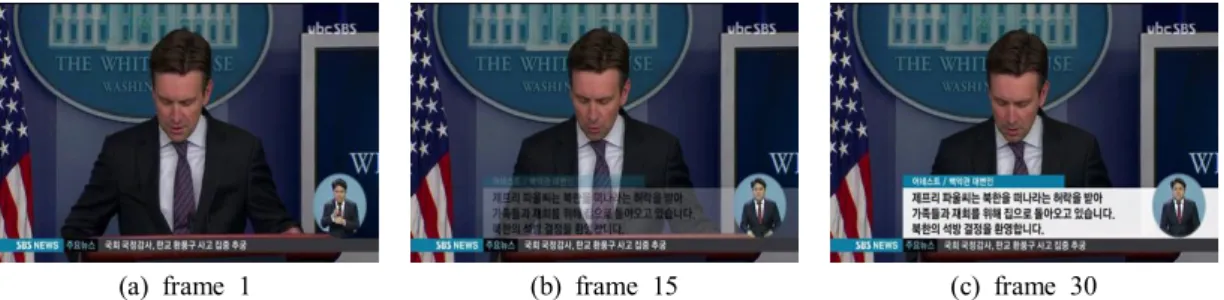
By observing a large quantity of TV news programs, as shown in Fig. 3.1, the appearance and disappearance of the overlay text occur suddenly or slowly in most news videos. Since the overlay texts appearing or disappearing in news videos are not changed faster than the scene content in a shot, the overlay text extraction from every frame is unnecessary and time-wasting. By precisely locating the critical frame where each overlay text appears or disappears, the overlay text detection can be focus solely on the frame contained the overlay texts.
Chapter 3 Video Clip Segmentation 24
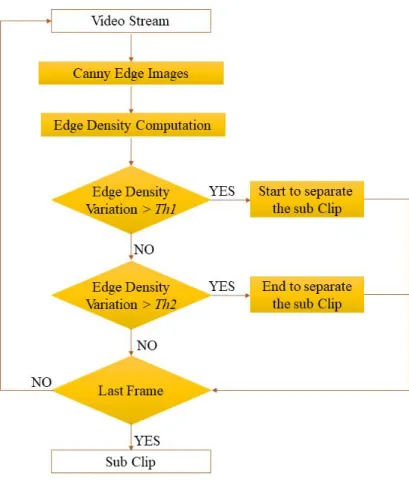
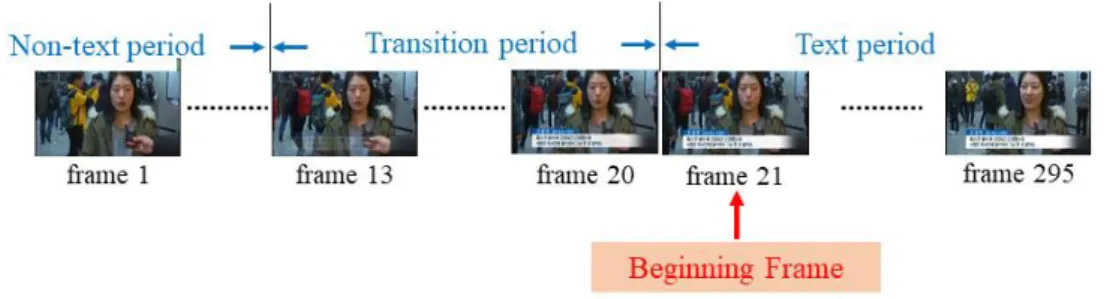
Therefore, to achieve a good result of the overlay text detection in news video sequences, this dissertation proposes the identification of the overlay text beginning frame. The beginning frame is defined as the frame which has abruptly difference at the edge density of the current frame and previous frame and a little difference at edge density of the current frame and next frame. The proposed method acts as the second pass over the output of a text detector in the entire video sequences. And the proposed system makes the sub-clip based on the beginning frame for only focusing on the frames with overlay text.
This dissertation uses the density of the text edge obtained by the edge detector. If a frame has a high edge density, it has the overlay text. Otherwise, a frame not contains the overlay text. This dissertation is compared to the performance of the beginning frame identification by the experiment between the Canny edge detector and the Harris corner detector. Then, the appropriate processing method is proposed with the detection beginning frame with Canny edge.
3.2 Characteristics of Overlay Text in Video
By observing a large number of TV programs, this dissertation defines the characteristics of overlay text in the video sequences as follows that might be useful for a video indexing system. The observed characteristics of overlay text could serve as features for a text detection, localization, segmentation and recognition processing.
(a) frame 1 (b) frame 15 (c) frame 30
Fig. 3.1. The example of overlay text appearance in broadcasting news video sequences
Chapter 3 Video Clip Segmentation 25
Overlay texts are meant to be read by humans at a range of viewing distances in a limited time. Therefore, there is usually a minimum size of characters. On the other hands, the upper bound on character size is much looser. Overlay text can often be as large as half the frame height. Characters of various fonts have large within-class variations and form many pattern sub-spaces, making it difficult to perform accurate recognition when the character class number is larges [2, 22].
The characters in a single overlay text tend to have a similar color. Even if the color does vary across the overlay text, it varies in a gradual way so that adjacent characters or character segments have very similar colors [22].
The contrast between text and background is often is high. This is because the background over which text is composited is varying both spatially and temporally and it often happens that the color of characters is similar to that of the surrounding frame region. However, even if this occurs it is usually true only for a portion of the overlay text since otherwise, the compositor would have chosen a different color for the text [22].
Characters belonging to an overlay text string are usually horizontally aligned.
This is a very strong feature. Also, the aspect ratio of the individual characters as well as that of the entire overlay text lies in a certain range [22].
Most overlay texts consist of a certain minimum and a maximum number of characters. In other words, at least one word but usually not more than a few. This is not true of single or double character logos or symbols, for example, the logo of the TV station, but since they are usually not relevant to the current scene content and hence not useful for a text indexing system, they can be ignored. Also, since overlay texts do not contain more than a few words, the characters are usually well separated.
Therefore, touching characters, a thorny issue in document character recognition is not as important in this application [22].
Overlay texts tend to retain their size and font over multiple frames. However, this is not always true. The text often has special graphic effects added such as zooming up or down. The position of overlay text can change, such as scrolling text, but does so in a very uniform way, either vertically or horizontally. Successive frames exhibit very small jitter in overlay text position, usually not more than one or two pixels. Therefore, this is a very strong feature [22].
Chapter 3 Video Clip Segmentation 26
3.3 Comparison of the Beginning Frame Identification Methods 3.3.1 Method by the Canny Edge Detector
Since texts are composed of line segments and text regions contain rich edge information, an edge-based method is used to extract the text in video sequences. This dissertation shows firstly that the Canny edge detector is used to extract edge points.
The Canny edge detector is based on the specification of detection and localization criteria in a mathematical form. It is necessary to augment the original two criteria with multiple response measures in order to fully capture the intuition of good detection. A detector uses adaptive thresholding with hysteresis to eliminate streaking of edge contours. The thresholds are set according to the amount of noise in the image, as determined by a noise estimation scheme. This detector made use of several operator widths to cope with varying image signal-to-noise ratios, and operator outputs were combined using a method called operators were used to predicting the large operator responses. If the actual large operator outputs differ significantly from the predicted values, new edge points are marked. Therefore, it is possible to describe edges that occur at different scales, even if they are spatially coincident [59].
In the video sequences, all frames are acquired images and transform them into grayscale images. There are several ways to convert color images into grayscale images.
This dissertation uses Y=0.299R+0.587G+0.11B to accomplish this. Where Y is the intensity value and R, G, B are the values on red, green, blue channels of the pixels.
The Canny edge detector is applied to each grayscale image yielding an edge map. And then, the text edge density is computed in edge map images. The text edge density defines as the number of detected edge pixels in a frame over the total number of pixels in the frame [60].
Since the text presents many edges, the frame included the overlay text has significant changes in the text density than the frame not overlaid the text as shown in Fig. 3.2. The period between the vertical red lines, in other words from the frame 13 to frame 20 like Fig. 3.2(d) has sharply different from the previous frame and frame 21 has little different of the edge density of frame 22. As a result, the beginning frame becomes the frame 21.
Chapter 3 Video Clip Segmentation 27
(a) frame 1 (b) frame 13 (c) frame 25
(d) the plot of edge density in whole video sequences Fig. 3.2. The result of edge density using the Canny edge detector
Chapter 3 Video Clip Segmentation 28
3.3.2 Method by the Harris Conner Detector
Corner points are the image features that are usually more salient and robust than the edge for pattern representation. A corner can be defined as the intersection of two edges or a point where there are two dominant and different edge directions in a local neighborhood of the point [6].
The corner points are the essential features by viewing the three-fold advantages for text detection. First, Corners are frequent and essential patterns in text regions. As an image feature, the corner is more stable and robust than other low-level features.
Therefore, the impact of background noises can be eliminated to a large extent. Second, The distributions of corner points in text regions are usually more orderly in comparison to the nontext regions. Therefore, the unordered nontext corner points can be filtered out. At last, the usage of corner points generates more flexible and efficient criteria, under which the margin between the text and nontext regions in the feature space is discriminative [61].
In this dissertation, the second method is the Harris corner detector to extract the corner points. The Harris corner detector is a popular interest point detector, since its strong invariance to rotation, scale, illumination variation, and image noise The method is based on the local autocorrelation function of a signal, which measures the local change of the signal with patches shifted by a small amount in different directions [6].
After extracting the corner points, it is necessary to compute the shape properties of the regions containing corner points. As a result, the detector can make the decision to accept the regions as text or not. First, to do this, this dissertation performs image morphology dilation on the binary corner images. The separate corner points that are close to