저작자표시-비영리-변경금지 2.0 대한민국 이용자는 아래의 조건을 따르는 경우에 한하여 자유롭게
l 이 저작물을 복제, 배포, 전송, 전시, 공연 및 방송할 수 있습니다. 다음과 같은 조건을 따라야 합니다:
l 귀하는, 이 저작물의 재이용이나 배포의 경우, 이 저작물에 적용된 이용허락조건 을 명확하게 나타내어야 합니다.
l 저작권자로부터 별도의 허가를 받으면 이러한 조건들은 적용되지 않습니다.
저작권법에 따른 이용자의 권리는 위의 내용에 의하여 영향을 받지 않습니다. 이것은 이용허락규약(Legal Code)을 이해하기 쉽게 요약한 것입니다.
Disclaimer
저작자표시. 귀하는 원저작자를 표시하여야 합니다.
비영리. 귀하는 이 저작물을 영리 목적으로 이용할 수 없습니다.
변경금지. 귀하는 이 저작물을 개작, 변형 또는 가공할 수 없습니다.
i
스포츠매니지먼트석사학위논문
SPORTS GOVERNANCE AS A KEY SUCCESS FACTORS OF
EFFECTIVENESS SERVICE DELIVERY IN A NON-PROFIT SPORTS
ORGANISATION:
THE CASE STUDY OF LESOTHO SPORTS AND RECREATION
COMMISSION
2020년 07월
서울대학교 대학원 체육교육과
LEBOHANG MOSHOESHOE
ii
이 논문은 문화체육관광부와 국민체육진흥공단 지원을 받아 수행된 연구임 This work was supported by Ministry of Culture, Sports, and Tourism and Sports Promotion Foundation
iii
Acknowledgements
My thanks giving goes out to all those who have helped me complete this proposal with whom this project may not have been possible. In particular, I would like to thank my tutor Inai for some excellent conversations, support and the perceptive comments that have kept me on track juggling this proposal as well as other life commitments. My appreciation also goes out to my wife Mantoetsi Moshoeshoe for supporting me throughout the last 1 year of my course. I would also like to forward my hearted appreciation to my children, Mabotle Moshoeshoe (the angel) and her big brother, Junior. J. Moshoeshoe for their patience and understanding whilst doing my research. My further gratitude goes to my supervisor, professor Kwon, Sun Yong for his extensive and helpful comments on early drafts. My best thanks giving goes to my classmates for their support all step of the way throughout the year.
iv
ABSRACT
SPORTS GOVERNANCE AS A KEY
SUCCESS FACTORS OF EFFECTIVENESS SERVICE DELIVERY IN A NON-PROFIT
SPORTS ORGANISTION:
THE CASE STUDY OF LESOTHO SPORTS AND RECREATION COMMISSION
LebohangMosoeshoe Global Sport Management, Department of Physical Education The Graduate School Seoul National University
It is argued that is difficult to test the effectiveness of non-profit sport organizational service delivery. As a result, many studies have been conducted on this issue. Some researchers developed the model of measuring the organizational service effectiveness while some argued that those models cannot give realistic result as they do not concentrate on other issues of importance. Though there is a lot of disagreement on this issue the conclusions were drawn from other model like multidimensionality and competency values model.
v
The opinion is that the effectiveness of service delivery can be measured by looking at the expectation the consumer has on the delivery of a service. Another conclusion is that the quality of the service depends also on the satisfaction of the service provider (the employee). This is due to the argument that when an employee is not satisfied he will also not give the best service to the consumer. As a result, the consumer’s judgment will not be on that organization as producing and delivering poor service.
These ideas bring another issue of judgment on whether the service is good or poor. Many researchers also argued about this matter but they agreed that the effectiveness of the nonprofit sport organization service delivery can only be judged by the person who uses the service. But also, another concern is how the employee’s happiness will be maintained so that they will deliver quality service to the clients. The concept of governance brought forward. The governance described by other scholars as only dealing with the planning part of the organization not directly involved with the everyday running activity of a nonprofit sport organization. The clear distinction made between types of governance. Thus, systemic governance, political (or democratic) governance and corporate (or organizational) governance. The first is concerned with the competition, cooperation, and mutual adjustment between organization in business and/or policy systems. The second approach is concerned with how governments or governing bodies in sport steer, rather than directly control, the behavior of organization.
The last one is concerned with normative, ethically‐informed standards of managerial behavior. In regard to this study the focus is on the better sport governance.
vi
This concept of sport government relies between democratic governance and organizational governance. One suggestion is that the term can be changed to better sport governance. This will leave a room for improvement for better governance practices by stakeholders in a sports fraternity. Other scholars of sports management suggestion is that, the board as a staring body can strategically take an opportunity on this notion to use sport governance principles as the tools to improve the service delivery of a nonprofit sport organization. The idea is that, the board can simply plan and provide a good working condition to everyone in a sport organization, facilitate the happiness of the service provide by employee, in return the consumer (stakeholders) will be satisfied. As a result the customers will consider and judge the service provision as effective.
These explain the concept of inseparability. The concept explains that there is no way that the service can be separated from its provider and consumer. It further shows that the service provision and delivery depend on the person providing it and also the person consuming it. These issues are important to the management and to the board member of the organisation. The concept simply says that everyone in the organisation considered as client and need to be taken care of, as everyone providing service to one another internally, and chain goes from the top policy maker to the bottom employees who give service to the external consumer.
The purpose of this study is to examine the effectiveness of nonprofit sport organisation service delivery to the stakeholders (clients), where the stakeholders in the context of this study are refered to the internal individual (e.g. employee and volunteers) and the external member of the organisation (e.g. media houses, sponsors).
vii
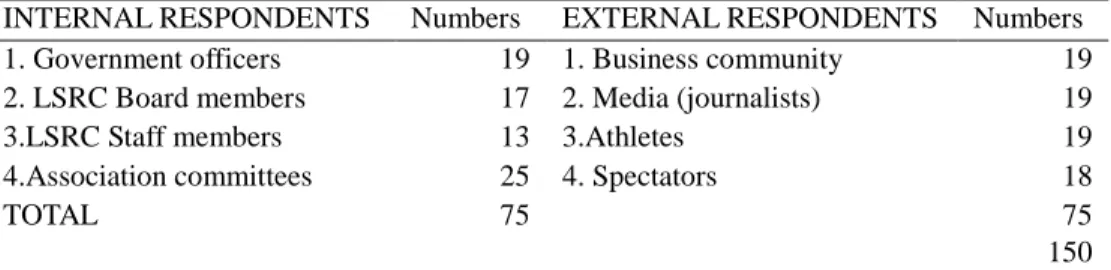
A non-probability purposive and convenient sampling method was used to select the participants sampling this current study. Non-random sampling (convenient sample) as a sampling method used to get readily available population sample. The population size was 150 respondents who were directly affiliated to Lesotho Sports and Recreation Commission. They were demographically equally divided according to gender groups. There were total of 8 groups who were considered internally and externally. The external stakeholders were representatives from 36 sports federations, media houses, athletes, general spectators, business community while the internal stakeholders were Lesotho Sports and Recreation Commission staff members, Lesotho Sports and Recreation Commission board members, Lesotho National Olympic Committee board and staff, and the government officials. Also, the same quota was taken from all those representatives. The numbers of 150 open ended questioners were designed delivered via emails, social media (whatsApp) and hand delivery. The nature of the items in the questionnaire was that respondents had to select answers which best represent their opinions. The design of this study was quantitative research...
The validity and reliability of the all variables appearing in the questioneer was obtained using Cronbach’s alpha Reliability test. There were 6 independent variables and one dependent variable. Four principles of sports governance of better sports governance repeated two times as implemented sport governance and influential factors of effectiveness service delivery. One measure of central tendency (mean) was used to analyze the data collected from the questionnaire.
viii
The findings of this study concluded that the implementations of the better sports governance directly contributing and influencing effectiveness of service delivery in Lesotho Sports and Recreation Commission though the finding revealed that the service delivery was significantly good, the stakeholder’s satisfaction was not influences by effectiveness service delivery.
Therefore, the recommendation is to do future research on what exactly influencing the satisfaction of the sports clients.
Key words : Better governance. Nonprofit organization. Service.
Effectiveness. Stakeholder Student number: 2018 – 29552
ix
Table of contents
Acknowledgements………...i
Abstract……….……….……….………...ii
Table of contents………iv
CHAPTER 1. INTRODUCTION………...………...…...………...1
1.1. Introduction………...1
1.2. Definition and understanding of the term organization………...1
1.3. Sport organization…...……….…...………...3
1.4. A distinctive description for profit and non-profit sport organizations…..7
1.5. Non-profit sport organizationand stakeholders………8
1.6. Stakeholders in a non-profit organization…………...…...…..…….…....10
CHAPTER 2. LITERATURE REVIEW………..13
2.1. Governance………...………..………...18
2.2. Good sport organizational governance ………..…………...11
2.3. Good governance principles……….………..…………..…....14
2.4. Good sport governance evaluation methods………...………...19
2.5. Service delivery in a nonprofit organization……..……….………..20
2.6. Service in the context of sport organization………..…...……...26
2.6.1. Service quality in the context of sport organization…….……….29
2.6.2. Effectiveness of service delivery in a non-profit sport organization ………..…..…...32
2.7. Understanding the link between good governance and service delivery...37
2.7.1. Previous studies………..………..…....41
2.8. The purpose of the study………42
2.8.1. Research questions……….…..43
CHAPTER 3. METHODS...………..46
3.1 Research design and methods……….46
3.1.1 Research design………..………...46
x
3.1.2 Rational for the selection of the respondent………..…..48
3.1.3 Sampling………..……..……50
3.2 Survey……….56
3.3 Data collection and analysis………61
3.3.1 Data collection………..61
3.3.2 Data analysis of survey………...63
3.4 Validity of data……….64
CHAPTER 4. RESULTS AND FINDINGS……….…...65
4.1. Introduction………65
4..2. Variable……….…….……...….…...65
4.2.1. Mission………...………….……….65
4.2.2 Organizational Capability………...……….………..66
4.2.3. Best sports governance principles………...67
4.2.3.1. Democracy……….…...…...67
4.2.3.2. Transparency……….……...68
4.2.3.3. Accountability……….…………68
4.2.3.4. Social responsibility………...…….………68
4.2.3.5 Effectiveness service delivery………...…...………69
4.3. Results……….………….……..71
4.3.1.demographicanalysis……….……….74
4.3.2 Reliability test results………...………..…………....74
4.4. Hypothesis testing results……….………74
4.4.1. ‘H 1. Effectiveness service delivery of a non-profit sport organization Were significantly influenced by Better sports governance Princiles…..74
4.4.2. ‘H 2. Effectiveness service delivery of a non-profit sport organization were significantly influenced by other organizational factors, Mission and Capability………..…..75
xi
4.4.3. ‘H 3. Satisfaction of the clients influenced by effectiveness service
Delivery’………...…...…….….…….77
CHAPTER 5. RESULTS AND FINDINGS……….………...78
5.1. Introduction………78
5.2. Demographic distribution……...……….……….……..78
5.2.1. Gender……….…..……...78
5.2.2. Relationship of the respondents with LSRC……….….….……….78
5.3. Research questions………..…..……...……..79
5.3.1. Factors contributing to the implementations of better governance……79
5.3.1.1. Democracy………....…...…...80
5.3.1.2. Transparency……….…....……81
5.3.1.3. Accountability………...……….….81
5.3.1.4. Social responsibility………...…….…....82
5.3.2. What are the factors influencing and contributing tothe effectiveness of a service delivery in a nonprofit sport organization?...83
5.3.3. What influences satisfaction of the stakeholders in regards to better sport governance principle and effeteness of service delivery in a nonprofit sport organization………...………...86
5.4. CONCLUSIONS……….……...87
5.5. RECOMMENDATIONS……..………...………...88
5.5.1. Study limitations……….…………...88
5.5.2. Future research……….…89
REFERENCES...…….…...91
APPENDIX………..….106
KOREAN ABSTRACT……….………..….127
xii
List of Tables and Figures
Table 1. Distribution of the population sample………...56
Table 2. Questioneer………60
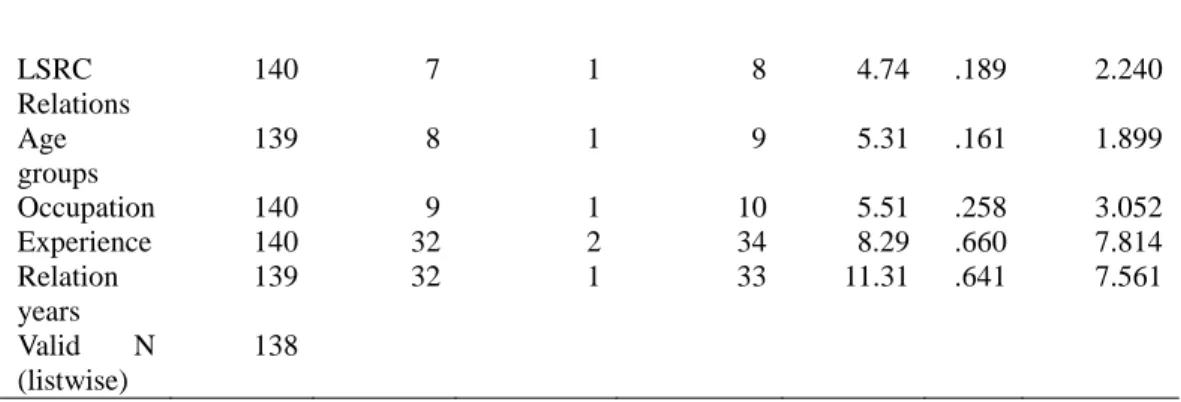
Table 3. Demographic frequency table………....69
Table 4. Gender frequency……….………..…70
Table 5. Reliability test statistics……….……….….…..72
Table 6. Sports governance factor table………..…….…75
Table . Mission and capability……….…....76
Table 8. Score satisfaction table……….……….77
1
Chapter 1.introduction
1.1. Introduction
It has been an argument that developing a classification of the observed phenomena is fundamental to any form scientific inquiry, “To classify things is to bring parsimony and mental order to one’s view of them” (Hammrick, 1984, p 27). It is therefore very important to understand anything before one can try to get into details on the complication matters.
With this regard, I will start by explaining and giving a clear background of what is an organization, which will lead to a clear understanding of a sports organization. Finally, the two will bring us to bottom of the matter, which is nonprofit sports organization.
Some of the most important topics that are going to be covered include the issues of governance which will provide the clear understanding of cooperate governance and the term “good sport governance” later this term will be translated into “better sport governance”. Lastly, the discussion will be whether better sport governance practices can significantly influence effectiveness of service delivered by sport organization to the stakeholders.
2
1.2. Understanding the definition of an organization
According to Rue & Byars (2009), an organization is a group of people working together in some type of concerted or coordinated effort to attain objectives. Similarly, Hitt, Black, Porter, & Hanson (2007) viewed an organization as inter connected set of individuals and groups who attempt to accomplish common goals through differentiated functions and intended coordination. Another argument that is not far from the other two explanations above explain an organization as a tool people use to coordinate their actions to obtain something that they desire or value – that is to achieve their goals. (Jone, 2010, p. 2)
There are several elements appearing on the description of an organization; people or more than one person, goals and system and that each organization has a distinct purpose, this purpose generally expressed as goals. The meanings further explains that each organization is composed of people and every organization has a systematic structure that defines the limit of each member.
Simon (1997, p.18-19) further explain an organization as pattern of communications and relations among a group of human beings, including the processes for marking and implementing decisions.
3
This pattern provides to organization members much of the information and many of the assumptions, goals, and attitudes that enter into their decisions, provides also a set of stable and comprehensive expectations as to what the other members of the group are doing and how they will react to what one says and does. The sociologist calls these patterns a “role system”
Many scholars classified an organization into two types, profit making organization and or non-profit making organization. “Traditionally organizations are categorized on the basis of whether their purpose is to make profit”, Chelladurai (2014) supports this notion. For the purpose of this study, the focus will be on a non-profit making organization. However, the next headings will give the clear distinctive explanation of sport organization, profit oriented sport organization and non-profit sport organization.
1.3. Sport organization
Most researchers point out that a group of people who are working together to attain a specific goal in sports are called organization, and most of them are publicly and privately owned. Some are voluntarily organized and they are involved in the provision of sport products and services.
4
The meaning provided by Robbins (1990) stated that, “sports organization is a social entity involved in the sport industry; it is goal- directed, with a consciously structured activity system and a relatively identifiable boundary.” The five key elements stipulated by this explanation are social entity; Involvement in the sports in industry; Goal-directed focus;
consciously structured activity system and relatively identifiable boundary.
These five key elements explained as follows:
“Social entity: All sport organizations are composed of people or group of people who interact with each other to perform those functions essential to the organization.
Involvement in the sports in industry: What differentiate sport organization from other organization, such as banks, pharmaceutical companies, and car dealership is the former’s direct involvement in one or more aspects of the sport industry, for example through production of sport related product or services. While agencies like banks, pharmaceutical companies and car dealership can be and have been involved in sports (primarily through sponsorships).
Goal-directed focus: All sport organizations exist for a purpose, it can be for making profit, encouraging participation in a given sport, or
5
winning Olympic medal. These goals are not usually easily obtainable by an individual, but by members working together. Sport organizations may have more than one goal, and individual members may have different goals from those of the organization.
Consciously structured activity system: The interaction of people or group of people in sports organization does not occur through random chances; rather there is conscious structuring of activity systems such as marketing, production and service development. The main functions of sport organization are broken down into smaller tasks or group of tasks; the mechanisms used to coordinate and controls these tasks helps to ensure the attainment of goals.
Identifiable boundary: Sport organization need to have a relatively identifiable boundary that distinguishes members from non-members.
Members of a sport organization usually have an explicit or implicit agreement with the organization through which they receive money, status, or some other benefit for their involvement. For some sports organization, particularly those in the voluntary or nonprofit sector, the boundaries may not be easily identified as in those sport organization concerned with making a profit or those in the public sector. Nevertheless, every sport
6
organization must have boundaries that helps distinguish members from non members, but these boundaries are not fixed and may change over time.”
All these explanations and examples about the sport organization essentially incorporate four elements;
(i) more than one person is needed to form a sport organization (ii) Those people called members when they jointly come
together, their contributions are specialized
(iii) Moreover, those specialized functions are coordinated. This brings us to what we call a division of labor.
Slack & Parent (2006); Smith & Stewart (1999) showed that many researchers have documented the distinctive characteristics of sport organization and the list is the relatively consistent. Smith & Stewart (1999) go on stipulating that the difference between sport organization and business organization is the way they measure performance. On the other hand, Hoye&Cusskelly (2007) pointed out that the main purpose of business organization is to make profit.
7
The understanding of sport organization will help to understand the difference and similarity of sport industry with other industries, the sport organization with any other organization and specifically the non-profit sport organization, which is basis of this study.
1.4. A distinctive description for profit and non-profit sport organization
The term non-profit organization is used to refer to an entity formed to provide social services rather than being formed to seek profit. ……
“While the organization’s revenues may exceed expenses, the excess must be used for the common good of society. It cannot directly benefit the members, and it cannot be referred to profit” (pp. 432-433). Many sport organizations such as sporting, good manufactures and athlete management companies considered as for profit organizations; the majority of sport organizations that provide participation opportunities and promote sport categorized as non-profit sport organization. (Hoye&Cuskelly, 2007)
There has been a debate around the usage of the words profit and non-profit organizations. Some scholars pointed out that an individual business providing fitness services is an example of a profit organization (even if it does not actually make a profit), whereas a university intramural
8
department offering the same service is an example of a non-profit organization (even if its receipt exceeds expenses) see Chelladurai (2014, p.
62). On the other hand, Hopkin (2001) distinguish non-profit organization from for profit organization in a legal perspective using a doctrine of private inurement. The doctrine stated that for a nonprofit organization to be tax exempted, it must be organized and operated so that no part of its net earnings inures to benefit of any private shareholder or individual” (p. 900).
It is from this perspective that though the issue of revenue distribution not clearly specified, the nonprofit sport organization can also make revenue.
1.5. Non-profit sport organizations and stakeholders
All organizations have a management structure that determines relationships between the different activities and the members, and subdivides and assigns roles, responsibilities, and authority to carry out different tasks. Organizations are open systems that affect and are affected by their environment (Business dictionary.com).The environment in the context of sport organization can be classified into two, the internal environment and the external environment.
A non-profit board ensures that sport organization conducts its mission without striving to make profit and that the benefits it creates
9
delivered to its members or individuals it exists to serve (Hoye&Cuskelly, 2007). The board is the internal structure; both internal and external environment can affect it. Kikulis (2000) explains board of a nonprofit organization as a volunteer at the top of the hierarchy of authority and the most common governance structure presenting sport organization. From this perspective, the conclusion can be that there are different types of sport organizations.
The above notion about the voluntarism and the service provider is supported by another one that the sport organization operate as voluntary or nonprofit organization; the funds they generate are used to further activities that benefit their membership or communities where they are based. Some sport organizations, particularly those from public sector, have as their primary function to aid and assist other organization in delivery of sports (Slack & Parent, 2006, p.4).
Examples of these non-profit organizations can be hierarchically or in an ascending order from international to country level. NOSOs are nonprofit organizations relying on federal and state government grants, supplemented by revenues from memberships, competition, and program fees, and, depending on the size and profile of the organization, sponsorship.
10
Consequence of the conversion from volunteer-administered entities to professionally structured and managed organizations supported by volunteers, governance practices by these non-profits become blurred struggling to define the roles of volunteers in relation to professionally appointed staff (Shilbury, 2001).
1.6. Stakeholders in a non-profit sport organization
The word stakeholder defined as group or individuals who can affect or affected by the achievement of the organization’s objectives’
(Chappelet, 2016). For nonprofit sport organization, there are many stakeholders and these can include sponsors, funding bodies, staff, public, communities, and government (Australian Sports Commission, 2005).
Leaopkey& Parent (2009) research consider how stakeholder might influence strategic activities of such as risk management in an organization.
The stakeholder’s theory in sport clubs by Thiela&Jochen (2009) stated that sports clubs are nonprofit organizations, they have some impact features that must be taken into consideration and that their chief characteristics are that: they are oriented towards the fulfillment of the interest of their membership. The findings from imperial evidence of stakeholder management in sports clubs shows that the sports clubs that
11
have good relationship with their external stakeholders will receive more financial and non-financial support from them (Marc, Francesco, Eduard
&Nuria, 2011). All stakeholders in sports fraternity identified and discussed according to their tasks by Chappelet (2016) in three systems: The Classical Olympic System; the regulated Olympic System and the total Olympic system. The list covers 24 stakeholders including sports organizations, media, governmental agencies and community representatives.
Example of non-profit sport organization, which is a stakeholder in the International Olympic Committee but also serving the interests of their stakeholders, is the National Olympic sporting organizations (NOSOs) in Australia. It is responsible for the provision of sports services to the community. Its tasks include amongst others, the delivery of programs designed to foster participation and those required to identify and develop elite athletes (Shilbury, 2001).
Another example is the Lesotho sport and Recreation Commission (LSRC) (Lesotho sports and recreation act, 2002). LSRC mandate is to provide leadership in the development of sport and recreation in Lesotho. Its objectives include, giving direction to the development of sport and sporting activities at both national and international levels and to promote the
12
importance of sport in national development; to promote public awareness of sportsmanship, recreation and leisure amongst other, (Lesotho sport and Recreation act, 2002).
13
Chapter 2. Literature review
2.1. Governance and good governance
The term “governance” used to refer to the exercise of authority within a given sphere, (Hewitt de Alcantara, 1998). Researchers like Hoye&
Auld, 2001; and Hoye (2006); define governance as a critical component of managing a sport organization since it is concerned with issues of policy and direction for the performance of sport organization. It is difficult to define governance, but it is perhaps easier to recognize it in practice. It involves the use of power to direct, control and regulates activities within an organization.
It deals with the high-level issues of strategy and policy direction, transparency, and accountability and is not concerned with daily operations, which are the responsibility of management.
Hossen, (2011), describes good governance as “not something that can easily achieved, much like the development and maintenance of the management-governance relationship, which exists within sport organizations (SOs).” By definition, managers within SOs are usually goal driven focused and often practical. The expectation is that they should be highly motivated to make an example to everyday staff within the
14
organization. In contrast, good governors should be thinkers. They are required to focus on the long-term aspects of the organization in relation to outcomes, values, vision and “high level strategic direction rather than operational strategies and goals” (Kilmister, 2006, p. 173). Good governors should establish a clear relationship with the CEO and make them accountable for their performance in that role. Boards that operate effectively within SOs add value to the organization that is greater than what the CEO or general staff can contribute.
Based on above discussion, it is clear that having an appropriate governance system in place; clearly indicate good monitoring of organization activities to deliver benefits to the sport organizations, members and society. Good governance also subsumes informal, non- governmental mechanisms and thus allows non-state actors be brought into the analysis of societal steering (Lemos&Agrawal, 2006, p. 298). In that regard, the notion of governance through so-called “governance networks”, used to describe public policy making and implementation through a web of relationships between state, market and civil society actors, has gained prominence in governance literature in recent years (Klijn, 2008, p. 511).
15
2.2. Good sport organizational governance
Lately good governance referred to as the ideal type of governance to correct societal ills, founded on structural attributes such as the rule of law, transparency, citizen participation, efficiency, effectiveness, and accountability, especially in a manner that is free from corruption (Matembe, 2010). It is usually referred to as “corporate governance” or “good corporate governance” in the cooperate world, which relates to the various ways in which private or public held companies are governed in ways which are accountable to their internal and external stakeholders (OECD, 2004, p.11).
It often used as a synonym for efficient management, thus governance can be used in modern corporations as corporate governance.
Kaufman &Kraay (2008, p. 4) define governance as the traditions by which, and institutions in which, authority in a country is exercised. The Australian Sports Commission (ASC) (2015), having carried out much research in this area, regards governance as concerning three key issues:
• Ensuring that an organization develops strategic goals and direction
• Ensuring that the Board monitors the performance of the organization to ensure that it achieves these strategic goals
16
• Ensuring that the Board acts in the best interests of the members
Following the existing literature, governance does not only explore the capacity of the state in decision-making, but also explores the governing arrangements, which refers to more than the institutions of government (Kelly, 2006, p. 607). As a result, various types of governance and interpretations have increased over the years, namely good governance, corporate governance, collaborative governance, e-governance and urban governance.
There is now a general consensus that sports governance should combine elements of corporate governance, as applied in the business world (Mallin 2011), and democratic governance, as advocated for the public sector, most notably by the World Bank (Bevir 2010). In fact, sport organizations blend certain characteristics of commercial organizations (especially when they sell broadcasting or marketing rights for their events) with those of public organizations (when they draw up rules for their sports and their events). However, for the purpose of this study the following section will only focus on good governance of a non-sport organization.
Chelledurai (2014, p. 62) pointed out that, “All government agencies are nonprofit organizations”. Slack & Parent (2006, p 4) further
17
explains that some sport organizations, particularly those from public sector, have as their primary function to aid and assist other organizations in delivery of sports. It is from these two notions and above explanation that I draw a conclusion that also proper governance (good governance) in the non-profit sport organizations can assist in the effectiveness of service delivery.
From this context, it is clear that good governance can play an integral role in the nonprofit sport organization effeteness of service delivery.
However, there is one question remaining. “An organization is a deliberate arrangement of people to accomplish some specific purpose. (Robbins, Coutlter, Laeach, &Kilfoil, 2010, p. 10). This means that a non-profit sport organisatin has a purpose of achieving something its members desired and value – that is to achieve their goals, Jones, (2010) pointed out that; the question is what can happen if governance is not good?
The Australian Sports Commission (2015) commented that poor governance has a variety of causes, including director inexperience, conflicts of interest, failure to manage risk, inadequate or inappropriate financial controls, and poor internal business systems and reporting.
Ineffective governance not only affects the particular Olympic Sports
18
Organization (OSO) but also may undermine confidence in the sport industry as a whole. (Camy& Robinson, 2007, p.24)
2.3. Good governance principles
Chappelet, (2017) explained that, “Since the beginning of the twenty-first century, governmental and intergovernmental bodies, national and international sport governing bodies and academics have put forward numerous lists – more than 30 in total – of governance principles for sport organizations” .
The IOC President, Jacques Rogge, in his opening speech of the First European Conference on the Governance of Sport held in 2001, also emphasized the principle of good governance and suggested that common features that should underlie all sport bodies include responsibility, democracy, transparency and solidarity. His argument was that if sport organizations complied with these principles, they would strengthen their position and provide considerable benefits to the stakeholders of sport, especially the clubs and athletes. In a subsequent address at the 2006 First Seminar on the Autonomy of the Olympic and Sport Movement, Jacques Rogge again emphasized the importance of sport good governance, in particular the need to be transparent, and stated that it is the responsibility of
19
the Olympic Movement to work in total transparency (Camy& Robinson, 2007, p.23.)
2.4. Good sport governance evaluation methods
Because of the acceptation, that setting out principles or guidelines of good sport governance is insufficient without an effective evaluation or governance measurements methods, Chappelet and Mrkonjic (2013) published various methods of evaluating sports’ good governance. In their previous studies, they put in place and include among others the Basic Indicators for Better Governance of International Sport (BIBGIS).
The IOC’s ‘Basic Universal Principles of good governance of the Olympic and sports movement’ (IOC, 2008), the BUPs, which is long catalogue of some 120 guidelines (mostly expressed as recommendations) was also drawn up in 2008 and approved by Olympic Congress in 2009. The Danish organization Play the Game published its Sports Governance Observer, which uses 36 indicators to assess four areas of governance (Geeraert 2015) and the 20 mandatory principles for sports governance (AIS, 2015) introduced by Australian government. At the end of the same year, also the UK government’s strategy for sport (HMG 2015) called for a new governance code in the UK (section 8.4, p. 64-65).
20
In 2016, the General Assembly of the Association of Summer Olympic International Federations (ASOIF) endorsed 50 governance indicators covering five key principles (ten indicators for each principle:
Transparency, Integrity, Democracy, Sports development and solidarity, and Control mechanisms), drawn up by an ad hoc taskforce (ASOIF, 2016).
Suggestions are made that IFs within the ASOIF must now assess whether these indicators respected in their organization. Rather than the ‘good governance’ so often alluded to since the World Bank first popularized the term, the objective should be to ensure ‘better governance’ within each organization and governance has to be monitored over time in order to determine whether it is improving.
2.5. Service delivery in a nonprofit organization
In this context of sport organization as explained in the above chapters describing a nonprofit sport organization, such organization is a service provider, and the sport product is a service itself. According to Chelledurai, (2014) all most all sports and recreation organizations classified as service orientated organizations. Organizations from traditional industries, sport organizations face the challenge of meeting the rising
21
expectations of spectators. These spectators are sport product consumer which is service.
Minnaar and Bekker (2005) asked; what and how much value was created in the process of service delivery?” A significant aspect of service provider- client interface is the amount and type of information exchanged between the client and provider in the production of the service (Chelladurai, 2014). A successful philosophy that focuses on total quality orientation in the transaction of the provider with the consumer asks organizations to define clearly their customers for being able to identify and respond to needs, but also to influence what is perceived service quality by the targeted segment of the market (Papadimitriou &Karteroliotis, 2000).
The consumers’ encounter with the service staff is probably the most important aspect of a service, as the intangibility of services automatically makes the customer contact a vital determinant of the quality of service experience. In this context, Verma (2012) classified service employees according to customer-contact and non-customer-contact employees. “Customer-contact employees, come into contact with customers in the process of the service provision” (Verma, 2012, p. 170).
22
Examples for customer-contact employees in a sports environment are stewards, or sales personnel in retail. Non-customer-contact employees are those who contribute to the service production, but not met the customers. Those back-end employees, such as electricians or kitchen help, support the delivery of the product but not seen in any as customer-contact employees. In the sport organization context the example of such support stuff employees are accountants, administrators, office assistants and clerks.
As mentioned above, special importance must be to customer- contact employees, as they have direct bearing on the quality of the service experience. Verma (2012) differentiated high-contact and low-contact services. This differentiation automatically provides a better understanding in the operational and system requirements. Customer contact refers to the physical presence of the customer in the situation. “The extent of contact refers to the percentage of time a customer ought to be in the system out of the total time it takes to serve him or her” (Verma, 2012, p.170). In high- contact service, service personnel interact for a certain period with the customers, like a guest service employee. In contrast, a low-contact service describes a very short period of interaction with the customer, like a ticket- taker, or an attendant. Furthermore, service personnel also classified
23
according to visibility. There are visible service personnel, like salespersons, and invisible service personnel such as cooks.
It is common that sport organizations receive varying feedback from their customers depending on different employees. When interacting with high-contact service personnel, customers assume significance to skills like social graces, communication, language, and to personality traits like friendliness, extroversion, energy or politeness (Verma, 2012). A key success factor for service personnel is being able to relate emotionally with the customer. Chelladurai (2014) used this contrast to categories service in to consumer and professional services. They distinguish consumer serves as largely based on low-skill and routine services including renting of facilities and retailing of goods and professional services as largely based on knowledge, expertise, and special competence of employee (the service provider).
Cho whan (2015) identified several factors, which may significantly improve the quality and performance by Careful selection and training of personnel; laying down norms, rules, and procedures. That was to ensure consistent behavior; ensuring consistent appearance, and ;reducing the importance of personal contact by introducing automation and
24
computerization wherever possible to ensure the high-contact service personnel in a professional service being dexterous in public relations and inter-personal skills, and the low-contact employees having high technical and analytical attributes,
Customer-contact employees in a professional service have a key role in delivering service quality. However, setting standards and communicating rules and norms are not enough to guarantee service quality in an environment, which is devoid of other positive motivators and stimuli (Kandampully, Mok, & Sparks, 2001). Marriott & Brown (1997, p. 34) formulated a simple but meaningful philosophy about the treatment of employees in a service environment: “Take care of your employees, and they will take care of your customer”. As Kandampully et al. (2001) worked out, it is essential for sport managers to create a service environment that not accomplished by words alone but by observable actions that promote good service.
It is important for an organization policy maker to develop a plan and working ethics that will enable manager and staff to work in harmony.
In a night shell, creating a successful and healthy working climate is a key success factor for service business success. Cook (2004, p. 6) said, “The
25
quality of external service delivery is a reflection of the quality of service that people within the organization provide each other”. This means that employees who do not feel valued or appreciated are less likely to deliver excellent service (Cook, 2004) that in turn results in a correlation between employee satisfaction measures and customer satisfaction measures. The above statement concludes that by improving employee satisfaction, successful service organizations are able to deliver superior service to customers.
Employee Grönroos (1998) used a triangle to illustrate that customer and employee relationships of services are directly affected by traditional external marketing and the interactive marketing between customers and employees in the service encounter, and indirectly affected by the internal marketing directed at employees (Hennig-Thurau& Hansen, 2000). This implies that the quality of the service produced and delivered depend on the satisfaction of a person producing it (employee), but at the same time the quality of the product (service) will be valued by the person receiving. As the interaction between the employee and the customer seriously affects the overall customer experience, service organizations must ensure that their employees have the traits of customer service orientation, Grönroos (1998).
26
Hennig–Thurau& Hansen (2000, p. 162) noted that relationship marketing should not be limited to frontline employees but should be extended to all personnel, as “high internal service quality and internal customer orientation are just as important as external service quality and customer orientation”. Meaning that in a sport organization regardless of type, nonprofit sport organization or profit oriented sport organization, all the internal people within the sport organization are regarded as client who consume the internal service, and the mode of providing that service to them also influence the way they will provide the service to external clients.
2.6. Service in the context of sport organization
It is very important to explaining and classifying things as that bring parsimony and mental order to one’s view of them (Hambrick, 1984, p. 27).
It is also of importance to start by looking at service in this phenomenon as a term so that it will help to give a better understanding of the whole study.
According to the criteria of whether an organization is producing goods or services, almost all sports and recreation organizations classified as service organization (Chelladurai, 2014, p. 23). This is from the notion that sport organizations exist to provide sport port product and service in the sport industry (Chelladurai, 2005). In the context of this study, service is a
27
product of sport organization. The product of any organization may be goods, services, or both. Goods are a physical object that produced at one time and used later. In contrast, a service is a “time-perishable, intangible experience perfumed for a customer acting in the role of co-producer”
(Fitzsimmons &Fitzsimmon, 2011, p. 4). In this context, the goods refer to all sports physical tangible products that can be seen or those that can be produced by sport organization and provided to the consumer or client.
The phrases “goods are produced and services are performed”
(George, 2008, p. 23, following Ratthmell, 1974, p. 1) show that service is different from goods even if they can both be the sport organization’s products. Bothma (2007) as any activity describes Service or benefit a supplier offers a customer that is intangible and does not results in anything tangible. Service, also defined by Gronroos, (1990); Lovelock, 1991; Sasser, Olsen, &Whyckoff, (1978); Schneider& Bowen, (1995) as an intangible occurrence, process, or performance that is produced and consumed simultaneously. They continue explaining that the nature of a service better understood by highlighting its pertinent attributes (Characteristics). They also said that the service attributes most frequently discussed are intangibility, perishability, heterogeneity, and simultaneity.
28
According to Kotler, Bowen and Makkens (2006, p. 42) there are four characteristics of service, they are; intangibility, variability, inseparability and perishability. All these means, services cannot be seen;
tested; felt; heard or smelled before purchased. The second means that quality of services depends on who provides them and when, where and how, while the third and the last means that service cannot be stored for later sale or use and services cannot be separated from their providers, respectively.
Out of all these meaning, it should better pointed out clearly, that goods might be used in the production of service. For example, in athletics or road run (marathon), an athlete may want a running shoe that is good to him/her, the specialist will use a high-quality equipment (machine) to test such athlete foot and recommend the correct running shoes. The athlete did not buy equipment, but rendered a service provided by specialist using specialized equipment.
In addition, that specialist might happen to be a coach provided by the sport organization. The coach will use a computer to draw a draining schedule for the athletes and use a training facility to provide the athlete with a training the athletes need. This means the athlete just received the serves rendered by sports organization. Goods properly called by
29
Chelladurai, Scott & Haywood-Farmer (1987) as facilitating goods and facilities.
2.6.1. Service quality in the context of sport organization
Service quality is defined as customer’s overall conception of the relative inferiority or greatness of the organization and its service (Bitner&Hubbert, (1994); Keiningham et al.(1995). The former implies the satisfaction feeling that the client has for the service provided by the organization. Klaus (1985) explained that as a total net value of benefit perceived in the service encounter over what had expected. Meaning the sport product consumer had a certain perceived value about the product (service). According to the Parasuraman, Zeithml, Valerie, Berry Leonard (1985), service quality adjusted using function of three characters which are consist with pre-purchase of customer expectations, perceived process quality and perceived output quality.
They further defined service quality as a gap between customer’s expectation of service and customer’s perception of the service experience.
Lewis & Booms, (1983) noted that “service quality aim to meeting the requirements of the customer’s expectation regularly”. Under customer expectation, customers think, service provider should offer excellent and
30
unbelievable service rather than they believe (Parasuram, Zeithaml& Berry, 1988). This implies that customers always compare service quality of the firm via expectation of the service and perception of the way the service has been performed (Gronroos, 1984; Lehtien&Lehtien, 1982; Lewis & Booms, 1983; Parasuraman at al., 1985). As a result, in order to maintain standard of service quality, customer’s behavioral objectives are important (Bitner, 1990). The ‘Service Quality Theory’ (Oliver, 1980) can explain interaction of customer’s behavioral objectives and service quality.
According to Service Quality Theory introduced by Oliver (1980), if performance of the service firm does not meet customer’s expectation, customers will judge that firm has ‘low quality’ and also, if performance of that service firm exceeds the expectation of the customers, customers will judge firm has ‘high quality’. Parasuraman et al., (1991) developed service quality model including multi-dimensions to measure the service quality.
Service quality scale consists with very important criteria to measure the customer’s perception and quality of the service (Parasuraman et al., 1988).
Service quality reflected from five dimensions such as assurance, empathy, reliability, responsiveness and tangible (Adhikari& Das, 2016).
31
The term satisfaction is a feeling (Kotler, 2009) that extending across the entire consumption horizon (Oliver, 1980). It is with this regard that satisfaction determined by comparing costs which customers give up to get a service and reward, which customers receive as response (Tam, 2004).
Therefore, customer satisfaction defined as an outcome of purchase and use came because of buyers’ comparison of the reward and costs of purchase (Churchill &Surprenant, 1982).
Customer satisfaction defined as an emotional response, which results from a cognitive process of evaluating the service received against the costs of obtaining the service (Woodruff, Clemons, Schumann, Gardial&
Bums, 1991). In other ward, service quality determined by the customer satisfaction and feeling of pleasure or distress came from comparing the perceived performance or out come in relation to the exceeded expectation of the nonprofit organization service provided. Apart from using attribute of various sport services, there are two issues highlighted Chelladurai&
Chang,(2000):
(a) Standard by which service evaluated and
(b) Who should be the judge of the service quality?
32
2.6.2. Effectiveness of service delivery in a non-profit sport organization
The effectiveness of non-profit sports organizations, high performance sports programs and in campus recreation programs has become a growing research interest. (Madella, Bayle & Tome 2005; Wolfe, Hoeber&Babiak 2002). Therefore, it is of importance to show what it takes to say the non-profit sport organization is effective.
Jones and Pendlebury, (2010) stated that structural, political and symbolic in order to produce movement towards goals in specific effectiveness refers to the success or otherwise the rate of achieving objectives. The further explain, “it concerns with performance outputs regardless of the amount of resources used. Effectiveness relates to goal achievement.
However, the central question in this regard is, whether goals and objectives achieved within the limitations of allocated resources? The issue of scarce resources and the manner they are managed to meet the needs and aspirations of the people is central to governance and service delivery.”(Jones and Pendlebury, 2010)
National Olympic sporting organizations (NOSOs) in Australia are
33
responsible for the provision of sports services to the community. This includes the delivery of programs designed to foster participation and those required to identify and develop elite athletes. Typically, the structure of NOSOs mirrors Australia’s federated model of government in which state sporting organizations make up the NOSO and are predominantly responsible for the delivery of sport services in their state (Hoye& Auld, 2001; Shilbury, 2001).
The term effectiveness and efficiency often used interchangeably. In an organizational perspective, specifically a nonprofit sport organization, they are queried different (Steers & Black, 1994). Organizational effectiveness is the prime dependent variable in many organizational contexts (Chelladurai& Haggerty, 1991), and it also multidimensionality. It is the cause of conceptual ambiguities and measurement difficulties. What constitutes effectiveness is in itself a paradox (Chelladurai& Haggerty, 1991). There appears to be no universal agreement on precisely what organizational effectiveness means, as organizational effectiveness means different things to different people.
The majority of authors agree that organizational effectiveness requires measuring multiple criteria and the evaluation of different
34
organizational functions using different 8 Shilbury& Moore, characteristics, and it should also consider both means (processes) and ends (outcomes) (Shilbury& Moore, 2006). These bring the conclusion that organizational effectiveness is the ultimate dependable in any organizational analysis. It was noted earlier that, an organization is social entity that set out to achieve certain purposes (Robbins, Coulter, &Kilfoil, 2012, p. 10). The managerial functions and processes are done to archive those purposes, meaning that whether purposes are archived or not it is critical to the analysis of an organization and management.
The other meaning is that organizational effectiveness is a theoretical core of all organizational models and it is final dependent variable inmost organizational studies (Chelladurai, Szyszlo, Haggerty, 1987, p. 111). Recently, interest to effectiveness studies has been strong in sports organizations and researchers such as (Bayle &Madella, 2002;
Papadimitriou& Taylor, 2000; Wolfe &Putler, 2002; Shilbury& Moore 2006; Papadimitriou, 2007; and Balduck, 2009; and Ibrahim, 2013) studied Effectiveness in sport organizations. To assess the organizational effectiveness there should be models in place. A number of authors have studied organizational effectiveness from different perspectives and with different criteria (Champbell, 1977; Steers, 1975; steers & Black, 1994).
35
The five significant models of organizational effectiveness are examined within the general framework of a systems perspective
(a) The goal model,
(b) The system resource model, (c) The process model,
(d) The process model, and the multiple c- constituency model and the competency values approach.
The goal attainment approach, the system resource approach and the internal process approach if the theoretical model to apply that cannot be considered reliable and adequate criteria in measuring organizational effectiveness (Quinn &Rohrbaugh, 1983; Zammuto, 1984),because their orientation is one-dimensional, (For example, the emphasis goal attainment approach on output) and focus on only a dimension. This issue is a very sensitive in nonprofit organizations, because nonprofit organizations such as sports federations develop their activities in various fields, pursue multiple goals and are active with the attitude multiple stakeholders’ satisfaction and regard to changes and growing demands against the external environment.
36
Due to difficulties in obtaining a reliable model for measuring organizational effectiveness, some researchers of Sports Management such as Chelladurai (1987, p. 11) Frisby (1986, p. 22) and Koksi (1995, p. 12) suggest organizations need to be evaluated with different parameters simultaneously and so the use of a multi-dimensional approach. Zammuto (1984, p. 614) suggest that “organization effectiveness fundamentally is value-based concept in that the whole of the evaluation processes requires the application of the value judgments, from the selection of the constituencies and weighting of the judgments to the development of the recommendations for future organizational performance”.
Balduck (2009, p. 2) investigated management and program effectiveness using the competing values approach as a theoretical framework at Belgian sport clubs and showed the dimension satisfaction, competition goal, acquiring sports members, and information and communication were significant predictors of the program effectiveness level. Rojas (2000, p.19) study literature review of nonprofit organizational effectiveness from which four models of organizational effectiveness was selected. Results showed that the competing values approach is the most proper approach to evaluating organizational effectiveness in nonprofit organizations. On the other hand, Shilbury& Moore (2006) stated that
37
multiple constituency Model is as requirements and it is components of the competing values approach. Thus, the most effective of multi-dimensional approach is competing values approach of Quinn &Rohrbaugh (1981, p.18).
In the context of good governance of nonprofit sport organization, Camy& Robinson (2007) stated that the Olympic Sport Organization’
effectiveness would best improved by applying the principles of governance in a way that is acceptable to the culture, politics and power systems within the organization.
2.7. Understanding the link between better governance and service delivery
In order to comprehend the link between good governance which Chapplet (2017) proposed to use better governance instate of good governance and effective service delivery, it is prudent to clarify what service delivery and good governance entails in the context of this study.
The link between the two concepts, better sport governance and good service delivery, were highlighted in the world Banks 2004 World Development Report. The report focused on the accountability structures and processes (World bank, 2004).It is since then that the sectorial
38
specialists’ become aware that the governance interventions can contribute to service delivery improvement and there is a growing recognition that both technical and governance elements are necessary facets of strengthening public service.
The meaning provide by Henry & Lee (2004) shows that,
“corporate or organizational governance is concerned with normative, ethically‐informed standards of managerial behavior with the focus at only four principles, namely: democracy; responsibility; Equity, and last but not one effeteness.” It is therefore clear that corporate governance can provides means for resolving unethical or socially unexpected behaviors such as racism; discrimination or conservatism also can assist in the delivery of service
Effectiveness is included as other principle of good governance practices in the above paragraph. Organizational effectiveness is a theoretical core of all organizational models and it is final dependent variable in most organizational studies (Chelladurai, Szyszlo& Haggerty, 1987). Chartered Institute of Public Finance and Accounting (CIPFA) (2007, p. 1) stated that proper governance has a significant role to play in effective service delivery in public institutions. This principle of good sport
39
governance can be linked to service delivery through the type of effeteness, namely “performance” which Chappelet, 2017, explain its neutral meaning include “success”, “impact”, “failure” or “benefits” which is defined differently by different stakeholders.
Measuring success in nonprofits has been described by Sawhill&
Williamson (2001) as “mission impossible,” largely because nonprofits have not traditionally relied on “profit” as a primary measure of performance.
The nonprofit literature (Bryson, 1995; Drucker, 1990; Forbes, 1998; Oster, 1995) is consistent in recognizing the difficulties of measuring success and by default the mission that nonprofits seeks to achieve. This literature notes the need for multiple measures (Forbes, 1998; Sawhill& Williamson, 2001), and consequently, this article reports the use of a multidimensional framework designed to measure effectiveness in a specific cohort of nonprofit organizations
According to the former South African Management Development Institute (SAMDI) (2002, p. 5) service delivery is the systematic arrangement for satisfactory fulfillment of the various demands for services, by undertaking purposeful activities with optimum resource use to delivering effective, efficient, and economic services resulting in
40
measurable and acceptable benefits of the customer. Thus, service delivery entails the activities of public officials, activities that require public officials to establish exactly what the public wants, and how best to fulfill those needs.
Service delivery is characterized by inter alia a high level of corruption, inequality, inadequate capacity for effective accountability of financial resources, persistent shortages in infrastructure implementation, inadequate community support, and limited communication amongst stakeholders (Ministry of Education and Sports, 2009; UBOS 2004, p.19)
Cook (2004’ p. 6) said, “The quality of external service delivery reflects the quality of service that people within the organization provide each other ……. that in turn results in a correlation between employee satisfaction measures and customer satisfaction measures”. This means that employees who do not feel valued or appreciated are less likely to deliver excellent service. The above statement concludes that by improving employee satisfaction, successful service organizations are able to deliver superior service to customers.
Cook (2004, p. 6) stipulated that, “the quality of external service delivery is a reflection of the quality of service that people within the