Environmental Science
Vol. 31, No. 2, pp. 136-148, May, 2015 http://dx.doi.org/10.7747/JFES.2015.31.2.136
Vascular Plants of Hyangro-bong in Gangwon-do, Korea
Mi Jeong Kwon
1and Gab-Soo Han
2,*
1Green Tree Hospital, Goisan 367-883, Republic of Korea
2Department of Environmental Landscape Architecture, Gangneung-Wonju National University, Gangneung 210-702, Republic of Korea
Abstract
Hyangro-bong is located on the northern side of the civilian access control line and therefore has gone through natural ecological succession without human interference. Currently, it forms a distinctive natural ecosystem in which rare wild animals and plants are various. It is located in the Baekdudaegan mountain system and plays an ecologically important role as a bridge that connects the Geumgang mountain and Seorak mountain. This study investigated the flora of the eastern parts, Forest Genetic Resources Reserve Area, of Hyangro-bong. A total of 363 vascular plants that belonged to 77 families, 206 genera, 310 species, 3 subspecies, and 47 varieties were found in the study area. Rare and endangered plants identified in this study included the critically endangered Swertia wilfordii and endangered Irisuniflora var. caricina. Furthermore, 4 vulnerable species, Hanabusaya asiatica, Codonopsis pilosula, Leontopodium japonicum, and Taxus cuspidata, were found. A total of 7 families and 14 taxa including Aconitum pseudolaeve and Clematis fusca var. coreana were confirmed as endemic plants. Naturalized plants belonging to 4 families, 11 genera, and 13 species were distributed along the Hyangro-bong forest roads.
Key Words: flora, endangered species, critically endangered species, endemic plants, naturalized plants
Received: February 4, 2015. Revised: April 27, 2015. Accepted: April 30, 2015.
Corresponding author: Gab-Soo Han
Department of Environmental Landscape Architecture, Gangneung-Wonju National University, Gangneung 210-702, Republic of Korea Tel: 82-33-640-2477, Fax: 82-33-640-2359, E-mail: [email protected]
Introduction
Hyangro-bong, a region that is often associated with cloud formation owing to its high elevation (1,287 m), is said to be named based on its resemblance to burning in- cense on a cloudy day. It is located on the north side of the civilian access control line and has experienced very little human interference since the Korean War. Therefore, it has gone through natural ecological succession. This has cre- ated a unique natural ecosystem inhabited by a number of rare wild animals and plants that possess the characteristics of both northern and southern plants (Park et al. 2001;
Korea Forest Service 2011). With respect to the preserva- tion of plant genes, species, and forest ecosystems as well as
academic research, its ecology is particularly well-suited be- cause it is an alpine zone of valuable primeval forests, it re- tains important, inherent Korean forest physiognomy, and it is a natural habitat for rare are useful plants. It is located in the Baekdudaegan mountain range and plays an economically significant role as a bridge that connects the Geumgang mountain and Seorak mountain. It is therefore designated as a Forest Genetic Resources Reserve Area (FGRRA).
FGRRA is officially designated by the Korea Forest Service (KFS) as areas that require protection and manage- ment to maintain diverse and sustainable forest ecosystems (Oh 2007; Cheon et al. 2014).
Due to the ecological importance of Hyangro-bong, ex-
tensive studies of the flora of this area have been performed
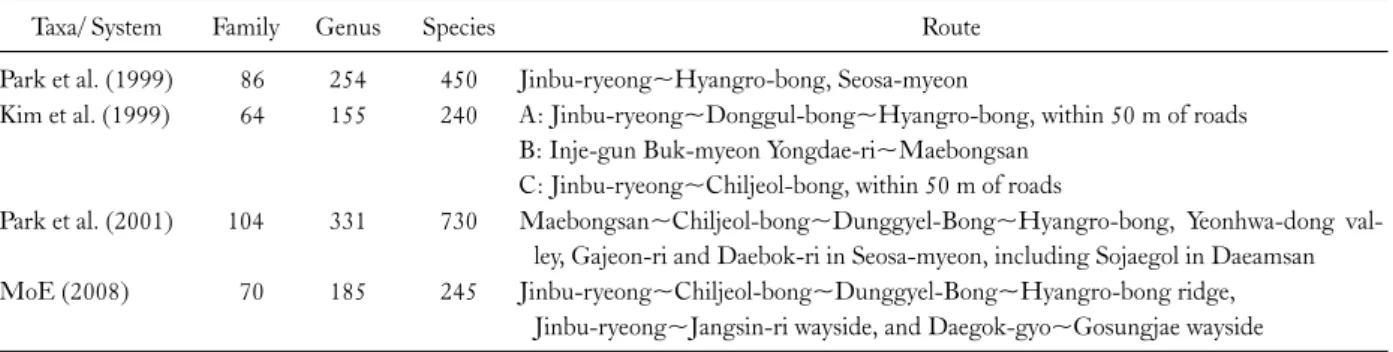
Table 1. Previous research on Hyangro-bong
Taxa/ System Family Genus Species Route
Park et al. (1999) 86 254 450 Jinbu-ryeong~Hyangro-bong, Seosa-myeon
Kim et al. (1999) 64 155 240 A: Jinbu-ryeong~Donggul-bong~Hyangro-bong, within 50 m of roads B: Inje-gun Buk-myeon Yongdae-ri~Maebongsan
C: Jinbu-ryeong~Chiljeol-bong, within 50 m of roads
Park et al. (2001) 104 331 730 Maebongsan~Chiljeol-bong~Dunggyel-Bong~Hyangro-bong, Yeonhwa-dong val- ley, Gajeon-ri and Daebok-ri in Seosa-myeon, including Sojaegol in Daeamsan MoE (2008) 70 185 245 Jinbu-ryeong~Chiljeol-bong~Dunggyel-Bong~Hyangro-bong ridge,
Jinbu-ryeong~Jangsin-ri wayside, and Daegok-gyo~Gosungjae wayside
(Kim et al. 1999; Park et al. 1999; Ministry of Environment
1993 & 1999; Park et al. 2001 & 2002; Korea National Arboretum 2008). MoE (1993) reported that the flora of Hyangro-bong at altitudes below 1,000 m is dominated by Quercus mongolica, which is typical of a climax temperate for- est in Korea. Above 1,000 m, polar climatic Abies neph- rolepis-Pinus koraiensis communities are partially distributed.
MoE (1999) reported that 620 species are distributed throughout the region’s natural ecosystems. Park et al.
(1999) investigated Hyangro-bong Seosa-myeon and con- firmed the inhabitation of 450 species (Table 1). Kim et al.
(1999) investigated the flora along the Jinbu-ryeong through Donggul-bong, Hyangro-bong, Maebong moun- tain and Chiljeol-bong and reported 240 species. Park et al.
(2001) also investigated Donggul-bong ~Chiljeol-bong, and Chiljeol-bong in the eastern valley of Maebong moun- tain and identified 730 species. These studies focused mainly on the ridges of the Hyangro-bong mountain range, the southern regions, and Seosa-myeon, and a number of species showed a large difference in abundance depending on the investigation route and study region. However, large-scale studies of Hyangro-bong are rare; this is be- lieved to reflect the difficult accessibility to the areas owing to the limited civilian access and unconfirmed landmine areas. Therefore, in this study, an extensive investigation was performed, surveying the entire eastern Forest Genetic Resources Reserve areas of the Chiljeol-bong-Hyangro- bong ridges, which have not yet been sufficiently examined.
Materials and Methods
Study areas
The average annual temperature of Gosung-gun over
the past 5 years was 12.4
oC, and the average annual precip- itation was 1,398.5 mm, indicating a relatively mild climate (Korea Meteorological Administration, 2014) owing to the influence of the Taebaek Mountain and the East Sea (Goseonggun 2014). However, it is known to have low win- ter temperatures and severe differences in climate depend- ing on altitude.
Geographically, Hyangro-bong (1,296 m) is located at 38
o19′ 51″N latitude and 128
o19′ 14″E longitude. It is a boundary between Gangwon-do Gosung-gun and Inje-gun, and spans the northern part of the civilian access control line. Furthermore, it is located at the Baekdudaegan moun- tain range and connects Donggul-bong (1,280 m) and Chiljeol-bong (1,172 m) at the southern and major moun- tain ranges, resulting in high-altitude topographical characteristics.
This study investigated the eastern side of the Forest Genetic Resources Reserve including the Donggul-bong, Chiljeol-bong, and Hyangro-bong ridges, accounting for approximately 4,258 ha in area. The altitude of the study area ranged from 200-1,300 m (Fig. 1). The altitude ranged from a minimum of 160 m to 1,287 m. A total of 75% of the study area was between 400-1,200 m and 13%
was above 1,000 m. Regarding the slope of the study area, 54% of the area had a steep slope of greater than 30
o. The major ridge of Hyangro-bong stretches from the north to south and small ridges are positioned in the east and west with respect to the main ridge. Therefore, the northern and southern edges of the study area were relatively widely dis- tributed, and a main water system was located to the east.
Flora investigation
The flora of the entire Forest Genetic Resources Reserve
Fig. 2. Investigated routes and survey points.
Fig. 1. Topographical characteristics of Hyangro-bong.
Area was surveyed via field studies from September to October in 2014. In terms of investigation methods, route-based and quadrat analyses were combined with con- sideration of the accessibility particular regions (Fig. 2).
Investigation routes were classified into 4 sections: section A included the forest roads of Jinbu-ryeong~Hyangro- bong, and sections B, C, and D included Chiljeol-bong, Donggul-bong, and Hyangro-bong towards the eastern part of the FGRRA boundary, respectively. The flora inves- tigation was based on the on-site reporting of plants in each of the target areas.
In addition, the vegetation list to identify vegetation structures for 117 designated quadrats throughout the study area was used in the flora analysis. To select each quadrat, grating grids were placed at regular intervals on the map of the entire target area using the square inves- tigation method, and each intersection point was designated as a preliminary investigation point. The size of each inter- section point was 20x20 m, and target areas that could not be investigated were replaced with nearby areas.
Plant species that were difficult to identify on-site were
classified and identified based on Lee (2003), the National
Species Information System and KFS, and the Korean
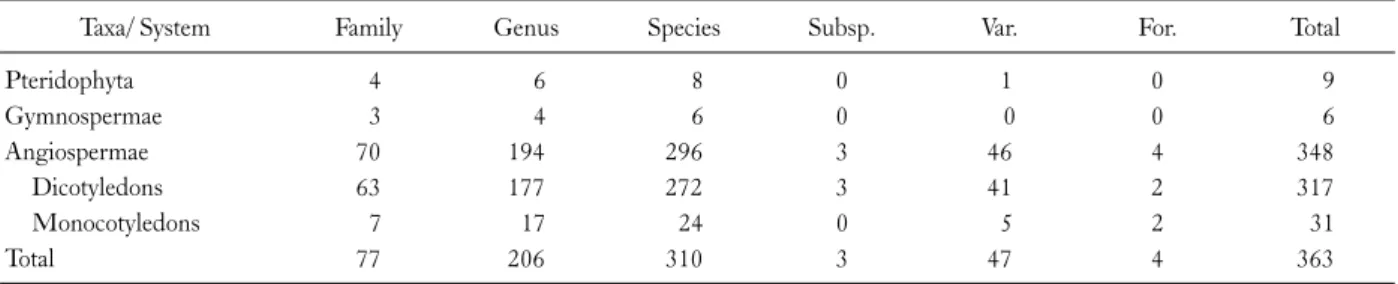
Table 2. Measured physiological indices
Taxa/ System Family Genus Species Subsp. Var. For. Total
Pteridophyta 4 6 8 0 1 0 9
Gymnospermae 3 4 6 0 0 0 6
Angiospermae 70 194 296 3 46 4 348
Dicotyledons 63 177 272 3 41 2 317
Monocotyledons 7 17 24 0 5 2 31
Total 77 206 310 3 47 4 363
Plant Names Index (www.nature.go.kr). Rare and critically endangered species, endemic species, and naturalized plants were classified based on KFS and KNA (2008). The list was arranged according to the Engler classification sys- tem, and within each family, the genus and species names were alphabetized.
Results and Discussion
Flora
In the Hyangro-bong flora investigation, a total of 363 vascular plants belonging to 77 families, 206 genera, 310 species, 3 subspecies, and 47 varieties were identified (Table 2), corresponding to 8.4% of the 4,338 known vas- cular plants on the Korean Peninsula (Lee et al. 2011) and 19.0% of vascular plant species that grow in Gangwon-do (Gangwon-do 1997).
Of the species identified, 2.5% were Pteridophyta spe- cies, including 4 families, 6 genera, 8 species, and 1 variety;
1.7% were gymnosperms, including 3 families, 4 genera, and 6 species; 87.3% were angiosperm Dicotyledone spe- cies including 348 taxa belonging to 63 families, 177 gen- era, 272 species, 3 subspecies, and 41 varieties; 8.5% were Monocotyledone species including 31 taxa belonging to 7 families, 17 genera, 24 species, and 5 varieties. The largest number of taxa belong to the chrysanthemum family (48 taxa, 13.2%) and the Rosaceae hybrid family had 25 taxa (6.9%) (Appendix 1).
In previous studies, Kim et al. (1999) reported 240 spe- cies, Park et al. (2002) found 730 species, and Park et al.
(1999) found 450 species. Such large discrepancies in the number of species identified among studies are thought to reflect the different investigation routes and time periods.
Although a direct comparison among studies is difficult due
to differences among the study areas, a comparison with the above studies of the Hyangro-bong flora confirmed that 58 taxa including Saussurea calcicola, Streptopus ovalis, and Iris uniflora var. caricina were newly identified in this study.
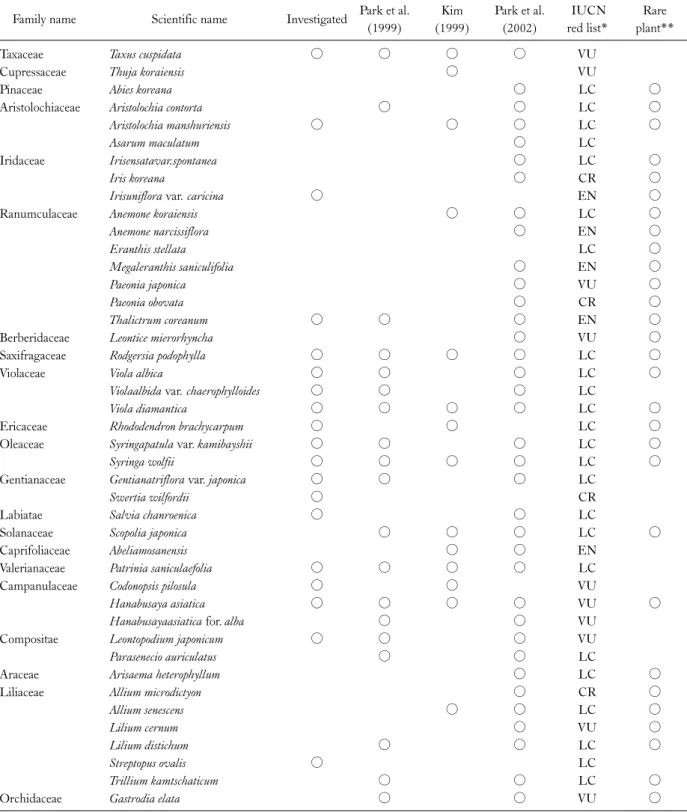
Rare and endangered plant lists and their distribution Based on the rare plants catalog (KFS 2009) provided by the Korea Forest Service, this study identified a critically endangered species, Swertia wilfordii, and 2 endangered species, Iris uniflora var. caricina and Thalictrum coreanum (Table 3). These two species were found in the shrub layers near Hyangro-bong and did not form communities. Four vulnerable species, Hanabusaya asiatica, Codonopsis pilosula, Leontopodium japonicum, and Taxus cuspidata, were found. L.
japonicum and H. asiatica formed communities near forest roads that were above 1,000 m. A total of 9 families and 11 species of least concern, including Streptopus ovalis and Viola diamantiaca, were found. Furthermore, 10 rare plant species designated by KFS and KNA (2008) were identified, cor- responding to 4.0% of all 250 rare plant species and 2.6% of 390 plant types investigated in this study. The only species identified that is officially protected by the Ministry of Environment was Thalictrum coreanum.
The aforementioned previous studies have reported 19, 14, and 36 rare and endangered plant species, vulnerable species, and species of least concern, respectively. In the present study, 3 species, Iris uniflora var. caricina, Swertia wilfordii, and Streptopus ovalis were found in the area for the first time. Some species including Leontopodium japonicum inhabit adjacent military roads, thereby requiring proper measures for protection.
Endemic plant lists and their distributions
Endemic plants adapt and evolve in a given environ
Table 3. List of rare and endangered plants in Hyangro-bong
Family name Scientific name Investigated Park et al.
(1999)
Kim (1999)
Park et al.
(2002)
IUCN red list*
Rare plant**
Taxaceae Taxus cuspidata ○ ○ ○ ○ VU
Cupressaceae Thuja koraiensis ○ VU
Pinaceae Abies koreana ○ LC ○
Aristolochiaceae Aristolochia contorta ○ ○ LC ○
Aristolochia manshuriensis ○ ○ ○ LC ○
Asarum maculatum ○ LC
Iridaceae Irisensatavar.spontanea ○ LC ○
Iris koreana ○ CR ○
Irisuniflora var. caricina ○ EN ○
Ranumculaceae Anemone koraiensis ○ ○ LC ○
Anemone narcissiflora ○ EN ○
Eranthis stellata LC ○
Megaleranthis saniculifolia ○ EN ○
Paeonia japonica ○ VU ○
Paeonia obovata ○ CR ○
Thalictrum coreanum ○ ○ ○ EN ○
Berberidaceae Leontice mierorhyncha ○ VU ○
Saxifragaceae Rodgersia podophylla ○ ○ ○ ○ LC ○
Violaceae Viola albica ○ ○ ○ LC ○
Violaalbida var. chaerophylloides ○ ○ ○ LC
Viola diamantica ○ ○ ○ ○ LC ○
Ericaceae Rhododendron brachycarpum ○ ○ LC ○
Oleaceae Syringapatula var. kamibayshii ○ ○ ○ LC ○
Syringa wolfii ○ ○ ○ ○ LC ○
Gentianaceae Gentianatriflora var. japonica ○ ○ ○ LC
Swertia wilfordii ○ CR
Labiatae Salvia chanroenica ○ ○ LC
Solanaceae Scopolia japonica ○ ○ ○ LC ○
Caprifoliaceae Abeliamosanensis ○ ○ EN
Valerianaceae Patrinia saniculaefolia ○ ○ ○ ○ LC
Campanulaceae Codonopsis pilosula ○ ○ VU
Hanabusaya asiatica ○ ○ ○ ○ VU ○
Hanabusayaasiatica for. alba ○ ○ VU
Compositae Leontopodium japonicum ○ ○ ○ VU
Parasenecio auriculatus ○ ○ LC
Araceae Arisaema heterophyllum ○ LC ○
Liliaceae Allium microdictyon ○ CR ○
Allium senescens ○ ○ LC ○
Lilium cernum ○ VU ○
Lilium distichum ○ ○ LC ○
Streptopus ovalis ○ LC
Trillium kamtschaticum ○ ○ LC ○
Orchidaceae Gastrodia elata ○ ○ VU ○
*CR: Critically endangered, EN: Endangered species VU: Vulnerable LC: Least concerned.
**Rare plants by Korean forest service (2009).
Table 4. List of the Korean endemic plants in Hyangro-bong
Family name Scientific name Investigated Park et al. (1999) Kim et al. (1999) Park (2002)
Pinaceae Abies koreana ○
Salicaceae Salix koriyanagi ○ ○
Asarum maculatum ○
Caryophyllaceae Pseudostellaria coreana ○
Ranumculaceae Aconitum pseudolaeve ○ ○ ○
Anemone koraiensis ○ ○
Clematis chiisanensis ○ ○
Clematisfusca var. coreana ○ ○ ○ ○
Clematis trichotoma ○ ○ ○
Thalictrum coreanum ○ ○ ○
Berberidaceae Berberis koreana ○ ○ ○
Cruciferae Arabis ligulifolia ○
Rosaceae Filipendula glaberrima ○ ○ ○ ○
Sanguisorba hakusanensis ○ ○ ○ ○
Leguminosae Vicia chosenensis ○ ○
Geraniaceae Geraniumeriostemon var. glabrescens ○ ○
Viola diamantica ○ ○ ○ ○
Labiatae Salvia chanroenica ○ ○
Scrophulariaceae Paulownia coreana ○
Caprifoliaceae Abeliamosanensis ○ ○
Lonicera subsessilis ○ ○
Weigela subsessilis ○ ○ ○ ○
Valerianaceae Patrinia saniculaefolia ○ ○ ○ ○
Valeriana fauriei ○ ○ ○
Hanabusaya asiatica ○ ○ ○ ○
Hanabusayaasiatica for. alba ○ ○
Compositae Aster koraiensis ○ ○
Cirsium setidens ○ ○ ○ ○
Saussurea calcicola ○
Saussurea macrolepis ○ ○
Saussurea seoulensis ○ ○ ○
Cyperaceae Carex okamotoi ○ ○
ment, and these processes explain the observed regional differentiation. Lee (1983) reported a total of 407 plant types belonging to 61 families, 172 genera, 339 species, 46 varieties, and 22 cultivars. Paik (1994) recently reported 570 plant types belonging to 72 families, 299 genera, 269 species, 1 subspecies, 174 varieties, and 125 cultivars. KFS and KNA (2008) reported 59 families, 162 genera, and 328 species. Of the species found in the current study, a total of 7 families and 14 taxa endemic to the Korean Peninsula in- cluding Aconitum pseudolaeve and Clematis fusca var. coreana were identified (Table 4). This corresponds to 4.3% of all known Korean endemic plant species according to KFS
(328) and 9.5% of the 148 Korean endemic plants types specific to Gangwon-do (Gangwon-do 1997). Including data from previous studies, 15 families and 32 species in- habit the area overall. The only species that was newly re- ported in the area was Saussurea calcicola.
Naturalized plants and their distributions
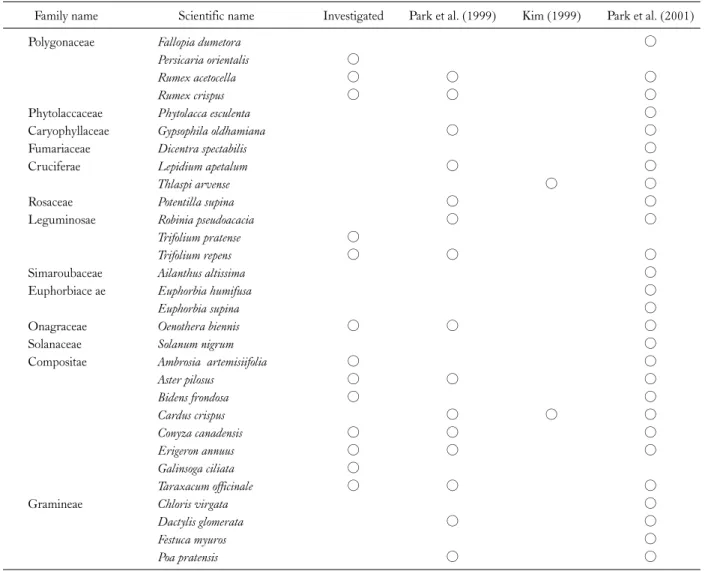
Naturalized plants refer to those that move from their
native habitats to other regions by human mediation (Park
2001). Naturalized plants in the region included 4 families,
11 genera, 13 species, and 13 types, such as Erigeron an-
nuus, Ambrosia artemisiifolia, Conyza canadensis, Bidens fron-
Table 5. List of naturalized plants in Hyangro-bong
Family name Scientific name Investigated Park et al. (1999) Kim (1999) Park et al. (2001)
Polygonaceae Fallopia dumetora ○
Persicaria orientalis ○
Rumex acetocella ○ ○ ○
Rumex crispus ○ ○ ○
Phytolaccaceae Phytolacca esculenta ○
Caryophyllaceae Gypsophila oldhamiana ○ ○
Fumariaceae Dicentra spectabilis ○
Cruciferae Lepidium apetalum ○ ○
Thlaspi arvense ○ ○
Rosaceae Potentilla supina ○ ○
Leguminosae Robinia pseudoacacia ○ ○
Trifolium pratense ○
Trifolium repens ○ ○ ○
Simaroubaceae Ailanthus altissima ○
Euphorbiace ae Euphorbia humifusa ○
Euphorbia supina ○
Onagraceae Oenothera biennis ○ ○ ○
Solanaceae Solanum nigrum ○
Compositae Ambrosia artemisiifolia ○ ○
Aster pilosus ○ ○ ○
Bidens frondosa ○ ○
Cardus crispus ○ ○ ○
Conyza canadensis ○ ○ ○
Erigeron annuus ○ ○ ○
Galinsoga ciliata ○
Taraxacum officinale ○ ○ ○
Gramineae Chloris virgata ○
Dactylis glomerata ○ ○
Festuca myuros ○
Poa pratensis ○ ○
dosa, Aster pilosus, Taraxacum officinale, Galinsoga ciliata, Rumex crispus, Rumex acetosella, Persicaria orientalis, Oenothera biennis, Trifolium pratense, and Trifolium repens (Table 5). These species correspond to 4.1% of all 321 known Korean naturalized plant types (KFS 2011).
Naturalized plants were mainly distributed near forest roads and are therefore subjected to outside influences and are thought to migrate via military vehicles and artificial paths, suggesting ecological changes owing to interference.
Naturalized plants are capable of interrupting natural ecosystems. They can result in continuous turnover of com- munities and demonstrate great adaptability to the environ- ment, which can be detrimental to natural vegetation (You 2009). Accordingly, eliminating naturalized plants based on
the status of natural habitats is necessary. In particular, as ci- vilians have very limited access to the study area, it is neces- sary to educate soldiers and control military vehicles.
Conclusions
This study investigated the flora in the eastern part of the Forest Genetic Resources Reserve Area of Hyangro-bong.
A total of 363 types of vascular plants belonging to 77 fami-
lies, 206 genera, 310 species, 3 subspecies, and 47 varieties
were identified in the study area. Rare and endangered
plants included the critically endangered Swertia wilfordii
and endangered Irisuniflora var. caricina. Four vulnerable
species, Hanabusaya asiatica, Codonopsis pilosula, Leontopo-
dium japonicum, and Taxus cuspidata, were also found, and L.
japonicum and H. asiatica formed communities near forest roads at elevations above 1,000 m. A total of 7 families and 14 taxa were endemic, including Aconitum pseudolaeve and Clematis fusca var. coreana. Thirteen types of naturalized plants belonging to 4 families, 11 genera, and 13 species were distributed along the Hyangro- bong forest roads.
Erigeron annuus, Ambrosia artemisiifolia, Conyza canadensis, Bidens frondosa, Aster pilosus, Taraxacum officinale, Galinsoga ciliata, Rumex crispus, Rumex acetosella, Persicaria orientalis, Oenothera biennis, Trifolium pratense, and Trifolium repens were the naturalized plants found around forest roads, which ex- perience frequent external influences. This study was im- portant because it investigated areas that had not been inves- tigated in previous studies. However, it was limited by its short duration; a long-term study is needed in the future.
References
Cheon KG, Byun JG, Jung SC, Sung JH. 2014. Community struc- ture of Quercus mongolica stand in Hyangrobong area, Baekdudaegan. J Agric Life Sci 48: 1-13. (in Korean with English abstract)
Goseonggun. 2014. http://www.goseong.org/ Accessed 20 Dec 2014.
Kim H, Chang CS, Jeon JI. 1999. Bull of Seoul Nat’l Univ.
Arboretum 19: 29-53.
Korea Biodiversity Information system. 2014. http://www.nature.
go.kr/ Accessed 25 Dec 2014.
Korea Forest Service, Korea National Arboretum. 2008. Rare Plants Data Book in Korea. Geobook, Daejeon.
Korea Forest Service. 2011. 2011 Forest Basic Statistics. Seoul, pp 359.
Korea Meteorological Administration. 2014. http://www.kma.go.
kr/weather/climate/data_monthly.jsp?prevType=sfc_ann_&type=
sfc_ann_&year=2013&x=37&y=7. Accessed 20 Dec 2014.
Korea National Arboretum. 2008. The plant resources status of for- est genetic resource reserve; 1st year 2007. pp 232.
Korean Plant Names Index. 2014. http://www.nature.go.kr/new- kfsweb/kfi/kfs/kbi/plant/pilbk/selectPlantPilbkGnrlList.do?mn
=KFS_28_01_02_01&orgId=kbi. Accessed 25 Dec 2014.
Lee BY, Nam GH, Lee JY, Park CH, Lim CE, Kim MH, Lee SJ, Roh TK, Lim JA, Han JE, Kim JH. 2011. National list of spe- cies of Korea (Vascular Plants). National Institute of Biological Resources. Incheon, Korea. (in Korean)
Ministry of Environment. 1993. ‘92 Scrutiny of the Natural Ecosystem Area. pp 173-203.
Ministry of Environment. 1999. (2nd) Korean Nationwide Survey on Natural Environments 1998, Nature of Goseong, Inje:
Kunkkachi-bong, Noinsan, Gunbongsan, Hwangro-bong, Chiljeol-bong, Maebongsan. Seoul.
Ministry of Environment. 2009. (3nd) Korean Nationwide Survey on Natural Environments 2008.
Park KS, Ahn CH, Park WG. 2001. A Study on the Flora and Vegetation of Civilian Control Line Area (Hyangro-Bong, Chiljeol-bong, Mt. Mae-Bong in Inje-gun, Kangwon-do). J Kor En 20: 81-116. (in Korean with English abstract)
Park KS. 2002. A study on the flora and vegetation in civilian con- trol line area (Hyangro-Bong, Chiljeol-Bong, Mt. Mae-Bong in Inje-gun, Kangwon-do). MS thesis. Gangwon national uni- versity, Chuncheon, Korea. (in Korean)
Park WG, Yoo SI, Park KS. 1999. A study on the flora Mt.
Hyangro-bong. J For Sci 15: 44-64.
You JH, Park KH, Yoon YC, Song BG. 2009. Vascular plants in coastal wetland in Gyeongsangnam-do, Korea. J Wetl Res 11:
29-38. (in Korean with English abstract)
Appendix 1. List of vascular plants of Hyangro-bong
No. Scientific name I A B C No. Scientific name I A B C
Dennstaedtiaceae 37 Quercus serrata * * * *
1 Lepisorus ussuriensis * * * 38 Quercus variabilis * * * *
Davalliaceae Ulmaceae
2 Woodsia manchuriensis * 39 Ulmus davidiana var. japonica * * *
3 Woodsia polystichoides * * * 40 Ulmus laciniata * * * *
Aspidiaceae Moraceae
4 Dryopteris crassirhizoma * * * * 41 Morus alba * *
5 Dryopteris expansa * 42 Morus bombycis * * * *
6 Onoclea orientalis * * Cannabinaceae
Asplediaceae 43 Humulus japonicus * * *
7 Athyrium niponicum * * Urticaceae
8 Athyrium yokoscense * * * 44 Boehmeria spicata * * * *
9 Pteridium aquilinum var. latiusculum * * * 45 Pilea hamaoi * *
Taxaceae 46 Pilea mongolica *
10 Taxus cuspidata * * * * 47 Pilea peploides * * * *
Cupressaceae Aristolochiaceae
11 Juniperus rigida * * * * 48 Aristolochia manshuriensis * * *
Pinaceae 49 Asarum sieboldii * * *
12 Abies holophylla * * * * Polygonaceae
13 Abies nephrolepis * * * * 50 Persicaria breviochreata *
14 Pinus densiflora * * * * 51 Persicaria hydropiper * * *
15 Pinus koraiensis * * * * 52 Persicaria lapathifolia * * *
Chloranthaceae 53 Persicaria longiseta * * *
16 Chloranthus japonicus * * * 54 Persicaria nepalensis * * * *
Salicaceae 55 Persicaria orientalis *
17 Populus davidiana * * * * 56 Persicaria posumbu var. laxiflora *
18 Salix caprea * * * * 57 Persicaria sagittata * * * *
19 Salix gracilistyla * * * * 58 Persicaria thunbergii * * *
20 Salix koreensis * * * 59 Polygonum aviculare * *
Juglandaceae 60 Rumex acetocella * * *
21 Juglans mandshurica * * * * 61 Rumex crispus * * *
Betulaceae Iridaceae
22 Alnus sibirica * * * * 62 Iris uniflora var. caricina *
23 Betula chinensis * * * Caryophyllaceae
24 Betula costata * * * * 63 Lychins cognata * * * *
25 Betula ermani * * * * 64 Pseudostellaria palibiniana * * *
26 Betula platyphylla var. japonica * * * * 65 Sagina japonica * *
27 Betula schmidtii * * * * 66 Silene firma * *
28 Betula davurica * * * Ranumculaceae
29 Carpinus cordata * * * * 67 Aconitum jaluense * * *
30 Carpinus laxiflora * * * * 68 Aconitum pseudolaeve * * *
31 Corylus heterophylla * * 69 Actaea asiatica * * * *
32 Corylus sieboldiana * * 70 Cimicifuga dahurica * * *
33 Corylus sieboldiana var. mandshurica * * * 71 Cimicifuga heracleifolia * * *
Fagaceae 72 Clematis alpina var. ochotensis *
34 Quercus acutissima * * * * 73 Clematis apiifolia * * *
35 Quercus aliena * * * * 74 Clematis fusca * * * *
36 Quercus mongolica * * * * 75 Clematis fusca var. coreana * * * *
Appendix 1. Continued
No. Scientific name I A B C No. Scientific name I A B C
76 Clematis heracleifolia * * 117 Prunus sargentii * * * *
77 Hepatica asiatica * * * 118 Prunus serrulata var. spontanea * *
78 Pulsatilla koreana * * * 119 Pyrus pyrifolia * * *
79 Thalictrum aquilegifolium var. sibiricum * * * 120 Pyrus ussuriensis * *
80 Thalictrum coreanum * * * 121 Rosa multiflora * * * *
81 Thalictrum filamentosum var. tenerum * * * 122 Rubus crataegifolius * * * *
82 Thalictrum kemense var. hypoleucum * 123 Rubus oldhamii * * *
Berberidaceae 124 Rubus phoenicolasius * * *
83 Berberis amurensis * * * * 125 Sanguisorba hakusanensis * * * *
84 Berberis koreana * * * 126 Sanguisorba officinalis * * * *
85 Caulophyllum robustum * * * * 127 Sorbaria sorbifolia var. stellipila * * * *
Magnoliaceae 128 Sorbus alnifolia * * *
86 Magnolia sieboldii * * * * 129 Sorbus amurensis *
Lauraceae 130 Sorbus commixta * * *
87 Lindera obtusiloba * * * * 131 Spiraea fritschiana * * *
Fumariaceae 132 Stephanandra incisa * * * *
88 Corydalis ochotensis * * * * Leguminosae
Cruciferae 133 Amphicarpaea bracteata subsp. edgeworthii * *
89 Arabis glabra * * * 134 Kummerowia striata * * *
90 Barbarea orthoceras * 135 Lespedeza bicolor * *
91 Capsella bursapastoris * * * * 136 Lespedeza crytobotrya * * *
92 Cardamine leucantha * * * * 137 Lespedeza maximowiczii * * * *
Crassulaceae 138 Maackia amurensis * * * *
93 Hylotelephium verticillatum * 139 Pueraria lobata * * * *
94 Hylotelephium viviparum * 140 Trifolium pratense *
95 Orostachys filirera * 141 Trifolium repens * * *
96 Sedum kamtschaticum * * * 142 Vicia amoena * * *
Saxifragaceae 143 Vicia amoena f. albiflora *
97 Astilbe koreana * * * 144 Vicia japonica * *
98 Astilbe rubra * * * * 145 Vicia unijuga * * * *
99 Deutzia glabrata * * * * 146 Vicia venosa var. cuspidata * * *
100 Deutzia grandiflora var. baroniana * * * Geraniaceae
101 Deutzia parviflora * * * 147 Geranium krameri *
102 Philadelphus schenckii * * * * 148 Geranium thunbergii * * *
103 Philadelphus schrenckii var. jackii * Rutaceae
104 Philadelphus tenuifolius * * * 149 Phellodendron amurense * *
105 Rodgersia podophylla * * * * 150 Zanthoxylum piperitum *
106 Saxifraga fortunei var. incisolobata * * * 151 Zanthoxylum schinifolium * * *
107 Saxifraga punctata * Euphorbiaceae
Rosaceae 152 Euphorbia sieboldiana * * * *
108 Agrimonia coreana * * 153 Securinega suffruticosa * * *
109 Agrimonia pilosa * * * Anacardiaceae
110 Filipendula glaberrima * * * * 154 Rhus javanica * * *
111 Potentilla chinensis * * 155 Rhus trichocarpa * * * *
112 Potentilla dickinsii * * * * 156 Rhus verniciflua *
113 Potentilla fragarioides var. major * * * Celastraceae
114 Potentilla freyniana * * * 157 Celastrus orbiculatus * * * *
115 Potentilla matsumurae * * 158 Euonymus oxyphyilus * * * *
116 Prunus padus * * * * 159 Euonymus sachalinensis * * * *
Appendix 1. Continued
No. Scientific name I A B C No. Scientific name I A B C
160 Triptergium regelii * * * * 196 Angelica tenuissima *
Staphyleaceae 197 Bupleurum longiradiatum * * * *
161 Staphylea bumalda * * * * 198 Heracleum moellendorffii *
Aceraceae 199 Peucedanum terebinthaceum * * *
162 Acer komarovii * * * * 200 Pimpinella brachycarpa * * *
163 Acer palmatum * * 201 Pimpinella koreana *
164 Acer pictum subsp. Mono * * * * 202 Pleurospermum camtschaticum * * *
165 Acer pseudosieboldianum * * * * 203 Sanicula chinensis * * *
166 Acer triflorum * * * Cornaceae
Balsaminaceae 204 Cornus controversa * * *
167 Impatiens textori * * * * Pyrolaceae
Rhamnaceae 205 Pyrola japonica * * *
168 Rhamnus ussuriensis * Ericaceae
Vitaceae 206 Rhododendron brachycarpum * *
169 Ampelopsis heterophylla * * * 207 Rhododendron mucronulatum * * * *
170 Vitis coignetiae * * * * 208 Rhododendron schlippenbachii * * * *
Tliaceae 209 Rhododendron yedoense var. poukhanense * * *
171 Tilia amurensis * * * * 210 Vaccinium hirtum var. koreanum * * * *
172 Tilia mandshurica * * * * Primulaceae
Actinidiaceae 211 Lysimachia barystachys *
173 Actinidia arguta * * * * 212 Lysimachia clethroides * * * *
174 Actinidia kolomikta * * * * 213 Lysimachia vulgaris var. davurica * *
175 Actinidia polygama * * * Symplocaceae
Hypericaceae 214 Symplocos chinensis f. pilosa * * * *
176 Hypericum ascyron * * * Styracaceae
Violaceae 215 Styrax obassia * * * *
177 Viola acuminata * * * * Oleaceae
178 Viola albica * * * 216 Fraxinus mandshurica * * * *
179 Viola albida var. chaerophylloides * * * 217 Fraxinus rhynchophylla * * * *
180 Viola collina * * 218 Ligustrum obtusif * * *
181 Viola diamantica * * * * 219 Syringa patula var. kamibayshii * * *
182 Viola orientalis * * * * 220 Syringa reticulata var. mandshurica * * *
183 Viola rosii * * * 221 Syringa wolfii * * * *
184 Viola selkirkii * * Gentianaceae
185 Viola verecunda * * 222 Gentiana scabra * * * *
Onagraceae 223 Gentiana triflora var. japonica * * *
186 Oenothera biennis * * * 224 Swertia japonica *
Alangiaceae 225 Swertia tetrapetala *
187 Alangium platanifolium var. trilobum * * * 226 Swertia wilfordii *
Araliaceae Asclepiadaceae
188 Aralia cordata var. continentalis * * * * 227 Cynanchum ascyrifolium * *
189 Aralia elata * * * * Convolvulaceae
190 Eleutherococcus sessiliflorus * * * 228 Cuscuta australis *
191 Kalopanax septemlobus * * * * Verbenaceae
Umbelliferae 229 Callicarpa japonica * * *
192 Angelica amurensis * 230 Clerodendron trichotomum * * *
193 Angelica decursiva * * * Labiatae
194 Angelica gigas * * * 231 Agastache rugosa * *
195 Angelica polymorpha * * 232 Elsholtzia ciliata * * * *
Appendix 1. Continued
No. Scientific name I A B C No. Scientific name I A B C
233 Isodon excisus * * * * 273 Ambrosia artemisiifolia * *
234 Meehania urticifolia * * * 274 Artemisia capillaris * * *
235 Prunella vulgaris var. lilacina * * * * 275 Artemisia feddei * *
236 Salvia chanroenica * * 276 Artemisia japonica * * *
Scrophulariaceae 277 Artemisia keikeana * * *
237 Melampyrum roseum * * * 278 Artemisia montana * * *
238 Melampyrum roseum var. ovalifolium * * 279 Artemisia princeps * * *
239 Melampyrum setaceum var. nakaianum * 280 Artemisia stolonifera * * * *
240 Pedicularis resupinata * * * * 281 Artemisia viridissima *
241 Scrophularia kakudensis * 282 Aster ageratoides * *
242 Veronicastrum sibiricum * 283 Aster meyendorfii * * * *
Phrymaceae 284 Aster pilosus * * *
243 Phryma leptostachya var. asiatica * * * 285 Aster scaber * * * *
Plantaginaceae 286 Aster tataricus * * *
244 Plantago asiatica * * * * 287 Atractylodes ovata * * * *
Rubiaceae 288 Bidens frondosa * *
245 Galium boreale var. boreale * 289 Cirsium setidens * * * *
246 Galium boreale var. amurense * 290 Conyza canadensis * * *
247 Galium dahuricum var. tokyoense * 291 Crepidiastrum chelidoniifolium * * * * 248 Galium verum var. asiaticum * * * 292 Crepidiastrum denticulatum * * *
249 Rubia akane * * * 293 Crepidiastrum sonchifolium * * *
250 Rubia chinensis * * 294 Dendranthema zawadskii var. latilobum * * *
251 Rubia cordifolia var. pratenis * * 295 Erigeron annuus * * *
Caprifoliaceae 296 Eupatorium japonicum * * *
252 Lonicera praeflorens * * * 297 Galinsoga ciliata *
253 Sambucus williamsii var. coreana * * * * 298 Hieracium umbellatum * * *
254 Viburnum opulus * * * * 299 Lactuca indica *
255 Viburnum wrightii * * * 300 Lactuca raddeana * *
256 Weigela subsessilis * * * * 301 Lactuca triangulata * *
Valerianaceae 302 Leibnitzia anandria * * *
257 Patrinia saniculaefolia * * * * 303 Leontopodium japonicum * * *
258 Patrinia scabiosaefolia * * * * 304 Ligula riafischeri * * * *
259 Patrinia villosa * * * 305 Parasenecio auriculata var. kamtschatica *
Dipsacaceae 306 Parasenecio auriculata var. matsumurana *
260 Scabiosa tschiliensis * 307 Parasenecio firmus *
Campanulaceae 308 Prenanthes tatarinowii *
261 Adenophora curvidens * 309 Saussurea calcicola *
262 Adenophora divaricata * 310 Saussurea grandifolia * * * *
263 Adenophora lamarckii * 311 Saussurea seoulensis * * *
264 Adenophora remotiflora * * * 312 Saussurea tanakae *
265 Adenophora triphylla var. japonica * * * 313 Serratula coronata var. insularis * 266 Adenophora verticillata var. hirsuta * 314 Solidago virgaurea subsp. asiatica var. asiatica * * * *
267 Codonopsis lanceolata * * * 315 Syneilesis palmata * * *
268 Codonopsis pilosula * * 316 Synurus deltoides * * * *
269 Hanabusaya asiatica * * * * 317 Taraxacum officinale * * *
Compositae Gramineae
270 Achillea alpina * * * 318 Calamagrostis arundinacea * *
271 Adenocaulon himalaicum * * * * 319 Diarrhena mandshurica *
272 Ainsliaea acerifolia * * * * 320 Digitaria ciliaris * *
Appendix 1. Continued
No. Scientific name I A B C No. Scientific name I A B C
321 Echinochloa utilis * 341 Allium thunbergii * * *
322 Microstegium japonicum * 342 Disporum smilacinum * * *
323 Miscanthus sinensis var. purpurascens * * * 343 Disporum viridescens * * *
324 Oplismenus undulatifolius * * * 344 Heloniopsis koreana * * *
325 Phragmites japonica * * * 345 Hosta capitata *
326 Phyllostachys nigra var. henonis * 346 Hosta longipes * *
327 Sasa borealis * * * * 347 Hosta longissima * *
328 Setaria glauca * * 348 Lilium tsingtauense * *
329 Setaria viridis * * * 349 Polygonatum inflatum * * *
330 Spodiopogon cotulifer * * * 350 Polygonatum involucratum * * *
331 Spodiopogon sibiricus * * * 351 Polygonatum odoratum var. pluriflorum * * *
332 Stipa pekinensis * * * 352 Smilacina japonica *
Cyperaceae 353 Smilax china * * * *
333 Carex humilis var. nana * * * * 354 Smilax nipponica * * *
334 Carex lanceolata * * 355 Smilax riparia var. ussuriensis * *
335 Carex lasiolepis * * 356 Smilax sieboldii *
336 Carex ligulata * 357 Streptopus ovalis *
337 Carex siderosticta * * * * 358 Veratrum maackii var. japonicum * *
Araceae 359 Veratrum oxysepalum * * * *
338 Arisaema amurense * * * Dioscoreaceae
Commelinaceae 360 Dioscorea quinqueloba * * *
339 Commelina communis * * * * 361 Dioscorea septemloba * *
Juncaceae Orchidaceae
340 Juncus effusus var. decipiens * * * 362 Cephalanthera longibracteata * * *
Liliaceae 363 Liparis kumokiri *
*I: investigated by this study, A: Park et al. (1999), B: Kim (1999), C: Park et al. (2001).