• 검색 결과가 없습니다.

Highly Flexible Dye-sensitized Solar Cell Prepared on Single Metal Mesh

N/A
N/A
Protected

Academic year: 2021

Share "Highly Flexible Dye-sensitized Solar Cell Prepared on Single Metal Mesh"

Copied!
5
0
0

로드 중.... (전체 텍스트 보기)

전체 글

(1)

1. Introduction

Dye-sensitized solar cells (DSSCs) have characteristic advantages including low production cost and high energy conversion efficiency even under weak illumination condition. With these advantages of DSSCs, it’s applied in the emerging fields of building integrated photovoltaic and electronics integrated photovoltaic like small portable power sources as demands are increased

1-3)

.

Generally in a sandwich type structure of DSSCs consisting of two facing transparent conductive oxide (TCO) coated substrates, TCO-coated substrate is an important component.

However TCO-coated substrate limited to rigidity and plastic substrates such as polyethylene terephthalate (PET) or polyethylene Naphthalate (PEN) which cannot bend or stand high temperature heat treatment. And TCO-coated substrates are very expensive it is for a large portion of the production cost of DSSCs

4-11)

.

Therefore, several researches have been underway to replace TCO films including metal-based meshes and carbon-based transparent conductive films.

Metal-based meshes are highly bendable and electrically

conductive, can treat at high temperature and fabricate with low cost. Before our team proposed the new DSSC structure utilizing glass paper in which a surface-treated stainless steel mesh is attached to one side of the glass paper, and Pt is deposited on the other side, forming the cell core.

Furthermore instead of attaching method, we have proposed new process fabricate the new type of the cell core with easy way

12)

.

In this study, we have proposed new types of single mesh DSSCs using a single sheet of stainless steel mesh fabricated by coating the photoelectrode and electrolyte filling material, chopped glass paper then coated the electrochemical catalyst as counter electrode on both sides of mesh. Our unique feature is being able to fabricate simply on a single stainless steel mesh as a core cell.

2. Experimental

Glass microfiber filters (CHMLAB Group, GF1 grade filter paper) were used as glass paper. Commercial 304 stainless steel (325 mesh) was used as the metal mesh. The stainless steel mesh was cleaned with acetone, ethanol, and water by sonication and dried in oven at 70°C overnight. After cleaning, a 300 nm Ti thin film was deposited on both sides of the stainless steel mesh by

Highly Flexible Dye-sensitized Solar Cell Prepared on Single Metal Mesh

Min Ju Yun ․ Seung I. Cha* ․ Seon Hee Seo ․ Dong Y. Lee

Nano Hybrid Technology Research Center, Creative and Fundamental Research Division, Korea Electrotechnology Research Institute, Boolmosan-ro 10beon-gil, Seongsan-gu, Changwon 641-120, Korea

ABSTRACT: Dye-sensitized solar cells (DSSCs) are applied in the emerging fields of building integrated photovoltaic and electronics integrated photovoltaic like small portable power sources as demands are increased with characteristic advantages. Highly flexible dye-sensitized solar cells (DSSCs) prepared on single stainless steel mesh were proposed in this paper. Single mesh DSSCs structure utilizing the spraying the chopped glass paper on the surface treated stainless steel mesh for integrating the space element and the electrode components, counter electrode component and photoelectrode component were coated on each side of the single mesh. The fabricated single mesh DSSCs showed the energy-conversion efficiency 0.50% which show highly bendable ability. The new single mesh DSSCs may have potential applications as highly bendable solar cells to overcome the limitations of TCO-based DSSCs.

Key words: Dye-sensitized solar cells, flexible, TCO-free structure, metal mesh, Glass paper

*Corresponding author: [email protected]

Received July 22, 2014; Revised August 18, 2014;

Accepted August 18, 2014

ⓒ 2014 by Korea Photovoltaic Society

This is an Open Access article distributed under the terms of the Creative Commons Attribution Non-Commercial License (http://creativecommons.org/licenses/by-nc/3.0)

which permits unrestricted non-commercial use, distribution, and reproduction in any medium, provided the original work is properly cited.

79

(2)

by direct-current sputtering.

The other side of stainless steel mesh opposite the Pt thin film was coated with TiO

2

paste containing 20 nm TiO

2

nanoparticles (ENB Korea) was deposited on the stainless steel mesh, followed by heat treatment at 480°C for 1 h in air. The 20-nm TiO

2

paste was deposited on the stainless steel mesh two times using 3M tape as a mask, followed by heat treatment at 480°C for 1 h in air.

For measurements, the active area size was 8 mm × 6 mm. After loading N719 dye (Sigma Aldrich) on the sintered electrode by immersion, the cell was cladded with PET-based laminated pouch film (0.1 mm thick, Sindoh Commerce) using a commercial hot-roll-coating machine (Sindoh Commerce, TL-4600). Before cladding, a small hole was made on one side of the cladding film for acetonitrile-based electrolyte (Solaronix SA, AN50) filling using a syringe.

Stainless steel mesh ribbon was placed on the Pt-coated side to expose to the external environment through the cladded film for electrical contact. The energy-conversion performance of the DSSCs was evaluated using a solar simulator (Abet Technologies, model Sun 2000, 1000 W Xe source, Keithley 2400 source meter) under 1.5 AM, 1 sun condition, calibrated by a KG-3 filter and NREL-certified reference cell without a mask.

3. Results and Discussion

The typical sandwich-type DSSCs structure consists of two TCO-coated substrates and the spacer for filling the electrolyte as shown in Fig. 1(a). One TCO-coated substrate is coated with a dye-sensitized TiO

2

film which is working as photoelectrode, the other TCO-coated substrate is coated with Pt catalyst layer is working as counter electrode. This structure has disadvantage for the highly flexible characteristic, the glass substrate is fragile and the sealant will be crack during the bending may cause the leaking the electrolyte. To solve these problems, we propose a single mesh DSSCs structure utilizing the spraying the chopped

glass paper on the surface treated stainless steel mesh for integrating the space element and the electrode components, Pt is deposited on the sprayed chopped glass paper surface and a dye-sensitized mesoporous TiO

2

photoelectrode is coated on the other side of stainless steel mesh. The illustration of the single mesh DSSCs plan and cross section is show in Fig. 1(b).

First of all, the stainless steel mesh’s surface is treated with Ti and TiO

2

by Ti sputtering on both sides to form a 300 nm thick layer then followed by heat treatment at 480°C for 1 hour in air to oxidize Ti thin film to improve the adhesion between the photoelectrode and stainless steel mesh. Then stainless steel mesh was dipped in 1wt% polyvinyl alcohol (PVA) to protect the side for the photoelectrode from overflowing and covering the chopped glass fiber solution.

Before coating the chopped glass fiber, TiO

2

layer was coated overall by doctor blade method and followed by heat treatment at 480°C for 1 hour in air to prevent the electrical shorts from the counter electrode and fill the electrolyte using the pores between the 20 nm TiO

2

nanoparticles. For coating the chopped glass fiber layer, the solution was prepared mixing the 0.1 g chopped glass paper and ethanol by sonication for 30 min to disperse the chopped glass paper and added the binder for the adhesive ability then proceeded stirring for 1h. Mixed solution was coated by spray method and followed by heat treatment at Fig. 1. Schematic illustration of (a) the conversional sandwich-

type dye-sensitized solar cells (DSSCs) and (b) the single

mesh DSSCs plane section and cross section view

(3)

120°C for 30 min for curing the binder. For the electrocatalytic and conductive layer, a Pt thin film of 40 nm thickness was sputter-coated on the chopped glass paper layer. To remove the PVA layer of the stainless steel mesh, the single mesh was rinsed to clean up and improve the conduction electrode part of the photoelectrode.

The TiO

2

layer was deposited as a photoelectrode on the other side of the stainless steel mesh using the doctor blade method

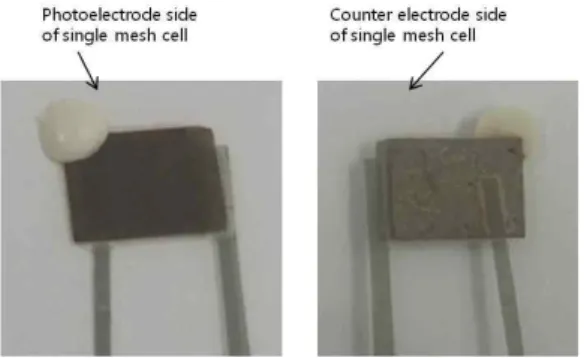
followed by sintering and dye loading step was processed for 20 hours at room temperature. The photography of single mesh DSSCs which is completed by filling the electrolyte and loading the Ru-complex dye, N719 is shown in Fig. 2. The left image is photoelectrode part and right one is counter electrode part. The process of the creating the single mesh cell is shown in schematic view briefly in Fig. 3.

Polymer sheaths were used to seal and cover the single mesh cell by hot rolling pressing method to prevent electrolyte solvent evaporation.

The chopped glass paper layer was sprayed on the one side of the stainless steel mesh was coated uniformly as shown in Fig.

4(a) and (b).

Connected between the junction of the glass paper is formed in the pore which acts as an electrolyte to fill. The surface of chopped glass paper was coated by Pt thin film. As shown in Fig.

4(c) and (d), Pt particles are covered on the glass paper surface, due to the connection between the glass paper fiber, Pt-coated side shows electrically conductive and gray color as shown in Fig. 2.

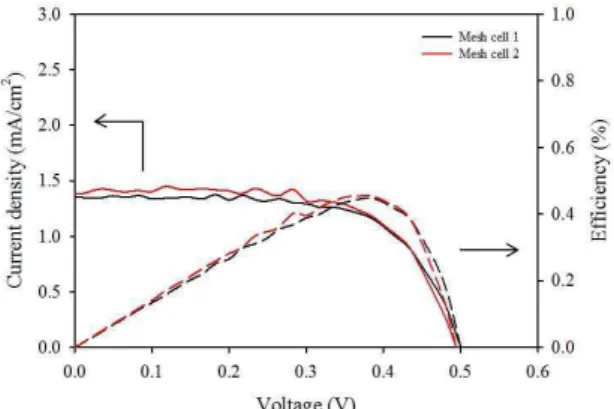
The photovoltaic performance of the single mesh DSSC under illumination of 1.5 AM, 1 sun condition was shown in Fig.

5. The open-circuit voltage (Voc), short-circuit current density (Jsc), and fill factior (FF) are 0.49V, 1.88 (mA/cm

2

), and 0.54, respectively, corresponding to an energy-conversion efficiency (η) of 0.5%. To confirm repeatability, we compared two single mesh cells under the same condition show the similar results as summarized in Table 1. The reasons of the low energy-conversion efficiency are the low short-current density and the low open- Fig. 2. Photography image of the single mesh DSSCs. The left

image is photoelectrode part and right is counter electrode part

Fig. 3. Schematic flow charts of the fabrication of single mesh DSSCs

Fig. 4. SEM micrographs of (a) surface of spray-coated chopped

glass paper of single mesh DSSCs, (b) high magnification

SEM image. (c) SEM micrograph of surface of sputter-

coated on the spray-coated chopped glass paper, (d)

high magnification SEM image with Pt particles

(4)

circuit voltage.

The binder is used as the adhesive leak in and cover the portion of the electrode of the photoelectrode could disturb the direct contact between the photoelectrode and stainless steel mesh which is working as the electrode. It make difficult to transfer the charge from the photoelectrode to the external circuit, could be recombination sites. This would be related to the short-circuit current density.

In order to avoid electrical short, gave a weak sputtering power during the Pt sputter-coating process. Thin thickness of Pt film may not enough to operation of the DSSCs and it affects the electrical propensity of the counter electrode. For these reasons, the short-circuit current density and the open-circuit voltage decreased and affects the energy-conversion efficiency.

Improving the materials like binder or electrochemical catalyst and processing, should be another factors to develop the performance of the single mesh DSSCs.

4. Conclusions

In summary, highly flexible single mesh dye-sensitized solar cells fabricated easily on one sheet of the stainless steel mesh by spraying the chopped glass paper. In the single mesh DSSCs design, one side of the stainless steel mesh spray-coated with chopped glass paper as filling the electrolyte and sputter-coated with Pt as electrochemical catalyst. The other side of the stainless

Acknowledgments

This work was supported by the “New & Renewable Energy Core Technology Program” of the Korea Institute of Energy Technology Evaluation and Planning (KETEP) granted financial resource from the Ministry of Trade, Industry & Energy, Republic of Korea (No. 2011T100100678).

References

1. B. O’regan and M. Grfitzeli, “A Low-Cost, High-Efficiency Solar Cell Based on Dye-Sensitized”, Nature, 353, pp. 737-740, 1991.

2. U. Bach, D. Lupo, P. Comte, J. Moser, F. Weissörtel, J. Salbeck, H. Spreitzer and M. Grätzel, “Solid-State Dye-Sensitized Mesoporous TiO

2

Solar Cells with High Photon-to-Electron Conversion Efficiencies”, Nature, 395, pp. 583-585, 1998.

3. F. Lenzmann and J. Kroon, “Recent Advances in Dye-Sensitized Solar Cells”, Advances in OptoElectronics, pp. 2007, 2007.

4. H. J. Snaith and L. Schmidt Mende, “Advances in liquid elec- trolyte and solid state dye sensitized Solar Cells”, Adv Mater, 19, pp. 3187-3200, 2007.

5. H. Lindström, A. Holmberg, E. Magnusson, S. Lindquist, L.

Malmqvist and A. Hagfeldt, “A New Method for Manufacturing Nanostructured Electrodes on Plastic Substrates”, Nano Letters, 1, pp. 97-100, 2001.

6. F. Pichot, J. R. Pitts and B. A. Gregg, “Low-Temperature Sintering of TiO

2

Colloids: Application to Flexible Dye-Sensitized Solar Cells”, Langmuir, 16, pp. 5626-5630, 2000.

7. H. Wang, Y. Liu, H. Huang, M. Zhong, H. Shen, Y. Wang and H. Yang, “Low Resistance Dye-Sensitized Solar Cells Based on all-Titanium Substrates using Wires and Sheets”, Appl Surf Sci, 255, pp. 9020-9025, 2009.

8. D. Zhang, T. Yoshida, T. Oekermann, K. Furuta and H. Minoura,

“Room Temperature Synthesis of Porous Nanoparticulate TiO

2

Films for Flexible Dye-Sensitized Solar Cells”, Advanced Functional Materials, 16, pp. 1228-1234, 2006.

9. S. Ito, G. Rothenberger, P. Liska, P. Comte, S. M. Zakeeruddin, P. Péchy, M. K. Nazeeruddin and M. Grätzel, “High-Efficiency Fig. 5. (a) Relationship between current density and voltage of

the single mesh DSSCs. Mesh cell 1 and 2 are fabricated under same condition

Table 1. Photovoltaic performances of single mesh DSSCs Voc (V) Jsc (mA/cm

2

) FF ŋ (%)

Mesh cell 1 0.49 1.88 0.54 0.50

Mesh cell 2 0.49 1.40 0.66 0.46

(5)

(7.2%) Flexible Dye-Sensitized Solar Cells with Ti-Metal Substrate for Nanocrystalline-TiO

2

Photoanode”, Chemical Communications, pp. 4004-4006, 2006.

10. Y. Fu, Z. Lv, S. Hou, H. Wu, D. Wang, C. Zhang and D. Zou,

“TCO-Free, Flexible, and Bifacial Dye-Sensitized Solar Cell Based on Low Cost Metal Wires”, Advanced Energy Materials, pp. 37-41, 2012

11. V. Vijayakumar, A. Du Pasquier and D. P. Birnie III, “Electrical

and Optical Studies of Flexible Stainless Steel Mesh Electrodes for Dye Sensitized Solar Cells”, Solar Energy Mater Solar Cells, 95, pp. 2120-2125, 2011.

12. S. I. Cha, Y. Kim, K. H. Hwang, Y. Shin, S. H. Seo and D. Y.

Lee, “Dye-Sensitized Solar Cells on Glass Paper: TCO-Free

Highly Bendable Dye-Sensitized Solar Cells Inspired by the

Traditional Korean Door Structure”, Energy & Environmental

Science, 5, pp. 6071-6075, 2012.

수치

Fig. 4. SEM micrographs of (a) surface of spray-coated chopped glass paper of single mesh DSSCs, (b) high magnification SEM image
Table 1. Photovoltaic performances of single mesh DSSCs Voc (V) Jsc (mA/cm 2 ) FF ŋ (%)

참조

관련 문서