Received: May 9, 2018 Revised: June 6, 2018 Accepted: June 21, 2018
Co-corresponding authors: Sang-Won Lee, MD, PhD, Division of Rheumatology, Department of Internal Medicine, Institute for Immunology and Immunological Diseases, Yonsei University College of Medicine, 50-1 Yonsei-ro, Seodaemun-gu, Seoul 03722, Korea.
Tel: 82-2-2228-1987, Fax: 82-2-393-6884, E-mail: [email protected] and Sang-Kyou Lee, PhD, Department of Biotechnology, Yonsei University College of Life Science and Biotechnology, 50-1 Yonsei-ro, Seodaemun-gu, Seoul 03722, Korea.
Tel: 82-2-2123-2889, Fax: 82-2-362-7265, E-mail: [email protected]
•The authors have no financial conflicts of interest.
© Copyright: Yonsei University College of Medicine 2018
This is an Open Access article distributed under the terms of the Creative Com- mons Attribution Non-Commercial License (https://creativecommons.org/licenses/
by-nc/4.0) which permits unrestricted non-commercial use, distribution, and repro- duction in any medium, provided the original work is properly cited.
C-Reactive Protein to Serum Albumin Ratio Is an Independent Predictor of All-Cause Mortality in Patients with ANCA-Associated Vasculitis
Jae-Seung Moon1, Sung Soo Ahn2, Yong-Beom Park2,3, Sang-Kyou Lee1,4, and Sang-Won Lee2,3
1Department of Biotechnology, Yonsei University College of Life Science and Biotechnology, Seoul;
2Division of Rheumatology, Department of Internal Medicine, Yonsei University College of Medicine, Seoul;
3Institute for Immunology and Immunological Diseases, Yonsei University College of Medicine, Seoul;
4Good T Cells, Inc., Seoul, Korea.
Purpose: We investigated whether C-reactive protein (CRP) to serum albumin ratio (CAR) could be an independent predictor of all-cause mortality in patients with antineutrophil cytoplasmic antibody (ANCA)-associated vasculitis (AAV).
Materials and Methods: We retrospectively reviewed the medical records of 170 patients with AAV. We collected clinical and lab- oratory data. We also examined AAV-related and traditional risk factors of all-cause mortality. To assess the hazard ratios of vari- ables, we performed univariable and multivariable Cox hazard model analyses.
Results: The mean age was 55.0 years and 53 patients (31.2%) were male among 170 patients with AAV (88 microscopic polyangi- itis, 43 granulomatosis with polyangiitis, and 39 eosinophilic granulomatosis with polyangiitis). ANCA was detected in 129 pa- tients (75.9%). The initial mean CRP and serum albumin were 41.1 (mg/L) and 3.6 (g/dL), and the mean CAR at diagnosis was 14.8. The most common risk factor of mortality was hypertension (42.4%), followed by chronic kidney disease ≥stage 3 (25.9%).
Fourteen patients (8.2%) died during the mean follow-up of 56.7 months. In both multivariable Cox hazard model analyses, CAR at diagnosis was identified as an independent predictor of all-cause of mortality comparable to diabetes mellitus (DM). More- over, patients with CAR ≥10.35 and having DM exhibited a higher frequency of all-cause mortality than those without.
Conclusion: CAR at diagnosis can be an independent predictor of all-cause mortality, comparable to DM, the conventional risk factor of mortality.
Key Words: Antineutrophil cytoplasmic antibody, vasculitis, c-reactive protein, albumin, mortality
pISSN: 0513-5796 · eISSN: 1976-2437 Yonsei Med J 2018 Sep;59(7):865-871
https://doi.org/10.3349/ymj.2018.59.7.865
INTRODUCTION
Antineutrophil cytoplasmic antibody (ANCA)-associated vas- culitis (AAV) is a group of systemic vasculitides encroaching small vessels, from capillaries to intraparenchymal arterioles and venules. AAV consists of three variants, such as micro- scopic polyangiitis (MPA), granulomatosis with polyangiitis (GPA), and eosinophilic granulomatosis with polyangiitis (EGPA).1,2 Because AAV may induce damage to major organs, AAV can occasionally be fatal: One year-cumulative patient survival rates were reported to range from 82% to 95% in Western countries3 and up to 79.1% in Japan.4 Meanwhile, it was recently reported that 10-year cumulative patient survival rate was 92.8% in Korean patients with AAV.5
So far, C-reactive protein (CRP)/serum albumin ratio (CAR) has been introduced as an independent predictor of all-cause mortality in cancers, inflammatory diseases and septic condi- tions.6-8 Since, AAV is also an inflammatory disease involving systemic major organs beyond vessels,1,2 one could reason- ably speculate that CAR might be a predictor of all-cause mortality during follow-up. However, no study has sought to clarify the clinical significance of CAR in predicting all-cause mortality in AAV patients. Hence, in this study, we investigat- ed whether CAR could be an independent predictor of all- cause mortality in 170 patients with AAV.
MATERIALS AND METHODS
Patients
We retrospectively reviewed the medical records of 170 pa- tients with AAV based on the following inclusion criteria: 1) patients who were first classified as AAV from October 2000 to September 2017 at the Department of Internal Medicine, Yon- sei University College of Medicine, Severance Hospital; 2) pa- tients who fulfilled the American College of Rheumatology 1990 criteria for the classification of GPA and EGPA and then reclassified by the algorithm suggested by the European Medi- cines Agency in 2007, in which the authors added the modified contents of the Chapel Hill Consensus Conferences Nomen- clature of Vasculitis proposed in 2012;1,2 3) patients who had well-documented medical records with which to assess both clinical manifestations at diagnosis and death during follow- up and to calculate vasculitis activity score represented by Bir- mingham vasculitis activity score (BVAS) and prognostic fac- tors identified by five factor score (FFS, 2009) at diagnosis;9,10 and 4) patients who had results on perinuclear (P)-ANCA and cytoplasmic (C)-ANCA or myeloperoxidase (MPO)-ANCA and proteinase 3 (PR3)-ANCA levels at diagnosis. This study was approved by the Institutional Review Board of Severance Hos- pital (4-2017-0673) who waved the need for the patient written informed consent, as this was a retrospective study.
Clinical and laboratory data
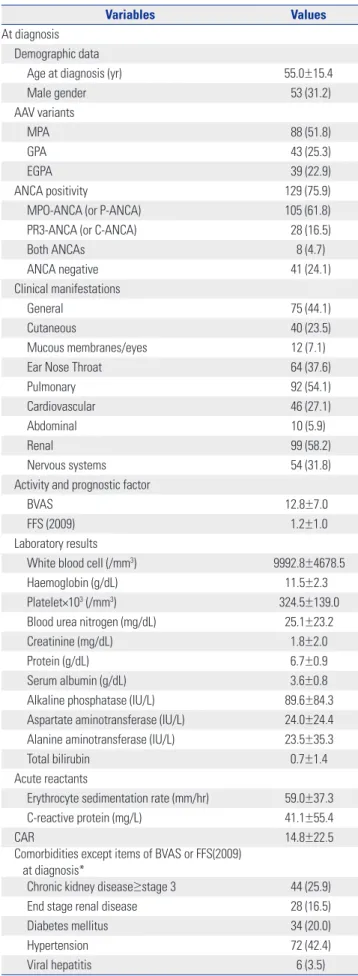
We obtained age at diagnosis and gender as demographic data. We collected clinical and laboratory results at diagnosis as described in Table 1. Comorbidities belonging to BVAS or FFS (2009), such as diffuse alveolar haemorrhage and cardio- vascular diseases, were excluded in risk factors. We also re- viewed medications administered during follow-up. We de- fined the follow-up duration as the period from diagnosis to the last visit in surviving patients, while we defined it as the period from diagnosis to death in deceased patients. CAR was calculated as CRP (mg/L) divided by serum albumin (g/dL).
Statistical analyses
All statistical analyses were conducted using SPSS software
Table 1. Baseline Characteristics of Patients with AAV (n=170) (Continued)
Variables Values
At diagnosis Demographic data
Age at diagnosis (yr) 55.0±15.4
Male gender 53 (31.2)
AAV variants
MPA 88 (51.8)
GPA 43 (25.3)
EGPA 39 (22.9)
ANCA positivity 129 (75.9)
MPO-ANCA (or P-ANCA) 105 (61.8)
PR3-ANCA (or C-ANCA) 28 (16.5)
Both ANCAs 8 (4.7)
ANCA negative 41 (24.1)
Clinical manifestations
General 75 (44.1)
Cutaneous 40 (23.5)
Mucous membranes/eyes 12 (7.1)
Ear Nose Throat 64 (37.6)
Pulmonary 92 (54.1)
Cardiovascular 46 (27.1)
Abdominal 10 (5.9)
Renal 99 (58.2)
Nervous systems 54 (31.8)
Activity and prognostic factor
BVAS 12.8±7.0
FFS (2009) 1.2±1.0
Laboratory results
White blood cell (/mm3) 9992.8±4678.5
Haemoglobin (g/dL) 11.5±2.3
Platelet×103 (/mm3) 324.5±139.0
Blood urea nitrogen (mg/dL) 25.1±23.2
Creatinine (mg/dL) 1.8±2.0
Protein (g/dL) 6.7±0.9
Serum albumin (g/dL) 3.6±0.8
Alkaline phosphatase (IU/L) 89.6±84.3
Aspartate aminotransferase (IU/L) 24.0±24.4 Alanine aminotransferase (IU/L) 23.5±35.3
Total bilirubin 0.7±1.4
Acute reactants
Erythrocyte sedimentation rate (mm/hr) 59.0±37.3
C-reactive protein (mg/L) 41.1±55.4
CAR 14.8±22.5
Comorbidities except items of BVAS or FFS(2009) at diagnosis*
Chronic kidney disease≥stage 3 44 (25.9)
End stage renal disease 28 (16.5)
Diabetes mellitus 34 (20.0)
Hypertension 72 (42.4)
Viral hepatitis 6 (3.5)
(version 23 for windows; IBM Corp., Armonk, NY, USA). The multivariable Cox hazards model was conducted to appropri- ately obtain hazard ratios (HR). In the multivariable Cox haz- ards model, the levels of protein, serum albumin, and CRP were excluded, because they are variables related to the equa- tion for CAR. The optimal cut-off of CAR for death (10.35) was extrapolated by calculating the area under the receiver opera- tor characteristic curve (sensitivity 64.3% and specificity 67.9%). Comparison of cumulative patient survivals between the two groups were analysed by the Kaplan-Meier survival analysis. p-values less than 0.05 were considered statistically significant.
RESULTS
Baseline characteristics of 170 patients with AAV The baseline characteristics are described in Table 1. The mean age was 55.0 years and 53 patients (31.2%) were male.
The mean BVAS and FFS (2009) at diagnosis were 12.8 and 1.2, respectively. The initial mean CRP and serum albumin levels were 41.1 (mg/L) and 3.6 (g/dL), respectively, and the mean CAR at diagnosis was 14.8. Fourteen patients (8.2%) died dur- ing the mean follow-up of 56.7 months.
CAR at diagnosis and all-cause mortality during the follow-up
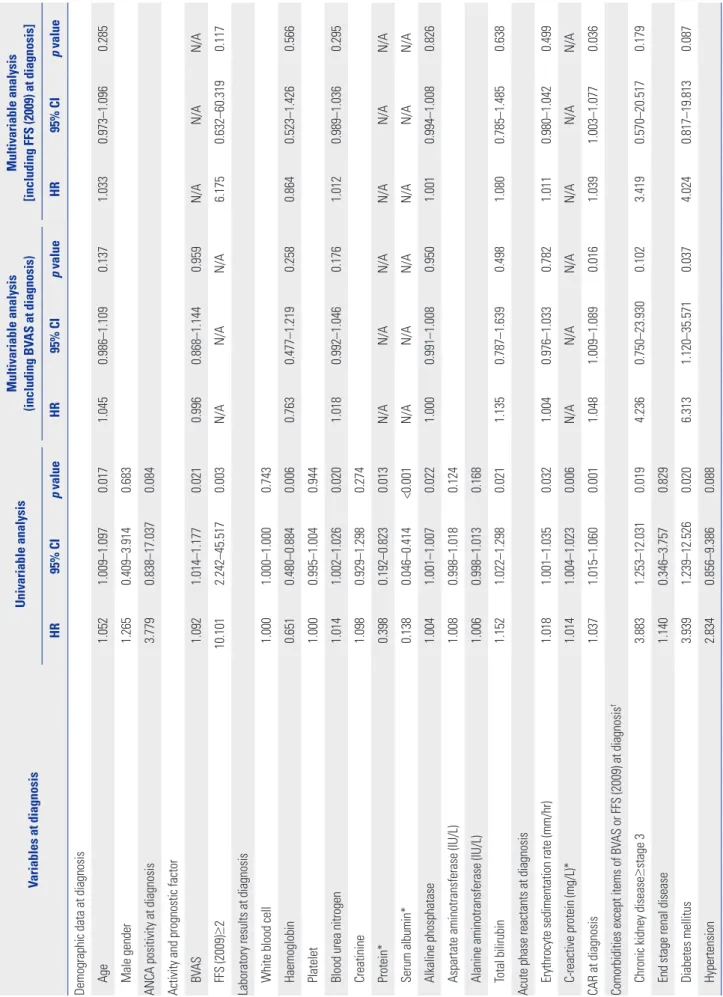
In univariable Cox hazard model analysis, CAR at diagnosis was significantly associated with all-cause mortality in AAV patients [HR 1.037, 95% confidence interval (CI) 1.015–1.060], along with age, BVAS, FFS (2009) ≥2, haemoglobin, blood urea
nitrogen, alkaline phosphatase, total bilirubin, erythrocyte sedimentation rate, chronic kidney disease (CKD) ≥stage 3 and DM at diagnosis. However, medications showed no pre- dictive value for mortality (Table 2).
Since BVAS and FFS (2009) share some items, we separately performed multivariable analysis with either BVAS or FFS (2009) ≥2, along with other variables with significance in uni- variable analysis. In multivariable Cox hazards model analysis with BVAS, CAR (HR 1.048) and DM (HR 6.313) were indepen- dent predictors of all-cause mortality in AAV patients (Table 2).
Meanwhile, in multivariable Cox hazards model analysis with FFS (2009) ≥2, only CAR (HR 1.039) was an independent pre- dictor of all-cause death in AAV patients (Table 2).
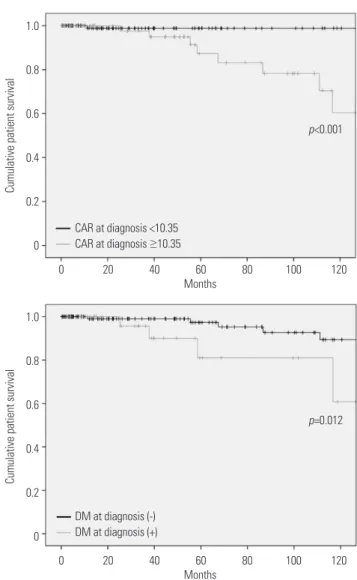
Optimal cut-off of CAR to predict all-cause mortality Cumulative patient survival rates according to CAR ≥10.35 and the presence of DM are depicted in Fig. 1. In Kaplan-Mei- er survival analysis, patients with CAR ≥10.35 exhibited a higher frequency of all-cause mortality than those without (p<0.001). Also, patients with DM also exhibited lower cumu- lative patient survival rate that those without (p=0.012).
DISCUSSION
In this study, we investigated whether CAR at diagnosis could predict all-cause mortality during the follow-up of AAV. Also, we demonstrated that CAR at diagnosis is an independent predictor of all-cause mortality comparable to DM, the con- ventional risk factor of mortality. Also we provided an optimal cut-off of CAR at diagnosis to estimate the risk of all-cause mortality.
How CAR at diagnosis could be an independent predictor of all-cause death in AAV patients could be explained as fol- lows: CRP is closely correlated with interleukin (IL)-6. Chronic inflammation enhances the production of IL-6, which, in turn, promotes the production of CRP in the liver, leading to an increase in CRP level in the peripheral circulation.11 Mean- while, IL-6 down-regulates or inhibits the production of albu- min in the liver, resulting in a decrease in serum albumin concentration.12 Accordingly, inflammatory burden can affect CAR via two different directions (increasing CRP and decreas- ing serum albumin), unlike CRP or serum albumin alone.
Thus, CAR with two variables affected by inflammatory bur- den in AAV could be a more stable and reliable index to pre- suppose all-cause mortality, compared to CRP or serum albu- min alone in AAV patients.
Here we provide two hypotheses regarding the connection between the inflammatory burdens at diagnosis and all-cause mortality in AAV patients. First, a large inflammatory burdens at diagnosis may provoke immunosuppressive drug-refracto- riness or cause a situation where patients should take larger doses of immunosuppressive drugs or have a longer period to Table 1. Baseline Characteristics of Patients with AAV (n=170) (Continued)
Variables Values
During follow-up
Follow-up duration (months) 56.7±54.4
Death 14 (8.2)
Medications administered
Glucocorticoid 145 (85.8)
Cyclophosphamide 71 (42.0)
Mycophenolate mofetil 10 (5.9)
Azathioprine 46 (27.2)
Tacrolimus 10 (5.9)
Rituximab 15 (8.9)
Methotrexate 13 (7.7)
AAV, ANCA-associated vasculitis; ANCA, antineutrophil cytoplasmic anti- body; MPA, microscopic polyangiitis; GPA, granulomatosis with polyangiitis;
EGPA, eosinophilic granulomatosis with polyangiitis; MPO, myeloperoxidase;
P, perinuclear; PR3, proteinase 3; C, cytoplasmic; BVAS, Birmingham vasculi- tis activity score; FFS, five factor score; CAR, C-reactive protein to serum al- bumin ratio.
Values are expressed as a mean±standard deviation or number (%).
*Interstitial lung disease, diffuse alveolar haemorrhage, ischemic heart dis- eases-related diseases and cerebrovascular accident are not included.
(Continued)
Table 2. Univariable and Multivariable Cox Hazard Model Analyses of Variables for All-Cause Death in AAV Patients during the Follow-Up (n=170) Variables at diagnosisUnivariable analysisMultivariable analysis (including BVAS at diagnosis)Multivariable analysis [including FFS (2009) at diagnosis] HR95% CIp valueHR95% CIp valueHR95% CIp value Demographic data at diagnosis Age1.0521.009–1.0970.0171.0450.986–1.1090.1371.0330.973–1.0960.285 Male gender1.2650.409–3.9140.683 ANCA positivity at diagnosis3.7790.838–17.0370.084 Activity and prognostic factor BVAS1.0921.014–1.1770.0210.9960.868–1.1440.959N/AN/AN/A FFS (2009)≥210.1012.242–45.5170.003N/AN/AN/A6.1750.632–60.3190.117 Laboratory results at diagnosis White blood cell1.0001.000–1.0000.743 Haemoglobin0.6510.480–0.8840.0060.7630.477–1.2190.2580.8640.523–1.4260.566 Platelet 1.0000.995–1.0040.944 Blood urea nitrogen1.0141.002–1.0260.0201.0180.992–1.0460.1761.0120.989–1.0360.295 Creatinine1.0980.929–1.2980.274 Protein*0.3980.192–0.8230.013N/AN/AN/AN/AN/AN/A Serum albumin*0.1380.046–0.414<0.001N/AN/AN/AN/AN/AN/A Alkaline phosphatase1.0041.001–1.0070.0221.0000.991–1.0080.9501.0010.994–1.0080.826 Aspartate aminotransferase (IU/L) 1.0080.998–1.0180.124 Alanine aminotransferase (IU/L) 1.0060.998–1.0130.168 Total bilirubin1.1521.022–1.2980.0211.1350.787–1.6390.4981.0800.785–1.4850.638 Acute phase reactants at diagnosis Erythrocyte sedimentation rate (mm/hr)1.0181.001–1.0350.0321.0040.976–1.0330.7821.0110.980–1.0420.499 C-reactive protein (mg/L)*1.0141.004–1.0230.006N/AN/AN/AN/AN/AN/A CAR at diagnosis1.0371.015–1.0600.0011.0481.009–1.0890.0161.0391.003–1.0770.036 Comorbidities except items of BVAS or FFS (2009) at diagnosis† Chronic kidney disease≥stage 33.8831.253–12.0310.0194.2360.750–23.9300.1023.4190.570–20.5170.179 End stage renal disease1.1400.346–3.7570.829 Diabetes mellitus3.9391.239–12.5260.0206.3131.120–35.5710.0374.0240.817–19.8130.087 Hypertension2.8340.856–9.3860.088
receive them. This situation may exacerbate the risk of infec- tion and cancer development.13 Second, a large inflammatory burden may reflect ready-made organ-damage at diagnosis and, furthermore, may result in end stage damage to various major organs during follow-up, such as diffuse alveolar haem- orrhage and end stage renal disease.9 This situation may ag- gravate the systemic complications of organ-damages by AAV, leading to an increase in all-cause mortality. In this study, the most common cause of death was serious infection in 12 pa- tients [pneumonia (n=7), bacterial sepsis (n=3), influenza in- fection (n=1), and biliary infection (n=1)]. Two patients died of AAV-related complication [diffuse alveolar haemorrhage (n=1) and cardiac arrest due to cardiomyopathy (n=1)]. This result might support to our hypotheses.
In patients with AAV, infection, cardiovascular damage, ma- lignancies, CKD, high BVAS, low haemoglobin, and immuno- suppressive drugs were reported to be associated with all- Table 2. Univariable and Multivariable Cox Hazard Model Analyses of Variables for All-Cause Death in AAV Patients during the Follow-Up (n=170) Variables at diagnosisUnivariable analysisMultivariable analysis (including BVAS at diagnosis)Multivariable analysis [including FFS (2009) at diagnosis] HR95% CIp valueHR95% CIp valueHR95% CIp value Viral hepatitis2.2090.275–17.7590.456 Medications administered during follow-up Glucocorticoid0.8650.191–3.9270.851 Cyclophosphamide1.8950.652–5.5040.240 Mycophenolate mofetil1.8710.404–8.6640.423 Azathioprine0.1360.027–1.6280.136 Tacrolimus0.0280.000–18.7590.282 Rituximab1.5540.419–5.7610.509 Methotrexate0.0290.000–10.7350.241 AAV, ANCA-associated vasculitis; ANCA, antineutrophil cytoplasmic antibody; BVAS, Birmingham vasculitis activity score; FFS, five factor score; CAR, C-reactive protein to serum albumin ratio; HR, hazard ratio; CI,
confidence interval. *Protein,
serum albumin and CRP were excluded in multivariable Cox hazard model analysis, because they are variables related to the equation for CAR. †Interstitial lung disease, diffuse alveolar haemorrhage, isch- emic heart diseases-related diseases, and cerebrovascular accident-related diseases were excluded as comorbidities.
1.0 0.8 0.6 0.4 0.2 0
Cumulative patient survival
0 20 40 60 80 100 120 Months
CAR at diagnosis <10.35 CAR at diagnosis ≥10.35
p<0.001
1.0 0.8 0.6 0.4 0.2 0
Cumulative patient survival
0 20 40 60 80 100 120 Months
DM at diagnosis (-) DM at diagnosis (+)
p=0.012
Fig. 1. A predictor of all cause-mortality in ANCA-associated vasculitis patients. Patients with CAR ≥10.35 and having DM exhibited a higher fre- quency of all-cause mortality than those without in Kaplan-Meier survival analysis. ANCA, antineutrophil cytoplasmic antibody; CAR, C-reactive protein to serum albumin ratio; DM, diabetes mellitus.
(Continued)
cause mortality.14 Meanwhile, age, male gender, DM, and hypertension are also considered as traditional risk factors of all-cause mortality in the general population.15 Recently, in Korean patients with AAV, it was reported that FFS (2009) at diagnosis ≥2 was associated with mortality.5 Accordingly, we included initial BVAS and FFS (2009) at diagnosis ≥2 in multi- variable Cox hazard model analysis along with both AAV-re- lated and traditional risk factors of all-cause mortality. In uni- variable analysis, almost all the risk factors exhibited predictive potential for mortality, similar to a previous study.14 However, in both multivariable Cox hazards model analyses with either initial BVAS or FFS (2009) at diagnosis ≥2, only CAR at diagnosis and DM were identified as an independent predictor of all-cause of mortality. Unlike the previous study investigating whether the initial clinical features and medica- tions administered could predict all-cause mortality,5 this study evaluated the clinical implications of CAR among clini- cal and laboratory variables, and so there might be a subtle difference in the results between the two studies.
Although no predictive value for all-cause mortality was wit- nessed in ANCA positivity (p=0.084) or hypertension (p=0.088) in the univariable Cox hazards model analysis in this study, ANCA positivity is one of AAV-related risk factors for serious outcomes,16 and furthermore, hypertension is a well-known conventional risk factor for mortality in the general popula- tion.15 Thus, to minimise the effect of two confounding factors, we included ANCA positivity and hypertension in the univari- able Cox hazard model analysis. Regardless of ANCA positivity and hypertension, only CAR exhibited statistical significance among variables when applying either BVAS at diagnosis or FFS (2009) at diagnosis ≥2 in the model (HR 1.050, p=0.025, and HR 1.042, p=0.039) (Supplementary Table 1, only online).
Our study has an advantage in that we first proved the clini- cal significance of CAR at diagnosis in predicting all-cause of mortality and furthermore, provided an optimal cut-off of CAR at diagnosis to estimate the risk of all-cause mortality. Howev- er, this study also has several limitations. First, as this study was designed as a retrospective study, we could not strictly control for confounding factors, including undocumented histories of medications, nutritional status related the level of serum albu- min, and comorbidities. Second, as this study was conducted in a single centre, the number of deceased patients was too small to perform sub-group analysis based on the causes of mortality. Third, we could not use the cut-off of CAR in the multivariate Cox hazard model analysis to presuppose all- cause mortality due to the small statistical power. This study may be a pilot study to first investigate the clinical implication of CAR in AAV patients. We believe that future prospective and multi-centric studies will validate the clinical implications of our results, and they will provide a clear optimal cut-off of CAR to predict all-cause mortality in AAV patients for use in real clinical settings. In conclusion, CAR at diagnosis can be an in- dependent predictor of all-cause mortality, comparable to
DM, the conventional risk factor of mortality.
ACKNOWLEDGEMENTS
This work was also supported by the National Research Foun- dation of Korea (NRF) grant funded by the Korea government (MSIT) (NRF-2017R1A2A1A17069807); Global Research Labo- ratory (GRL) Program through the National Research Founda- tion of Korea (NRF) funded by the Ministry of Science and ICT (NRF-2016K1A1A2912755).
ORCID
Sang-Kyou Lee https://orcid.org/0000-0002-3272-9264 Sang-Won Lee https://orcid.org/0000-0002-8038-3341
REFERENCES
1. Jennette JC, Falk RJ, Bacon PA, Basu N, Cid MC, Ferrario F, et al.
2012 revised International Chapel Hill Consensus Conference Nomenclature of Vasculitides. Arthritis Rheum 2013;65:1-11.
2. Watts R, Lane S, Hanslik T, Hauser T, Hellmich B, Koldingsnes W, et al. Development and validation of a consensus methodology for the classification of the ANCA-associated vasculitides and polyarteritis nodosa for epidemiological studies. Ann Rheum Dis 2007;66:222-7.
3. Tan JA, Dehghan N, Chen W, Xie H, Esdaile JM, Avina-Zubieta JA.
Mortality in ANCA-associated vasculitis: ameta-analysis of obser- vational studies. Ann Rheum Dis 2017;76:1566-74.
4. Yamagata K, Usui J, Saito C, Yamaguchi N, Hirayama K, Mase K, et al. ANCA-associated systemic vasculitis in Japan: clinical fea- tures and prognostic changes. Clin Exp Nephrol 2012;16:580-8.
5. Mun CH, Yoo J, Jung SM, Song JJ, Park YB, Lee SW. The initial pre- dictors of death in 153 patients with ANCA-associated vasculitis in a single Korean centre. Clin Exp Rheumatol 2018;36 Suppl 111:65-72.
6. Zhou T, Zhan J, Hong S, Hu Z, Fang W, Qin T, et al. Ratio of C-re- active protein/albumin is an inflammatory prognostic score for predicting overall survival of patients with small-cell lung cancer Sci Rep 2015;5:10481.
7. Qin G, Tu J, Liu L, Luo L, Wu J, Tao L, et al. Serum albumin and C- reactive protein/albumin ratio are useful biomarkers of Crohn’s disease activity. Med Sci Monit 2016;22:4393-400.
8. Kim MH, Ahn JY, Song JE, Choi H, Ann HW, Kim JK, et al. The C- reactive protein/albumin ratio as an independent predictor of mortality in patients with severe sepsis or septic shock treated with early goal-directed therapy. PLoS One 2015;10:e0132109.
9. Mukhtyar C, Lee R, Brown D, Carruthers D, Dasgupta B, Dubey S, et al. Modification and validation of the Birmingham Vasculitis Activity Score (version 3). Ann Rheum Dis 2009;68:1827-32.
10. Guillevin L, Pagnoux C, Seror R, Mahr A, Mouthon L, Le Toume- lin P; French Vasculitis Study Group (FVSG). The Five-Factor Score revisited: assessment of prognoses of systemic necrotizing vasculitides based on the French Vasculitis Study Group (FVSG) cohort. Medicine (Baltimore) 2011;90:19-27.
11. Rhodes B, Fürnrohr BG, Vyse TJ. C-reactive protein in rheumatol- ogy: biology and genetics. Nat Rev Rheumatol 2011;7:282-9.
12. Mihara M, Hashizume M, Yoshida H, Suzuki M, Shiina M. IL-6/
IL-6 receptor system and its role in physiological and pathological conditions. Clin Sci (Lond) 2012;122:143-59.
13. Emadi A, Jones RJ, Brodsky RA. Cyclophosphamide and cancer:
golden anniversary. Nat Rev Clin Oncol 2009;6:638-47.
14. Flossmann O, Berden A, de Groot K, Hagen C, Harper L, Heijl C, et al. Long-term patient survival in ANCA-associated vasculitis.
Ann Rheum Dis 2011;70:488-94.
15. Murray CJ, Atkinson C, Bhalla K, Birbeck G, Burstein R, Chou D,
et al. The state of US health, 1990-2010: burden of diseases, inju- ries, and risk factors. JAMA 2013;310:591-608.
16. Durel CA, Berthiller J, Caboni S, Jayne D, Ninet J, Hot A. Long- term followup of a multicenter cohort of 101 patients with eosino- philic granulomatosis with polyangiitis (Churg-Strauss). Arthritis Care Res (Hoboken) 2016;68:374-87.