ABSTRACT
Objective: The aim of this study was to evaluate under target rates of low-density lipoprotein- cholesterol (LDL-C) in Korean patients with stable coronary artery disease (CAD) or an acute coronary syndrome (ACS) in real world practice.
Methods: Dyslipidemia International Study II was an international observational study of patients with stable CAD or an ACS. Lipid profiles and use of lipid-lowering therapy (LLT) were documented at enrollment, and for the ACS cohort, 4 months follow-up was recommended.
Rates of under target LDL-C as per European guidelines, were evaluated, and multivariate regression was performed to identify predictive factors of patients presenting under the target.
Results: A total of 808 patients were enrolled in Korea, 500 with stable CAD and 308 with ACS. Of these, 90.6% and 52.6% were being treated with LLT, respectively. In the stable CAD group, 40.0% were under target LDL-C, while in ACS group, the rate was 23.7%. A higher statin dose was independently associated with under target LDL-C in both groups (OR, 1.03;
p=0.046 [stable CAD] and OR, 1.05; p=0.01 [ACS]). The mean statin dosage (atorvastatin equivalent) was 17 mg/day. In the 79 ACS patients who underwent the follow-up examination, the LDL-C under target rate rose to 59.5%.
Conclusion: Only a minority of patients with stable CAD or ACS were under their target LDL-C level at enrollment. The statin dose was not sufficient in the majority of patients.
These results indicate a considerable LLT gap in Korean patients with established CAD.
Keywords: Cholesterol; Hydroxymethylglutaryl-CoA reductase inhibitors; Acute coronary syndrome; Coronary artery disease; Dyslipidemias
Original Article
Received: Mar 25, 2019 Revised: Jul 18, 2019 Accepted: Aug 6, 2019 Correspondence to Yangsoo Jang
Division of Cardiology, Department of Internal Medicine, Severance Hospital, Yonsei University College of Medicine, 50-1 Yonsei-ro, Seodaemun-gu, Seoul 03722, Korea.
E-mail: [email protected]
*Current address: Department of Pharmacy Practice, College of Pharmacy, University of Rhode Island, Kingston, RI, USA.
Copyright © 2019 The Korean Society of Lipid and Atherosclerosis.
This is an Open Access article distributed under the terms of the Creative Commons Attribution Non-Commercial License (https://
creativecommons.org/licenses/by-nc/4.0/) which permits unrestricted non-commercial use, distribution, and reproduction in any medium, provided the original work is properly cited.
ORCID iDs Sang-Hak Lee
https://orcid.org/0000-0002-4535-3745 Woo-Hyuk Song
https://orcid.org/0000-0002-1698-4628 Myung Ho Jeong
https://orcid.org/0000-0003-4173-1494 Seung-Ho Hur
https://orcid.org/0000-0002-3895-1915 Dong Woon Jeon
https://orcid.org/0000-0001-7409-4378 Wonju Jeung
https://orcid.org/0000-0002-1713-182X
Sang-Hak Lee ,1 Woo-Hyuk Song ,2 Myung Ho Jeong ,3 Seung-Ho Hur ,4 Dong Woon Jeon ,5 Wonju Jeung ,6 Anselm K Gitt ,7,8 Martin Horack ,7 Ami Vyas ,9,* Dominik Lautsch ,10 Baishali Ambegaonkar ,10 Philippe Brudi ,10 Yangsoo Jang 1
1 Division of Cardiology, Department of Internal Medicine, Severance Hospital, Yonsei University College of Medicine, Seoul, Korea
2Cardiovascular Division, Department of Internal Medicine, Korea University Ansan Hospital, Ansan, Korea
3Department of Cardiovascular Medicine, Chonnam National University Hospital, Gwangju, Korea
4Department of Cardiology, Keimyung University Hospital, Daegu, Korea
5 Division of Cardiology, Department of Internal Medicine, National Health Insurance Service Ilsan Hospital, Goyang, Korea
6Merck Sharp & Dohme (MSD), Seoul, Korea
7Stiftung Institut für Herzinfarktforschung, Ludwigshafen, Germany
8Klinikum der Stadt Ludwigshafen, Medizinische Klinik B, Ludwigshafen, Germany
9Department of Epidemiology, School of Public Health, Rutgers University, Piscataway, NJ, USA
10Merck & Co., Inc., Kenilworth, NJ, USA
Dyslipidemia and Rate of Under-Target Low-Density Lipoprotein-Cholesterol in Patients with Coronary Artery
Disease in Korea
Anselm K Gitt
https://orcid.org/0000-0003-2573-7239 Martin Horack
https://orcid.org/0000-0003-4345-7257 Ami Vyas
https://orcid.org/0000-0002-2660-2494 Dominik Lautsch
https://orcid.org/0000-0003-3803-1817 Baishali Ambegaonkar
https://orcid.org/0000-0002-1458-7063 Philippe Brudi
https://orcid.org/0000-0002-5414-0805 Yangsoo Jang
https://orcid.org/0000-0002-2169-3112 Funding
This work was supported by Merck & Co., Inc., Kenilworth, NJ, USA.
Conflict of Interest
The authors have no conflicts of interest to declare.
Author Contributions
Conceptualization: Jeung W, Gitt AK, Horack M, Vyas A, Lautsch D, Ambegaonkar B, Brudi P, Jang Y. Formal analysis: Lee SH. Funding acquisition: Jang Y. Investigation: Song WH, Jeong MH, Hur SH, Jeon DW, Jang Y.
Methodology: Jang Y. Project administration:
Jeung W, Gitt AK, Horack M, Vyas A, Lautsch D, Ambegaonkar B, Brudi P, Jang Y. Resources:
Jang Y. Supervision: Jang Y. Validation: Jang Y. Visualization: Lee SH. Writing - original draft: Lee SH. Writing - review & editing: Lee SH, Song WH, Jeong MH, Hur SH, Jeon DW, Jang Y.
INTRODUCTION
It has been demonstrated that the 5-year incidence of major vascular events can be cut by approximately a fifth by reducing the level of low-density lipoprotein-cholesterol (LDL-C) by 39 mg/dL (1 mmol/L).1 The European Society of Cardiology (ESC) and European
Atherosclerosis Society (EAS) guidelines for the management of dyslipidemias recommend that an LDL-C level of <70 mg/dL (1.8 mmol/L) should be the aim in patients at very high cardiovascular risk, which includes those with documented cardiovascular disease.2 According to the lipid treatment assessment project (L-TAP) 2, a survey performed in >10,000 dyslipidemic patients in 9 countries (United States, Canada, Mexico, Brazil, Spain, Netherlands, France, Taiwan, and Korea) between 2006 and 2007, 75.7% of U.S patients and 67.3% of Canadian patients attained their LDL-C target (defined according to regional guidelines at the time).3 The result in Spain was lowest, with 47.4% of patients reaching their LDL-C goal. These goal attainment figures are similar to those observed in the original Dyslipidemia International Study (DYSIS), with 63.2% of high-risk patients and 48.2% of total patients in Europe and Canada who were on statin treatment reaching their LDL-C target.4
Lipid-lowering therapy (LLT) is widely used in South Korea and one study suggested more intensive treatment use than in other Asian countries.5 However, achievement of recommended LDL-C target levels remains suboptimal. In the Centralized Pan-Asian Survey of the Under treatment of Hypercholesterolemia (CEPHEUS), 31.5% of the very high-risk LLT patients from South Korea had reached their LDL-C target of <70 mg/dL.5 Although this compares favorably with the 24.4% observed in the non-Korean Asian patients and the 22.8%
found for the overall global CEPHEUS cohort,6 it remains disappointingly low.
The aim of this study was to assess the rate of under-target LDL-C in Korean patients with stable coronary artery disease (CAD) or an acute coronary syndrome (ACS). The LLT regimen was also investigated.
MATERIALS AND METHODS
1. Study patients and design
DYSIS II was a multinational, observational, cross-sectional study that enrolled patients over 18 years of age with stable CAD or ACS. Data were collected from 21 countries across the Asia-Pacific region, Europe, and the Middle East and Africa.7,8 The present article involves the patients enrolled in Korea between July 2013 and July 2014. Data of patients with CAD were collected at outpatient visit, whereas those of patients with ACS were obtained at hospital admission and by telephone interview or outpatient visit 4 months after discharge.
Stable CAD was defined as coronary artery stenosis >50% by either coronary angiography or coronary CT, prior percutaneous coronary intervention, prior coronary artery bypass graft, or ACS >3 months prior to the outpatient visit. ACS was defined as ST-segment elevation myocardial infarction (STEMI), non-STEMI or unstable angina. A lipid profile was collected for each patient. For the stable CAD group, this was constructed from by the last samples taken in the past 12 months, while for the ACS group, it was from samples taken in 24 hours of hospital admission. Individuals were excluded if they were currently participating in a clinical trial, and for the ACS group, if they died during the hospital stay. Patients were divided based on whether or not they were taking LLT at the time of enrollment. Patients in
the LLT group needed to be treated for 3 months or longer. The study protocol was approved by ethics committee at each site (4-2013-0210) and study was conducted in accord with the Declaration of Helsinki.
2. Data collection
Baseline demographic and clinical characteristics were documented. These included age, sex, body mass index (BMI), lifestyle factors, and comorbidities. Obesity was defined as a BMI >30 kg/m2. A sedentary lifestyle was defined as walking for <20–30 minutes on <3–4 days a week. Diabetes mellitus was defined as current treatment, previous diagnosis of diabetes mellitus, or a fasting plasma glucose level ≥126 mg/dL.9 Hypertension was defined as current treatment, a previous diagnosis of hypertension, or a blood pressure >140/90 mm Hg.10,11 Chronic kidney disease (CKD) was defined as stage 3, 4, or 5 when a glomerular filtration rate was 30–59, 15–29, or <15 mL/min/1.73m2, respectively.12
The baseline lipid profile included total cholesterol, triglycerides, high-density lipoprotein cholesterol (HDL-C), LDL-C and non-HDL-C. The cardiovascular risk level of the ACS patients prior to the ACS event was determined according to the 2011 ESC/EAS guidelines as very high, high, moderate, or low.13 The corresponding target LDL-C levels for these groups were <70 mg/dL, <100 mg/dL, <115 mg/dL, and <130 mg/dL. The proportions of patients in each risk category that had achieved their specific LDL-C target were calculated. Target achievement was re-evaluated at the 4-month follow-up for ACS patients with a further lipid profile available.
LLT was classified as statin monotherapy, non-statin monotherapy, statin plus ezetimibe or statin plus other non-statin (fibrates, omega-3 fatty acids, or nicotinic acid). Statins included lovastatin, pravastatin, simvastatin, atorvastatin, rosuvastatin, fluvastatin, and pitavastatin.
Atorvastatin dose equivalents were based on a systematic review of clinical trial data on the LDL-C-lowering efficacy of various statins.14
3. Statistical analysis
SAS version 9.3 (SAS Institute, Cary, NC, USA) was used for statistical analyses. Data are presented as means with standard deviations, medians with interquartile ranges, or absolute values with percentages. Statistical significance was determined using the Mann-Whitney- Wilcoxon test or the χ2 test.
Multivariate regression analyses were performed in both groups to identify any determinants of LLT-treated patients achieving an LDL-C level of <70 mg/dL. The covariates included age, female gender, diabetes mellitus, hypertension, congestive heart failure, current smoking, sedentary lifestyle, stable angina, CKD and statin dose (i.e., atorvastatin equivalent dose).
Mortality at follow-up was estimated using Kaplan–Meier analysis, with p-values calculated using a log-rank test. All statistical comparisons were 2-tailed, and results with a p-value of
<0.05 were considered significant.
RESULTS
1. Patient characteristics
The stable CAD group consisted of 500 patients. The mean age was 64.4±10.3 years and 73.2% were male (Table 1). The majority of this group (90.6%) was under LLT. The mean
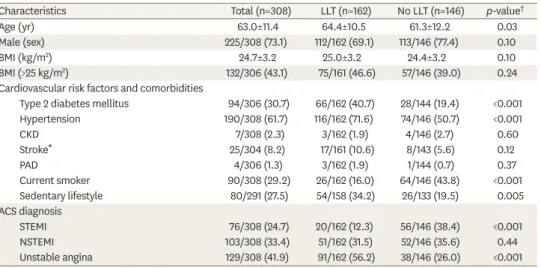
age was higher and type 2 diabetes mellitus was more common in the LLT group. The ACS group consisted of 308 patients. The mean age was 63.0±11.4 years and 73.1% were male (Table 2). Prior to their admission for ACS, 52.6% of these patients were being treated with LLT. Patients with prior LLT were older and more likely to have type 2 diabetes mellitus and a sedentary lifestyle. Conversely, current smoking was less common in this subgroup. In regard to clinical presentation of ACS, STEMI was less common, whereas unstable angina was more common in patients with prior LLT compared to those with no LLT.
Table 1. Patient characteristics: stable CAD group
Total (n=500) LLT (n=453) No LLT (n=47) p-value‡
Age (yr) 64.4±10.3 64.7±10.4 61.6±9.2 0.03
Male (sex) 366/500 (73.2) 328/453 (72.4) 38/47 (80.9) 0.21
BMI (kg/m2) 24.9±3.2 25.0±3.2 24.3±3.0 0.18
BMI (>25 kg/m2) 228/497 (45.9) 209/450 (46.4) 19/47 (40.4) 0.53
Cardiovascular risk factors and comorbidities
Type 2 diabetes mellitus 198/500 (39.6) 188/453 (41.5) 10/147 (21.3) 0.007
Hypertension 343/500 (68.6) 314/453 (69.3) 29/47 (61.7) 0.28
CKD 16/500 (3.2) 16/453 (3.5) 0/47 (0.0) 0.19
Stroke* 43/498 (8.6) 40/451 (8.9) 3/47 (6.4) 0.56
PAD 9/500 (1.8) 8/453 (1.8) 1/47 (2.1) 0.86
Current smoker 92/500 (18.4) 83/453 (18.3) 9/47 (19.1) 0.89
Sedentary lifestyle 124/499 (24.8) 107/453 (23.6) 17/46 (37.0) 0.08
Family history of CAD 65/436 (14.9) 61/397 (15.4) 4/39 (10.3) 0.39
History of CAD
Prior PCI 445/500 (89.0) 404/453 (89.2) 41/47 (87.2) 0.68
Prior CABG 22/500 (4.4) 21/453 (4.6) 1/47 (2.1) 0.42
History of ACS† 195/500 (39.0) 172/453 (38.0) 23/47 (48.9) 0.14
Data presented as mean±standard deviation or number (%).
LLT, lipid-lowering therapy; BMI, body mass index; CKD, chronic kidney disease; CAD, coronary artery disease;
PAD, peripheral artery disease; PCI, percutaneous coronary intervention; CABG, coronary artery bypass grafting;
ACS, acute coronary syndrome.
*Includes ischemic and hemorrhagic stroke; †>3 months prior to enrollment; ‡The p-values calculated using χ2 test or Mann-Whitney-Wilcoxon test.
Table 2. Patient characteristics: ACS group
Characteristics Total (n=308) LLT (n=162) No LLT (n=146) p-value†
Age (yr) 63.0±11.4 64.4±10.5 61.3±12.2 0.03
Male (sex) 225/308 (73.1) 112/162 (69.1) 113/146 (77.4) 0.10
BMI (kg/m2) 24.7±3.2 25.0±3.2 24.4±3.2 0.10
BMI (>25 kg/m2) 132/306 (43.1) 75/161 (46.6) 57/146 (39.0) 0.24
Cardiovascular risk factors and comorbidities
Type 2 diabetes mellitus 94/306 (30.7) 66/162 (40.7) 28/144 (19.4) <0.001
Hypertension 190/308 (61.7) 116/162 (71.6) 74/146 (50.7) <0.001
CKD 7/308 (2.3) 3/162 (1.9) 4/146 (2.7) 0.60
Stroke* 25/304 (8.2) 17/161 (10.6) 8/143 (5.6) 0.12
PAD 4/306 (1.3) 3/162 (1.9) 1/144 (0.7) 0.37
Current smoker 90/308 (29.2) 26/162 (16.0) 64/146 (43.8) <0.001
Sedentary lifestyle 80/291 (27.5) 54/158 (34.2) 26/133 (19.5) 0.005
ACS diagnosis
STEMI 76/308 (24.7) 20/162 (12.3) 56/146 (38.4) <0.001
NSTEMI 103/308 (33.4) 51/162 (31.5) 52/146 (35.6) 0.44
Unstable angina 129/308 (41.9) 91/162 (56.2) 38/146 (26.0) <0.001
Data presented as mean±standard deviation or number (%).
LLT, lipid-lowering therapy; BMI, body mass index; CKD, chronic kidney disease; ACS, acute coronary syndrome;
PAD, peripheral artery disease; STEMI, ST-segment elevation myocardial infarction; NSTEMI, non-ST-elevation myocardial infarction.
*Includes ischemic and hemorrhagic stroke; †The p-values calculated using χ2 test or Mann-Whitney-Wilcoxon test.
2. Lipid profiles and under-target rate
The mean LDL-C level of the patients with stable CAD was 81±28 mg/dL, and 40.0% of the patients had LDL-C <70 mg/dL (Table 3). The LDL-C level in the LLT group was lower than that of no LLT group (78 and 110 mg/dL in the LLT and no LLT groups, respectively; p<0.001).
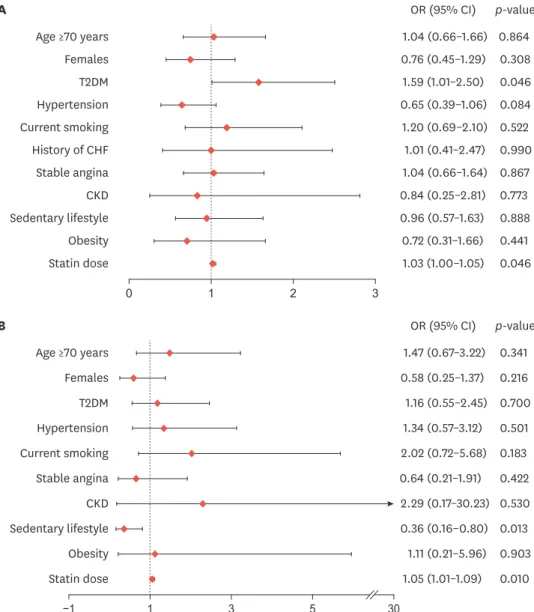
Accordingly, the proportion of subjects under target LDL-C level was higher in the LLT group (43.0% and 10.6% for LLT and no LLT groups, respectively; p<0.001). In the multivariate analysis, diabetes mellitus (OR, 1.59; p=0.046) and statin dosage (OR, 1.03; p=0.046) were found to be associated with under-target LDL-C levels in stable CAD group with LLT (Fig. 1A).
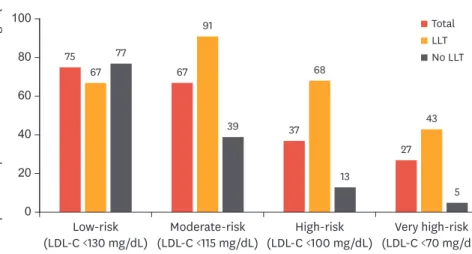
In the ACS group, the mean LDL-C level was 101±39 mg/dL, and 23.7% of patients displayed an LDL-C level of <70 mg/dL (Table 3). The LLT group had a lower mean LDL-C value than the no LLT group (83 and 121 mg/dL in LLT and no LLT groups, respectively; p<0.001). The proportion of patients with under target LDL-C level of <70 mg/dL was greater in the LLT group than the no LLT group (38.3% and 7.5%, respectively; p<0.001). When the patients were sub-divided according to their pre-ACS risk status, under-target rates were 66.7%, 91.4%, 68.4%, and 42.9% for the low, moderate, high, and very high-risk groups, respectively (Fig. 2). In the ACS group with no LLT, the corresponding rates were 76.9%, 38.8%, 12.5%, and 5.3%, respectively. In the multivariate analysis, statin dosage (OR, 1.05; p=0.01) and sedentary lifestyle (OR, 0.36; p=0.01) were associated with under-target rate (Fig. 1B). For some of the ACS group, lipid levels were re-assessed at 4 months after discharge. For the ACS patients treated with LLT at admission (n=79), the proportion of patients with under-target LDL-C of <70 mg/dL increased from 50.0% to 64.3% in this period (Fig. 3). Whereas, in ACS patients with no LLT at admission (n=146) the proportion increased from 5.4% to 59.5%.
3. LLT
For patients with stable CAD being treated with LLT, statin monotherapy was the most commonly used (81.2%), followed by statin plus ezetimibe (13.0%) and statin plus other non- statin (5.3%) (Table 4). Atorvastatin (43.9%), rosuvastatin (27.7%) and simvastatin (14.6%) were frequently used (Supplementary Table 1). The mean daily statin dosage (atorvastatin- equivalent) was 17±10 mg.
For the ACS patients treated with LLT at admission, the predominant LLT regimen was statin monotherapy (84.6%), and a small proportion of subjects were receiving a statin plus ezetimibe (6.8%) or a statin plus other non-statin (6.2%). The mean daily statin dosage (atorvastatin equivalent) was 17±12 mg. At 4-month follow-up, 98.3% of patients were receiving LLT: statin monotherapy (83.4%), statin plus ezetimibe (9.0%). The mean daily statin dosage (atorvastatin-equivalent) was 21±14 mg at this time point (Table 4).
Table 3. Lipid profile at baseline
Variables Stable CAD ACS
Total (n=500) LLT (n=453) No LLT (n=47) p-value Total (n=308) LLT (n=162) No LLT (n=146) p-value
TC (mg/dL) 148±33 145±32 178±33 <0.001 168±54 152±59 186±41 <0.001
Triglycerides (mg/dL) 148±101 146±100 163±111 0.42 138±138 149±146 126±129 <0.01
HDL-C (mg/dL) 45±11 45±11 42±10 0.19 41±11 41±11 41±11 0.11
LDL-C (mg/dL) 81±28 78±26 110±28 <0.001 101±39 83±30 121±38 <0.001
Non-HDL-C (mg/dL) 103±32 100±31 135±31 <0.0001 125±44 108±40 144±40 <0.0001
LDL-C (<70 mg/dL)* 200/500 (40.0) 195/453 (43.0) 5/47 (10.6) <0.001 73/308 (23.7) 62/162 (38.3) 11/146 (7.5) <0.001
Distance to LDL-C <70 mg/dL (mg/dL)† 27±24 24±23 45±24 <0.0001 45±33 29±26 57±34 <0.0001
Data presented as mean±standard deviation or number (%).
CAD, coronary artery disease; ACS, acute coronary syndrome; LLT, lipid-lowering therapy; TC, total cholesterol; HDL-C, high-density lipoprotein cholesterol;
LDL-C, low-density lipoprotein cholesterol.
*Target for very high-risk patients; †Difference between actual LDL-C value and the goal of LDL-C <70 mg/dL.
0 1 2 3 Age ≥70 years
Females T2DM Hypertension Current smoking History of CHF Stable angina CKD Sedentary lifestyle Obesity Statin dose
p-value 0.864 0.308
0.084 0.522 0.990 0.867 0.773 0.888 0.441 0.046 0.046 OR (95% CI)
1.04 (0.66–1.66) 0.76 (0.45–1.29) 1.59 (1.01–2.50) 0.65 (0.39–1.06)
1.20 (0.69–2.10) 1.01 (0.41–2.47) 1.04 (0.66–1.64) 0.84 (0.25–2.81) 0.96 (0.57–1.63) 0.72 (0.31–1.66) 1.03 (1.00–1.05) A
−1 1 3 5 30
Age ≥70 years Females T2DM Hypertension Current smoking Stable angina CKD Sedentary lifestyle Obesity Statin dose
OR (95% CI) 1.47 (0.67–3.22)
0.58 (0.25–1.37) 1.16 (0.55–2.45) 1.34 (0.57–3.12)
2.02 (0.72–5.68) 0.64 (0.21–1.91) 2.29 (0.17–30.23) 0.36 (0.16–0.80) 1.11 (0.21–5.96) 1.05 (1.01–1.09)
p-value 0.341 0.216 0.700 0.501 0.183 0.422 0.530 0.013 0.903 0.010 B
Fig. 1. Determinants of under low-density lipoprotein-cholesterol target of <70 mg/dL for patients treated with lipid-lowering therapy. (A) Determinants in stable coronary artery disease group, (B) Determinants in acute coronary syndrome group. ORs and 95% CIs calculated using logistic regression, with adjustment for all variables included in the figure.
CHF, congestive heart failure; CKD, chronic kidney disease; T2DM, type 2 diabetes mellitus; OR, odds ration; CI, confidence interval.
Table 4. Use of LLT
Therapies Stable CAD
(n=500) ACS
On admission
(n=308) 4-month
follow-up (n=307)
LLT 453 (90.6) 162 (52.6) 296 (98.3)
Statin monotherapy 368 (81.2) 137 (84.6) 251 (83.4)
Average statin dose (atorvastatin equivalent) (mg/day)* 17±10 17±12 21±14
Non-statin monotherapy 2 (0.4) 4 (2.5) 3 (1.0)
Statin+ezetimibe 59 (13.0) 11 (6.8) 27 (9.0)
Statin+other non-statin 24 (5.3) 10 (6.2) 15 (5.0)
Data are presented as number (%).
LLT, lipid-lowering therapy; CAD, coronary artery disease; ACS, acute coronary syndrome.
*Normalized according to atorvastatin potency.
DISCUSSION
In the present study, we found the mean LDL-C levels were 81 and 101 mg/dL in patients with stable CAD and those with ACS at enrollment. Only 40% and 24% of patients in each group had LDL-C levels under target of <70 mg/dL (for stable CAD and ACS, respectively). High statin dosage was identified as an independent determinant of under-target rate of LDL-C in both groups; however, the mean dosage at enrollment was not sufficiently high. Of the ACS patients who underwent the 4-month follow-up examination, 62% achieved the LDL-C target.
The Korean data from the Pan-Asian CEPHEUS study, one of several studies regarding achievement rates of LDL-C targets among patients with hypercholesterolemia who were receiving LLT, showed that 51.2% of patients had LDL-C levels below target according to the National Cholesterol Education Program Adult Treatment Panel III guidelines.5 In a
Proportion of patients under LDL-C target (%)
40 80 100
0 20 60
Low-risk
(LDL-C <130 mg/dL) Moderate-risk
(LDL-C <115 mg/dL) High-risk
(LDL-C <100 mg/dL) Very high-risk (LDL-C <70 mg/dL)
Total LLT No LLT 75
67 77
67 91
39 37
68
13
27 43
5
Fig. 2. Under-target rate of patients with ACS classified by pre-ACS risk status*.
LLT, lipid-lowering therapy; LDL-C, low-density lipoprotein-cholesterol; ACS, acute coronary syndrome.
*Risk categories and corresponding LDL-C targets specified in the 2011 European Society of Cardiology/European Atherosclerosis Society guidelines.10
29 50
5
62 64 60
Proportion of patients with LDL-C <70 mg/dL (%)
40 80 100
0 20 60
At hospital
admission At 4-month
follow-up All patients
LLT No LLT
Fig. 3. Under-target rate of patients with acute coronary syndrome at hospital admission and 4-month follow-up*. LLT, lipid-lowering therapy; LDL-C, low-density lipoprotein-cholesterol.
*Includes only patients with lipid levels available from both baseline and 4-month follow-up.
separate study conducted in a primary care setting, only 28.6% of Korean patients with hypercholesterolemia at very high risk, 79.2% of those at high risk, and 87.4% of those at moderate risk achieved target LDL-C levels of <70 mg/dL, <100 mg/dL, and <130 mg/dL, respectively, despite the use of statin therapy.15 Similarly, among the 2,093 diabetic patients who received LLT, only 34.2% of very high-risk and 68.6% of the high-risk patients attained target LDL-C level of <70 mg/dL and <100 mg/dL, respectively.16 Even with increasing use of statins and improved management of LDL-C, the 2010 Korean National Health and Nutrition Examination Survey showed that only 47.7% of diabetic patients reached LDL-C target of <100 mg/dL.17 In the Return on Expenditure Achieved for Lipid Therapy in Asia study, less than 40% of patients with coronary heart disease and/or diabetes mellitus reached LDL-C <100 mg/
dL, ranging from 56% in China to 16% in Taiwan.18 Taiwan displayed improved LDL-C goal attainment in a recent study, with 54% of patients with cardiovascular disease reaching the LDL-C target of <100 mg/dL.19 In the relatively large CEPHEUS Pan-Asian study, less than half of the patients (49.1%) reached their LDL-C goal, even though 85% were receiving statin treatment. Furthermore, the LDL-C goal of <70 mg/dL was attained by only 34.9% of the very high-risk patients.20
In L-TAP 2, a multinational study including LDL-C data from patients in American, European and Asian countries, LDL-C goal attainment was achieved in 73% of patients, with success rates varying from as low as 47% to as high as 84%.3 It should be noted that LDL-C targets and risk categories varied between countries, and, unlike for DYSIS II, coronary heart disease was not an inclusion criterion. Substantial progress had been made since the original L-TAP study, which had a goal attainment rate of 38% for LDL-C.21 L-TAP 2 showed a goal attainment rate of 30% in the very high-risk patient group.3 These results are similar to those observed in the original DYSIS study from Europe and Canada, showing that overall 48.2% of patients did not achieve their LDL-C treatment goal.4
There were several known determinants of achievement of LDL-C targets. Use of potent LLT and patient compliance with therapy are important determinants, as well as baseline LDL-C, nationality, age, gender, smoking, concomitant diabetes, and systolic blood pressure.5,16,19 A previous study including European and Canadian patients showed that potency of LLT was significantly correlated with goal attainment. It also showed that ischemic heart disease, diabetes, high blood pressure and obesity negatively impacted the treatment result.4 Patients with more aggressive LLT showed better outcome, while more than half of the patients did not have any change in medication.17
Low rate of obtaining lipid profiles at 4 months follow-up in the ACS group is a limitation of our study. Obtaining lipid profile in more patients in this group might have provided clearer insight into the relationship between LDL-C reduction, LLT use, and cardiovascular events during the 4-month period. Furthermore, the short follow-up time resulted in occurrence of few events, making it difficult to draw definitive conclusions from the observed differences between groups.
In conclusion, only a minority of patients with stable CAD or ACS were under their target LDL-C levels at enrollment. Despite high statin dose being an independent determinant of under-target rate, statins were not used in sufficient dose in the majority of patients. Our current real-world survey suggests that there remains a considerable LLT gap in Korean patients with established CAD.
SUPPLEMENTARY MATERIAL
Supplementary Table 1
Use of statins in patients receiving lipid-lowering therapy Click here to view
REFERENCES
1. Baigent C, Keech A, Kearney PM, Blackwell L, Buck G, Pollicino C, et al. Efficacy and safety of cholesterol- lowering treatment: prospective meta-analysis of data from 90,056 participants in 14 randomised trials of statins. Lancet 2005;366:1267-1278.
PUBMED | CROSSREF
2. Catapano AL, Graham I, De Backer G, Wiklund O, Chapman MJ, Drexel H, et al. 2016 ESC/EAS guidelines for the management of dyslipidaemias. Eur Heart J 2016;37:2999-3058.
PUBMED | CROSSREF
3. Waters DD, Brotons C, Chiang CW, Ferrières J, Foody J, Jukema JW, et al. Lipid treatment assessment project 2: a multinational survey to evaluate the proportion of patients achieving low-density lipoprotein cholesterol goals. Circulation 2009;120:28-34.
PUBMED | CROSSREF
4. Gitt AK, Drexel H, Feely J, Ferrières J, Gonzalez-Juanatey JR, Thomsen KK, et al. Persistent lipid abnormalities in statin-treated patients and predictors of LDL-cholesterol goal achievement in clinical practice in Europe and Canada. Eur J Prev Cardiol 2012;19:221-230.
PUBMED | CROSSREF
5. Sung J, Kim SH, Song HR, Chi MH, Park JE. Lipid-lowering treatment practice patterns in Korea:
comparison with the data obtained from the CEPHEUS Pan-Asian study. J Atheroscler Thromb 2014;21:1219-1227.
PUBMED | CROSSREF
6. Chiang CE, Ferrières J, Gotcheva NN, Raal FJ, Shehab A, Sung J, et al. Suboptimal control of lipid levels:
results from 29 countries participating in the Centralized Pan-Regional Surveys on the Undertreatment of Hypercholesterolaemia (CEPHEUS). J Atheroscler Thromb 2016;23:567-587.
PUBMED | CROSSREF
7. American Diabetes Association. Standards of medical care in diabetes--2013. Diabetes Care 2013;36 Suppl 1:S11-S66.
PUBMED | CROSSREF
8. Chobanian AV, Bakris GL, Black HR, Cushman WC, Green LA, Izzo JL Jr, et al. The seventh report of the joint national committee on prevention, detection, evaluation, and treatment of high blood pressure: the JNC 7 report. JAMA 2003;289:2560-2572.
PUBMED | CROSSREF
9. Mancia G, Fagard R, Narkiewicz K, Redon J, Zanchetti A, Böhm M, et al. 2013 ESH/ESC guidelines for the management of arterial hypertension: the task force for the management of arterial hypertension of the European Society of Hypertension (ESH) and of the European Society of Cardiology (ESC). Eur Heart J 2013;34:2159-2219.
PUBMED | CROSSREF
10. Gitt AK, Lautsch D, Ferrières J, De Ferrari GM, Vyas A, Baxter CA, et al. Cholesterol target value attainment and lipid-lowering therapy in patients with stable or acute coronary heart disease: results from the Dyslipidemia International Study II. Atherosclerosis 2017;266:158-166.
PUBMED | CROSSREF
11. Poh KK, Ambegaonkar B, Baxter CA, Brudi P, Buddhari W, Chiang FT, et al. Low-density lipoprotein cholesterol target attainment in patients with stable or acute coronary heart disease in the Asia-Pacific region: results from the Dyslipidemia International Study II. Eur J Prev Cardiol 2018;25:1950-1963.
PUBMED | CROSSREF
12. Levin A, Stevens PE, Bilous RW, Coresh J, De Francisco ALM, De Jong PE, et al. Kidney Disease:
Improving Global Outcomes (KDIGO) CKD Work Group. KDIGO 2012 clinical practice guideline for the evaluation and management of chronic kidney disease. Kidney Int Suppl 2013;3:1-150.
13. European Association for Cardiovascular Prevention & RehabilitationReiner Z, Catapano AL, De Backer G, Graham I, Taskinen MR, et al. ESC/EAS guidelines for the management of dyslipidaemias: the
task force for the management of dyslipidaemias of the European Society of Cardiology (ESC) and the European Atherosclerosis Society (EAS). Eur Heart J 2011;32:1769-1818.
PUBMED | CROSSREF
14. Weng TC, Yang YH, Lin SJ, Tai SH. A systematic review and meta-analysis on the therapeutic equivalence of statins. J Clin Pharm Ther 2010;35:139-151.
PUBMED | CROSSREF
15. Lee JA, Sunwoo S, Kim YS, Oh HJ, Kang HC, Park KC, et al. Achieving recommended low density lipoprotein cholesterol goals and the factors associated with target achievement of hypercholesterolemia patients with rosuvastatin in primary care. Curr Med Res Opin 2013;29:751-760.
PUBMED | CROSSREF
16. Hwang JY, Jung CH, Lee WJ, Park CY, Kim SR, Yoon KH, et al. Low density lipoprotein cholesterol target goal attainment rate and physician perceptions about target goal achievement in Korean patients with diabetes. Diabetes Metab J 2011;35:628-636.
PUBMED | CROSSREF
17. Yu SH, Kang JG, Hwang YC, Ahn KJ, Yoo HJ, Ahn HY, et al. Increasing achievement of the target goals for glycemic, blood pressure and lipid control for adults with diagnosed diabetes in Korea. J Diabetes Investig 2013;4:460-465.
PUBMED | CROSSREF
18. Kim HS, Wu Y, Lin SJ, Deerochanawong C, Zambahari R, Zhao L, et al. Current status of cholesterol goal attainment after statin therapy among patients with hypercholesterolemia in Asian countries and region:
the Return on Expenditure Achieved for Lipid Therapy in Asia (REALITY-Asia) study. Curr Med Res Opin 2008;24:1951-1963.
PUBMED | CROSSREF
19. Ho LT, Yin WH, Chuang SY, Tseng WK, Wu YW, Hsieh IC, et al. Determinants for achieving the LDL-C target of lipid control for secondary prevention of cardiovascular events in Taiwan. PLoS One 2015;10:e0116513.
PUBMED | CROSSREF
20. Park JE, Chiang CE, Munawar M, Pham GK, Sukonthasarn A, Aquino AR, et al. Lipid-lowering treatment in hypercholesterolaemic patients: the CEPHEUS Pan-Asian survey. Eur J Prev Cardiol 2012;19:781-794.
PUBMED | CROSSREF
21. Pearson TA, Laurora I, Chu H, Kafonek S. The lipid treatment assessment project (L-TAP): a multicenter survey to evaluate the percentages of dyslipidemic patients receiving lipid-lowering therapy and achieving low-density lipoprotein cholesterol goals. Arch Intern Med 2000;160:459-467.
PUBMED | CROSSREF