Vol. 42, No. 2, pp 102~106 (2007)
Influence of reinforcing systems and microstructures of SBR on water swelling behaviors of SBR composites
Sung-Seen Choi† and Sung-Ho Ha
Department of Chemistry, Sejong University, 98 Gunja-dong, Gwangjin-gu, Seoul 143-747, Korea
(Received March 15, 2007, Revised & Accepted April 10, 2007)
충전 시스템과
SBR
의 미세 구조가SBR
복합체의 수팽윤 거동에 미치는 영향최 성 신†․하 성 호 세종대학교
(2007년 3월 15일 접수, 2007년 4월 10일 수정 및 채택)
ABSTRACT : Water swelling behaviors of SBR vulcanizates with different reinforcing systems of carbon black, silica without a coupling agent, and silica containing a coupling agent were studied.
Distilled water and 3.5% NaCl solution were used as swelling media. The water swelling ratios in the distilled water were higher than those in the salt solution. The water swelling ratios of the carbon black-filled samples were lower than those of the silica-filled ones. For the silica-filled SBR vulcanizates, the specimens without the silane coupling agent had higher water swelling ratios than those containing it. Water swelling behaviors of SBR composites with different 1,2-unit contents were also compared. The water swelling ratios tended to decrease by increasing the 1,2-unit content.
요 약 : 카본블랙, 커플링제가 없는 실리카, 그리고 커플링제를 함유한 실리카 등 다른 충전 시 스템을 갖는 SBR 가황물의 수팽윤 거동에 대해 연구하였다. 증류수와 3.5% NaCl 용액을 팽윤 매질로 사용하였다. 증류수에서의 수팽윤비가 소금물에서의 그것보다 높았다. 카본블랙으로 보 강된 가황물의 수팽윤비가 실리카로 보강된 것보다 낮았다. 실리카로 보강된 SBR 가황물의 경 우, 커플링제가 없는 것이 커플링제를 함유한 것보다 더 큰 수팽윤비를 나타내었다. 1,2-유니트 함량이 다른 SBR 가황물의 수팽윤 거동에 대해서도 비교하였다. 수팽윤비는 1,2-유니트 함량이 증가함에 따라 감소하는 경향을 보였다.
Keywords : water swelling, SBR vulcanizate, microstructure, carbon black, silica, crosslink density
†대표저자(e-mail : [email protected])
Ⅰ. Introduction
Crosslinked rubber articles are swollen by a good solvent and the swelling phenomenon is used to measure the crosslink density of a cured rubber.1-4 Swelling behavior of a rubber vulcanizate is a
diffusion process. The amount of a given solvent that will diffuse into rubber until it reaches equili- brium swelling mainly depends on the degree of compatibility between the rubber and solvent. Rub- ber composites containing water-absorbent resin can swell water.5-8 Water-swellable rubber articles have applications for sealing to prevent water leakage from pipe or block connections.
Carbon black and silica are the most popular reinforcing agents in rubber compounds.9-13 Since silica has a number of hydroxyl groups (silanol, Si-OH) and intermolecular hydrogen bonds between silanol groups on the silica surface are very strong, it can aggregate tightly and cause a poor dispersion of silica in a rubber compound.13-15 In general, a silane coupling agent such as bis-(3-(triethoxysilyl)- propyl)-tetrasulfide (TESPT) is used to improve the filler dispersion and to prevent adsorption of cura- tives on the silica surface.16,17
In the present work, water swelling properties of styrene-butadiene rubber (SBR) composites with different reinforcing systems of carbon black, silica without a coupling agent, and silica containing a coupling agent were investigated. Distilled water and 3.5% NaCl solution were used as swelling media. Water swelling properties of SBR composites with different 1,2-unit contents were also compared.
SBR is a copolymer of styrene and butadiene. The butadiene units have three different microstructures of cis-1,4-, trans-1,4-, and 1,2-units. The 1,2-unit is more interactive with carbon black and silica than the other components of cis-1,4- and trans-1,4- units.18-20
Ⅱ. Experimental
The nine SBR compounds were made of SBR, filler (silica or carbon black), silane coupling agent, cure activators, antidegradants, and curatives. The three compounds were carbon black-reinforced com- pounds and the six compounds were silica-reinforced ones. Of the silica-reinforced compounds, the three compounds did not contain the silane coupling agent while the other three compounds contained the silane coupling agent of 3.0 phr. SBR 1502 of Kumho Petroleum Co., VSL 2525 of Lanxess Co., and NS 116 of Nippon Zeon Co. were employed as SBR. The 1,2-unit contents are 18, 25, and 60 wt%, respectively. Z175 (silica) and N220 (carbon black) were used as fillers. Si69 of Degussa Co.
(TESPT) was used as a silane coupling agent. The
filler content was 50.0 phr. The compounds had the same formulations except the reinforcing systems including the silane coupling agent. Mixing was performed in a Banbury type mixer at a rotor speed of 40 and 25 rpm for master batch (MB) and final mixing (FM) stages, respectively. The initial tem- peratures of the mixer were 110 and 80℃ for MB and FM stages, respectively. The MB compounds were prepared as follow. (1) The rubber was loaded into the mixer and preheated for 0.5 min. (2) The fillers and silane coupling agent were compounded into the rubber for 2.0 min. (3) The cure activators and antidegradants were mixed for 2.0 min and the compounds were discharged. The FM compounds were prepared by mixing the curatives with the MB compounds for 2.0 min. The vulcanizates were prepared by curing at 160℃ for the tmax in a press mold (2×140×140 mm3).
The sample dimension for the swelling experi- ment was about 10×10 mm2. Organic materials in the samples were extracted before the swelling experiment. They were removed by extracting with THF and n-hexane for 3 and 2 days, respectively, and were dried for 2 days at room temperature. The weights of the organic materials-extracted samples were measured. They were soaked in the distilled water or 3.5% NaCl solution for 1 and 3 days at room temperature. The water swelling ratio (Sw) was calculated by the equation (1).
Sw (%) = 100×(Ws-Wu) / Wu, (1)
where Ws and Wu are weights of the swollen and unswollen samples. Experiments were carried out three times and they were averaged. Apparent cross- link densities (1/Q) of the samples were measured using toluene.
Ⅲ. Results and Discussion
The organic materials-extracted samples were immersed in the distilled water or 3.5% NaCl solution at room temperature to investigate water
10 20 30 40 50 60 0.0
0.2 0.4 0.6 0.8 1.0 1.2
Swelling Ratio (%)
Content of the 1,2-Unit (wt%)
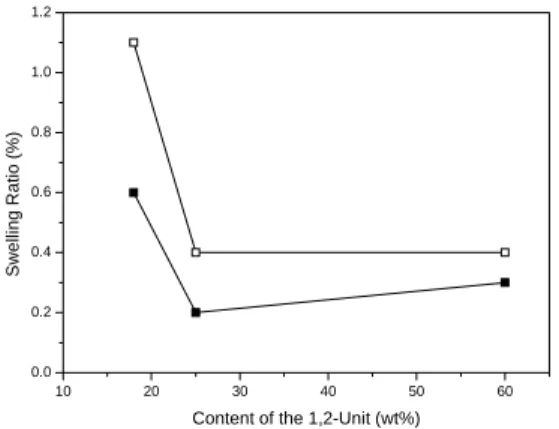
Figure 1. Variations of the water swelling ratios of carbon black-reinforced SBR composites as a function of the 1,2-unit content in SBR. Solid and open symbols indicate the swelling times of 1 and 3 days, respectively.
swelling behaviors. The 3.5% NaCl solution was employed as a model of sea water. Figure 1 shows variations of the water swelling ratios of the carbon black-reinforced SBR specimens. The carbon black- reinforced SBR vulcanizates did not swell in the salt solution. For the distilled water swelling, the water swelling ratios are very small (most of them are less than 1%). The water swelling ratio is enhanced by increasing the swelling time and on the whole tends to reduce with increasing the 1,2-unit content of SBR. The very small water swelling ratios of the carbon black-reinforced SBR specimens is because of the much less polar property of the carbon black surface compared to water.
The silica-reinforced SBR vulcanizates have better water swelling ratios than the carbon black- reinforced ones, especially the silica-reinforced SBR specimens without the silane coupling agent, as shown in Figures 2 and 3. The silica-reinforced SBR vulcanizates swell in the salt solution as well as in the distilled water. The water swelling ratios of the distilled water are larger than those of the salt water.
For the silica-reinforced SBR vulcanizates without the silane coupling agent, the variations of the water swelling ratios with the 1,2-unit content of SBR show reduced trends as shown in Figure 2. The water swelling ratios enhance with increasing the
10 20 30 40 50 60
1 2 3 4 5 6
Swelling Ratio (%)
Content of the 1,2-Unit (wt%)
Figure 2. Variations of the water swelling ratios of silica-reinforced SBR composites without the silane cou- pling agent as a function of the 1,2-unit content in SBR.
Squares and circles standard for the swelling in distilled water and 3.5% NaCl solution, respectively. Solid and open symbols indicate the swelling times of 1 and 3 days, respectively.
10 20 30 40 50 60
0.0 0.4 0.8 1.2 1.6
Swelling Ratio (%)
Content of the 1,2-Unit (wt%)
Figure 3. Variations of the water swelling ratios of silica-reinforced SBR composites containing the silane coupling agent as a function of the 1,2-unit content in SBR.
Squares and circles standard for the swelling in distilled water and 3.5% NaCl solution, respectively. Solid and open symbols indicate the swelling times of 1 and 3 days, respectively.
swelling time. The much less swelling ratios of the salt water may be due to the hydrated radii of ions.
Ions in aqueous solution are stabilized by water molecules. The hydrated radius of an ion is the effective radius of the ion plus its sheath of tightly held water molecules whose electric dipoles are attracted to the ion. The hydrated radii of Na+ and
Cl- in aqueous solution are 450 and 300 pm, respec- tively, while the radii of the naked Na+ and Cl- are 102 and 184 pm, respectively.21,22 Diffusion of the hydrated ions into the rubber specimen can be much more difficult than that of pure water molecule.
For the silica-reinforced SBR vulcanizates con- taining the silane coupling agent, the water swelling ratios are reduced with increasing the 1,2-unit content of SBR but the trends are not clear as shown in Figure 3. The water swelling ratios of the silica-reinforced specimens containing the silane coupling agent are larger than those of the carbon black-reinforced specimens but are much smaller than those of the silica-reinforced specimens without the silane coupling agent. The reduced swelling ratios of the silica-reinforced specimens by adding the silane coupling agent can be explained with the reduced polarity of silica surface by modifying with the silane coupling agent, TESPT. Ethoxy groups of the silane coupling agent, bis-(3- (triethoxysilyl)- propyl)-tetrasulfide, react with the silanol groups of silica and siloxane bonds (~Si-O-Si~) are formed.
The TESPTs bound to the silica surface make the silica surface less polar. The silane molecule bound to the silica surface can react with a rubber molecule to form a crosslink between silica and rubber.
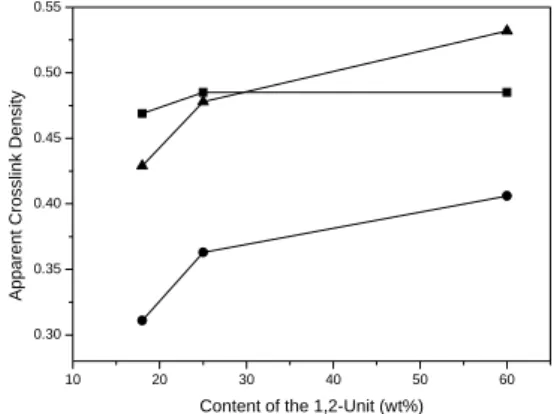
The water swelling ratios on the whole tend to reduce with increasing the 1,2-unit content of SBR regardless the reinforcing systems as shown in Figures 1-3. We at first expected that the water swelling ratios are increased as the 1,2-unit content of SBR becomes higher since the 1,2-unit is more polar than the cis-1,4- and trans-1,4-units. This can be explained with the crosslink densities. The apparent crosslink densities (1/Q) were increased by increasing the 1,2-unit content of SBR as shown in Figure 4. Swelling ratio is an inverse property to the crosslink density. Thus, it is only just that the water swelling ratios decreased with increasing the 1,2-unit content of SBR. However, for some of the specimens with the 1,2-unit content of 60 wt%, the water swelling ratios are slightly larger than for the specimens with the 1,2-unit content of 25 wt% as
10 20 30 40 50 60
0.30 0.35 0.40 0.45 0.50 0.55
Apparent Crosslink Density
Content of the 1,2-Unit (wt%)
Figure 4. Variations of the apparent crosslink densities (1/Q) of SBR composites as a function of the 1,2-unit content in SBR. The swelling solvent was toluene. Squares, circles, and triangles indicate the reinforcing systems of carbon black, silica without the silane coupling agent, and silica containing the silane coupling agent, respectively.
shown in Figures 1-3. This implies that the 1,2-unit can slightly contribute to increase the water swelling more than the cis-1,4- and trans-1,4-units.
References
1. S.-S. Choi, J.-C. Kim, and C.-S. Woo, “Accele- rated thermal aging behaviors of EPDM and NBR vulcanizates”, Bull. Kor. Chem. Soc., 27, 936 (2006).
2. S.-S. Choi, S.-H. Ha, and C.-S. Woo, “Thermal aging behaviors of rubber vulcanizates cured with single and binary cure systems”, Bull. Kor.
Chem. Soc., 27, 429 (2006).
3. H. Acharya and S. K. Srivastava, “Influence of nanodispersed organoclay on rheological and swelling properties of ethylene propylene diene terpolymer”, Macromol. Res., 14, 132 (2006).
4. G. K. Jana and C. K. Das, “Recycling natural rubber vulcanizates through mechanochemical devulcanization”, Macromol. Res., 13, 30 (2005).
5. G. Wang, M. Li, and X. Chen, “Preparation and water-absorbent properties of a water- swellable rubber”, J. Appl. Polym. Sci., 68, 1219 (1998).
6. Z. Zhang, G. Zhang, D. Li, Z. Liu, and X.
Chen, “Chlorohydrin water-swellable rubber com- patibilized by an amphiphilic graft copolymer.
II. Effects of PVA-g-PBA and CPA on water- swelling behaviors”, J. Appl. Polym. Sci., 74, 3145 (1998).
7. Z. Zhang, G. Zhang, C. Wang, D. Liu, Z. Liu, and X. Chen, “Chlorohydrin water-swellable rubber compatibilized by an amphiphilic graft copolymer. III. Effects of PEG and PSA on water-swelling behavior”, J. Appl. Polym. Sci., 79, 2509 (2001).
8. J. H. Park and D. Kim, “Preparation and characterization of water-swellable natural rub- bers”, J. Appl. Polym. Sci., 80, 115 (2001).
9. G. R. Cotton, “Mixing of carbon black with rubber. I. Measurement of dispersion rate by changes in mixing torque”, Rubber Chem.
Technol., 57, 118 (1984).
10. S. Wolff and U. Görl, “The influence of modi- fied carbon blacks on viscoelastic compound properties”, Kautsch. Gummi Kunstst., 44, 941 (1991).
11. T. C. Gruber and C. R. Herd, “Anisometry measurements in carbon black aggregate popu- lations”, Rubber Chem. Technol., 70, 727 (1997).
12. H. Raab, J. Fröhlich, and D. Göritz, “Surface topography and ist influence on the activity of carbon black”, Kautsch. Gummi Kunstst., 53, 137 (2000).
13. S. Wolff and M.-J. Wang, “Filler-elastomer interactions. Part IV. The effect of the surface energies of fillers on elastomer reinforcement”, Rubber Chem. Technol., 65, 329 (1992).
14. Y.-C. Ou, Z.-Z. Yu, A. Vida, and J. B.
Donnet, “Effects of alkylation of silica filler on rubber reinforcement”, Rubber Chem. Technol., 67, 834 (1994).
15. Y. Li, M. J. Wang, T. Zhang, F. Zhang, and X. Fu., “Study on dispersion morphology of silica in rubber”, Rubber Chem. Technol., 67, 693 (1994).
16. S.-S. Choi, “Influence of silane coupling agent on properties of filled styrene-butadiene rubber compounds”, Kor. Polym. J., 8, 285 (2000).
17. A. S. Hashim, B. Azahari, Y. Ikeda, and S.
Kohjiya, “The effect of TESPT on silica rein- forcement of styrene-butadiene rubber” Rubber Chem. Technol., 71, 289 (1998).
18. S.-S. Choi, “Characterization of bound rubber of filled styrene-butadiene rubber compounds using pyrolysis-gas chromatography”, J. Anal. Appl.
Pyrolysis, 55, 161 (2000).
19. S.-S. Choi and I.-S. Kim, “Filler-polymer in- teractions in filled polybutadiene compounds”, Eur. Polym. J., 38, 1265 (2002).
20. S.-S. Choi, I.-S. Kim, S. G. Lee, and C. W.
Joo, “Filler-polymer interactions of styrene and butadiene units in silica-filled styrene-butadiene rubber compounds”, J. Polym. Sci. Part B:
Polym. Phys., 42, 577 (2004).
21. D. C. Harris, Quantitative Chemical Analysis, 6th Ed., W. H. Freeman and Co., New York (2003).
22. J. McMurry and R. C. Fay, Chemistry, 4th Ed., Pearson Education, Inc., New Jersey (2004).