Influence of Reinforcing Systems on Thermal Aging Behaviors of NR Composites
Sung-Seen Choi † and Jong-Chul Kim
Department of Chemistry, Sejong University, 98 Gunja-dong, Gwangjin-gu, Seoul 143-747, Korea (Received May 16, 2011, Revised May 25, 2011, June 3, Accepted June 8, 2011)
충전 시스템이 NR 복합체의 열노화 거동에 미치는 영향
최성신
† ․ 김종철
세종대학교 화학과
접수일(2011년 5월 16일), 수정일(2011년 5월 25일), 게재확정일(2011년 6월 8일)
ABSTRACT:Five natural rubber (NR) composites with different reinforcing systems of unfilled, carbon black, carbon black with silane coupling agent, silica, and silica with silane coupling agent were thermally aged and change of the crosslink densities by the accelerated thermal aging was investigated. The crosslink densities on the whole increased as the aging time elapsed irrespective of the reinforcing systems. The crosslink density changes became noticeable by increasing the aging temperature. For carbon black-filled composites, the silane coupling agent made the crosslink density change to be increased. For silica-filled composites, however, the silane coupling agent made the crosslink density increment reduced at 60 and 70℃ and it hardly affect the degree of the crosslink density change at 80 and 90℃. The activation energies for the crosslink density changes of the carbon black-filled samples increased continuously in a logarithmic fashion, whereas that of the silica-filled one showed a quasi-steady state ranges at aging times of 30-150 days. The activation energy of the unfilled sample increased exponentially with the aging time. The experimental results were explained with sulfur donation from the silane coupling agent, surface modification of the filler by the silane coupling agent, adsorption of curative residues on the silica surface, and release of the adsorbed curative residues.
요 약:비보강, 카본블랙, 카본블랙과 실란커플링제, 실리카, 실리카와 실란커플링제 등 5가지의 다른 충전 시스템을 갖는 NR 복합체를 열노화시켰으며, 가속 열노화에 의한 가교밀도 변화를 연구하였다. 가교밀도는 충전 시스템과 관계없이 노화 시간이 경과함에 따라 증가하였다. 노화 온도가 높아질수록 가교밀도는 눈에 띄게 변하였다. 카본블랙으 로 보강된 NR 복합체의 경우, 실란커플링제는 가교밀도를 증가시켰다. 하지만 실리카로 보강된 NR 복합체의 경우에는 60℃와 70℃ 노화에서는 가교밀도 증가분이 감소하였으며, 80℃와 90℃에서는 거의 영향을 주지 않았다. 카본블랙으 로 보강된 NR 복합체의 가교밀도 변화에 대한 활성화 에너지는 로그 함수 형태로 지속적으로 증가한 반면, 실리카로 보강된 NR 복합체의 경우에는 노화 시간 30-150일 구간에서는 거의 변화가 없었다. 비보강 시험편의 활성화 에너지 는 노화 시간에 따라 지수 함수 형태로 증가하였다. 실험 결과는 실란커플링제로부터의 황 제공, 실란커플링제에 의한 충전제의 표면 개질, 실리카 표면에서의 가교제 잔류물의 흡착, 그리고 흡착된 가교제 잔류물의 방출 등으로 설명하였다.
Keywords:NR composite, thermal aging, reinforcing system, crosslink density change
†
Corresponding Author. E-mail: [email protected]
Ⅰ. Introduction
Physical properties of rubber composites are improved by reinforcing with fillers and the most popular reinforcing fillers used in rubber compounds are carbon black and silica. 1-10 Types and contents of fillers also affect the cure characteristics and the cure rate of a filled rubber compound is faster than that of an unfilled one. 11,12 Silica-filled rubber compounds have
slower cure characteristics relative to carbon black-filled ones since silica adsorbs curatives. 13-15 The crosslink density of a carbon black-filled rubber composite is influenced by the struc- ture and surface chemistry of carbon black. 11 The carbon black leads to higher crosslink density and better reversion re- sistance. 11,16
Silica has a number of hydroxyl groups (silanol, ~Si-OH),
which results in strong filler-filler interactions and adsorption
of polar materials by hydrogen bonds. 6,17 Since intermolecular
hydrogen bonds between silanol groups on the silica surface
are very strong, it can aggregate tightly. 7,18 Its property can
cause a poor dispersion of silica in a rubber compound. In general, a silane coupling agent such as bis-(3-(triethox- ysilyl)-propyl)-tetrasulfide (TESPT) is used to improve the fill- er dispersion and to prevent adsorption of curatives on the silica surface. 15 TESPT reacts with silanol on the silica surface and a siloxane bond is formed. The silane molecule bound to the silica surface can react with a rubber chain to form a crosslink between silica and rubber.
Brown and coworkers reported physical property changes of rubber composites after natural aging for 40 years and com- pared with the accelerated heat aging results. 19,20 Relative devi- ations for the physical property changes of natural aging results for long time were very big but the data are valuable. The big deviation of the physical property might be due to the difference in the initial state of the samples. Lots of samples are needed to measure physical properties and to perform ther- mal aging for long time. Physical properties of a rubber com- posite depend on its crosslink density. 21 The crosslink density of a rubber vulcanizate varies with the vulcanization temper- ature as well as with the cure time even for the same formu- lation. The size of sample should be small enough to minimize the experimental errors, but relatively large sample size should be required for the measurement of physical properties. Sample dimension for measurement of the crosslink density is less than 1×1 cm 2 . Thus, experimental errors to examine thermal aging behaviors can be reduced by measuring the crosslink density changes not the physical property changes because lots of samples with the same initial conditions can be obtained from one press mold to measure the crosslink density changes.
In the present work, we studied thermal aging behaviors of natural rubber (NR) composites reinforced with different reinforcing systems via tracing the changes in crosslink densities. Unfilled, carbon black, carbon black with silane cou- pling agent, silica, and silica with silane coupling agent were employed as the reinforcing systems. Thermal aging was car- ried out for 2 to 185 days in a convection oven and the thermal aging behaviors were compared for two cases: short-term and long-term aging periods. Activation energy for the crosslink density change by thermal aging was obtained from the Arrhenius plot and the variation with the aging time was also investigated to characterize the thermal aging behaviors.
Ⅱ . Experimental
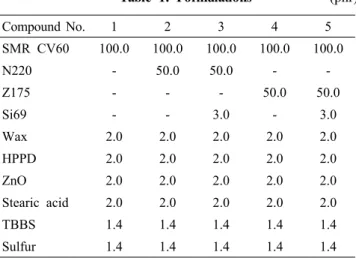
Five NR compounds were made of rubber, filler (carbon black or silica), silane coupling agent (TESPT), antidegradants (HPPD and wax), cure activators (ZnO and stearic acid), cure accelarator (TBBS), and sulfur. Si69, bis-(3-(triethoxysilyl)- propyl)-tetrasulfide (TESPT), supplied from Degussa Co. was employed as a silane coupling agent. The formulations were given in Table 1. Mixing was performed in a Banbury type
Table 1. Formulations (phr)
Compound No. 1 2 3 4 5
SMR CV60 100.0 100.0 100.0 100.0 100.0
N220 - 50.0 50.0 - -
Z175 - - - 50.0 50.0
Si69 - - 3.0 - 3.0
Wax 2.0 2.0 2.0 2.0 2.0
HPPD 2.0 2.0 2.0 2.0 2.0
ZnO 2.0 2.0 2.0 2.0 2.0
Stearic acid 2.0 2.0 2.0 2.0 2.0
TBBS 1.4 1.4 1.4 1.4 1.4
Sulfur 1.4 1.4 1.4 1.4 1.4
N220: carbon black Z175: silica
Si69: Si69: bis-(3-(triethoxysilyl)-propyl)-tetrasulfide (TESPT) HPPD: N-phenyl-N'-(1,3-dimethylbutyl)-p-phenylenediamine TBBS: N-tert-butyl-2-benzothiazole sulfenamide
mixer at a rotor speed of 40 and 30 rpm for master batch (MB) and final mixing (FM) stages, respectively. The initial temperatures of the mixer were 110 and 80 ℃ for the MB and FM stages, respectively. The MB compounds were pre- pared as follow: (1) The rubber was loaded into the mixer and premixed for 0.5 min. (2) The filler and silane coupling agent were compounded into the rubber for 2.5 min. (3) The cure activators and antidegradants were mixed for 1.5 min and the compounds were discharged. The FM compounds were prepared by mixing the curatives with the MB compounds for 2.0 min. The sheet-shaped vulcanizates were prepared by cur- ing at 160 ℃ for 20.0 min in a press mold.
The sample dimension for accelerated thermal aging was 3.0×6.0 cm 2 with 2.0 mm thickness. Thermal aging was per- formed at 60, 70, 80, and 90 ℃ for 2, 4, 6, 8, 10, 15, 20, 25, 30, 35, 45, 55, 65, 75, 85, 105, 125, 145, 165, and 185 days in a convection oven. Crosslink densities of the samples were measured by a swelling method. Organic additives in the samples were removed by extracting with THF and n-hex- ane for 3 and 2 days, respectively, and they were dried for 2 days at room temperature. The weights of the organic materi- als-extracted samples were measured. They were soaked in n-decane for 2 days and the weights of the swollen samples were measured. The swelling ratio (Q) was calculated by the equation, Q = (W s - W u ) / W u , where W s and W u are weights of the swollen and unswollen samples. In general, the recip- rocal swelling ratio (1/Q) was used as the apparent crosslink density. Experiments were carried out three times and the ob- tained values were averaged.
Organic materials in the aged samples were extracted with
THF and analyzed with GC/MS. GC/MS chromatograms and mass spectra of the extracted materials were acquired with 6890N/5987 GC/MS of Agilent Co. DP-5MS capillary column (length 30 m) was used. Injector temperature of the GC was 250 ℃. The GC oven temperature program was as follows:
(1) The initial temperature was 70 ℃ and kept for 3 min. (2) The temperature was then increased from 70 to 300 ℃ at a rate of 10 ℃/min.
Ⅲ . Results and discussion
Bound rubber contents of the filled samples were measured to compare the degree of reinforcement. In general, the bound rubber content depends on characteristics of filler such as sur- face area, structure or morphology, and surface activity. Bound rubber contents of the carbon black-filled compounds without and containing TESPT were 20.0 and 22.1 %, respectively, while those of the silica-filled ones were 10.9 and 21.2 %, respectively. Difference in the bound rubber contents of carbon black-filled compounds without and containing TESPT was not significant, but for the silica-filled ones the difference was noticeably big. This indicates that TESPT strikingly enhances the bound rubber content of the silica-filled compound.
Crosslink denisty change (ΔX c ) was calculated by the equa- tion (1)
ΔX
c= 100 × {(1 / Q
f) - (1 / Q
i)} / (1 / Q
i) (1)
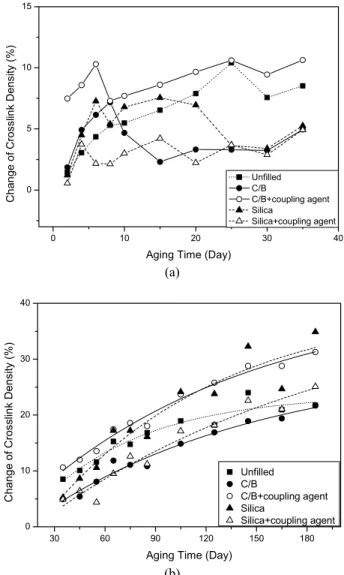
where (1/Q i ) and (1/Q f ) are the apparent crosslink densities of the specimens before and after the thermal aging. The ex- perimental results were plotted by two aging times of short- term and long-term agings as shown in Figures 1 - 4. The ΔX c s for the short-term aging of 2 - 35 days generally increase with increasing the aging time, but the increasing pattern is somewhat fluctuated. The degree of ΔX c is governed by the competition reactions between the formation of new crosslinks and the dissociation of existing crosslinks. The newly formed crosslinks give rise to the increase of total crosslink density, whereas the dissociation of existing crosslinks reduces the total crosslink density. Curatives and their residues such as sulfur, zinc complex, cure accelerator residues, and pendent sulfide groups remained in a rubber vulcanizates can lead to new crosslinks, 22 whereas the polysulfides are easily dissociated by heating. 23,24 The enhancement of crosslink density by thermal aging implies that the formation of new crosslinks dominates over the dissociation of existing crosslinks.
For the thermal aging at 60℃ within 35 days (Figure 1(a)), the crosslink density (X c ) increased after the thermal aging and the degree of ΔX c varied up and down with the aging time except the unfilled sample. This indicates that there exists a local minimum region where the dissociation of existing
0 10 20 30 40
0 5 10 15
Unfilled C/B
C/B+coupling agent Silica
Silica+coupling agent
Ch an ge o f Cr oss lin k D e ns ity ( % )
Aging Time (Day)
(a)
(a)
30 60 90 120 150 180
0 10 20 30 40
Ch an ge of Cro ss lin k Den sit y ( % )
Aging Time (Day) Unfilled C/B
C/B+coupling agent Silica
Silica+coupling agent
(b)
(b)
Figure 1. Variations of the crosslink density changes with the aging time for NR composites: (a) short-term and (b) long- term thermal aging at 60℃. The squares, circles, and triangles indicate the unfilled, carbon black-filled, and silica-filled speci- mens, respectively. The solid and open symbols stand for the specimens without and containing the coupling agent, respectively.
crosslinks exceeds the amounts of newly formed crosslinks.
For the short-term aging, the ΔX c s of the carbon black-filled composite containing TESPT are larger than those of the others. Considering the long-term aging for 185 days at 60
℃ (Figure 1(b)), the ΔX c s continuously increased with the
aging time elapsed irrespective of the reinforcing systems. For
the carbon black-filled composites, the ΔX c s of the sample
containing TESPT were much larger than those of the sample
without TESPT, whereas for the silica-filled composites the
ΔX c s of the sample containing TESPT were much smaller
than those of the sample without TESPT. This indicates that
TESPT plays a role to increase ΔX of the carbon black-filled
composite, whereas it does not play an increasing role of ΔX
in the silica-filled ones. This can be explained by the prefer- ential role of TESPT either preventing the adsorption of the curatives on the silica surface or acting as a sulfur donor. Silica has a number of silanol groups, polar materials such as cure accelerator and antiozonant in a rubber compound can be easi- ly adsorbed on the silica surface. Ethoxy groups of TESPT, (CH 3 CH 2 O) 3 SiCH 2 CH 2 CH 2 -S 4 -CH 2 CH 2 CH 2 Si(OCH 2 CH 3 ) 3 , can react with silanol groups of the silica to form siloxane bond (~Si-O-Si~). The TESPT molecules bonded to the silica surface prevent the curatives from adsorption. Since TESPT has about four sulfur atoms every one molecule, elemental sulfur can be isolated from it by heating. 18 Thus, the total sulfur content becomes higher in a rubber compounds by add- ing TESPT. However, TESPT in the carbon black-filled com- pound rarely react with carbon black because the number of functional groups on the carbon black surfaces is quite limited.
Thus, most of TESPT in the carbon black-filled compound will remain. The sulfur donation of TESPT increases the cross- link density of the carbon black-filled composite during ther- mal aging. On the contrary, for the silica-filled compounds, TESPT can react with silanol groups of silica and also make a crosslink between silica and rubber by formation of siloxane bond with silica and sulfur bond with a rubber chain. For the silica-filled composite without TESPT, some curatives will be adsorbed on the silica surface. The adsorbed curatives can be released during thermal aging and participate in crosslinking reactions leading to an increase of the crosslink density.
The ΔX c s of the unfilled sample are smaller than those of the carbon black-filled composite containing TESPT and silica-filled composite without TESPT, while they are larger than those of the carbon black-filled composite without TESPT and silica-filled composite containing TESPT. The ΔX c s of the carbon black-filled composite without TESPT are lower than those of the others. This means that the carbon black-filled composite without TESPT has a good thermal resistance at 60 ℃.
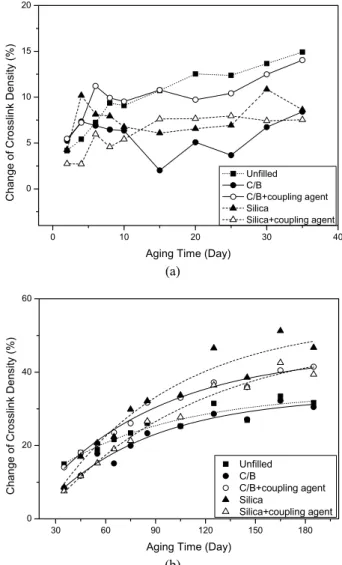
The ΔX c s notably increased as the aging temperature be- came higher as shown in Figures 1-4. The ΔX c s at 70 ℃ aging are higher than those at 60 ℃ aging (Figures 1 and 2).
Some experimental results at 70 ℃ aging showed similar trends to those at 60 ℃ aging. The ΔX c s of the carbon black-filled composite without TESPT are lower than those of the others. For long-term aging, the ΔX c s of the unfilled sample are smaller than those of the carbon black-filled sample containing TESPT and silica-filled sample without TESPT, while they are larger than those of the carbon black-filled sam- ple without TESPT and silica-filled sample containing TESPT.
For the short-term aging within 35 days, the ΔX c s of the un- filled sample are relatively higher than those of the others.
For thermal aging longer than 85 days, the ΔX c s of the sili- ca-filled sample without TESPT are larger than those of the
0 10 20 30 40
0 5 10 15 20
Ch ang e of Cr os sl ink Den sit y ( % )
Aging Time (Day) Unfilled C/B
C/B+coupling agent Silica
Silica+coupling agent
(a)
(a)
30 60 90 120 150 180
0 20 40 60
Aging Time (Day)
Ch ang e of Cr os sl ink Den sit y ( % )
Unfilled C/B
C/B+coupling agent Silica
Silica+coupling agent
(b)
(b)
Figure 2. Variations of the crosslink density changes with the aging time for NR composites: (a) short-term and (b) long- term thermal aging at 70℃. The squares, circles, and triangles indicate the unfilled, carbon black-filled, and silica-filled speci- mens, respectively. The solid and open symbols stand for the specimens without and containing the coupling agent, respectively.
carbon black-filled sample containing TESPT. This may be due to the activation of release of adsorbed curatives and im- plies that release of the adsorbed curatives is strikingly acti- vated at 70 ℃.
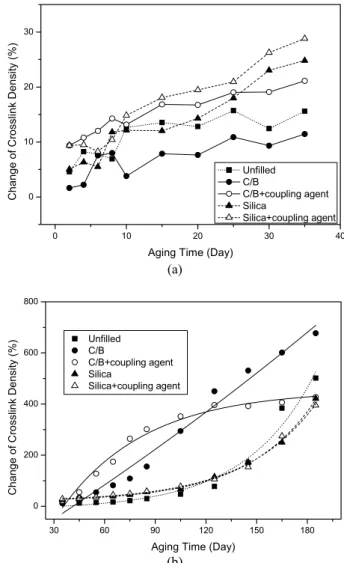
Variation of the ΔX c s at 80 ℃ with the aging time shows
different trends from those at 60 and 70 ℃ as shown in Figure
3. For the short-term aging as shown in Figure 3(a), the fluctu-
ation of the ΔX c values at 80 ℃ was considerably smaller
compared with those at 60 and 70 ℃ aging. The ΔX c s of
the carbon black-filled sample containing TESPT are larger
than those of the others. The decreasing order of the ΔX c s
was carbon black-filled sample containing TESPT > sili-
ca-filled sample containing TESPT > unfilled sample ≅ sili-
ca-filled sample without TESPT > carbon black-filled sample
0 5 10 15 20 25 30 35 40 0
10 20 30
Change of Cros sl ink D ens ity (%)
Aging Time (Day) Unfilled C/B
C/B+coupling agent Silica
Silica+coupling agent
(a)
(a)
30 60 90 120 150 180
0 100 200 300
Unfilled C/B
C/B+coupling agent Silica
Silica+coupling agent
C ha nge of Cro ssl ink D ens ity (% )
Aging Time (Day)
(b)
(b)
Figure 3. Variations of the crosslink density changes with the aging time for NR composites: (a) short-term and (b) long- term thermal aging at 80℃. The squares, circles, and triangles indicate the unfilled, carbon black-filled, and silica-filled specimens, respectively. The solid and open symbols stand for the specimens without and containing the coupling agent, respectively.
without TESPT. For the long-term aging as shown in Figure 3(b), the ΔX c s of the carbon black-filled samples ex- ponentially increase as the aging time elapses. This may be due to the fast consumption of antidegradants in the sample at high temperature. In general, migration rates of anti- degradants in a carbon black-filled rubber vulcanizate are rela- tively faster than those in a silica-filled one. 25,26 If anti- degradants do not exist in a rubber vulcanizate, carbon-carbon double bonds (C=C) of rubber chains are degraded by ozone and oxygen and then new chemical bonds between rubber chains can be formed by a radical process. A direct bond for- mation between rubber chains results in increase of the cross- link density. The ΔX c s of the unfilled sample are higher than
0 10 20 30 40
0 10 20 30
Chan ge o f Cr os sl ink Dens ity (%)
Aging Time (Day) Unfilled C/B
C/B+coupling agent Silica
Silica+coupling agent
(a)
(a)
30 60 90 120 150 180
0 200 400 600 800
Unfilled C/B
C/B+coupling agent Silica
Silica+coupling agent
Chan ge of Cros slink D ensit y (% )
Aging Time (Day)
(b)
(b)
Figure 4. Variations of the crosslink density changes with the aging time for NR composites: (a) short-term and (b) long- term thermal aging at 90℃. The squares, circles, and triangles indicate the unfilled, carbon black-filled, and silica-filled specimens, respectively. The solid and open symbols stand for the specimens without and containing the coupling agent, respectively.
those of the carbon black-filled sample without TESPT for the thermal aging at 80 ℃ during 75 days. However, after 75 days of thermal aging, the ΔX c s of the unfilled sample are lower than those of the carbon black-filled sample without TESPT.
The ΔX c s of the rubber composites after thermal aging at
90 ℃ notably increase irrespective of the reinforcing systems
as shown in Figure 4. The ΔX c s of the carbon black-filled
sample containing TESPT are larger than those of the others
within 8 days at 90 ℃ aging as shown in Figure 4(a) and
the ΔX c s of the carbon black-filled sample containing TESPT
are smaller than those of the silica-filled sample containing
TESPT until 35 days. For the long-term aging as shown in
Figure 4(b), the ΔX c s of the unfilled and silica-filled samples increase exponentially as the aging time elapses. The ΔX c s of the carbon black-filled samples are larger than those of the unfilled and silica-filled samples. The ΔX c s of the silica-filled samples containing and without TESPT are nearly the same.
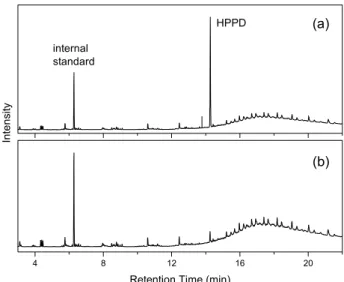
The ΔX c s of the unfilled sample are larger than those of the silica-filled samples after 145 days. The ΔX c s of the carbon black-filled samples without TESPT are larger than those of the carbon black-filled samples containing TESPT after 130 days. The amazing increase of the crosslink density by the long-term thermal aging at 90 ℃ may be due to the lack of antidegradants remained in the aged samples. Antidegradants protect degradation of rubber chain. As discussed above, new chemical bonds between rubber chains can be formed when antidegradants do not exist in a rubber vulcanizate. Consump- tion rates of antidegradants rapidly increase as the aging tem- perature increases. Figure 5 shows notable decrease of HPPD in the silica-filled sample by thermal aging at 90 ℃ for 5 and 35 days.
Activation energies for the ΔX c s by thermal aging were obtained from the Arrhenius plot of lnk vs 1/T, where k is the ΔX c and T is the aging temperature, to characterize the thermal aging behaviors according to the reinforcing systems.
The activation energies vary with the aging time as shown in Figure 6. This implies that states of the vulcanizates depend on the aging time. Density and type of crosslinks are changed hourly because new crosslinks are formed and the existing crosslinks are dissociated by thermal aging. And kinds and amounts of curative residues remained in the sample are also hourly changed. The activation energies of the carbon black- filled composites continuously increase with increase in the aging time. This is natural because amounts of curative resi- dues remained in the sample decrease as the aging time elapses. For the thermal aging for a long time, activation en- ergies of the carbon black-filled composites are higher than those of the silica-filled ones. This may be due to the release of curative residues adsorbed on silica. Values of the activation energies of the silica-filled composites are very fluctuating up and down at the initial period and do not show a significant change during 45 - 145 days and then increase. The quasi-plea- teu values of activation energies of the silica-filled composites at 45 - 145 days imply that kinds and amounts of curative residues remained in the sample are significantly not changed due to release of the adsorbed curatives.
The activation energy of the unfilled sample decreases until 65 days and then increases. This trend was reported for NBR. 27 This can be explained with the reactivity of rubber chain and migration behaviors of crosslinking-related chemicals such as zinc complexes, curative residues, sulfur, and so on. In general, sulfur crosslinks are made between allylic carbons. 24 As the aging time elapses, the crosslinking-related chemicals will
(b)
Inte n si ty
internal standard
HPPD (a)
4 8 12 16 20
Retention Time (min)
Figure 5. GC/MS TIC chromatograms of the extracted organic materials from the silica-filled NR composite containing TESPT thermally aged for 5 (a) and 35 (b) days at 90℃.
0 50 100 150 200
-50 0 50 100 150