• 검색 결과가 없습니다.

Characteristics of SAW humidity sensor using nanocrystalline ZnO films

N/A
N/A
Protected

Academic year: 2021

Share "Characteristics of SAW humidity sensor using nanocrystalline ZnO films"

Copied!
5
0
0

로드 중.... (전체 텍스트 보기)

전체 글

(1)

Characteristics of SAW humidity sensor using nanocrystalline ZnO films

Hoang-Si Hong and Gwiy-Sang Chung Abstract

In this work, the nanocrystalline ZnO/polycrystalline(poly) aluminum nitride(AlN)/ Si-layered structure was fabricated for humidity sensor applications based on surface acoustic wave(SAW). The ZnO film was used as a sensitive material layer. The ZnO and AlN(0002) were deposited by a sol-gel process and a pulse reactive magnetron sputtering, respectively.

The ZnO sensitive films coated on AlN have a hexagonal wurtzite structure after the thin films annealed at 400

o

C, 500

o

C and 600

o

C. The surface of the film exhibits sponginess and a nanometer particle size(below 50 nm). The largest shift in the frequency response was at approximately 200 kHz(the relative humidity: 10 %~90 %) for the structure annealed at 400

o

C. The effect of the change in the environmental temperature on the frequency response of the SAW humidity sensor was also investigated.

Key Words : nanocrystalline ZnO, AlN thin film, SAW humidity sensor, sol-gel

1. Introduction

Recently, chemical sensors based on surface acoustic wave(SAW) have been widely investigated due to sev- eral attractive advantages such as high sensitivity, small size, reliability and wireless ability [1,2] . Among many factors, coated sensitive materials and piezoelectric sub- strates play important roles in improving SAW sensor properties. Up to now, almost all of the group studies have developed SAW chemical sensors based on LiNbO 3 substrates [1,2] . Among these popular sensitive materials, ZnO, one of versatile II-VI, has been used widely in a variety of applications, including a humidity sensing layer. Due to its interesting structures, such as nanocrystalline or nanotetrapod, with a high surface-to- volume ratio which can absorb water vapor, this mate- rial led the change in electrical properties or mass load- ing of ZnO coated on a quartz tuning fork [3,4] . Moreover, ZnO can be easily deposited by traditional methods such as sol-gel [3] . Therefore, the application of nanocrystalline ZnO thin films in a SAW humidity sen- sor is feasible.

For a piezoelectric substrate, AlN films were proven to benefit SAW applications because of the high-acous-

tic velocity, superior temperature and chemical stability, and good piezoelectric [5] . Moreover, AlN thin film was suitable for the deposition theories relating to post heat- treatment such as sol-gel, due to the stability of SAW properties of thin film at annealing temperatures below 600 o C [5] . In addition, in comparison of the temperature coefficient of frequency(TCF) of traditional bulk sub- strates such as LiNbO 3 and LiTaO 3 (upper 40 ppm/ o C), that of AlN/Si( − 30 ppm/ o C) is significantly smaller, which can reduce the influence of outside tempera- ture [6] . Furthermore, these above mentioned traditional bulk substrates are difficult to integrate into the silicon device fabrication process.

In this work, nanocrystalline ZnO was prepared by sol-gel due to the simplicity of the process, its low cost, and the ability to easily control the properties of the thin film by adjusting the coating time and annealing tem- perature. Also, the layered structure(ZnO/ inter-digital transducer(IDT)/AlN/Si) was chosen and fabricated for SAW humidity sensors due to ease of fabrication and high sensitivity.

2. Experimental

The high-quality polycrystalline piezoelectric(002)- oriented AlN thin films, with thicknesses(h) of 0.5 µm, were deposited on (100) Si wafers by a pulsed reactive magnetron sputtering system [5] . Next, the ZnO coating

울산대학교 전기공학부(School of Electrical Eng., University of Ulsan)

Corresponding author: [email protected]

(Received : March 2, 2010, Revised : June 22, July 9, 2010,

Accepted : August 2, 2010)

(2)

solution was prepared by sol-gel process from zinc ace- tate, methoxyethanol, and monoethanolamine, in a mag- netic stirrer for 2 hr at 70 o C. The solution was aged at room temperature for several days.

To fabricate a SAW humidity sensor with a layered structure, the first two-port SAW delay lines, based on IDT/AlN/Si, were made by using photolithography technology and wet etching. To make the IDTs, a Al layer with a thickness of 100 nm was deposited on the AlN/ Si structure by using thermal evaporator method and IDTs were created by Al wet etching. IDTs of 50 finger pairs, having a period of electrodes (d) of 10 µm, were used. The aperture was 100 λ =4000 µm. The IDT- IDT gap was 5 mm. The wavelength( λ =4d) was 40 µm.

Subsequently, the SAW humidity sensors was created by the coating of the sensing films multi layer(ZnO) on the IDT/AlN/Si structure. After each ZnO layer was coated on the IDT/AlN/Si structure by spin coating devices at room temperature with a rate 2500 rpm, the sample was heat-treated in air at 300 o C for 10 minutes.

Ten coatings were performed to obtain approximately a thickness of 300 nm of ZnO films. Finally, these obtained samples were heat-treated by post-annealing in air at 400 o C, 500 o C and 600 o C for 1 hr by a furnace.

The controlled humidity environments for humidity measurement were achieved using a saturated aqueous solution of K 2 CO 3 (for 30 % or 50 % relative humidity (RH)), CuSO 4 .5H 2 O(for 70 % and 90 % RH), and des- iccant(for 10 % RH) in a closed glass vessel at an ambi- ent temperature of 25 o C. The monitoring of the relative humidity values was confirmed by the use of a com- mercial hygrometer. The response of the transmission characteristics of the SAW humidity sensors, according to a change in the relative humidity, was measured by an Agilent 8802A Network Analyzer in the humidity range of 10 % to 90 % at room temperature. The change in morphology of the films, along with the annealing temperature and thickness of the films, were examined by using the JSM-6500F FE-SEM. The phases of the films were determined by a high resolution triple axis X-ray diffractometer(HRXRD), Philips X’Pert ro- MRD.

3. Results and Discussion

Fig. 1 shows the XRD pattern of the ZnO/ AlN/Si structure annealed at 500 o C and the (002) ZnO peaks

for the structures annealed at 500 o C and 600 o C(inset).

Obvious peaks can be observed at 2 θ =31.79 o , 34.46 o , 4.5 o , 56.7 o , 62.8 o and 72.5 o , corresponding to (100), (002), (102), (110), (103), and (004) reflections of the wurtzite structure ZnO, respectively. Other peaks appearing at 2 θ =36.08 o and 76.47 o , indicated (002) and (004) planes of the AlN film. It is clear that the poly AlN films grown on Si substrates had a (002) preferred orientation. For the other samples, annealed at 400 and 600 o C, the number of peaks in the XRD pattern are almost the same as those of the structure annealed at 500 o C but the (002) ZnO peak is narrower. While the (002) peak of XRD pattern for the structure annealed at 400 o C is weaker and wide.

Figs. 2(a)~(c) show the SEM micrographs of the ZnO/AlN/Si structures annealed at 400 o C, 500 o C and 600 o C, respectively. The surface of the ZnO films is spongy and porous. In comparison of the grain size of the ZnO thin film annealed at 400 o C, to that of the sam- ples annealed at 500 o C and 600 o C, the grain size is larger, which indicates that the increase in the annealing temperature led to growth in both particle and pore size of the ZnO thin film. The change in size of the particle affects the sensitivity of the humidity sensor. To confirm the change in the above-mentioned particule size, crys- tallite sizes of the films are determined by using the fol- lowing equation [7] : D=K λ /(B cos θ ), where D is the

Fig. 1. XRD spectra of the ZnO/AlN/Si structure annealed

at 500 o C and 600 o C .

(3)

crystallite size, K is a fixed number of 0.9, λ is the x- ray wavelength, and B is the full width at half maxi- mum of the first peak. The results show that the crys- tallite size annealed at 400 o C, 500 o C and 600 o C are 19.23 nm, 29.13 nm and 43.8 nm, respectively.

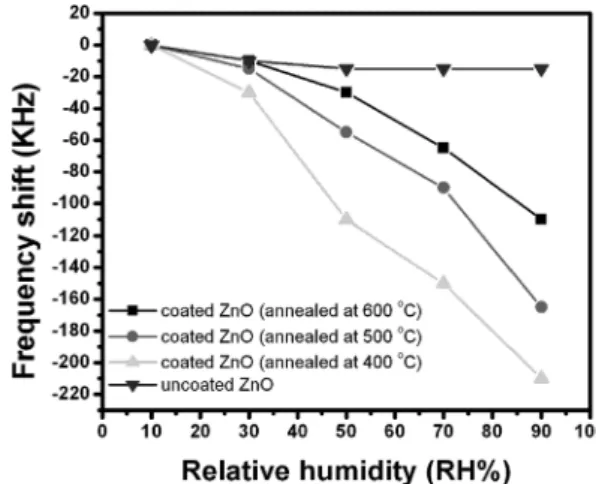
To determine the sensitivity of SAW humidity sen- sors, the frequency response of a two-port SAW delay line was examined at approximately 10 %, 30 %, 50 %, 70 % and 90 % RH at room temperature. The results are shown in Fig. 3.

The center frequency of the AlN/Si structure without ZnO did not demonstrate any obvious change, and the maximum shift was about 10 kHz. This is due to the AlN film surface has large grain size and solid. More-

over, The AlN film had a columnar structure with (002) orientation while the hexagonal structure of the ZnO film is porous grains. Therefore, frequency shift of the SAW resonator(uncoated ZnO) is only about 10 kHz in range from 10 to 90 % RH. The frequency shift(toward reduction) is about 210 kHz, 170 kHz and 110 kHz for the ZnO/IDTs/AlN/Si structures annealed at 400 o C, 500 o C and 600 o C, respectively, in the range from 10 % to 90 % RH. In this case, the frequency shift( ∆f x ) deter- mined by the formula: ∆f x =( f x −f 10 ), where f 10 is the center frequency of SAW humidity sensor under 10 % RH and is center frequency of the SAW humidity sensor under 30 o C, 50 o C, 70 o C and 90 % RH, respectively.

The original frequency responses of the two-port SAW delay line coated ZnO film(annealed at 500 o C) at room temperature according to a change in the relative humidity(at 10 % and 90 % RH) is shown in Fig. 4.

The center frequency are 125.82 MHz( f 10 ) and 125.65 MHz( f 90 ) for RH under 10 and 90 %, respec- tively. Therefore, frequency shift(towards decrease) cor- responding to an increase in the relative humidity from 10 % to 90 % is 0.17 MHz(170 kHz). If the IDTs/AlN/

Si structure(uncoated ZnO) is the reference sensor, then maximum frequency shift of ZnO/IDTs/AlN/Si struc- ture annealed 400 o C, 500 o C and 600 o C is about 200 kHz, 160 kHz and 100 kHz, respectively.

The structure with the ZnO annealed at 400 o C proved to have the highest sensitivity. This was due to the increase in the surface area for water vapor absorp-

Fig. 2. SEM images of ZnO/AlN/Si structures with different annealing temperatures: (a) ZnO annealed at 400

o

C; (b) ZnO annealed at 500

o

C; (c) ZnO annealed at 600

o

C; (d) as-deposited AlN(uncoated ZnO) and (e) cross-section of the structure annealed at 500

o

C.

Fig. 3. Relationship between the frequency shift and the

corresponding relative humidity at different annealing

temperature for the ZnO/AlN/Si structure.

(4)

tion of the thin film which was a result of a decrease in the grain size. The greater surface area provides more sites for water absorption [8] . In comparison with the sen- sitivity of SAW humidity sensors, based on polymers grown on LiNbO 3 , our 200 kHz(the maximum fre- quency shift) result is larger than the 40 kHz for the Meso-tetra porphyrin(TPPS 4 ) [8] . However, this result is less than the 350 kHz for PANI nanofibres coated on a LiNbO 3 substrate [1] . This variation can originate with the diversity in the surface-to-volume ratio of the sen- sitive layer.

Fig. 5 shows the fractional change in the frequency shift of the ZnO/IDTs/AlN/Si structure annealed at

500 o C as a function of temperature in the range of 25 o C to 80 o C. The characteristic was measured at the same RH(30 % RH) as the room environment. In this way, the temperature strongly affects the resonant fre- quency of the structure. However, the decrease in the resonant frequency of the structure, according to an increase in the temperature, is nearly linear, which is the basis of the temperature error compensation by soft- ware.

4. Conclusion

Nanocrystalline ZnO thin films grown on an AlN/Si substrate were fabricated. In the annealing temperature range of 400 o C, 500 o C to 600 o C for 1 hr, the particle size of the ZnO films was increased from 19.23 nm to 43.8 nm. The surface of the films exhibited a spongy texture, which is suitable for water vapor absorption. In addition, the obtained films also had wurtzite structure.

The maximum frequency shift of the sensor was 200 kHz with a change in RH from 10 % to 90 % at room temperature, when the structure was annealed at 400 o C. The sensitivity of the sensor can be improved by a decrease in the grain size. The change in the res- onance frequency in the 25 o C to 80 o C temperature range is approximately linear. Therefore, the application of nano-crystalline ZnO thin films for SAW humidity sensors is definitely possible. This result is the basis for the full study of SAW humidity sensors intended for harsh environments and produced at low cost.

Acknowledgement

This research was financially supported by Grant No.

B0009720 from the Regional Technology Innovation Program of the Ministry of Knowledge Economy.

References

[1] T. T. Wu, Y. Y. Chen, and T. H. Chou, “A high sen- sitivity nanomaterial based SAW humidity sensor”, J. Phys. D: Appl. Phys., vol. 41, pp. 085101(1)- 085101(3), 2008.

[2] W. Wang, K. Lee, T. Kim, I. Park, and S. Yang, “A novel wireless, passive CO

2

sensor incorporating a surface acoustic wave reflective delay line”, Smart Mater. Struct., vol. 16, pp. 1382-1389, 2007.

Fig. 4. Frequency response of the two-port SAW delay line(coated ZnO annealed at 500

o

C) at 10 % and 90 % RH.

Fig. 5. Temperature effect on frequency of a delay line

coated ZnO(annealed at 500

o

C).

(5)

[3] X. Zhou, T. Jiang, J. Zhang, X. Wang, and Z. Zhu,

“Humidity sensor based on quartz tuning fork coated with sol-gel-derived nanocrystalline zinc oxide thin film”, Sens. & Actu. B , vol. 123, pp. 299- 305, 2007.

[4] X. H. Wang, Y. F. Ding, J. Zhang, Z. Q. Zhu, S. Z.

You, S. Q. Chen, and J. Zhu, “Humidity sensitive properties of ZnO nanotetrapods investigated by a quartz crystal microbalance”, Sens. & Actu. B , vol.

115, pp. 421-427, 2006.

[5] H. S. Hong and G. S. Chung, “Effect of thermal annealing on SAW properties of AlN films depos- ited on Si substrate”, J. Korean Phys. Soc ., vol. 54, pp. 1519-1525, 2009.

[6] S. H. Hoang and G. S. Chung, “Surface acoustic wave characteristics of AlN thin films grown on a polycrystalline 3C-SiC buffer layer”, Microelect.

Eng ., vol. 86, pp. 2149-2152, 2009.

[7] W. P. Tai and J. H. Oh, “Humidity sensing behaviors of nanocrystalline Al-doped ZnO thin films pre- pared by sol-gel process”, J. Mater. Sci: Mater.

Elect ., vol. 13, pp. 391-394, 2002.

[8] R. Rimeika, D. Ciplys, V. Poderys, R. Rotomskis, S. Balakauskas, and M. S. Shur, “Subsecond-response SAW humidity sensor with porphyrin nanostructure deposited on bare and metallised piezoelectric sub- strate”, Elect. Let. , vol. 43, pp. 1047-1048, 2007.

황 시 홍

• 1999(BS) Univ. of Tech., Hanoi, Vietnam

• 2001(MS) Univ. of Tech., Hanoi, Vietnam

• 2010(PhD) Univ. of Ulsan

• 2002 Faculty of Elec. Eng. Hanoi Univ.

of Tech. Hanoi, Vietnam

• Rresearch fields: SiC, ZnO, AlN based on SAW devices.

정 귀 상

• 1992

3

TUT(

공학박사

)

• 2004

2

UC Berkeley

연구교수

• 2009

8

Stanford Univ.

방문교수

현재울산대학교전기공학부교수

주관심분야

: Sensor nodes & Energy

harvesting based on M/NEMS

수치

Fig. 1 shows the XRD pattern of the ZnO/ AlN/Si structure annealed at 500 o C and the (002) ZnO peaks
Fig. 2. SEM images of ZnO/AlN/Si structures with different annealing temperatures: (a) ZnO annealed at 400 o C; (b) ZnO annealed at 500 o C; (c) ZnO annealed at 600 o C; (d) as-deposited AlN(uncoated ZnO) and (e) cross-section of the structure annealed at
Fig. 4. Frequency response of the two-port SAW delay line(coated ZnO annealed at 500 o C) at 10 % and 90 % RH.

참조

관련 문서

10 Change of frequency characteristics of the resonators according to adjustment of their g/L ratios ··· 17 Fig.. 11 Change of frequency characteristics of the resonators

Daily mean of air pressure, air temperature, dew-point temperature, wind direction and speed, relative humidity and cloud amount is the average of hourly

Daily mean of air pressure, air temperature, dew-point temperature, wind direction and speed, relative humidity and cloud amount is the average of hourly

In addition, it may be fluctuated by environmental (temperature, humidity, etc.) changes in the installation site. The alarm must be set within a range where the performance

웹 표준을 지원하는 플랫폼에서 큰 수정없이 실행 가능함 패키징을 통해 다양한 기기를 위한 앱을 작성할 수 있음 네이티브 앱과

_____ culture appears to be attractive (도시의) to the

The index is calculated with the latest 5-year auction data of 400 selected Classic, Modern, and Contemporary Chinese painting artists from major auction houses..

1 John Owen, Justification by Faith Alone, in The Works of John Owen, ed. John Bolt, trans. Scott Clark, "Do This and Live: Christ's Active Obedience as the