• 검색 결과가 없습니다.

Effects of Rhythmic Auditory Stimulation Using Music onGait With Stroke Patients

N/A
N/A
Protected

Academic year: 2021

Share "Effects of Rhythmic Auditory Stimulation Using Music onGait With Stroke Patients"

Copied!
10
0
0

로드 중.... (전체 텍스트 보기)

전체 글

(1)

Introduction

Stroke not only causes serious motor limitations, but also interferes with patients’ social activities, re- lationships, and emotional life, leading to considerable reductions in the patients’ quality of life (Poynter et al, 2009). In particular, gait problems appear in most stroke patients (McFadyen et al, 2009). Restoration and improvement of walking is highly relevant for the social and vocational reintegration of stroke sur- vivors (Eich et al, 2004). Compared with healthy persons, stroke patients show a lower velocity, re- duced cadence and stride and asymmetry between

the two lower limbs (Marigold and Eng, 2006; Yang et al, 2007a). Bearing more body weight on the non-paretic limb may cause these typical spatio- temporal gait problems (Mansfeild et al, 2013).

Commonly, stroke patients show the typical abnormal gait patterns such as circumduction, genu recurvatum, and spastic paretic stiff-legged gait (Kerrigan et al, 1999). These abnormal gait patterns take a long time to improve for reeducating gait in rehabilitation, which is the most important goal in stroke patients (Mirelman et al, 2010). Therefore, an appropriate approach for im- proving gait in stroke patients is important and a crit- ical issue in stroke rehabilitation (Yang et al, 2007b).

Corresponding author: Young-keun Woo [email protected]

Effects of Rhythmic Auditory Stimulation Using Music on Gait With Stroke Patients

Yong-seop Oh 1 , MSc, PT, Hee-soo Kim 2 , PhD, PT, Young-keun Woo 3 , PhD, PT

1

Dept. of Physical Therapy, Raon hue Rehabilitation Hospital

2

Dept. of Physical Therapy, Hallym Polytechnic University

3

Dept. of Physical Therapy, College of Medical Science, Jeonju University

Abstract

This study aimed to determine the effects of Rhythmic Auditory Stimulation (RAS) using music and a metronome on the gait of stroke patients. 13 female and 15 male volunteers were randomly allocated to two groups: namely a group to receive RAS using music and a metronome group (the experimental group; n 1 =14) and a group to receive RAS using a metronome only (the control group; n 2 =14). The affected side was the left side in 15 subjects and the right side in 13 subjects. The mean age of the subjects was 56.6 years, and the mean onset duration of stroke was 8.6 months. Intervention was applied for 30 minutes per session, once a day, 5 times a week for 4 weeks. To measure the patients’ gait improvement, we measured gait velocity, cadence, stride length, double limb support using GAITRite, body center sway angle using an accelerometer, and Timed Up-and-Go test. Functional Gait Assessment were conducted before and after the experiment. The paired t-test was used for comparisons before and after the interventions in each group. Analysis of covariance was used for comparisons between the groups after the interventions. Statistical significance was set at α=.05. Within each of the two groups, significant differences in all of the dependent variables before and after the experiment (p<.05) were observed. However, in the comparison between the two groups, the experimental group showed more significant improvements in all dependent variables than the control group (p<.05). Our results also suggest that in applying RAS in stroke patients, the combination of music and a metronome is more effective than using a metronome alone in improving patients’ gait.

Key words: Gait; Music; Rhythmic auditory stimulation; Stroke.

(2)

Recently, new intervention methods that emphasize sensual elements and use external sensory impulses have been studied to improve the aforementioned symptoms. These new intervention methods have been shown to have positive results (Michel and Mateer, 2006; Moon, 2012). Cha (2009) reported that the sensual experience can change brain plasticity and that the rhythm affects and provides timing and anticipatory information for effective control of brain activations. However, the neural network in the brain that sends signals to execute gait patterns is altered in stroke patients. This results in interrupted rhythm during walking (Ford et al, 2007). Recent data sug- gest that rehabilitative procedures involving highly repetitive, rhythmically patterned movement training are particularly effective (Büetefisch et al, 1995), possibly by facilitating long-term potentiation in the sensorimotor cortex as a mechanism for motor learn- ing (Asanuma and Keller, 1991). Among these re- habilitative procedures, Rhythmic Auditory Stimulation (RAS) has been reported to be effective in improving stroke patients’ gait ability (Thaut, 2003). In their experiment, Thaut et al (1997) showed improved symmetry in gait patterns after RAS using metronome. Jeong and Kim (2007) showed positive effects of RAS using tambourine for 2 hours per week for 8 weeks on for example, range of motion, mood, and interpersonal relationship, but not in walking. Hayden et al (2009) used intervention dura- tions of 30, 20, and 10 minutes during RAS to im- prove gait speed, stride length, and gait cycle, but found no significant differences between these training times. Most RAS approaches improved gait ability in stroke patients (Kadivar et al, 2011). However, other studies reported that, although RAS showed effects on balance ability, the improvement of gait ability was not obvious (Hayden et al, 2009; Pelton et al, 2010).

The results of an experiment using functional magnetic resonance imaging and position emission tomography suggest that when patients were con- centrated on sounds, the movements of their pa- retic-side limbs appear more normal and had

smoother patterns and their brain activity increases (Horenstein et al, 2009). Furthermore, considerable evidence in motor control research indicate that au- ditory rhythm can improve timing and variability of motor responses (Smyth and Wing, 1984). Moreover, sound can control cognition in movement (Mazza et al, 2007) and affects brain waves, which is a related event (Beer and Röder, 2005; Eimer, 2001). These results show that concentrated sounds affect and im- prove the learning process. Futhermore, treadmill gait training using music increased the symmetry of gait pattern, stride length, and step length, and decreased stride time (Roerdink et al, 2007). Therefore, music with rhythm during treadmill gait training will im- prove gait ability in stroke patients. In this context, the present study aimed to examine the effects of gait training using music and a metronome in order to maximize external sensory impulses toward the improvement of stroke patients’ gait.

Methods

Subjects

The subjects of the present study were selected

from a pool of patients who had been diagnosed with

stroke and hospitalized at H hospital located in

Gyeonggi-do (13 women, 15 men). Of these subjects,

28 who had a stroke at least 6 months earlier, ob-

tained 24 points or more in the Korean version of the

Mini-Mental State Examination, had no hearing defect,

had no orthopedic injury in any of the 2 lower limbs,

can walk independently without any aids during 30

minutes, provided written informed consent and un-

derstood the purpose of this experiment, had no prob-

lems to participate in the experiment as confirmed by

their physicians were selected. Those who had diple-

gia, had cerebellar disease, or could not communicate

were excluded. The 28 selected patients were divided

into two groups of 14 patients each as follows: a

group to receive RAS using music and a metronome

(the experimental group) and a group to receive RAS

(3)

using a metronome only (the control group). The af- fected side was the left side in 15 patients and the right side in 13 patients. The type of stroke was in- farction in 14 patients and hemorrhage in the other 14 patients. The mean age of the subjects was 56.6 years, and the mean onset of stroke was 8.6 months.

The subjects were assigned into two groups by ran- dom drawings of numbered card: Those who draw an odd number were assigned to the experimental group, and those who got an even number were assigned to the control group. The meaning of the random as- signments was not explained to the subjects and physiotherapists who were involved in the experiment.

Measurement

GAITRite (GAITRite, CIR System Inc., New Jersey, USA) was used to collect spatiotemporal gait meas- urement data such as velocity, cadence, stride length, and double limb support (McDonough et al, 2001;

van Uden and Besser, 2004). The walkway was 5 m in distance, 60 ㎝ in width, and .6 ㎝ in height, with an electrical foot pressure system. It had 16,128 sen- sors installed at every 1.27 ㎝ of the walkway in or- der to collect quantitative data during walking.

Instructed by the experimenter, the subjects walked at comfortable velocities on the walking board to which the special sensors were attached. The subjects walked an additional 3 m before and after the walking board.

The intrarater reliability of the spatiotemporal gait variables in the gait analyzer used for stroke patients was r=.72~.94. The interrater intraclass correlation co- efficients were r=.76~.95 for velocity, r=.83~.97 for cadence, and r=.69~.95 for the paretic and non-paretic side step lengths (Kuys et al, 2011).

A wireless 3-axis accelerometer (MMA7331L, Freescale, Texas, USA) was used to measure the body center sway angles. When the subject was walking on the walking board, an accelerometer at- tached to a region between L3 and L4 in each sub- ject was used to measure acceleration. The body center sway angle x-theta was calculated around the X-axis of the coronal plane. Rotation angle y-theta

was calculated around the Y-axis of the sagittal plane, and rotation angle z-theta was calculated around the Z-axis of the transverse plane. The an- gles by which the body center moved from each axis were obtained. The body center sway angles (Δ x-theta, Δy-theta, and Δz-theta) were obtained as the differences between the maximum and minimum values (Tuck, 2007). The accelerometer showed high reliability of r=.98 for measuring the stroke patients’

gait velocity and r=.99 for determining the number of steps (Dobkin et al, 2011). To measure walking ca- pacities for examining changes in the subjects’ basic motility and balance, the Timed Up-and-Go (TUG) test was performed. The intrarater reliability of the test in the stroke patients was r=.99, and its inter- rater reliability was r=.98 (Podsiadlo and Richardson, 1991). Next, Functional Gait Assessment (FGA) was conducted to measure walking capacities. This assess- ment showed high intrarater reliability of r=.95~.98 and high interrater reliability of r=.89~.97 in stroke patients (Thieme et al, 2009). The physiotherapists only participated in the measurements before and af- ter the interventions, and were blinded to any in- formation about the experiment. All data on the measured parameters were expressed as mean values after 3 measurements were obtained. The subjects did not use any walking aids and were barefoot dur- ing the walking test. Measurements were performed by the physiotherapists in special rooms in order to prevent other factors that would affect the measure- ment results of the gait parameters.

Procedure

The 28 patients were randomly assigned to the

experimental (n 1 =14) and control groups (n 2 =14). The

subjects received explanations about the testing

methods and the intervention programs before the

first testing session. The tests for measuring the

gait parameters were performed 1 day before the in-

tervention was started. The interventions were con-

ducted for 30 minutes, 5 times per week for 4

weeks. After 4 weeks of the interventions, post-tests

(4)

were performed by using the same procedures as those used in the pre-tests. Gait training was im- plemented in an oval track structure with a total length of 4173.4 ㎝. To implement gait training, each subject wore a wireless headset (BT65N, Abe, Shenzhen, China) and synchronized their steps to the rhythm of the music. The RAS in the experimental group was given by creating an MP3 file containing music that was inserted in the metronome sounds by using a metronome program (FretwayMetro, Fretway, Minnesota, USA) and a digital MIDI (Logic, Sample, Pennsylvania, USA). The file was replayed by using Windows Media Player (Windows Media Player, Microsoft, New York, USA). The music selected was composed of 2 beats with four-four and two-four time signatures, considering the 2-point gait cycle that were preferred by the subjects in Korean pop, pop, and classic music (Cho, 2010). To facilitate the subjects in keeping the beat while hearing the music, one beat of the metronome sound was given to one beat of the music. The procedure was as follows: for the first 2 minutes, the subjects swayed theirs shoulders from side to side or tapped on the floor with their soles while listening to the music. During the next 10 minutes, the patients underwent gait training with RAS. Then, they walked without any rhythm for 1 minute. Finally, they took a rest for 2 minutes. This procedure was repeated 2 times.

Massage and extensional exercises were then pro- vided during the second 2 minutes of rest (Hayden et al, 2009). Music provided the frequency of the metronome in the initial contacts of both feet during walking for deciding the beats in the first walk. The instruction was to take a step with the beats. The subjects were then guided according to the regular stimulation rhythm on both sides for walking that was set before the intervention. The speed of adap- tation during RAS was calculated based on step counts measured by using GAITRite before starting the training. The speed of the provided rhythms was set to the cadence in the first week and increased by 10% from the initial cadence in the second week.

In the third week, the cadence was measured again, and the speed of the rhythms was increased by 10%

from the increased cadence. Finally, in the fourth week, RAS was intermittently removed to train the subjects for carry-over (Thaut et al, 1997). The ex- perimental and control groups used the same track for gait training and walked according to the rhythm of the sound from the wireless headset. The beats were set before the training, and the instruction was to match heel strike with the metronome beats dur- ing walk for symmetrical walking. The training time schedules were assigned to the control and ex- perimental groups. During the resting time after the second session, stretching exercises and massage were provided. The speed of the metronome was gradually increased in both groups during 4 weeks of intervention. In the control group, we used only met- ronome by using a computer program without music.

Data analysis and statistics

In the present study, statistical analyses were per- formed by using PASW ver. 18.0 (SPSS Inc., Chicago, IL, USA). The normal distribution of data for all var- iables was determined by the Kolmogorov-Smirnov test. General characteristics and homogeneity of de- pendent variables were analyzed by using the chi-squared test and independent t-test. A paired t-test was performed to compare intragroup differ- ences before and after the training in each group.

Analysis of covariance (ANCOVA) was used to compare the differences in the dependent variables after training between the groups. In the ANCOVA, the pretest values of measured dependent variables were used as covariates for each group. Statistical significance level was set at α=.05.

Results

The homogeneity of the subjects was showed no

significant differences between the control and ex-

perimental groups (Table 1).

(5)

Changes in spatiotemporal gait

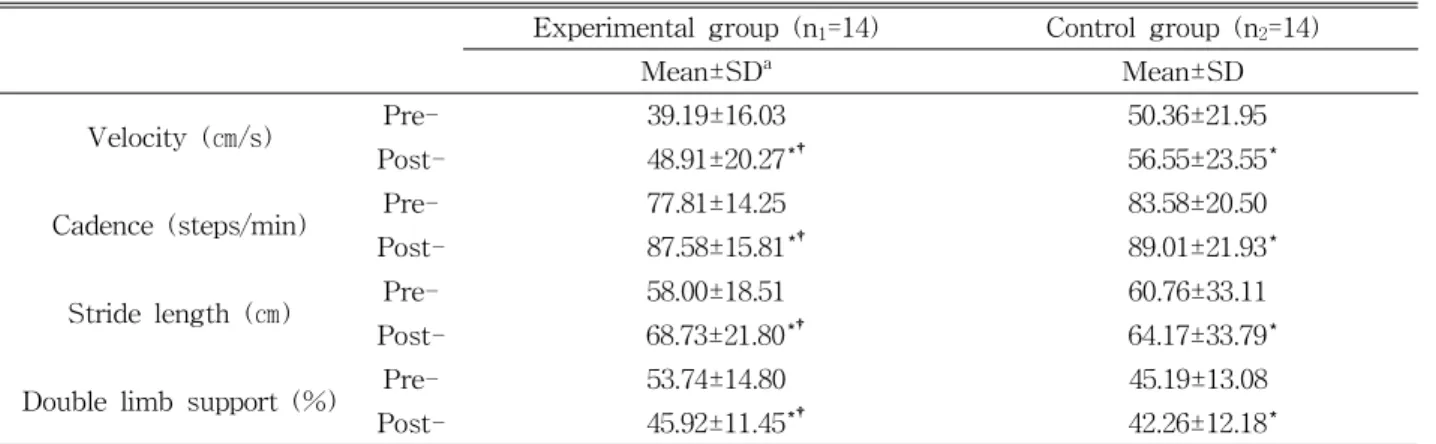
In the within-group comparisons, both groups showed significant differences in velocity and ca- dence before and after the experiment. In the be- tween-group comparison, however, the experimental

group showed more significant improvements in veloc- ity and cadence than did the control group (Table 2).

Changes in body center sway angle In the within-group comparisons, both groups Factor

Subjects (N=28)

Experimental group (n 1 =14)

Control group

(n 2 =14) X 2 /t p

Mean±SD a Mean±SD Mean±SD

Gender

Female/Male (%) 13/15 (46.4/53.6) 8/6 (51.7/42.9) 7/7 (50.0/50.0) .144 .705 Affected side

Left/Right (%) 15/13 (53.6/46.4) 6/8 (42.9/57.1) 9/5 (64.3/35.7) 1.292 .256 Type of stroke

Infarction/Hemorrhage (%) 14/14 (50.0/50.0) 8/6 (57.1/42.9) 6/8 (42.9/57.1) .571 .450

Age (year) 56.6±7.9 55.8±8.0 57.4±8.0 .544 .591

Duration b 8.6±2.1 8.3±2.3 8.9±1.9 .720 .478

Velocity (㎝/s) 44.8±19.7 39.2±16.0 50.4±22.0 1.539 .136

Cadence (steps/min) 80.7±17.6 77.8±14.3 83.6±20.5 .864 .396

Stride length (㎝) 59.4±26.4 58.0±18.5 60.8±33.1 .272 .788

Double limb support (%) 49.5±14.4 53.7±14.8 45.2±13.1 -1.618 .118

Δ x-theta (㎭) 31.4±10.8 34.4±12.0 28.4±8.8 -1.515 .142

Δ y-theta (㎭) 21.2±10.2 22.1±10.2 20.3±10.4 -.452 .655

Δ z-theta (㎭) 23.7±13.7 23.9±14.5 23.6±13.5 -.060 .952

TUG c (s) 30.6±6.8 28.6±3.6 32.5±8.6 1.583 .131

FGA d (score) 16.3±2.3 16.1±2.5 16.4±2.3 .240 .812

a mean±standard deviation, b months between stroke onset and assessment, c timed up-and-go test, d functional gait assessment.

Table 1. Homogeneity of the subjects

Experimental group (n 1 =14) Control group (n 2 =14)

Mean±SD a Mean±SD

Velocity (㎝/s) Pre- 39.19±16.03 50.36±21.95

Post- 48.91±20.27* 56.55±23.55*

Cadence (steps/min) Pre- 77.81±14.25 83.58±20.50

Post- 87.58±15.81* 89.01±21.93*

Stride length (㎝) Pre- 58.00±18.51 60.76±33.11

Post- 68.73±21.80* 64.17±33.79*

Double limb support (%) Pre- 53.74±14.80 45.19±13.08

Post- 45.92±11.45* 42.26±12.18*

a mean±standard deviation, *intragroup statistically significant at p<.05, intergroup statistically significant at p<.05.

Table 2. Changes in spatiotemporal gait

(6)

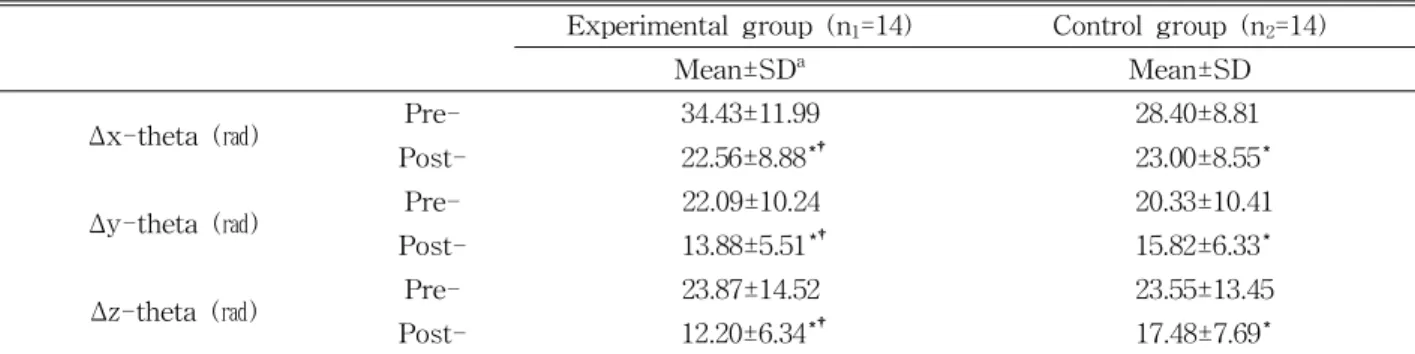
showed significant differences in all axes of the body center sway angles before and after the experiment.

In the between-group comparison, the experimental group showed more significant improvements in all axes of the body center sway angles than did the control group (Table 3).

Changes in walking capacity

In the within-group comparisons, both groups showed significant differences in TUG and FGA be- fore and after the experiment. In the between-group comparison, the experimental group showed more significant improvements in TUG and FGA than did the control group (Table 4).

Discussion

In the present study, RAS using music and a metronome was applied in stroke patients divided in- to an experimental group and a control group. The

effects of RAS on the two groups were compared.

The effects that improved gait after training in the individual groups were then compared. Our results suggest that the patients’ gait improved more in the experimental group. The specific findings of our study are as follows: First, the measurements of the temporal gait variables showed greater improvement after the experiment than before the experiment.

Intragroup velocity changes increased by 19.87% in the experimental group and by 10.94% in the control group. Cadence changes increased by 9.76±4.82 steps/min in the experimental group and by 5.44±3.74 steps/min in the control group. Therefore, as com- pared with the control group, the experimental group showed more significant increases in both variables.

This result is consistent with those reported by Schauer and Mauritz (2003), where velocity was im- proved when music exercise feedback gait training was applied five times per week in 23 stroke patients. Moreover, Kim (2007) reported that gait speed significantly increased when the music was Experimental group (n 1 =14) Control group (n 2 =14)

Mean±SD a Mean±SD

TUG b (s) Pre- 28.57±3.59 32.50±8.56

Post- 20.79±3.62* 25.36±5.36*

FGA c (score) Pre- 16.14±2.45 16.36±2.27

Post- 21.21±2.36* 19.36±2.90*

a mean±standard deviation, b timed up-and-go test, c functional gait assessment, *intragroup statistically significant at p<.05, intergroup statistically significant at p<.05.

Table 4. Changes in walking capacity

Experimental group (n 1 =14) Control group (n 2 =14)

Mean±SD a Mean±SD

Δ x-theta (㎭) Pre- 34.43±11.99 28.40±8.81

Post- 22.56±8.88* 23.00±8.55*

Δ y-theta (㎭) Pre- 22.09±10.24 20.33±10.41

Post- 13.88±5.51* 15.82±6.33*

Δ z-theta (㎭) Pre- 23.87±14.52 23.55±13.45

Post- 12.20±6.34* 17.48±7.69*

a mean±standard deviation, *intragroup statistically significant at p<.05, intergroup statistically significant at p<.05.

Table 3. Changes in body center sway angle

(7)

provided to healthy adults. These studies supported our finding that music contributed to the improve- ment of gait speed. Thaut et al (2007) indicated that compared with neurodevelopmental treatment, rhyth- mic stimulation using music led to greater improve- ment in stroke patients’ cadence. Iwanaga et al (2005) suggested that music inhibited para- sympathetic nerve system and facilitated the sym- pathetic nerve system, therefore festinating heart- beats and increasing blood flow, which contribute to the efficacy of physical movement. The results of these studies support our results that gait speed and cadence were improved. As auditory feedback not only adjusts muscle tone through the reticulospinal tract but also affects actions that are directly con- trolled by the neocortex, such as walking, velocity and cadence could increase because of the gradual increase in the speed of music and rhythms.

Furthermore, both groups showed significant differ- ences in the changes in stride lengths and double limb support, which are spatial gait variables. The experimental group showed significantly greater im- provement than the control group. Prassas et al (1997) reported that musical rhythms increased the step lengths of stroke patients. Similarly, consistent with our results, the results of the study by Schauer and Mauritz (2003) indicated that when RAS was applied in stroke patients for 20 minutes, double limb support decreased. However, contrary to the results of the present study, decreases in stride and step lengths were reported in a study by Roerdink et al (2007) where treadmill training and RAS were combined. The results of the study by Roerdink et al (2007) differed from those reported in the present study possibly because training in the former/latter study was implemented on flatland, as treadmills show a characteristic of producing shorter step lengths compared with flatland. Therefore, the de- creases in double limb support could have resulted from the quickened toe take-off of the paretic side and the shortened stance phase of the non-paretic side. Physical responses occur easily when dancing

or marching to music. Thus, spatial gait variables showed greater improvements in the experimental group.

Both groups showed significant decreases in body center sway angles around the X-, Y-, and Z-axes.

Our results are consistent with those of a study in- dicating that when RAS was applied to stroke pa- tients, pelvic stability and trunk sway decreased, thus shortening gait time (Malcolm et al, 2009).

Musical rhythms play the role of a promoter to lead irregular movements to harmonious activities and ac- tivate the limbic system in order to increase changes in emotions and to ensure the continuity of movements. That is, musical rhythms maintained the rhythmicalness of movements as a timekeeper, there- by reducing the body center sways.

In addition, both groups showed a significant in- crease in TUG and FGA. Similar to the measure- ment results reported in the present study, the aver- age TUG of stroke patients reported in previous studies was 22.6 seconds. FGA was reported to be 13.86 points (Ng and Hui-Chan, 2005; Thieme et al, 2009). However, contrary to the results of the pres- ent study, in a study conducted by Hayden et al (2009) where stroke patients were divided into 3 groups and musical rhythmic auditory gait training was implemented 10, 20, and 30 times, respectively, the groups showed no improvement in TUG. The reason underlying this divergence in the results can be the fact that unlike in the previous study where the amount of training increased, speeds were changed in the present study. The improvements in TUG and FGA are considered to have resulted from the improvement of the stroke patients’ cadence, stride lengths, and double limb support.

Musical rhythms improves the interactions be-

tween the brain and muscles because auditory stim-

ulation is transmitted to the cerebral cortex through

the supraspinal auditory system. Musical rhythms

draw unconscious responses and positively affect

sensory and instinctive movement control (Peterson

and Thaut, 2007; Thaut et al, 1997). Edworthy and

(8)

Waring (2006) reported that fast and loud music op- timally improved exercise capacity. Copeland and Franks (1991) suggested that slow and smooth music improved endurance, and physical and emotional stabilities. Preferred music decreased stress by fa- tigue when exercising physical performance (Yamashita et al, 2006). In former studies, walking with and without music affected gait parameters and physical functions, and RAS is thought to have brought about gait improvement based on this neu- rological mechanism. Our results suggest that graded increasing speed affected gait speed, and RAS with preferred music maximized the effect on gait ability.

Further studies are needed on RAS with preferred music as additional programs in gait training of stroke patients.

One limitation of this study was that it did not consider various contexts of walking in stroke pa- tients because the experiments were performed in a special room that is not interrupted by any noise or other factors. In addition, the music was used for rhythm and sound in training session. Thus, we could not consider various beats and songs. Further study is needed to investigate the effects of various songs or beats of music as RAS on gait ability. The results of the present study should be further sub- stantiated in clinical studies. We expect that RAS using music will be effectively used in training for gait improvement.

Conclusion

This study demonstrate that stroke patients can successfully apply music with RAS, and that im- provements in velocity, cadence, stride length, and double limb support, 3 axes body center sway an- gles, TUG and FGA support can be achieved when this device is provided in combination with music and gait exercise using rhythmic sensation or other treatment intervention and interdisciplinary rehabilitation.

References

Asanuma H, Keller A. Neuronal mechanisms of mo- tor learning in mammals. Neuroreport. 1991;2(5):

217-224.

Beer AL, Röder B. Attending to visual or auditory motion affects perception within and across mo- dalities: An event-related potential study. Eur J Neurosci. 2005;21(4):1116-1130.

Büetefisch C, Hummelsheim H, Denzler P, et al.

Repetitive training of isolated movements im- proves the outcome of motor rehabilitation of the centrally paretic hand. J Neurol Sci. 1995;

130(1):59-68.

Cha YA. Rhythm, Music and the Brain: Scientific foundation and clinical application. Seoul, Hakjisa, 2009:39-60.

Cho NJ. The effects of visual and auditory rhythmic stimulation balance and gait in patients with stroke. Jeollabuk-do, Seonam University, Doctoral Dissertation. 2010.

Copeland BL, Franks BD. Effects of types and in- tensities of background music on treadmill endurance. J Sports Med Phys Fitness. 1991;31 (1):100-103.

Dobkin BH, Xu X, Batalin M, et al. Reliability and validity of bilateral ankle accelerometer algo- rithms for activity recognition and walking speed after stroke. Stroke. 2011;42(8):2246-2250.

http://dx.doi.org/10.1161/STROKEAHA.110.611095 Edworthy J, Waring H. The effect of music tempo and loudness level on treadmill exercise.

Ergonomics. 2006;49(15):1597-1610.

Eich HJ, Mach H, Werner C, et al. Aerobic treadmill plus bobath walking training improves walking in subacute stroke: A randomized controlled trial. Clin Rehabil. 2004;18(6):640-651.

Eimer M. Crossmodal links in spatial attention be- tween vision, audition, and touch: Evidence from event-related brain potentials. Neuropsychologia.

2001;39(12):1292-1303.

Ford MP, Wagenaar RC, Newell KM. The effects of

(9)

auditory rhythms and instruction on walking patterns in individuals post stroke. Gait Posture.

2007;26(1):150-155.

Hayden R, Clair AA, Johnson G, et al. The effect of rhythmic auditory stimulation (RAS) on physical therapy outcomes for patients in gait training following stroke: A feasibility study. Int J Neurosci. 2009;119(12):2183-2195. http://dx.doi.org/

10.3109/00207450903152609

Horenstein C, Lowe MJ, Koenig KA, et al.

Comparison of unilateral and bilateral complex finger tapping-related activation in premotor and primary motor cortex. Hum Brain Mapp. 2009;30 (4):1397-1412. http://dx.doi.org/10.1002/hbm.20610 Iwanaga M, Kobayashi A, Kawasaki C. Heart rate

variability with repetitive exposure to music.

Biol Psychol. 2005;70(1):61-66.

Jeong S, Kim MT. Effects of a theory-driven music and movement program for stroke survivors in a community setting. Appl Nurs Res. 2007;20(3):

125-131.

Kadivar Z, Corcos DM, Foto J, et al. Effect of step training and rhythmic auditory stimulation on functional performance in parkinson patients.

Neurorehabil Neural Repair. 2011;25(7):626-635.

http://dx.doi.org/10.1177/1545968311401627

Kerrigan DC, Bang MS, Burke DT. An algorithm to assess stiff-legged gait in traumatic brain injury. J Head Trauma Rehabil. 1999;14(2):

136-145.

Kim JH. The impact that presence of music and tem- po weigh in walk-pattern when walking freely.

Seoul, Kookmin University, Master Thesis. 2007.

Kuys SS, Brauer SG, Ada L. Test-retest reliability of the gaitrite system in people with stroke un- dergoing rehabilitation. Disabil Rehabil. 2011;

33(19-20):1848-1853. http://dx.doi.org/10.3109/096 38288.2010.549895

Malcolm MP, Massie C, Thaut M. Rhythmic audi- tory-motor entrainment improves hemiparetic arm kinematics during reaching movements: A pilot study. Top Stroke Rehabil. 2009;16(1):69-79.

http://dx.doi.org/10.1310/tsr1601-69

Mansfield A, Danells CJ, Zettel JL, et al.

Determinants and consequences for standing balance of spontaneous weight-bearing on the paretic side among individuals with chronic stroke. Gait Posture. 2013;38(3):428-432. http://

dx.doi.org/10.1016/j.gaitpost.2013.01.005

Marigold DS, Eng JJ. The relationship of asymmetric weight-bearing with postural sway and visual reliance in stroke. Gait Posture. 2006;23(2):

249-255.

Mazza V, Turatto M, Rossi M, et al. How automatic are audiovisual links in exogenous spatial atten- tion? Neuropsychologia. 2007;45(3):514-522.

McDonough AL, Batavia M, Chen FC, et al. The validity and reliability of the gaitrite system’s measurement: A preliminary evaluation. Arch Phys Med Rehabil. 2001;82(3):419-425.

McFadyen BJ, Hegeman J, Duysens J. Dual task ef- fects for asymmetric stepping on a split-belt treadmill. Gait Posture. 2009;30(3):340-344. http://

dx.doi.org/10.1016/j.gaitpost.2009.06.004

Michel JA, Mateer CA. Attention rehabilitation fol- lowing stroke and traumatic brain injury. A review. Eura Medicophys. 2006;42(1):59-67.

Mirelman A, Patritti BL, Bonato P, et al. Effects of virtual reality training on gait biomechanics of individuals post-stroke. Gait Posture. 2010;31(4):

433-437. http://dx.doi.org/10.1016/j.gaitpost.2010.

01.016

Moon SJ, Kim YW, Kim TH. The effects of balance training with visual cue deprivation on gait function in patients with stoke. J Korean Soc Phys Med. 2012;7(4):411-421.

Ng SS, Hui-Chan CW. The timed up & go test: Its reliability and association with lower-limb im- pairments and locomotor capacities in people with chronic stroke. Arch Phys Med Rehabil.

2005;86(8):1641-1647.

Pelton TA, Johannsen L, Huiya Chen, et al.

Hemiparetic stepping to the beat: Asymmetric

response to metronome phase shift during tread-

(10)

mill gait. Neurorehabil Neural Repair.

2010;24(5):428-434. http://dx.doi.org/10.1177/15459 68309353608

Peterson DA, Thaut MH. Music increase frontal EEG coherence during verbal learning. Neurosci Lett.

2007;412(3):217-221.

Podsiadlo D, Richardson S. The timed “up & go”: A test basic functional mobility for frail elderly person. J Am Geriatr Soc. 1991;39(2):142-148.

Poynter B, Shuman M, Diaz-Granados N, et al. Sex differences in the prevalence of post-stroke de- pression: A systematic review. Psychosomatics.

2009;50(6):563-569. http://dx.doi.org/10.1176/appi.

psy.50.6.563

Prassas S, Thaut M, McIntosh G, et al. Effects of auditory rhythmic cuing on gait kinematic pa- rameters of stroke patients. Gait Posture. 1997;6 (3):218-223.

Roerdink M, Lamoth CJ, Kwakkel G, et al. Gait co- ordination after stroke: Benefits of acoustically paced treadmill walking. Phys Ther. 2007;87(8):

1009-1022.

Schauer M, Mauritz KH. Musical motor feedback (MMF) in walking hemiparetic stroke patients:

Randomized trials of gait improvement. Clin Rehabil. 2003;17(7):713-722.

Smyth MM, Wing AM. The Psychology of Human Movement. London, Academic Press, 1984:

163-169.

Thaut MH. Neural basis of rhythmic timing net- works in the human brain. Ann N Y Acad Sci.

2003;999:364-373.

Thaut MH, Leins AK, Rice RR, et al. Rhythmic au- ditory stimulation improves gait more than

NDT/bobath training in near-ambulatory pa- tients early poststroke: A single-blind, random- ized trial. Neurorehabil Neural Repair. 2007;21 (5):455-459.

Thaut MH, McIntosh GC, Rice RR. Rhythmic facili- tation of gait training in hemiparetic stroke rehabilitation. J Neurol Sci. 1997;151(2):207-212.

Thieme H, Ritschel C, Zange C. Reliability and val- idity of the functional gait assessment (german version) in subacute stroke patients. Arch Phys Med Rehabil. 2009;90(9):1565-1570.

Tuck K. Tilt sensing using linear accelerometers [Internet]. Arizona, 2007 June 2 [Cited 2014 Dec 14]. Available from: http://www.thierry-leqeun.

fr/data/AN3461.pdf

van Uden CJ, Besser MP. Test-retest reliability of temporal and spatial gait characteristics meas- ured with an instrumented walkway system (gaitrite). BMC Musculoskelet Disord. 2004;5:13.

Yamashita S, Iwai K, Akimoto T, et al. Effects of music during exercise on RPE, heart rate and the autonomic nervous system. J Sports Med Phys Fitness. 2006;46(3):425-430.

Yang YR, Chen YC, Lee CS, et al. Dual-task-related gait changes in individuals with stroke. Gait Posture. 2007a;25(2):185-190.

Yang YR, Wang RY, Chen YC, et al. Dual-task ex- ercise improves walking ability in chronic stroke: A randomized controlled trial. Arch Phys Med Rehabil. 2007b;88(10):1236-1240.

This article was received May 18, 2015, was re-

viewed May 19, 2015, and was accepted August

26, 2015.

수치

Table  2.  Changes in spatiotemporal gait
Table  4.  Changes in walking capacity

참조

관련 문서

Purpose: The aim of the investigation was to identify the effects of purposeful activities combined with music on upper extremity function, motivation, and mood in

리듬청각자극 제공 에 따른 트레드밀 보행훈련은 뇌졸중 환자의 보행변수 향 상에 영향을 미칠 수 있지만 제공되는 리듬청각자극에 즉 각적으로 반응하는 것에 제한이

The Effects of Action Observational Physical Training with Rhythmic Auditory Stimulation on Muscle Activity of the Lower Extremity and Gait Ability in Patients with Chronic

Effects of Somatosensory Stimulation Therapy on Upper Limb Sensory and Function and Self-Esteem of Stroke Patients.. Lee Jiyung, OT 1 ․ Choi Wonho,