Introduction
Cerebral palsy (CP) is a permanent neurological disorder resulting from damage to brain regions that control posture, movement, and balance, following abnormal development (prenatal) or injury to the de- veloping brain (perinatal) (Rosenbaum et al, 2007).
Neuromuscular deficits observed in children with CP include impaired motor control, disturbances of sen- sation, perception, cognition, and musculoskeletal problems (Rosenbaum et al, 2007; Shumway-Cook et al, 2003). In addition, lack of balance control and im- paired movement and postural control disturb a child’s right reaction, therefore increasing the risk of falling. Consequently, children with CP suffer from
functional limitations and altered daily life activities (Franjoine et al, 2003; van der Heide et al, 2004).
Indeed, falls are the leading cause of functional disability in patient with neurological disorders.
Fall-related injuries such as fractures, muscle injury and traumatic brain injury hinder independent activ- ity and alter quality of life (Fortinsky et al, 2008;
Legters, 2002). However, falls may be prevented if the risk factors, such as balance dysfunction, are di- agnosed through early assessment and treatment plans designed to decrease the risk of falling are fol- lowed (Hernandez and Rose, 2008; Tinetti et al, 1994). For this purpose, a reliable and valid assess- ment is needed to evaluate balance dysfunction and to identify the risk of falling. The validation of such
Corresponding author: Gyoung-mo Kim [email protected]
This work was supported by the Baekseok University Faculty Research Grant of 2016.
Comparison of the Pediatric Balance Scale and Fullerton Advanced Balance Scale for Predicting Falls in Children With Cerebral Palsy
Gyoung-mo Kim, PhD, PT
Dept. of Physical Therapy, Division of Health Science, Baekseok University
Abstract 1)
Background: The Pediatric Balance Scale (PBS) and the Fullerton Advanced Balance (FAB) scale were used to assess balance function in patients with balance problem. These multidimensional clinical balance scales provide information about potential risk factors for falls.
Objects: The purpose of this study was to investigate and compare the predictive properties of the PBS and FAB scales relative to fall risk in children with cerebral palsy (CP) using a receiver operating characteristic analysis.
Methods: In total, 49 children with CP (boy=21, girl=28) who were diagnosed with level 1 or 2 according to the Gross Motor Function Classification System participated in this study. The PBS and FAB were performed, and verified cut-off score, sensitivity, specificity, and the area of under the curve (AUC).
Results: In this study, the PBS scale was as a predictive measure of fall risk, but the FAB was not significant in children with CP. A cut-off score of 45.5 points provided optimal sensitivity of .90 and specificity of .69 on the PBS, and a cut-off score of 21.5 points provided optimal sensitivity of .90 and specificity of .62 on the FAB. Both scales showed moderately accurate of AUC with .79 and .76, respectively.
Conclusion: The PBS is a useful screening tool for predicting fall risk in children with cerebral palsy, and those who score 45.5 or lower indicate a high risk for falls and are in need of balance intervention.
Key Words: Cerebral palsy, Fullerton advanced balance scale; Pediatric balance scale; Receiver
operating characteristics.
assessment is additionally important to evaluate im- provement in balance following treatment and to pre- dict the prognosis of patients in clinical settings (Franjoine et al, 2003; Hernandez and Rose, 2008).
Clinical balance scales are effective assessment tools to evaluate various dimensions of postural con- trol, such as static or dynamic postural control as well as feedforward and feedback postural control (Schlenstedt et al, 2016). Particularly, multidimen- sional clinical balance scales have the advantage of providing a detailed description of symptoms and in- formation about potential risk factors for falls that could be used to justify and plan the treatment (Li et al, 2012; Smania et al, 2010).
For a long time, the Pediatric Balance Scale (PBS), a modified version of the Berg Balance Scale (BBS), has been reliably used to assess balance in children with CP, delayed development, and other neurological disorders (Darr et al, 2015; Verbecque et al, 2015). Specifically, the PBS allows evaluation of balance dysfunction in a time dependent manner, in- cluding changes with age and treatment (Darr et al, 2015; Franjoine et al, 2003). Because PBS is easy to use and requires minimal equipment, it has been widely applied and therefore, translated into at least nine different languages (Darr et al, 2015). However, the PBS has several limitations. First, it does not include items that assess dysfunction of the multi- ple sensory systems such as the visual and ves- tibular systems associated with balance function dur- ing gait. Second, it is not suitable for assessing bal- ance in a higher functioning children aged over 6 years due to a ceiling effect (Franjoine et al, 2003;
Franjoine et al, 2010).
Recently, the Fullerton Advanced Balance (FAB) scale has been validated and compared with the ex- isting balance assessment tools, such as BBS, to as- sess postural control in patients with neurological disorders (Schlenstedt et al, 2016). The FAB scale is a performance-based measure that was developed to identify the subtle changes in balance and compre- hensively approach the multiple dimensions of bal-
ance (Rose et al, 2006). It includes items that are specifically designed to assess the balance abilities in higher functioning individuals and to assess the mul- tiple dimensions of balance including both static and dynamic environments, and reactive postural control (Boulgarides et al, 2003; Brauer et al, 2000).
Sensitivity and specificity are the main measures used for evaluation of test accuracy in the diagnostic test with dichotomous outcome evaluation (Swets, 1979). Generally, sensitivity is the proportion of cor- rectly classified cases among all of those that are truly positive, and specificity is the proportion of correctly classified cases among all of those that are truly negative (Eng, 2005). The sensitivity and spe- cificity vary across the different threshold, and the sensitivity is inversely related with specificity. The plot of sensitivity versus (1-specificity) is called a receiver operating characteristic (ROC) curve. The area under the ROC curve (AUC), has been consid- ered an effective measure of accuracy with mean- ingful interpretations. This curve plays a central role in evaluating diagnostic ability of tests to dis- criminate the true state of subjects, finding the op- timal cut off values, and comparing two alternative diagnostic tasks when each task is performed on the same subject (Hajian-Tilaki, 2013; Hanley and McNeil, 1982).
Several studies have been conducted to assess balance function, and the reliability and validity of the Korean version of PBS (KPBS) has been veri- fied (Ko et al, 2008; Lim, 2016). However, to date, no studies that verify the prospective use of KPBS to assess falls have been conducted. Although, the FAB is able to predict recurrent fallers from non-recurrent fallers with a sensitivity and specific- ity in healthy older adults, it remains unclear whether this scale is appropriate to predict falls in children with CP (Hernandez and Rose, 2008;
Schlenstedt et al, 2016).
The purpose of the this study was to investigate
and compare the predictive properties of PBS and
FAB scales relative to fall risk in children with CP.
Methods
Participants
Forty-nine children (boy=21, girl=28) with CP par- ticipated in this study. All participants met the in- clusion criteria of being clinically diagnosed with level 1 or 2 according to the Gross Motor Function Classification System. In this system, level 1 in- dicates that the child is able to climb stairs without the use of a railing, and level 2 indicates that the child is able to walk with physical assistance or use handheld mobility devices (Rosenbaum et al, 2002).
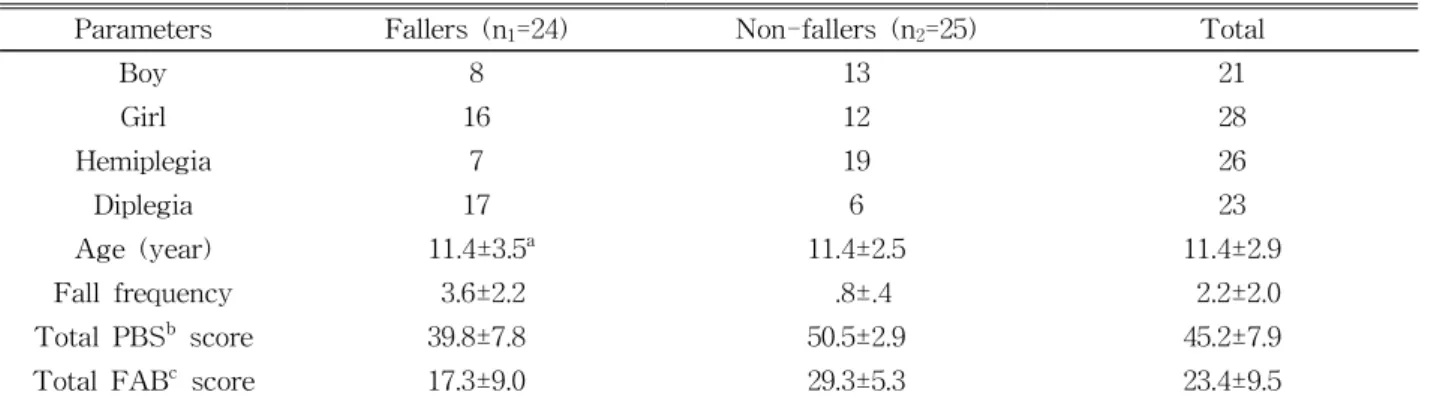
Children were excluded from the study if they met any of the following criteria: (1) a history of any or- thopedic injuries within the previous three months, (2) any medical conditions that resulted in activity restriction, and (3) a history of any uncontrolled seizures within the previous six months. The general characteristics of the participants are presented in Table 1.
Procedures
Prior to initiation of the study, parents or guard- ians of all participants were sufficiently informed re- garding the research purposes and procedures. They agreed to the publishing of their study data, and signed informed consent forms. All participants com- pleted a general characteristics questionnaire doc- umenting their medical history, sex, age, and fall
frequency. The participants were assessed randomly to evaluate their balance ability using the PBS and FAB scales. Any criterion that was duplicated be- tween the PBS and FAB scales was performed only once, and scored on each scale to minimize learning effect and fatigue. Fall history was recorded by ask- ing the participants how often they had fallen during the last six months, and two or more falls were re- garded as a positive fall history (Shumway-Cook et al, 2000). A fall was defined as any event that led to an unplanned, unexpected contact with a supporting surface. Falls resulting from unavoidable environ- mental hazards, such as a chair collapsing, were ex- cluded (Shumway-Cook et al, 1997; Shumway-Cook et al, 2000).
Instruments
The PBS was developed as a modified version of the BBS to identify balance dysfunction in school-age children with motor deficits. It consists of 14 items; sitting to standing (item 1), standing to sitting (item 2), transfers (item 3), standing un- supported (item 4), sitting unsupported (item 5), standing with eyes closed (item 6), standing with feet together (item 7), standing with one foot in front (item 8), standing on one foot (item 9), turning 360 degrees (item 10), turning to look behind (item 11), retrieving object from floor (item 12), placing al- ternate foot on stool (item 13), reaching forward with
Parameters Fallers (n
1=24) Non-fallers (n
2=25) Total
Boy 8 13 21
Girl 16 12 28
Hemiplegia 7 19 26
Diplegia 17 6 23
Age (year) 11.4±3.5
a11.4±2.5 11.4±2.9
Fall frequency 3.6±2.2 .8±.4 2.2±2.0
Total PBS
bscore 39.8±7.8 50.5±2.9 45.2±7.9
Total FAB
cscore 17.3±9.0 29.3±5.3 23.4±9.5
a
mean±standard deviation,
bpediatric balance scale,
cFullerton advanced balance scale.
Table 1. Demographic characteristics of the participants (N=49)
outstretched arm (item 14). In PBS, the concept of functional balance is defined that the ability of a child to gain and maintain upright posture control during childhood activities of daily living, school, and play. Each item is scored on a 5-point scale (range 0∼4) with specific qualitative and quantitative scor- ing criteria. The total score can range from 0 to 56, and a lower score indicates greater balance disability.
The PBS has a high test-retest reliability [Intra-class correlation coefficient (ICC)=.998] and in- ter-rater reliability (ICC=.997) (Darr et al, 2015;
Franjoine et al, 2003).
The FAB, multi-item balance assessment tool, was initially developed to assess postural control in high- er functioning individuals. It consisted of 10 items;
standing with feet together and eyes closed (item 1), reaching forward to retrieve an object (item 2), turn- ing in a circle (item 3), stepping up and over a bench (item 4), tandem walking (item 5), standing on one leg (item 6), standing on foam with eyes closed (item 7), jumping for distance (item 8), walking with head turns (item 9), and recovering from an un- expected loss of balance (item 10). Each item is scored on a 5-point Likert scale (range 0∼4), with 0 indicating that the person is unable to perform and 4 indicating the highest performance level. The total score ranges from 0 to 40, a score 25 or lower in- dicates a high risk of falling. The FAB scale has al- so a high test-retest reliability (r=.96), and in- ter-rater reliability (r=.91∼.95). Moreover, it corre- lates with the BBS (r=.75, p<.001) (Hernandez and Rose, 2008; Klein et al, 2011; Rose et al, 2006).
Statistical analysis
For statistical analysis, SPSS ver 18.0 (SPSS Inc.,
Chicago, IL, USA) was used. Two statistical meas- ures were used to examine the fall risk predictive properties of the PBS and FAB scales. First, a bina- ry logistic regression analysis was performed on the basis of the total PBS and FAB scores, to inves- tigate a predictive model for fall risk. Second, an ROC analysis was conducted for each balance scale to determine the cut-off score that provides the opti- mal level of sensitivity and specificity.
Results
Predicted probability of falling as a function of the PBS and FAB scale
The results of the binary regression analysis showed that a test of the full model was sig- nificantly reliable (N=49, χ
2=34.88, p<.001), and in- dicated the total PBS score was predictive of fall risk. The Hosmer-Lemeshow test, which is used to formally evaluate the goodness-of-fit for logistic re- gression models, was not statistically significant (p=.99), indicating that the assessed model was good.
The overall prediction success rate was 79.6% (Table 2). The total PBS was significant as a predictive variable for evaluating fall risk (p<.05) while the to- tal FAB score was not (Table 3).
Predictive values for the PBS and FAB scales
The PBS and FAB scales showed comparable ac- curacy identifying fallers with two or more falls ver- sus non-fallers, with an AUC of .79 and .76, re- spectively (Figure 1). In the PBS, a cut-off score of 45.5 points provided optimal sensitivity of .90 and
Observed Predicted
Faller Non-faller Percentage correct (%)
Faller 20 5 80.0
Non-faller 5 19 79.2
Overall percentage 79.6
Table 2. Frequencies of test outcome for faller and non-faller
specificity of .69. In the FAB scale, a cut-off score of 21.5 points provided optimal sensitivity of 0.90 and specificity of .62 (Table 4).
Discussion
The objective of the present study was to inves- tigate the predictive properties of PBS and FAB rel- ative to faller status in children with CP. For that, an ROC analysis was used to decide whether total PBS and FAB cut-off scores produced the optimal level of sensitivity and specificity. The basic as-
sumption of ROC analysis is that a diagnostic varia- ble is utilized to discriminate between two mutually exclusive states of tested participants. The diagnostic sensitivity and specificity are a function of the se- lected cut-off value. An ROC analysis assesses the diagnostic performance of the system in terms of sensitivity and (1-specificity) for each possible cut-off value of the test (Greiner et al, 2000). The AUC is a summary statistic of diagnostic accuracy.
Swets (1988) proposed the arbitrary guideline to dis- tinguish between non-informative (AUC<.5), less accurate (.5<AUC<.7), moderately accurate (.7
<AUC<.9), highly accurate (.9<AUC<1) and per- fect tests (AUC=1).
The binary logistic regression analysis indicated that the PBS is a predictive measure of faller status in children with CP. Specifically, whenever the total PBS score increase by one point, the probability of children with CP who were classified as a non-fall- ing group increased 1.79. The AUC value of .79 and the optimal cut-off score of 45.5-points of the PBS provides optimal sensitivity and specificity on the PBS, with a good level of sensitivity (90%) but poor level of specificity (67%). This is in contrast with a previous study reporting a cut-off score from 23.3-points (age of 2 years 4 months) to 54.6-point (age of 13 years 7 months) in typically developing children (Franjoine et al, 2010). The higher PBS cut-off score may be because the participants in the
B S.E Wald df p Exp (B)
Total PBS
ascore .59 .25 5.65 1 .02* 1.79
Total FAB
bscore -.56 .11 .27 1 .61 .95
Constant -26.02 9.76 7.10 1 <.001 .00
a
pediatric balance scale,
bFullerton advanced balance scale, *p<.05.
Table 3. Predicted probability of falling as a function of total PBS and FAB scores
Test AUC
aCut-off score Sensitivity Specificity
PBS
b.79 ≤45.5/56 .90 .69
FAB
c.76 ≤21.5/40 .90 .62
a