EMG Activities of Trunk and Lower Extremity Muscles Induced by Different Intensity of Whole Body Vibration During Bridging Exercise
Tack-hoon Kim, Ph.D., P.T.
Houng-sik Choi, Ph.D., P.T.
Dept. of Physical Therapy, Hanseo University
Abstract
1)The purpose of this study was to investigate the trunk and lower extremity muscle activity induced by three different intensity conditions (intensity 1, 3, 5) of whole body vibration (WBV) during bridging exercise. Surface electromyography (EMG) was used to measure trunk and lower extremity muscles activity. Eleven healthy young subjects (6 males, 5 females) were recruited from university students. The collected EMG data were normalized using reference contraction (no vibration during bridging) and ex- pressed as a percentage of reference voluntary contraction. To analyze the differences in EMG data, the repeated one-way analysis of variance was used. A Bonferroni's correction was used for multiple comparisons. The study showed that EMG activity of the rectus abdominis, external oblique, internal ob- lique, erector spinae and rectus femoris muscles was not significantly different among three intensity conditions of WBV during bridging exercise (p>.05). However, there were significantly increased EMG activity of the medial hamstring muscle (p=.001) and medial gastrocnemius muscle (p=.027) in the in- tensity 3 condition compared with the intensity 1 condition This result can be interpreted that vibration was absorbed through the distal muscles, plantar flexor and knee flexor.
Key Words: Bridging exercise; Electromyography; Vibration intensity; Whole body vibration.
Introduction
Trunk muscle co-activation is considered necessary in achieving adequate spinal stability to prevent and treat low back injury (Axler and McGill, 1997).
Vera-Garcia et al (2000) reported that performing curl-ups on a labile surface changed the muscle ac- tivity amplitude required to perform the movement.
Trunk bridging exercises are often used as therapeutic exercises for lumbopelvic stabilization. Lehman et al (2005) suggested that performing bridging exercise on a Swiss ball rather than the ground resulted in in- creases in trunk muscle activity. During three bridg- ing exercises (single bridging, ball bridging and uni- lateral bridging), the ratio of the internal oblique to the rectus abdominis was high due to relatively de- creased activity of the rectus abdominis (Stevens et
al, 2006). Stevens et al (2007) reported that local in- ternal oblique abdominal muscle was increased on both sides during bridging exercises and after training the activity of the rectus abdominis was significantly higher during the symmetric bridging exercises.
The vibration exercise platform, which vibrates between 1 and 50 ㎐, was originally developed by biomechanical engineer in Europe for use in the space program to prevent bone density changes in astronauts. Recently, whole body vibration (WBV) has emerged as an alternative strength training in- tervention, with gains reported to be comparable to resistive training in young adults who were healthy (Delecluse et al, 2003). WBV training might poten- tially be useful to enhance balance. The subject per- forms exercises on a platform that generates vertical sinusoidal vibrations. The mechanical stimuli are Corresponding author: Houng-sik Choi [email protected]
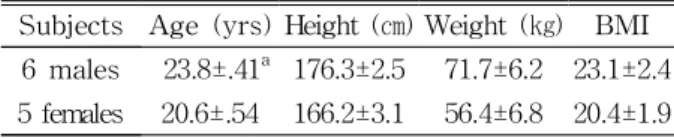
Subjects Age (yrs) Height (㎝) Weight (㎏) BMI 6 males 23.8±.41a 176.3±2.5 71.7±6.2 23.1±2.4 5 females 20.6±.54 166.2±3.1 56.4±6.8 20.4±1.9
aMean±SD.
Table 1. Characteristics of the subjects (N=11) transmitted to the body where they stimulate the
primary endings of the muscle spindles which in turn activate alpha-motor neuron resulting in muscle contraction (Burke and Schiller, 1976; Hagbarth and Eklund, 1966). Previous studies have shown that WBV has been promoted as a strength training in- tervention because it could increase motor activity of the lower limbs through reflex-induced muscle con- traction (Cardinale and Lim, 2003; Roelants et al, 2006). In most cases, vibration has been shown to positively influence maximal strength and force out- put (Bosco et al, 1999; Warman et al, 2002), power output (Bosco et al, 1998; 1999; 2000). WBV was re- ported to improve vertical jump height (Cochrane and Stannard 2005; Torvinen et al, 2002) and muscular contractile properties (van den Tillaar, 2006) in healthy young subjects as well as to increase strength in the elderly (Roelants et al, 2004; Roelants et al, 2006; Verschueren et al, 2004). Additionally, WBV was shown to positively influence the postural control and mobility in multiple sclerosis (Schuhfried et al, 2005) and unilateral chronic stroke patients (van Nes et al, 2004). Cheung et al (2007) reported that despite the benefits on muscular performance, the efficacy of WBV on balancing ability is still uncertain which may be dependent of age and physical condition.
Trans et al (2009) show that the WBV exercise regime (25∼30 ㎐) on a stable platform yielded in- creased muscle strength, while the WBV exercise on a balance board showed improved proprioception. The WBV is time-saving and safe method for re- habilitation of women with knee osteoarthritis.
Fontana et al (2005) reported that WBV may induce improvements in lumbosacral repositioning accuracy when combined with a weight bearing exercise.
Incorporating vibration exercise into treatment needs to be developed with caution, as prolonged high frequency vibration is known to have detrimental effects on muscles, most particularly increasing fatigue (Bongiovanni et al, 1990), and causing, in some cir- cumstances, disturbances in proprioception (Brumagne et al, 1999; Ribot-Cisar et al, 1998; Rogers et al, 1985).
Harazin and Grezesik (1998) found that the vi- bration magnitudes being transmitted by the hip, shoulder and head decreased with an increase in fre- quency above 16∼20 ㎐. Crewther et al (2004) inves- tigated gravitational forces and WBV. Gravitational force associated with semi-squat (2.34 g) was sig- nificantly greater than the standing postures.
Significant damping was observed as the vibratory stimulation was transmitted to the proximal segment.
Findings were discussed in terms of safe, progressive and effective prescription of vibratory stimulation.
There are numerous studies on trunk stability ex- ercises on unstable surfaces using a Swill ball, and studies using a WBV were undertaken in standing or squat position. Study using a WBV during bridg- ing was not found in the literature and proper vi- bration intensity was not studied during bridging exercise. Therefore the effect of bridging exercise and vibration intensity using a WBV on trunk and lower extremity muscle activity during bridging was investigated in this study.
Methods Subjects
Eleven healthy young subjects (6 males, 5 fe- males) were recruited from Hanseo University in Korea. The subjects without intense physical activ- ities or muscle damages within two weeks before the beginning of the study participated. The subjects had a mean age of 22.4±1.7 years, a mean height of 171.7±5.9 ㎝, a mean weight of 64.7±10.0 ㎏, and a mean body mass index of 21.9±2.5 ㎏/㎡ (Table 1).
Before the study, the principal investigator explained all the procedures to the subjects in detail.
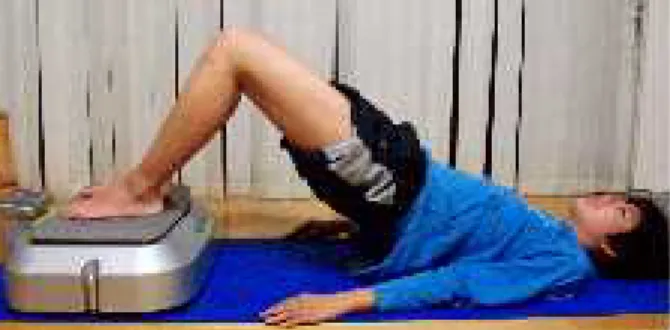
Figure 1. Supine bridging exercise on the WBV platform.
Surface Electromyographic Recording2)
We collected and amplified electromyographic data using a Biopac MP100A System1). The skin was prepared by shaving hair and rubbing the skin with an alcohol-water solution to decrease impedance.
Surface electrode pairs were placed in a bipolar con- figuration over the seven muscle sites, and distance between two electrodes were 2 ㎝. The seven sites on the dominant side were as follows: 1) the rectus abdominis (RA) muscle, 2 ㎝ lateral to the umbilicus, 2) the external oblique (EO) muscle, halfway be- tween the anterior superior iliac spine (ASIS) and the inferior border of the ribcage at a slightly obli- que angle running parallel with the underlying mus- cle fibers, 3) the internal oblique abdominal (IO) muscle, approximately 2 ㎝ medial and inferior to the right anterior superior iliac spine, 4) the erector spi- nae (ES) muscles placed half the distance between the greater trochanter and the sacral vertebrae in the middle of the muscle on an oblique angle at the level of the trochanter or slightly above, 5) the rectus femoris (RA) placed the anterior aspect of the thigh, midway between the superior border of the patella and the anterior superior iliac spine, 6) the medial hamstring muscle (MH), the midway on a line be- tween the medial epicondyle of the femur and the ischial tuberosity, and 7) the medial gastrocnemius (MG) muscle, one hand breadth below the popliteal crease on the medial mass of the calf (Cram et al, 1998; Perotto, 1996). The bandpass filter of 80∼250
㎐ was used, and data were converted to digital data at a sampling rate of 1000 ㎐. The EMG data was processed into the root mean square (RMS) using a windows of 300 ㎳ data points. For a normalization, reference contraction (no vibration during bridging) was used and EMG data were expressed as a per- centage of reference voluntary contraction (%RVC).
Whole Body Vibration (WBV)
Intensity for WBV consisted of 15 levels (15 level:
1,200 vibrations per minute). The maximal amplitude was 15.4 ㎜. In this study, stage 1, 3, and 5 was chosen for the experiment.
Procedures 3)
Subjects was positioned in lying supine on the floor with their feet on the WBV platform2), knees bent 90 degrees, toes facing forward and hands on the floor by their sides, palms facing down. Subjects lifted their pelvis off the ground and pushed through the feet to assume a bridging posture (Figure 1).
Feedback from instructor was given in order to ach- ieve a consistent trunk and lower limb posture during each 4 condition (0, 1, 3, 5 intensity). Subjects was aimed to keep their spines neutral position with their leg parallel to their trunk during bridging. EMG data were collected for 5 seconds during the isometric por- tion of each different intensity condition during bridg- ing posture with their feet on the WBV platform.
Three trials of each of these exercise were recorded.
Statistical Analysis
All data were expressed as the mean and standard deviation. To analyze the differences in EMG data, the repeated one-way analysis of variance was used.
A Bonferroni's correction was used for multiple comparisons. The analysis of data was performed using SPSS version 12.0 program and significant level set at α=.05.
1) MP100A-CE, Biopac System Inc., Goleta, CA, U.S.A.
2) BBSliner, SECO Inc, Bucheon, Korea.
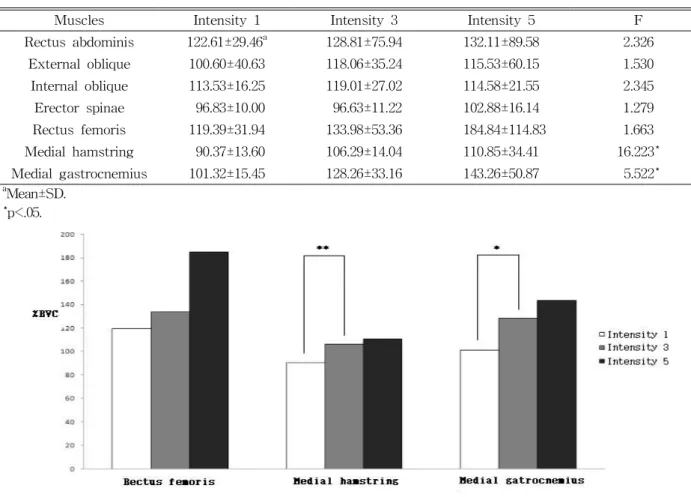
Figure 2. The %RVC data of the lower extremity muscles between different 3 intensity condition of WBV during bridging posture (*p<.05, **p<.01).
Muscles Intensity 1 Intensity 3 Intensity 5 F
Rectus abdominis 122.61±29.46a 128.81±75.94 132.11±89.58 2.326
External oblique 100.60±40.63 118.06±35.24 115.53±60.15 1.530
Internal oblique 113.53±16.25 119.01±27.02 114.58±21.55 2.345
Erector spinae 96.83±10.00 96.63±11.22 102.88±16.14 1.279
Rectus femoris 119.39±31.94 133.98±53.36 184.84±114.83 1.663
Medial hamstring 90.37±13.60 106.29±14.04 110.85±34.41 16.223*
Medial gastrocnemius 101.32±15.45 128.26±33.16 143.26±50.87 5.522*
aMean±SD.
*p<.05.
Table 2. Comparison of the %RVC of the muscles intensity induced on WBV during bridging exercise (N=11) Results
The study demonstrated that EMG activity of the RA, EO, IO, ES and RF muscles did not show sig- nificant difference among three different intensity conditions of WBV during bridging exercise (p>.05).
However, there were significantly increased EMG activity of the MH (p=.001) and MG (p=.027) in the intensity 3 condition compared with the intensity 1 condition (Table 2) (Figure 2).
Discussion
The study indicated that there were no significant differences in EMG activity of the RA, EO, IO, ES
and RF muscles between three intensity condition of WBV during bridging exercise (p>.05).
Stevens et al (2007) reported that IO muscle was increased on both sides during bridging exercises and after training, the activity of the RA was significantly higher during the symmetric bridging exercises.
However, those studies showed that EMG activity of the RA, IO, EO, and ES muscle were not significantly different between the bridging in supine position con- dition and ball bridging condition after training.
Lehman et al (2005) showed that EMG activity of the RA, EO, IO, and ES muscles were not significantly different during bridging between on the floor and on the ball. However, Kim (2009) reported that the IO, EO, and ES with feet on ball bridging and calf on ball bridging exercise showed significantly higher
muscle activity than the floor bridging exercise.
Lifting one leg in supine position requires cocon- traction between abdominal and trunk muscle and is used for trunk stabilizing exercise because it pre- vents trunk and pelvic rotation and maintains verte- bral neutral position (Barnett and Gilleard, 2005;
Hubley-Kozey and Vizina, 2002; O'Sullivan, 2000).
Trunk rotation is controlled by internal oblique, ex- ternal oblique, and transverse abdominals that runs obliquely or transversely than rectus abdominals that runs longitudinally (Hall and Brody, 1999; Neumann, 2002). This study utilized left-right vibration by WBV during bridging with both feet fixed. Therefore trunk rotation was less than one leg lifting so that no difference in trunk muscle activity was observed.
There were significantly increased EMG activity of the MH (p=.001) and MG (p=.027) in the intensity 3 than those in intensity 1 condition (Table2) (Figure 2). Rees et al (2008) suggested that average strength gains following eight weeks of WBV training were larger for ankle plantar flexors than for knee and hip flexors and extensors. WBV induced larger gains in ankle plantar flexor strength than in more proximal leg musculature. This result is in accordance with research findings of Blottner et al (2006) demonstrat- ing that vibration applied at the foot predominantly recruits the calf musculature to dampen the stimulus.
WBV can stimulate a number of muscle groups of the lower body at the same time. However, the muscle group closer to the vibration platform will attenuate more of the vibration stimulus than prox- imal muscles of the leg (Roelants et al, 2006).
Safety consideration is more important in vibration training than traditional training. This is because too strong vibrations would lead to various damaging ef- fects to the body, ranging from headache to internal bleeding or even death. Particular care should be tak- en for the head (Mester et al, 2005). High trans- mission factor to the head should always be avoided.
Thus, the frequencies used in vibration training should not be lower than 20 ㎐. Crewther et al (2004) sug- gested, in general, vibration should be applied with
frequencies of 25∼50 ㎐ and amplitude ranging from 1 to 10 ㎜, resulting in gravitational forces of 3∼7 g.
As vibration frequency increased during WBV in our study, the trunk muscle activity did not show significant differences. This result can be interpreted that vibration was absorbed through the distal mus- cles, plantar flexor and knee flexor.
In this study, the effect of stability exercise was investigated by inducing trunk instability with differ- ent vibration intensity during bridging. There was no significant trunk muscle activity difference with three different vibration intensity. However, MH and MG showed significant difference with increasing vi- bration intensity. As shown by Rees et al (2008), it was determined that distal muscles, especially plantar flexors was activated. Future studies are required using various vibration intensity and including trunk instability such as one leg lifting in bridging during WBV. Because muscle activity was measured only in dominant lower extremity, the change of muscle ac- tivity in non-dominant lower extremity was not determined. Muscle activity was collected for five second period so that muscle activity in one vi- bration cycle was not assessed. These limitations should be considered in future studies.
Conclusion
This study compared EMG activity of trunk and lower extremity muscles according to 3 different in- tensity conditions (1, 3, 5 intensity) of WBV during bridging. We found that EMG activity of the trunk muscles (RA, EO, IO, ES and RF) did not show significant differences among three intensity con- ditions of WBV during bridging exercise. However, there were significantly increased EMG activity of the lower extremity muscle (MH and MG) of the in- tensity 3 than those in intensity 1 condition. As vi- bration frequency decreased during WBV in our study, the trunk muscle activity did not show sig- nificant differences. This result can be interpreted
that vibration was absorbed through the distal mus- cles, plantar flexor and knee flexor. Future studies are required using various vibration intensity and in- cluding trunk instability such as one leg lifting in bridging during WBV.
References
Axler CT, McGill SM. Low back loads over a varie- ty of abdominal exercises: Searching for the safest abdominal challenge. Med Sci Sports Exerc. 1997 ;29(6):804-811.
Barnett F, Gilleard W. The use of lumbar spinal sta- bilization techniques during the performance of abdominal strengthening exercise variations. J Sports Med Phys Fitness. 2005;45(1):38-43.
Blottner D, Salanova M, Püttmann B, et al. Human skeletal muscle structure and function preserved by vibration muscle exercise following 55 days of bed rest. Eur J Appl Physiol. 2006;97(3):261-271.
Bongiovanni LG, Hagbarth KE, Stjernberg L.
Prolonged muscle vibration reducing motor out- put in maximal voluntary contractions in man. J Physiol. 1990;423:15-26.
Bosco C, Colli R, Cardinale M, et al. The effect of whole body vibration on mechanical behaviour of skeletal muscle and hormonal profile, IN:
Musculo-Skeletal Interations, 1998.
Bosco C, Cardinale M, Tsarpela O. Influence of vi- bration on mechanical power and electromyogram activity in human arm flexor muscles. Eur J Appl Physiol Occup Physiol. 1999;79(4):306-311.
Bosco C, Iacovelli M, Tsarpela O, et al. Hormonal responses to whole-body vibration in men. Eur J Appl Physiol. 2000;81(6):449-454.
Brumagne S, Lysens R, Swinnen S, et al. Effect of paraspinal muscle vibration on position sense of the lumbosacral spine. Spine. 1999;24(13):1328-1331.
Burke D, Schiller HH. Discharge pattern of single motor units in the tonic vibration reflex of hu- man triceps surae. J Neurol Neurosurg
Psychiatry. 1976;39(8):729-741.
Cardinale M, Lim J. Electromyography activity of vastus lateralis muscle during whole-body vi- brations of different frequencies. J Strength Cond Res. 2003;17(3):621-624.
Cheung WH, Mok HW, Qin L, et al. High-frequency whole-body vibration improves balancing ability in elderly women. Arch Phys Med Rehabil.
2007;88(7):852-857.
Cochrane DJ, Stannard SR. Acute whole body vi- bration training increases vertical jump and flex- ibility performance in elite female field hockey players. Br J Sports Med. 2005;39(11):860-865.
Cram JR, Kasman GS, Holtz J. Introduction to Surface Electromyography. Gaithersburg, An Aspen Pub, 1998.
Crewther B, Cronin J, Keogh J. Gravitional forces and whole body vibration: Implications for pre- scription of vibratory stimulation. Physical Therapy in sport. 2004;5(1):37-43.
Delecluse C, Roelants M, Verschueren S. Strength increase after whole-body vibration compared with resistance training. Med Sci Sports Exerc.
2003;35(6):1033-1041.
Fontana TL, Richardson CA, Stanton WR. The effect of weight-bearing exercise with low frequency, whole body vibration on lumbosacral proprio- ception: A pilot study on normal subjects. Aust J Physiother. 2005;51(4):259-263.
Hall CM, Brody LT. Therapeutic Exercise: Moving toward function. 1st ed. Philadelphia, Lippincott Williams and Wilkins, 1999.
Hagbarth KE, Eklund G. Tonic vibration reflexes (TVR) in spasticity. Brain Res. 1966;2(2):201-203.
Harazin B, Grzesik J. The transmittion of vertical whole-body vibration to the body segments of standing subjects. Journal of Sound and Vibration. 1998;215(4):775-787.
Hubley-Kozey CL, Vezina MJ. Muscle activation during exercises to improve trunk stability in men with low back pain. Arch Phys Med Rehabil. 2002;83(8):1100-1108.
This article was received October 2, 2009, and was accepted November 3, 2009.
Kim MJ. Effect of bridging stabilization exercise on trunk muscle activity on and off a Swiss ball.
Physical Therapy Korea. 2009;16(1):18-24.
Lehman GJ, Hoda W, Oliver S. Trunk muscle activ- ity during bridging exercises on and off a Swiss ball. Chiropr Osteopat. 2005;13:14.
Mester J, Kleinöder H, Yue Z. Vibration training:
Benefits and risks. J Biomech. 2006;39(6):1056-1065.
Neumann DA. Kinesiology of the Musculoskeletal System. 1st ed. St. Louis, Mosby, 2002.
O'Sullivan PB. Lumbar segmental 'instability':
Clinical presentation and specific stabilizing ex- ercise management. Man Ther. 2000;5(1):2-12.
Perotto A. Anatomical Guide for the Electromyo- grapher: The limbs and trunk. 3rd ed.
Springfield, Thomas, 1996.
Rees SS, Murphy AJ, Watsford ML. Effects of whole-body vibration exercise on low- er-extremity muscle strength and power in an older population: A randomized clinical trial.
Phys Ther. 2008;88(4):462-470.
Ribot-Ciscar E, Rossi-Durand C, Roll JP. Muscle spindle activity following muscle tendon vibration in man. Neurosci Lett. 1998;258(3):147-150.
Roelants M, Delecluse C, Verschueren SM.
Whole-body-vibration training increases knee-ex- tension strength and speed of movement in older women. J Am Geriatr Soc. 2004;52(6):901-908.
Roelants M, Verschueren SM, Delecluse C, et al.
Whole-body-vibration-induced increase in leg muscle activity during different squat exercises.
J Strength Cond Res. 2006;20(1):124-129.
Rogers DK, Bendrups AP, Lewis MM. Disturbed pro- prioception following a period of muscle vibration in humans. Neurosci Lett. 1985;57(2):147-152.
Schuhfried O, Mittermaier C, Jovanovic T, et al.
Effects of whole-body vibration in patients with multiple sclerosis: A pilot study. Clin Rehabil.
2005;19(8):834-842.
Stevens VK, Bouche KG, Mahieu NN, et al. Trunk muscle activity in healthy subjects during
bridging stabilization exercises. BMC Musculoskelet Disord. 2006;7:75.
Stevens VK, Coorevits PL, Bouche KG, et al. The in- fluence of specific training on trunk muscle re- cruitment patterns in healthy subjects during sta- bilization exercises. Man Ther. 2007;12(3):271-279.
Torvinen S, Kannus P, Sievänen H. Effect of four-month vertical whole body vibration on performance and balance. Med Sci Sports Exerc.
2002;34(9):1523-1528.
Trans T, Aaboe J, Henriksen M, et al. Effect of whole body vibration exercise on muscle strength and proprioception in females with knee osteoarthritis. Knee. 2009;16(4):256-261.
van den Tillaar R. Will whole-body vibration training help increase the range of motion of the ham- strings? J Strength Cond Res. 2006;20(1):192-196.
van Nes IJ, Geurts AC, Hendricks HT, et al.
Short-term effects of whole-body vibration on postural control in unilateral chronic stroke pa- tients: Preliminary evidence. Am J Phys Med Rehabil. 2004;83(11):867-873.
Vera-Garcia FJ, Grenier SG, McGill SM. Abdominal muscle response during curl-ups on both stable and labile surfaces. Phys Ther. 2000;80(6):564-569.
Verschueren SM, Roelants M, Delecluse C, et al.
Effect of 6-month whole body vibration training on hip density, muscle strength, and postural control in postmenopausal women: A randomized controlled pilot study. J Bone Miner Res.
2004;19(3):352-359.
Warman G, Humphries B, Purton J. The effects of timing and application of vibration on muscular contractions. Aviat Space Environ Med.
2002;73(2):119-127.