1. Introduction
Soil plays important roles in supporting primary productivity, modulating nutrient flows, and promo- ting the ecosystem health (Xian et al. 2012). Toxic trace elements (TTEs) in soils derived from human activities are constantly released into the terrestrial environment and therefore they are of increasingly growing concern worldwide (Wahsha et al. 2016).
People are becoming more aware of the inferences of TTEs contaminated soils on human and environ- mental health, resulting in the improvement and development of technologies for clean-up of TTEs contaminated sites.
Various techniques can be used to decrease the risk posed by toxic elements in mined soils. The selection
of specific technological methods is dependent upon the extent and nature of the contamination, type of soil, characteristics of the contaminated site, availability of materials, and relevant regulations. Conventional techniques to remediate TTEs contaminated soils are mainly based on physical and chemical methods.
Despite high efficiency, majority of these techniques are costly, environmentally destructive. Financial and technical implications and complexities have made soil clean-up a challenging task. Innovative low-cost, low-input technologies are needed for soil remedi- ation and community acceptance. One promising technology is the in situ stabilization of TTEs in soils by the addition of various amendments (Oste et al.
2002, Basta and McGowen 2004). Compared with other remediation techniques, in-situ chemical stabili-
https://doi.org/10.17820/eri.2020.7.2.134 Online ISSN: 2288-8527
ORIGINAL ARTICLE
Changes in Availability of Toxic Trace Elements (TTEs) and Its Effects on Soil Enzyme Activities with Amendment Addition
Sang-Hwan Lee1*, Misun Park1 and Min-Suk Kim2
1Researcher, Technical Research Institute, Mine Reclamation Corporation, Wonju 26464, Korea
2Research Professor, O-JEong Resilience Institute, Korea University, Seoul 02841, Korea
Received 4 June 2020, revised 16 June 2020, accepted 19 June 2020, published online 30 June 2020
ABSTRACT: In-situ stabilization is a remediation method using amendments to reduce contaminant availability in contaminated soil. We tested the effects of two amendments (furnace slag and red mud) on the availability of toxic trace elements (TTEs) and soil enzyme activities (dehydrogenase, phosphatase, and urease). The application of amendments significantly decreased the availability of TTEs in soil (p < 0.05). The decreased availability of TTE content in soils was accompanied by increased soil enzyme activities. We found significant negative relationships between the TTE content assessed using Ca(NO3)2-, TCLP, and PBET extraction methods and soil enzyme activities (p < 0.01). Soil enzyme activities responded sensitively to changes in the soil environment (pH, EC, and availability of TTEs). It could be concluded that soil enzyme activities could be used as bioindicators or ecological indicators for soil quality and health in environmental soil monitoring owing to their high sensitivity to changes in soil.
KEYWORDS: Amendments, Bioavailability, In-situ stabilization, Soil enzyme, TTEs
*Corresponding author: [email protected], ORCID 0000-0001-9637-9593
ⓒ Korean Society of Ecology and Infrastructure Engineering. All rights reserved.
This is an open-access article distributed under the terms of the Creative Commons Attribution Non-Commercial License (http://creativecommons.org/licenses/by-nc/3.0/), which permits unrestricted non-commercial use, distribution, and reproduction in any medium, provided the original work is properly cited.
134
zation is less expensive and may provide a long-term remediation.
A continuous monitoring of a contaminated site is a mandatory need mainly when a polluted site has to be characterized for a possible further design and imple- mentation of a restoration process. It must be verified whether the cleanup of the site has been effectively achieved and the pollution completely removed. The recovery of derelict soils should be assessed not only by soil chemical characteristics determined by con- ventional analytical tests and extraction procedures, but also by assays that measure the restoration of soil habitat function. In fact, chemical data alone are not sufficient to evaluate the toxic effects of pollutants and characterize contaminated environments, as they do not consider the effects of chemical compounds on organisms or the interactions among contaminants, the soil matrix, and biota (Brown et al. 2005, Leitgib et al. 2007). It is difficult to determine the point at which degraded soil is fully restored. Thus, indicators that reflect the state and function of the soil, such as soil enzyme activities, and link information regarding microbial biomass and soil physical and chemical parameters are indispensable (Leitgib et al. 2007, Antunes et al. 2011).
Soil enzymes play critical roles in organic matter decomposition, redox reactions and nutrient cycling.
Their activities indicate the degree of biochemical reactions in soil, and can serve as important biological indicators for evaluating quality of soil contaminated by TTEs (Tang et al. 2019). In other words enzymes may act as sensors of a specific molecule or its by- products, may evaluate their amounts and concent- ration and assess the effective restoration of a contaminated site. In this case they act as biosensors and may provide simple, highly sensitive assays to detect initial indication of either environmental pollution or obtained restoration (Garcia et al. 2001, Kudanga et al. 2011, Van Dyk and Pletschke 2011).
They may give information not only on the impact of pollution on the quality of the involved environment
but also on its actual restoration by a remediation treatment (Niemeyer et al. 2012, Gao et al. 2013).
Important role that enzymes play in the environ- ment is to assist the detection and quantification of the amount of pollutants and to give indications on the health and quality status of the polluted/restored target environment. In other words they may act as (bio) sensors and (bio) indicators (Rao et al. 2014). How- ever, to our knowledge, little information is available about the effects of amendments addition on enzyme activities in soils contaminated TTEs. The relation- ships between enzyme activities and physicochemical properties, (bio) availability of the TTEs have been rarely evaluated simultaneously. We assessed the ability of several industrial byproducts (furnace slag and red mud) to reduce the availability of TTEs in soils and evaluated the response of soil enzymes as biological indicators to the soil amendments.
2. Materials and Methods
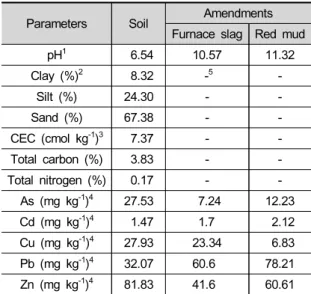
2.1 Characterization of soil and amendments Used soil in this investigation was collected from agricultural land adjacent to the abandoned Dukgog gold mine in Chungnam Province, Korea (36°37'44"N, 126°56'58"E). The physico-chemical properties of the soil (<2 mm) and amendments were shown in Table 1.
Textural analysis was performed using the pipetting method of Gee and Bauder (1986). Soil pH and electrical conductivity (EC) were determined using 1:5 soil/H2O (Thomas 1996). Total C and N were determined by the Turin (Nelson and Sommers 1996) and Kjeldahl (Mremner 1996) methods, respectively.
Cation exchange capacity (CEC) was determined using the ammonium-saturation and distillation method (Sumner and Miller 1996). Pseudo-total trace element (As, Cd, Cu, Pb, and Zn) concentrations in soils and amendments were measured by inductively coupled plasma optical emission spectrometry (ICP-OES) after digestion of the samples with aqua regia according to ISO 11466 (ISO 1995). Table 1
shows the main physico-chemical properties of both the soil and amendments used in this investigation.
2.2 Experimental set-up
Furnace slag and red mud were added to Dukgog mine soil (arsenic contaminated soil) at 2 - 6%, and 1 - 4% w/w rate. Amendments used in this experiment were reduced to a particle size of <2 mm. Non- amended soil was used as the control. The amend- ments were thoroughly mixed with the soils to obtain homogeneity, and were then equilibrated for 40 d, during which soil moisture was maintained, and the soils were thoroughly mixed at weekly intervals.
2.3 Contaminant extractability leachability, and bioaccessability
The effect of each amendment on contaminant extractability was evaluated using 0.1 M Ca(NO3)2. Extraction with 0.1 M Ca(NO3)2 solution was per-
formed according to the procedure of Conder et al.
(2001) to measure Ca(NO3)2-extractable metals: 1 g soil was combined with 0.1 M Ca(NO3)2, mixed in a shaker, centrifuged for 20 min at 5100 × g, and then filtered through Whatman GF/F 0.7 µm borosilicate glass filters. Contaminants were measured in soils by TCLP extraction according to the USEPA method 1311 (USEPA 1986). The TCLP extracting agent was acetic acid (pH 2.88). The solid/liquid ratio TCLP was kept at 1:20. After 18 h of mixing in a TCLP tumbler, the leachate was filtered using Whatman GF/F 0.7 µm borosilicate glass filters. The availability to the human gastrointestinal (GI) system of TTEs in ingested soil was estimated using the modified Physiologically Based Extraction Test (PBET) procedure described by Geebelen et al. (2003): 0.35 g soil was shaken (30 rpm) with synthetic gastric solution (0.4 M glycine;
pH 2.2) for 1 h at 37°C, and then filtered through Whatman GF/F 0.7 µm borosilicate glass filters. The filtrate was acidified by adding a small amount of nitric acid to pH< 2, followed by ICP analysis.
2.4 Soil enzyme activities
Immediately following aging, soils were sub- sampled to determine enzyme activity and soil microbial biomass, which were used as microbial endpoints. Soil subsamples were kept moisture at under 4°C. Before analyses, samples were sifted through a 2 mm sieve, and their water content was determined to express microbial activity on a dry- matter basis. Dehydrogenase activity was determined by the reduction of 2,3,5-triphenyltetrazolium chloride (TTC) to triphenyl formazan (TPF) (Casida et al.
1964). Phosphatase activity was determined using p-nitrophenyl phosphate disodium as a substrate (Tabatabai and Bremner 1969) and urease activity was measured using the method of Kandeler (1995).
Although fluorogenic substrate assay has been widely used due to high sensitivity and potential for simultaneous assay of multiple enzyme in the same samples, it also raised concerns about data accuracy
Table 1. Soil physic-chemical properties and total metal concentrations of the soils and amendments used in this experiment*
Parameters Soil Amendments
Furnace slag Red mud
pH1 6.54 10.57 11.32
Clay (%)2 8.32-5 -
Silt (%) 24.30 - -
Sand (%) 67.38 - -
CEC (cmol kg-1)3 7.37 - -
Total carbon (%) 3.83 - -
Total nitrogen (%) 0.17 - -
As (mg kg-1)4 27.53 7.24 12.23 Cd (mg kg-1)4 1.47 1.7 2.12 Cu (mg kg-1)4 27.93 23.34 6.83 Pb (mg kg-1)4 32.07 60.6 78.21 Zn (mg kg-1)4 81.83 41.6 60.61
*Mean values of three replicates.
1Soil pH measured at the ratio of soil to H2O as 1:5 (mass:volume).
2Particle size was analyzed by pipetting method.
3Cation exchange capacity.
4Aqua regia extractable metal concentration.
5“-” means not determined.
and reproducibility (Zhang et al. 2010, Deng et al.
2017). For this reason, chromogenic enzyme assays were conducted.
2.5 Phytoavailability
To examine the effect of the addition of amend- ments on the phytoavailability of contaminants, lettuce (Lactuca sativa. L) was grown in plastic pots (1 kg capacity, 15 cm diameter, 25 cm height) filled with contaminated soils, prepared as described above. Lettuce seeds were initially sown in peat-based horticultural compost. 2 wk after germination, the seedlings were transplanted into contaminated soils (5 seedlings/pot, 3 pots per treatment). The trials were conducted under controlled greenhouse conditions (temperature 15 - 25°C, relative humidity 60 - 70%) with daily watering. After 45 d, the lettuce was harvested, rinsed with DW, and dried at 80°C for 48 h.
Lettuce shoot samples were digested in hot nitric acid, and the resultant solutions were filtered.
2.6 Quality control
All chemicals were of analytical grade or better.
Centrifuges were acid washed (5% HNO3) before each use, and disposable labware was used for all other analyses. Heavy metals analyses were conducted using inductively coupled plasma optical emission spectrometry (ICP-OES); blanks were run for back- ground correction and other error sources. Multi element standards were run every 20 samples, with recovery within 100 ± 10%.
2.7 Statistical analyses
All values obtained from soil chemical and bio- logical analyses were reported as the means of three replicates. The data were checked for homogeneity of variance and normality (Kolmogorov-Smirnov test) and, when possible, subjected to one-way ANOVA.
For significant differences (p < 0.05), a post-hoc Tukey honestly significant difference (HSD) test was
used to further elucidate differences among means (p < 0.05). Pearson correlation coefficients were calculated between soil metal contents and microbial activity and plant metal contents. Statistical analyses were conducted using SPSS 11.5 for Windows.
3. Results
3.1 Soil pH and EC
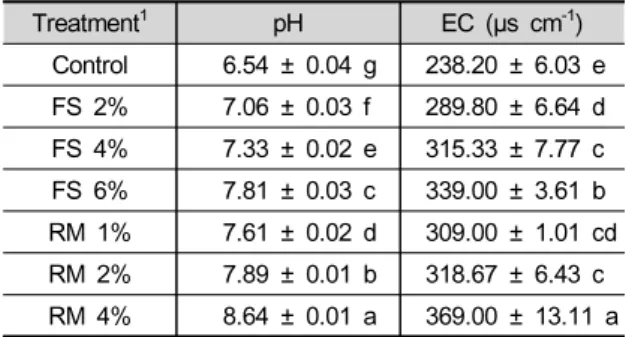
After amendments were applied, both pH and EC increased significantly (p < 0.05; Table 2). Soil pH increased from 6.54 to approximately 7.81 and 8.64 in 6% furnace slang - and 4% red mud-amended soil, respectively. Soil EC increased from 238 to 339 and 369 µS cm-1 in the furnace slag and red mud treat- ments, respectively.
3.2 Contaminant extractability, leachability and bioaccessability
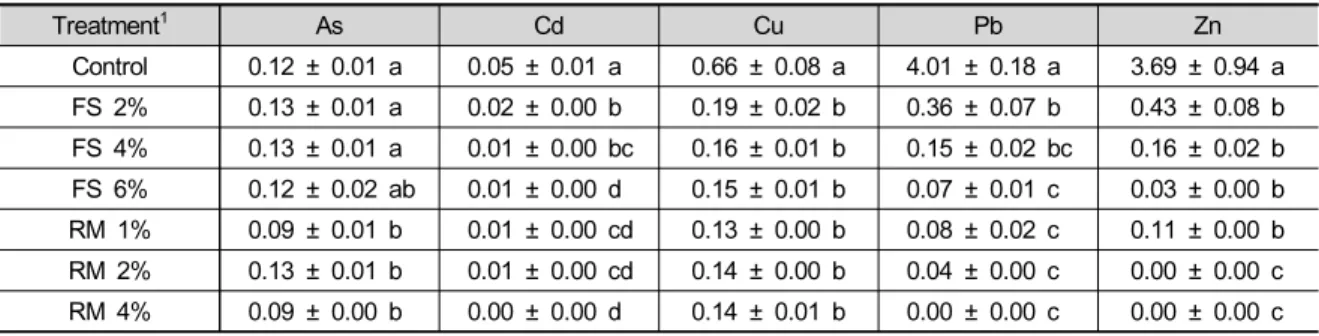
The application of amendments had no significant effect (p > 0.05) on total As, Cd, Pb, and Zn con- centrations in soils (data not shown). We determined contaminant’s extractability, leachability, and bio- accessibility. The application of amendments also significantly decreased Ca(NO3)2-extractable TTEs concentrations, with red mud being the most effective (Table 3). Compared to the control soil, a 4% red mud addition reduced Ca(NO3)2-extractable As, Cd, Cu,
Table 2. pH and electrical conductivity (EC) of the soils with different amendment additions*
Treatment1 pH EC (µs cm-1)
Control 6.54 ± 0.04 g 238.20 ± 6.03 e FS 2% 7.06 ± 0.03 f 289.80 ± 6.64 d FS 4% 7.33 ± 0.02 e 315.33 ± 7.77 c FS 6% 7.81 ± 0.03 c 339.00 ± 3.61 b RM 1% 7.61 ± 0.02 d 309.00 ± 1.01 cd RM 2% 7.89 ± 0.01 b 318.67 ± 6.43 c RM 4% 8.64 ± 0.01 a 369.00 ± 13.11 a
*Means and standard deviation (n = 3) followed by different letter within a column are significantly different (p < 0.05).
1FS, furnace slag; RM, red mud.
Pb, and Zn by 28%, 92%, 78%, 100%, and 100%, respectively. Contaminants leachability was also significantly reduced by amendments addition, with red mud being the most effective (Table 4). Compared to the control soil, a 4% red mud addition reduced TCLP-extractable As, Cd, Cu, Pb, and Zn by 44%, 42%, 82%, 97%, and 60%, respectively. Bioaccessible soil TTEs was determined using the PBET method
(Table 5). PBET Pb decreased significantly only in the 4% red mud treatment, which resulted in 29%, 10%, 50%, and 4% of bioaccessible As, Cd, Pb, and Zn, respectively.
3.3 Soil enzyme activity
Compared to non-amended soil, dehydrogenase, phosphatase and urease activity were significantly
Table 3. Ca(NO3)2 extractable toxic trace elements (mg kg-1) of the soils with different amendments addition*
Treatment1 As Cd Cu Pb Zn
Control 0.12 ± 0.01 a 0.05 ± 0.01 a 0.66 ± 0.08 a 4.01 ± 0.18 a 3.69 ± 0.94 a FS 2% 0.13 ± 0.01 a 0.02 ± 0.00 b 0.19 ± 0.02 b 0.36 ± 0.07 b 0.43 ± 0.08 b FS 4% 0.13 ± 0.01 a 0.01 ± 0.00 bc 0.16 ± 0.01 b 0.15 ± 0.02 bc 0.16 ± 0.02 b FS 6% 0.12 ± 0.02 ab 0.01 ± 0.00 d 0.15 ± 0.01 b 0.07 ± 0.01 c 0.03 ± 0.00 b RM 1% 0.09 ± 0.01 b 0.01 ± 0.00 cd 0.13 ± 0.00 b 0.08 ± 0.02 c 0.11 ± 0.00 b RM 2% 0.13 ± 0.01 b 0.01 ± 0.00 cd 0.14 ± 0.00 b 0.04 ± 0.00 c 0.00 ± 0.00 c RM 4% 0.09 ± 0.00 b 0.00 ± 0.00 d 0.14 ± 0.01 b 0.00 ± 0.00 c 0.00 ± 0.00 c
*Means and standard deviation (n = 3) followed by different letter within a column are significantly different (p < 0.05).
1FS, furnace slag; RM, red mud.
Table 4. Leachability (TCLP) toxic trace elements (µg kg-1) of the soils with different amendments addition*
Treatment1 As Cd Cu Pb Zn
Control 25.1 ± 1.08 ab 2.2 ± 0.20 c 39.5 ± 8.04 a 39.2 ± 8.63 a 196 ± 17.12 c FS 2% 26.6 ± 5.29 ab 3.2 ± 0.44 ab 20.3 ± 0.86 b 25.9 ± 4.55 b 311 ± 23.29 ab FS 4% 32.0 ± 3.21 a 3.4 ± 0.17 a 17.1 ± 1.35 bc 18.3 ± 1.48 b 292 ± 33.75 b FS 6% 22.2 ± 3.41 b 3.9 ± 0.55 a 15.3 ± 0.25 bcd 17.5 ± 2.47 b 356 ± 23.15 a RM 1% 12.3 ± 1.66 c 2.4 ± 0.30 bc 12.0 ± 0.69 bcd 3.3 ± 1.19 c 181 ± 10.28 c RM 2% 12.8 ± 0.81 c 2.2 ± 0.08 c 10.1 ± 0.19 cd 0.9 ± 0.37 c 192 ± 6.97 c RM 4% 14.0 ± 1.41 c 1.3 ± 0.07 d 7.2 ± 0.23 d 1.0 ± 0.05 c 77 ± 7.22 d
*Means and standard deviation (n = 3) followed by different letter within a column are significantly different (p < 0.05).
1FS, furnace slag; RM, red mud.
Table 5. Physiologically based extraction test (PBET) toxic trace elements (mg kg-1) of the soils with different amendments addition*
Treatment1 As Cd Cu Pb Zn
Control 1.88 ± 0.15 ab 0.19 ± 0.02 a 5.42 ± 0.64 a 7.49 ± 1.01 ab 15.02 ± 0.90 bc FS 2% 2.67 ± 0.33 a 0.22 ± 0.01 a 5.66 ± 0.34 a 8.14 ± 0.63 ab 18.15 ± 1.60 a FS 4% 2.25 ± 0.28 a 0.20 ± 0.02 a 5.48 ± 0.23 a 8.19 ± 0.48 ab 17.28 ± 0.90ab FS 6% 2.44 ± 0.38 a 0.24 ± 0.05 a 5.64 ± 0.54 a 8.88 ± 0.77 a 17.85 ± 0.27 a RM 1% 2.45 ± 0.36 a 0.22 ± 0.05 a 5.32 ± 0.63 a 4.74 ± 0.58 c 15.74 ± 0.89 abc RM 2% 2.71 ± 0.40 a 0.20 ± 0.01 a 6.42 ± 0.58 a 6.83 ± 0.66 b 16.36 ± 0.30 abc RM 4% 1.32 ± 0.11 b 0.17 ± 0.01 a 6.12 ± 0.29 a 3.72 ± 0.35 c 14.41 ± 0.69 c
*Means and standard deviation (n = 3) followed by different letter within a column are significantly different (p < 0.05).
1FS, furnace slag; RM, red mud.
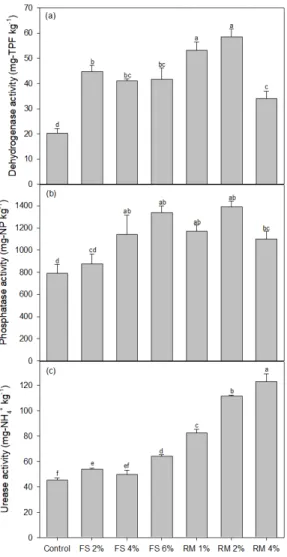
higher, in furnace slag- and red mud-amended soils (p < 0.05; Fig. 1). But activity of dehydrogenase and phosphatase were decreased in highest ratio red mud (4%) amended soil. Urease activity was continuously increased with increasing the amount of amendment.
Usually, higher enzyme activities were observed in red mud - amended soils than furnace slag - amended soils.
3.4 Plants
Compared to non-amended soil, the concentrations of TTEs in lettuce grown in red mud-amended soils
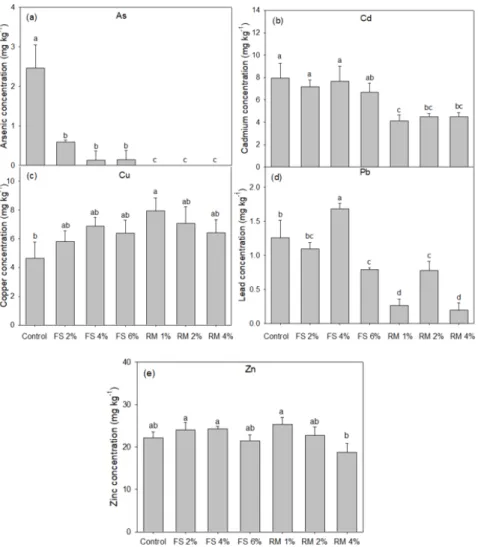
showed significant (p < 0.05) decreased (Fig. 2). Most notable was that grown in soil amended with 4% red mud which had 0%, 57% and 16% of the As, Cd and Pb, respectively, detected in lettuce shoots grown in control soil. The effects of amendment addition on the reduction of Cu and Zn translocation were not significant.
3.5 Correlations
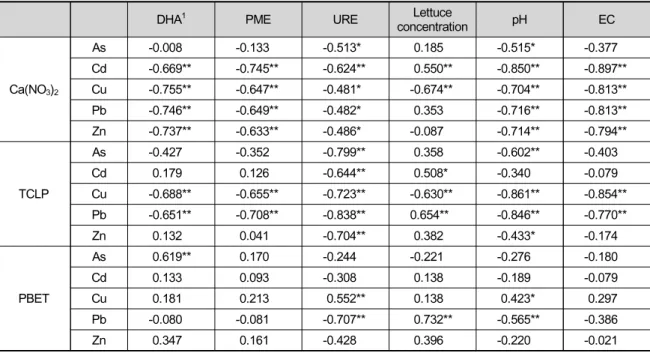
Table 6 shows the Pearson’s correlation coefficients between extractable TTEs, soil enzyme activities, and lettuce bioconcentrations. Significant negative cor- relations were observed between TTEs contents and soil enzyme activities. The correlation coefficients were significantly higher between soil enzyme activities and Ca(NO3)2-extractable TTEs contents than TCLP and PBET- extractable. Significantly higher correlations were observed between Ca(NO3)2- extractable Cd, leachable Cd and Pb, bioaccessible Pb and lettuce concentrations.
4. Discussion
In this study, we compared the ability of two kinds of amendments to reduce TTEs availability.
Amendments, furnace slag and red mud are all industrial waste or by-products which have been shown to have great potential in TTEs stabilization in soil. The application of amendments that can immobilize TTEs in situ may provide a cost-effective and sustainable solution for the remediation of contaminated soil (Oste et al. 2002, Lee et al. 2011).
The total concentrations of TTEs in soil did not change significantly when amendments were added (data not shown). Although the amendments had no effect on total metals concentrations, they signifi- cantly decreased the available fractions of TTEs (Tables 3 - 5). It can be said that the stabilization of TTEs in this experiment might be resulted from two processes. First, the increased soil pH associated with the application of alkaline amendments reduced
Fig. 1. Results of soil enzyme activity in amendments additions. Different letters are significantly different (p <
0.05). FS and RM indicated furnace slang and red mud, respectively.
solubility of TTEs in soil and increased metal sorption to soil particles because of the net negative charge increase of variably charged colloids, such as clays, organic matter, and Fe and Al oxides (Kumpiene et al.
2008). Also, increased soil pH and carbonate buf- fering can lead to the formation of metal-carbonate precipitate complexes that decrease metal avail- ability. Second, the availability of soil TTEs are mainly controlled by adsorption/desorption processes and co-precipitation (Kumpiene et al. 2008). The great reduction in availabile TTEs was likely due to their sorption via inner sphere complexation on the reactive surface of newly formed Fe oxides. Fe oxides have the greatest potential for As and heavy metal
adsorption in soil (Kumpiene et al. 2008) the large amount of Fe and Al oxides in furnace slang and red mud introduce new sorptive surfaces that may immobilize heavy metals in soils through specific sorption or chemisorption (Lee et al. 2011, Kim et al.
2020).
The significant decrease of Ca(NO3)2-extractable TTEs concentration, which represent TTEs that are sorbed onto the soil solid phase (McLaughlin et al.
2000). The decreased concentrations of extractable TTEs in the amended soils can be attributed in part to a significant increase in soil pH (Table 2) caused by the alkaline nature of the amendments. The Ca(NO3)2
extracts used as surrogate measures of TTEs avail-
Fig. 2. Toxic trace elements concentrations in lettuce shoot grown in amendments additions. Different letters are significantly different (p < 0.05). FS and RM indicated furnace slang and red mud, respectively.
ability were non-aggressive extracts developed to measure readily labile metals in soils (Lee et al. 2011).
Unlike Ca(NO3)2-extractable TTEs contents, the effects of amendments on bioaccessible TTEs, determined using the PBET, were minimal (Table 4), which may be attributed to the difference in the extractant pH.
The acidic (pH 2.2) extraction solution of the PBET is more aggressive at dissolving TTEs than is a neutral solution (pH 7.0; Ca(NO3)2). Thus, TTEs is easily desorbed and solubilized by the low pH of the GI tract (Geebelen et al. 2003).
Soil enzyme activities were negatively correlated with content of available TTEs fraction. Our results were consistent with several other studies demon- strating that soil enzyme activities are inversely related to TTEs concentrations (Madojón et al. 2001, Karaca et al. 2002, Moreno et al. 2002). We found strong negative correlations between Ca(NO3)2-extractable TTEs content and soil enzyme activities. The inhibition of enzyme activities by toxic elements in soil is principally attributed to an indirect effect (suppression of the microbial population and cellular activities)
and/or a direct effect (inactivation of extracellular enzymes due to binding with the metals) (Kizilkaya and Bayrakli 2005).
Dehydrogenase, phosphatase and urease activity has a positive correlation coefficient of 0.4415, 0.5187 and 0.7165, respectively with soil pH, indicating the importance of the pH on the enzyme activities. A similar relationship was also reported by Mora et al.
(2005). At the same time, the increase in pH implies a reduction of the available TTE fractions, which in turn reduces heavy metal toxicity to microorganisms. The positive effect of soil amendments on soil enzyme activities may be attributed to a decrease in the bioavailability of TTEs, as estimated by the soil extractions. The observed positive correlation between soil enzyme activity and the pH indicates the beneficial effect of the amendments on soil pH. Similarly, the increase in EC induced by additives significantly activated most of soil enzyme activities may indicate a positive effect of EC on enzyme activities. Ellis et al.
(2001) found that pH had the greatest bearing on dehydrogenase activity in a Zn-polluted soil. Dehydro-
Table 6. Correlation coefficients between TTE concentrations and soil enzyme activities in soils (n = 21)
DHA1 PME URE Lettuce
concentration pH EC
Ca(NO3)2
As -0.008 -0.133 -0.513* 0.185 -0.515* -0.377
Cd -0.669** -0.745** -0.624** 0.550** -0.850** -0.897**
Cu -0.755** -0.647** -0.481* -0.674** -0.704** -0.813**
Pb -0.746** -0.649** -0.482* 0.353 -0.716** -0.813**
Zn -0.737** -0.633** -0.486* -0.087 -0.714** -0.794**
TCLP
As -0.427 -0.352 -0.799** 0.358 -0.602** -0.403
Cd 0.179 0.126 -0.644** 0.508* -0.340 -0.079
Cu -0.688** -0.655** -0.723** -0.630** -0.861** -0.854**
Pb -0.651** -0.708** -0.838** 0.654** -0.846** -0.770**
Zn 0.1320.041 -0.704** 0.382-0.433* -0.174
PBET
As 0.619** 0.170 -0.244 -0.221 -0.276 -0.180
Cd 0.133 0.093 -0.308 0.138 -0.189 -0.079
Cu 0.181 0.213 0.552** 0.138 0.423* 0.297
Pb -0.080 -0.081 -0.707** 0.732** -0.565** -0.386
Zn 0.347 0.161 -0.428 0.396 -0.220 -0.021
*, ** indicated significant at p < 0.05 and p < 0.01, respectively, according to Pearson’s correlation analysis.
1DHA, dehydrogenase; PME, phosphatase; URE, urease; EC, electrical conductivity.
genase activity negatively correlated with Cd (p <
0.05), and Zn (p < 0.01) soluble concentrations (Table 6 and Fig. 1). Dehydrogenase is widely used in evalu- ating the metabolic activity of soil microorganisms.
Dehydrogenase has been used as an indicator of microbiological activity in soil management studies (Bergstrom et al. 1998). Dehydrogenase activity depends on the metabolic state of soil microorganisms although its use as an indicator of soil microbial activity has been criticized because the enzyme is affected by numerous factors (soil type, pH, etc.) (Nannipieri et al. 1990). Dehydrogenase could be determined from the intracellular enzymes in a reduced number of microbes in soil or could be the result of differences in the composition of microbiota in stressed soil. Some researchers (Oliveira and Pampulha 2006, Kim et al. 2018) suggested that dehydrogenase assay is a useful indicator for evaluating the effect of toxic metals on soil microbial activity.
Though, examined enzyme in this experiment showed similar response to soil management, the response of soil enzymes to soil parameters has not yet reached a consensus conclusion due to the complex environmental conditions (Tang et al. 2019). There are many differences in the existing literature on the relationship between soil physicochemical parameters and soil enzymes. For example, Huang et al. (2017) proved that pH was negatively correlated with invertase and alkaline phosphatase activities, and positively related to urease activity, but Yang et al.
(2016) found that these enzyme activities were independent of pH, and Bera et al. (2016) showed that a positive correlation between pH and alkaline phosphatase activity.
The decreased uptake of TTEs by lettuce grown in amended soils is clearly related to the decrease of the available fraction of TTEs. The most obvious effect was the significant reduction of TTE transfer in lettuce grown in soil amended with red mud (Fig. 2).
Lee et al. (2011) also reported that heavy metals content in lettuce shoots was greatly reduced by red
mud treatment. The decreased uptake of As and metals observed in this study was clearly related to the decrease in available fractions of As and metals (Fig.
2). The comparable literature report is that of Ascher et al. (2009). They reported that As contents in lettuce shoot were largely reduced by iron containing amend- ments and foliar As, Cd, Pb, and Zn concentrations in lettuce shoots correlated closely with concentrations in soil extracts.
5. Conclusion
Our results point to the potential use of soil enzyme activities as indicators of soil quality changes associated with TTEs and remedial measures. Thus, monitoring the change of soil enzyme activities are useful indicators of the re-establishment of biotic connections and restoration functions in degraded systems. But the impact of soil properties on enzyme activities of TTEs-contaminated soils is still the direction of future research, especially in the presence of additives.
Acknowledgements
This research was funded by Korea Environmental Industry & Technology Institute (KEITI) [2020002 480002].
References
Antunes, S.C., Pereira, R., Marques, S.M., Castro, B.B., and Gonçalves, F. 2011. Impaired microbial activity caused by metal pollution: a field study in a deactivated uranium mining area. Science of Total Environment 410-411: 87-95.
Ascher, J., Ceccherini, M.T., Landi, L., Mench, M., Pietramellara, G., Nannipieri, P., and Renella, G. 2009.
Composition, biomass and activity of microflora, and leaf yields and foliar elemental concentrations of lettuce, after in situ stabilization of an arsenic contaminated soil.
Applied Soil Ecology 41(3): 351-359.
Basta, N.T. and McGowen, S.L. 2004. Evaluation of chemical immobilization treatments for reducing heavy
metal transport in a smelter-contaminated soil. Environ- mental Pollution 127(1):73-82.
Bera, T., Collins, H.P., Alva, A.K., Purakayastha, T.J., and Patra, A.K. 2016. Biochar and manure effluent effects on soil biochemical properties under corn production.
Applied Soil Ecology 107: 360-367.
Bergstrom, D.W., Monreal, C.M., and King, D.J. 1998.
Sensitivity of soil enzyme activity to conservation practices. Soil Science Society of America Journal 62(5): 1286-1295.
Brown, S., Sprenger, M., Maxemchuk, A., and Compton, H. 2005. Ecosystem function in allubial tailing after biosolids and lime addition. Journal of Environment Quality 34(1): 139-148.
Niemeyer, J.C., Lolata, G.B., De Carvalho, G.M., Da Silva, E.M., Sousa, J.P., and Nogueira, M.A. 2012. Microbial indicators of soil health as tools for ecological risk assessment of a metal contaminated site in Brazil.
Applied Soil Ecology 59: 96-105.
Casida, L.E., Klein, D.A., and Santoro, T. 1964. Soil de- hydrogenase activity. Soil Science Society of America Journal 47: 599-603.
Conder, J.M., Lanno, R.P., and Basta, N.T. 2001. Assess- ment of metal availability in smelter soil using earth- worms and chemical extractant. Journal of Environment Quality 30(4): 1231-1237.
Deng, S., Dick, R., Freeman, C., Kandeler, E., and Weintraub, M.N. 2017. Comparison and standardization of soil enzyme assay for meaningful data interpretation.
Journal of Microbiological Methods 133: 32-34.
Ellis, R.J., Neish, B., Trett, M.W., Best, J.G., Weightman, A.J., Morgan, P., and Fry, J.C. 2001. Comparison of microbial and meiofaunal community analyses for de- termining impact of heavy metal contamination. Journal of Microbiological Methods 45(3): 171-185.
Gao, Y.C., Wang, J.N., Xu, J.B., Kong, X., Zhao, L., and Zeng, D.H. 2013. Assessing the quality of oil-contami- nated saline soil using two composite indices. Ecological Indicators 24: 105-112.
Garcia, J., Zhang, Y., Taylor, H., Cespedes, O., Webb, M.E., and Zhou, D. 2001. Multilayer enzyme coupled magnetic nanoparticles as efficient, reusable biocatalysts and biosensors. Nanoscale 3(9): 3721-3730.
Gee, G.W. and Bauder, J.W. 1986. Particle size analysis.
In, Klute, A. (ed.), Methods of soil analysis. Part I.
Physical and mineralogical methods. American Society of Agronomy, Madison, Wisconsin, USA. pp. 383-411.
Geebelen, W., Adriano, D.C., van der Lelie, D., Mench, M., Carleer, R., Clijsters, H., and Vangronsveld, J. 2003.
Selected bioavailability assays to test the effect of amendment-induced immobilization of lead in soils.
Plant and Soil 249: 217-228.
Huang, D., Liu, L., Zeng, G., Xu, P., Huang, C., Deng,
L., Wang, R., and Wan, J. 2017. The effects of rice straw biochar on indigenous microbial community and enzymes activity in heavy metal-contaminated sediment.
Chemosphere 174: 545-553.
ISO. 1995. Soil quality - extraction of trace elements soluble in aqua regia, ISO 11466. International Organization of Standardization, Geneva, Switzerland.
Kandeler, E. 1995. Enzymes involved in nitrogen meta- bolism. In, Schinner, F., Ohlinger, R., Kandeler, E., and Margesin, R. (eds.), Methods in Soil Biology. Springer- Verlag, Berlin, Germany. pp. 171-176.
Karaca, A., Naseby, D.C., and Lynch, J.M. 2002. Effect of cadmium contamination with sewage sludge and phosphate fertilizer amendments on enzyme activities, microbial structure and available cadmium. Biology and Fertility of Soils 35: 428-434.
Kim, M.S., Min, H.G., Lee, S.H., and Kim, J.G. 2018. A comparative study on poaceae and leguminosae forage crops for aided phytostabilization in trace-element- contaminated soil. Agronomy 8: 105.
Kim, M.S., Min, H.G., Lee, S.H., and Kim, J.G. 2020.
Effects of amendments on heavy metal uptake by leafy, root, fruit vegetables in alkali upland soil. Ecology and Resilient Infrastructure 7(1): 63-71. (in Korean) Kizilkaya, R. and Bayrakli, B. 2005. Effects of N-enriched
sewage sludge on soil enzyme activities. Applied Soil Ecology 30(3): 192-202.
Kudanga, T., Nyanhongo, G.S., Guebitz, G.M., and Burton, S. 2011. Potential applications of laccase-mediated coupling and grafting reactions: a review. Enzyme and Microbial Technology 48(3): 195-208.
Kumpiene, J., Lagerkvist, A., and Maurice, C. 2008.
Stabilization of As, Cr, Cu, Pb and Zn in soil using amendments—a review. Waste Management 28(1): 215- 225.
Lee, S.H., Kim, E.Y., Park, H., Yoon, J.H., and Kim, J.G.
2011. In situ stabilization of arsenic and metal-conta- minated agricultural soil using industrial by-products.
Geoderma 161(1-2): 1-7.
Leitgib, L., Kálmán, J., and Gruiz, K. 2007. Comparison of bioassays by testing whole soil and their water extract from contaminated sites. Chemosphere 66(3): 428-434.
Madojón, E., Burgos, P., Lopez, R., and Cabrera, F. 2001.
Soil enzymatic response to addition of heavy metals with organic residues. Biology and Fertility of Soils 34:
144-150.
McLaughlin, M.J., Zarcinas, B.A., Stevens, D.P., and Cook, N. 2000. Soil testing for heavy metals. Communications in Soil Science and Plant Analysis 31: 1661-1700.
Mora, A.P.d., Ortega-Calvo, J.J., Cabrera, F., and Madejón, E. 2005. Changes in enzyme activities and microbial biomass after “in situ” remediation of a heavy metal- contaminated soil. Applied Soil Ecology 28(2): 125-137.
Moreno, J.L., Hernández, T., Pérez, A., and García, C.
2002. Toxicity of cadmium to soil microbial activity:
effect of sewage sludge addition to soil on the ecological dose. Applied Soil Ecology 21(2): 149-158.
Mremner, J.M. 1996. Nitrogen-total. In, Spark, D.L. (ed.), Method of Soil Analysis: Chem ical m ethods, Part III- Chemical Methods. American Society of Agronomy, Madison, WI, USA. pp. 1085-1121.
Nannipieri, P., Ceccanti, B., Bollag, J., and Stotzky, G.
1990. Ecological significance of the biological activity in soil. In, Bollag, J.M. and Stotzky, G. (eds.), Soil Biochemistry. Marcel Dekker Inc., New York, USA. pp.
293-355.
Nelson, D.W. and Sommers, L.E. 1996. Total carbon, organic carbon, and organic matter. In, Sparks, D.L. (ed.), Method of Soil Analysis: Part III- Chemical Methods.
American Society of Agronomy, Madison, WI, USA.
pp. 1201-1229.
Oliveira, A. and Pampulha, M.E. 2006. Effect of long-term heavy metal contamination on soil microbial character- istics. Journal of Bioscience and Bioengineering 102(3):
157-161.
Oste, L., Lexmond, T.M., and van Riemsdijk, W.H. 2002.
Metal immobilization in soils using synthetic zeolites.
Journal of Environment Quality 31(3): 813-821.
Rao, M.A., Scelza, R., Acevedo, F., Diez, M.C., and Gianfreda, L. 2014. Enzymes as useful tools for environ- mental purposes. Chemosphere 107: 145-162.
Sumner, M.E. and Miller, W.P. 1996. Cation exchange capacity and exchange coefficients. In, Sparks, D.L. (ed.), Method of Soil Analysis: Part III - Chemical Methods.
American Society of Agronomy, Madison, WI, USA. pp.
1201-1229.
Tabatabai, M.A. and Bremner, J.M. 1969. Use of p-nitro- phenyl phosphate for assay of soil phosphatase activity.
Soil Biology and Biochemistry 1(4): 301-307.
Tang, J., Zhang, J., Ren, L., Zhou, Y., Gao, J., Luo, L., Yang, Y., Peng, Q., Huang, H., and Chen, A. 2019.
Diagnosis of soil contamination using microbiological indices: A review on heavy metal pollution. Journal of Environmental Management 242: 121-130.
Thomas, G.W. 1996. Soil pH and soil acidity. In, Sparks, D.L. (ed.), Methods of soil analysis. Part III- Chemical Methods. American Society of Agronomy, Madison, WI, USA. pp. 475-490.
USEPA. 1986. Test methods for evaluating solid waste.
Laboratory manual physical/chemical methods. SW-846.
U.S. Gov. Print. Office, Washing, DC., USA.
Van Dyk, J.S. and Pletschke, B. 2011. Review on the use of enzymes for the detection of organochlorine, organo- phosphate and carbamate pesticides in the environment.
Chemosphere 82(3): 291-307.
Wahsha, M., Nadimi-Goki, M., and Bini, C. 2016. Land contamination by toxic elements in abandoned mine areas in Italy. Journal of Soils and Sediments 16: 1300-1305.
Xian, Y., Wang, M., and Chen, W. 2012. Quantitative assessment on soil enzyme activities of heavy metal contaminated soils with various soil properties. Chemo- sphere 139: 604-608.
Yang, J., Yang, F., Yang, Y., Xing, G., Deng, C., Shen, Y., Luo, L., Li, B., and Yuan, H. 2016. A proposal of “core enzyme” bioindicator in long-term Pb-Zn ore pollution areas based on topsoil property analysis. Environmental Pollution 213: 760-769.
Zhang, F.P., Li, C.F., Tong, L.G., Yue, L.X., Li, P., Ciren, Y.J., and Cao, C.G. 2010. Response of microbial characteristics to heavy metal pollution of mining soils in central Tibet, China. Applied Soil Ecology 45(3):
144-151.