• 검색 결과가 없습니다.

Effect of NCO Index on the Particle Size of Polycarbonate Diol-based Polyurethane Dispersion

N/A
N/A
Protected

Academic year: 2021

Share "Effect of NCO Index on the Particle Size of Polycarbonate Diol-based Polyurethane Dispersion"

Copied!
6
0
0

로드 중.... (전체 텍스트 보기)

전체 글

(1)

DOI: https://doi.org/10.7473/EC.2020.55.1.20

Effect of NCO Index on the Particle Size of Polycarbonate Diol-based Polyurethane Dispersion

Dong-Eun Kim, Seung-Oh Kang, and Sang-Ho Lee

Department of Chemical Engineering, Dong-A University, 37 Nakdong-Daero 550beon-gil, Saha-gu, Busan 49315, Republic of Korea

(Received November 13, 2019, Revised December 2, 2019, Accepted December 3, 2019)

Abstract: The effect of the isocyanate index (NCO index) on the particle size and particle size distribution of a waterborne polyurethane dispersion (WPUD) with polycarbonate-diol was determined. The WPUDs were prepared using a conven- tional acetone process with polycarbonate-polyol (M

n

= 2028), 4,4′-methylenebis(cyclohexyl isocyanate) (H

12

MDI), 2,2- bis(hydroxymethyl) propionic acid (DMPA), and dibutyltin dilaurate catalyst. At NCO index values below 1.5, the number average particle diameter of the WPUDs significantly increased with the NCO index, whereas the particle diameter slightly varied at higher NCO indexes. The dependency of the WPUD viscosity on the NCO index exhibited similar behavior to that of the particle size. The relative values of the full width at half maximum of the WPUD particle distribution curves at various NCO indexes were not influenced by the NCO index.

Keywords: polycarbonate-polyol, polyurethane dispersion, NCO index, particle size, viscosity

Introduction

코팅, 점/접착제, 실란트, 바인더, 인공피혁 용으로 사용되 는 폴리우레탄은 용매가 단독 또는 혼합된 상태로 제조된다.

이러한 용제형 폴리우레탄은 용도에 따라 적절한 용매를 선 정하거나 혼합 용매의 조성비를 변화시켜서 제품의 물성을 조 절할 수 있는 장점이 있다. 용제형 폴리우레탄의 용매로는 DMF, THF, toluene, acetone, MEK, NMP 등이 있다.

1-7

그러 나, 이 용매들은 인체와 환경에 대한 유해성이 높고 휘발성이 강하여 노출농도를 규제하고 있다. 반면에 유기용매가 함유 되어 있지 않은 수분산 폴리우레탄(WPUD)은 VOCs 규제에 대처하는 측면에서 유리하여, 용제형 폴리우레탄에 비하여 경 도, 광택, 내화학성 등 물성 측면에서 열세임에도 불구하고 폴 리우레탄 산업에서 적용이 확대되는 추세이다.

8-16

산업 현장에서 수분산 폴리우레탄에 요구되는 물성 중의 하 나는 물에 분산된 폴리우레탄 사슬의 분산안정성이다. 수분 산 폴리우레탄의 분산안정성은 폴리우레탄의 원료인 이소시 아네이트와 폴리올의 종류, 원료의 당량비뿐만 아니라 제조 공정, 고형분 함량 등과 관련된 폴리우레탄의 입자 크기, 점도, 분자량 등과 같은 물성에 영향을 받는다고 보고되고 있

다.

17-20

분산안정성에 관한 연구를 소개하자면, 고온에서 단기

간 보관 후에 WPUD의 상태 변화를 관측하거나,

21

Freeze-

thaw stability를 통한 저온에서의 상태 변화를 측정하여 분산 안정성을 보고하였다.

22-27

그러나, 수분산 폴리우레탄의 분산 이 장기간 유지되는 저장안정성에 대한 연구는 많이 이루어 지지 않은 상태로, 이들 연구를 소개하자면, Michel은

21

poly(neopentyl glycol adipate)와 4,4′-methylenebis(cyclohexyl isocyanate) (H

12

MDI), 2,2-bis(hydroxymethyl)propionic acid (DMPA)를 이용하여 PU prepolymer를 합성하고, 미반응 iso- cyanate를 hydroxyethylacrylate와 pentaerythritol-triacrylate와 반응시킨 후에 수분산시켜서 만든 WPUD의 저장안정성을 연 구하였다. 이들은 고형분 함량이 35~45 wt.%인 WPUDs를 60ºC에서 보관했을 때 약 500 시간 이후에 입자 크기가 41~96 nm에서 90~600 nm로 커지는 것을 보고하였다. Chinwanitcharoen 은

20

poly(ethylene adipate)glycol (M

n

1000)과 4,4’-diphenyl- methane diisocyanate (MDI), 2,2-bis(hydroxy-methyl)propionic acid, ethylene glycol (EG)을 주원료로, 용매로 N-methyl-2- pyrrolidone (NMP)와 아세톤을 이용하여 WPUD를 합성하였 다. 이들은 아세톤의 함량에 따른 WPUD 입자 크기와 저장 안정성에 대한 영향을 연구하여, 시간 경과에 따라 WPUD의 입자 크기가 증가한다고 보고하였다. 한편, Blum

19

등은 poly- carbonate-diol과 (phthalic acid anhydride/adipic acid/neopentyl- glycol/hexanediol)로부터 제조한 polyester-diol을 사용하고, 이소시아네이트로 isophorone diisocyanate (IPDI)와 H

12

MDI 를 사용하고 DMPA를 내부유화제로 사용하여 WPUD를 합성 하고 저장안정성을 관찰하였다. 이들은 DMPA의 양이 3 wt.%

Corresponding author E-mail: [email protected]

(2)

보다 많고 DMPA의 carboxylic group이 중화된 정도가 60~

115%인 조건에서 합성된 WPUDs의 저장안정성이 좋다고 보 고하였다.

앞에서 소개된 WPUD의 안정성은 대부분 원료나 당량비의 영향에 관한 내용을 주로 보고하고 있다. WPUD의 안정성을 보관 온도와 연관시킨 연구도 freeze thaw method을 이용한 단기간의 안정성 측정결과가 있으나, 특정 온도에서의 장기 간에 걸친 경시변화에 대한 연구는 미흡하다. 본 연구의 동기 는 polycarbonate-diol로 제조한 WPUD의 분산안정성이 시간 에 따라 변화하는 정도를 규명하는 것이다. 이를 위하여 poly- carbonate-diol, H

12

MDI, DMPA를 사용하여 PU prepolymer를 합성하고, 물에 분산시킨 후에 사슬연장 단계를 거쳐서 WPUD를 제조하였다. 온도가 WPUD의 저장안정성에 주는 영향을 원료의 분자 크기와 조성이 주는 영향으로부터 분리 하기 위하여, PU prepolymer 합성 과정에서 isocyanate index (NCO index = [NCO]/[OH])를 변화시켜서 PU prepolymer의 중합도를 조절하고, 그에 따른 점도와 입자크기에 대한 영향 을 상온(25ºC)에서 고찰하였다. Polycarbonate-diol로 제조한 WPUD의 분산안정성에 대한 시간과 온도의 영향을 연구하기 에 앞서서 수행한 본 논문의 내용은 WPUD의 점도, 입자크 기, 상분리 등과 같은 저장안정성에 관련된 물성들이 온도와 시간의 경과에 따라 어떻게 영향을 받는가를 비교하기 위한 기준 자료로 활용될 것이다.

Experimental

1. 시약

주원료로 polycarbonate-diol T5652 (PC-diol, M

n

2028.4, Asahi Kasei)와 4,4′-methylenebis(cyclohexyl isocyanate) (H

12

MDI, 순도 99.5%, Covestro)를 사용하였다. 내부유화제로 2,2-bis(hydroxymethyl) propionic acid (DMPA, 순도 98%, Sigma Aldrich)를 사용하였다. 촉매로 dibutyltin dilaurate (DBTDL, 순도 95%, Sigma Aldrich)를 사용하였다. 중화제로 triethylamine (TEA, 순도 99%, 대정화금)을 사용하였고, acetone(순도 99.9%)은 대정화금에서 구입하였다. 사슬 연장

제는 ethylene diamine (EDA, 순도 99%, Sigma Aldrich)를 사 용하였다. 분산에 사용된 물은 2차 탈이온수를 사용하였다.

2. WPUD 합성 및 분산

수분산 폴리우레탄은 최소한의 유기용제를 사용하는 pre- polymer mixing process로 합성하였다. 실험에 앞서 PC-diol과 DMPA는 70

o

C 진공오븐에서 12시간 이상 건조시켜 수분을 제거하였다. 500 mL 4구 플라스크에 PC-diol과 DPMA를 투 입하여 100 rpm으로 약 1시간 교반한 후에, 계획된 NCO index에 따라 준비한 H

12

MDI를 투입하였다. WPUD 합성 시 에 적용한 원료들의 배합비는 Table 1에 정리하였다. DBTDL 촉매를 0.1 wt% 투입하고 100

o

C에서 4시간 동안 350 rpm으 로 교반하며 NCO terminated prepolymer를 합성하였다. PU prepolymer 중합 과정에 저압의 질소를 흘려 주었으며, 시간 경과에 따라 반응-생성 혼합물의 NCO%를 측정하여 NCO%

가 변하지 않는 시점에서 반응을 종료하고 냉각하였다. 반응 이 진행됨에 따라 점도가 증가하여 교반이 어려운 경우에 아 세톤을 소량 투입하여 점도를 조절하였다.

PU prepolymer의 온도를 50

o

C 이하로 낮춘 후에 DMPA의 carboxylic acid group과 동일한 당량의 TEA를 투입하여 1시 간 이상 중화하였다. 중화가 끝난 후 교반속도를 900 rpm 높 이고 탈이온수를 빠르게 투입하여 PU prepolymer를 분산시 키고 EDA를 투입하여 사슬 연장하여 최종적인 WPUD를 제 조하였다.

3. 분석

PU prepolymer 합성 과정에서 반응의 진행 정도는 KS M5969를 참고하여 다음과 같은 방법으로 측정하였다. 시간 에 따라 반응-생성물 시료(0.3~0.5 g)에 0.1 N n-dibutylamine 용액을 25 mL를 첨가하고, 0.1% bromophenol blue 지시약을 소량 넣은 후 0.1 N HCl 표준용액으로 적정하여 측정하였다. 채 취한 시료의 IR spectra를 FT-IR (Thermo fisher scientific, Nicolet 380)의 ATR mode로 측정하여 각각의 NCO index에 맞추어 설정된 조성으로 합성한 PU prepolymer 내의 urethane Table 1. The Composition of the WPUDs Synthesized the Polycarbonate-diol for This Study

Formulation No. PC-1.17-E PC-1.25-E PC-1.33-E PC-1.50-E PC-1.70-E

PC-diol (T5652) 60.00 g 60.00 g 60.00 g 60.00 g 60.00 g

DMPA 3.97 g 3.97 g 3.97 g 3.97 g 3.97 g

H

12

MDI 36.27 g 38.75 g 41.23 g 46.50 g 52.70 g

TEA 5.99 g 5.99 g 5.99 g 5.99 g 5.99 g

EDA 0.60 g 0.89 g 1.17 g 1.78 g 2.49 g

NCO index 1.17 1.25 1.33 1.50 1.70

degree of polymerization of the each

prepolymer 13 9 7 5 3.9

(3)

과 urea의 함량을 비교하였다. 시간에 따른 점도와 입도의 변 화는 점도계(Brookfield viscometer, DV-II + Pro) 및 dynamic light scattering (K-ONE nanoparticle size analyzer, Multiscope model)를 이용하여 측정하였다.

Results and Discussion

1. WPUD의 성분 분석

합성한 WPUDs를 깊이가 약 1 mm가 되도록 테프론 용기 에 넣고 상온에서 5일 동안 건조시킨 후에, 이어서 65

o

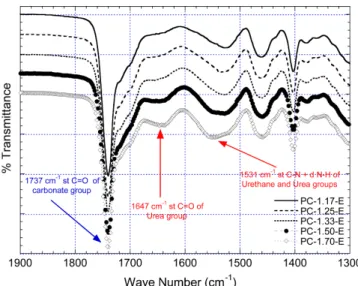
C에서 12시간 건조하여 만든 필름을 FT-IR을 이용하여 구성 성분을 분석하였다. Figure 1은 건조된 필름의 IR spectra로 1900~

1300 cm

1

영역의 피크를 보여준다. N=C=O stretching에 해 당하는 2270 cm

1

피크는 나타나지 않았다. 1647 cm

1

에서 보 이는 피크는 PU prepolymer의 사슬연장 과정에서 EDA를 사 슬연장제로 사용하였기 때문에 형성된 urea 기의 C=O stretch- ing에 의한 것으로, PU prepolymer의 제조 과정에서 NCO index가 높을수록 흡광도가 커졌다. 이의 원인은 아래와 같이 설명할 수 있다. PU prepolymer의 중합도는 NCO index 값이 높을수록 작아지므로, PU prepolymer의 수와 그 말단에 있는 NCO group이 많아진다. 따라서 높은 NCO index 조건에서 중 합시킨 PU prepolymer를 EDA로 사슬 연장하는 과정에서 urea가 많이 생성되기 때문이다. NCO index가 증가함에 따라 1531 cm

1

에서 나타난 피크의 흡광도가 증가하였다. 1531 cm

1

피크는 urethane의 C-H-N bending과 urea의 N-H bend- ing이 겹쳐서 나오는 피크로, WPUD에서 우레탄기와 우레아 기의(hard-segment) 함량이 증가하는 것을 보여준다. 한편 1737 cm

1

에 보이는 피크는 polycarbonate-diol의 carbonate기

에 있는 C=O가 수소결합을 하지 않은 상태에서 stretching 운 동에 의하여 나타나는 피크이다. 이 피크는 수소결합을 한 urethane 기의 C=O stretching에 의한 피크 1710 cm

1

와 수소 결합을 한 urea 기의 C=O stretching에 의한 피크 1647 cm

1

와 구분된다.

28

WPUD를 건조하여 만든 필름은 두께, 거칠기 등이 일정하 지 않으므로 흡광도 측정은 이들의 영향을 받을 수 있다.

Table 1의 조건에서 합성한 PU prepolymer에 함유된 우레아 와 우레탄 기의 함량을 IR spectra로 정량 분석하는 과정에서 PU 필름의 형상에 의한 영향을 배제하기 위하여 prepolymer 의 특성 피크들의 세기를 다음과 같이 normalization 하였다.

Normalized intensity는 prepolymer의 IR 특성 피크 중에서 1737 cm

1

에서 나타나는 수소결합을 하지 않은 carbonate 기 의 C=O stretching 피크의 세기로 1647 cm

1

(urea 기의 C=O stretching) 피크의 세기와 urethane의 C-H-N과 urea의 N-H bending이 겹쳐서 나타나는 1531 cm

1

피크의 세기를 나누어 서 그 비로 구하였다. Figure 2는 Table 1의 조성에서 합성한 PU prepolymer들의 IR 특성 피크를 normalization한 결과로, NCO index의 증가함에 따라 urea 기의 C=O stretching 피크 와 urethane의 C-H-N과 urea의 N-H bending 피크의 normalized intensity가 정량적으로 증가하는 것을 명확하게 보여준다.

28,29

2. WPUD 입자 크기와 점도에 대한 NCO index의 영향

Figure 3은 NCO index 값이 1.17, 1.33, 1.50, 170인 조건에 서 제조한 WPUDs의 입자 크기와 분포 정도를 보여준다. 입

Figure 1. FT-IR spectra of the PU films using the WPUDs synthe- sized with PC-diol (T5652) and H

12

MDI. The formulation of each WPUD was presented at Table 1.

Figure 2. The variation of normalized intensity of the peaks

appeared at 1647 cm

1

and 1531 cm

1

with NCO index (=NCO

equivalent/OH equivalent). 1647 cm

1

peak corresponds to the

C=O stretching peak of the urea group. 1531 cm

1

peak corre-

sponds to the peak of C-N stretching and N-H bending of urethane

and urea groups, which appears overlapped.

(4)

자 크기의 분포는 NCO index의 변화와 무관하게 unimodal 형 태로 나타난다. Table 2에 NCO index에 따른 수평균 입자직 경( )과 반치전폭(FWHM, Full width at half maximum), 점 도, 고형분 함량의 값을 정리하였으며, 에 따른 FWHM의 상대적인 비(= (FWHM  )/ )도 보고하였다. WPUDs의 수평균 입자직경은(NCO equivalent)/(OH equivalent) 값이 1.70에서 1.17로 감소함에 따라 29.0 nm에서 201.8 nm로 커 졌다. 이는 초기 반응물에서 NCO 기의 당량수와 OH 기의 당 량수가 같을수록(NCO index 값이 1.0에 가까워질수록) PU prepolymer의 중합도가 증가하며 최종 WPUD의 입자크기가 커짐을 보여준다. FWHM 값은 NCO index가 감소함에 따라 29.8 nm에서 208.7 nm로 커져 입자분포가 넓어지는 것으로 보이나, 수평균 입자직경을 기준으로 비교하면 그 값은 대부 분 0.033 내외로 일정하였다.

Figure 4는 Table 1에 기재된 조성에 따라 반응물의 NCO index를 변경시키며 합성한 PU prepolymer의 이론 분자량과 PU prepolymer로부터 제조한 WPUD의 입자크기 변화를 보 여준다. PU prepolymer의 이론 분자량은 단계중합 반응에서 중합도 예측에 널리 사용되는 Carothers equation을 이용하여 계산하였다. WPUD 입자들의 수평균 직경은 NCO index가 감

소함에 따라 29.0 nm (NCO index=1.70)에서 201.8 nm (NCO index=1.17)로 약 7배 증가하였다. PU prepolymer를 EDA로 사슬을 연장하고 분산시키는 과정에서 PU prepolymer의 분 자량이 WPUD의 입자 크기에 크게 영향을 주는 것은 쉽게 예 상할 수 있다. Figure 4는 PU의 분자량은 아니지만, Carothers equation으로 계산한 prepolymer의 이론 분자량과 WPUDs에 서의 측정한 PU 분자의 입자크기가 NCO index가 감소함에 따라 동일한 패턴으로 증가하는 것을 잘 보여준다.

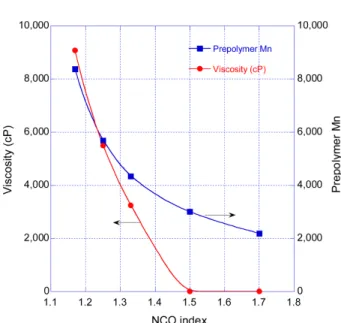
Figure 5는 Table 1의 원료 조성에서 제조한 WPUD의 점도 를 25ºC에서 측정한 값과 NCO Index의 관계를 보여준다.

NCO index 값이 1.5와 1.7일 때에 WPUD의 점도는 10과 17 cP로 거의 같았다. NCO index 값이 1.33에서 WPUD의 점도 는 3257 cP로 약 300배 정도로 급격하게 증가하였다. NCO index 값이 1.33보다 더 작아지면 WPUD의 점도는 더 급격하 게 증가하여서, NCO index 값이 1.17인 경우에 WPUD의 점 도는 9088 cP로 커졌다. NCO index 값이 작아짐에 따라 WPUD의 점도가 급격하게 증가하는 현상은 PU prepolymer 의 분자크기가 NCO index 값에 따라 변하는 것과 관계가 있 d

n

d

n

d

n

d

n

Figure 3. The effect of NCO index on the particle size distribu- tions of the WPUD.

Table 2. Particle Size and Viscosity of the WPUDs Synthesized at Various NCO Index Conditions

Formulation No. PC-1.17-E PC-1.25-E PC-1.33-E PC-1.50-E PC-1.70-E

[nm] 201.8 N/A 137.5 44.3 29.0

FWHM [nm] 208.7 N/A 140.1 45.9 29.8

0.034 N/A 0.189 0.358 0.303

Viscosity [cP] 9,088 5,496 3,257 10 17

Solid content % 25.3 25.9 28.2 29.7 30.7

*반치전폭 (FWHM, Full width at half maximum) d

n

FWHM d –

n

d

n

---

Figure 4. The effect of NCO index on the number average mole-

cular weight of the prepolymer and the particle size of the WPUD

prepared with the prepolymer. The number average molecular

weight of the prepolymers was estimated with Carothers’ equation.

(5)

다. Figure 5는 NCO index가 1.5와 1.7인 조건에서 PU pre- polymer의 수평균분자량은 각각 3008(중합도=5.0)와 2196 (중합도=3.9)로 큰 차이가 없으나, NCO index가 1.4보다 낮아 지는 영역에서 수평균분자량이 급격하게 증가하는 것을 보여 준다. PU prepolymer의 중합도는 반응물의 양론비를 나타내 는 reactant ratio (NCO index의 역수) 값이 1보다 작아지는 정 도가 증가할수록 감소한다. 특히, reactant ratio가 중합도에 주 는 영향은 reactant ratio 값이 1에 가까울수록 크다. Figure 5 는 NCO index 값이 1.5 (i.e. reactant ratio = 0.67) 보다 커지 면 PU prepolymer의 분자량과 그로부터 만들어진 WPUD의 점도가 크게 변하지 않는 것을 보여준다. Figure 4와 Figure 5 를 같이 살펴보면, NCO index 값이 1.5보다 큰 조건에서 제 조한 WPUD의 입자크기( 29.0~44.4 nm)가 NCO index 값 이 1.5보다 작은 조건에서 제조한 입자의 크기( 137.5~

201.8 nm)에 비하여 작으며 의 차이가 14.5 nm로 큰 차이 가 없는 것과 같이, NCO index값이 1.5보다 큰 조건에서 제 조한 WPUD의 점도가 (10~17 cP)로 NCO index 값이 1.5보 다 작은 조건에서 제조한 WPUD의 점도보다 작으며 그 점도 값에도 큰 변화가 없는 것을 알 수 있다. NCO index 값이 감 소함에 따라 점도가 커지는 경향은 NCO index 값이 감소함 에 따라 WPUD의 입자크기가 증가하는 경향과 일치한다.

PC-1.33-E, PC-1.50-E, PC-1.70-E의 고형분 함량은 29.5 ± 1.2 wt.%인 반면, NCO index가 1.17와 1.25 조건에서 합성한 PC-1.17-E과 PC-1.25-E의 고형분 함량은 25.3~25.9 wt.%로 PC-1.33-E, PC-1.50-E, PC-1.70-E의 고형분 함량에 비하여 약 4 wt.% 낮다. 이것은 NCO/OH의 양론비가 1.0에 가까워짐에 PU prepolymer의 분자량이 커지고 그에 따라 점도가 높아져

서, 물에 분산 시에 많은 양의 탈이온수를 투입하였기 때문이 다. PC-1.17-E과 PC-1.25-E의 고형분 함량이 29~30 wt.%로 높다고 가정하면 이들의 점도는 Figure 5에 보여진 값보다 더 높을 것으로 예상된다.

Conclusions

Polycarbonate-diol과 H

12

MDI, DMPA를 원료로 사용하여 PU prepolymer를 합성하고 EDA로 사슬연장을 통하여 제조 한 WPUD의 입자 크기와 점도에 NCO index가 주는 영향을 고찰하였다. NCO index가 값이 1.50보다 낮은 조건에서 제조 한 WPUD의 입자 크기와 점도는 NCO index가 값이 낮아질 수록 급격히 증가하는 반면에, NCO index 값이 1.5보다 큰 조 건에서 제조한 WPUD의 입자 크기는 NCO index 값에 의하 여 영향을 크게 받지 않는다. NCO index와 WPUD의 점도와 의 관계도 WPUD의 입자 크기가 NCO index에 의하여 받는 영향과 같은 경향을 보인다. 이로부터 WPUD의 입자 크기와 점도는 직접적인 관계를 가지는 것으로 추정된다. 한편, WPUD의 수평균입자 직경은 NCO index 값이 커짐에 따라 감 소하는 반면에, NCO index값이 상대적 FWHM값에 주는 영 향을 미미한 것을 확인하였다. 본 연구의 결과는 WPUD의 장 기 저장안정성에 대한 온도와 시간의 영향을 규명하기 위한 기준 자료로 활용될 것이다.

Acknowledgements

이 논문은 동아대학교 교내연구비 지원에 의하여 연구되 었음.

References

1. N. D. Hann, “Effects of lithium bromide on the gel‐perme- ation chromatography of polyester‐based polyurethanes in dimethylformamide”, J. Polym. Sci.: Polym. Chem. Ed., 15, 1331 (1977).

2. U. Khan, P. May, A. O’Neill, and J. N. Coleman, “Develop- ment of stiff, strong, yet tough composites by the addition of solvent exfoliated graphene to polyurethane”, Carbon, 48, 4035 (2010).

3. M. Kiremitci, M. Pulat, C. Şenvar, Aİ. Şerbetçi, and E. Pişkin,

“Structural and cellular characterization of solvent-casted polyurethane membranes”, Clin. Mater., 6, 227 (1990).

4. L. Bao, Y. Lan, and S. Zhang, “Synthesis and properties of waterborne polyurethane dispersions with ions in the soft seg- ments”, J. Polym. Res., 13, 507 (2006).

5. J. Y. Jang, Y. K. Jhon, I. W. Cheong, and J. H. Kim, “Effect of process variables on molecular weight and mechanical prop- d

n

d

n

d

n

Figure 5. The effect of NCO index on the number average mole-

cular weight of the prepolymer and the viscosity of the WPUD

prepared with the prepolymer. The number average molecular

weight of the prepolymers was estimated with Carothers’ equation.

(6)

erties of water-based polyurethane dispersion”, Colloids. Surf.

A Physicochem. Eng. Asp., 196, 135 (2002).

6. Y. Jhon, I. Cheong, and J. Kim, “Chain extension study of aqueous polyurethane dispersions”, Colloids. Surf. A Physico- chem. Eng. Asp., 179, 71 (2001).

7. A. K. Nanda, D. A. Wicks, S. A. Madbouly, and J. U. Otaigbe,

“Effect of ionic content, solid content, degree of neutraliza- tion, and chain extension on aqueous polyurethane disper- sions prepared by prepolymer method”, J. Appl. Polym. Sci., 98, 2514 (2005).

8. C. Y. Bai, X. Y. Zhang, J. B. Dai, and C. Y. Zhang, “Water resistance of the membranes for UV curable waterborne poly- urethane dispersions”, Prog. Org. Coat., 59, 331 (2007).

9. M. C. Delpech and F. M. Coutinho, “Waterborne anionic polyurethanes and poly(urethane-urea)s: influence of the chain extender on mechanical and adhesive properties”, Polym. Test., 19, 939 (2000).

10. V. García-Pacios, V. Costa, M. Colera, and J. M. Martín- Martínez, “Waterborne polyurethane dispersions obtained with polycarbonate of hexanediol intended for use as coat- ings”, Prog. Org. Coat., 71, 136 (2011).

11. B. Kim, “Aqueous polyurethane dispersions”, Colloid Polym.

Sci., 274, 599 (1996).

12. D. Lee, H. Tsai, H. Wang, and R. Tsai, “Aqueous polyure- thane dispersions derived from polycarbonatediols”, J. Appl.

Polym. Sci., 94, 1723 (2004).

13. M. Lu, J. Lee, M. Shim, and S. Kim, “Synthesis and proper- ties of anionic aqueous polyurethane dispersions”, J. Appl.

Polym. Sci., 86, 3461 (2002).

14. F. Najafi, F. Manouchehri, and M. Shaabanzadeh, “Synthesis and characterization of anionic polyester-polyurethane disper- sion as environmentally-friendly water based resins”, Journal of Chemical Health Risks, 1, 23 (2011).

15. A. K. Nanda and D. A. Wicks, “The influence of the ionic concentration, concentration of the polymer, degree of neu- tralization and chain extension on aqueous polyurethane dis- persions prepared by the acetone process”, Polymer, 47, 1805 (2006).

16. H. Sardon, L. Irusta, M. J. Fernández‐Berridi, J. Luna, M.

Lansalot, and E. Bourgeat‐Lami, “Waterborne polyurethane dispersions obtained by the acetone process: A study of col-

loidal features”, J. Appl. Polym. Sci., 120, 2054 (2011).

17. M. Szycher, “Szycher's Handbook of Polyurethanes”, CRC press (2012).

18. F. Zhang, X. Wei, and Z. Xiao, “Study on high‐solid content Si/PU polyurethane dispersion with PES/PPG composite soft segment”, J. Appl. Polym. Sci., 127, 1730 (2013).

19. H. Blum, W. Hovestadt, L. Kahl, and D. A. Wicks, U.S. pat- ent 6084051A (2000).

20. C. Chinwanitcharoen, S. Kanoh, T. Yamada, S. Hayashi, and S. Sugano, “Preparation of aqueous dispersible polyurethane:

effect of acetone on the particle size and storage stability of polyurethane emulsion”, J. Appl. Polym. Sci., 91, 3455 (2004).

21. T. Michel, R. Patrice, and D. G. Philippe, “Colloidal stability of surfactant-free radiation curable polyurethane dispersions”, Prog. Org. Coat., 55, 128 (2006).

22. C. Fang, X. Zhou, Q. Yu, S. Liu, D. Guo, R. Yu, and J. Hu,

“Synthesis and characterization of low crystalline waterborne polyurethane for potential application in water-based ink binder”, Prog. Org. Coat., 77, 61 (2014).

23. M. Torres and W. Canet, “Rheological properties of frozen vegetable purees. Effect of freeze-thaw cycles and thawing conditions”, Eur. Food Res. Technol., 213, 30 (2001).

24. Y. Berezkin and M. Urick, “Modern polyurethanes: Overview of structure property relationship”, ACS Symp. Ser., 1148, 65 (2013).

25. M. Song, J. Kim, and K. Suh, “Preparation of UV‐curable emulsions using PEG‐modified urethane acrylates: The effect of nonionic and anionic groups”, J. Appl. Polym. Sci., 62, 1775 (1996).

26. C. Fang, X. Zhou, Q. Yu, S. Liu, D. Guo, R. Yu, and J. Hu,

“Synthesis and characterization of low crystalline waterborne polyurethane for potential application in water-based ink binder”, Prog. Org. Coat., 77, 61 (2014).

27. K. Roschmann, J. Leuninger, R. Dersch, C. Zhao, L. Zhuo, and T. A. Cunningham, U.S. patent 20060052502A1 (2009).

28. 김동은, “수분산 난연 폴리우레탄 복합체 합성과 열적 특성”, 석사학위논문, 동아대학교 일반대학원 (2019).

29. H.-K. Shin and S.-H. Lee, “Effect of Catalyst Type and NCO

Index on the Synthesis and Thermal Properties of Poly(ure-

thane-isocyanurate) Foams”, Elast. Compos., 53, 86 (2018).

수치

Figure 1. FT-IR spectra of the PU films using the WPUDs synthe- synthe-sized with PC-diol (T5652) and H 12 MDI
Figure 3.  The effect of NCO index on the particle size distribu- distribu-tions  of  the  WPUD.
Figure 5. The effect of NCO index on the number average mole- mole-cular  weight  of  the  prepolymer  and  the  viscosity  of  the  WPUD prepared  with  the  prepolymer

참조

관련 문서

Research design, data, methodology: This study uses market share index (MSI), trade specialization index (TSI), export bias index (EBI), export intensity index (ie)

So, this research was done for evaluating the usefulness of Periodontal age 「 index 」 by using 「 Periodontal age index 」 to examine subjective consciousness on

The purpose and necessity of this study was to investigate the effect of the 8-week GX complex exercise program on the stress index, blood lipid and APG

Additionally, all Google user to download the query index data as a CVS file. So, we gather the individual companies listed on KOSPI100’s search volume index by

The PDRI was originally designed to evaluate the definition of an entire unit, building, facility, or item of infrastructure. On smaller retro-fit projects, the facilitator

Despite the still significant oversupply of skilled staff in the commercial and administrative occupations (last place in the ranking) and in occupations in

이를 통해 조직성숙도지표와 조직신뢰도 지표, 협동조합원칙 지표, 협동조합가치지표를

1 John Owen, Justification by Faith Alone, in The Works of John Owen, ed. John Bolt, trans. Scott Clark, "Do This and Live: Christ's Active Obedience as the