Article
Isolation and identification of blacken spoilage inducing bacteria from Korean dried persimmon
Byoung-Kwan Kim1,2, Eun-Young Hong1, Shin-Kyo Chung1,3*
1School of Food Science & Technology, Kyungpook National University, Daegu 702-701, South Korea
2Program in Microbial Pathogenesis and Host Defense, University of California, San Francisco, California, USA
3Food and Bio-industry Research Institute, Kyungpook National University, Daegu 702-701, Korea Abstract
Blacken spoilage is one of the common problems during the cold storage of dried persimmon in Korea. We collected the spoiled dried persimmon in the refrigerator and classified them to 4 types depending on their appearances. Furthermore we isolated blacken spoilage inducing bacteria from type D of dried persimmons. Among the isolates we identified the seven blacken spoilage inducing bacteria. They areAeromonas hydrophila DP1, Cedecea davisaeDP2,Ewingella americanaDP3,Flavimonas oryzihabitansDP4,Providencia rettgeriDP5,Providencia rustigianiiDP6 andSerratia plymuthicaDP7. Strains were identified based on their morphological, cultural and physiological properties. We also found thatEwingella americana DP3,Flavimonas oryzihabitansDP4 were the major blacken spoilage inducing bacteria during dried persimmon storage.
Keywords:Dried persimmon, blacken spoilage bacteria,Ewingella Americana, Flavimonas oryzihabitans,
Introduction1)
Persimmon is one of the major fruits grown mostly in Far East Asian countries including Korea, China and Japan. Fresh persimmon fruit needs to be consumed shortly after harvest because of its perishability. Therefore, more than 50% of persimmon used to be processed to dried persimmon by sun-drying at the harvesting area in Korea. Amount of dried persimmon production has increased about 10% annually (Kim et. al, 1995; Cho, 2007). Dried persimmon is called Gotgam in Korea, Hoshigaki in japan and Shi-bing in China. Most of dried persimmon processing, such as peeling and dehydration, is carried out in the open field, which causes the contamination of diverse microbe including harmful bacteria. Bacterial contamination, stiffening or blackening of dried persimmon spoilage are common problems during long term storage (Kim et. al, 1993). In order to improve the quality of dried persimmon for prolonged storage sulfur fumigation treatment (Leeet. al, 1994) and improved packaging material (Leeet. al, 1995) have been studied. Because the use of sulfur additives onto the agricultural produce have been more and more regulated currently, the use of natural products for the prevention of spoilage have been studied onto several agricultural produce (Cleveland et al, 2001). In order to study the microbial
contamination of the dried persimmon, the changes of total bacterial cell, yeast and fungi wereinvestigated during air drying (Honget. al, 2001). In this study, among various microbe found in dried persimmon we isolated and identified seven blacken spoilage inducing bacteria during long term storage.
Materials and Methods
Collection and classification of spoiled dried persimmon Ny/PE packaged Sangju Dungsi (A variation of Diospyros kaki THUNB from Sangnju, Korea) dried persimmons were purchased from the local company in Sanju, Korea. Degree of Dried persimmon spoilage was classified into 4 groups by the spoiled appearance. Classification criteria are as follows;
A; slight softening, similar to original condition, B; softening, slight white powder, C; slight blackness, deep softening, D;
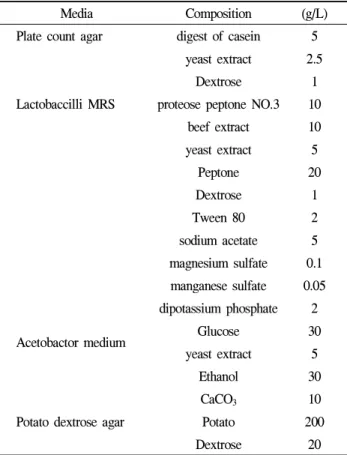
deep blackness, deep softening. Microbes from each sample were grown in 4 different rich media (Table 1).
Isolation and cultivation of spoilage inducing bacteria Nutrient agar plates used in this experiment were shown in Table 1. In order to isolate bacteria from dried persimmon, the blacken part of dried persimmon were isolated and vortexed
Received: November 7, 2012 / Revised: December 12, 2012 / Accept: December 19, 2012
*Corresponding Author: Shin-Kyo Chung, Tel. 82-53-950-5778, Fax. 82-53-950-6772, Email.[email protected]
This research was supported by Technology Development Program for Agriculture and Forestry, Ministry for Food, Agriculture, Forestry and Fisheries, Republic of Korea.
©2012 College of Agricultural and Life Science, Kyungpook National University
This is an Open Access article distributed under the terms of the Creative Commons Attribution Non-Commercial License (http://creativecommons.org.1:censes/by-nc/3.0)
Table 1. Media for microflora determination of the spoiled dried persimmon
Media Composition (g/L)
Plate count agar digest of casein 5 yeast extract 2.5
Dextrose 1
Lactobaccilli MRS proteose peptone NO.3 10 beef extract 10 yeast extract 5
Peptone 20
Dextrose 1
Tween 80 2
sodium acetate 5 magnesium sulfate 0.1 manganese sulfate 0.05 dipotassium phosphate 2
Acetobactor medium Glucose 30
yeast extract 5
Ethanol 30
CaCO3 10
Potato dextrose agar Potato 200
Dextrose 20
vigorously in distilled water. Resuspended samples were serially diluted and plated in 4 respective agar plates shown in Table 1.Microbe was initially classified by colony morphology. These colonies were streaked a few times to obtain a pure colony.
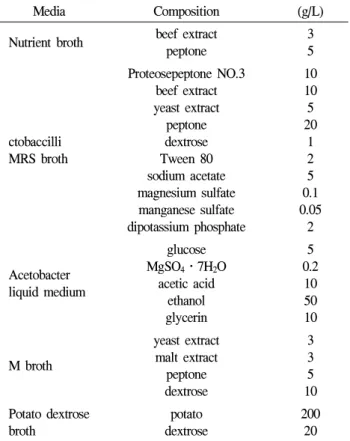
The isolated colonies were cultured in liquid media (Table 2) for 24 to 48 hours at 37℃ for subsequent experiments.
In order to observe the effect of isolated bacteria on dried persimmon, each strain was grown in overnight then and resuspended in the same amount of PBS after centrifugation.
Prior to the experiment classification A grade dried persimmon is illuminated on 500µW/cm2UV for 20 minutes. One ml of each resuspended culture was inoculated to UV treated dried persimmons. Blackened spoilage of dried persimmon was monitored by appearance, color and smell at 30℃. When blacken spoilage was observed bacteria was re-isolated and compared to originally inoculated bacteria by observing microscopic morphology and gram staining.
2)
Identification of isolated bacteria
In order to identify the isolated bacteria color and shape of colonies were first observed (Gerhardt et. al, 1981). The isolated
bacteria were also observed under microscope and tested for Gram staining. Biochemical characteristics of the bacteria are tested with API 20E (API System S.A., BioMerieux SA, France) kit. Identification with API 20E kit was followed by manufacturer’s instruction. Analytical Index provided by API System S.A was served as a reference (Stanek, et. al, 1981;
Ekwall, et. al, 1982; Aldridge, et. al, 1981 ).
A
B
Fig. 1. The photos of the spoiled dried persimmon.
A: the pool of the spoiled gotgam, B: the deep blackckened gotgam (D in Table 1.).
Selection of major blacken spoilage bacteria by color measurement
Either the seven bacteria grown overnight or PBS was inoculated on the dried persimmon. The inoculated dried persimmons were stored at 37℃ and their surface changes were monitored. And the color values ofbacteria inoculated dried persimmons were measured for 40 days at 30 ℃. Hunter colorimeter (Colorimeter, Model CR-200, Minolta Co., Japan) was used to measure whiteness (L), redness (a) and yellowness (b) and ΔE values were calculated (Simon et. al, 1996). L, a and b values of the standard plate are 97.79, -0.38, and 2.03, respectively.
ΔE =
Table 2. Liquid media for growth of microorganism isolated from the spoiled dried persimmon
Media Composition (g/L)
Nutrient broth beef extract
peptone 3
5
ctobaccilli MRS broth
Proteosepeptone NO.3 beef extract yeast extract peptone dextrose Tween 80 sodium acetate magnesium sulfate manganese sulfate dipotassium phosphate
1010 205 12 0.15 0.052
Acetobacter liquid medium
glucose MgSO4․7H2O
acetic acid ethanol glycerin
0.25 1050 10
M broth
yeast extract malt extract
peptone dextrose
33 105 Potato dextrose
broth potato
dextrose 200
20
Results and Discussions
3)
Microflora of spoiled dried persimmon
Commercially available dried persimmons are collected and classified into 4 groups depending on their spoilage pattern and degree. Microbe from each sample was grown in 4 corresponding media shown in table 2. The total microbial counts on bacteria, lactic acid bacteria, acetic acid bacteria, yeast, and mold from respective classified sample were shown in Fig. 2.
As the spoilage progresses the number of total microbes increased on all media plates except mold. The number of general bacteria from nutrient media (NM) and yeast from YM broth media (YM) showed highest colony forming unit (CFU) in all groups. Additionally CFU detected in NM and YM from group D is more than 2 orders of magnitude compared to that of non-spoiled group A. This suggests that these general bacteria and yeast may play a major role in the spoilage. CFU of mold does not exceed 103CFU/g regardless of spoilage progress but mold became visual after long term storage. Number of lactobacillus and acetic acid bacteria also increase 2 orders of magnitude as spoilage progresses. There are more Lactobacilli
on lactobaccilli MRS media than acetic acid bacteria on acetobacter medium in the spoiled group of dried persimmon.
It was reported that the growth of acetic acid bacteria on the spoiled persimmon occurred with the softening of texture after alcohol production by yeast (Adams et. al., 1985).
Fig. 2. Total microorganism count of the spoiled dried persimmon.
■ : Bacteria , ▒ : Lactic acid bacteria, ▦ : Acetic acid bacteria, ▧ : Yeast,
▩ : Mold (The same as Table 1.).
Isolation and identification of blacken spoilage inducing bacteria
Seven bacteria isolated from spoiled dried persimmons were inoculated on UV treated dried persimmon and then incubated for 48 hour at 30℃. All isolated bacteria showed growthand induced spoilage involved blacken and odor. The isolated bacteria grownon dried persimmons are compared with originally inoculated strains by microscopic morphology and Gram staining. Isolated bacteria were identified by API system.
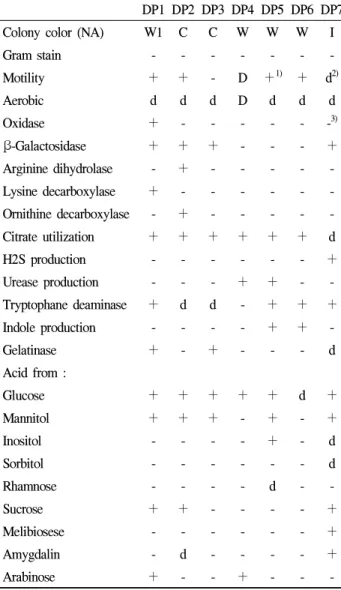
Physiological and biochemistry charactersof the isolated strains were shown in Table 3. Aeromonas hydrophila, Cedecea davisae, Ewingella americana, Flavimonas oryzihabitans, Providencia rettgeri, Providencia rusting, Serratia plymuthica were identified as a blacken inducing bacteria on the dried persimmons. These identified bacteria were termed as Aeromonas hydrophilaDP1, Cedecea davisaeDP2,Ewingella americana DP3, Flavimonas oryzihabitans DP4, Providencia rettgeri DP5,Providencia rustiginiiDP6,Serratia plymuthica DP7, respectively. DP1 isVibrionaceaefamily and D2~D7 are Enterobacteriaceaefamily. All of them are Gram (-)rod shaped facultative aerobe.
Table 3. Biochemical properties of each microorganism from the spoiled dried persimmon
DP1 DP2 DP3 DP4 DP5 DP6 DP7
Colony color (NA) W1 C C W W W I
Gram stain - - - -
Motility + + - D +1) + d2)
Aerobic d d d D d d d
Oxidase + - - - -3)
β-Galactosidase + + + - - - +
Arginine dihydrolase - + - - - - -
Lysine decarboxylase + - - - -
Ornithine decarboxylase - + - - - - -
Citrate utilization + + + + + + d
H2S production - - - +
Urease production - - - + + - -
Tryptophane deaminase + d d - + + +
Indole production - - - - + + -
Gelatinase + - + - - - d
Acid from :
Glucose + + + + + d +
Mannitol + + + - + - +
Inositol - - - - + - d
Sorbitol - - - d
Rhamnose - - - - d - -
Sucrose + + - - - - +
Melibiosese - - - +
Amygdalin - d - - - - +
Arabinose + - - + - - -
1 W : white, C : creamy, I : iridescent
1)positive for 90~100% of strain. 2)positive for 26~74% of strain.
3)positive for 0~10% of strain 4)
Selection of major blackenspoilage inducing bacteria In order to find out major spoilage causing bacteria, 1 ml of each strain was inoculated on UV treated dried persimmon then ΔE value was monitored over 40 days (Fig. 2). ΔE value represents color changes including blacken spoilage so high ΔE value means deeply progressed blacken spoilage. In general, as storage period gets longer L value decreased whereas a value was increased. No significant difference of b value was observed (Data not shown).
All the tested strains contributed to the increase of ΔE values which mean the degrees of browness during storage period.
EitherEwingella americanaDP3 orFlavimonas oryzihabitans DP4 treated persimmon showed the highest ΔE at the end of the 40 day storage. Both Ewingella americana DP3 or Flavimonas oryzihabitansDP4 treated persimmon showed not only high initial ΔE value but also steep increase of ΔE value.
This suggested that Ewingella americanaDP3 andFlavimonas oryzihabitans DP4 were the major blacken spoilage inducing bacteria.Aeromonas hydrophila DP1 andSerratia plymuthica DP7 were also significantly affect blacken spoilage.Flavimonas oryzihabitans DP4 was also known as Psusedomonas oryzihabitans and it was known to be a yellow pigment producing bacteria (Freney et. al., 1988). Even though no significant b value was observe during spoilage process it would be interesting to find out ifFlavimonas oryzihabitanscan cause yellowness on dried persimmon in a certain condition. When persimmon is stored without bacterial inoculation ΔE value decreasedfor the first 15 days because dehydration driven white power formation contribute to the increase of whiteness represented by L value. As storage period extend L value of non-inoculated group increased but not as much as bacteria inoculated groups.
Fig. 2. Changes of Hunter color values of dried persimmon inoculated with the isolated strains during storage at 30℃.
(△-△ : non-treated, ○-○ : DP1, ◇-◇ : DP2, ▲-▲ : DP3, ◆-◆ : DP4,
□-□ : DP5, ■-■ : DP6, ●-● : DP7 strain) Acknowledgments
This research was supported by Technology Development Program for Agriculture and Forestry, Ministry for Food, Agriculture, Forestry and Fisheries, Republic of Korea.
References
Adams MR (1985) Vinegar in microbiology of fermented food.
Vol. Ⅰ, Wood, B. J. B. (ed.), Elsevier Applied Science Publishers, London.
Aldridge KE, Hodges RL (1981) Correlation studies of entero-set 20, API 20E and conventional media system for Enterobacteriaceae identification. Journal of Clinical Microbiology 13(1): 120-125.
Cho DR (2007) Variation tendency and enlargement scheme of market scale for dried persimmons in Korea. Korean Journal of Food Market Economics 24(4): 131-148.
Cleveland J, Montville TJ, Nes IF, Chikindas ML (2001) Bacteriocins: safe, natural antimicrobials for food preservation.International Journal of Food Microbiology 71(1):1-20.
Ekwall E, Dimander M (1982) Comparison of micro-ID with API 20E for identification of Salmonella, Shigella and Yersinia species.European Journal of Clinical Microbiology 1(3): 134-137.
Freney J, Hansen W, Etienne J, Vandenesch F, Fleurette J (1988) Postoperative infant septicemia caused by Pseudomonas luteola (CDC Group Ve-1) and Pseudomonas orzihabitans (CDC Group Ve-2).Journal of Clinical Microbiology26 (6): 1241-1243.
Gerhardt P, Murray RGE, Costilow RN, Nester EW, Wood WA, Krieg NR, Phillips GB (1981) Manual for General Microbiology. American Society for Microbiology.
Washington D. C.
Hong EY, Kim YC, Rhee CH, Kang WW, Choi JU, Chung SK (2001) Changes of microflora in processing and preservation of dried persimmon. Korean Journal of Postharvest Science and Technology8(4): 374-378.
Kim JG, Chang H S, Jeong ST, Kim YB (1996) Effect of Gas-exchange Packaging on Quality of Dried Persimmons during Storage.RDA Journal of Agricultural Science38(1):
909-914.
Kim JK, Jang HS, Kim YB, Kim JH (1993) Improvement of drying method for dried persimmon by far infrared ray.
RDA Journal of Agricultural Science 35(2): 766-770.
Kim YB, Lee JS, Lim BS (1995) Studies on the Integrated techniques for freshness retention processing and utilization of astringent persimmon. Korean National Horticultural Research Institute, 15-31.
Lee MH, Lee SH, Park SD, Cho BS (1995) The effect of package material and moisture content on storage of dried persimmons at room temperature. Korean Journal of Postharvest Science and Technology2(2): 285-291.
Lee SD, Lee MH, Lee HU (1994) Effect of Quality Changes According to Drying Method of Astringent persimmon (Diospyroskaki L.) after Peeling. RDA Journal of Agricultural Science 36(2): 699-704.
Simal S, Rosselló C, Sánchez E, Cañellas J(1996) Quality of raisins treated and stored under different conditions.Journal of Agricultural and Food Chemistry44(10): 3297-3302.
Stanek G, Hirschl A, Potter M (1982) Identification of Gram negative rods and evaluation of their antibiotic sensitivity.
Zentralblatt für Bakteriologie, Mikrobiologie und Hygiene 253(1): 71-75.
5)