J. Exp. Biomed. Sci. 2010, 16(2): 75~82
Genetic Relationship between SCCmec Types and Virulence Factors of Methicillin-Resistant Staphylococcus aureus Clinical Isolates in Korea
Kwanhun Lim1, Gyusang Lee1, Min Park1, Jin-Hee Lee2, In Bum Suh2, Sook Won Ryu2, Yong-Bin Eom3 and Jong-Bae Kim1,†
1Department of Biomedical Laboratory Science, College of Health Science, Yonsei University, Wonju, Korea
2Department of Clinical Laboratory Science, Kang-won National University Hospital, Chuncheon, Korea
3Department of Biomedical Laboratory Science, Korea Nazarene University, Cheonan, Korea
The molecular epidemiological characteristics of methicillin-resistant Staphylococcus aureus (MRSA) isolates have demonstrated their genetic diversity and evolution. A total of 137 strains of MRSA clinical isolates was collected from Korean healthcare facility in 2007. The MRSA clinical isolates were analyzed by molecular typings (SCCmec element and agr locus typing), virule nce factor gene detections {(Panton-Valentine leukocidin (PVL), enterotoxin, exfoliative toxin and toxic shock syndrome toxin-1), and amplified fragment length polymorphism (AFLP)}. The MRSA clinical isolates were classified as SCCmec type II-agr type 1 (2 strains), type II-agr type 2 (79 strains), type III-agr type 1 (24 strains), type III-agr type 2 (2 strains), type IV-agr type 1 (27 strains), type IV-agr type 2 (2 strains), and non-typable (1 strain, agr type 3). Based on SCCmec types, SCCmec type II (95.1%) and III (88.5%) indicated higher multidrug resistance rate than SCCmec type IV (10.3%) (P<0.001). The most common enterotoxin genes were seg (83.8%), sei (83.1%), and sec (80.2%). The tst gene was present in 86 out of 137 (62.8%) MRSA isolates. All MRSA isolates were negative for PVL and exfoliative toxin genes. The combinations of toxin genes were observed in particular SCCmec types; 97.6% of SCCmec type II strains carried sec, seg, sei and tst genes, 73.0% of SCCmec type III strains carried sea gene, and 89.7% of SCCmec type IV strains carried sec, seg and sei genes. Each of the SCCmec types of MRSA isolates had distinct AFLP profile. In conclusion, SCCmec type II, agr type 1 and 2 have demonstrated to be the most common types in Korea, and the results indicated that the virulence factors are closely associated with their molecular types (SCCmec and agr types).
Key Words: MRSA, SCCmec, agr locus, Staphylococcal toxin gene, AFLP, PCR
INTRODUCTION
Methicillin-resistant Staphylococcus aureus is one of the major human pathogens both in nosocomial and community- associated infections, such as skin and soft tissue infections (SSTIs), pneumonia, and bacteremia. The emergence of MRSA was due mainly to the acquisition of mecA gene, which is located on a mobile genomic island, named as
staphylococcal cassette chromosome mec (SCCmec) (Ito et al., 2003). Seven main types of SCCmec (type I to VII) are recognized as of current. While SCCmec type II and III cause resistance to multiple classes of antibiotics due to the additional drug resistance genes integrated into SCCmec, other SCCmec types (I, IV, V, VI and VII) are known to cause only β-lactam antibiotic resistance (Ito et al., 2001;
Oliveira et al., 2006).
The pathogenicity of S. aureus infections is linked to the expression of several extracellular protein toxins, including enterotoxins (SE), exfoliative toxin (ET), toxic shock syndrome toxin-1 (TSST-1), and the leukocidins (Dinges et al., 2000). These toxins are known to be responsible for specific clinical syndromes, staphylococcal enterotoxins for food poisoning, and Panton-Valentine leukocidins (PVL)
*Received: 4 June, 2010 / Revised: 18 June, 2010 Accepted: 21 June, 2010
†Corresponding author: Jong-Bae Kim, Department of Biomedical Laboratory Science, College of Health Science, Yonsei University, 234 Maeji-ri, Heungup-myun, Wonju-si, Kangwon-do 220-710, Korea.
Tel: 82-33-760-2423, Fax: 82-33-760-2561 e-mail: [email protected]
for severe skin and soft tissue infections (Lina et al., 1999).
Virulence gene expression in S. aureus is controlled by RNA III, a central pleiotropic regulator transcribed from the accessory gene regulator (agr) locus, including those involved in exoprotein, exotoxin and adhesin expression (Arvidson et al., 2001). The central segment of the agr locus, which consists of C-terminal two-thirds of AgrB, AgrD, and N-terminal half of AgrC, shows striking interstrain variation. This finding has led to the division of Staphylococcus aureus isolates into four different agr specificity groups (Gilot et al., 2002).
Accurate molecular epidemiological typing has become of primary importance for the classification of MRSA isolates and the control of their spread. In many laboratories, conventional methods of typing such as serotyping and bacteriophage typing have been replaced by PCR-based methods (van Belkum A. 1994). To investigate the virulence factors of MRSA clinical isolates, SCCmec typing, agr locus typing and amplified fragment length polymorphism (AFLP) were used to analyze the relationship among the three methodologies in this study.
MATERIALS AND METHODS Specimen collection
A total of 137 MRSA clinical isolates was collected from Kangwon-do healthcare facility from July to November in 2007. These were collected from wound, urine, tissue, sputum, pus, eye, abscess, blood, urine/catheter tip and other sites.
Antimicrobial susceptibility test
Minimal inhibitory concentrations of clinical anti- microbials for all isolates were determined by MicroScan Walk/Away 96 AI system (Dade Behring, Sacramento, CA, USA) and were interpreted according to CLSI M100-S16 (formerly NCCLS, 2006). Twenty-four antimicrobial agents were tested: penicillin, oxacillin, amoxicillin/K clavulanate, ampicillin, imipenem, meropenem, ticarcillin/K clavulanate, cefazolin, cephalothin, cefuroxime, cefotaxime, cefepime, ciprofloxacin, ofloxacin, chloramphenicol, clindamycin, gentamicin, erythromycin, tetracycline, synercid, rifampin,
vancomycin, teicoplanin, and trimethoprim-sulfamethoxazole.
For this study, multidrug resistance was defined as resistance to penicillin and oxacillin plus three or more antibiotics.
Bacterial DNA extraction
To prepare DNA templates, brain heart infusion (Difco, Detroit, USA) broth was inoculated with one colony of MRSA strain. After 24 hours incubation at 37℃, 1 ml of the culture were centrifuged at 12,000 × g for 10 minutes.
The pellets were resuspended in 1 ml of saline, harvested by centrifugation. Bacterial genomic DNA was extracted using the AccuPrep® Genomic DNA Extraction Kit (Bioneer Co., Daejeon, Korea), and kept at -20℃ until use.
SCCmec, agr locus typing, and mecA gene detection Presence of mecA gene, SCCmec, and agr locus typing were investigated by PCR using primers and previously described conditions (Ito et al., 2001; Gilot et al., 2002;
Zhang et al., 2005).
Detection of staphylococcal toxin genes
Sequences specific for staphylococcal enterotoxin (sea to sej), exfoliative toxin (eta and etb) and toxic shock syndrome toxin-1 (tst) genes were detected by PCR as previously described (Mehrotra et al., 2000; Sharma et al., 2000; Rosec and Giguad, 2002). The PVL genes (lukS-PV and lukF-PV) were detected by duplex PCR. The 20 μl of PCR mixture contained 2 μl template DNA, PCR buffer (40 mM KCl, 10 mM Tris-HCl, 1.5 mM MgCl2), 2.5 mM (each) dNTP, 20 pmol of lukS-PV-F (5'ATCACTCCTA- TTGCTACTTC3'), lukS-PV-R (5'ATCTACATTGGGGTC- ATTTG3'), 40 pmol of lukF-PV-F (5'GTAAGTGAGAA- AAAGGTTGA3'), lukF-PV-R (5'TGGATAACACTGGC- ATTTTG3'), and 0.5 U of G-Taq DNA polymerase (Cosmo Genetech Co., Seoul, Korea). The amplification was performed in a thermal cycler (GeneAmp® PCR System 2700, Perkin-Elmer Cetus, Boston, USA) beginning with an initial denaturation step at 94℃ for 5 minutes followed by 25 cycles of 94℃ for 30 seconds, 48℃ for 30 seconds, and 72℃ for 30 seconds, ending with a final extension step at 72℃ for 10 minutes followed by a hold at 4℃. The PCR products were analyzed using 1.5% agarose gel
electrophoresis with 0.5 μg/ml of ethidium bromide and visualized under UV light.
Fingerprinting by AFLP
AFLP analysis was performed using the established procedures with minor modification (Janssen et al., 1996;
Gibson et al., 1998). Briefly, the genomic DNA (1 μg) was digested with 10 U HindIII (Fermentas, Burlington, Canada) and ApaI (Fermentas, Burlington, Canada). For the ligation of the adapters, 5 pmol of HindIII adapter (ADH), ApaI adapter (Apa) and 10 Weiss unit of T4 DNA ligase (Fermentas, Burlington, Canada) were added. The primer used in the PCR step included the respective restriction enzyme and the adapter sequence plus one extension base for primer (G for HindIII primer). The DNA bands were analyzed by Quantity One Version 4.5.0 program (Bio-Rad, Hercules, CA, USA) and similarity index by dendrogram for genetical similarity to band pattern of each clinical isolates were examined.
Statistical methods
Statistical analysis was applied by using Microsoft® Office Excel® 2007 (Microsoft Co., Redmond, WA, USA).
Comparisons of proportions were carried out using the χ2 test.
RESULTS Specimen collection
A total of 137 different MRSA isolates was examined.
They were isolated from abscess (n=8), culture of blood (n=16), bronchial washing (n=3), catheter (n=1), drain (n=2), ear discharge (n=3), gastric juice (n=1), joint fluid (n=1), pus (n=2), sore (n=1), sputum (n=47), tip (n=17), tissue (n=3), urine (n=7), and wound (n=25).
Antimicrobial susceptibility test
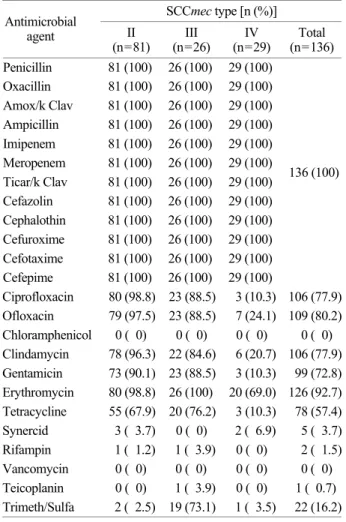
Table 1 shows the antimicrobial susceptibility pattern based on SCCmec types (relationship between the anti- microbial susceptibility pattern and the SCCmec types).
Our results indicate the resistance of MRSA isolates to ciprofloxacin (77.9%), ofloxacin (80.2%), chloramphenicol
(0%), clindamycin (77.9%), gentamicin (72.8%), erythromycin (92.7%), tetracycline (57.4%), synercid (3.7%), rifampin (1.5%), vancomycin (0%), teicoplanin (0.7%), and trimethoprim/sulfamethoxazole (16.2%). All MRSA isolates were found to be resistant to β-lactam antibiotics (penicillin, oxacillin, amoxicillin/clavulanic acid, ampicillin, imipenem, meropenem, ticarcillin/clavulanic acid, cefazolin, cephalothin, cefuroxime, cefotaxime and cefepime). Anti- micribial resistance rates differed significantly between SCCmec types; SCCmec type II and III were more resistant than SCCmec type IV against ciprofloxacin (P<0.001), ofloxacin (P<0.001), clindamycin (P<0.001), gentamicin (P<0.001), erythromycin (P<0.001) and tetracycline (P<
0.001), SCCmec type III was more resistant than SCCmec type II and IV against trimethoprim/sulfamethoxazole (P<
Table 1. Antimicrobial resistance of MRSA isolates based on SCCmec type
SCCmec type [n (%)]
Antimicrobial
agent II
(n=81) III
(n=26) IV
(n=29) Total (n=136) Penicillin 81 (100) 26 (100) 29 (100)
Oxacillin 81 (100) 26 (100) 29 (100) Amox/k Clav 81 (100) 26 (100) 29 (100) Ampicillin 81 (100) 26 (100) 29 (100) Imipenem 81 (100) 26 (100) 29 (100) Meropenem 81 (100) 26 (100) 29 (100) Ticar/k Clav 81 (100) 26 (100) 29 (100) Cefazolin 81 (100) 26 (100) 29 (100) Cephalothin 81 (100) 26 (100) 29 (100) Cefuroxime 81 (100) 26 (100) 29 (100) Cefotaxime 81 (100) 26 (100) 29 (100) Cefepime 81 (100) 26 (100) 29 (100)
136 (100)
Ciprofloxacin 80 (98.8) 23 (88.5) 3 (10.3) 106 (77.9) Ofloxacin 79 (97.5) 23 (88.5) 7 (24.1) 109 (80.2) Chloramphenicol 0 ( 0) 0 ( 0) 0 ( 0) 0 ( 0) Clindamycin 78 (96.3) 22 (84.6) 6 (20.7) 106 (77.9) Gentamicin 73 (90.1) 23 (88.5) 3 (10.3) 99 (72.8) Erythromycin 80 (98.8) 26 (100) 20 (69.0) 126 (92.7) Tetracycline 55 (67.9) 20 (76.2) 3 (10.3) 78 (57.4) Synercid 3 ( 3.7) 0 ( 0) 2 ( 6.9) 5 ( 3.7) Rifampin 1 ( 1.2) 1 ( 3.9) 0 ( 0) 2 ( 1.5) Vancomycin 0 ( 0) 0 ( 0) 0 ( 0) 0 ( 0) Teicoplanin 0 ( 0) 1 ( 3.9) 0 ( 0) 1 ( 0.7) Trimeth/Sulfa 2 ( 2.5) 19 (73.1) 1 ( 3.5) 22 (16.2) Abbreviations: Amox/k Clav; Amoxicillin/K Clavulanate, Ticar/k Clav; Ticarcillin/K Clavulanate, Trimeth/Sulfa; Trimethoprim/
Sulfamethoxazole
0.001). SCCmec type II and III have higher multidrug resistance rate than SCCmec type IV (Table 2, 93.5% versus 10.3%, P<0.001).
Molecular characteristics of the MRSA isolates
Using PCR method, 136 MRSA isolates (99.3%) were found to be positive for the mecA gene. The MRSA isolates were found to be SCCmec type II-agr type 1 (2 strains), type II-agr type 2 (69 strains), type III-agr type 1 (24 strains), type III-agr type 2 (2 strains), type IV-agr type 1 (27 strains), type IV-agr type 2 (2 strains) (Table 3). Only one MRSA isolate was negative for the mecA gene and
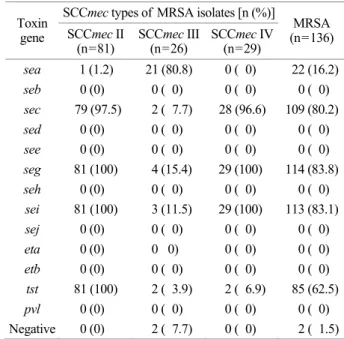
was classified as non-typable (agr type 3). Staphylococcal toxin gene distribution differed significantly between SCCmec types (Table 4). Of the 136 SCCmec type II, III and IV isolates, 100%, 92.3% and 100% had one or more toxin genes, respectively. The seg enterotoxin gene was the Table 2. Antimicrobial resistance profile of MRSA isolates based on SCCmec type
SCCmec type [n (%)]
Resistance profile
II III IV No. of isolates (%) Resistance
classification
P, OX 1 ( 1.2) 0 ( 0) 12 (41.4) 13 ( 9.6)
P, OX, E 1 ( 1.2) 3 (11.5) 12 (41.4) 16 (11.8)
P, OX, CD, E 0 ( 0) 0 ( 0) 2 ( 6.9) 2 ( 1.5)
P, OX, CP, GM 2 ( 2.5) 0 ( 0) 0 ( 0) 2 ( 1.5)
NMDR
P, OX, CP, CD, E 2 ( 2.5) 0 ( 0) 0 ( 0) 2 ( 1.5)
P, OX, CP, CD, E, TE 5 ( 6.2) 0 ( 0) 0 ( 0) 5 ( 3.7)
P, OX, CP, E, GM, TE 1 ( 1.2) 1 ( 3.9) 0 ( 0) 2 ( 1.5) P, OX, CP, GM, TE, T/S 1 ( 1.2) 1 ( 3.9) 0 ( 0) 2 ( 1.5)
P, OX, CP, CD, E, GM 20 (24.7) 3 (11.5) 0 ( 0) 23 (16.9)
P, OX, E, GM, RIF, TE, T/S 0 ( 0) 1 ( 3.9) 0 ( 0) 1 ( 1.5) P, OX, CP, CD, E, GM, TE 46 (56.8) 0 ( 0) 2 ( 6.9) 48 (35.3) P, OX, CP, CD, E, GM, RIF, TE 1 ( 1.2) 0 ( 0) 0 ( 0) 1 ( 0.7) P, OX, CP, CD, E, GM, TE, T/S 1 ( 1.2) 16 (61.5) ( 3.5) 18 (13.2) P, OX, CP, CD, E, GM, TEI, TE, T/S 0 ( 0) 1 ( 3.9) 0 ( 0) 1 ( 1.5)
MDR
Total 81 26 29 136
Abbreviations: NMDR; non multidrug resistance, MDR; multidrug resistance, P; penicillin, OX; oxacillin, E; erythromycin, CD;
clindamycin, CP; ciprofloxacin, TE; Tetracycline, GM; gentamicin, T/S; trimethoprim-sulfamethoxazole, RIF; rifampin, TEI; teicoplanin
Table 3. agr locus type of MRSA isolates based on SCCmec type agr type [n (%)]
SCCmec type
agr 1 agr 2 agr 3 agr 4 SCCmec II
(n=81) 2 ( 2.5) 79 (97.5) 0 (0) 0 (0) SCCmec III
(n=26) 24 (92.3) 2 ( 7.7) 0 (0) 0 (0) SCCmec IV
(n=29) 27 (93.1) 2 ( 6.9) 0 (0) 0 (0) Total
(n=136) 53 (39.0) 83 (61.0) 0 (0) 0 (0)
Table 4. Association of individual toxin genes particular SCCmec MRSA types
SCCmec types of MRSA isolates [n (%)]
Toxin
gene SCCmec II
(n=81) SCCmec III
(n=26) SCCmec IV (n=29)
MRSA (n=136) sea 1 (1.2) 21 (80.8) 0 ( 0) 22 (16.2) seb 0 (0) 0 ( 0) 0 ( 0) 0 ( 0) sec 79 (97.5) 2 ( 7.7) 28 (96.6) 109 (80.2) sed 0 (0) 0 ( 0) 0 ( 0) 0 ( 0) see 0 (0) 0 ( 0) 0 ( 0) 0 ( 0) seg 81 (100) 4 (15.4) 29 (100) 114 (83.8) seh 0 (0) 0 ( 0) 0 ( 0) 0 ( 0) sei 81 (100) 3 (11.5) 29 (100) 113 (83.1) sej 0 (0) 0 ( 0) 0 ( 0) 0 ( 0) eta 0 (0) 0 0) 0 ( 0) 0 ( 0) etb 0 (0) 0 ( 0) 0 ( 0) 0 ( 0) tst 81 (100) 2 ( 3.9) 2 ( 6.9) 85 (62.5) pvl 0 (0) 0 ( 0) 0 ( 0) 0 ( 0) Negative 0 (0) 2 ( 7.7) 0 ( 0) 2 ( 1.5)
most common (83.8%), followed by sei (83.1%), sec (80.2%) and sea (16.8%). SCCmec types III had higher rate of sea gene than SCCmec types II and IV (80.8% versus 0.3%, P<0.001) and SCCmec types II and IV had higher rate of sec, seg and sei than SCCmec types III (sec; 97.3%
versus 7.7%, P<0.001, seg; 100% versus 15.4%, P<0.001, sei; 100% versus 11.5%, P<0.001). The tst gene was present in 86 out of 137 (62.8%) MRSA isolates and all agr type 2 MRSA isolates had tst gene. SCCmec type II had higher rate of tst gene than SCCmec type III and IV (100% versus 7.3%, P<0.001). All MRSA isolates were negative for PVL and exfoliative toxin genes.
The combinations of toxin genes were observed in particular SCCmec types (Table 5). In SCCmec type II isolates, the simultaneous presence of sec, seg, sei and tst occurred frequently (97.5%), whereas the sec, seg and sei combination was observed more often in SCCmec type IV (89.7%) isolates. In SCCmec type III (73.1%) isolates, only sea gene was frequently observed.
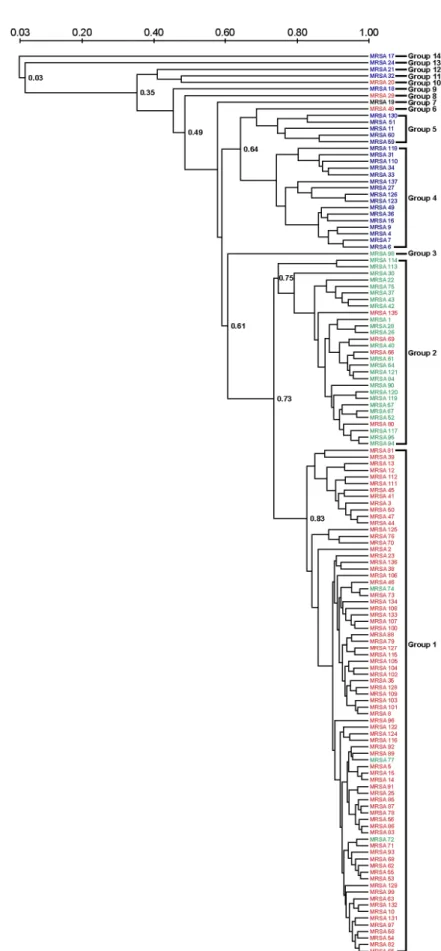
The 137 MRSA isolates were clustered into 14 distinct groups (similarity coefficient, 73%) by AFLP analysis (Fig.
1). The main cluster (n=122, 89.1%) of AFLP groups consisted of four groups (group 1, n=77; group 2, n=29;
group 4, n=16; and group 5, n=5). Each main group consisted of distinct SCCmec types. Group 1 consisted of mainly SCCmec type II MRSA isolates (n=74, 96.1%), group 2 consisted of mainly SCCmec type IV MRSA
isolates (n=25, 86.2%), and group 4 and 5 consisted of mainly SCCmec type III MRSA isolates (n=21, 100%).
DISCUSSION
Findings from numerous recent studies have suggested that antibiotic resistance and virulence genes may be linked in the same replicon: moreover, recent findings also suggest that a single strain has the capacity to be involved in both virulence and resistance in the long run. This phenomenon has been often observed in S. aureus (Gill et al., 2005). MRSA was first reported in 1961, two years after the introduction of methicillin into clinical practice (Jevons, 1961). During the 1970s, MRSA was disseminated worldwide, from Australia, Japan, all the way to USA and even more. Today, MRSA is known to be one of the major causes of nosocomial infections. Beginning in the late 1990s, there have been numerous reports on MRSA colonization and infection in the community that involved patients lacking of healthcare risk factors (David et al., 2008). The community-acquired MRSA (CA-MRSA), which carried commonly the SCCmec type IV and PVL gene, was known to be associated with life-threatening diseases such as necrotizing pneumonia and necrotizing fasciitis, which is primarily caused by PVL exotoxin (Boyle-Vavra and Daum, 2007).
Most clinical studies of MRSA have not considered Table 5. Association of staphylococcal toxin gene profiles with particular SCCmec MRSA types
SCCmec types of MRSA isolates [n (%)]
Toxin gene profiles SCCmec II
(n=81) SCCmec III
(n=26) SCCmec IV
(n=29)
MRSA (n=136)
sea* 0 ( 0) 19 (73.1) 0 ( 0) 19 (14.0)
seg 0 ( 0) 1 ( 3.9) 0 ( 0) 1 ( 0.7)
sea, seg 0 ( 0) 1 ( 3.9) 0 ( 0) 1 ( 0.7)
seg, sei 0 ( 0) 0 ( 0) 1 ( 3.5) 1 ( 0.7)
seg, sei, tst 1 ( 1.2) 0 ( 0) 0 ( 0) 1 ( 0.7)
sea, seg, sei 0 ( 0) 1 ( 3.9) 0 ( 0) 1 ( 0.7)
sec, seg, sei* 0 ( 0) 1 ( 3.9) 26 (89.7) 27 (19.9)
sea, seg, sei, tst 1 ( 1.2) 0 ( 0) 0 ( 0) 1 ( 0.7)
sec, seg, sei, tst* 79 (97.5) 1 ( 3.9) 2 ( 6.9) 82 (60.3)
Negative 0 ( 0) 2 ( 7.7) 0 ( 0) 2 ( 1.5)
Total 81 26 29 136
*P<0.001, comparison of 3 SCCmec types (χ2 test)
Fig. 1. Dendrogram of the similarity index among MRSA isolates by AFLP analysis. Red; SCCmec type II MRSA isolates, Blue;
SCCmec type III MRSA isolates, Green; SCCmec type IV MRSA isolates, Black; SCCmec non-typable MRSA isolate.
overall molecular microbiological factors, such as virulence gene, resistance gene and accessory gene regulator (agr) locus. Therefore, in this study, we demonstrated the distribution of overall molecular microbiological factors in MRSA isolates and the relationship of molecular micro- biological factors based on SCCmec types.
Based on the class of mecA gene complex and the type of ccr gene complex present, SCCmec gene locus is generally subdivided into 5 types, namely, SCCmec I to V, although there are also several variants based on poly- morphisms (Oliveira and Lencastre, 2002; Ito et al., 2004).
Recently, most MRSA isolates in Korea and Japan were found to be SCCmec type II, whereas SCCmec type III (or IIIA) have been found to be the most common type in strains from other eight Asian countries (Thailand, Sri Lanka, Indonesia, Vietnam, Philippines, Saudi Arabia, India, and Singapore) (Ko et al., 2005; Kim et al., 2006). Findings from this study show that SCCmec type II is most prevalent genotype of MRSA, followed by SCCmec type IV and III.
MRSA isolates in this study have also shown three different agr locus types: agr type 1 (38.7%), agr type 2 (60.6%) and agr type 3 (0.7%). The agr type 2 was found to be the most common type in this study, which is likely to demonstrate distinct ability in surviving the hospital settings and thus is frequently found in cases of hospital-acquired MRSA (HA-MRSA) in Korea (Yoon et al., 2007). In our study, only one MRSA isolate was classified as agr type 3 (SCCmec non-typable strain), which is the prevalent type of CA-MRSA strains circulation in France, Switzerland, and Australia (Vandenesch et al., 2003). SCCmec types of MRSA isolates had significantly different agr types. Most SCCmec type II MRSA isolates had agr type 2 (97.5%), whereas SCCmec type III and IV MRSA isolates had agr type 1 (92.3% and 93.1%) (P<0.001).
Antibiotic resistance rate was lower than those found in other studies (Kim et al., 2006), while the multidrug resistance rate was 97.0%. Based on SCCmec types, SCCmec type II and III had higher multidrug resistance rate than SCCmec type IV (P<0.001). On the other hand, MRSA strains had no significant difference in multidrug resistance rate based on agr types.
Our investigation was aimed to find the prevalence of
SE genes (sea to sej), ET genes (eta and etb), PVL genes (lukF-PV and lukS-PV) and TSST-1 gene (tst), and to analyze AFLP profiles in MRSA isolates. We found that seg, sei, sec and tst were the most common toxins in clinical MRSA isolates in Korea. The rate of SE genes and TSST-1 gene in MRSA isolates significantly differed among SCCmec types. Moreover, the combinations of toxin genes were significantly different among SCCmec types. The AFLP analysis showed that each group consisted of distinct SCCmec types. These results indicate that same SCCmec types of MRSA strains in the sample demonstrate close relationship of genetic factors, such as virulence genes and resistance genes. None of the MRSA isolates contained the PVL genes which are reported to be the highly linked epidemiologic marker for CA-MRSA (Vandenesch et al., 2003). Other studies have demonstrated that PVL genes were detected in fewer than 5% of S. aureus isolates in a hospital (Kim et al., 2006).
In conclusion, our study was performed to investigate the overall molecular microbiological factors and to analyze the genetic relationship between SCCmec types. We demonstrated that clinical MRSA strains isolated in Korea show different patterns of antibiotic resistance, SCCmec types, agr types and virulence gene profiles. The overall microbiologic factors had close genetic relationship based on SCCmec types. These data may indicate that evolutionary change of MRSA associated with both antibiotic resistance genes and their related virulence factors.
REFERENCES
Arvidson S, Tegmark K. Regulation of virulence determinants in Staphylococcus aureus. Int J Med Microbiol. 2001. 291: 159 -170.
Boyle-Vavra S, Daum RS. Community-acquired methicillin- resistant Staphylococcus aureus: the role of Panton-Valentine leukocidin. Lab Invest. 2007. 87: 3-9.
David MZ, Glikman D, Crawford SE, Peng J, King KJ, Hostetler MA, Boyle-Vavra S, Daum RS. What is community- associated methicillin-resistant Staphylococcus aureus? J Infect Dis. 2008. 197: 1235-1243.
Dinges MM, Orwin PM, Schlievert PM. Exotoxins of Staphylococcus aureus. Clin Microbiol Rev. 2000. 13: 16-34.
Gill SR, Fouts DE, Archer GL, Mongodin EF, DeBoy RT, Ravel J, Paulsen IT, Kololnay JF, Brinkac L, Beanan M, Dodson RJ, Daugherty SC, Madupu R, Angiuoli SV, Durkim AS, Haft DH, Vamathevan J, Khouri H, Utterback T, Lee C, Dimitrov G, Jiang L, Oil H, Weidman J, Tran K, Kang K, Hance IR, Nelson KE, Fraser CM. Insights on evolution of virulence and resistance from the complete genome analysis of an early methicillin-resistant Staphylococcus aureus strain and a biofilm-producing methicillin-resistant Staphylococcus epidermidis strain. J Bacteriol. 2005. 187: 2426-2438.
Gilot P, Lina G, Cochard T, Poutrel B. Analysis of the genetic variability of genes encoding the RNA III-activating components Agr and TRAP in a population of Staphylococcus aureus strains isolated from cows with mastitis. J Clin Microbiol. 2002. 40: 4060-4067.
Ito T, Katayama Y, Asada K, Mori N, Tsutsumimoto K, Tiensasitorn C, Hiramatsu K. Structural comparison of three types of staphylococcal cassette chromosome mec integrated in the chromosome in methicillin-resistant Staphylococcus aureus.
Antimicrob Agents Chemother. 2001. 45: 1323-1336.
Ito T, Okuma K, Ma XX, Yuzawa H, Hiramatsu K. Insights on antibiotic resistance of Staphylococcus aureus from its whole genome: genomic island SCC. Drug Resist Updata 2003. 6:
41-52.
Ito T, Ma XX, Takeuchi F, Okuma K, Yuzawa H, Hiramatsu K.
Novel type V staphylococcal cassette chromosome mec driven by a novel cassette chromosome recombinase, ccrC.
Antimicrob Agents Chemother. 2004. 48: 2637-2651.
Jevons MP. Celvenin-resistant Staphylococci. Br Med J. 1961. 1:
124-125.
Kim JS, Song W, Kim HS, Cho HC, Lee KM, Choi MS, Kim EC.
Association between the methicillin-resistance of clinical isolates of Staphylococcal aureus, their staphylococcal cassette chromosome mec (SCCmec) subtype classification, and their toxin gene profiles. Diagn Microbiol Infect Dis. 2006. 56:
289-295.
Ko KS, Lee JY, Suh JY, Oh WS, Peck KR, Lee NY, Song JH.
Distribution of major genotypes among methicillin-resistant Staphylococcus aureus clones in Asian countries. Antimicrob Agents Chemother. 2005. 43: 421-426.
Lina G, Piemont Y, Godail-Gamot F, Bes M, Peter MO, Gauduchon V, Vandenesch, F, Etienne J. Involvement of Panton-Valentine leukocidin-producing Staphylococcus aureus in primary skin infections and pneumonia. Clin Infect Dis. 1999. 29: 1128 -1132.
Mehrotra M, Wang G, Johnson WM. Multiplex PCR for detection of genes for Staphylococcus aureus entrotoxins, exfoliative toxins, toxic shock syndrome toxin 1, and methicillin resistance. J Clin Microbiol. 2000. 38: 1032-1035.
Oliveira DC, Lencastre H. Multiplex PCR strategy for rapid identification of structural types and variants of the mec element in methicillin-resistant Staphylococcal aureus.
Antimicrob Agents Chemother. 2002. 46: 2155-2161.
Oliveira DC, Milheirico C, de Lencastre H. Redefining a structural variant of staphylococcal cassette chromosome mec, SCCmec type VI. Antimicrob Agents Chemother. 2006. 50: 3457- 3459.
Rosec JP, Giguad O. Staphylococcal enterotoxin genes of classical and new types detected by PCR in France. Int J Food Microbiol. 2002. 77: 61-70.
Sharma NK, Rees CE, Dodd CE. Development of a single-reaction multiplex PCR toxin typing assay for Staphylococcus aureus strains. Appl Environ Microbiol. 2000. 66: 1347-1353.
van Belkum A. DNA fingerprinting of medically important microorganisms by use of PCR. Clin Microbiol Rev. 1994.
7: 174-84.
Vandenesch F, Naimi T, Enright MC, Lina G, Nimmo GR, Heffernan H, Liassine N, Bes M, Greenland T, Reverdy ME, Etienne J. Community-acquired methicillin-resistant Staphylococcua aureus carrying Panton-Valentine leukocidin genes: Worldwide emergence. Emerg Infect Dis. 2003. 9:
978-984.
Yoon HJ, Choi JY, Lee K, Yong D, Kim JM, Song YG. Accessory gene regulator group polymorphism in methicillin-resistant Staphylococcus aureus: An association with clinical significance. Yonse Med J. 2007. 48: 176-183.
Zhang K, McClure JA, Elsayed S, Louie T, Conly JM. Novel multiplex PCR assay for characterization and concomitant subtyping of SCCmec types I to V in MRSA. J Clin Microbiol.
2005. 43: 5026-5033.